As a natural mineral, sepiolite has many industrial applications related specifically to its physical properties (Zheng et al., Reference Zheng, Han, Huang, Dai, Qian, Zhang and Ren2010; Deng et al., Reference Deng, Jiang, Fan, Zhao, Ouyang and Tan2019; Jiang et al., Reference Jiang, Jiang, Zhao, Peng, Qin, Ouyang and Ding2020, Reference Jiang, Han, Jiang, Xu, Ouyang and Sun2021; Hamid et al., Reference Hamid, Tang, Hussain, Usman, Liu and Ulhassan2021). Due to their inherently large surface areas (~320 m2 g–1) and great adsorption capacities, sepiolite-based materials have shown great potential for applications in the fields of environmental clean-up and protection (Alcântara et al., Reference Alcântara, Darder, Aranda and Ruiz-Hitzky2012; Fayazi et al., Reference Fayazi, Afzali, Ghanei-Motlagh and Iraji2019; Bashir et al., Reference Bashir, Ali, Shaaban, Gulshan, Iqbal and Khan2020). Sepiolite is a microcrystalline hydrated magnesium silicate hydrate that belongs to the phyllosilicate family. It has a unit cell formula of Si12O30Mg8(OH)4(H2O)4⋅8H2O. This silicate is composed of continuous silica tetrahedral chains with the apical oxygen inverted periodically. Furthermore, discontinuous octahedral sheets are constructed in the [010] direction, thereby forming channels parallel to the c-axis of the crystal (García-Romero & Suárez, Reference García-Romero and Suárez2013, Reference García-Romero and Suárez2018; Lu & Wang, Reference Lu and Wang2022). The channel structure provides sepiolite with a very large specific surface area, potentially diversifying its advanced applications (Qiu et al., Reference Qiu, Guo, Qi, Cheng and Jing2021; Erdoğan & Esenli, Reference Erdoğan and Esenli2022). In addition, due to its nanochannels with a size range of 0.6–0.9 nm, sepiolite has been classified as a molecular sieve material (Alver, Reference Alver2018; Cecilia et al., Reference Cecilia, Vilarrasa-García, Cavalcante, Azevedo, Franco and Rodríguez-Castellón2018). Therefore, sepiolite could be used as an active component for the adsorption of various small polar molecules (Delgado et al., Reference Delgado, Uguina, Sotelo, Ruíz and Rosário2007; Yuan et al., Reference Yuan, Gao, Hu, Luo, Huang, Jin and Liang2018). Experimental results have indicated the dependence of the gas adsorption of sepiolite on molecule size as well as on the interactions between the molecules and the channel walls.
Acid treatment has been used widely to improve the adsorption properties of sepiolite (Yebra-Rodríguez et al., Reference Yebra-Rodríguez, Martín-Ramos, Del Rey, Viseras and López-Galindo2003). Acid-activated sepiolite exhibited weak acidity and small ζ-potential values, indicating the dominance of Lewis acid centres on its surface (Sabah et al., Reference Sabah, Çinar and Çelik2007). The special affinity of sepiolite towards NH3 indicated the occurrence of specific interactions with the acid groups on its surface. Although the adsorption behaviour of sepiolite has been studied widely, the molecular mechanism underlying the impacts of hazardous gases such as NH3, H2S and SO2 on the adsorption behaviour of sepiolite has not yet been resolved. Due to the limitations of experimental technologies, the interactions between these hazardous gas molecules and sepiolite cannot be measured directly. However, molecular dynamics (MD) simulations can provide more precise microscopic information on sepiolites compared to experimental methods.
The distribution and dynamics of the confined water in the channel nanopores of sepiolite have been investigated using MD simulations (Zhou et al., Reference Zhou, Lu and Boek2016). Based on these results, a new zeolitic water model was proposed to study the water mobility in these channels. Herein, the MD simulation method was employed to investigate the adsorption mechanism of NH3, H2S and SO2 on sepiolite. The adsorption sites and molecular configurations of the hazardous gases in the sepiolite channels were studied. This study provides new research insights and methods for studying the application of sepiolite materials.
Experimental
Simulation structure of sepiolite
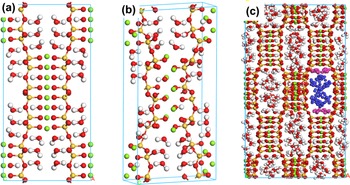
The molecular models of sepiolite shown in Fig. 1 were constructed according to previous studies (Muniz-Miranda et al., Reference Muniz-Miranda, Lodesani, Tavanti, Presti, Malferrari and Pedone2016; Zhou et al., Reference Zhou, Lu and Boek2016). The calculation model was based on the molecular formula Mg8(Si12O30)(OH)4(OH2)4⋅nH2O, where n indicates the number of zeolitic water molecules in the calculated system (Kitayama & Hayakawa, Reference Kitayama and Hayakawa1992; Suárez & García-Romero, Reference Suárez and García-Romero2013). The H2O molecules in sepiolite can be classified into two groups after structure optimization: (1) H2O molecules that are bonded strongly to Mg2+ ions located at the edges of octahedral sheets, corresponding to the structural water reported in previous studies (Balci, Reference Balci1999; Fitaroni et al., Reference Fitaroni, Venâncio, Tanaka, Gimenez, Costa and Cruz2019); and (2) H2O molecules that form hydrogen bonds between themselves, called ‘zeolitic water molecules’ (Cornejo & Hermosin, Reference Cornejo and Hermosin1988; Balci, Reference Balci1999). The calculated system, containing zeolitic water molecules, is shown in Fig. 1c. Water molecules were located in the channels inside sepiolite.
Computational models of sepiolite. The Si, O, Mg and H atoms are represented in yellow, red, green and grey, respectively. The pink and blue atomic clusters indicate structural water and zeolitic water, respectively. (a) The atomic configuration of the cell before simulation. (b) The atomic configuration of the cell after a relaxation process. (c) The atomic configuration of the supercell in the MD simulation.

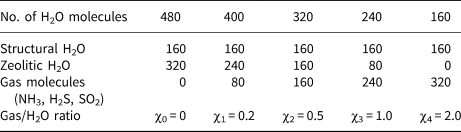
The adsorption of gas molecules into sepiolite channels was simulated by constructing a computational model. The computational model contained 160 structural water molecules and 320 zeolitic water molecules. Owing to the high stability of the structural water, these molecules were maintained in the channels throughout the simulation process. Following this, a portion of the zeolitic water molecules was substituted artificially with the gas molecules. The ratios of the number of gas/water molecules (χi) are listed in Table 1.
Ratios of the numbers of gas/water molecules (χi) in the channels of the computational model.

Forcefield setup and MD parameters
The MD simulation was performed using the Forcite module in BIOVIA Material Studio 2017 R2. All simulations were performed by using the fully atomistic COMPASS II forcefield (Sun et al., Reference Sun, Xiao, Liu, Zhao and Xiao2014; He et al., Reference He, Li, Lv, Gao, Kowalski, Valentin and Alexiadis2020). Equilibration was performed in a canonical ensemble at 300 K with a time constant of 1 × 10–15 s. Pre-equilibration procedures (100 × 10–20 s) were performed to ensure that the system reached the equilibrium state. The simulations were performed for ~3 × 10–12 s with a time step of 2 × 10–15 s. The atom coordinates were saved every 1 × 10–15 s.
Results and discussion
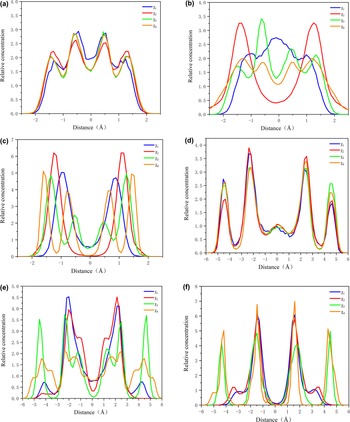
The distributions of adsorbed gas molecules in the channels of sepiolite are shown in Fig. 2. The coordinate origin was placed at the centre of the channel. At various values of χi, sepiolite showed similar adsorption behaviour towards NH3 in the x- and y-directions (Fig. 2a,d). These results indicate that the number of zeolitic water molecules had a minor effect on the adsorption of NH3 molecules. The distributions of the NH3 molecules in the channels were symmetrical in the x- and y-directions. The adsorption peaks were located at 0.5 and 1.4 Å from the centre of the channels in the x-direction and at 2.5 and 4.5 Å from the centre of the channels in the y-direction. For H2S (Fig. 2b,e), the molecular distribution changed with increasing χi values. In the x-direction, the adsorption peak was located at the centre of the channel at χ1 = 0.2 before disappearing at χ1 = 0.5. Two adsorption peaks were observed at 1.5 Å from the centre of the channel. Four adsorption peaks were observed at χ3 = 1 and χ4 = 2. In the y-direction, the molecular distribution of H2S exhibited a similar shape at various χi values. For SO2 (Fig. 2c,f), the molecular distribution was affected by the value of χi in the x- and y-directions. The results obtained indicated that the molecular configuration of the gases in the channels was determined by both χi and the interactions between the gas molecules and sepiolite. The adsorbed gas molecules in the channels were distributed symmetrically.
Distribution of the adsorbed gas molecules in the channels. (a,d) Distribution of NH3 in the x- and y-directions. (b,e) Distribution of H2S in the x- and y-directions. (c,f) Distribution of SO2 in the x- and y-directions.

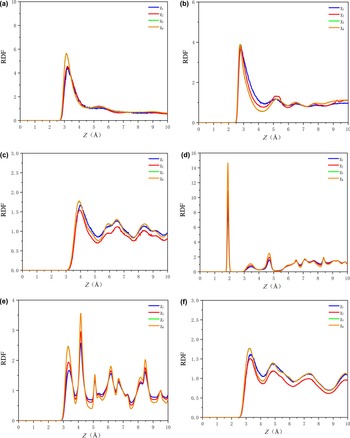
The radial distribution function (RDF) was employed to evaluate the interaction between gas molecules and sepiolite (Abbaspour et al., Reference Abbaspour, Akbarzadeh and Valizadeh2018; Lamichhane & Ghimire, Reference Lamichhane and Ghimire2021). For NH3 adsorption, the N–N, N–Ow, N–Si, Mg–Ow, Si–Ow and N–Os distances are presented in Fig. 3, where Ow = O atoms in zeolitic water molecules and Os = O atoms in structural water molecules. The RDFs of N–N and N–Os in Fig. 3a,f show a similar pattern. The peaks were located at ~3.2 Å, indicating that NH3 molecules exhibited the same level of affinity towards the nearest N and Si atoms. The RDF in Fig. 3b demonstrates a stronger N–Ow interaction compared to N–N and N–Os interactions. The NH3 molecules exhibited a weak interaction with the Si atoms. Therefore, the NH3 adsorption of sepiolite can be increased via the interaction between NH3 and zeolitic water molecules. The complicated adsorption process is associated with the number of zeolitic water molecules. However, the structural water molecules were bonded tightly to the Mg2+ in the sepiolite, producing only a small decrease in NH3 adsorption. The results in Fig. 3 indicate that the N–N, N–Ow, N–Si, Mg–Ow, Si–Ow and N–Os interactions were not affected significantly by the change in χi. For H2S (Fig. S1), the S–Ow distance was very similar to the S–Os distance, indicating that the H2S molecules interacted identically with the O atoms in both zeolitic and structural water molecules. In comparison, the SO2 molecules (Fig. S2) exhibited a high affinity to the O atoms in the structural water but not in the zeolitic water. The interactions among the SO2 molecules increased with the decreasing number of zeolitic molecules. These results demonstrate that the SO2 molecules tended to adsorb onto the channel walls, indicating the stability of SO2 molecules adsorbed on sepiolite.
RDF patterns of NH3 adsorption with various values of χi, wherein N indicates the N atoms in NH3, Ow is the O atoms in zeolitic water molecules, Si and Mg indicate the Si and Mg atoms in sepiolite and Os indicates the O atoms in structural water molecules. (a) N–N; (b) N–Ow; (c) N–Si; (d) Mg–Ow; (e) Si–Ow; and (f) N–Os. Z = distance between the atoms.

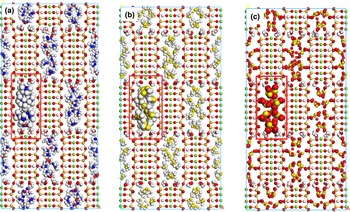
In the absence of zeolitic water in the channel, the structural water molecules were bound tightly to the Mg2+ during the simulation process for both H2S and SO2 (Fig. 4). However, during the adsorption of NH3, some of the bonds between the structural water molecules and Mg2+ were broken, and so the water molecules interacted with the NH3 molecules. In addition, the adsorbed gas molecules in the channels exhibited various configurations. The H2S and SO2 molecules exhibited ring-like structures in the channels.
Snapshoots of the molecular configurations of the gases in the channels after relaxation at χ4 = 2.0, where N is represented by the blue balls, S is represented by the yellow balls, O is represented by the red balls, H is represented by the grey balls and Mg is represented by the green balls. (a) NH3 model; (b) H2S model; and (c) SO2 model.

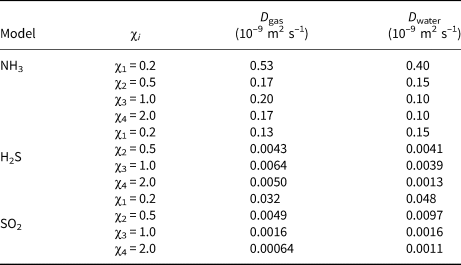
The stability of the adsorption was evaluated using the diffusion coefficients of the gas molecules, and the results are shown in Table 2 (Zhou et al., Reference Zhou, Lu and Boek2016; Largo et al., Reference Largo, Haounati, Akhouairi, Ouachtak, El Haouti and El Guerdaoui2020). For NH3, the diffusion coefficient of the molecules in the channel was 0.53 × 10⁻⁹ m2 s–1 at χ1 = 0.2, which decreased to 0.17 × 10⁻⁹ m2 s–1 at χ2 = 0.5. When χ3 increased continuously to 1.0, the diffusion coefficient increased slightly and then declined to 0.17 × 10⁻⁹ m2 s–1 at χ4 = 2.0. The relatively high diffusion coefficient indicates a weak interaction between NH3 molecules and sepiolite. The change in the H2S diffusion coefficient was similar to that observed for NH3, which indicates that the adsorption of H2S molecules is related to the number of zeolitic water molecules. At χ1 = 2.0, the diffusion coefficient of H2S was 0.50 × 10⁻¹² m2 s–1, which was three orders of magnitude lower than that at χ1 = 0.2. This indicates that sepiolite shows a great adsorption ability towards H2S. In comparison, the diffusion coefficients of SO2 and H2O decreased gradually with increasing χi, which could be ascribed to the strong interaction between SO2 and the walls of the channel. In addition, the diffusion coefficients of SO2 were an order of magnitude lower than those of H2S, suggesting a greater adsorption ability for SO2 in sepiolite. At χ4 = 2.0, the diffusion coefficients of structural water molecules for both H2S and SO2 were also similar, which is in agreement with the molecular configurations shown in Fig. 4.
Diffusion coefficients of the gas molecules in the channels of the computational model.

Conclusions
MD simulations have been employed successfully to study the adsorption mechanism of hazardous gases such as NH3, H2S and SO2 on sepiolite. Upon calculation of the distribution and diffusion coefficients of the gas molecules in the channels of sepiolite, it was found that the adsorption ability of sepiolite for the three gases followed the order SO2 > H2S > NH3. While the NH3 molecules in the channels exhibited great affinity for the water molecules, and H2S molecules showed strong interactions with the water molecules and the walls of the channels. The SO2 molecules exhibited strong interactions with both the Si atoms in sepiolite and the O atoms in structural water. Thus, it was found that the atomic configuration of the gas molecules in the channels are affected by both χi and the interactions between the gas molecules and sepiolite. Additionally, ring-like structures are observed in the molecular configurations of H2S and SO2. Future experiments will be required to validate these findings.
Financial support
This work was financially supported by the Natural Science Foundation of Hunan Province (No. 2019JJ40093) and the High-Level Talent Gathering Project in Hunan Province (No. 2019RS1059). ACSA also thanks the CNPq (425730/2018-2) and FAPEMA (00961/18).
Conflicts of interest
The authors declare that they have no conflicts of interest.
Supplementary material
To view supplementary material for this article, please visit https://doi.org/10.1180/clm.2022.22.