Introduction
Of the 23 species comprising the genus Oryza, only two are cultivated (Vaughan et al., Reference Vaughan, Morishima and Kadowaki2003), while the remaining are wild species. These wild species bear traits that are useful for the improvement of cultigens due to their adaptation to harsh environments (Khush, Reference Khush1997). Therefore, they have been included in the conservation of the genus Oryza.
Asian rice (Oryza sativa L.) was domesticated around 10,000 years ago from the wild annual O. rufipogon. It includes two main subspecies: indica (adapted to tropical and subtropical floating, lowland and irrigated agrosystems) and japonica (adapted to temperate and tropical upland ecosystems) (Chang, Reference Chang1984; Khush, Reference Khush1997). These two subgroups differ in grain shape, apiculus hair length, leaf width and colour, and in their reaction to phenol (Kovach et al., Reference Kovach, Sweeney and McCouch2007). Isozymes were used to classify the species into six varietal groups with indica and japonica being the major groups (Glaszmann, Reference Glaszmann1987). Simple sequence repeats (SSR) were further used to divide O. sativa into five groups consistent with the isozyme structure (Garris et al., Reference Garris, Tai, Coburn, Kresovich and McCouch2005).
African rice (O. glaberrima) was initially domesticated 3500 years ago in the inner delta of the Niger River and later in West African coasts (Portères, Reference Portères1956; Chang, Reference Chang1976; Second, Reference Second1985). Its ancestor is the annual wild O. barthii, which is derived from the perennial O. longistaminata (Sarla and Mallikarjuna Swamy, Reference Sarla and Mallikarjuna Swamy2005). SSR defined three African rice subgroups: a floating photosensitive ecotype adapted to a deep-water agrosystem; a non-floating ecotype adapted to a rainfed lowland agrosystem; an upright ecotype adapted to a rainfed upland agrosystem (Semon et al., Reference Semon, Nielsen, Jones and McCouch2005).
Asian rice is cultivated worldwide, while two cultivated rice species have been cropped together only in Africa since the 15th or 17th century (Linares, Reference Linares2002). African rice is less diverse than Asian rice (Chang et al., Reference Chang, Marciano and Loresto1977; Second, Reference Second1985; Barry et al., Reference Barry, Pham, Billot, Courtois and Ahmadi2007). Major rice collections were assembled during the 1960 s in most African countries and seeds were stored with IRAT-ORSTOM (France), the International Institute of Tropical Agriculture (Nigeria), International Rice Research Institute (the Philippines) and the Japanese Institute of Genetics (Oka, Reference Oka1977). Rice species from Guinea, Mali and Nigeria have also been collected, studied and stored in various genebanks (Bezançon et al., Reference Bezançon, Bozza, Koffi and Second1977; Semon et al., Reference Semon, Nielsen, Jones and McCouch2005; Barry et al., Reference Barry, Pham, Billot, Courtois and Ahmadi2007). New cultivated rice species were collected recently in West Africa, but Niger was excluded (Barry et al., Reference Barry, Pham, Billot, Courtois and Ahmadi2007; Nuijten et al., Reference Nuijten, van Treuren, Struik, Mokuwa, Okry, Teeken and Richards2009). This country is the nearest bordering to the primary centre of diversification of African rice in the downstream part of the Niger River. An online search on the AfricaRice database further revealed that only 32 accessions were ever collected from Niger until 2007, but they were not available (at least until 2010). Niger should benefit from the global efforts to conserve ex situ local rice diversity, particularly if high-yielding Asian rice cultivars are promoted in major irrigated areas to replace African rice landraces. Our research was therefore undertaken to collect rice and its related Oryza species from Niger, to describe this germplasm with agro-morphological traits and to assess whether geographical and ecological distributions affect such traits.
Materials and methods
Germplasm collection
Seven of the eight regions of Niger were visited. Villages were chosen randomly along different eco-geographical zones where rice is cropped (Fig. S1, available online). A distance of more than 2000 km was travelled in the course of seed collection, largely by canoes and boats in the region of the Niger River and by motorcycles and cars in the other collection areas. Four main zones were visited, namely the Niger River, the Dallol Maouri – a seasonal tributary of this river in the southwest, the central-south zone along the marshes of Goulbi of Maradi and Lake Madarounfa, and Lake Chad together with the Komadougou River in the southeast. In each zone, three rice agrosystems are practiced, namely floating deep-water (>1.5 m depth), rainfed lowland ( < 1 m depth) with semi-controlled immersion and irrigated paddy rice with full water control.
The village as a finite entity was the basis of the sampling strategy. In each village, a meeting was held with farmers, the community leaders, the local representative of agricultural services and the farmers' cooperative. A comprehensive inventory of cultivars and landraces known to farmers was made. From the list, each cultivar or landrace was called and two to four farmers were asked to bring seed samples, hereafter referred to as ‘accessions’. The community was then asked to identify the accession by consensus. If the samples brought were mixed, the farmers were invited to resample within the provided samples some seeds presenting the identified accessions. Farmers who brought the accessions were interviewed in public to complete the passport data of the accessions. If a listed accession was recognized as disappeared or abandoned, we asked the community about the reasons that led to its disappearance or abandonment. In addition to this, farmers were also requested to inform the collection team about any other village where the absent accessions could be found. Generally, an identified accession was resampled again in one to two villages following its first appearance in order to confirm the name. If a name already recorded appeared later (in very distant villages, eco-geographical zones or ethnic groups), it was sampled again. Additionally, if an accession already identified and sampled appeared again under a different name in another village, it was resampled and all related information was taken again from the farmer.
Overall, 202 rice accessions were collected, of which nine samples of wild O. barthii were collected at sites far from any cultivated rice farm. The accessions were brought to the AfricaRice research station, where the seeds of each sample were visually separated from off-types to constitute ‘pure’ samples for each accession. If the off-types derived from a sample did not correspond to any identified accessions, they were kept. The accessions were then coded using the initials of the region from where they were collected, and followed by a number corresponding to the order of collection (e.g. TH3 corresponded to the third accession collected in the region of Tahoua, while DF13 was the 13th accession collected in the region of Diffa). The kept off-types were named after their sample code followed by an alphabetic letter (e.g. DS14-E was the fifth off-type in the 14th accession collected in the region of Dosso).
A total of 370 rice accessions, including 168 off-types derived from each sample, plus check cultivars were grown in the first trial in 2008 (a purification–characterization trial). From the purification–characterization field trial, a total of 270 accessions (comprising 202 accessions and 68 ‘unique’ off-types) were selected for the second field trial in 2009 (characterization trial). In this trial, we included eight check cultivars: two irrigated indica (IR64, B6144); one traditional deep-water floating indica (RAM63); one upland japonica (Moroberekan); two African rice (upland CG14 and lowland TOG7106); two Asian–African interspecific hybrids (upland NERICA14 and lowland NERICAL41).
Field trials
The purified accessions as well as all the related unique off-types and check cultivars were sown at the AfricaRice research station (Togoudo, Benin) during the rainy season of 2008. The field was regularly watered during dry spell periods. An augmented experimental design with five replicated checks (ITA212, NERICA4, NERICA14, B6144 and TOG7106) in ten blocks was used. When enough seed was available, the plot size for each accession was 0.6 × 1.5 m with three rows, 0.2 m spacing between and within the rows and 0.4 m between the plots. The direct seeding rate was three plants per hill. Thinning 20 d after sowing (DAS) left one plant per hill. A total of 200 kg/ha Nitrogen-Phosphorous-Potassium (NPK) (15:15:15) was applied to all plots just after thinning. Urea was also applied at a rate of 100 kg/ha 3 weeks after thinning. Regular weeding was done when necessary. Data were recorded on five to ten plants of the inner row from the seedling stage to harvest. For each accession, panicles of five well-identified plants from the inner row were individually harvested and the remaining ten were bulk-harvested.
From the 2008 purification–characterization field trial, a total of 270 accessions were selected after eliminating the accessions that were similar in the field. The testing accessions and eight check cultivars were directly sown during the rainy season of 2009 in plastic buckets of 5 L capacity at a rate of two plants per bucket. The buckets were laid out in a randomized complete block design with two replications. Three buckets per accession were used in each replication, i.e. a total of 12 plants were sown per accession. NPK (15:15:15) and urea were applied at 20 DAS and at the panicle initiation stage, respectively. The field was watered during dry spell periods. Only 44 discriminating traits, selected after a factorial analysis on the previous year's dataset, were recorded on five plants per accession.
Data collection and analysis
Data were recorded using the descriptor list for wild and cultivated rice species (Bioversity International et al., 2007). During the trials, 44 agro-morphological traits were measured (Table S1, available online). A factorial analysis was performed on the dataset, and 34 traits that contributed the most to the different factors (when the correlation was >0.45) were selected for analyses.
In addition to data collection, the accessions were classified into Asian or African rice based mainly on the ligule length and shape. The species of Asian rice have long ligules, while those of African rice have short ligules (Sarla and Mallikarjuna Swamy, Reference Sarla and Mallikarjuna Swamy2005). Similarly, awn length, texture and consistency, as well as grain length (Besancon, Reference Besancon1993) (Fig. S2, available online), were used to classify the intermediate forms into African rice or O. barthii, in addition to the samples of O. barthii collected in wild populations far from cultivated fields.
Pearson's principal component analysis (PCA) was performed on the standardized quantitative data for 18 traits, followed by the assignment of the different accessions into groups by an agglomerative hierarchical clustering (ACH) method. Dissimilarities were computed based on the Euclidean distance and aggregation of accessions was based on the Ward method (Ward, Reference Ward1963). Discriminant analyses (DA), based on the 37 traits (18 quantitative and 19 qualitative), were conducted using groupings identified by cluster analysis with eco-geographical zones, agrosystems and species as categorical variables. These analyses were performed using XL-STAT 2010 software.
The diversity of phenotypic traits was estimated using the Shannon–Weaver diversity index (Shannon, Reference Shannon1948), computed with Microsoft Excel 2010 software. The Shannon–Weaver diversity index was computed on the 44 traits, but only the results from the 34 most variable traits (15 quantitative and 19 qualitative) are presented. Quantitative continuous data were transformed into categorical data by defining for each phenotypic trait class based on either the rice descriptors (Bioversity International et al., 2007) or as described by Sanni et al. (Reference Sanni, Fawole, Guei, Ojo, Somado, Tia, Ogunbayo and Sanchez2008). When information was not available, three classes were defined based on the mean, median and quartiles. The Shannon–Weaver diversity index H′ was computed as:
 $$\begin{eqnarray} H \prime = - { \sum _{ i = 1}^{ k } }\, P _{ i }\,log\,_{2} P _{ i }, \end{eqnarray}$$
where k is the number of phenotypic classes for a character and P i is the relative abundance of individuals in the ith class, which was calculated as the ratio of individuals in the phenotypic class i to the total number of individuals (N). H′ was divided by its maximum value (log2 k) to range between 0 and 1 (Abdi et al., Reference Abdi, Bekele, Asfaw and Teshome2002; Sanni et al., Reference Sanni, Fawole, Guei, Ojo, Somado, Tia, Ogunbayo and Sanchez2008).
Results
Collecting mission
The distances between the 50 visited villages ranged from 1 km between the closest Gatawani Béri and Gatawani Kaina (within the southwest region of Dosso), to about 1500 km between the farthest Koutougou (in the southwest region of Tillabéry) and Dagaya (in the southeast region of Diffa near the Lake Chad). The collecting areas were situated mainly in the Sahel zone with an annual rainfall ranging from 200 to 600 mm, while one-third of the Niger River and the whole Dallol Maouri are in the Sudan savannah (with an annual rainfall ranging from 600 to 900 mm).
As seeds were sampled from granaries, 59% of the collected samples contained off-type seeds, ranging from one to nine mixtures of seed types, with a mean of four different types per accession. After the purification–characterization field trial in 2008, 68 off-types were kept in the collection. These off-types often corresponded to cultivars that had disappeared, as reported by the farmers. Sometimes they were intermediate forms between the wild and cultivated rice species. In addition to cultivated rice samples and intermediate mixed forms, we also collected ten wild rice accessions belonging to O. barthii (nine) and O. longistaminata (one). Surprisingly, in the village of Mill (region of Diffa, Lake Chad zone), old women did harvest natural populations of O. barthii that grew along marshes. The habitat of the collected rice samples ranged from floating rice in deep-water to rainfed lowland rice and fully irrigated paddy rice.
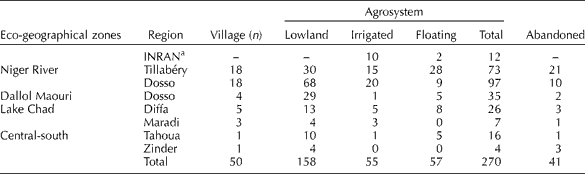
The accessions were not evenly distributed from the collecting area (Table 1). About 27% of the samples were collected from 18 villages in the region of Tillabéry, and 36% from 18 villages in the region of Dosso. Hence, 63% of the accessions were collected along the Niger River. The accessions from the region of Diffa (five villages) accounted for 9.6%, while 5.9% of the accessions were from Tahoua (two villages), 2.6% from Maradi (three villages) and 1.5% from Zinder (one village).
Distribution of the accessions from the different regions and eco-geographical zones of Niger

a Accessions collected at the INRAN were counted along with those obtained from the Niger River zone because more than 50% of the irrigated areas lie along this river wherein farmers grew improved cultivars.
There was a significant difference in the number of accessions collected from one region to another. The majority of the collection (35.6%) originated from the region of Dosso along the Niger River and in the Dallol Maouri watercourse, compared with 27% collected from the region of Tillabéry, which is the main rice-growing area of the country. This situation arose by the collection process per se because, due to logistics, we started the process in the region of Dosso. As any accession was only collected in the first villages where it was found, most of the accessions were from Dosso. The second explanation could be that villages around the two dominant hydrographical formations of the region of Dosso were visited (the Niger River and the Dallol Maouri), while none of the tributaries of the Niger River was included in the region of Tillabéry. Last but not least, several villages with large irrigated areas under the supervision of the Office National des Aménagements Hydro-Agricoles (ONAHA) were avoided while collecting in the region of Tillabéry because of the predominance of modern Asian rice cultivars released by the Institut National de la Recherche Agronomique du Niger (INRAN). With a few exceptions, all cultivars found in Dosso were also in Tillabéry. ‘El Sambera’ was only found in the region of Dosso and in Maradi under another name but not in the other regions. This cultivar was probably brought from Nigeria, as observed with most accessions from the central-south zone.
The lowland, floating and irrigated rice accessions accounted for 58.5, 21.1 and 20.4%, respectively (Table 1). The same agrosystems were observed across the main eco-geographical zones, but not in all the regions. Zinder and Maradi did not have floating rice accessions, while irrigated rice was absent in Zinder. Genetic erosion, defined as the disappearance of named landraces in regions or agrosystems where they have been reported before, was observed in Tillabéry (Table 1), particularly in traditional rice-growing areas such as the canton of Sinder (homeland of the Wogo people) and Koutougou (homeland of the Songhai people). In many villages of Tillabéry, farmers informed us that any named accessions that could not be found in Sinder or Koutougou must be considered as definitely lost. Moreover, only 20% of the accessions (all belonging to African rice) found and listed in Sinder by Bonkoula and Miezan (1982) were still grown at the time of our collecting mission. Drought and floods were cited as main reasons for the disappearance of landraces in Sinder, while the farmers in Koutougou claimed that the floating cultivar D5237 (introduced in the 1950 s by the colonial administration) was the main cause of the disappearance of landraces. D5237 was later renamed as Degaulle and overcame the previously named Degaulle (which has red grains), because of its white grains, the ease of husking and the high value in the market. The farmers did not indicate any pathogen or pest as a reason for abandonment of landraces.
According to the farmers, the cropping cycle of the cultivars ranged from 3 to 5 months around the Lake Chad and the central-south zone, from 3 to 6 months in the Dallol Maouri and up to 7 months along the Niger River. They classified 60.6% of the accessions as tall cultivars (plant height >1 m), 26.7% as medium height (0.5–1 m) and 12.8% as short ( < 0.5 m).
New cultivars were available from neighbouring villages, farmers and the local farmers' union. The farmers' union also works with the national seed dissemination institutions, started by the National Agricultural Research Institute (INRAN), and the national irrigated areas office (ONAHA). New cultivars could also be brought from neighbouring countries. For example, some new cultivars came from Benin and Nigeria in Dosso, while in Tillabéry, they were often brought from Mali but seldom from Burkina Faso. Nigeria was the most frequent provider of new cultivars in the villages visited in the central-south area, while in Diffa, the main source was the INRAN followed by Nigeria and sometimes Chad.
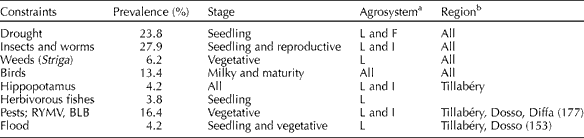
During the community meeting, farmers were asked to rank the most important constraints on rice production in their areas (Table 2). Drought at the seedling stage (before the setting of the full season) and the filling up of the valleys was cited as the most important constraint in 23.8% of the villages in rainfed lowland and floating deep-water agrosystems across the regions. The main cause for this stress was irregular rainfall patterns before the peak of the season, and the need for the plant to reach a certain stage before the flood. Insects and telluric worms at the seedling and reproductive stages were also cited as the most damaging constraints in 27.9% villages in lowland and irrigated agrosystems. Farmers described diseases such as rice yellow mottle virus (RYMV) and bacterial blight (BB) that affected lowland and irrigated rice accessions in 16.4% of the villages in all the areas, except in the central-south zone. Birds, hippopotamuses, fishes and flood were noted as major constraints in 13.4, 4.2 and 4.2% of the villages, respectively.
Main constraints on rice production, as described by farmers during germplasm collection in Niger in 2008

RYMV, rice yellow mottle virus; BLB, bacterial leaf blight.
a L, lowland; I, irrigated; F, floating.
b Total number of farmers interviewed (N= 194): Tillabéry (N= 64), Dosso (N= 89), Diffa (N= 24), Maradi (N= 6), Zinder (N= 4) and Tahoua (N= 7).
The local naming of rice accessions referred mostly to morphological characteristics of plants or seeds. For example, ‘MaïAdda’ in the Hausa language means ‘the one with a machete’ that refers to the shape of the extremity of the grain and recalls the extremity of a machete. Another example is ‘Waïhidjo’, which means ‘the bride’ in the Zarma language because of the highly droopy panicles and the upright status of the flag leaf that farmers call ‘a veiled decent bride’. The meaning can also be related to agronomic traits. For example, the name of the accession ‘Aysi a filla’ means ‘I will never do it again’ in the Zarma-Songhai language, which relates to the long cycle of this cultivar that discourages farmers to plant it again. Another example is the accession ‘Hawrou ga koungou’ that means ‘eat to satiate’ in the Zarma language because the cooked rice will melt during the night due probably to the quality of the composition of starch, with a negative paste viscosity and thus a negative paste setback. Sometimes accessions were simply named after the person who brought them into the village or the farmer who was supposed to breed them. For example, the most popular lowland cultivar was named ‘Degaulle’ because of its tall height that reminded farmers the former French President General Charles De Gaulle. Also, the most popular irrigated rice cultivar IR1529 was called ‘Saga’ because it was first released in the irrigated area of Saga and thereafter spread throughout the country. With a few exceptions, the farmers' naming was consistent in each region, but not across the regions.
Agro-morphological characterization
A total of 25 accessions were identified as O. barthii, 177 accessions as Asian rice, 67 accessions as African rice and one accession as O. longistaminata (Table 3). The accession of O. longistaminata was collected as a rhizome in a small bucket with soil and transplanted later.
Summary of the distribution of the accessions by Oryza species and collecting zone

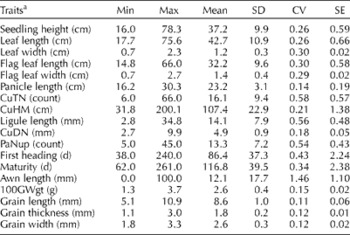
The descriptive statistics including the range, the mean and the coefficient of variation of the 18 quantitative traits are summarized in Table 4. The coefficient of variation was particularly high for awn length (145.8%) because this trait ranged from awnless accessions (34%) to 100 mm awn length in some accessions. The lowest coefficient of variation was calculated for grain length (11.2%). Days to maturity followed by the first heading date had the highest standard deviation, thereby reflecting the broad range of cropping cycles of the accessions included in this germplasm collection. Leaf width and 100-grain weight showed the narrowest diversity ranges among all the traits.
Summary statistics of the 18 quantitative continuous traits assessed on the 270 accessions from Niger

SE, standard error; CV, coefficient of variation; SD, standard deviation.
a CuTN, culm tiller number, CuHM, culm height at maturity; CuDN, culm diameter at nodes; PaNup, panicle number per plant; first heading, days from sowing to first heading; maturity, days to maturity; 100GWgt, 100-grain weight.
The frequency distributions of the 19 qualitative traits were also computed. Figure S3 (available online) provides an example for the distribution of spikelets borne on secondary branches of the panicles and for colour variation of the caryopsis. Most accessions (70.7%) had dense panicles, with two to three secondary branches per primary branch, while 16.7% developed three to four secondary branches per primary branch and 12.6% developed sparse secondary branches with most spikelets borne directly on the primary branches. There were 37.9% of accessions with brown pericarp of the caryopsis, while 34.2% were white, 15.6% red or purple and 12.3% light brown or whitish.
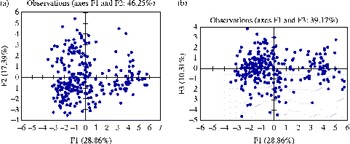
Table 4 gives the summary of the four principal components from PCA based on 18 quantitative traits measured on the 270 accessions. The first two principal components (PC1 and PC2) explained 28.86 and 17.39% of the total variation, respectively. The main traits that had the highest loading scores (and hence contributed most for the differences) were flag leaf width and length, leaf blade width and length, culm number, ligule length and panicle number and length for PC1, and flag leaf length, culm length and diameter, maturity and heading dates for PC2. The PC bi-plot (Fig. 1(a) and (b)) was useful to visualize two to three grouping patterns, though these groupings were not clearly defined.
(colour online) Principal component (PC) bi-plot of (a) PC1 (accounting for 28.86%) and PC2 (accounting for 17.39%) and (b) PC1 (accounting for 28.86%) and PC3 (accounting for 10.31%) resulting from 18 quantitative traits assessed on 270 accessions from Niger plus eight cultivar checks.

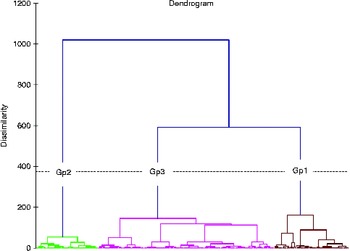
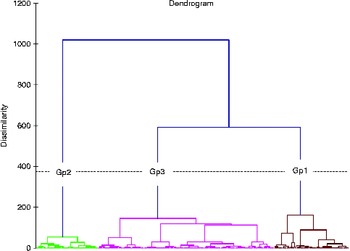
The four PCs were used to classify the accessions using an ACH method, based on Euclidean distance dissimilarities. Three phenotypic groups were identified (Fig. 2 and Table S3 (available online)). The first group (Gp1) comprised 52 Asian rice accessions (50% each from floating and lowland agrosystems), 13 African rice accessions (ten floating and three lowland ecotypes) and one floating O. longistaminata accession. The floating check RAM63 and the lowland cultivar TOG7106 were also in Gp1. Individuals within Gp1 had erected leaves with a weak anthocyanin presence on the outer surface of the basal leaf sheath of seedlings. They also had an intermediate leaf length with narrow width, thick culms, medium tillering ability and very long ligules, due to a high number of Asian rice accessions in this group. Additionally, Gp1 accessions were semi-compact, and had awnless panicles or with very short awns. Most of them are photosensitive accessions with late first heading and extended days to maturity. The second group (Gp2) consisted of 56 accessions, of which 35 were African rice (six floating and 29 lowland types), 16 belonged to the wild O. barthii (three floating ecotypes and 13 lowland ecotypes) and 5 were Asian rice. Gp2 accessions had short crop cycles (51 days from sowing to flowering and 78 days to maturity), short and yellowish green ligules, and long leaves. In addition, they showed high tillering ability, broad flag leaves and long spreading panicles with most of the spikelets borne directly on primary branches. Their grains had a purple apex as well as long awns, when close to maturity. There were 156 accessions in the last group (Gp3). Most of them (126 accessions) were Asian rice (including the check cultivars IR64, B6144, NERICAL41, NERICA14 and Moroberekan). All the irrigated ecotypes (except TY51-F) clustered in Gp3. The check cultivar CG14 and 21 African rice accessions (mostly lowland ecotypes) were also included in Gp3. Nine wild O. barthii, including the two pure wild types harvested far from any cultivated rice farm, were in this group. Accessions in Gp3 had dwarf or semi-dwarf plants with short erect leaves, pubescent flag leaves only on the upper surface, medium ligule length with yellowish green auricles and light green collars. They showed a medium tillering ability and medium crop cycle length. Panicles were either semi-compact or droopy and clustered with low grain shattering.
(colour online) ACH dendrogram of the 270 accessions from Niger and eight cultivar checks based on Euclidean distance dissimilarities of 18 quantitative traits.
A further DA based on the three groups, which was obtained with cluster analysis as the categorical variable and the 36 quantitative and qualitative traits as explanatory variables, assigned 100% of the accessions into their pre-defined a priori group (Fig. S4a, available online). The first factor was associated with five quantitative traits (leaf width, flag leaf width, ligule length, days to first heading and days to maturity) and four qualitative traits (leaf blade attitude: erect or droopy; ligule shape: obtuse or rounded; apiculus coloration of the lemma: purple apex; awn colour: purple). The second factor was strongly correlated with leaf and flag leaf length, and plant height. The DA conducted using eco-geographical zones (Fig. S4b, available online) assigned 75.99% of the accessions into their respective groups. It was observed that accessions from the central-south and Dallol Maouri zones are clearly different from the other two eco-geographical zones. On the contrary, the accessions collected around the Lake Chad were mixed with the accessions collected from the other eco-geographical zones. This result suggested that most of the phenotypic variation of rice in that region was also included in the Niger River. The DA performed using the different rice-growing agrosystems (as defined by the farmers) accurately assigned the accessions into their pre-defined groups: floating (f), lowland (L) or irrigated (i) (Fig. S5a, available online). Compared with the other categorical variables, however, the level of separation among these agrosystems was low. The appropriate accession assignment to the Oryza species was confirmed using the assigned species as the categorical variable. The DA assigned 99.6% of the accessions into their appropriate species (Fig. S5b, available online).
Phenotypic diversity of the collection
The Shannon–Weaver diversity index was computed on 15 quantitative and 19 qualitative descriptors (Table S4, available online). This diversity index was first calculated for the entire collection (H′), and for the four eco-geographical zones of collection and the groupings identified through the cluster analysis (Table S5, available online). Thereafter, the diversity index of the collection was calculated for the three species and three agrosystems (Table S6, available online). The overall Shannon index for the 34 traits ranged from 0.16 for the weight of 100 grains to 0.98 for the outer diameter of the basal portion of the plants' main culm (CuDN, culm diameter at nodes), with an average of 0.65. The pairwise comparisons of the mean Shannon–Weaver diversity index did not differ significantly (P>0.05) among the collecting zones, among the phenotypic groupings and also among the three species. This diversity index was, however, different from one zone to another and from one group to another for specific descriptors. While there was no significant variation in the panicle length and the weight of 100 grains in the 27 accessions from the central-south zone or the 52 accessions of the phenotypic group Gp2 (H′ = 0), the diversity of panicles was H′ = 0.40 for the accessions in the Niger River zone and H′ = 0.41 for those of the phenotypic group Gp3. Additionally, Gp1 accessions had the highest diversity for 100-grain weight (H′ = 0.37), while the accessions in the Niger River zone showed the highest diversity between the zones of collection (H′ = 0.18) and plant height among the descriptors (H′ = 0.67). The variability was high for caryopsis pericarp colour, flag leaf attitude, panicle main axis attitude, culm habit and panicle shattering, regardless of the zone of collection or the phenotypic groupings. Diversity for days to first heading and days to maturity was very high and stable only between the eco-geographical zones. H′ was very high in the accessions of Gp3 for both descriptors but was low in those of Gp2 and Gp1. The variability of the colours of flowers' stigma and the lemma of grains was low in the accessions of Gp2 and high in those of the other groups. Grain length had the highest diversity (H′ = 0.96) in the accessions of the phenotypic group Gp1 and in the region of the Lake Chad. The Shannon–Weaver diversity index was very low in O. sativa accessions for leaf blade attitude (the angle of openness of the blade tip as measured against the culm on the leaf below the flag leaf) compared with that in the other species (Table S6, available online). On the contrary, the colour of ligules was more variable in O. sativa accessions and awn distribution on the panicle had a narrow diversity in O. barthii accessions. However, the Shannon diversity index was different between the agrosystems. The irrigated agrosystem had a low Shannon index compared with the floating and lowland agrosystems, due to relatively low index values for traits such as leaf blade pubescence on the blade surface, coleoptile anthocyanin coloration, ligule length, leaf blade attitude, culm habit (most of them were erect) and attitude of the panicle main axis (often droopy), with low grain shattering ability. The main characteristic of this group was the prevalence of only O. sativa accessions related to breeding programmes, while the other two agrosystems (floating and lowland) included accessions of the three species.
Discussion
Collecting mission
The village, the administrative region or the eco-geographical zone have been used as the basis for collecting rice genetic resources in an entire country or region for further ex situ conservation in genebanks (Barry et al., Reference Barry, Pham, Billot, Courtois and Ahmadi2007). A collecting mission for rice could follow hydrographical maps of the target area because of the adaptation of this crop to humid environments. Our collecting mission was therefore conducted by following the distribution of villages along the main watercourses and marshes in Niger. The region of Agadez (which is mainly desertic) was excluded.
Farmers do not differentiate cultivars according to African or Asian species. They classify them into ‘irrigated rice’ for most of the bred cultivars and ‘lowland rice’ for some floating and lowland cultivars, or ‘river or marsh rice’ for old African rice landraces. However, they are aware of the two wild African rice relatives, namely the annual O. barthii (‘Sombay’ in the Zarma-Songhai west language or ‘Fouremmi’ in the Kanuri east language) and the perennial O. longistaminata (‘Baou’ in the Zarma-Songhai language). Local people harvest and consume O. longistaminata and O. barthii in the Niger Delta of Mali (Second et al., Reference Second, Bezançon and Bozza1977) and at Tillabéry in Niger (Bonkoula and Miezan, Reference Bonkoula and Miezan1982), respectively. We observed the same during the collecting mission around the Komadougou River in the region of Diffa but not in the Niger River valley.
Farmers informed us that drought and insects were the main constraints on rice production, particularly at the seedling and reproductive stages in lowland and irrigated agrosystems. Drought is one of the main limiting factors for rice farming worldwide (Courtois et al., Reference Courtois, McLaren, Sinha, Prasad, Yadav and Shen2000; Manickavelu et al., Reference Manickavelu, Nadarajan, Ganesh, Gnanamalar and Chandra Babu2006), while stem borers and rice bugs have been cited as major pests on rice in Africa. Drought occurs often in Africa due to the unequal rainfall distribution both in time and space, and poor soils (Balasubramanian et al., Reference Balasubramanian, Sie, Hijmans and Otsuka2007). It seems to be more damaging at the reproductive stages, especially during flowering, because rice may recover at the vegetative stage (Yue et al., Reference Yue, Xue, Xiong, Yu, Luo, Cui, Jin, Xing and Zhang2006). In addition to insects and drought, farmers also rated weeds and diseases as harmful in the collecting areas, particularly in irrigated and lowland agrosystems. Weeds are also responsible for nitrogen loss (up to 25%) in West Africa (Becker and Johnson, Reference Becker and Johnson2001), while RYMV and BB are recognized as the most damaging diseases in Niger (Basso et al., Reference Basso, Souley, Adamou, Sere and Halidou2010).
Farmers' naming of rice cultivars in Niger often refers to plant morphology, specific agronomic traits, the name of the person who brought it to the village or the name of the original village from where it came. This naming seems to be similar to that used by rice farmers in Gambia (Nuijten and Almekinders, Reference Nuijten and Almekinders2008). Generally, farmers' naming of rice cultivars was consistent in a region, even if sometimes there was a direct translation of the name from one language or a misspelling of the name, e.g. the accession ‘Waihidjo’ in the Zarma-Songhai language, meaning ‘the bride’, is called ‘Amaria’ (‘the bride’) by the Haussa people, while the cultivar ‘Degaulle’ in the region of Tillabéry is known as ‘Dikkol’ in the region of Diffa (>1200 km afar). This synonymy could be explained by the relatively small number of ethnic groups and dialects in Niger (nine dialects), of which Hausa and Zarma are spoken by nearly 80% of the population.
Phenotypic variation and diversity
The phenotypic characterization of plants can provide useful information on the spatial distribution and structure of this diversity. Such information is useful for optimal exploitation of crop genetic resources. Niger rice germplasm was characterized by very late maturing accessions, with 36% of them requiring in excess of 145 d from sowing to maturity. Plant height of 36.4% of accessions varied between 1 and 1.2 m and 60% of them had a light brown caryopsis. Sanni et al. (Reference Sanni, Fawole, Guei, Ojo, Somado, Tia, Ogunbayo and Sanchez2008) noted that rice landraces from Côte d'Ivoire were tall and late maturing, while most of the rice landraces (68%) from Burkina Faso also showed late maturity and had light brown to brown pericarps (Sié et al., Reference Sié, Zongo and Dakouo1998). Oka (Reference Oka1977) indicated that some rice cultivars grown in Africa were photoperiod-sensitive and had a brown pericarp.
Although the number of accessions varied among the four eco-geographical zones, there was a clear pattern of morphological adaptation in the central-south and Dallol Maouri zones. This situation could be explained by the marginalization of the central-south zone compared with the Dallol Maouri zone which is more exposed to the influence of the Niger River zone, where most of the new varieties are introduced for evaluation. The variability of the accessions collected around the Lake Chad was similar to that of the accessions collected along the Niger River, except for a very few O. barthii accessions that are endemic to the Lake Chad. These accessions were collected in wild populations far from any cultivated rice farms. They had spread-out culms (inclination of the base of the main culm from vertical >60–80°) and were very early maturing (first heading 38–41 d after sowing in four experiments), with few long grains (>10 mm) on the panicles and very long rigid awns (>80 mm). A similar trait diversity was noted for O. barthii accessions from Mali (Bezançon et al., Reference Bezançon, Bozza, Koffi and Second1977). Most of the O. barthii accessions in the Niger River zone had semi-erect to open culms (20–40°), were early to medium maturing and had medium length grains with long but less rigid awns. None of the wild populations of O. barthii was collected far from cultivated rice fields along the Niger River. Farmers in this region grow only Asian rice in their irrigated areas.
Rice cropping intensification along the Niger River had probably promoted gene flow and natural hybridization between Asian rice cultivars and wild O. barthii populations. Gene flow was observed in Asia between rice cultivars, wild O. rufipogon, and the weedy rice O. sativa f. spontanea (Chen et al., Reference Chen, Lee, Song, Suh and Lu2004). Gene flow could explain the reduction in grain size and the openness of culms, as well as the lengthening of the crop cycle of the O. barthii accessions collected from the Niger River zone. According to Second (Reference Second1985), the population of adventive O. barthii found in the inland delta of the Niger River (East) in Mali was different from O. barthii populations found in the western part of Mali. The same author made a similar observation concerning the differences in the isozyme profiles of O. barthii populations found on the western side of the Lake Chad (in Niger) and those found on the eastern and the southern side (Chad and Nigeria). The inland delta of the Niger River seems to have been the first centre of domestication of African rice from its wild progenitor O. barthii. The Lake Chad area would have been a ‘non-centre’ (Harlan, Reference Harlan1975) from where wild accessions were taken to be further domesticated elsewhere and spread far from it. Due to the high annual population growth rate (2.9%) in Niger, farmers have been obliged to occupy the remaining refuges for wild species. Such a phenomenon of the disappearance of wild species was also observed for the Asian wild rice O. rufipogon in Thailand (Akimoto et al., Reference Akimoto, Shimamoto and Morishima1999).
Farmers assigned rightly most of the accessions to the appropriate agrosystems. Most accessions were grown in rainfed lowlands. Farmers clearly noticed that most of the irrigated cultivars were dwarf to semi-dwarf, and therefore could not stand the unpredictable water depth that depends on the amount of rainfall and the duration of the rainy season. The irrigated rice was dominant in large-scale irrigation schemes promoted by the National Food Security Program. The INRAN breeding programme has given priority to this agrosystem. Farmers have also started using some semi-dwarf to intermediate height cultivars in the lowland agrosystem, which explains some admixtures in the two agrosystems. Deep-water and floating agrosystems are the extension of the lowland agrosystem. Depending on the amount of rainfall and the level of flooding of the river, the cultivated surfaces vary between these agrosystems. Hence, there is a continuum between them, but it does not occur between the floating and irrigated agrosystems. Certainly, morphological characters such as culm height and cycle from sowing to maturity readily distinguish the ecotype groupings. Such separation between agrosystems has also been observed in Mali and Nigeria (Second, Reference Second1985; Akpokodje et al., Reference Akpokodje, Frederic and Erenstein2001).
In this study, the PCA did not show a clear grouping pattern of the accessions using 18 quantitative traits. On the contrary, a clear grouping pattern has been observed for three out of eight traits measured on a Spanish barley collection (Lasa et al., Reference Lasa, Igartua, Ciudad, Codesal, García, Gracia, Medina, Romagosa, Molina-Cano and Montoya2001). However, the clustering of our accessions following the hierarchical classification led to three phenotypic groupings. Gp1 included floating African rice accessions and long-cycle Asian rice accessions, which clustered with the wild O. longistaminata. Barry et al. (Reference Barry, Pham, Billot, Courtois and Ahmadi2007) found a similar grouping of lowland African rice accessions and photoperiodic Asian rice germplasm from maritime Guinea. Photosensitive rice accessions were found in Nigeria in both African and Asian rice germplasm (Aladejana and Faluyi, Reference Aladejana and Faluyi2007). This photosensitivity could affect the harvesting of two crops per year, whereas in Niger, farmers found this trait convenient because it allows them to partition their work for 4–5 months during the sole rainy season of the year. Their production system consists of sowing the fields early during the rainy season, and then taking care of other crops, mainly because there is no need for weeding rice fields due to the high water level. The clustering of most Asian rice accessions with some lowland African rice accessions in Gp3 agrees with the findings of Semon et al. (Reference Semon, Nielsen, Jones and McCouch2005). These authors have analysed 198 accessions of African rice from various countries and observed that some accessions of African rice clustered within the accessions of Asian rice due to gene flow between these two species.
Phenotypic variability in Niger rice germplasm was high, regardless of the phenotypic cluster, the zone of collection or ecology, except in the irrigated agrosystem. This finding could be explained by the existence of the same agrosystems across the regions and at the village level. Another explanation could be good seed exchanges and cultivar spread within the rice-growing areas of Niger. A further reason could be the relatively narrow genetic basis of the varieties released in the irrigated agrosystem, compared with the traditional agrosystems (lowland and floating), where ancient and recent rice accessions were cultivated together. The genetic basis of irrigated rice in Niger could be widening using accessions from lowland and floating compartments in breeding programmes. The mean Shannon–Weaver diversity index of Niger germplasm was higher than that calculated using 13 descriptors on 880 rice accessions from Côte d'Ivoire (Sanni et al., Reference Sanni, Fawole, Guei, Ojo, Somado, Tia, Ogunbayo and Sanchez2008), though this index could vary when comparing individual descriptors. These index differences between Niger and Côte d'Ivoire could reflect the species grown by farmers and separation between the agrosystems where they thrive. For example, the low value of H′ for leaf blade pubescence in Côte d'Ivoire's germplasm was probably due to the predominance of hair on the leaves of Asian rice, while African rice germplasm can have both hairless and glabrous leaves (Chang et al., Reference Chang, Marciano and Loresto1977), thus increasing the Shannon–Weaver diversity index.
A high level of agro-morphological variability was observed in Niger, regardless of the collecting zone. Tillabéry constitutes the primary centre of rice cultivation in Niger. Nevertheless, rice cultivation is expanding progressively, probably because of recurrent food insecurity in Niger due to irregular rainfall patterns that affect other crops and due to the expansion of irrigated rice schemes (DREF, 2010; World Bank, 2010). Rice cropping intensification between 1975 and 1985 led to the loss of several African rice landraces in Tillabéry, as observed while comparing what remains available with those grown in 1982 (Bonkoula and Miezan, Reference Bonkoula and Miezan1982). Collecting rice germplasm in Niger and their ex situ conservation allows safeguarding the remaining few African rice landraces and their wild ancestors O. barthii and O. longistaminata. These crop wild relatives could be useful for improving rice, as already done, through backcross breeding of Asian rice with its wild ancestor O. rufipogon (Thomson et al., 2003; McCouch et al., Reference McCouch, Sweeney, Li, Jiang, Thomson, Septiningsih, Edwards, Moncada, Xiao, Garris, Tai, Martinez, Tohme, Sugiono, McClung, Yuan and Ahn2007). A double of the collection was deposited at the Africa Rice Center (AfricaRice) for long-term conservation and utilization in breeding programmes. Subsequently, the collection was screened for resistance to the RYMV, the major rice disease in lowland and irrigated agrosystems. Furthermore, two varieties, released by the INRAN for the irrigated agrosystem, are being improved for their resistance to the RYMV using marker-assisted backcross programmes.
Supplementary material
To view supplementary material for this article, please visit http://dx.doi.org/10.1017/S1479262113000221
Acknowledgements
Mounirou Sow received a PhD fellowship from the Africa Rice Center (AfricaRice) through a project funded by the United States Agency for International Development (USAID). The authors thank the USAID for funding the collecting mission. They also thank the AfricaRice, Genetic Resources Unit and African Rice Initiative teams for their support during the planning of the collection and also for their advice during the field trials.