1 Pre-R Dentalisation
Pre-R Dentalisation (henceforth PreRD) refers to the dental pronunciation of general English non-sibilant alveolar consonants before /r/ and /ǝr/ in certain non-standard varieties. It is a well-known, indeed stereotyped, feature of Irish English, such that we find the following pronunciations in conservative Tyrone English (which otherwise has alveolar /t/, /d/ and /n/): [
 ɾäˑe] try, [
 ɾäˑe] dry, [s
ɾi
t] street, [ˈɛ
 ɾe] entry, [ˈbɛ
ɚ] better, [ˈw
 ɚ] wonder and dinner [ˈdǝ
ɚ]. PreRD in Ireland is often accompanied by two other features which make it an even more complex phonological alternation, involving as it does an interaction between morpheme boundaries and lexical and post-lexical rules. These features are: (i) an associated /r/-Realisation Effect (RRE), whereby /r/ is pronounced as a tap after a dental consonant (including those which arise as a result of PreRD); and (ii) a Morpheme Boundary Constraint (MBC), which blocks PreRD across Class 2 morpheme boundaries (Bermúdez-Otero & McMahon Reference Bermúdez-Otero, McMahon, Aarts and McMahon2006; Harris Reference Harris1985: 58, 211ff; Reference Harris2006). The RRE results in pronunciations such as Tyrone English [
ɾäˑe] try and [θɾʉː]~[
ɾʉː] through, as opposed to [kɹäˑe] cry, and may result in a tap in words such a better and bother when followed by another vowel (e.g. Tyrone English [ˈbɛ
ǝɾ ǝt ˈðät] better at that, [ˈbɒðǝɾ ǝˈbǝʉt ǝt] bother about it; note there is no general tapping of /r/ intervocalically in words such as marry [ˈmäɹe] or phrases such as offer of help [ˈɒfəɹ ə ˈhɛl
p]). The MBC allows dentalisation in cases such as better ‘more good’ [ˈbɛ
ɚ], matter [ˈmä
ɚ], elementary [ˌɛlǝˈmɛ
(ǝ)ɾe] and secondary [ˈsɛkǝ
(ǝ)ɾe], but not in cases such as better ‘one who bets’ [ˈbɛtɚ], fatter [ˈfätɚ], bet her [ˈbɛtɚ], at her [ˈätɚ], hat-rack [ˈhätˌɹä
 ] and go to Rome [ˈɡoʊ tǝ ˈɹoʊm].
Maguire (Reference Maguire2012a) described how PreRD was also a feature of northern English dialects as recorded in traditional dialect studies such as the Survey of English Dialects (Orton & Dieth Reference Orton and Dieth1962–71, henceforth SED; see also Ellis Reference Ellis1869: IV. 1239, Shorrocks Reference Shorrocks1998: 352–4, 356–7). In that paper, I argued that given the high degree of homology between the feature in northern England and Ireland, PreRD in Irish English must have had its origin in English in Britain, although reinforcement by Irish Gaelic may have played a role too. The reported existence of PreRD in Scotland, particularly in areas associated with Gaelic contact, was also noted (Maguire Reference Maguire2012a: 364), but the small amount of published comment on the phenomenon in Scotland meant that its presence there was not further discussed. The presence (or absence) of PreRD in Scotland and the precise geographical and linguistic patterning of it there is, however, crucial for our understanding of the nature and history of the phenomenon and how it is that it came to be characteristic of varieties of English throughout the island of Ireland. If PreRD in Scotland is particularly associated with Gaelic or formerly Gaelic-speaking areas, this would suggest that contact with Irish Gaelic in Ireland may have been more important in the development of the phenomenon there than Maguire (Reference Maguire2012a) suggests.Footnote 2 If, however, PreRD is not particularly associated with Gaelic-influenced varieties in Scotland, this suggests that the phenomenon has a long history in English and Scots (since it has been recorded as far south as Derbyshire and throughout Ireland). It would also help to explain how such a phonologically complex pattern survived the processes of language contact and new dialect formation which gave rise to the distinctive varieties of English present in Ireland.
This article is organised as follows. In section 2, I discuss published documentation of PreRD in Scotland. In section 3, I examine evidence for the phenomenon in the unpublished phonetic materials collected as part of the Linguistic Survey of Scotland, Scots Section (henceforth LSS; results from the LSS were published as the Linguistic Atlas of Scotland, Mather & Speitel 1975, 1977, Reference Mather and Speitel1986), which reveal that not only PreRD but also the RRE and MBC were found in many mid-twentieth-century Scots dialects. In section 4, I discuss the importance of these findings for our understanding of the nature and history of PreRD in Britain and Ireland. The existence of PreRD from Shetland in the north to Dumfriesshire in the south suggests that this feature has a long history in Scotland as well as England, and this helps to explain how the feature became part of Irish English. The presence of the MBC in northern Scotland (as well as parts of northern England and Ireland) potentially has important consequences for the life cycle of phonological processes (Bermúdez-Otero 2007, Reference Bermúdez-Otero, Honeybone and Salmons2015), which is also explored in this section. It will be seen that the Scottish data analysed in this article are crucial for a full understanding of PreRD in Britain and Ireland, and this study demonstrates not only the importance of Scots for an understanding of language history in Britain and Ireland but also shows the value of the data collected by the LSS.
2 Pre-R Dentalisation in Scotland
Although Ellis (Reference Ellis1869: IV. 1239) states of PreRD that ‘There is no trace of it in Scotch’, there are some indications in published sources that PreRD is found, at least occasionally, in Scotland, including in Ellis's own work (see figure 1 in Maguire Reference Maguire2012a). In addition to recording it in 65 percent of tokens in Liddesdale Head, Roxburghshire (Ellis Reference Ellis1889: V. 721–3), just over the border from Cumberland (where PreRD predominates), he recorded it in about half of all tokens in Wick, Caithness (pp. 684–93, 696, 787–8), in a handful of tokens in Glenfarquhar, Kincardineshire (pp. 760–3), and in a single token (stretched) in Dunrossness, Shetland (pp. 689, 819). It is difficult to know what to make of the isolated and occasional records of the phenomenon in particular, especially given the small amount of data available for each location, the sparsity of locations surveyed and questions regarding the accuracy of Ellis's data (Maguire Reference Maguire2012b).
PreRD in the LSS

PreRD is also recorded in Caithness in Grant & Murison (Reference Grant and Murison1931: xxxviii): ‘d and t before r are pronounced with the tongue advanced to the teeth’. No further details are given. Another description of PreRD in Scotland is found in Shuken (Reference Shuken and Trudgill1984, Reference Shuken and Görlach1985), where the phenomenon is unambiguously identified as a feature of Hebridean English. Shuken (Reference Shuken and Trudgill1984: 156), who studied Hebridean English in Harris, Lewis and Skye, describes the situation as follows:
Dental variants of /t/ and /d/ sometimes occur, but only before /r/ or before a central retroflex vowel plus /r/ e.g. wonder [w
 ː
ɚɹ]. Dentals were particularly frequent in /dr/ and /tr/ clusters, especially in Lewis and Harris, e.g. tree [
ɾiː].
Although we aren't told whether or not this dentalisation operates across morpheme boundaries, and although there doesn't appear to be an RRE, since tapped /r/ is found intervocalically and ‘in releasing clusters’ generally (Shuken Reference Shuken and Trudgill1984: 160), this looks very much like PreRD as found in Ireland and northern England.
Two other general statements on the presence of PreRD in Scotland are noteworthy in that they both claim the feature is widespread in Scotland but in neither case provide any relevant data or references to sources for this information. The first of these, Ó Baoill (Reference Ó Baoill, Ureland and Broderick1991: 590), states that ‘This rule of fronting’ (his term for PreRD) ‘is found in many Scottish English dialects.’ The second, Ó hÚrdail (Reference Ó hÚrdail and Kallen1997: 146), claims that dentalisation ‘remains a striking feature of Scottish English also’, although he does not clarify whether this is dentalisation as described at the start of the present article, or the much more widespread (and possibly related) change of /d/ to /ð/ in words such as father and, dialectally, fodder (see section 3.2).
Assuming that they do refer to PreRD, these two statements are curious given the complete lack of reference to the phenomenon in other studies of Scots and Scottish English phonetics and phonology. Thus there is no evidence for it in the southern counties of Scotland (Murray Reference Murray1873), in Perthshire, Ayrshire or Fife and the Lothians (Wilson Reference Wilson1915, Reference Wilson1923, Reference Wilson1926), in the Buchan dialect (Dieth Reference Dieth1932; Wölck Reference Wölck1965), in Berwickshire (Wettstein Reference Wettstein1942), in Roxburghshire (Zai Reference Zai1942), in Glasgow (Macafee Reference Macafee1983), nor in Northern or Insular Scots (Millar Reference Millar2007). Our most detailed source for phonological variation in Scots dialects, the Linguistic Atlas of Scotland, vol. 3 (Mather & Speitel Reference Mather and Speitel1986; henceforth LAS3), is silent on the issue, but this may be a result of the focus in that study on vowel phoneme systems (for further discussion, see section 3). And in his detailed studies of the phonetics and phonology of Scots dialects, Johnston (Reference Johnston and Jones1997a, Reference Johnston and Jones1997b) makes no mention of PreRD either, even though he does refer (Reference Johnston and Jones1997b: 505) to generalised dentalisation of /t/, /d/ and /n/ in some Scots varieties, and to lenition of /d/ to /ð/ before /ǝr/ (Reference Johnston and Jones1997a: 102; Reference Johnston and Jones1997b: 506).
The failure to describe PreRD in some of these studies (e.g. Wilson's) could be the result of the analysis not being phonetically detailed enough, but that can't be the case for all of them. In particular, the detailed analysis of vowel qualities in LAS3 suggests that had similar details been published for the consonant systems of each dialect (rather than the brief summary notes which accompany each entry) we might have a clearer idea of the extent to which PreRD was, or was not, a feature of Scots in the mid twentieth century. It is this issue I turn to in the next section.
3 The Linguistic Survey of Scotland materials
The third volume of the Linguistic Atlas of Scotland, Scots Section (LAS3) is the most important published source of information on the phonology of traditional twentieth-century regional varieties of Scots. It is also problematic in several not inconsequential ways (see Aitken & Macafee Reference Aitken and Macafee2002: 106–8 and Johnston Reference Johnston and Aitken2006). One issue with it is that is only presents in detail a part of the data collected for the survey, the vowels in stressed syllables, in heavily systematised form. As is stated in LAS3 (p. xiii), phonetic transcriptions were made at each location not only for the stressed vowels in the wordlist given but also for the consonants, unstressed vowels, personal pronouns and deictics in additional parts of the wordlist not covered in LAS3. Some details of the phonetics and phonology of the consonants at each location were, in fact, included in LAS3, in the form of default consonant phoneme skeletons (pp. 377–92) and phonetic notes for each location. But much of the phonetic detail for the consonant systems of these varieties was not published (e.g. there is very little indication as to the pronunciation of /r/ at most localities). This means that much phonetic material of interest to this study of PreRD and otherwise was gathered in the LSS but remains unknown. These unpublished field-recordings are discussed further in the remainder of this section and form the basis for the analysis of PreRD in Scotland in this article.
In the 1950s, the LSS surveyed 188 locations in Lowland Scotland, north Northumberland and east Ulster, this survey ultimately giving rise to LAS3. The original fieldworkers’ notebooks for these locations are held by the Celtic & Scottish Studies section of the School of Literatures, Languages and Cultures at the University of Edinburgh.Footnote 3 These notebooks consist of the dialect pronunciations at each locality of a list of (mostly) Standard English words, phonetically transcribed during the interview in the IPA or some variant of it. The notebooks contain phonetic transcriptions of most or all of 982 words (the whole word, not just the stressed vowel, was transcribed), the first 786 of which comprise the wordlist detailed in LAS3. The next 121 are polysyllabic words designed to detail the pronunciation of unstressed Scots vowels (and vowel harmony where it exists), and the remaining 75 words are personal pronouns and deictics in various syntactic and prosodic contexts. At most locations, a single informant supplied the pronunciations.
The LSS was interested in recording the most traditional, old-fashioned forms of speech in Lowland Scotland. It was, in many ways, equivalent (if rather different in theoretical orientation) to other traditional dialect studies such as the SED. This meant that the informants were typically older and rural, with men being more common than women (LAS3: xii, 397–8). In other words, the data gathered by the LSS were not necessarily representative of the population at large, but they can be thought of as being representative in another way, in as much as they reveal a historically and geographically consistent picture of traditional Scots phonology.
The method for eliciting the pronunciations contained in the notebooks is described in LAS3 (p. xii). In essence, the fieldworkers asked the informants for their local (Scots) pronunciation of each of the words in the wordlist, using Standard English pronunciations in the question. So the fieldworker might ask ‘How do you pronounce head [hɛd]?, and expect an answer such as [hid]. The elicitation methods assumes that the informants have control of two phonological systems or dialects (or even languages), or that they may at least have two (or more) phonological forms for some or all of the words on the wordlist, that the informants know which one is required for the purposes of the survey, and that they are able to produce the non-standard forms readily (and relatively naturally) under such circumstances. As the editors of the LSS put it, they made use of ‘most Scots’ linguistic sophistication and awareness of their bilingualism’ (Mather & Speitel Reference Mather and Speitel1975: 14), and the survey was intended to reflect ‘a potential of dialect available in the early 1950s’ (ibid.) in the area under investigation. The results of this method, which consistently recorded in great detail endogenous Scots phonological patterns, stand as a testament to its efficacy. With regards to the feature under investigation in this article, Pre-R dentalisation, the LSS fieldworkers’ notebooks contain a wealth of data revealing that it, as well as the RRE and to a lesser extent the MBC, was a noticeable feature of many Scots dialects in the mid twentieth century. As such, the LSS data are crucial for understanding the dialectology and history of the phenomenon.
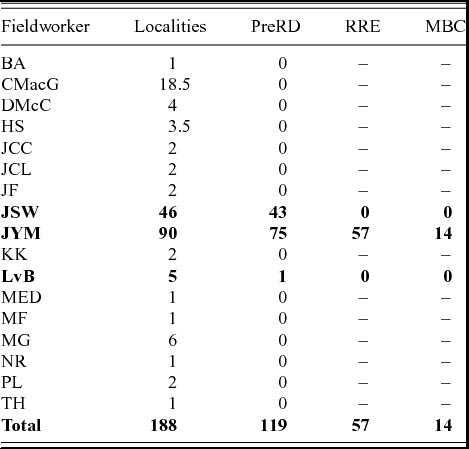
The LSS employed seventeen fieldworkers for the collection of the phonetic data for LAS3 (see table 1 and LAS3, pp. 397–8). The number of locations surveyed by these fieldworkers varies dramatically, from only one (BA, MED, MF, NR, TH) to ninety (JYM). In fact, three fieldworkers were responsible for 82 per cent of the fieldwork (and indeed JSW and JYM were by far the major contributors of these three), and none of the others contributed more than 3 per cent of the total. Not surprisingly, there are differences in transcription practices among the various fieldworkers, potentially leading to ‘fieldworker isoglosses’ (Trudgill Reference Trudgill1983: 38–41), a situation where differences in phonetic transcriptions between locations are not the result of actual distinctions between the dialects but are instead the product of different transcription practices by the people recording the data. For example, different fieldworkers might use broader or narrower phonetic transcriptions, they might have different appreciations of particular sounds, they might use different symbols for the same sounds, or they might include or ignore particular phonetic features.
Fieldworkers on the LSS
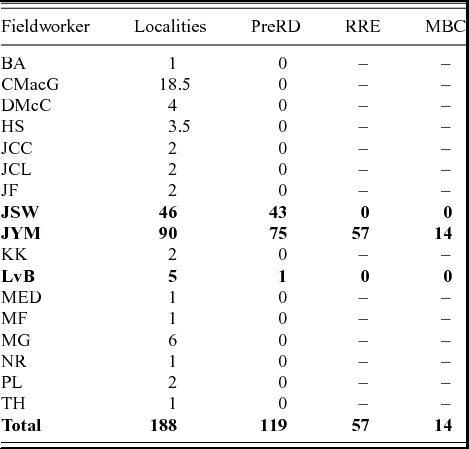
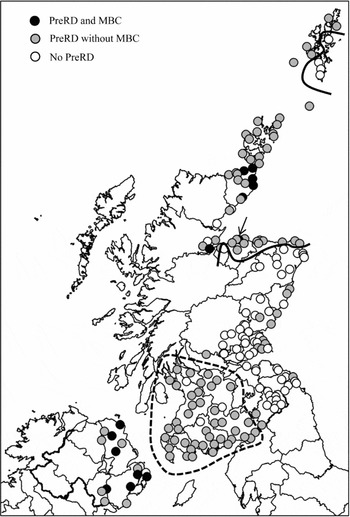
The extent to which fieldworker isoglosses exist in the LSS data (published and unpublished) remains to be assessed in detail, and this is complicated by the small amount of data contributed by most of the fieldworkers. However, table 1 reveals that for the feature under consideration in this article, PreRD, there appears to be a strong fieldworker effect. Table 1 shows that of the seventeen LAS3 fieldworkers, only three (JSW, JYM and LvB) recorded PreRD in their transcriptions, with JSW recording it at almost all locations and LvB recording it at only one location. Whilst the failure of any one of the other fieldworkers to record PreRD is not remarkable given the small number of locations they surveyed and the fact that the feature is not present across all of Lowland Scotland, the complete absence of the feature in the transcriptions of most fieldworkers, despite the fact that they transcribed data from locations across the survey area, suggests that this pattern is not accidental. That is, the evidence suggests that many of the LAS3 fieldworkers did not record PreRD even where it may have been present. Two obvious examples of this are provided by the transcriptions for locations in Shetland and by those in northeast Scotland. In Shetland, JYM's transcriptions (six locations) always indicate presence of PreRD, whilst LvB's transcriptions (four locations) never do (see figure 1). In northeast Scotland (Banffshire, Aberdeenshire), there is a sharp isogloss between points 8.1-8.5, 9.1-9.2, which were surveyed by JYM and have PreRD, and points 8.6, 9.3-9.12, which were surveyed by other fieldworkers and were not recorded with PreRD (again see figure 1). Thus our evidence for PreRD in Scotland comes from essentially two fieldworkers, albeit the two who provided the vast majority of the LAS3 data. There are also differences between the transcription practices of JSW and JYM which must be borne in mind when assessing the evidence they provide for PreRD. JSW transcribed very broadly, almost phonemically, giving relatively little phonetic detail and indicating very little phonetic variation within a locality (so that, for example, when a feature such as PreRD was recorded, it was usually recorded consistently in every environment where it could occur). As will be seen in the analysis in this article, JSW did not record either the MBC or the RRE. JYM, on the other hand, produced highly detailed phonetic transcriptions, with multiple diacritics on vowels and consonants and a great deal of variation within phonemes, so that when he recorded features such as PreRD his transcriptions show much more variation in the degree to which they were present than JSW's transcriptions. Unlike JSW, JYM did record evidence for the MBC and RRE in Scots dialects. The differences between these two fieldworkers are further complicated by the fact that the geographical areas they surveyed did not overlap. JSW surveyed locations in southwest Scotland exclusively (see figure 1), whilst JYM surveyed a range of locations in northern, eastern and southeastern Scotland and in east Ulster. As such, it is not always clear whether the differences between their transcriptions are due to differing transcription practices or to geographical variation.
3.1 PreRD in the LSS materials
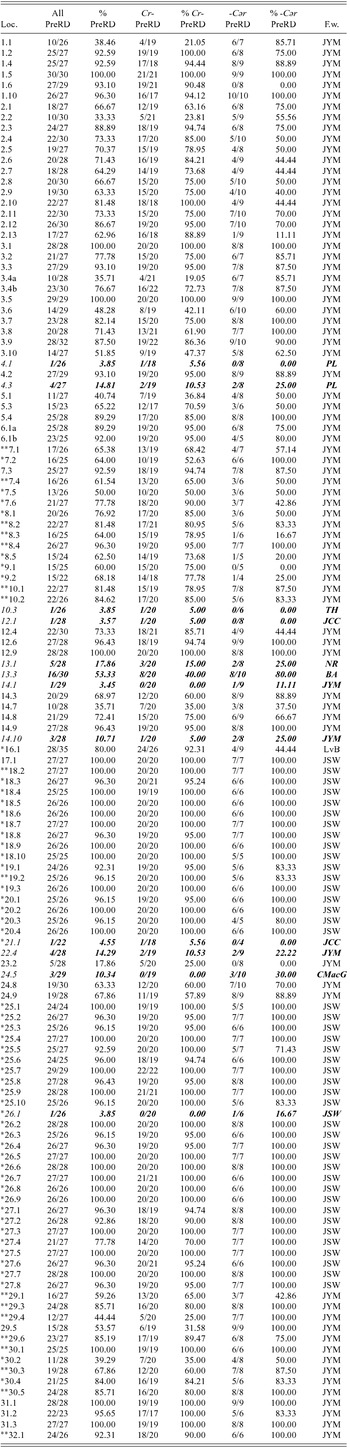
For my analysis of PreRD in the unpublished LSS data, the pronunciations of /t/, /d/ and /n/ in all words where PreRD is possible in the extended wordlist were determined.Footnote 4 Of the 188 locations surveyed by the LSS, 131 appear to show some evidence of PreRD (i.e. they are recorded with some degree of dentalisation of /t/ and /d/ before /r/ and /ər/) – see table 2.
Levels of PreRD overall and by environment in the LSS a

aLoc. = location; All PreRD = overall rates of PreRD in the variety; Cr- PreRD = rates of PreRD in tr- and dr- clusters; -Cər PreRD = rates of PreRD in -tər and -dər sequences; F.w. = fieldworker; * = /n/ for /nd/ in wander and wonder but no dentalisation of /n/; ** = /n/ for /nd/ in wander and wonder with dentalisation of /n/.
However, not all of these locations can be considered to have PreRD owing to the occurrence, in some varieties of Scots, of dental pronunciations of the coronal consonants generally (see Johnston Reference Johnston and Jones1997b: 505). Where dental pronunciation of /t/ and /d/ generally has been recorded, or in locations where PreRD was only recorded in a very small number of tokens (so that we can't be sure that they aren't just isolated cases of general dentalisation that just happen to occur in PreRD environments), the level of dentalisation in PreRD environments has been compared with the level of dentalisation of /t/ and /d/ in initial and intervocalic position generally in the LSS wordlist.Footnote 5 When this is done, PreRD is not significant for twelve locations (marked in italics and bold in table 2),Footnote 6 leaving us with 119 locations which have significant (and indeed highly significant) levels of PreRD (83 per cent on average). In other words, PreRD is a consistent feature of many of the dialects recorded by the LSS in the 1950s, as figure 1 makes abundantly clear.
PreRD is particularly prominent in northern Scotland, including Shetland and Orkney, in southwest Scotland, and in Ulster, though this pattern may reflect the differing transcription practices of the fieldworkers as much as anything. As was discussed in section 3, it is noticeable that PreRD was only recorded by three of the seventeen LSS fieldworkers, LvB, JSW and JYM, and that LvB only recorded it in one location. Indeed, JSW and JYM recorded PreRD at significantly different levels (97.5 and 74.5 per cent respectively).Footnote 7 It is also possible that PreRD was present in other parts of Scotland but that the other fieldworkers did not record it, given the scatter of locations surveyed by JYM in eastern Scotland with PreRD and the sharp fieldworker isoglosses in northern Scotland between locations with PreRD surveyed by JYM and those without PreRD surveyed by other fieldworkers.
PreRD is recorded for both /t/ and /d/ but only rarely for /n/ (in the words wander and wonder when the /d/ is deleted, e.g. [wʌ
ər]).Footnote
8
In the LSS, the only recorded PreRD realisations are [
], [
] and [
] (cf. the situation in English dialects described by Maguire Reference Maguire2012a: 371). Although Maguire (Reference Maguire2012a) found a significant difference between the levels of PreRD in Cr- and -Cər sequences in English dialects as recorded in the SED, no such difference exists overall in the LSS data.
3.2 -dər lenition
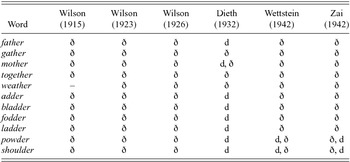
Maguire (Reference Maguire2012a) discussed the relationship between PreRD and ‘-dər lenition’ in English, two phenomena which were probably historically the same but which have diverged from each other over recent centuries. Although PreRD dentalisation may result in dentalisation not only of /t/ but also of /d/ before /ər/, in most Ulster and northern English dialects the sequence /dər/ usually occurs when it is preceded by /l/ or /n/, since an early change (dated to around 1400 by Luick Reference Luick1964: 1010–12; Dobson Reference Dobson1957: 956) led to the lenition of /d/ to /ð/ before /ər/ otherwise. Thus, in addition to words such as father, gather, mother, together and weather which originally had Old English /d/ but which now have /ð/ in almost all varieties of English (including RP), we get /ð/ in words such as adder, bladder, fodder, ladder and powder, which had Old English /d(d)/ or French /d/. This -dər lenition is much more widespread than PreRD in English, but the identical conditioning and the similar change to a dental consonant suggest that it started off as part of PreRD (which thus has a long history in English), but diverged from it as a result of the phonemic split between /d/ and /ð/ (see Maguire Reference Maguire2012a for further discussion). Given that PreRD is present in Scotland, we would expect that -dər lenition is also a feature of Scots dialects. Although the LSS wordlist contains the words father and mother (and most dialects have /ð/ in them), it does not contain any of the words which have -dər lenition in English dialects but which have /d/ in RP (e.g. fodder, ladder), so it is not possible to tell whether -dər lenition in its wider sense applied. However, other sources for Scots dialects reveal that -dər lenition did apply in Scots dialects, in both the set of words in which it does in RP and the set of words in which it does not (see table 3). Wilson (Reference Wilson1915, Reference Wilson1923, Reference Wilson1926) records [ð] in Perthshire, Ayrshire and Fife and the Lothians, whilst Wettstein and Zai record [ð] in Berwickshire and Roxburghshire. At first glance Dieth (Reference Dieth1932) appears to record a system similar to RP in the northeast Buchan dialect, but the presence of /d/ in words such as brother, bother, rather and wether, all of which had [ð] in Old English, points to a merger of /ð/ and /d/ in this environment in this dialect too at some stage in the past (see Dieth Reference Dieth1932: 109–11 and Johnston Reference Johnston and Jones1997a: 102, Reference Johnston and Jones1997b: 506; see also the discussion in section 4 of this article).
-dər lenition in Scots dialects

The presence of thoroughgoing -dər lenition across Scots dialects implies that if -dər lenition and PreRD were once the same phenomenon, then PreRD was also once found across (lowland) Scotland. I return to the importance of this issue in section 4.
3.3 The Morpheme Boundary Constraint in the LSS materials
No published source mentions the existence of the MBC in Scots or Scottish English varieties in Scotland. Although the published wordlist in LAS3 does not contain any bimorphemic words, the extended unpublished LSS wordlist includes two bimorphemic words (beater, fatter), as well as the morphologically opaque better (‘more good’). The unpublished data therefore provides us with an (admittedly somewhat limited) opportunity to assess the extent to which the MBC is present in locations with PreRD. It turns out on examination of these data that there is some evidence for the MBC in Scots dialects, though only in the transcriptions of one of the fieldworkers, JYM, who sometimes provides extra data bearing on the issue for some of the locations he surveyed in the form of additional phonetic transcriptions of related words such as better ‘one who bets’.
If the degree of PreRD in /tər/ sequences in monomorphemic words (including better ‘more good’) and bimorphemic words (including the extra ones provided by JYM) in the extended wordlist is compared for all locations with PreRD, the MBC is found (using Fisher's Exact Test, p ≤ 0.05) to be present in a cluster of locations in Caithness, one location in Ross and Cromarty, one location in Moray and, not surprisingly, in many locations in Ulster (see figure 1). The low number of tokens means that we cannot put too much weight on the evidence from any single location, but the geographical and linguistic coherence of the pattern strongly suggest that the MBC was a feature of some Scots (and Ulster English) dialects in the 1950s, albeit one which was only recognised by a single fieldworker. Whether the geographical limits of the MBC in Scots dialects are the result of different fieldworker transcription practices (section 3), or are a genuine geographical effect remains unknown. The data from location 7.2 (Hopeman, Moray, indicated by an arrow in figure 1) in table 4 illustrate the pattern.
Evidence for the MBC in Hopeman, Moray (LAS3 location 7.2)

A much more robust result is obtained by comparing the levels of dentalisation in monomorphemic and bimorphemic words across all of the locations with PreRD surveyed by JYM. Just including Scottish locations (the presence of the MBC being uncontroversial in Ulster dialects), the figures are: 265 tokens with dental pronunciations vs 128 with alveolar pronunciation in monomorphemic words, and 53 dental pronunciations vs 82 alveolar pronunciations in bimorphemic words. This is a highly significant difference (χ² (1) = 33.3, p < 0.0001). In other words, there is incontrovertible evidence for the MBC in the Scots dialects surveyed in the LSS by JYM, even if the small number of tokens at any one location makes it difficult to be sure exactly where the MBC applies.
3.4 The R-Realisation Effect in the LSS materials
Johnston (Reference Johnston and Jones1997b: 510) states that ‘Traditionally, Scots had either a tap [ɾ] or a true trill [r] . . . in all positions’, and that although [r] has declined considerably and is as much a stereotype of Scots as anything else, ‘a tap in all positions is usual among older speakers everywhere, especially in rural Scots’ (pp. 510–11). Older sources for Scots dialects support Johnston's statement, with those from the late nineteenth and early twentieth centuries describing Scots /r/ as a trill in all positions, and with those from later in the twentieth century giving a tap as a common pronunciation of /r/.Footnote 9
In addition to Scottish Standard English [ɹ], Johnston (Reference Johnston and Jones1997b: 511) notes that in peripheral dialects subject to Celtic influence (i.e. those along the Highland Line, North Northern dialects and those in Ulster) retroflex [ɻ] is a common realisation of /r/, and that this pronunciation varies with [ɾ] in Insular Scots ([ɻ] occurring in coda position). Pharyngeal and vocalised /r/, now frequent in Urban Scottish varieties (Stuart-Smith Reference Stuart-Smith, Corbet, McClure and Stuart-Smith2003), is described by Johnston (Reference Johnston and Jones1997b: 511) as a relatively recent development.
All this being the case, we might wonder how there could be an RRE in Scots dialects (though descriptions of the pronunciation of /r/ do not exist for most traditional varieties). LAS3 is silent on the issue, except in cases where the pronunciation of /r/ is uvular (Northumberland and sporadically in Scotland). The fieldworkers’ notebooks on which LAS3 is based do however contain much information on the pronunciation of /r/ in Scots dialects, though the data is not unproblematic for a variety of reasons. Firstly, there are clear differences in transcription practice between the fieldworkers, with some using the symbol [r] throughout, perhaps as a cover symbol for some kind of rhotic rather than to strictly denote an alveolar trill, whilst others give more phonetic detail. JSW, for example, typically gives [ɾ] in initial clusters (as in green), but [r] elsewhere, though it is not always clear what this [r] stands for (in some cases it appears, from his notes, to be a cover symbol for the trill or for approximant and fricative realistions). JYM, on the other hand, gives a profusion of phonetic symbols for /r/ (e.g. [ɹ], [ɻ], [ɽ], [
 ], [
 ], [r], [ɾ], [
 ]), the meaning of which is not always entirely clear (and it seems likely that [r] is sometimes used as a neutral cover symbol by JYM too). Given JSW's transcription practices with respect to /r/, it is not surprising that he does not record an RRE in the dialects he surveyed (i.e. those of southwest Scotland). Whether this means that the RRE was not present in these dialects or whether JSW just failed to record it is unknown, but it is noteworthy that the pattern he identifies is the same as described by Shuken for Highland and Hebridean English (see section 2). In the single location where LvB records PreRD, there is also no RRE in the data. This means that further analysis of the RRE applies only to those locations with PreRD surveyed by JYM.
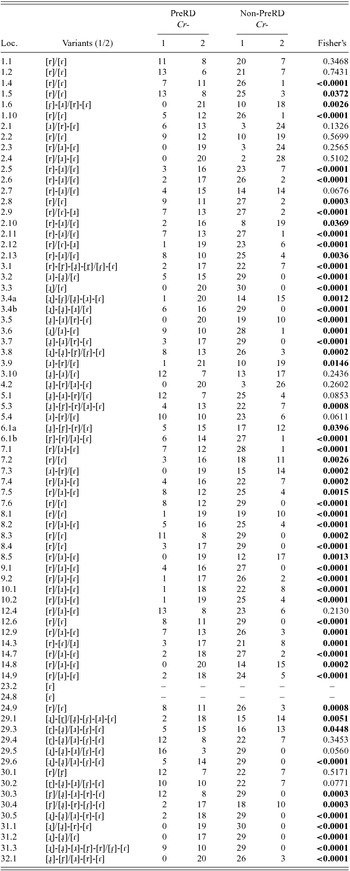
Of the 75 locations where JYM records PreRD, 57 have some kind of RRE. If /r/ in PreRD Cr- (/tr/, /dr/, /str/) clusters is compared with /r/ other Cr- clusters (e.g. /br/, /kr/),Footnote
10
there is often a clear (if not absolute) distinction in the range of phonetic variants which occurs in each environment.Footnote
11
Typically, [ɾ] (occasionally [
]) is preferred in PreRD environments, whilst [r] (whether that is an alveolar trill or a cover symbol) and (presumably) approximant variants such as [
] and [ɻ] are preferred in non-PreRD environments, though there is a fair bit of variation in what variants occur at each location and which of these are preferred in the two environments. In order to determine whether an RRE occurred at each location, /r/ variants were grouped to maximise the differences between PreRD and non-PreRD environments, and the significance or otherwise of these differences were tested using Fisher's Exact Test, with a probability of 0.05 or less being taken as evidence of the RRE (see table 5, significant results in bold). Thus, for example, location 1.4 is recorded with two /r/ variants in Cr- clusters, [r] and [ɾ]. In PreRD Cr- clusters, [r] occurs 7 times and [ɾ] 11 times, whilst in non-PreRD Cr- clusters [r] occurs 26 times and [ɾ] just once. This very skewed distribution of variants is highly unlikely to occur by chance and is indicative of a very strong RRE in the dialect (probability of occurrence by chance being less than 1 in 10,000). A more complex but equally clear case is provided by location 3.1, where the variants [r], [
], [
] and [
r
] occur twice in PreRD Cr- clusters but 22 times in non-PreRD Cr- clusters, whilst [
] and [ɾ] occur 17 times in PreRD clusters and only 7 times in non-PreRD clusters (again a highly unlikely pattern to occur by chance).
The R-Realisation Effect in locations surveyed by JYM

In other words, there is substantial evidence for the RRE in the dialects recorded in the LSS, albeit only in the transcriptions provided by one of the fieldworkers, who mostly surveyed dialects in Ulster and northern Scotland. Whether additional evidence for the RRE across a wider geographical area would have been provided had JYM surveyed other areas unfortunately remains unknown.
4. Discussion
The evidence from the Linguistic Survey of Scotland fieldworkers’ notebooks suggests that PreRD was a common and robust feature of mid-twentieth-century Scots dialects, from Shetland in the north to Berwickshire in the southeast and Wigtonshire in the southwest (and of course in the Scots and Mid-Ulster English dialects in east Ulster). Although the feature appears to be largely absent from eastern Scotland, it was, nevertheless, recorded throughout the country. The extent to which PreRD is still a feature of Scottish varieties today remains unknown, though I have heard it occasionally in recent years, including in the speech of a female student from the Central Belt and a prominent Scots scholar from Ayrshire, suggesting that it does still exist to some degree north of the Border if not south of it (Maguire Reference Maguire2012a).
There is a major issue with the LSS evidence for PreRD however. There are sometimes striking differences between the transcription practices of the seventeen fieldworkers, with only three of them (LvB, JSW and JYM) recording PreRD at all (and LvB only does so at one location). And although JSW and JYM, the two main fieldworkers on the LSS, both recorded PreRD at high levels in different parts of the survey area, they did so in rather different ways, with JYM recording a fair degree of variation in the prevalence of the feature along with evidence for the MBC and the RRE, whilst JSW recorded PreRD at levels of nearly 100 per cent in most locations but did not indicate the presence of the MBC or RRE. It is very likely that some of these differences represent ‘fieldworker isoglosses’ (Trudgill Reference Trudgill1983: 38–41) rather than genuine dialect differences and, as such, they constitute a weakness in the LSS record of mid-twentieth-century Scots dialects. But it seems unlikely that either JSW or JYM were entirely wrong in their interpretation of this aspect of Scots phonology, even if they may have missed or misinterpreted some details (e.g. it might be the case that JSW failed to record the MBC given the very small number of words in the wordlist with a Class 2 morpheme boundary, though see the discussion below). It is noteworthy that in southern Scotland the geographical distribution of PreRD recorded by JSW closely agrees with that recorded by JYM (see figure 1, with PreRD on either side of the dotted line), and it also matches the geographical distribution of the feature in northern England (as revealed in Ellis Reference Ellis1889: V and the SED). In southern Scotland, there is an east–west split, with PreRD a consistent feature of dialects in west Roxburghshire (as recorded by JYM) and Dumfriesshire (as recorded by JSW), but it is almost entirely absent from east Roxburghshire and Berwickshire (mostly surveyed by JYM). This is exactly parallel to the east–west split south of the Scottish–English border, with PreRD predominating in Cumberland and southwest Northumberland but being absent in the rest of Northumberland (see figures 1 and 3 in Maguire Reference Maguire2012a). This geographical consistency reveals not only a striking case of cross-border linguistic continuity (see Maguire Reference Maguire and Hickey2015), but also suggests that JSW and JYM were faithfully recording the status of PreRD in the dialects they surveyed.
In general terms, PreRD in Scotland is the same as it is in Ireland and northern England. /t/ and /d/ (but rarely /n/) are pronounced as dental [
] and [
] immediately before /r/ or /ər/. And although the MBC is only recorded in the LSS in a small number of locations in northern Scotland (as well as in Ulster) by a single fieldworker, this aspect of PreRD takes the same form as it does in Ireland and northern England: PreRD is blocked by Class 2 morpheme boundaries. Furthermore, the RRE is present in many of the dialects with PreRD (albeit only in those transcribed by JYM), and its form is similar to the RRE in Irish English and northern English dialects: /r/ is typically realised as a tap immediately after dentalised /t/ and /d/ and is typically realised as something else in other environments.
In other words, PreRD is essentially the same phenomenon in the Scots dialects recorded in the LSS as it is in Ireland and in northern England, and it must have a common origin. The alternative, that PreRD arose independently in these different areas, is extremely unlikely. The widespread occurrence of the RRE, involving tapped realisations of /r/ in PreRD environments, from northern Scotland to southern Ireland to southern Lancashire, suggests that this feature was once characteristic of the whole PreRD area and that it has been lost in some areas (again assuming that its absence in some of the LSS localities is not just the result of differing transcription practices). The absence of the MBC in many Scots dialects, assuming that this is not just an artefact of fieldworker transcription practices, may also conceivably be the result of its loss, given the presence of the MBC in dialects across Ireland, in northern England and in northern Scotland (note that the MBC was often not present in individual northern English dialects recorded in the SED). However, caution is necessary here, since PreRD is a stem level phonological process (as indicated by its failure to apply across Class 2 morpheme boundaries). As Bermúdez-Otero (Reference Bermúdez-Otero and de Lacy2007: 7–8) explains in his discussion of the life cycle of phonological processes, we expect phonological features to begin their lives as exceptionless phonetic rules which are not constrained by morphological structure. In the case of PreRD, this would mean that the pattern should first have developed without any morpheme boundary effects (i.e. dentalisation in better ‘more good’ and better ‘one who bets’). Given a modular feed-forward architecture of phonology (Bermúdez-Otero Reference Bermúdez-Otero and de Lacy2007: 5–6), as PreRD and the MBC demand, we would expect that over time the process of dentalisation would become sensitive to morphological structure, such that effects like the MBC would develop (Bermúdez-Otero's Phase III). In other words, dialects with PreRD but no MBC (i.e. with PreRD operating across Class 2 morpheme boundaries) may in fact represent an earlier stage in the phonologisation of this feature rather than a later breakdown of its complexity. In addition, the independent development of the MBC in geographical widespread dialects is to be expected given the modular architecture of phonology common to all dialects of English and Scots. The fact that the MBC may have arisen independently in northern English, northern Scots and Ulster dialects (it being absent in a variety of northern English and most Scots dialects) is a good demonstration of the life cycle of phonological processes as described by Bermúdez-Otero (Reference Bermúdez-Otero and de Lacy2007),Footnote 12 and would, indeed, explain the very limited distribution of the MBC in Scotland (rather than us needing to assume widespread loss or unrecording). Although loss of the MBC in various dialects (e.g. as a result of levelling of traditional dialects in contact with more standard varieties of the language) cannot be ruled out entirely, and the extent to which the MBC has been under-recorded is unknown, it is most parsimonious to assume that it has developed in different dialects as a natural consequence of the phonological architecture of English and Scots. The alternative, that some dialects have lost the MBC whilst retaining PreRD, would constitute an instance of domain broadening. Since the life cycle of phonological processes is considered to be essentially unidirectional, domain-broadening is rare and is only found ‘in circumstances that favour higher rates of replication error than intergenerational transmission within a speech community: a notable case is the propagation of dialect features across communal groups through contact between adult speakers’ (Bermúdez-Otero Reference Bermúdez-Otero, Honeybone and Salmons2015: 386; see also Bermúdez-Otero & Trousdale Reference Bermúdez-Otero, Trousdale, Nevalainen and Traugott2012: 704–5). This being the case, an explanation of the patchy distribution of the MBC which follows from the known architecture of the phonology of English and Scots is to be preferred over one which goes against it, and, consequently, the time depth of the MBC in any dialect must remain unknown.
The widespread occurrence of PreRD in Scotland, especially its presence in Shetland and Orkney, where Scots was introduced in the fifteenth century (Millar Reference Millar2007), suggests that the feature is of considerable antiquity in Scots, as it also appears to be in English (Maguire Reference Maguire2012a). Indeed, the presence of -dər lenition in all Scots dialects (merger of [ð] and [
] in some northern Scots dialects notwithstanding, as discussed in section 3.2) may mean that the feature has a history in Scotland extending back to at least the early fifteenth century. That -dər lenition is this old in Scots is confirmed by evidence from the corpus of Older Scots texts compiled for the Linguistic Atlas of Older Scots (LAOS;Footnote
13
see also the brief discussion in Johnston Reference Johnston and Jones1997a: 102). The earliest evidence of -dər lenition in LAOS is the form fayer ‘father’ from 1395 (<y> being a development of <þ>), mothir ‘mothir’ from 1429, to-gither ‘together’ from 1431, and fathir ‘father’ from 1433. Although -d- and -dd- spelling are most common for these and similar words in the LAOS fifteenth-century texts, the fact that words with historical [ð] (e.g. brother, other) are also sometimes spelt with -d- and -dd- suggests either that the litterae -d- and -dd- could be used to represent both /d/ and /ð/, or that there was, like the situation in the Buchan dialect in the twentieth century, a merger (to an extent at least) of /d/ and /ð/ before /ər/ (as Johnston Reference Johnston and Jones1997a suggests). In the first case, Older Scots fifteenth-century -d- and -dd- spellings may well hide [ð] pronunciations; in the second case, we have evidence for dentalisation (and perhaps lenition) of /d/ before /ər/ in fifteenth-century Scots.
The widespread presence (and inferred antiquity) of PreRD in Scotland and the existence of the MBC and RRE in a range of Scots dialects tell us a considerable amount about varieties of English and Scots in Britain and Ireland and highlights the importance of the LSS data for understanding their phonological history. The presence of PreRD, in all its complexity, in both English (from at least the north Midlands northwards) and Scots dialects (from the extreme southwest to the far north), combined with the presence of -dər lenition in these dialects (and indeed in most dialects of English) suggests that the feature is at least as old as the period (up until the fifteenth century) in which Older Scots and (northern) Middle English formed ‘a common speech area’ (Williamson Reference Williamson, Fanego, Méndez-Naya and Seoane2002: 253). It seems likely, then, that PreRD was a feature of Middle English, perhaps even Early Middle English. Similarly, the presence of the RRE in dialects as far apart as Caithness, Tyrone and Lancashire suggests that this too is of considerable antiquity in English and Scots. Given what was said in section 3.4, that in our earliest phonetic records Scots /r/ was pronounced as a trill [r] in all positions, the existence of the RRE in the LSS data (albeit only in JYM's transcriptions) is somewhat surprising. Since the RRE in these Scots dialects is similar to the RRE in northern English and Irish English dialects, it is reasonable to assume that RRE in Scots and in English have the same origin. But if this is the case, Scots must have maintained a distinction, which has gone unreported, between these different allophones of /r/ for centuries (even if this distinction was lost in some dialects), and that reports of trilled [r] in all positions are either in error or apply only to certain Scots dialects. From a phonological perspective, the existence of the MBC and its patchy distribution (assuming that this is not a consequence of its loss) provide excellent evidence for the modular feedforward architecture of English and Scots phonology, and of the life cycle of sound changes which such a model predicts.
Finally, the widespread (and apparently long-term) existence of PreRD and the RRE in Scots dialects in the mid twentieth century has important consequences for the origins of these features in Irish English varieties. Firstly, the presence of these features in Scots as well as English dialects requires their history to be extended right back to the Middle English period. It is quite possible, as argued in Maguire (Reference Maguire2012a), that given this time depth PreRD was present throughout much of England in earlier times (especially if the evidence of -dər lenition is considered). This being the case, PreRD (and the RRE) was a feature of many of the English input varieties to Ireland in the sixteenth and seventeenth centuries, making its continued presence in Ireland unremarkable. Secondly, the presence of PreRD in Scots dialects helps to explain the presence of these features in northern Irish English varieties for which Scots dialects were a major input variety in the seventeenth century (Corrigan Reference Corrigan2010: 109–21). For example, Mid-Ulster English as spoken in places like Tyrone developed as a result of contact between Scots, English and Irish after the plantations of Ulster. With PreRD present in both English and Scots dialects, explaining the presence of PreRD and the RRE in the newly developed Mid-Ulster English dialects becomes straightforward: these features would have been present in the majority of the input varieties and would thus have inevitably survived the process of new dialect formation (see Trudgill Reference Trudgill2004: 113–15). Furthermore, the majority input ensured that these rather marked and complex interacting features were not simplified (Trudgill Reference Trudgill2004: 85–6). Thirdly, the presence of PreRD in Scots dialects, many of which show little or no evidence of influence from Scottish Gaelic (see Macafee & Ó Baoill Reference Macafee, Ó Baoill and Tristram1997) and which are situated far from the Highland Line, suggests, even if other evidence did not, that PreRD does not originate as a contact feature of Gaelic origin. The absence of a strictly similar feature in Gaelic varieties, the presence of PreRD in Scots dialects in places like the Scottish Borders, and the presence of PreRD (in a very similar form) throughout most of northern England essentially rule out any role for Gaelic languages in the development of the feature. If this is true of English and Scots varieties in Britain, it may also be true of English and Scots varieties in Ireland, which have PreRD as a result of their British ancestry, not as a result of Irish influence (see further Maguire Reference Maguire2012a: 378).
5 Conclusion
Despite substantial documentation of Scots dialects and historical varieties, and a scattering of references to the presence (or absence) of PreRD in Scotland, no detailed evidence for the feature, or any for the MBC or the RRE, has been published. But thanks to the work of the Linguistic Survey of Scotland, a unique record of these and many other phonetic and phonological features of Scots dialects has been made. Although there are problems with the LSS data and their interpretation (not least the issue of differing fieldworker transcription practices), the survey provides strong evidence for the existence of PreRD, the RRE and the MBC across much of Scotland in the mid twentieth century.Footnote 14 In so doing, it not only offers us an insight into the phonological history of Scots, but also helps us to understand the history of these features in English and their origins in Irish English, and provides additional evidence for the phonological architecture of the language. PreRD has a long history in Britain, stretching back at least until the Older Scots/Middle English period (as evidenced by its geographical distribution, its existence in Shetland and Orkney, and its likely identity in the past with -dər lenition). The presence of the RRE in many Scots dialects indicates that the pronunciation of /r/ in Scots in the past was more complicated than it being a trill [r] in all positions, and that the opposition between a tap in PreRD environments and a trill or some other kind of /r/ in non-PreRD environments was maintained for centuries.
The presence of PreRD in Scotland also helps us to understand how the feature came to be so characteristic of varieties of Irish English. The geographical extension and consequent time depth of these features means that they were undoubtedly present in English and Scots input varieties when Irish English was being formed. Indeed, the existence of PreRD in many Scots and English dialects meant that in the formation of Ulster Englishes in particular its retention was all but inevitable, with the consequence that Gaelic influence (in Scotland or Ireland) is hardly needed to explain its presence (not that an obvious analogue to PreRD is a feature of Gaelic varieties in any case). The fact that PreRD is now much more prominent in Ireland than it is in Britain is a consequence of its decline and disappearance in England, not a consequence of language contact in Ireland. The extent to which PreRD, the MBC and the RRE still survive in Scotland remains to be seen.