Introduction
Maxillofacial gunshot wounds have been described in peacetime (related to suicide, homicide, or accidental situations)Reference Makhlouf, Scolan, Ferretti, Stahl and Paysant 1 and during wars,Reference Dobson, Newell and Shepherd 2 but currently they are reported rarely. The injury severity varies according to the caliber of the weapon and the distance from which the patient was shot. Facial gunshot injuries cause devastating functional and aesthetic consequences for victims.Reference Hollier, Grantcharova and Kattash 3 The two first vital complications are heavy bleeding and airway compromise. Initial emergency management should focus upon control or prevention of these vital complications. As with all gunshot wound trauma victims, the initial field exam has to be extended to other regions of the body to determine the trajectory of the bullet and detect injury to other organs. This case has been reported on a victim of four gunshots, one of which struck the face with the bullet lodging itself in the C4 vertebrae.
Report
A 28-year-old male was wounded by four bullets and treated by a prehospital medical team. The initial exam revealed a wound in the left calf and a through-and-through wound of the left shoulder; no fracture and no hemorrhage was noted. Another right peri-areolar wound had only an entrance wound without observed hemorrhagic or respiratory compromise. No exit was found for the peri-areolar wound. A left malar entrance wound was observed and was associated with a bulky hematoma but without external hemorrhage in the throat or epistaxis. No exit wound was visualized. The victim had no obvious focal neurologic deficit and was able to move each limb, but he was limited by pain due to peripheral injuries. Pulmonary auscultation was audible minimally on the right side, but no respiratory distress was noted. The abdominal exam was normal. The Glasgow Coma Score (GCS) was 15, heart rate was 60 beats/min, blood pressure was 110/40 mmHg, and ambient oxygen saturation was 95%.
He was immobilized by a rigid cervical collar and a backboard. Oxygen was administrated by high-concentration facial mask at 9 L/min. Initial treatment consisted of peripheral intravenous infusions of saline 0.09% and hydroxyethyl starch, 1 mg of atropine was injected to treat a vagal bradycardia, and he received 25 mg of Ketamine associated with 8 mg of Morphine to treat pain, as well as prophylactic antibiotics (amoxicillin-clavulanic acid).
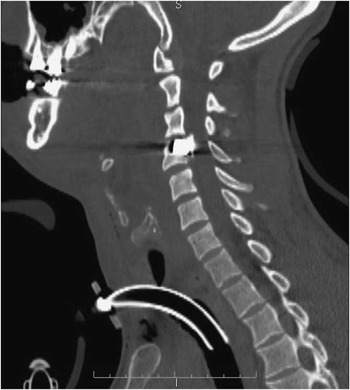
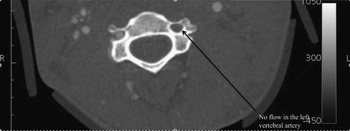
He was evacuated quickly by medical ambulance to the intensive care unit of a receiving hospital. An orotracheal intubation augmented with an Eichmann gum elastic bougee was performed to prevent airway compression by hematoma. Focused Assessment with Sonography for Traumas sonography highlighted a right pneumothorax which was not treated initially as no oxygen desaturation had occurred. A CT-scan detected a comminuted fracture of the left mandibular ramus with active bleeding at its internal side. The bullet was seen across the fourth cervical vertebra on the left part with recoil of the posterior corpus wall (Figure 1). No circulation was visualized in the left vertebral artery, probably due to segmentary compression (Figure 2). One costal fracture with right moderate hemopneumothorax and pulmonary contusion was confirmed. His Injury Severity Score (ISS) was 29.
Bullet Seen Across the Fourth Cervical Vertebra on the Left Part with Recoil of the Posterior Corpus Wall.

No Circulation Visualized in the Left Vertebral Artery, Probably Due to Segmentary Compression.

The victim underwent a surgical tracheotomy and mandibular, shoulder and calf debridement, and a right chest tube. With lightening of sedation, a Brown-Sequard syndrome was observed with left peripheral facial paralysis and swallowing difficulties attributable to blast consequences. An osteosynthesis of the mandibule was made seven days later. He left the intensive care unit at day 14 for rehabilitation. Police investigation concluded at an attempted homicide.
Discussion
Studies of firearm injuries in non-war settings have found that approximately one-half are the result of suicide, 44% of assault, four percent due to legal intervention, and three percent are deemed accidental or undetermined. The head and the neck are the most frequently impacted areas (31.3% of the cases). The face was injured in 3.3% of the cases and the neck in 3.6%.Reference Makhlouf, Scolan, Ferretti, Stahl and Paysant 1 , Reference Papadopoulos, Kanakaris and Danias 4 In wartime, maxillofacial injuries were found in 6.4% of the cases.Reference Levin, Zadik, Peleg, Bigman, Givon and Lin 5 As with the victim described in this report, maxillofacial gunshot injuries frequently affect men (85% to 100%) and young people (17-58 years old) with a mean age of 30 years.Reference Papadopoulos, Kanakaris and Danias 4 - Reference Glapa, Kourie, Doll and Degiannis 6
The significance of the case described is the secondary spinal lesion. A published review of 12 suicide attempts by facial gunshots failed to find any spinal injury.Reference Alper, Totem, Cankayali and Songür 7 Kihtir et al studied the association of cervical injuries with gunshots to the face on 54 patients. They divided the face into three zones. Spinal fractures were noted in 10% of maxillary injury and in 20% of orbital injuries. None were noted for mandibular injuries (lower face).Reference Kihtir, Ivatury, Simon, Nassoura and Leban 8 , Reference Bono and Heary 9 Most of the time, associated spinal injuries are not life threatening.Reference Bono and Heary 9 A study has shown that firearm fatalities concerning the face had a mean ISS of 30, and those concerning the neck had an ISS of 39.Reference Papadopoulos, Kanakaris and Danias 4 The mortality rate of maxillofacial injuries varies from 2.8% to 11.0% shortly after arrival at the hospital.Reference Hollier, Grantcharova and Kattash 3 , Reference Levin, Zadik, Peleg, Bigman, Givon and Lin 5 Firearm injuries to the face have a low mortality rate, provided that the airway is kept patent and hemorrhage is controlled.Reference Glapa, Kourie, Doll and Degiannis 6
When facial injuries are evident, the mouth and pharynx should be examined for oral and facial bleeding. Foreign bodies must be removed carefully. The first urgent action is to verify or to ensure airway patency. Only 1.6% of facial traumas have been reported to have airway compromise.Reference Tung, Tseng, Chen, Lai and Chen 10 Airway obstruction frequently is caused by tongue base or maxillary prolapse, pharyngeal edema, or hematoma and severe hemorrhage. Half of the patients with gunshot injuries to the face undergo orotracheal intubation on scene or in the resuscitation room. Twenty-one percent to 56% of those wounded in the lower one-third of the face require tracheostomy on, or shortly after, hospital arrival.Reference Hollier, Grantcharova and Kattash 3 , Reference Glapa, Kourie, Doll and Degiannis 6 The severity of Le Fort fractures correlated with an increased need for intubation.Reference Ng, Saadat and Sinha 11 Because the risk of difficult intubation is increased by facial trauma,Reference Dupanovic, Fox and Kovac 12 the status of the cervical spine is frequently unknown, and orotracheal intubation should be avoided until the spine has been taken care of.
In facial trauma, risks and benefits of airway control and techniques of cervical spine immobilization are still under debate.Reference Brywczynski, Barrett, Lyon and Cotton 13 Intubation is recommended in cases of bilateral mandibular fractures, copious bleeding in the mouth, loss of protective laryngeal reflexes, GCS <8 or >2 point fall, seizures, and deteriorating blood gases.Reference Perry and Morris 14 , Reference Dunham, Barraco and Clark 15 But laryngoscopy and intubation may induce significant spine movement, particularly at the occipito-atlantal and atlanto-axial joints.Reference Crosby 16
The management of patients with penetrating neck injuries in the prehospital setting, and in the emergency department, has evolved with regard to the necessity for spinal immobilization. Spinal immobilization appears crucial for unstable cervical lesions, especially when both rotation and linear displacement of the spine are associated. In a series of 463 penetrating traumas to the neck with gunshot wound, Lustenberger et al reported that the rate of cervical spine and of unstable cervical spine injuries were 12.1% and 0.9 %, respectively.Reference Lustenberger, Talving and Lam 17 In contrast, Isiklar and Lindsey reviewed 37 patients who sustained low-velocity gunshot wounds to the spine column.Reference Isiklar and Lindsey 18 Among the 12 patients with penetrating injuries to the cervical spine, three had unstable injuries. The Isiklar and Lindsey study points out a significant number of unstable cervical spine injuries secondary to low-velocity gunshot traumas. Conflicting reports in the literature provide no definitive spinal immobilization guidance. Moreover, the use of cervical collars is also controversial, in so far as it can make it more difficult to manage the patient’s airway and obscure injuries such as the development of expanding hematoma, tracheal deviation, subcutaneous emphysema, and diminished or absent carotid pulsation that are indicators of life-threatening conditions.Reference Tourtier, Pierret, Charbonnel and Auroy 19
In practice, the management of patients with a suspected, or proven, cervical spine injury, or with neurologic deficit, requires immobilization of the cervical spine until radiographic imaging is complete. If intubation is required, it is recommended to practice manual in-line cervical immobilization (MILI) which allows withdrawal of the anterior component of the cervical collar and increases mouth opening. But this technique, when compared to orotracheal intubation without MILI, increases failure rate at 30 seconds and worsens laryngeal visualization during direct laryngoscopy.Reference Thiboutot, Nicole, Trépanier, Turgeon and Lessard 20 Optical fiber intubation is probably the best way to maintain spine alignment, but it is rarely available in a prehospital environment and may be difficult in facial trauma due to hemorrhage and swelling.Reference Perry and Morris 14 , Reference Maurin, de Regloix, Caballé, Arvis, Perrochon and Tourtier 21 The use of a laryngeal mask airway is controversial in trauma because the airway is not protected formally and its introduction provokes spinal movement.
The use of nasotracheal intubation route is a source of controversy. Nasal intubation technically is more challenging than orotracheal intubation with an increased rate of bleeding and sinusitis.Reference Timmermann, Eich and Russo 22 Nasal tracheal intubation often requires several minutes to complete, and there is no evidence of less spine movement compared to the oral route combined with manual in-line stabilization. Experiences of retrograde intubation are limited, and there has been reported difficulty in passing the guide wire and impaction of the endotracheal tube on the anterior commissure of the larynx.Reference Perry and Morris 14 In cases of intubation failure and ventilation impossibility, needle cricothyroidotomy has been advocated. Percutaneous tracheostomy can also be used in an emergency, but it should only be performed by experienced practitioners.Reference Perry and Morris 14
Only 1.9% of facial gunshot wound victims have life-threatening hemorrhage, while 6.2% of victims with facial fractures required life-saving intervention.Reference Tung, Tseng, Chen, Lai and Chen 10 In an emergency, reduction of displaced fractures may reduce bleeding and partially restore the airway.Reference Perry and Morris 14 To control exsanguinating hemorrhage in maxillofacial trauma, Foley catheter positioning has been a first step in controlling bleeding.Reference Shimoyama, Kaneko and Horie 23 , Reference Vriens and Leenen 24 The use of QuickClot has been described as effective in severe-bleeding models, but it requires care in application to avoid any collateral tissue damage by exothermic reaction with temperatures up to 90°C, making its use ill-advised in base of skull fractures.Reference Pusateri, Holcomb, Kheirabadi, Alam, Wade and Ryan 25
In a series of 40 patients with facial gunshot trauma who needed operation, most of them underwent surgery on the day of admission.Reference Glapa, Kourie, Doll and Degiannis 6 The others had surgery in the 10 days after trauma, as illustrated by the case presented.
Treatment of gunshot spine fractures differs from other mechanisms of injury. A spinal intra-canal copper bullet, or new onset neurologic deficit, can justify operative decompression or bullet removal. For neural deficits at the cervical and thoracic levels, operative decompression is of little benefit, regardless of complication rates,Reference Bono and Heary 9 whereas it may be beneficial in cases of neurologic progression.Reference Hollier, Grantcharova and Kattash 3 With gunshots to the T12 to L5 levels, better motor recovery has been reported after intra-canal bullet removal versus non-operative treatment. Seven to 14 days of broad-spectrum antibiotic has lead to lower rates of infection after gunshots to the spine.Reference Bono and Heary 9 Furthermore, steroids are not recommended as they have not been shown to improve neurologic prognosis and caused more infectious complications.Reference Hollier, Grantcharova and Kattash 3
Twelve percent of patients with maxillofacial trauma have residual hemiparesis or significant upper motor neuron weakness. As with the described case, 19% have residual cranial nerve paralysis involving cranial nerves III, VII, and XII.Reference Hollier, Grantcharova and Kattash 3
Conclusion
Maxillofacial wounds are observed rarely. If they involve the lower one-third of the face, airway patency and hemorrhage control are the two most urgent complications. In cases of maxillary or orbit injuries, the spine might be injured. All actions to treat the patient need to be performed, keeping in mind cervical spine immobilization. Facial gunshot victims should be transported to a trauma center with maxillofacial and neurosurgery facilities because one-half of them require emergent operative intervention. Twenty percent of survivors have complicating hemiparesis or cranial nerve paralysis.
Author Contributions
OM treated the patient and drafted the manuscript. SdR helped to draft the manuscript. SD directed the prehospital medical intervention. HL took the decision to send a prehospital medical ambulance on this case. SB and BH took part in the documentary research. JC and GB participated in the conception and corrections of this article. JPT revised the manuscript and gave final approval of the version to be published. All authors read and approved the final manuscript.
Supplementary Material
To view supplementary material for this article, please visit http://dx.doi.org/10.1017/S1049023X1500463X.