Introduction
When Morocco issued a new family code (Mudawwanat al-Usra) in February 2004, secular women's groupsFootnote 1 and the international media praised the law as a social revolution that greatly improved women's legal position (Tremlett Reference Tremlett2004). Inside and outside the country, there was little doubt that the law marked “a turning point” (Gray Reference Gray2013, 40). The new law was assumed to trigger social change, that is, to make large numbers of people engage in relationships and practices that differ from those embraced before (Vago Reference Vago2012, 309). By the end of the decade, however, secular women's groups had become disappointed because the law did not function as a tool of “social engineering” to the extent that they had hoped.Footnote 2
Morocco's first codified family law was issued in five different books right after independence over the course of 1957 and 1958 in the Official Gazette (Bulletin Officiel).Footnote 3 The first family law reform since independence took place in a climate of political liberalization and constitutional reform in 1993 following a 1-million-signature campaign launched by the Union de l'Action Féminine (UAF) in 1992. The petition campaign, which called for family law reform, was met with great resistance mainly but not exclusively by Islamists and ‘ulamā’ (religious authorities). Despite the opposition, the reform introduced amendments, albeit a limited number, to the family code.Footnote 4 The 1993 reform was seen as part of a wider opening toward international law and, in particular, the Convention on the Elimination of All Forms of Discrimination Against Women (CEDAW), which Morocco ratified the same year (Alami M'chichi et al. Reference Alami M'chichi, Malika Benradi and Mouaqit2003, 39). Despite its limits, the 1993 reform succeeded in bringing “gender back to mainstream political debate” (Salime Reference Salime2011, 32). The 2004 family law needs to be seen as a continuation of this dynamic.Footnote 5
The new personal status law or family law introduced a number of important changes. Prior to 2004, a woman required the consent of her guardian, normally her father, to contract a marriage. The 2004 family law made the marriage guardian optional for women who have reached the age of legal majority (eighteen years).Footnote 6 It raised the legal marriage age to eighteen for both boys and girls,Footnote 7 from sixteen and fifteen, respectively.Footnote 8 However, a judge can authorize an underage marriage when this is seen as being in the interest (maṣlaḥa) of the minor.Footnote 9 The 2004 family law brought polygyny under tighter judicial control.Footnote 10 It abolished the obligation for a woman to be obedient to her husband.Footnote 11 The husband is no longer considered the head of the household; instead, the 2004 law established the principle of shared responsibility between husband and wife within the family.Footnote 12 The code also, for the first time, provides the option of concluding a shared assets (amwāl mushtaraka) agreement, a prenuptial agreement.Footnote 13
The law thereby gave in to many of the demands of secular women's groups (Mariami Reference Mariami2004). The reform was thus interpreted as a clear victory of the reformist camp at the expense of social conservatives, who had unsuccessfully mobilized against the reform. Islamists, ‘ulamā’, and other social conservatives had condemned the family law reform project and portrayed it as in violation of Moroccan norms and values and as contrary to Islamic law (Buskens Reference Buskens2003, 95).
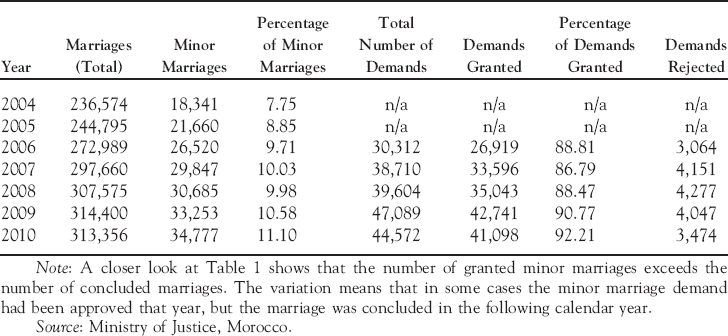
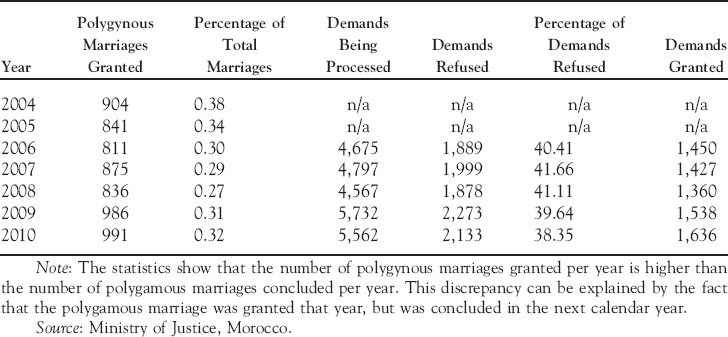
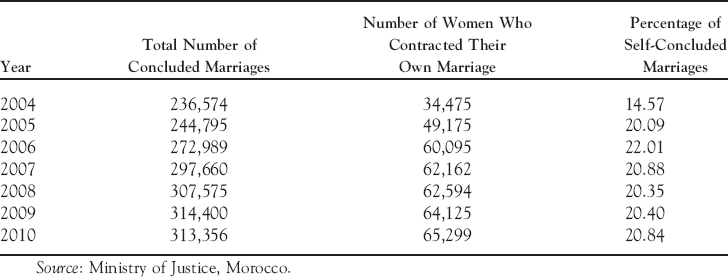
However, a decade later, the winners and losers of reform are more difficult to determine. Feminists are dismayed by the persistence of high rates of marriage involving a minor, polygyny, and marriage guardianship. Minor marriage has not disappeared but in fact increased in the 2000s (see Table A1 in the Appendix). Polygyny figures remained stable (see Table A2).Footnote 14 Also, only around 20 percent of women choose to marry without a marriage guardian (see Table A3).Footnote 15
A number of conventional explanations are usually advanced to explain why statutory law reform often does not have the intended outcome. These include people's ignorance of the law, insufficient enforcement capacities of the state (Aldashev et al. Reference Aldashev, Chaara, Platteau and Wahhaj2012a, 194), and people's perception that the reformed statutory laws are in violation of their customary practices and beliefs (Aldashev et al. Reference Aldashev, Chaara, Platteau and Wahhaj2012b, 795–96). Moroccan women's groups have argued along similar lines. They in particular criticized the state for not carrying out enough awareness campaigns, which in turn left people uninformed about the new provisions (Association Démocratique des Femmes du Maroc 2007, 52; Benradi et al. Reference Benradi, M'chichi, Ounnir, Mouaqit, Boukaïssi and Zeidguy2007, 48).Footnote 16 Moroccan academics have pointed to insufficient human and physical resources of courts, which make it impossible to guarantee a proper application of the 2004 code (Benradi et al. Reference Benradi, M'chichi, Ounnir, Mouaqit, Boukaïssi and Zeidguy2007, 282; El Mekkaoui Reference El and Naji2009, 46–51). Similar arguments are debated in the Moroccan media.Footnote 17
While it is too early, after just a little over a decade, to judge the law's impact, the discrepancy between the euphoria that greeted the law in 2004 and the lack of excitement about the family code a decade later invites further investigation. Despite the great (academic) interest in the reform process and, in particular, in the role of the secular women's movement (Wuerth Reference Wuerth2005; Sadiqi and Ennaji Reference Sadiqi and Ennaji2006; Mir-Hosseini Reference Mir-Hosseini2007; Sadiqi Reference Sadiqi2008), little is known about what came after, that is, how the 2004 family law is implemented. What is the role of the state in the implementation of the family code? How do state and nonstate actors interpret the law, and what is their role in its implementation?
Conventional explanations that attempt to shed light on why the law does not work or works differently than intended are based on the assumption that the homogeneous state faces resistance from society. This article argues that the conceptualization of the state as an autonomous and homogeneous organization does not help us understand the complexities of how the 2004 family law is implemented. This approach overlooks that different parts of the state have taken very different approaches to the 2004 family law. Different agencies of the state have emphasized and rejected different concepts contained within the 2004 law. The state is therefore not enforcing one normative order against cultural resistance from society. Instead, different state actors are themselves actively involved in the production and preservation of multiple normativities. The law incorporates different categories of meaning that are understood differently by people depending on their legal consciousness, that is, the way ordinary people think about law and legality (Merry Reference Merry1990, 4).Footnote 18 The multiple interpretations of the 2004 law are greatly facilitated by the law's ambiguity.Footnote 19 Marriage guardianship has not been abolished but made optional. Minor marriage and polygyny have not been outlawed but have been made conditional in the case of the former and, with respect to the latter, put under tighter state control. The law can only effect change when it alters the relationships between people, that is, their mutual rights and obligations (Falk Moore Reference Falk Moore1973, 734).Footnote 20 This process has at best been incomplete.
The article proceeds as follows. It first demonstrates that conventional approaches to the study of law and social change assume the homogeneity of the state. It then explains why the state-in-society approach is the most appropriate approach to study how the law is implemented in Morocco.Footnote 21 The empirical part of the article then compares how two types of “street-level bureaucrats” interpret and engage with the 2004 law: the social assistant (al-musā‘id al-ijtimā'ī), a judicial auxiliary, and the ‘ulamā’ (religious authorities) of the Rabita Mohammedia des Oulémas du Maroc, a state religious institution. Street-level bureaucrats interact with citizens on a daily basis (Lipsky Reference Lipsky1980, 3). They familiarize citizens with legal provisions and mediate the relationship between citizens and the state (Lipsky Reference Lipsky1980, 4). Due to the interactive nature of their work, street-level bureaucrats are particularly apt for a study that aims to better grasp how the law is implemented. Moving beyond the state level, the article then compares how two women's groups, the secular Association Démocratique des Femmes du Maroc (ADFM) and the Islamist Organisation for the Renewal of the Female Consciousness (ORCF), teach the family law to their constituencies.Footnote 22 Women's groups have been instrumental in mobilizing their members in favor of and against the 2004 reform and have run extensive programs to familiarize their constituencies with the new provisions of the 2004 law. The law's ability to trigger social change does not depend on its coercive capacities alone.Footnote 23 It depends also on the law's ability to create norms, symbols, and categories that resonate with people (Merry Reference Merry1990, 10). Analyzing the legal consciousness of reform opponents toward the law will therefore help assess the law's potential to trigger social change. The article thereby conducts a study of the “multiple places of normative production” (Dupret, Berger, and al-Zwaini Reference Dupret, Maurits and al-Zwaini1999, xiii). These two women's groups were selected because they hold leadership positions within their respective networks.Footnote 24 They exemplify the state-in-society approach since they demonstrate that the border between the state and nonstate spheres is not clearly demarcated. Members of ADFM and ORCF are not salaried employees of the state, but both organizations have at times received state funding. They interact regularly with government representatives, and members of both organizations have held public office.Footnote 25
The street-level bureaucrats as well as women's rights activists are engaged in a process of translation or vernacularization, during which certain de jure concepts of the family code are stressed, explained, and, while doing so, de facto adjusted to local circumstances. Translation is important for the law to become acceptable, but if the translation is fully in accordance with existing power relationships, it is less unlikely to trigger social change (Merry Reference Merry2006, 135–36).Footnote 26 As part of the translation process, translators often use images, symbols, and stories that are part of local culture (Merry Reference Merry2006, 136–37).
This article is based on semistructured interviews conducted in Morocco with street-level bureaucrats as well as with members of secular and Islamist women's groups during two fieldwork stays between March and May 2012 and between August and October 2013.Footnote 27 It also draws on participant observations of family law training sessions carried out by ADFM and ORCF in Rabat and Casablanca; written sources such as family law training manuals and documents produced by the Moroccan Ministry of Justice; and the respective statutory laws and relevant statistics on the application of family law in Morocco.Footnote 28
The Assumed Homogeneity of the State
Conventional approaches of the state stress that the state imposes a single normative system and set of rules of behavior within its given territory (Migdal Reference Migdal2001, 48). In developing societies where alternative normative orders are often strong, the ability of the state to impose such a single set of norms is assumed to be more limited, which implies that legal reforms aiming to modify customary rules would often fail to deliver results (Aldashev et al. Reference Aldashev, Chaara, Platteau and Wahhaj2012a, 182). A number of conventional explanations are therefore provided to explain why statutory law reform often fails to trigger social change. These explanations include people's ignorance of the law due to high illiteracy rates,Footnote 29 insufficient enforcement capacities of the state, and the manipulation of elites who use customary law to acquire new formal rights (Aldashev et al. Reference Aldashev, Chaara, Platteau and Wahhaj2012a, 194). Also, people might feel that the formal law clashes with their customary practices and beliefs, local customary authorities do not want to implement the new law, and people do not use the state court system for fear of social sanctions by their respective communities (Aldashev et al. Reference Aldashev, Chaara, Platteau and Wahhaj2012b, 795–96).
This conceptualization of legal change juxtaposes state and society and assumes a division between a homogenous state and its society in which the state conveys a unified message that is rejected by parts of society who cling to their alternative normative believes. They are partly able to do so due to the weak enforcement mechanisms of the state. This approach overlooks that not only customary authorities but state actors themselves might (at times) promote norms that are greatly at odds with the state's own statutory laws or elements of that law—that is, in this case, the 2004 Moroccan family law. Different state actors are therefore not only engaged in a struggle against cultural norms and values embedded in society that are at odds with the state's statutory laws, but they are instrumental in preserving them. At times there is great overlap between state and nonstate actors and their interpretations of the law.
Adopting the State-in-Society Approach
This study adopts the state-in-society approach, which has not previously been taken into consideration by studies of family law reform in Morocco. The state-in-society approach is particularly appropriate for this study of legal change because it does not conceptualize state and society as homogenous or their relationship as simply dichotomous. It does not draw a picture of an active state at the center and a passive society as the recipient of state legislation.
The state-in-society approach proposes that state organizations operate quite similarly to other types of social organizations and constantly struggle with these organizations over the right to regulate people's behavior (Migdal Reference Migdal2001, 12). State agencies are therefore not autonomous from society, but constrained by it, which prevents the state from achieving an unrestrained reordering of society (Migdal Reference Migdal2001, 56).Footnote 30 It is relatively easy for an authoritarian regime like Morocco to issue laws that express the views of politically dominant actors since it controls the relevant political organs and processes, as the 2004 family law reform process illustrates.Footnote 31 However, the regime then requires cooperation from both state and nonstate actors to implement these policies. Thus, it depends on street-level bureaucrats as well as civil society groups when it comes to the implementation of the law. Actors other than the regime and the ruler shape how the law is implemented. The often unintended consequences of legislative change are therefore not always the result of lacking resources or poorly trained officials, but are due to the competition between different groups within the state apparatus and other social groups (Migdal Reference Migdal2001, 12).
How Street-Level Bureaucrats Interpret the Law
The Creation of the Social Assistant
Since the mid-2000s, the Moroccan government has more closely cooperated with international actors, mainly UN Women (formerly UNIFEM), to guarantee a “better” implementation of the family law. The position of the social assistant had already been referred to in the 2004 family code, but the profession was not operationalized,Footnote 32 which in turn was criticized by women's groups and academics (Benradi et al. Reference Benradi, M'chichi, Ounnir, Mouaqit, Boukaïssi and Zeidguy2007, 110; El Mekkaoui Reference El and Naji2009, 50). The cooperation between the Moroccan government and international actors is exemplified by the creation of the position of the social assistant (al-musā‘id al-ijtimā'ī).Footnote 33 The social assistant is a judicial auxiliary, employed by the Ministry of Justice, who is based in the family law sections of the courts. According to the guidelines formulated by the Moroccan Ministry of Justice to clarify and define the tasks, qualifications, and competences of all civil servants, the social assistant is intended to facilitate the work of the judge. He or she (currently the overwhelming majority of social assistants are female) conducts social inquiries by interviewing people in cases of kafāla (a type of foster care system), the marriage of minors, the marriage of mentally disabled people, custody cases, and polygyny. The report of the social assistant is intended to give the judge a better idea of the social circumstances of the case so that the judge can make a more informed decision (Moroccan Ministry of Justice 2012).Footnote 34
The institutionalization of the social assistant by the state is based on a pilot project carried out by UN Women (then UNIFEM) in 2008.Footnote 35 UNIFEM recruited and trained social assistants to operate at the family court in Tangier. The project was then evaluated as successful, and the Moroccan government formally decided to include the position of social assistant in the 2011 national budget.Footnote 36 The state will continue to recruit 100 social assistants each year until courts in bigger cities have two to three social assistants and tribunals in smaller cities have one social assistant.Footnote 37 The social assistant is thus a street-level bureaucrat in the making. The institution is not fully implemented.
This creation of the social assistant needs to be seen as part of the wider judicial reform process that aims to modernize the judiciary and to establish a judiciary of proximity. The importance of the rule of law and the independence of the judiciary have been stressed by the state since the inauguration of King Muhammad VI in 1999 (Sater Reference Sater2009, 187). This was part of a strategy to generate trust in the judiciary in order to attract foreign investment and EU funding. This reason is why these reforms tend to focus on increasing the efficiency of the judiciary rather than on creating an independent judiciary. Programs include technological updates of courts and surveys about the friendliness of court personal and the efficiency of legal procedures. The state has emphasized the importance of commercial courts and women's rights, given their importance internationally (Sater Reference Sater2009, 190–91).
Areas of Responsibility of Social Assistants: Polygyny and Minor Marriage
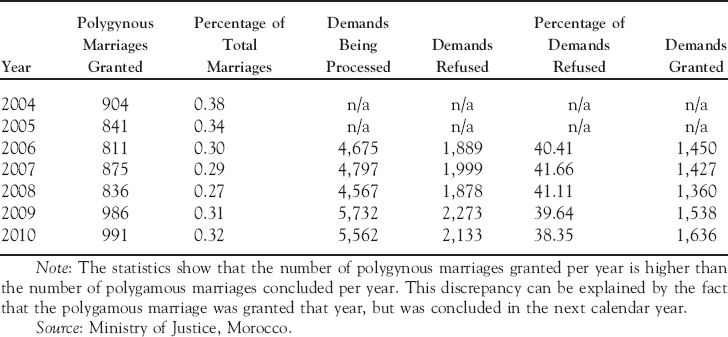
The 2004 code stipulates that polygyny should be authorized only in exceptional cases such as sickness of the first wife. The first wife has to be notified before the conclusion of the second marriage.Footnote 38 The husband also has to demonstrate that he has sufficient financial resources to support two (or more) wives. Women's group research demonstrates that, in reality, the exceptionality of cases is hardly ever verified: the first wife is often not informed about the second marriage, and polygyny is always authorized if the husband is seen as financially capable (Fédération de La Ligue Démocratique des Droits des Femmes 2007, 28–29). Polygyny data demonstrate that between 2006 and 2010, around 40 percent of the demands for a polygynous marriage were rejected (see Table A2). There is no statistical information available to clarify on what grounds these demands were rejected. The social assistant is tasked to investigate whether the first wife is sick, whether she is informed about the second marriage, and whether the husband is financially capable of supporting two (or more) wives. One of the social assistants interviewed stated:
Often husbands say that the woman is ill and when I do my home visit, I find that the woman is not ill but young and healthy. I then do my report and often the judge refuses the polygynous marriage and bases himself on my findings.Footnote 39
This might indicate that the conditions for polygyny, which women's groups have claimed were not observed in the past, might become subject to greater scrutiny once the position of the social assistant is well operationalized.
Despite the new 2004 family code setting the legal marriage age at eighteen for men and women, judges can grant a marriage below age eighteen under certain conditions, namely, if the minor has an interest in the marriage.Footnote 40 The presence of a medical certificate, the consent of the minor, and the consent of the marriage guardian are required to authorize such a marriage.Footnote 41 Statistics generated by the Ministry of Justice demonstrate that judges in around 90 percent of the cases between 2006 and 2010 acceded to requests for minor marriage (see Table A1). The statistics show that minor marriages have been constantly increasing since the issuing of the family code in 2004.Footnote 42
In cases of minor marriage, the social assistant investigates whether financial constraints oblige the family to marry off the daughter and whether the girl is pursuing an education that could be interrupted as a result of an early marriage. Poverty is one of the main reasons for early marriage (Benradi et al. Reference Benradi, M'chichi, Ounnir, Mouaqit, Boukaïssi and Zeidguy2007, 109). According to the social assistants interviewed, judges have dismissed cases as illegitimate in which families wanted to marry off their daughters for financial reasons.Footnote 43
Social assistants' responsibilities also include checking the medical certificate that must be presented to the judge in order to certify the physical maturity of the minor. Due to corruption, families were able to obtain medical certificates without any physical examination of the minor girl. This was also possible because the position of the social assistant was not operationalized (Benradi et al. Reference Benradi, M'chichi, Ounnir, Mouaqit, Boukaïssi and Zeidguy2007, 110). Social assistants must also ensure that the minor has consented to the marriage. Social assistants at the Casablanca family tribunal said that they also conduct a follow-up home visit to check whether the conditions of the underage marriage are “good” or not.Footnote 44
Social assistants also discuss the meaning of marriage and make sure that minors understand what it means to build a family according to the 2004 family law. When asked about how the family law defines the meaning of marriage, a social assistant at the family court in Rabat answered:
I say that there needs to be respect between spouses. The husband has the responsibility to pay nafaqa [maintenance] and to treat the woman well. The wife takes care of the house and the children. Sometimes I say that from an Islamic perspective it is important to understand that women are fragile and more emotional. One has to understand that women talk a lot.Footnote 45
The statement indicates that this social assistant continues to stress complementary gender roles. The stipulation of the family code that men and women have shared responsibilities for the family is interpreted as different responsibilities (women are caretakers, men are providers) rather than as sharing the same responsibilities.
The Challenges and Limitations of the Social Assistant's Work
Social assistants face several challenges that are related to lack of experience, poor resources, popular resistance, and lack of legal regulation of their profession. Social assistants are very young, which makes it more difficult for them to make people cooperate. One of the social assistants interviewed said:
At the beginning it was difficult, because people always said: “Oh, you are so young. You are not a judge.” But now I have more experience of how to react and people are happy because they realize that they are being listened to.Footnote 46
Social assistants often try to circumvent their lack of experience by inventing a certain sympathetic narrative. When talking to socially conservative clients, social assistants foster a conservative image of themselves, showing deference to conservative gender roles. The message is very much determined by its recipient, which most certainly goes against the intentions of UN Women and secular feminists. One of the assistants stated:
Sometimes we are obliged to say that we are married and have children. There was one case when a woman told me that she found numbers of women in her husband's calendar. I said that I myself had been in the same situation and that I found out that the contacts were professional working contacts. You always have to create a feeling of commonality. You have to cite examples of your own family.Footnote 47
Similarly, another social assistant explained that she would cite verses of the Qur’an in a reconciliation session to stress the religious importance of reconciliation if the couple is religious.Footnote 48
The social assistants who work at the family tribunal in Casablanca said that they make home visits in cases of polygyny and minor marriage. The same is true of the social assistants interviewed in Tangier. However, the social assistants in Rabat admitted that they only make home visits in cases of kafāla because their expenses for home visits are not reimbursed. They are also not insured when they leave the office for these field trips.Footnote 49 Social assistants are sometimes refused access to the home in the first place and have to present authorization from the public prosecutor in order to convince people to let them enter their home. Social assistants stated that men in particular feel that the social assistant is biased because the large majority of them are female.Footnote 50 Only two out of the twenty-four trained assistants in 2011 were men.Footnote 51
Besides their lack of material resources and experience, social assistants complain that there is no clear law that defines their role and that no statute exists that recognizes the social assistant as an independent profession. In practice, this has meant that many social assistants simply work as judicial clerks, and judges often refuse to work with the social assistant because there is no law that obliges them to do so.Footnote 52 Some judges, however, have articulated support for the institution.
The social assistant is useful. The social assistant does not wear a gown like the judge. He or she is a normal person. Maybe somebody will be afraid to talk to me, but with the social assistant it is different. The social assistant has no authority over people and is therefore easier to talk to. The judge is an authority. He has to be neutral and cannot be empathetic. He cannot laugh.Footnote 53
Street-level bureaucrats considerably shape how the law is implemented—often in unintended ways. The social assistant is tasked with improving the application of the law to guarantee a better protection of women's legal rights. It is possible that once the profession is well operationalized, minor marriage as well as polygynous marriages will be less often authorized. Women's rights groups, and UN Women particularly, want to stress the new equality provisions of the code—such as equal marriage age for men and women and shared responsibility for the family, that is, sharing the same responsibilities. However, as the interviews with social assistants indicate, they often convey a message of complementary rather than equal gender roles. Since social assistants are in a weak position because they are young and inexperienced, a stranger to the family, and have limited resources and time, they rely heavily on the authority of social norms to argue their case and to reconcile people or explain the meaning of “the family.” The strategy that social assistants will use depends on the type of clients with whom they are confronted. The social assistant itself is a metaphor for the law and its flexibility. However, the fact that young women perform the very challenging task of social assistant presents in itself a challenge to conservative gender roles.
Besides the multiple normativities conveyed by the social assistant, the creation of this position, as well as the way in which it operates, considerably expands previous state policies and the state's reach. The state has literally knocked at the doors of its citizens and, more importantly, people have opened their doors. The most private matter—the family—has become an issue of increasing public concern.Footnote 54 This expansion of the state is an expression of a redefinition of the state's role. The guidelines of the Ministry of Justice state that the social assistants are supposed to improve the image of the Ministry of Justice (Moroccan Ministry of Justice 2012). A social assistant at the family tribunal in Rabat explained that the social assistant is there to humanize the judiciary and that the idea was based on a speech given by King Muhammad VI in October 2010 in which he proclaimed that the judiciary is at the service of the citizen.Footnote 55 After the speech, the quotation “the judiciary is at the service of the citizen” (al-qa‘ā’fi khidmat al-muwā’in) has been put up in all Morocco tribunals.Footnote 56 It seems likely that the state also sees this emerging profession as a mechanism to improve perceptions of the Ministry of Justice in the eyes of the citizen by establishing a judiciary of proximity. The judiciary is widely perceived as inefficient and corrupt. By presenting itself as the mediator and by trying to address people's private concerns, the Ministry of Justice may seek to ameliorate this image.
‘Ulamā’: Spreading Knowledge About the Family Code
The Rabita Mohammedia des Oulémas du Maroc is a state religious institution that is overseen by the king, replacing in 2006 the prior Rabita des Ouléma du Maroc.Footnote 57 The ‘ulamā’ of the Rabita are directly appointed by the king.Footnote 58 The creation of the Rabita was part of a wider process of reform of the religious field in the mid-2000s. The reform of the religious field partly aimed at bringing religious institutions under greater state control and consolidating the king's ultimate authority over them (Maghraoui Reference Maghraoui2009, 196).
The Rabita has eleven research centers—among them a center for studies of the Sunna, Sufism, and the Centre for Women's Studies in Islam. These institutes were set up to produce high-level religious knowledge and to revalue the religious sector as an institution that has an important role to play in addressing social problems.Footnote 59 The ‘ulamā’ became integrated into the state's bureaucracy as part of the state-building process. In the process, the ‘ulamā’ lost much of their previous autonomy.Footnote 60 However, in the 2000s, the state actively began to implicate them in various reform efforts. The training of the ‘ulamā’ of the Rabita in the family code, gender, and human rights needs to be seen in this context.
Since lack of awareness and misinformation among the population about the content of the code are seen as major obstacles to the application of the law by both the government and women's groups, the government decided to employ ‘ulamā’ to educate the population about the 2004 family code. The director of Rabita's Centre d'Études et de Recherches en matière des Valeurs, who carried out the training of the ‘ulamā’ in Marrakesh and Ifran, explained that since all Moroccans are believers, people consult the ‘ulamā’ on a large number of daily issues.Footnote 61 The ‘ulamā’, being deeply embedded and closely connected to the people in their local community, can communicate certain messages about legal change to constituencies that are otherwise difficult for state agencies to reach. Before the new 2004 family law was issued ‘ulamā’ had been among the main opponents of the proposed reform.Footnote 62 The ‘ulamā’ had felt largely excluded from the process of family law reform, which partly explained their opposition to the proposed reform. Involving them in the implementation of the 2004 law could also be a measure to increase their own support for the family law.
Since April 2010, the Rabita Mohammedia des Oulémas du Maroc has cooperated with the UN Population Fund (UNFPA), jointly conducting approximately ten workshops. The cooperation aimed at involving ‘ulamā’ in the fight against HIV and at familiarizing them with concepts such as gender, reproductive health, and human rights.
A training manual was developed and used in the training of the seventy ‘ulamā’ of the Rabita over the course of 2010 and 2011. These ‘ulamā’ then selected 500 ‘ulamā’, who work in local mosques throughout the country, and trained them. The manual aims to educate ‘ulamā’ in topics such as the family code, reproductive health, the fight against HIV, gender, and human rights. ‘Ulamā’ also learn various communication skills in order to better familiarize and sensitize people to these issues.Footnote 63 The following brief overview of how the manual explains these different issues and concepts serves to illustrate how the state agencies explain the content of the family code to religious practitioners and what aspects they want to stress.
According to the manual, the 2004 Moroccan family law “was a remarkable step forward for the rights and social relations and consecrated equality between men and women” (Rabita Mohammadia des Ouléma du Maroc 2010, 69). It lists the changes brought about by the family code. The legal age of marriage was raised to eighteen for boys and girls. Women who have reached the age of eighteen no longer require the consent of their guardian to be married. The family is under the responsibility of both spouses rather than headed by the husband. Divorce is now under the control of the judge. The divorced woman benefits from the financial means acquired during the marriage if a shared assets agreement has been concluded. The law recognized civil marriage, the protection of the child, and the affiliation of a child born or conceived during the time of engagement (Rabita Mohammadia des Ouléma du Maroc 2010, 70). The manual thereby emphasizes most of the issues that have been contested by socially conservative groups.
The training manual makes extensive reference to UN conventions and human rights treaties, including the Convention on the Elimination of All Forms of Discrimination Against Women (CEDAW), which Morocco ratified in 1993. It adopts many of the concepts present in these conventions, such as gender, gender-based violence, and equality between men and women.
It extends the role of ‘ulamā’, who are now seen as “local educators” in family law. The manual specifically states that ‘ulamā’ should use practical examples close to the everyday lives of people and support them with religious references. Abstract official messages are thereby translated into everyday language and made more accessible to the grassroots. Whether the individual ‘ālim, religious authority, will understand the state message as intended and will apply it accordingly remains open to speculation, as in the case of the social assistant. They may have personal reservations about some or all of it, and the transmission process may be very selective. There are no control mechanisms in place to check the work of the ‘ulamā’, so there is no guarantee that they transmit the content of the family code as laid out in the manual.
An interview with the president of the ‘ulamā’ of Casablanca gives an impression of how the content of the training is interpreted by religious practitioners. A member of the Rabita, the president of the ‘ulamā’ of Casablanca has participated in the training and has since then trained the members of the women's section at the Casablanca mosque where he delivers the Friday prayer.Footnote 64 Asked how he understood the concept of gender (al-naw‘ al-ijtimā‘ī), he answered:
Women complete men. There are always two sides no matter where you look: feminine and masculine. They are complementary. One is always in need for the complementary part—for a partner. But people are treated differently. Why are women beaten? Why does the husband think that he can beat his wife? To beat (‘araba) in Arabic can mean many things. The Prophet—peace be upon him—never beat a woman. This behavior has to do with education and must be changed.Footnote 65
The statement demonstrates that the president of the ‘ulamā’ of Casablanca does not believe in gender equality and socially constructed roles, but that both sexes have distinct roles and characteristics. Like some of the social assistants, he supports complementary rather than equal rights for men and women. Societally harmful behavior such as violence against women has to be corrected, but that does not imply that gender equality is favored.
We also discussed the amendments to the family code. The president of the ‘ulamā’ of Casablanca emphasized that the institution of guardianship was not abolished by the 2004 law and pointed out that the law still refers to the walī (guardian). According to him, the guardianship is an obligation in Islam because the guardian fulfills an important protective function for the girl. Moreover, he argued that in practice the walī is always present since one has to ask the father's permission before marrying the daughter.Footnote 66
The president of the ‘ulamā’ of Casablanca also explained that in his previous career as an ‘adl (professional witness who, among other things, sets up the marriage contract) he always married girls off at the age of fifteen. He criticized the fact that judges at the family tribunal in Casablanca, in what has become an informal agreement, no longer authorize a marriage under the age of seventeen. He remarked that women may be physically ready and miss an opportunity to get married because of the law. According to him the law is therefore harmful to their interests—that is, marriage is the ultimate goal of every girl and always seen as in a girl's interest. He also criticized the fact that the new law had made divorce too easy for women. Women would ask for divorce “if the husband raises his voice.”Footnote 67 He also rejected the concept of shared assets, hailed as a success by women's groups, because it facilitates divorce by making people think about divorce when they get married.
One cannot but notice the discrepancy between the content of the training manual and the views articulated by the president of the ‘ulamā’ of Casablanca. An interview with a single person cannot serve as the basis for generalizations. However, since the president of the ‘ulamā’ of Casablanca has trained other people and leads the Friday prayer in an important mosque in Casablanca, he can nonetheless be seen as representative of a fairly common standpoint. It invites questions about whether and how the message of increasing equality between men and women promoted by some state agencies will be understood and transmitted. Similar to that cleric, other ‘ulamā’ might reject ideas of equality between men and women or the concept of gender equality as promoted by CEDAW. Nevertheless, the training exposes ‘ulamā’ to these ideas and concepts, be it followed by rejection or acceptance of these new norms and values.
The above discussion demonstrates that there is much space for considerable variation between the official message and how street-level bureaucrats interpret it. Moving beyond the state level, the next section analyzes how secular feminists and Islamist women's groups engage with the law. It demonstrates that state and nonstate actors partly overlap in their interpretations of the law, thereby emphasizing the utility of the state-in-society approach and its avoidance of sharp divisions between state and society.
Nonstate Actors: Teaching the 2004 Family Law to their Constituencies
ADFM: Promoting Equality and Shared Responsibility
The Association Démocratique des Femmes du Maroc (ADFM) has developed a training manual that covers four topics of the family code that the organization views as particularly important: divorce, shared assets (amwāl mushtaraka), minor marriage, and gender (Association Démocratique des Femmes du Maroc 2012). I attended two of the four sessions—on shared assets and on divorce—at ADFM's Centre d'Écoute (Centre Nejma) in Rabat.Footnote 68 The training manual, which elaborates the content of the individual training sessions, states as one aim of the training to equip women with knowledge about their rights as guaranteed to them by the Moroccan Constitution and the 2004 family code (Association Démocratique des Femmes du Maroc 2012, 11).
Training on Divorce
At the beginning of the session, the instructor showed a film about a woman who was experiencing problems with her husband. The woman portrayed in the film was from a lower-class background and the film was set in a rural area and depicted the woman working in the fields. The instructor later explained to me that the film was chosen so that the women who attend the course could relate to the main character. Afterward, the instructor asked the women present to talk about their own problems. Fatima, a woman in her mid-forties who lives in the Oudayas, the old part of Rabat, with her three children, gave a very emotional testimony. She explained that her husband is violent and does not pay nafaqa (maintenance). She had gone to the family court to file a complaint, but her husband still did not pay and she did not have time to wait. She broke down in tears. The instructor intervened and commented on the case and said that Fatima was a victim of psychological, physical, and financial violence. The instructor then read the articles concerning divorce in the family code and said: “If you don't understand something, let me know. These are Articles 94 to 97 of the family code. They are for you. Talk to your friends about them.”Footnote 69 She then explained the procedures of divorce and what kind of steps a woman has to take. Some of the women asked how to register the case in court and what kinds of documents they would need. One of them asked how much nafaqa (maintenance) one obtains. The instructor explained that the amount of nafaqa depends on the financial situation of the husband. She then taught the participants how to frame their personal problems in legal terms in order to initiate a court proceeding.
Shared Assets Training
The instructor explained the concept of shared assets and its place in the 2004 law. The instructor asked what kind of assets can be divided. She explained that anything that can be turned into money can be divided at the time of divorce including land, an income, and savings in the bank. The instructor distributed a picture that depicted a woman with five arms feeding her kids, cooking, doing the laundry, and cleaning all at the same time. The picture was entitled “Une vie de rêve …. [A dream life],” which is ironic since most of the women who attend the course were illiterate and did not understand French. She asked women whether they do all these things—the women affirmed. The instructor then tried to clarify that all household work has financial value and that women are therefore contributing to the development of the household's assets.
If you hired somebody to cook and clean you would have to pay for it. It is a job. If you did not do it, you would have to hire somebody to do it. Raising the children is essential. Not enough value is given to housework and childcare.Footnote 70
The women nodded in agreement. The instructor explained that in the family code it is stipulated that women and men have shared responsibilities within the family—meaning that they share the same responsibilities.
How do you divide the responsibility in the family? Is the responsibility shared in all ways? The Mudawwana talks about shared responsibilities, but does that actually exist in your families?Footnote 71
The instructor asked how one applies the Mudawwana when the contribution of women to the development of the assets of the family is difficult to prove.
This is why you have to ask for the contract of shared assets. There is a marriage contract and then there is a contract for shared assets. What do you write in it? You and your husband write in it how you will divide the assets during your marriage.Footnote 72
I met the instructor again one week after the second training to talk about her reflections on the course and her methodology. She explained that the principal objective of the classes is to prepare women to discuss their problems and to learn about their rights in order to “empower them,” so they can solve their problems themselves.
It became clear from the two sessions as well as the interview with the instructor that the main objective of these workshops was to change women's consciousness and to make them question existing gender roles. Based on the premise that legal knowledge can help empower women by changing their consciousness and that laws can trigger social change, the trainings focused very much on the law itself and specific articles. Lack of a proper education was seen as the main obstacle for women to become empowered. The instructor explained: “We teach these women how to live correctly. They were poorly brought up [mal élevées].”Footnote 73 This narrow view that focuses on education and training leaves out broader issues of social inequality that impact women's position taking and legal choices.
It is interesting that one of the four foci of the ADFM training is on shared assets since most of the participants clearly came from lower-class backgrounds and most likely had no assets to divide at the time of divorce, but instead struggled to make ends meet on a daily basis. The training underlines that the people who empower impose their own middle-class needs on the people who are supposed to be empowered. The behavior of dominant groups becomes exemplary. From their perspective, the law has a universal value and is an instrument to transform society (Bourdieu Reference Bourdieu1987, 847). A family code training session organized by an Islamist women's group adopted a very different focus, as is shown next.
Islamists: Reconciling the Family
The evidence drawn on here mainly consists of participant observations and informal discussions during a two-day, eighteen-hour family code training I attended at the Chamber of Commerce in Casablanca on April 14 and 15, 2012, as well as on interviews with Islamist women activists before and after the training. The training was organized by the Islamist Organisation for the Renewal of the Female Consciousness (ORCF) and funded by the Moroccan Ministries of Solidarity, Women, Family, and Social Development and of Justice (Ministry of SWFSD), as part of the government's efforts to implement the family code and to familiarize people with the content of the code.
The training was attended by an official of the ministry as well as thirty women, representing thirteen different organizations that regularly work with ORFC.Footnote 74 ORFC stated that the training session aimed at familiarizing attendees with the content of the 2004 family code. The training started with a five-minute Qur'anic recitation; prayer times were also observed throughout the day. After a brief introduction by an ORCF representative, the representative from the Ministry of SWFSD addressed the attendees. The representative talked about Morocco's obligation to comply with international conventions, with the 2004 family law being an important step in this regard. The aim of the family code, she said, is to stabilize the family since it is the fundamental unit of society. She then mentioned the new 2011 Moroccan Constitution, which, according to her, demonstrates the state's commitment to women's rights.Footnote 75 She outlined that the attendees play an important role in training their associations' members in matters related to the family code.
A judicial clerk from the family tribunal in Casablanca had been invited as a judicial expert to explain the different areas of the family code to participants. She is also a member of ORCF. Before Morocco's first Islamist-led government was formed in January 2012, she was not allowed to attend any activities organized by the Islamist organization because the Islamist Party of Justice and Development (PJD) was then in the opposition.Footnote 76
The judicial clerk gave an introduction to the family code, stressing men's and women's complementary rather than equal roles. She then drew attention to one of the biggest challenges to the new law, which, according to her, is the consistently very high number of unregistered marriages. The 2004 family code stipulates that a registered marriage contract is the only accepted proof of marriage.Footnote 77 However, the number of so-called fātiḥa marriages (religious, unregistered marriages) remains high. The state originally allowed a period of five years during which people could belatedly register their fātiḥa marriage. When the period was close to its expiration in 2009, the Ministry of Justice realized that the timeframe originally set was not feasible. Since then the period has been extended twice.Footnote 78 The judicial clerk stressed that it is particularly important to register the marriage for the sake of the children, whose enrollment in school requires a marriage certificate. In the case of a divorce, it is difficult for the woman to claim alimony for herself and her children if the marriage was not registered.
With respect to marriage guardianship, the clerk stated that women who have reached the legal age can contract their own marriage, which is allowed by the Qur’an. This was a point that was hotly debated afterward and most women disagreed that women should marry without their guardian's explicit consent.
The clerk explained that the family law is not a secular law, but that it represents Maliki law and was amended through ijtihād (independent reasoning). The king as the highest religious authority in the country in his capacity as amīr al-mu’minīn, commander of the faithful, engaged in ijtihād and in a process of shūra (consultation) with the parliament.Footnote 79
Despite the training being officially announced as a family code training, most of the discussions focused on aspects of women's lives and their personal problems that did not necessarily relate to the family code. After the introductory talk on the family law by the clerk, questions from the audience were addressed; this turned into a general discussion about marital life. One woman wanted to know whether presents had to be returned when an engagement is broken. Another woman asked whether the family code also stated the age at which women can become engaged. One of the members of the Movement for Unity and Reform (MUR), an Islamist grassroots movement close to the PJD, wanted to talk about appropriate forms of dress, an area not mentioned by the family code at all.
Afterward, as one of the training tasks, the moderator asked what areas women regard as important and would like to include in their organizations' projects in order for their constituencies to benefit and in order to transmit their newly gained knowledge about the family code. Almost all the projects suggested aimed at improving sulḥ, reconciliation between couples to avoid divorce. According to the participants, divorce is harmful to society and especially to women, and it therefore has to be avoided at all costs. One project that was suggested would aim to improve attempts at sulḥ by improving communication within the family. Lack of communication was perceived as a major problem that often leads to family conflicts. Another suggestion focused on how associations could help families reconcile and to facilitate the sulḥ process. Participants claimed that divorce rates were high because women and men did not know their rights and obligations stipulated in the family code and reconciliation procedures were not working.
The importance of sulḥ procedures is also stressed by other Islamist women's groups that coordinated and work with the ORCF. The at the time president of the Islamist Mountada al-Zahra forum, an umbrella for sixty-three smaller women's groups including several Islamist organizations, echoed Islamist women's concerns that the reconciliation (sulḥ) provisions of the 2004 law are ineffective.Footnote 80 According to her, judges do not have time to engage in a serious sulḥ process due to their large caseload, which partially explains the high divorce numbers.Footnote 81
The Mountada al-Zahra forum has taken action to remedy the insufficient ṣulḥ procedures. Around thirty Centres d'Écoute (counseling centers) operate under the umbrella of Mountada al-Zahra. These centers have begun to specialize in reconciliation efforts. According to then-president of Mountada al-Zahra forum, organizations discovered through their centers that the reasons for divorce were very banal at times, relating to lack of education about rights and obligations and a failure of proper communication within the family.Footnote 82
During lunch and coffee breaks I had the opportunity to discuss women's issues with various participants of the training. The general notion of equality between men and women was rejected by the workshop participants, who saw men's and women's roles as complementary. New provisions of the 2004 family code, such as the right of a woman to contract her own marriage without a guardian, were declared un-Islamic. Similar to the president of the ‘ulamā’ of Casablanca, workshop participants explained that no respectable woman could get married without the consent of her family and that the family law had preserved the institution of the walī, who provides an important protection mechanism for women. Attendees found that women had asked for “too much,” leading to traditional gender roles being weakened. As a result, conflicts emerged and divorce became more frequent.Footnote 83 The newly gained easy access to divorce, especially in the form of al-tafrīq li-l-shiqāq wal-nizā‘ (divorce because of discord and conflict), was viewed by attendees with great concern, since it allegedly makes men more hesitant to get married because they fear that the most trivial matter could make the woman ask for divorce. Subsequently, the new provisions have decreased women's chances of getting married and thereby being taken care of.Footnote 84
Like the secular feminists, the participants, most of whom were teachers, appear to have looked for solutions to these problems that correspond to their own cultural capital as teachers, and therefore they generally viewed the issue as an educational one that cannot be addressed by legal reform alone. They explained that young people, especially girls, lack “proper” Islamic education. They dress inappropriately, thereby disrespecting Islamic dress codes. An Islamic education teacher explained that she always includes Islamic norms in her classes. When she talks about sexually transmitted diseases, she always stresses that these are the result of inappropriate, non-Islamic conduct. Similarly, a woman who worked with criminal youth explained that the young perpetrators have distanced themselves from religion, which has led them to become criminal. With her newly gained knowledge about the family code, she hopes that she can help young people construct stable families and thereby give them new hope.
The training stayed very much on the personal level, with participants discussing personal problems and cases that had occurred in their families or circle of friends. Participants did not look at the law itself or read specific articles. Whereas secular women's groups would emphasize the importance of “the law” to change society, this power was not acknowledged by the workshop participants at all. Law, in their view, should reflect social conditions, rather than trying to change them. The importance of Morocco's compliance with international conventions, stressed by the introductory speech of the family ministry representative, was not discussed any further.
Most of the provisions praised by secular women's groups were not addressed or were rejected. Participants criticized the fact that secular feminists “teach women how to divorce” and thereby, according to them, encourage divorce, which will harm women in the long run because it makes them vulnerable and financially unprotected.
In a discussion with the representative of the Ministry of Family Affairs, one week after the Casablanca training, she revealed that she was not entirely satisfied with the way the training was conducted. She felt that it did not satisfactorily address the legal issues of family law reform and focused too much on the social problems of individuals. At the same time, it became clear that cooperation between the ministry and the Islamist ORCF would most likely continue in slightly amended form—with greater focus on the law—since these groups have access to large constituencies that the state would otherwise have difficulty in reaching. It is likely that ORFC will slightly amend the way it carries out training, taking the legal aspects of the law and international conventions more strongly into account if it wants to retain access to state funding in the future. This is one example of how state and society constantly interact and influence each other.
Conclusion
This article set out to demonstrate that an accurate understanding of the implementation of Morocco's 2004 family code must not depart from the assumption of a homogenous state that imposes itself on society. Instead, the boundaries between state and nonstate actors are often fluid. The state is not a unified actor that simply contests norms within society that are at odds with the state's statutory law. Instead, different state agencies emphasize different aspects of the law. Similarly, street-level bureaucrats' interpretations of the law at times overlap with those of nonstate actors who disagree with some of the norms incorporated into the law. State agencies thereby themselves help foster, at least indirectly, the proliferation of conflicting interpretations of the law, for example, by funding such NGOs.
The process of translation, what is being translated, and by whom it is translated is crucial for the implementation of the law. Although Merry correctly observes that “intermediaries such as NGO and social movement activists” are of critical importance in this regard (Merry Reference Merry2006, 3), it is important to note that not all activists are in favor of norms embedded in international law, and that they may in fact actively argue against the validity of international law and in favor of cultural specificity. The literature's predominant focus on pro-international law activists obscures the many other actors, such as street-level bureaucrats, who are involved in the translation process. Once governments enact reforms, in part to comply with international conventions like CEDAW, a number of new actors become involved in the implementation process. Some of them might not agree with some of the key concepts that are promoted by the new laws. They engage in translation not out of conviction, but out of professional duty. Street-level bureaucrats might not share the objectives set out by their state agency and hence might not work wholeheartedly (or at all) toward achieving these goals (Lipsky Reference Lipsky1980, 16).Footnote 85 An analysis of how new norms embedded in legislation become translated must therefore include street-level bureaucrats.
As a result of differing conceptions of the state and family's welfare roles, different groups emphasize or reject different concepts of the law. Islamist women's groups emphasize reconciliation (ṣulḥ) procedures and complementary rights within the family, while ADFM shows little interest in reconciliation and instead emphasizes the new rights that women gained through family law reform, such as the right to marry without a marriage guardian. Some therefore criticize the feminist movement as having no particular interest in the family as a unit and as having reduced the question of family law to women's rights (El Mekkaoui Reference El and Naji2009, 94). The differences in emphasis are partly related to different understanding of what social ills the family law should address—high divorce rates or women's legal inferiority—and by whom. Many Islamists see the family as best equipped to provide support for individuals and therefore view divorce as a rupture to family relations to be avoided at all costs. Easy access to divorce (for men and women) is therefore seen as a threat to this welfare model. Most feminists, meanwhile, attribute this welfare role to the state. It is conceivable that these differing views may change in the future, depending on the extent to which the state continues to expand not only its control over family matters, as it did, for instance, by introducing the social assistant, but also its provision of welfare more broadly.
Divergent interpretations of the law are also greatly facilitated by its ambiguity, which in turn enables different groups to bring in their own agendas. Instead of presenting a radical rupture and replacing them in their entirety, the new law coexists with and modifies some of the norms that were expressed in the previous law (Falk Moore Reference Falk Moore1973, 742). Legislation only modifies elements of the social field to which people belong, whereas most other characteristics remain unchanged. Legislation thus only partially alters existing social relationships (Falk Moore Reference Falk Moore1973, 743). For instance, even though the 2004 law sets the legal marriage age at eighteen for boys and girls, economic conditions that make parents inclined toward marrying their girls off at a younger age have not changed. Such underlying conditions help explain the divergent emphases in actors' agendas, and are linked to no small degree with the state's welfare provision, as noted earlier. The internationally predominant focus of women's groups on raising awareness of and educating publics about provisions of new laws neglect such underlying economic issues.
This article centered its analysis on the first part of the translation chain, that is, on how different actors translate and interpret the 2004 family law. Since legal practice is likely to be influenced by ordinary people's experience with the legal system, future research on the ground should analyze how the translations by activists and street-level bureaucrats inform the legal practice of ordinary people of different social backgrounds and in different settings.Footnote 86
Appendix
Figures of Minor Marriages, Demands Granted and Rejected

| Year | Marriages (Total) | Minor Marriages | Percentage of Minor Marriages | Total Number of Demands | Demands Granted | Percentage of Demands Granted | Demands Rejected |
|---|---|---|---|---|---|---|---|
| 2004 | 236,574 | 18,341 | 7.75 | n/a | n/a | n/a | n/a |
| 2005 | 244,795 | 21,660 | 8.85 | n/a | n/a | n/a | n/a |
| 2006 | 272,989 | 26,520 | 9.71 | 30,312 | 26,919 | 88.81 | 3,064 |
| 2007 | 297,660 | 29,847 | 10.03 | 38,710 | 33,596 | 86.79 | 4,151 |
| 2008 | 307,575 | 30,685 | 9.98 | 39,604 | 35,043 | 88.47 | 4,277 |
| 2009 | 314,400 | 33,253 | 10.58 | 47,089 | 42,741 | 90.77 | 4,047 |
| 2010 | 313,356 | 34,777 | 11.10 | 44,572 | 41,098 | 92.21 | 3,474 |
Note: A closer look at Table 1 shows that the number of granted minor marriages exceeds the number of concluded marriages. The variation means that in some cases the minor marriage demand had been approved that year, but the marriage was concluded in the following calendar year.
Source: Ministry of Justice, Morocco.
Figures of Polygynous Marriages per Annum
| Year | Polygynous Marriages Granted | Percentage of Total Marriages | Demands Being Processed | Demands Refused | Percentage of Demands Refused | Demands Granted |
|---|---|---|---|---|---|---|
| 2004 | 904 | 0.38 | n/a | n/a | n/a | n/a |
| 2005 | 841 | 0.34 | n/a | n/a | n/a | n/a |
| 2006 | 811 | 0.30 | 4,675 | 1,889 | 40.41 | 1,450 |
| 2007 | 875 | 0.29 | 4,797 | 1,999 | 41.66 | 1,427 |
| 2008 | 836 | 0.27 | 4,567 | 1,878 | 41.11 | 1,360 |
| 2009 | 986 | 0.31 | 5,732 | 2,273 | 39.64 | 1,538 |
| 2010 | 991 | 0.32 | 5,562 | 2,133 | 38.35 | 1,636 |
Note: The statistics show that the number of polygynous marriages granted per year is higher than the number of polygamous marriages concluded per year. This discrepancy can be explained by the fact that the polygamous marriage was granted that year, but was concluded in the next calendar year.
Source: Ministry of Justice, Morocco.
Figures for Women Who Contracted Their Marriage Without Their Marriage Guardian
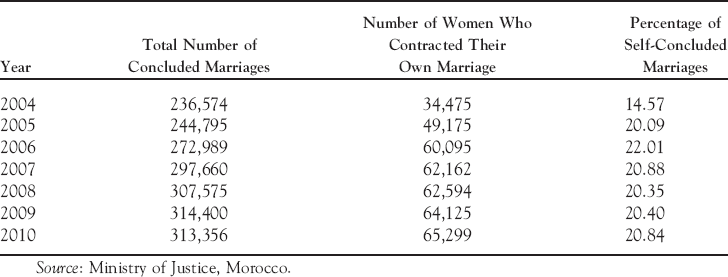
| Year | Total Number of Concluded Marriages | Number of Women Who Contracted Their Own Marriage | Percentage of Self-Concluded Marriages |
|---|---|---|---|
| 2004 | 236,574 | 34,475 | 14.57 |
| 2005 | 244,795 | 49,175 | 20.09 |
| 2006 | 272,989 | 60,095 | 22.01 |
| 2007 | 297,660 | 62,162 | 20.88 |
| 2008 | 307,575 | 62,594 | 20.35 |
| 2009 | 314,400 | 64,125 | 20.40 |
| 2010 | 313,356 | 65,299 | 20.84 |
Source: Ministry of Justice, Morocco.