


In recent decades, efforts to make nation-states more democratic have been remarkably successful. Yet the results have often failed to live up to the hopes of democracy's advocates. The frequent undermining of free and fair elections and the incidence of democratic backsliding in regimes as diverse as Russia, Thailand, and Venezuela, where formally democratic institutions were present, suggest that sometimes adopting new democratic institutions is not enough. The emergence of new forms of electoral authoritarian or hybrid regimes that combine systematic abuses of democratic practice with formally democratic constitutions thus present major puzzles for the study of democratization (Levitsky and Way Reference Levitsky and Way2002; Schedler Reference Schedler2006).
One scholarly response to this challenge has been to define democracy narrowly, focusing attention on the conditions under which formal democratic rules are adopted. From this perspective, the challenge of “democratic transition” is analytically separate from that of “democratic consolidation” or “democratic quality.” This distinction is premised on a crisply minimalist procedural definition of democracy that emphasizes democratic procedures rather than substantive outcomes, and it is a perspective that has much to say for itself. If we avoid including other social desiderata in our concept of democracy, we can develop more parsimonious theory (Diamond Reference Diamond1999, 8; Schmitter and Karl Reference Schmitter and Karl1991). Moreover, a focus on process rather than outcome allows us to circumvent normative and conceptual debates that sometimes stall or preclude theorizing altogether.
As powerful as this response is, it leaves unanswered an important question: how much do democratic procedures on their own actually accomplish? Democratic theory typically claims that democratic procedures accomplish a great deal, protecting the outcomes of political competition from becoming mere reproductions of preexisting asymmetries in coercive and material resources (Przeworski Reference Przeworski1991, 13; Tilly Reference Tilly2007, 117–18). However, is this correct in practice? Or, do de facto socioeconomic inequalities undercut basic electoral fairness even in the presence of democratic procedures? This question has long concerned theorists of democracy, including early democrats such as John Stuart Mill, who saw great promise in democratic and representative government, but also pondered whether the very procedural goals of increased accountability and competition sought with democratic rules are compromised when, for example, voters with limited “capacity” are enfranchised (Mill [1865] Reference Mill1998, 286–7). Though long a subject of concern, rigorously demonstrating the relationship between the character of social structure and the fairness of elections poses substantial empirical challenges.
This paper analyzes the historically prominent case of nineteenth-century Germany (Berman Reference Berman2001; Blackbourn and Eley Reference Blackbourn and Eley1984; Sheehan Reference Sheehan1978) to examine these issues. In particular, I explore the first 40 years of elections after the 1871 adoption of universal male suffrage in Germany, an institutional innovation that occurred in Germany at a relatively early stage of economic development, nearly 50 years before Great Britain, supported by a uniform electoral system with majoritarian voting rules and two-rounds to guarantee 50%-plus vote for the winning candidate in single-member districts. Recent scholarship suggests that the 1871 imposition of universal male suffrage for national parliamentary elections generated a robust, contentious, and competitive electoral culture that was fully comparable if not more advanced than many of its North Atlantic neighbors at the time (Anderson Reference Anderson2000, 8–13; 24–30).
Yet, the secondary literature also makes clear that, as in other European and North American countries in the period (Ziblatt Reference Ziblatt2006), certain institutional features of the German political system persistently fell short of contemporary democratic criteria.Footnote 1 Free and fair elections throughout their first 40 years in Germany were also often thwarted by informal power relations—agrarian and industrial employers coercing employees to vote for certain parties, clergy intervening in elections; state officials pressuring or threatening voters, or local election officials manipulating the operation of polling stations by turning away voters qualified to vote (Anderson Reference Anderson2000; Argersinger Reference Argersinger1992; Arsenschek Reference Arsenschek2003; Bensel Reference Bensel2004; Cox and Kousser Reference Cox and Kousser1981; Hoppen Reference Hoppen1994; Kühne Reference Kühne1994; Nossiter Reference Nossiter1974).
To explore the sources of such practices and the incomplete institutionalization of elections more broadly, this paper takes advantage of an underutilized but unusually thorough and systematic data set of disputed election cases filed to the German national parliament (Reichstag) between 1871 and 1912. By examining the regional distribution of every formally disputed election in all of Imperial Germany's 397 electoral constituencies across all 13 elections of its existence, it is possible to offer the first quantitative analysis of the practice of elections in nineteenth-century Germany. Moreover, by identifying very precisely where and when German parliamentary elections were formally disputed over a 40-year period, it is possible to test a set of general arguments about the conditions under which fundamental democratic practice is subverted.
This article investigates these issues in light of new empirical evidence. In a historical setting where land remained a major source of power, wealth, and prestige, we can ask the questions: did economic disparities in the German countryside subvert the operation of democratic rules and procedures? If so, how exactly? After presenting the results of a quantitative analysis of all elections for all seats in the life of Imperial Germany between 1871 and 1912, I analyze a case study and more detailed data on electoral fraud to probe two causal mechanisms that untangle the important relationship between socioeconomic inequality and democratic practice.
THEORY: ELECTORAL FRAUD AND THE SHAPING OF DEMOCRATIC PRACTICE
Democratization is usefully conceptualized as a process of introducing free and fair competition into a political system and thereby “institutionalizing uncertainty” (Dahl Reference Dahl1971; Przeworski Reference Przeworski, O'Donnell, Schmitter and Whitehead1986, 58). By subjecting the selection of political leaders to a process of fair and free competition coupled with equal participation by a broad electorate, democratic institutions leave the main procedures of a political regime neutral, insulating political outcomes as much as possible from the preexisting influence of socially powerful groups and interests (Tilly Reference Tilly2007, 117–20).
Given this conceptualization, it is not surprising that scholars usually argue that the incidence of electoral fraud, which comes in the form of political violence, vote-buying, “influence,” and various forms of procedural vote rigging (Lehoucq Reference Lehoucq2003), is the product of political actors’ efforts to tilt “the electoral playing field” in their direction, thereby aiming to reduce the indeterminacy of elections.Footnote 2 There are several variants of this argument. In one view, the more competitive elections are, the more likely electoral fraud since the electoral stakes are higher for all participants (Lehoucq and Molina Reference Lehoucq and Jiménez1999, Reference Lehoucq and Jiménez2002). In another important account, the relationship is not so direct although the causal logic is similar: in some instances politicians will commit election fraud even when elections are not close to discourage future electoral competition (Simpser Reference Simpser2005). Finally, a third perspective is that the relationship between electoral competition and electoral fraud is mediated by electoral institutions (Birch Reference Birch2007; Chang and Golden Reference Chang and Golden2007; Hicken Reference Hicken and Schaffer2007). This research has found, for example, that electoral manipulation is more likely in majoritarian or plural single-member systems than in proportional systems.
It is correct to argue that partisan motivations are present in fights over the outcomes of elections. But an explanation of electoral fraud that remains silent on the structural conditions underpinning it, as well as the precise causal pathways leading to fraud, is incomplete. Such an account fails to address who the perpetrators of fraud actually are, how they overcome complex collective action problems entailed in committing fraud, and what actions they deploy. Thus, in addition to being attentive to how the strategic environment set by elite competition and partisanship affect actors’ preferences, it is crucial to highlight the societal contexts in which elite actors and political institutions operate that may determine the capacity of elites to carry out electoral fraud, one powerful mechanism of limiting uncertainty over electoral outcomes (Alexander Reference Alexander2002). Building on accounts that emphasize socioeconomic inequality as a barrier to the adoption of democratic rules (Acemoglu and Robinson Reference Acemoglu and Robinson2006; Boix Reference Boix2003; Ziblatt Reference Ziblatt2008), we might also expect that socioeconomic disparities diminish the fairness of elections—making elections endogenous to socioeconomic interests—even after the “choice” of formally democratic rules. In particular, the gap between de jure political equality promised by new formal democratic institutions and preexisting de facto unequal distribution of social power in a society (Acemoglu and Robinson Reference Acemoglu and Robinson2008) represents a problem for fair elections because it generates opportunities for the institutional subversion of the very formal democratic rules that insulate politics from preexisting asymmetries in resources.
In historical settings in which land is the main source of power, wealth, and prestige, this problem takes a distinctive form for two analytically separate reasons: First, the unequal distribution of land undercuts free and fair elections, because in such settings landlords have greater capability to deploy longstanding monopolistic “patron-client” influence in one domain into the electoral arena (see Baland and Robinson Reference Baland and Robinson2006; Medina and Stokes Reference Medina, Stokes, Kitschelt and Wilkinson2007). As elaborated more fully in the third section of this article, however, landholding inequality's relationship with electoral fraud counterintuitively does not simply rest on landlords’ patron-client traditional social power over their dependents’ voting behavior, as scholars of voting in traditional rural societies have long suspected (e.g., Nossiter Reference Nossiter1974; Moore Reference Moore1976). Instead, this paper proposes a second mechanism: landholding inequality's impact on electoral fraud can travel via an even more robust institutional causal pathway, in which old patterns of co-optation are recast as landed elites “capture” local institutions, thereby equipping landed elites with the institutional, coercive, and material resources to subvert free and fair elections, even as their traditional social power erodes.
In sum, electoral fraud represents a “soft underbelly” of political scientists’ nearly exclusive focus on the formal institutions of democracy. The structure of society can obstruct democratic practice even after the “choice” of formally democratic rules. In this sense, elections do not automatically lead to the democratization of other institutional arenas in a polity (Bunce Reference Bunce2008; Hadenius and Teorell Reference Hadenius and Teorell2007; Lindberg Reference Lindberg2006), because socioeconomic inequality can itself block the institutionally transformative effect of elections.
RESEARCH DESIGN AND DATA
The first step of our analysis is to test the empirical prediction: in electoral districts with higher levels of landholding inequality, the incidence of electoral fraud will be greater, all else held equal. The strong ceteris paribus assumption in this formulation is crucial because others have demonstrated that a range of additional factors, including competitiveness of elections (Lehoucq and Molina Reference Lehoucq and Jiménez1999, Reference Lehoucq and Jiménez2002; Simpser Reference Simpser2005) and the nature of electoral institutions (Birch Reference Birch2007; Chang and Golden Reference Chang and Golden2007; Kunicová and Rose-Ackerman Reference Kunicová and Rose-Ackerman2005), shape the incidence of electoral fraud and corruption. Above and beyond these other frequently-cited factors, however, my aim is to test whether landholding inequality in a rural context shapes the practice of democracy. To that end I do not undertake a cross-national comparative analysis but instead I leverage enormous spatial variation within Germany by using detailed micro-level data on patterns of rural social structure across Germany's 397 electoral districts. The aim is to assess why some electoral constituencies were subject to more electoral fraud than others.
Conducting such an analysis with the case of Imperial Germany is promising for several reasons. First, in contrast to Britain where suffrage rules often varied from constituency to constituency, elections for Germany's national parliament operated under a uniform national electoral system, representing an opportunity to examine the intersection of political equality and social inequality up close while holding constant the electoral system variables that others have convincingly demonstrated shape the incidence of corruption and electoral misconduct. Alongside this institutional uniformity governing national parliamentary elections, there was substantial subnational socioeconomic variation for a single country in the degree of urbanization, land inequality, and demographic diversity, making the task of identifying the structural roots of fraud particularly fruitful. In the following I discuss how I measure landholding inequality as well as electoral fraud and additional control variables.
Measuring the Explanatory Variables: Landholding Inequality
The concept that drives our analysis is landholding inequality, an indicator of asymmetric socioeconomic power, wealth, and prestige in an age when land remained a major source of political power. I measure inequality of landholding, focusing on both the average size of farms and the distribution of size of agricultural landholdings for each electoral constituency. Was an electoral constituency marked by highly inequitable distribution of landholdings, where a few estate owners held most of the land? Or was an equal distribution of smaller landholdings predominant? Other scholars have tried to measure landholding inequality, usually in a cross-national context (e.g., Boix Reference Boix2003; Muller and Seligson Reference Muller and Seligson1987; Russett Reference Russett1964), providing revealing but aggregated figures of, for example, the “average number of family farms” or “average size of farms” in a country as well as cross-national measures of land distribution. Because such aggregation often loses information, and especially because my focus is on subnational differences within a single country, my analysis begins by trying to reconstruct the actual number and size of landholdings at the most micro-level possible. Moreover, rather than only recording the “average” size of farms in different large regions as past scholars have done (e.g., Gerschenkron Reference Gerschenkron1948) that may also conceal inequalities, we can additionally estimate the “distribution” of agricultural units (i.e., how similarly or unevenly sized are agricultural units).
One remarkable yet untapped empirical resource presents itself from Germany's national census. In 1898 the Imperial Statistical Office (das Kaiserliche Statistische Amt) released the census results of German agriculture, based on data from surveys of over five million farms that were collected at what might be called the “county” level for 1,004 small county units (Kreise) in Germany.Footnote 3 For each district, the census reports the number of farms as well as total area held by all farms in 18 different size categories. The average number of farms in these county units was 5,507, and a remarkable 66% of farms were smaller than 2 hectares. But these data also make clear that Germany was distinguished by substantial regional variation in both the size and number of agricultural units. For example, in 1895, although more than half of all farms were smaller than 2 hectares, in an eastern Prussian district such as Fischhausen, the median farm size was between 60 and 70 hectares. Overall, what scholars such as Gerschenkron (Reference Gerschenkron1948) have argued tends to be true: the districts with the greatest concentration of landholding tend to be found in the northeastern parts of Prussia.
Despite the richness of the economic material contained in this census report, the political significance of this well-known variation has until now been difficult for scholars to assess because the 397 federal electoral constituencies do not correspond with the approximately 1,004 counties for which Germany's Statistical Office collected its census data. However, this gap in the scholarship can be overcome. The German statistical office's data are for counties that are smaller than the electoral constituency units, and it is thus possible to aggregate these smaller units at the electoral constituency level to give us a sense for the first time of the size, number, and concentration of agricultural holdings for each of Germany's 397 national parliamentary constituencies. After identifying which counties fell in which electoral constituencies, I calculated not only the average size but also the inequality of landholding in each Reichstag constituency using a Gini coefficient. In this instance, the Gini coefficient, which reflects the magnitude of the deviation from any perfectly equal distribution, tells us the degree to which all agricultural land in an electoral constituency is concentrated in the hands of fewer or more farmers.Footnote 4 I aggregated these data to correspond with the 397 federal electoral constituencies in order to assess the degree to which land was inequitably or equitably distributed.
How do the data look? As Figure 1 demonstrates with the data from 1895, the level of inequality varied widely. In the 397 constituencies, the average Gini coefficient score in 1895 was 0.72. The inequality ranged from a coefficient of 0.46 to 0.95 with an interquartile range for Gini scores for the 397 of 0.20.
Landholding Inequality, German Electoral Constituencies, 1895

To test the robustness of this measure of landholding inequality, I also substitute two alternative measures of landholding inequality for the Gini coefficient in each of the analyses below, using the same 1895 data source: the share of total land in each constituency held by largest group of landowners (i.e., over 200 hectares) and the average size of farms in each constituency.Footnote 5
Measuring the Dependent Variable: Electoral Fraud
The aim of the analysis is to link the variations in the inequality of landholding described above with the incidence of electoral fraud. But how do we measure electoral fraud? Electoral fraud comes in three varieties: coercion and threats from state officials, church officials, or employers to induce voters to vote for a particular party or candidate (e.g., Anderson Reference Anderson2000; Hoppen Reference Hoppen1994; Kousser Reference Kousser1974; Posado-Carbo Reference Posado-Carbo1996); vote buying to inflate or depress votes and turnout (Nichter Reference Nichter2008; Schaffer Reference Schaffer2007); or systematic procedural violations, including vote rigging, closing of poll stations early, manipulation of voter registration rolls, and failure to advertise elections or to distribute ballots in certain constituencies. In Lehoucq's (2003) agenda-setting paper on the topic, election fraud is defined as any electoral “violation of the law.” Another broader definition of electoral fraud is the “introduction of bias into the administration of elections” such that the voting process itself is distorted (Schedler Reference Schedler2002, 105). The latter definition is particularly useful because it makes room for the fact that electoral manipulations might at times not violate formal law but may violate democratic norms of freedom and fairness.Footnote 6 But how do we know when such norms have been violated? This raises an important measurement challenge that I directly address below. However, conceptually, the first step is to recognize that electoral fraud can consist of a range of illegal and legal actions that violate democratic norms by inflating or deflating vote totals for one candidate or party, including actions such as violence, coercion, “influence,” vote buying, or procedural manipulations.
The empirical difficulties facing scholars interested in measuring illicit activities is always challenging, but the task is especially so in historical contexts where only the indirect observation of electoral fraud is possible. For this paper I use an enormously rich but never-before quantitatively analyzed documentary source of evidence found in the thousands of pages in the Reichstag parliamentary minutes of election disputes, or petitions charging “election misconduct.”Footnote 7 Following the lead of Lehoucq and Molina's (2002) groundbreaking study of Costa Rica and Bensel's (2004) qualitative study of American elections in the nineteenth century, I examine all 974 cases of disputed elections that were voted on in the plenary sessions of the German parliament over the life of Imperial Germany (there were 13 national parliamentary elections between 1871 and 1912). Since Imperial Germany's majoritarian electoral system had 397 single-member districts, the 974 seats that were challenged over the 13 elections represent only a portion of the 5,152 total seats elected in the 13 elections between 1871 and 1912.
Using these data I measure electoral fraud by coding each of the over 5,000 elections dichotomously (whether the election was subject to dispute or not). In Figure 2, we see the number of total disputed elections (of the 397 seats) for each of the 13 elections in the period.
Number of Disputed Elections in Imperial Germany, by Year, 1871–1912

Also, we can summarize the incidence of the dependent variable as the total number of times a seat was disputed during the entire time period, ranging from zero to a maximum possible score of 13. In Figure 3, we see a map of Imperial Germany, coded by the total number of disputes in each constituency between 1871 and 1912.
Total Number of Disputed Elections, by Constituency, 1871–1914

As comprehensive as these data are, they raise two important content validity questions (e.g., Adcock and Collier Reference Adcock and Collier2001). First, does the content of election petitions that resulted in election disputes in pre-1914 Germany actually fall into categories that we would normally consider electoral fraud? And, second, can we have sufficient confidence in the procedures that oversaw the election disputes to give us a reasonably valid picture of election practices “on the ground”?
On the first point, in addition to pinpointing where and when elections were disputed, the paper trail of the Reichstag minutes also helps us identify the content of the charges behind each disputed election. I discuss these petitions in further detail below. But, it is important to report here that each of the 974 disputed seats was based on multiple petitions (totaling thousands of petitions over the entire period 1871–1912). Even a cursory review of these individual petitions opens an illuminating perspective on the substance of the practice of elections in nineteenth-century Germany. It shows, in the historian Margaret Anderson's words, “where the electoral shoe pinched: what practices were taken for granted, and what aroused anger” (Anderson Reference Anderson2000, 25). In nineteenth-century Britain and the United States, violence and “vote buying” were complaints very prevalent in the official records of election disputes (e.g., Argersinger Reference Argersinger1992; Gwyn Reference Gwyn1962; O'Leary Reference O'Leary1962). Though mostly absent in Germany in the same period, German elections had their own distinct flaws.
I examined the content of each of the detailed individual petitions emerging from the 1890 and 1912 elections that generated 155 disputed seats. Of the combined total of 617 petitions from those two years, there were four main types: (1) election-day manipulations or errors by poll-station officials; (2) aggressive interventions of local government officials during election campaigns, undercutting fair competition; (3) private “influence” or coercive pressure from agrarian and industrial employers as well as religious figures and civic associations (such as a very active war-veterans association); and (4) vote buying (Stenographische Berichte, 1871–1912).Footnote 8 The content of these individual petitions is summarized in fuller detail in the discussion of causal mechanisms below, but a first point is that the election disputes reflected precisely the types of election practices (e.g., vote buying, intimidation, influence) that today count as electoral fraud.Footnote 9
Although no picture of electoral fraud is ever entirely complete, there are several reasons we can have relative confidence in the source used here. First, the process overseeing the investigation of elections in Germany was notably robust and fair. As leading secondary accounts have confirmed, the system of election disputes in Germany was also thorough and meticulous (e.g., Anderson Reference Anderson2000, 31–4; Arsenschek Reference Arsenschek2003, 48; 60–6), leaving in its wake the best available source for contemporary scholars trying to reconstruct the content of German election practices. The procedure was governed by the German parliament's own rules and was regarded as an island of democratic norms in an otherwise often nondemocratic setting (Anderson Reference Anderson2000, 279–82). The committee charged with overseeing the process operated autonomously from party influence. It was a prestigious committee, usually chaired by a former judge. Most committee members had legal training, which gave the process a highly judicial orientation (Arsenschek Reference Arsenschek2003, 67–70). Since this single parliamentary election committee processed individual voter petitions, the comparability of the disputed cases in the analysis is greater than if the analysis were based solely on more idiosyncratic individual voter petitions.Footnote 10 The legal basis of the parliament's unusual degree of autonomy in this domain was anchored in the 1871 Imperial German Constitution (Article 27) which granted the right of the parliament to oversee the election of its own members as well as the right, in the words of Article 27, “to examine the legality of the election of its members, and decide thereon” (Huber Reference Huber1988, 888). Beyond this constitutional article, it was entirely up to the parliament to determine how the process of resolving election disputes should operate.
According to rules adopted by the parliament in 1871 and reformed in 1876, all eligible voters and members of parliament had the right to file written complaints of any perceived election misconduct that had to arrive at the offices of the Reichstag within 10 days of an election (in case of no runoff), or 10 days after the announcement of results (in case of runoff). Unlike Britain, no fee was required, increasing access for normal voters. After complaints were filed, parliamentary rules established in 1876 stipulated that two steps were followed. First, there was a routine parliamentary review of the election procedures in each of the 397 parliamentary constituencies. Second, this was followed by the standing 14-member Election Dispute Committee's (Wahlprüfungskommission) investigation of every formal complaint that arrived at the Reichstag within the 10-day period after the election.Footnote 11 After the work of the Election Dispute Committee was finished, election cases deemed by the committee to possess sufficient merit were forwarded to a plenary session of the parliament as a whole. Here the cases were reviewed and voted on (as being a “valid” election or not) along with cases that had emerged in the “routine” review.Footnote 12 Of the 5,152 total seats that were elected between 1871 and 1914, the cases coded in this analysis as “disputed” were the 974 that rose to the level of being forwarded by the committee for a vote in the larger plenary session of the parliament.
Despite this robust procedure, there remain some measurement concerns. If, however, we are explicit about these potential sources of error, they can be addressed directly in empirical analysis. For example, it is possible that the incidence of disputed elections reviewed by the committee and voted on by the plenary session of parliament reflected slight changes in the procedure, from year to year and case to case, in addition to any changes on the ground. Indeed, in some years some cases were dropped by the Wahlprüfungskommission (with no written record of which were dropped) if it was felt that a particular case had insufficient evidence to be taken seriously. Additionally, despite the high level of professionalism in the committee, it is very likely that partisanship played an important role, both in the process of submitting complaints and in the process of evaluating complaints. Finally, it is possible that a source of bias in the measure used here comes from the possibility that election “complaints” reflected, as one historian has put it, “the willingness to protest” in addition to the actual election practices.Footnote 13
Each of these threats of measurement error can be addressed directly with careful empirical analysis. We can introduce statistical controls into the analysis for each. For example, we can include variables such as the partisan makeup of legislature and the election disputes committee, as well as electoral competitiveness (i.e., closeness of individual election races at the constituency level) to control for concerns about partisanship. To address concerns that disputes actually measure willingness to complain or the degree of social mobilization, we can include control variables for this, including the variables urbanization, level of economic development, election turnout, and electoral success of Social Democratic Party (Sozialdemokratische Partei Deutschlands, SPD). Finally, to address the concern that slight changes in parliamentary or committee membership or parliamentary procedure might be captured in the data, we can introduce controls into a time-series analysis that measure the changing partisan profile of the parliament as a whole and the committee membership as well as controls for the most important procedural changes over time in the decision-making process of the parliamentary committee that oversaw the procedure of election disputes.
In sum, although no indirect measure of electoral fraud can ever give us a full picture of all election fraud, especially in the historical context of a different century, the use of the German parliamentary record does represent an enormously rich source and the most accurate picture available to assess actual election practice on the ground in Imperial Germany.
Control Variables
To estimate the impact of rural inequality on the practice of elections, it is crucial to control for the factors identified above and others that might affect incidence of electoral fraud.
Partisanship. Chief among existing arguments are those that emphasize the dynamics of electoral competition and partisanship (e.g., Birch Reference Birch2007; Lehoucq and Molina Reference Lehoucq and Jiménez1999, Reference Lehoucq and Jiménez2002; Simpser Reference Simpser2005). We would expect partisanship and electoral competition to matter for several reasons: First, parties and citizens are arguably more likely to petition to annul an election if a particular election is close because the chance of overturning the election is greater. Second, the partisan makeup of the parliament and the election dispute committee might determine how parliamentarians evaluated election petitions, being sympathetic to petitions from their own party and less so to petitions from opposing parties. Thus, it is doubly crucial to include a control for the dynamics of electoral competition and partisanship in order to estimate the impact of the structural factor this paper argues is so important.
In the analysis, I control for partisanship in two ways: first, I control for the competitiveness of elections of every elected seat (e.g., Lehoucq and Molina Reference Lehoucq and Jiménez1999; Simpser Reference Simpser2005); second, I control for the partisan makeup of the legislature and the election disputes committee. For the first measure, I utilize election data from a data set on Reichstag election results (ICPSR 1984), adopting a standard measure of competitiveness: the difference between the two top vote-receiving parties' share of the votes.Footnote 14 Roughly speaking, the smaller the margin, the more competitive the election, and the more we would expect reports of electoral fraud.
To assess whether the resulting partisan makeup of the legislature and the election disputes committee itself shaped the reporting of electoral fraud, I use several measures: First, I created a “center-of-gravity index” that ranks both the legislature as a whole and the election dispute committee for each legislative period on a Left-Right scale ranging from 0 to 4, using Cusack and Iversen's (Reference Cusack and Iversen2000) measure.Footnote 15 Second, I also assess the share of seats held by the two main Conservative Parties that typically represented landed elites in each legislative period.
Economic Development. Because of wide-ranging differences across German territory in level of urbanization, industrialization, and socioeconomic development, the standard arguments linking economic modernization and democracy are relevant. In addition to the accounts that demonstrate that socioeconomic development is linked to the probability of democratization (Boix Reference Boix2003; Lipset Reference Lipset1959), others have demonstrated that democracies survive longer—with higher quality elections—in wealthier countries (Przeworski et al. Reference Przeworski, Alvarez, Cheibub and Limongi2000). Finally, it also makes sense to think that the incidence (timing and location) of complaints about electoral fraud might be more prevalent in economically developed areas because of a third mechanism: the link between urbanization and social mobilization (della Porta and Diani Reference della Porta and Mario1999, 29–33). As social movement theory also teaches us, more urbanized areas generate social networks that tend to give rise to more sustainable acts of mobilization and a greater willingness to protest a range of issues, including, perhaps, the outcomes of elections.
Thus, to highlight the role of landholding inequality, I control for this related but distinct structural variable by using the earliest available census data (1895 and 1907) at the constituency level (reported by Reibel Reference Reibel[2007]) to measure the percentage of the population employed in the agricultural sector for each constituency. For purposes of robustness I also use an alternative measure of urbanization, drawing on data reported by Schmädeke (Reference Schmädeke1995).Footnote 16
Other Controls. It is important to control for the range of additional variables we might expect to affect electoral fraud. In addition to the population of a district, it is also possible that the degree of social mobilization or socialist threat might affect the inclination to file an organized protest. Thus I include controls for the following variables: the share of the SPD's vote in the first round, using Reichstag election result data (ICPSR 1984) as well as the election turnout rate in first- and second-round ballots (as a percentage of eligible voters) for each constituency and each election, also using ICPSR data.
To control for the potential impact of religious cleavages, I included measures for the percentage of Catholics in each constituency for each election as well as a religious polarization score that measures the largest religious group's share of the population (whether Catholic or Protestant), again using ICPSR data. Finally, given the variation over time in the incidence of reported fraud (see Figure 2), I also include a range of measures to assess the impact of time within the pooled data: dummy variables for each year to test year effects, and number of years since first election, as well as a measure intended to capture changes of the procedure of the parliamentary committee overseeing the election dispute procedure.Footnote 17
EMPIRICAL ANALYSIS
The theoretical argument, empirical expectations, and alternative arguments can be examined against the evidence by utilizing several statistical analyses. I first conduct a time-series cross-sectional analysis of electoral fraud (with the incidence of electoral fraud as a dichotomous variable). I use a logit model with robust standard errors. Estimating this model gives us the average effect of each independent variable on the dependent variable.Footnote 18 The results are listed in Table 1.
Time-Series Cross-Sectional Analysis of Electoral Fraud

a Coefficient and standard error multiplied by 106 for readability.
Notes: *p < 0.1, **p < 0.05, ***p < 0.01; robust standard errors in parentheses. Hypotheses are direction-specific; however, levels of significance reported throughout this paper are for two-tailed tests.
Table 1 reports the findings for a pooled analysis that covers the entire time period and every electoral constituency in Germany, excluding the most highly urbanized districts—those above the 90th percentile in urbanization (i.e., with fewer than 11.7% of the population employed in the agricultural sector)—because our main independent variable (landholding inequality using farm data) is more likely a valid measure of economic inequality in rural areas.Footnote 19 In Model 1 of Table 1, I include a measure of landholding inequality (Gini coefficient) with only the main control variables—competition, turnout, economic development, population, and religion.Footnote 20 I omit controls for the passage of time. Several control variables are, as expected, significant in each specification.Footnote 21 Most importantly for this paper, the level of landholding inequality of a district significantly increases the probability of electoral fraud in a electoral constituency.Footnote 22 This finding is robust to several measures of inequality, including the fraction of land held by the largest landowners and average farm size. In Model 2, I test for a linear effect of time by including a variable that measures the number of years that had passed since the first election in Imperial German in 1871.Footnote 23 The main structural variables, including the variable of chief interest (landholding inequality), remained statistically significant. In Model 3, I test whether a more nuanced curvilinear relationship existed between the passage of time and the level of fraud—a relationship suggested by the trend in Figure 2, which shows that 1893 was the high point in a decade-long increase in reported fraud that began around 1890. To do so, I include the same measure of time and also include its square. The results indicate the following: though the passage of time itself was important in explaining the incidence of election disputes, landholding inequality and the other structural variables remain statistically significant.
To probe this idea further, in Models 4 and 5 of Table 1, I test an idea that emerges out of the secondary literature: that the changing partisan makeup of the parliament itself and the shifting parliamentary process overseeing election disputes might have affected the number of disputes generated (Hatschek Reference Hatschek1915). To measure the impact of these variables, I first report in Model 4 the results for a measure of the partisan profile of the election dispute committee (using the center-of-gravity index). The center-of-gravity score is not significant, suggesting that whether the committee veered to the left or the right side of the political spectrum made little difference in the incidence of fraud reports.Footnote 24 Bolstering this finding that partisanship did not exert a systematic effect on the process of vetting election disputes is the fact that the varying share of Conservative members on the election committee (which ranged from 1 to 3 of a 14-member committee at different points between 1874 and 1912) is not negatively correlated—as one might expect—with the number or rate of Conservative seats investigated in the same period.Footnote 25
Nonetheless, this does not mean that the procedure of investigating and processing election disputes did not exert some impact on the incidence of disputed seats. In Model 5, I use the secondary literature's meticulous biographical profiles of the 12 men who chaired the election dispute committee between 1871 and 1915 to code dichotomously whether an election dispute investigation took place during a period when a committee chairman was regarded by the secondary literature as “neutral” and “professional” vis-a-vis the election dispute process or regarded as “partisan” and/or “corrupt” (Arsenschek Reference Arsenschek2003, 71–4) In fact, as Model 5 shows, the neutrality of the chairmanship is statistically significant at the 0.01 level. The positive coefficient suggests that a more neutral chairmanship and election review process is associated with more election disputes. Equally important, Models 4 and 5 demonstrate that, even holding constant all controls, including the changing nature of the process overseeing election complaints, the structural reality on the ground mattered. Namely, even with a changing process and a neutral election dispute committee, the level of landholding inequality continued to significantly affect the probability of disputed elections.
To illustrate the substantive effect of landholding inequality on the probability of flawed elections, as reported in Table 1, I simulated the effect of inequality on the probability of reported election fraud using Model 3 and by holding all other variables at their mean values. A shift from the minimum to the maximum value of inequality more than doubles the probability that a district reported fraud: an increase from 9% to 22%. Shifting inequality from one standard deviation below the mean to one standard deviation above the mean increases the probability of reported fraud from 12% to 18%.Footnote 26 Use of White's heteroskedasticity-consistent standard errors had little effect on the statistical significance of any of the results.
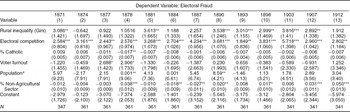
In addition to these robust pooled findings suggesting the importance of landholding inequality for the whole period, we can further refine the analysis by conducting cross-sectional analyses of each individual election year from 1871 until 1912 to interrogate how the relative weight of the independent variables changed over time. Though this analysis is limited by the fact that the earliest landholding inequality data are only available in 1895, the cross-sectional analysis generates some revealing intertemporal variations.Footnote 27 I have examined cross-sectional data for each of the 13 elections between 1871 and 1914).Footnote 28 I report the logit regression results in Table 2 for each election year between 1871 and 1912, again excluding urban districts from the analysis.Footnote 29
Cross-Sectional Analysis of Electoral Fraud by Year, 1871–1912
a Coefficient and standard error multiplied by 106 for readability.
Notes: *p < 0.1, **p < 0.05, ***p < 0.01; robust standard errors in parentheses. Hypotheses are direction-specific; however, levels of significance reported throughout this paper are for two-tailed tests.
First, as reported in Table 2, whereas the competitiveness of elections consistently is related to reported incidence of fraud in all models, landholding inequality has an uneven relationship with electoral fraud across time. However, there does appear to be a pattern that closely maps onto the sharp divide that German historiography has marked at 1890, a year that leading scholars of Germany have argued represented a “turning point” (Evans Reference Evans1987, 87), a “refounding of the Reich” (Blackbourn Reference Blackbourn1980, 14), and a moment in which “one pattern of politics began to be replaced by another” (Eley Reference Eley1980, 19). In 1890, Bismarck resigned from power, the ban on the SPD expired, and the Conservative Party increasingly faced the onset of increasingly well-organized mass party politics (Eley Reference Eley1980, 24–30). In the period before 1890 (columns 1–7 in Table 2), landholding inequality is only inconsistently related to electoral fraud, a finding possibly explained by the relatively secure position in which the Conservative Party found itself during these years, unchallenged by a still-banned SPD and safely entrenched in a political environment where the old style of Honoratiorenpolitik (“politics of notables”) still predominated. By contrast, in all six elections between 1890 and 1912 (summarized in columns 8–13 in Table 2), landholding inequality had a strong and statistically significant positive relationship with electoral fraud, with the exception of the last election of the Reich in 1912.Footnote 30 That representatives from areas of high rural inequality would increasingly rely on election manipulation after 1890 is likely part of what has been called a “counteroffensive” campaign of the Conservative Party that was now under assault from more robustly organized parties, single-issue groups, and a SPD that was no longer banned (Retallack Reference Retallack1988, 156–8). Indeed, after the SPD's ban was lifted, in October 1890, the SPD leadership announced a new slogan and a new strategy—“Out into the Countryside!” (Eley Reference Eley1980, 24). In this context, with traditional forms of power under siege, it is not altogether surprising that electoral fraud in the countryside would also become more common in inequitable areas after 1890.
A second benefit of conducting cross-sectional analyses by each election year is that we can assess whether specific institutional reforms (including the partial introduction of the secret ballot in 1903) had any effect in either reducing the incidence of election fraud or in reducing the strength of the relationship between landholding inequality and election fraud. In Table 2, between 1890 and 1898, before the introduction of the secret ballot, we see that landholding inequality had a similarly strong association with electoral fraud. In 1890, for example, a move from minimum to maximum in landholding inequality, holding all other variables constant, increased the probability of a dispute from 6% to 28%. In 1898, the probability would have increased from 9% to 29%. Surprisingly, after the introduction of the secret ballot for the 1903 elections, as Table 2 shows, the overall incidence of fraud continued its drop (it had reached a high point in 1893), but the coefficient actually increased in value. In 1907, we see that landholding inequality persisted as important four years later and only in 1912 does landholding inequality finally decline in substantive and statistical significance. This last prewar election—and the success of the SPD—suggests change was afoot. However, with the arrival of war in 1914, it is impossible to know in which direction German politics might have moved had war not intervened.
Thus, we see that economic inequality in the German countryside was associated with electoral fraud that undermined the fairness of elections. But surprisingly, at first glance, the 1903 introduction of voting booths appears not to have been a “silver bullet” that immediately solved the problem of electoral fraud.Footnote 31 How do we explain this puzzling finding? Also, how do we explain the fact that the relationship of landholding inequality and electoral fraud, though weak before 1890, strengthened in the later years of the Reich? The findings presented so far call out for a more in-depth analysis of the causal mechanisms linking land inequality and fraud, a task I undertake in the following section.
CAUSAL MECHANISMS: LINKING LAND INEQUALITY AND ELECTORAL FRAUD
The analysis so far has demonstrated that, in general, disputed and problematic elections were more likely in conditions of highly unequal landholding. The question remains: what was the causal process through which this relatively abstract and distant concept of landholding inequality actually operated on the ground leading to election fraud? This section empirically probes the causal pathways or mechanisms linking landholding patterns to electoral fraud, giving the findings above greater plausibility, and also deepening our understanding of the barriers faced by any democratizing society, including pre-World War I Germany. Additionally, such an account helps explain two further puzzles: first, why did an important institutional reform such as the 1903 secret ballot reform appear not to have had much effect on the relationship between inequality and fraud? Second, why as traditional patriarchal forms of politics were declining did the relationship between landholding inequality and electoral fraud actually strengthen?
There are at least two different mechanisms with distinct observable implications that possibly explain how landholding inequality increases the likelihood of electoral fraud. The first, which we can call the “traditional social power” effect, is suggested by a rich sociological literature on power in traditional and rural societies as well as a well-developed historiography on nineteenth-century elections (Eisenstadt and Roniger Reference Eisenstadt and Roniger1984). This perspective highlights the fused authority, power, prestige, and wealth of elites in traditional or rural societies whose control and legitimacy relies on traditional personalistic patron-client ties. In conditions of high landholding inequality, it is argued, elites and their dependents operate in a tightly bound universe of mutual obligations, fused authority, and invidious hierarchy that together allow landlords to leverage their control from one domain into others (e.g., Medina and Stokes Reference Medina, Stokes, Kitschelt and Wilkinson2007, 80). Operating through traditional forms of “deference” (Moore Reference Moore1976) but also via the direct deployment of threats and coercion, this first logic linking land inequality and fraud is premised on a direct causal pathway that travels via face-to-face social patron-client relations.
In the domain of electoral politics, this effect has been described most vividly by historians of pre-1832 British elections in which landlords “marched” their tenants to the polls to watch them publicly vote or in which landlords’ threats to eliminate grazing rights, employment, or loans shaped the political behavior of dependents in traditional patron-client relationships (e.g., Gash Reference Gash1977, 177–92). An observable implication of this logic, if in effect, is that landlords ought to be the actors directly deploying their own power, status, and wealth to compel their enfranchised dependents and employees to vote in line with the patrons’ preferences.
As important as this mechanism may be, especially in underinstitutionalized contexts where traditional social power persists, a less frequently noted second mechanism linking landholding inequality and electoral fraud is one that is found as traditional social power erodes but in contexts where landholding inequality remains. The result is not the disappearance of the linkage between landholding inequality and election fraud. Instead, an alternative logic that we can call a “capture effect” emerges in which landed elites seek to preserve their electoral dominance in the countryside but no longer do so inside a direct patron-client relationship. Instead, they exert influence indirectly via the capture of rural local public officials such as mayors, county commissioners, police officials, and election officials, who in turn are the actors that interfere with free and fair elections. In its most acute form, capture occurs as socioeconomic interests infiltrate the state by using their own personnel to staff the state (Bernstein Reference Bernstein1955, 82; Quirk Reference Quirk1981, 43).Footnote 32 Thus, a “hard” twofold empirical test for the capture effect involves assessing the following: first, that it is not landed elites, but government officials who manipulate elections; and second, that higher levels of landholding inequality increase the likelihood that prominent local landed nobility (rather than nonnoble professionals) staff local government positions.
To weigh the relative importance of the traditional social power effect and the capture effect, this section focuses on one key region: East Elbia, Prussia (in the upper northeast corner of Figures 2 and 3). The seven provinces east of the Elbe River in Prussia (including East Prussia, West Prussia, Brandenburg, Pommern, Posen, Saxony, and Silesia) were the heartland of Prussian power, disproportionately influencing the development of Germany as a whole (Clark Reference Clark2007, xiii). Not only was this an “extreme” region marked by the highest rates of landholding inequality and electorate fraud in Germany, but it also was a region where the traditional social power logic ought to have been present if it were still in effect anywhere in Germany, given the late persistence of feudalism and landlord power in this region. Surprisingly, however, as we shall see, traditional social power was in decline even here, thus making it an empirically useful “crucial case” that helps expose both the limits of this logic and the importance of alternative causal processes.Footnote 33 Using memoirs of government officials, more detailed election dispute data, and secondary material, the aim in this case study is not to demonstrate that a relationship between land inequality and fraud exists. Rather the aim is to illustrate how landholding inequality matters.
A Case Study: Politics in the East Elbian “Junker's Paradise”
If there were anywhere in Germany where traditional social power ought to have still been observable in the nineteenth century, it was in the seven provinces east of the Elbe River. This was a region where feudalism lasted longer than anywhere in Germany (into the nineteenth century), landholding inequality was higher than anywhere in Germany (Kaiserliches Statistisches Amt 1898, 351–413), and elections were marred by a greater incidence of electoral fraud than anywhere in Germany. It was a region where traditional Junker social power had been so dominant into the late nineteenth century that Helmuth von Gerlach in the famous memoir of his youth in the 1880s in this part of Germany called it a “Junker's Paradise” (von Gerlach Reference von Gerlach1925, 25).
Remarkably, however, in Germany by 1871 it appears that these traditional avenues of elite control were quietly eroding even in this most patrimonial part of Germany. Throughout the nineteenth century, what contemporary critics called Germany's “Bread Lords” did still rely, when possible, on their traditional social power, whether through use of direct coercion or networks of deference (see discussion and examples in Anderson Reference Anderson[2000, 152–98]; Suval Reference Suval[1985, 102–3]). However, recent historiography (e.g., Hagen Reference Hagen2002; Wagner Reference Wagner2005) has revised our stereotyped image of a static and unchanging eastern Prussia by pointing out that by 1875, only 19% of total rural population still lived on the traditional rural estates (Gutsbezirke) directly administered by nobility (Wagner Reference Wagner2005, 534). Moreover, since the abolition of feudalism in the first part of the century, by the 1870s, labor was increasingly mobile even in eastern parts of Prussia, with massive inflows and outflows of labor (Grant Reference Grant2005, 79–113). Economic historian Oliver Grant (Reference Grant2005) analyzes census data to show that the eastern provinces in fact had among the highest rates of emigration in Germany from the 1870s onward (2005, 85–6) and was also the recipient of above-average levels of foreign agricultural workers (including Poles, Russians, and workers from Austria-Hungary), constituting around 4–6% of total agricultural workers by 1907 (2005, 93).
The consequences of such social turmoil, as Max Weber himself reported in his 1892 profile of agricultural workers in eastern Prussia was that the old order was “in ruins” (Weber [1892, 494, 633], cited by Anderson Reference Anderson[2000, 164]). Landholding inequality persisted, but traditional “deference communities” (Moore, Reference Moore1976) and the traditional underpinnings of patron-client relations were eroding, as labor mobility increased and new nobility and a new class of rural bourgeoisie now occupied the landscape along with the older Junker class. This social uprooting explains, in part, why when one systematically hand-codes the content of the 617 petitions behind the 155 disputed seats that were discussed in the Reichstag plenary sessions after two elections (1890 and 1912), only 12% entailed complaints of “private” electoral “influence” of landlords or employers.Footnote 34
Yet, if traditional routes of patron-client social control were in decline even in this region, why did the relationship of landholding inequality and electoral fraud not only persist but in fact grow stronger in the period between 1890 and 1912 in locations such as the eastern provinces of Prussia? To answer this question requires turning our attention to a counterintuitive second possible causal mechanism linking inequality and fraud in this period, a mechanism we have called the capture effect, which highlights the process by which asymmetries or inequalities in socioeconomic wealth first led to the penetration of local government institutions that are then manned by “captured” government officials who in turn commit electoral fraud as part of an institutionalized system of electoral manipulation and control.
Indeed, when we systematically look at the 617 petitions that generated the 155 disputed seats in the 1890 and 1912 elections, it was not landed elites who appeared to directly manipulate elections, as a traditional social power argument would predict. Rather, 66% of charges of misconduct were against local government officials and polling station chairs.Footnote 35 But it is crucial to emphasize that such charges of government officials manipulating elections were not disconnected from underlying socioeconomic conditions. In fact, the opposite was true: as the analysis above demonstrated, elections were more likely to be subject to manipulation in regions marked by high levels of landholding inequality. And, moreover, it was Conservative Parties, who dominated these rural areas who disproportionately were accused of benefiting from election fraud: In 1890, Conservative Party victories were the subject of 42% of the disputes, although they won only 19% of the seats; and in 1912, they were the subject of 38% of disputes despite winning only 12% of the seats (Arsenschek Reference Arsenschek2008).
One example that helps illustrate the capture effect is found in the east Elbian electoral district of Prenzlau-Angermünde (fourth district of Brandenburg), with a population in the 1890s of 120,000, located 100 kilometers northeast of Berlin, just west of the Oder River but squeezed up against the eastern edge of the state of Mecklenburg Strelitz. Not far from Junker-dominated landscapes conjured up in Theodor Fontane's 1899 novel The Stechlin, the fourth electoral district of Brandenburg was a prototypically rural district with open green fields, lakes, and a predominant reliance on agriculture that was spread out across two counties, Prenzlau and Angermünde. Marked by among the highest levels of electoral fraud in Germany (with four of the six elections disputed between 1890 and 1912) and high levels of rural inequality, it is a district that brings into sharp focus the role of the capture effect in linking landholding inequality and electoral fraud. In the six parliamentary elections between 1890 and 1912 in Prenzlau-Angermünde, the Conservatives were dominant, winning every election but relying increasingly on active interventions in the electoral process by local government officials. In the 1893 election, the longstanding local administrator or prefect (Landrat) of the central government, Karl Ulrich von Winterfeldt, a major landowner from a prominent family in the district who had occupied his position as Landrat since 1863 also ran for the first time for parliament as the Conservative Party candidate from his district. His simultaneous status as one of the region's largest landowners, the central government's most important local administrator, and Conservative-Party candidate for the national parliament was not uncommon and is a particularly stark example of how local landed elites deployed local state power to capture the election process for political ends.
The Landrat position that von Winterfeldt occupied has been described as “the linchpin” of the Prussian system of public administration (Jacob Reference Jacob1963, 15) and was also the decisive pivot in the capture of the electoral process (e.g., Fenske Reference Fenske and Fenske2002, 562–74). As with each Landrat in each of Prussia's over 400 counties, von Winterfeldt was not only the central government's bureaucratic “field officer” on the ground, overseeing tax assessment, schools, the military draft, police, and the management of elections, but he also was, decisively, required to be a landowner in the district, usually deeply embedded in, and in constant contact with, the local nobility (Muncy Reference Muncy1944, 59). In Germany as a whole, the higher the level of landholding inequality the smaller the number of landowners above 200 hectares (r = 0.80) (Kaiserliches Statistisches Amt, 1898, 351–413). This arguably made the collective action problems of capture (e.g., Stigler Reference Stigler1971) easier to solve since the social networks of new and old landowners were therefore smaller and more tightly knit in places such as eastern Prussia where landholding inequality was high.
Indeed, in Prenzlau this was true: there were only seven estates over 1,000 hectares (Kaiserliches Statistisches Amt 1898, 355). Before 1872, when von Winterfeldt had first come into office, the Landrat's position depended entirely on the nomination of leading landowners whose dominance in the county council (Kreistag) was assured by a weighted electoral system. And, even after the important 1872 reform of local government (Wagner Reference Wagner2005, 291–328), the king's Interior Ministry only appointed officials after consulting with property owners in the district, who continued to exert a de facto veto on nominees for the position.Footnote 36 Von Winterfeldt, like many Landräte, survived the reform. The result was an official who was, in Bismarck's own critical view of the position of Landrat, a “Janus” figure, often embedded in networks of the local community and only formally loyal to the central bureaucracy (Muncy Reference Muncy1944, 58). While von Winterfeldt successfully managed his district for 33 years, the price for Landräte who failed to conform to local norms was high, sometimes resulting in their expulsion from their position, under pressure from local elites (Wagner Reference Wagner2005, 206–14). By all accounts, it was crucial for the formally neutral Landrat to integrate himself into local social networks. As one Landrat from Posen reported in his memoirs in 1894, “I had to join the local branch of the Agrarian League, because everyone I interact with socially—and everyone I hunt with—is a member!” (cited by Wagner Reference Wagner[2005, 425]).
In Prenzlau, a crucial part of the Landrat von Winterfeldt's official function, as for every Landrat, was his sole responsibility for “impartially” managing elections—generating lists of registered voters, manning precincts, and ensuring votes were counted. However, in a pattern that was observable throughout much of Prussia, von Winterfeldt was drawn from the nobility, like an estimated 56% of Landräte in Prussia as a whole (and an even greater 81% in the province of Brandenburg, where Prenzlau was located (Eifert Reference Eifert2003, 98–9). The consequence was that a narrow strata of powerful local landed elites was often in control of the local state apparatus. But the local “influence” of Landräte simultaneously had its uses for the central state.
For example, when the German Interior Ministry sent specific instructions to all Landräte throughout Prussia to use their authority over elections to favor Conservative Parties but to avoid overly explicit electoral corruption for fear of the parliamentary election disputes investigation committee (Fairbairn Reference Fairbairn1997, 77), the government's interests and those of the Landrat were neatly aligned. Especially in eastern Prussia, the Landrat was usually a member of the local branch of the Conservative Party, attended election rallies for the Conservative Party, often traveled around the district to local villages while pressuring mayors (whom he appointed and who needed his approval to stay in office) to generate Conservative victories. In addition to visiting local officials during campaigns, the Landrat also often visited local tavern owners, providing pressure that they not let their facilities be used for opposition-party gatherings of Social Democratic and Left Liberal Parties (Wagner Reference Wagner2005, 422). Moreover, in his position of generating voter lists and overseeing elections, the Landrat used his personal network of relations to make clear to local rural mayors and poll station chairs, that Conservative victories would be rewarded with infra structure programs and Conservative defeats would be punished with unfavorable tax assessments (Wagner Reference Wagner2005, 422–3).
In the case of Karl Ulrich von Winterfeldt's candidacy in Prenzlau-Angermünde in 1893, he was elected decisively with 64% of the vote against a Social Democrat who received 20% of the vote (Reibel Reference Reibel2007, 40), undoubtedly aided by his own threefold role of local notable, election administrator, and candidate for office. In fact, immediately after the votes were counted in 1893, von Winterfeldt's Social Democratic opponent and a group of voters submitted a complaint to the Reichstag election disputes committee that the election result should be overturned because voters’ secret ballots were systematically violated by polling station officials, who had been appointed by von Winterfeldt (Stenographische Berichte, January 17, 1884, 686). Despite the possibility of the validity of the complaints, the parliamentary committee followed its normal precedent of not overturning the election since the scale of fraud was not sufficient to alter the results of the election.
Similarly, in the next election in 1898, the Conservative Party's candidate was again Karl Ulrich von Winterfeldt, who also again won by a 40-point margin over the same Social Democratic opponent (Reibel Reference Reibel2007, 40). But this time, the election was administered by a new Landrat: Joachim von Winterfeldt, the elder von Winterfeldt's 32-year-old son, who had trained at his father's side the year before in the office of Landrat (von Winterfeldt Reference von Winterfeldt1942, 88). Thus, in 1898, the complex logistical task of running the election fell to the new Landrat, who recounts his experiences as new Landrat in his memoirs (von Winterfeldt Reference von Winterfeldt1942, 80–111). In 1898, he helped ensure that his father, the elder von Winterfeldt, won against his Social Democratic opponent, but victory was achieved at the cost of more vigorous petitions from the Social Democratic opposition, filed to the Reichstag, claiming that the new Landrat of Prenzlau (the younger von Winterfeldt) had altered the outcome of the vote by removing massive numbers of seasonal workers from the voting rolls, and that local election officials had systematically violated the secret ballot and had rejected qualified voters for invalid reasons, leading to the victory of von Winterfeldt's father (Stenographische Berichte, March 9, 1899, 1431).
In 1907 and 1912, the Conservative Party won again, against a consistently strong SPD (again winning around 20% of the vote in both elections). But for the latter election, with the illness and death of the elder von Winterfeldt in 1908, it was the younger von Winterfeldt, Joachim, who successfully ran for office on the Conservative ticket. In both 1907 and 1912, petitions were again filed, challenging the validity of the election, but this time from the election committee of the Left Liberals who had split the opposition vote with the Social Democrats in 1907 and 1912. In these two elections, election petitions complained that the new Landrat had once again systematically excluded large numbers of seasonal workers from voting rolls; had expelled voters from the voting stations; had violated the secret ballot, throwing away ballots for the opposition parties; and had thwarted opposition efforts to mobilize and organize rural workers (Stenographische Berichte, July 13, 1909, 9,462; March, 9, 1914, 7,939).
Overall, in Prenzlau-Angermünde, we see a recurring trend that was not found everywhere in Germany but nonetheless was in effect where landholding inequality and electoral fraud were both high: local officialdom, closely tied to and often manned by local landowning elites’ interests, worked on behalf of the Conservative Party, blocking the exercise of free and fair elections. There are three chief reasons to believe that the capture effect present in Prenzlau-Angermünde was not merely unique to that district. First, as noted earlier, in Germany as a whole, election disputes tended to involve local government officials and not employers or landlords directly pressuring employees, as a “traditional social power” logic would expect. Second, the failure of the 1903 secret ballot to disrupt the landholding inequality–electoral fraud link, though puzzling from a traditional social power perspective, makes sense if we consider that an institutional reform that might have broken a dyadic patron-client tie would likely have little effect on a more institutionalized form of electoral fraud in which it was government officials and polling station chairs and committees enforcing the secret ballot who themselves were the chief culprits of election fraud.
Finally, if we analyze the Prussian Interior Ministry's own Annual Almanac in 1892 that lists the name of every Landrat for all 481 Prussian counties (also listing whether a Landrat was a nobleman or not), we can assess the hypothesis that high land inequality increased the likelihood of “capture” across all of Prussia's counties. As noted earlier, one core mechanism of capture is when powerful socioeconomic interests themselves staff administrative bodies. Thus, in one particularly revealing test of the claim that high landholding inequality leads to greater capture, we can compare districts where the Prussian Interior Ministry's personnel almanac lists that a nobleman, rather than a professional bureaucrat without noble heritage, occupied a county's position of Landrat.Footnote 37 A simple t-test comparing districts where in 1891 a nobleman was Landrat (n = 243) with districts with nonnoblemen as Landrat (n = 238) confirms the conventional wisdom that historians of Prussian public administration have long observed (Eifert Reference Eifert2003, 99; Muncy Reference Muncy1944, 189): noblemen tended to occupy the highest county administrative position of Landrat in districts with higher landholding inequality (p < 0.001), greater percentage of land held by landowners with more than 200 hectares (p < 0.001), and higher average-size landholding (p < 0.001), while nonnoblemen (usually with legal training using the position as a first step on a bureaucratic career) were more likely to be found as Landräte in districts with lower levels of landholding inequality; smaller, average-size estates; and smaller portion of land held by large landholders.Footnote 38
In short, the case of Prenzlau-Angermünde in East Elbia Prussia reveals a broader causal logic: landholding inequality led to electoral fraud not because landed elites still possessed traditional forms of patron-client social power over their dependents. In fact, such forms of personalistic power were in decline in this period despite high levels of landholding inequality. In their place, however, as the scope of activity of the central state expanded, landed elites developed innovative strategies of capture that provided landed elites with the new forms of institutionalized capacity to carry out the systematic manipulation of elections.
CONCLUSION
This article has examined the spatial and temporal diversity of the practice of elections within the single case of Imperial Germany, where elections were robust and contentious, but were carried out in a society marked by substantial spatial variation in socioeconomic structure. While the strategic context of electoral competition clearly affects political actors’ motives vis-à-vis elections, this article has also made the case that the character of social structure shapes the fairness of elections. The main empirical finding is that election fraud and flawed elections are more likely when elections are introduced into settings marked by high levels of landholding inequality. Even in the presence of uniform rules of universal male suffrage, in such settings landed elites were more likely to capture the key local institutions of the state, providing them with the coercive and material resources to disrupt fair and free elections in order to defend the countryside from oppositional mobilization efforts.
There are two main implications to be drawn from this analysis, one for the study of Germany and a second for the study of democratization more generally. First, Germany's difficult passage to democracy has long been regarded as instructive for theorists of democracy but has in recent years generated a starkly bifurcated debate. On the one hand, there are historians and social scientists who contend that premodern or feudal legacies blocked and then poisoned Germany's democratization (Dahrendorf Reference Dahrendorf1967; Moore Reference Moore1967; Wehler Reference Wehler1983), leading Germany down a historically unique path (Sonderweg) away from the rest of the “West,” until the mass destruction of two world wars. On the other hand, recent leading scholars of German democratization have sought to diminish the differences between nineteenth-century Germany and other European and North American cases, arguing that Germany was not unique, and moreover it was arguably more democratic than its North Atlantic counterparts in the late nineteenth century (Anderson Reference Anderson2000; Berman Reference Berman2001; Blackbourn and Eley Reference Blackbourn and Eley1984).
The findings in this paper challenge both perspectives, compelling us to reformulate our understanding of the rural roots of Imperial Germany. Imperial Germany ought not simply be regarded as an unchanging “premodern” political regime dominated by feudal legacies. However, the state of Prussia's landed elites did have a perniciously formative effect on Germany's political development. But they did so through an essentially “modern” political bargain struck between landed elites and the government of the German state. Undergirding this bargain was a pattern of electoral fraud that left its imprint on the entire political regime. In a form that surely looks recognizable to students of developing democracies today (Gandhi and Przeworski Reference Gandhi and Przeworski2007; Kitschelt and Wilkinson Reference Kitschelt and Wilkinson2007; Magaloni Reference Magaloni2008), in Imperial Germany, local government officials acted as “brokers” (Wagner Reference Wagner2005, 586–687) in a clientelist arrangement between the central government and its most important constituency: Prussia's landed elites. At the local level, landed elites enabled local government officials to use electoral manipulation in the delivery of reliable Conservative votes from their “core” rural constituencies; this blocked the democratization of the countryside. In exchange, Conservative parliamentarians and the central government delivered governmental policies (infrastructure investments, favorable tax policies, and protectionism) targeted specifically to these districts (Wagner Reference Wagner2005, 386–412).
The result was a highly institutionalized and robust political regime in which landholding inequality, electoral fraud, and persistence of the regime were tightly interwoven, making small measures such as the introduction of the secret ballot in 1903 extremely hard-fought and not particularly effective. The consequences were far-reaching: this political bargain helped roll back and weaken mid-century Liberal dominance in the countryside in the 1870s and 1880s in Prussia, (Kühne Reference Kühne1994, 58–77) leaving rural voters “available” for later socialist efforts at mobilization and dooming the chances for a moderate Red-Green coalition, which, Gregory Luebbert (Reference Luebbert1991) and others have argued, led to the failure of democracy in Germany in the 1930s.
In addition to these implications for the study of Germany and Europe, there are implications of this case for the study of democratization more generally. While the political equality offered by universal, equal, direct suffrage was, and continues to be, regarded as potentially transformative, its impact is conditional and can be diminished if introduced into settings marked by stark socioeconomic inequalities and steep social hierarchies. Electoral fraud and manipulation are the result when democracy bumps up against economic inequality. This finding challenges recent claims that elections are ipso facto democratizing (Bunce Reference Bunce2008; Hadenius and Teorell Reference Hadenius and Teorell2007; Lindberg Reference Lindberg2006). An important implication of this article's empirical finding is that elections can sometimes have the opposite effect. Elections in nondemocratic regimes can potentially bolster entrenched interests, buying greater legitimacy for imperfect regimes, thereby extending their life span (Gandhi and Przeworski Reference Gandhi and Przeworski2007). Thus, we need not only focus on the “adoption” or short-term “choice” of democratic procedures as most empirical work continues to do but also to examine the long-term process of democratization as it confronts, and is shaped by, a variety of “push-back” tactics such as election manipulation that are deployed with the goal of making elections endogenous to preexisting social power. Moreover, if the very procedural goals of adopted de jure rules are undermined by de facto social power, the foundational concept of democratic transition itself becomes fragile. Indeed, since democracy is rarely if at all ever achieved “at once,” we are then left asking: might it be time to drop the longstanding but tenuous distinction between democratic transition and democratic consolidation from our vocabulary altogether?
If election fraud is a mechanism for subverting or co-opting formal processes of democratization, then this suggests an alternative avenue for studying the processes of democratization. Rather than focusing on what “proximate” conditions are present at singular moments of transition, this finding indicates that it is useful to study democratization as a process of institutional development with a longer time frame (Tilly Reference Tilly2007) in which formal moves to democratize intersect with diverse forms of push-back with varying degrees of subtlety (e.g., suffrage restrictions, institutional reforms to diminish the impact of elections). The question of why such efforts take different forms and when they are more or less successful requires a broader comparative scope than the one adopted in this paper. Yet, understanding the strategies of how societal interests protect themselves in the face of democratizing changes represents a fruitful area of future inquiry.
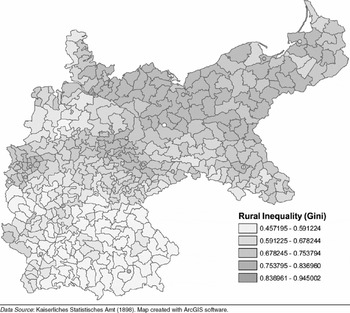
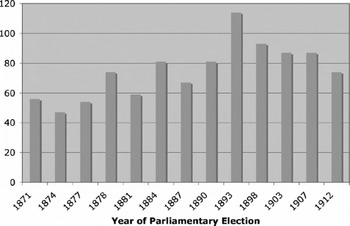
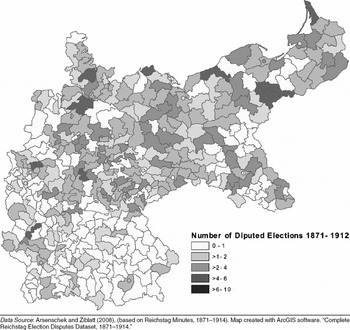
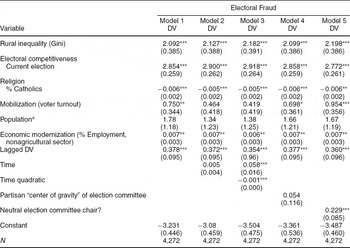
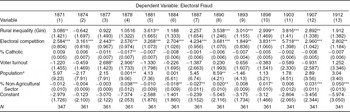



Comments
No Comments have been published for this article.