This paper sets out some of the economic factors underpinning Scotland's move to a low carbon economy. Economics matters, since it addresses the costs of reducing greenhouse gas emissions, the costs of climate change impacts, and the economic factors which motivate individuals' behaviour and the behaviour of businesses. All of these are important in understanding the barriers to meeting targets and to successful adaptation, and in thinking about how these barriers can be lifted.
From an economics viewpoint, we ask three questions:
(i) How can Scotland's mitigation targets best be met?
(ii) How should Scotland adapt to the impacts of climate change?
(iii) What are the incentives for behavioural change towards a low carbon economy?
We conclude by offering a series of recommendations to policy makers.
1. How can Scotland's mitigation targets best be met?
The Scottish Government has set ambitious targets for reducing GHG emissions. These include a 42% reduction by 2020 relative to 1990 levels. Also of relevance is the Scottish Government's target to meet the equivalent of 100 per cent of gross annual electricity demand from renewables by 2020.
1.1. Considerations from economic theory
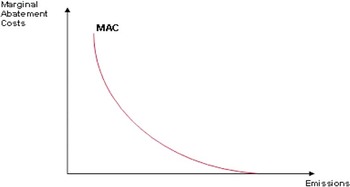
Economists have long argued that society can achieve emission targets at lower cost if some allowance is made for the marginal abatement costs (MACs) varying across pollution sources. By ‘marginal’, we mean the costs of reducing emissions by one additional unit (e.g. one more tonne per year). Figure 1 illustrates the concept of marginal abatement curves. Major sources of greenhouse gas emissions in Scotland are the energy supply sector, other industrial sources, transport, agriculture and heating of people's homes. Reducing emissions from the energy sector would be very unlikely to cost the same, per additional tonne, as reducing emissions from households. Moreover, the costs of reducing emissions vary within a particular sector, so that, for example, reducing emissions is more costly from some businesses than from others due to differences in production activities. Thus we expect marginal abatement costs to vary both across sectors and within sectors, and some evidence on this for Scotland is presented later. For some mitigation options, marginal abatement costs may be negative. For example, many instances have been noted where businesses can both reduce carbon emissions and save money by investing in energy efficiency. In answering question (iii), we note some reasons why such negative cost options may not be taken up by businesses and households.
illustration of a Marginal Abatement Cost curve.

Why does this variation in marginal abatement costs across polluters matter? By re-allocating abatement from high-cost sources to lower-cost sources, a given total emission reduction can be achieved at lower total costs; or, put another way, a greater total emission reduction can be achieved for a given total cost. The lowest cost way of achieving a given target reduction requires that marginal abatement costs be equalised across sources (Baumol & Oates Reference Baumol and Oates1988), and it makes sense to opt for policies that can get close to such outcomes. As targets become tougher over time, the costs of meeting targets can rise, and so saving costs becomes even more important. But how can such a ‘least cost’ outcome be achieved?
Market mechanisms, which include pollution taxes and tradeable pollution permits, have emerged from economic theory as a potential means of achieving target pollution reductions at least cost. These mechanisms work by incentivising polluters to reduce emissions up to the point where marginal abatement costs are equal to the ‘price of pollution’. In a pollution tax system, this price is equal to the tax rate. In a tradeable permit scheme, the price is equal to the current price of permits. Hybrid schemes also exist (OCC 2009), whilst pollution reduction subsidies can also be considered as economic instruments. The ability of businesses to set their own emission reduction levels relative to this uniform price is key, since it encourages those with the lowest marginal abatement costs to undertake the greatest degree of emission reductions. So long as the pollution tax rate is set high enough, or the total supply of tradeable permits set low enough, then the target pollution reduction is achieved – in theory, at least cost to the economy as a whole. Market mechanisms can also provide greater incentives for businesses to innovate and invest in cleaner technologies than regulatory alternatives, which either specify what technologies must be adopted (e.g., house construction standards) or how much emissions are permitted for certain activities (e.g., EU emission limits for new cars). Evidence submitted during the Inquiry recognised the role market mechanisms play in incentivising investment in low carbon technologies and the additional economic benefits this will bring to Scotland. Market mechanisms can be applied to any type of polluter, including households. Thus, higher fuel prices provide incentives to reduce CO2 emissions from driving, whilst per-kg rubbish collection charges would reduce solid waste generation by households.
The main benefit of carbon taxes and tradeable pollution permits is that they put a price on carbon – a point highlighted throughout the Inquiry. Putting a price on pollution is vital to efficient public policy, since it provides an on-going incentive to reduce carbon emissions in every sphere of economic activity. Market mechanisms can achieve a given reduction in emissions at a lower cost to society than standards and regulations, because they provide greater flexibility in the means by which emissions are reduced, through setting such a price on pollution. However, a carbon tax cannot guarantee a certain level of emissions and tradeable pollution permits suffer from initial distributional consequences and price volatility, making accurate estimation of the total cost of compliance difficult (IPCC Reference Metz, Davidson, Bosch, Dave and Meyer2007). Furthermore, policy predictability is essential, since to influence behaviour, investors and consumers must believe a given policy will be maintained into the future (OCC 2009). Given these drawbacks, it has been suggested that regulations are more appropriate than market mechanisms because regulations provide certainty about emission levels (IPCC Reference Metz, Davidson, Bosch, Dave and Meyer2007). Regulations appeal because they provide clear guidance and reduce uncertainty for investors and are preferable where informational barriers prevent businesses and households from responding to price signals (IPCC Reference Metz, Davidson, Bosch, Dave and Meyer2007), or when the carbon price is too low to have a significant effect (OCC 2009). However, regulations need to be enforced, which is costly, whilst they impose excessive costs on society of meeting pollution reduction targets.
The EU Emissions Trading Scheme (ETS) provides a good example of regulating emissions using a market mechanism. But is important to understand the distinction between the ETS and non-ETS sectors within the EU and that there are limited opportunities for trading emissions control responsibilities across these two sectors. Bohringer et al. (Reference Bohringer, Rutherford and Tol2009) estimate that restricting trading between ETS and non-ETS sectors raises the costs of meeting the EU's 20% target reduction by 2020 by between 14% and 53%. If no trading is allowed, costs rise by a further 40% over the period 2013–2020. These results show the importance of allowing flexibility in emission reductions, the desirability of a single (implicit) carbon price ruling throughout the EU and the importance of allowing as many emission sources as feasible to take part in carbon trading, for cost savings to be maximised.
Governments are now making increased use of market mechanisms to control pollution (see OECD 2007)). For air quality, evidence suggests that significant costs savings have been generated by such schemes, relative to more regulatory approaches (eg Carlson et al. Reference Carlson, Burtraw, Cropper and Palmer2000). In other settings, costs savings have been less than envisaged, although still considerable (Shortle & Horan Reference Shortle and Horan2008). Transactions costs (the costs of gathering information, making decisions/contracting, and controlling/policing) in pollution trading schemes can significantly erode potential cost savings, yet the EU ETS is still estimated to have reduced the EU wide costs of meeting Kyoto targets by 24–60% over a base case of equal allocation of control responsibility. Despite recent challenges to the US sulphur trading scheme, the scheme has been deemed a success, having reduced CO2 emissions by half during its lifetime, at a significantly lower cost than regulatory alternatives.
Actual choice across policy instruments is, however, more a matter of political expediency than economic argument, and one of the main reasons why the EU chose a cap-and-trade system for CO2 control rather than a carbon tax (Ellerman et al. Reference Ellerman, Convery and de Perthuis2010). Indeed, the lack of political will to attempt to control energy use by imposing higher costs on local people was recognised by many during the Inquiry. Industrial sources of pollution have long been regulated, thus the setting up of a cap-and-trade system was relatively straightforward. Imposing a carbon tax would have been more difficult politically. Policy options in such sectors for mitigation thus tend to depend on voluntary participation in subsidy-based schemes, rather than on cap-and-trade. During the Inquiry, it was suggested that politicians need to work together to make the unpopular choices that are necessary for transition to a low carbon economy.
1.1.1. Multiple targets
Adding additional targets without adding additional policy mechanisms can increase the costs of meeting carbon targets, by imposing restrictions on how these are met. Two examples are the EU target of 20% penetration of renewable energy by 2020, and an EU aspiration for a 20% improvement in energy efficiency by 2020. As Bohringer et al. (Reference Bohringer, Rutherford and Tol2009) show, introducing such additional constraints raises the costs of meeting CO2 reduction targets substantially, by up to 90% over the ‘no renewable standard’ case for 2013–2020. However, there are possible off-setting benefits from a separate renewable target if, for example, this is achieved by renewable portfolio standards (e.g., the requirement that at least x% of electricity consumption is met from renewable sources). Such schemes are now common world-wide, and can reduce carbon leakage associated with tradeable emission permit markets. Carbon leakage can arise, for instance, if EU consumption of carbon-intensive consumption goods is met by production outwith the EU ETS area (Davis & Balistreri Reference Davis and Balistreri2010).
Carbon reduction targets could be set in terms of the carbon embodied in consumption goods, rather than the carbon involved in production. This would counter the leakage problem noted above. However, such a move would impose considerable monitoring problems on regulators (measuring the carbon flows in consumption), and might also logically lead to the imposition of import taxes levied on the carbon content of goods. This would be unlikely to be popular with developing and transition economies, and might well be counter to current WTO agreements. Evidence collected during the Inquiry shows that some stakeholders view multiple targets as a barrier to mitigation, because having to comply with a variety of schemes makes the regulatory environment more complex.
1.1.2. Encouraging cleaner technology
Directed technical change can reduce the costs of future cuts in GHG emissions by gradually replacing ‘dirty’ technology with ‘clean’ (i.e., low-carbon) technology. Acemoglu et al. (Reference Acemoglu, Aghion, Bursztyn and Hemous2010) have recently argued that such innovation results in two externalities: one is a reduction in pollution, and the second is to make future innovations more profitable. This means that a government needs to introduce two instruments: a carbon tax and an innovation subsidy. This needs to happen as soon as possible, due to rising costs of climate change and current over-investment in dirty technologies. However, the innovation subsidy should be temporary, since as soon as clean technology establishes a technical lead over dirty technology, businesses can be relied on to invest in further clean innovations without the subsidy. The short-run cost of the technology subsidy will depend on the current gap between clean and dirty technologies, whilst the magnitude of the optimal innovation subsidy depends on the elasticity of substitution between clean and dirty technologies. Using a carbon tax alone will mean higher costs over time, where such ‘innovation externalities’ are present.
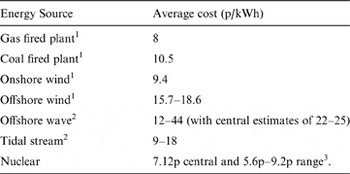
The UK government is committed to supporting a more stable environment for investment in low-carbon electricity generation (HM Treasury 2010) arguing that, to encourage investment in renewable energy, the electricity market must be reformed (DECC 2010a). Reform proposals include carbon price support. The electricity generation sector faces a carbon price through the EU ETS scheme. However, the carbon price has not been stable and reform of fuel duty and the climate change levy in relation to fossil fuels used in the generation of electricity is proposed to provide greater support to the carbon price and greater certainty regarding costs and benefits of alternative investments (HM Treasury 2010). Carbon price support increases the cost of fossil fuel generation relative to renewable energy generation, thus incentivising investment in low-carbon technology (HM Treasury 2010). Table 1 gives estimates of the relative costs of electricity generation from conventional and renewable sources in the UK.

The carbon price used in policy appraisal, the shadow price of carbon, is distinct from that faced by electricity producers. A new approach to carbon valuation was outlined in 2008–2009 by DECC, which has brought the shadow price of carbon more in line with that faced by the electricity sector. This approach distinguishes between a ‘traded price of carbon’ and a ‘non-traded price of carbon’ for use in the short term. The ‘traded price of carbon’ is based on estimates of the future price of EU emissions allowances, and will be used in appraising those policies that reduce/increase emissions in sectors covered by the EU ETS. The ‘non-traded price of carbon’ is based on estimates of the marginal abatement cost required to meet specific emission reduction targets, and will be used in appraising those policies that reduce/increase emissions in sectors not covered by the EU ETS. In the long term (i.e., from 2030 onwards), a single traded price of carbon, based on estimates of future global carbon market prices, will be used (DECC 2009). The short-term carbon values were revised in June 2010. The 2011 short-term traded price of carbon was estimated at £14.3 per tonne CO2e, with a range of £7.4 to £18.1, and the short-term non-traded price of carbon at £52.5 per tonne CO2e, with a range of £26.2 to £78.7 (DECC 2010b). In 2030, the long-term traded price of carbon is estimated at £70 per tonne CO2e, with a range of £35 to £105, and in 2050, the long-term traded price of carbon is estimated at £200 per tonne CO2e, with a range of £100 to £300 (DECC 2009). These figures can be compared to a number of other current ‘carbon prices’. For example, the traded price of CO2 under the EU ETS at time of writing is around 4.60 euro/tonne (£4/tonne), having fallen around 60% in the 12 months to May 2012, due to a collapse in demand following the global recession starting in 2008. The EU has indicated that it would prefer the price to be around 20 euro/tonne, to provide stronger incentives for abatement. In Australia, the Gillard government plans the introduction of a carbon tax of $23 (around £14.20) for each tonne of CO2 beginning on 1 July 2012, imposing this on the 500 largest emitters of carbon. The price will rise by 2.5 per cent a year in real terms during a three-year fixed price period until 1 July 2015. The carbon price mechanism will then transition to an emissions trading scheme, in which the price will be determined by the market. Trading will be allowed with international permits markets such as the EU-ETS, although with the imposition of a floor price.
1.1.3. Summary
Other things being equal, policy design for reducing GHG emissions should focus on market mechanisms that permit flexibility in response on the part of polluters, whether households, local authorities or businesses. This is particularly when differences in marginal abatement costs across sources are large. Introducing additional targets is likely to increase the costs of achieving CO2 reduction targets, by reducing the flexibility with which these targets can be met. There may also be an important role for state under-writing of investments in new low-carbon technologies, and in providing temporary innovation subsidies for new technologies.
1.2. Delivering reductions in GHG emissions
In terms of delivering reductions in emissions, two challenges arise: are differences in MACs sufficiently large, and do current policies promote cost-effective responses?
With regard to the former, two questions arise:
• What estimates of marginal abatement costs (MACs) are available for the main economic sectors?
• Do these show potential for cost-savings from the flexible policies itemised above?
In terms of the first question, the evidence is patchy, both in terms of control options and sectors. Point estimates exist for some sectors/control options, but few data exist on MAC functions. In general, MACs rise for a given sector as the degree of emission reductions increases (Fig. 1). However, MAC curves for any sector will shift as technology changes and the shape of future MAC curves is also important, but we know even less about this.
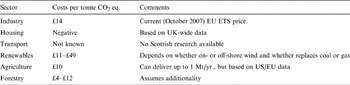
Table 2 (Hanley Reference Hanley2007) demonstrates that (i) costs varied substantially across and within sectors; (ii) there were important gaps in the data (e.g. transport sector); (iii) relatively low cost options seemed to exist in the land use sectors; (iv) for housing, measures were available to cut emissions that reduce costs; and (v) cutting CO2 by investing in some forms of wind energy was a relatively expensive way of reducing emissions.
Estimates of relative abatement costs for Scottish sectors (Hanley Reference Hanley2007).

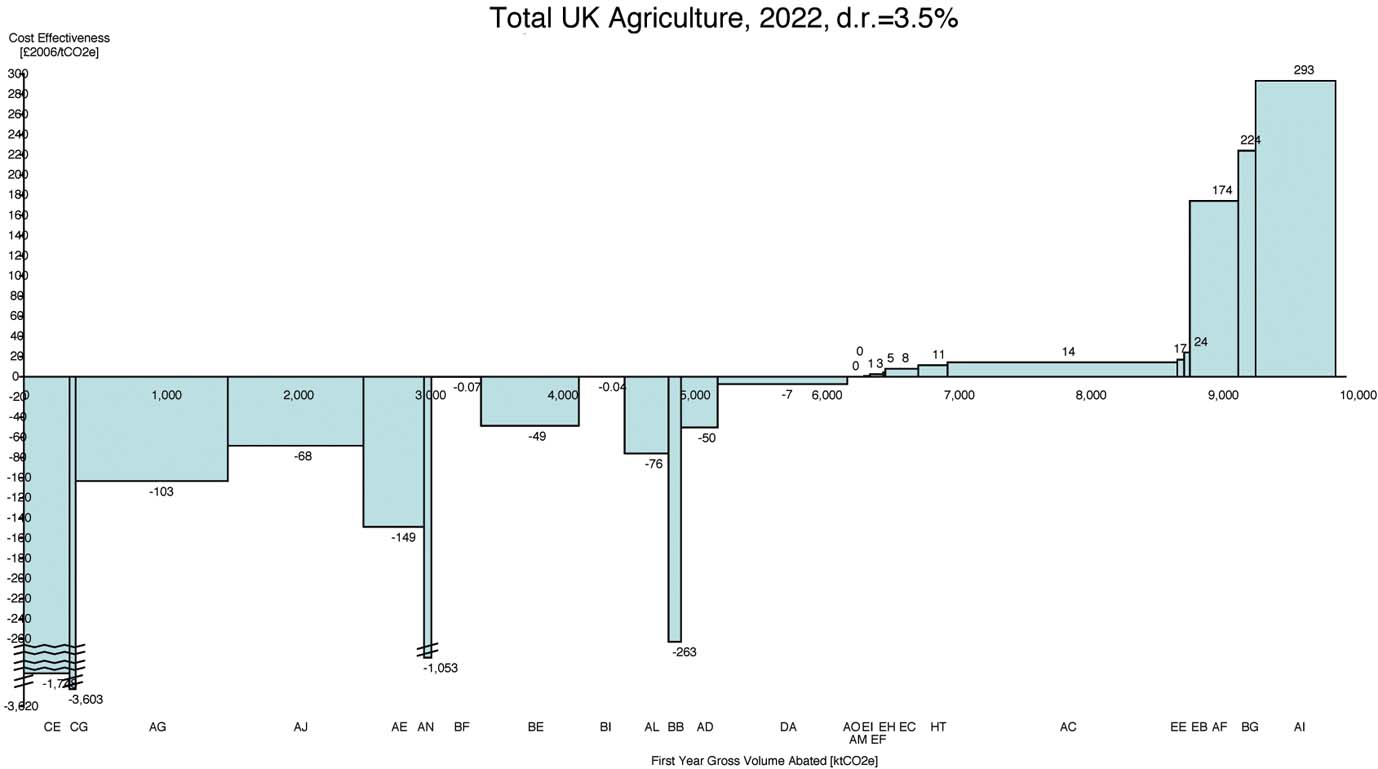
Since 2007, some new data have become available. Estimates for agriculture and forestry courses are provided by Campbell et al. (Reference Campbell, Lilly, Towers, Chapman, Werritty and Hanley2012, this volume). Progress has been patchy, but includes:
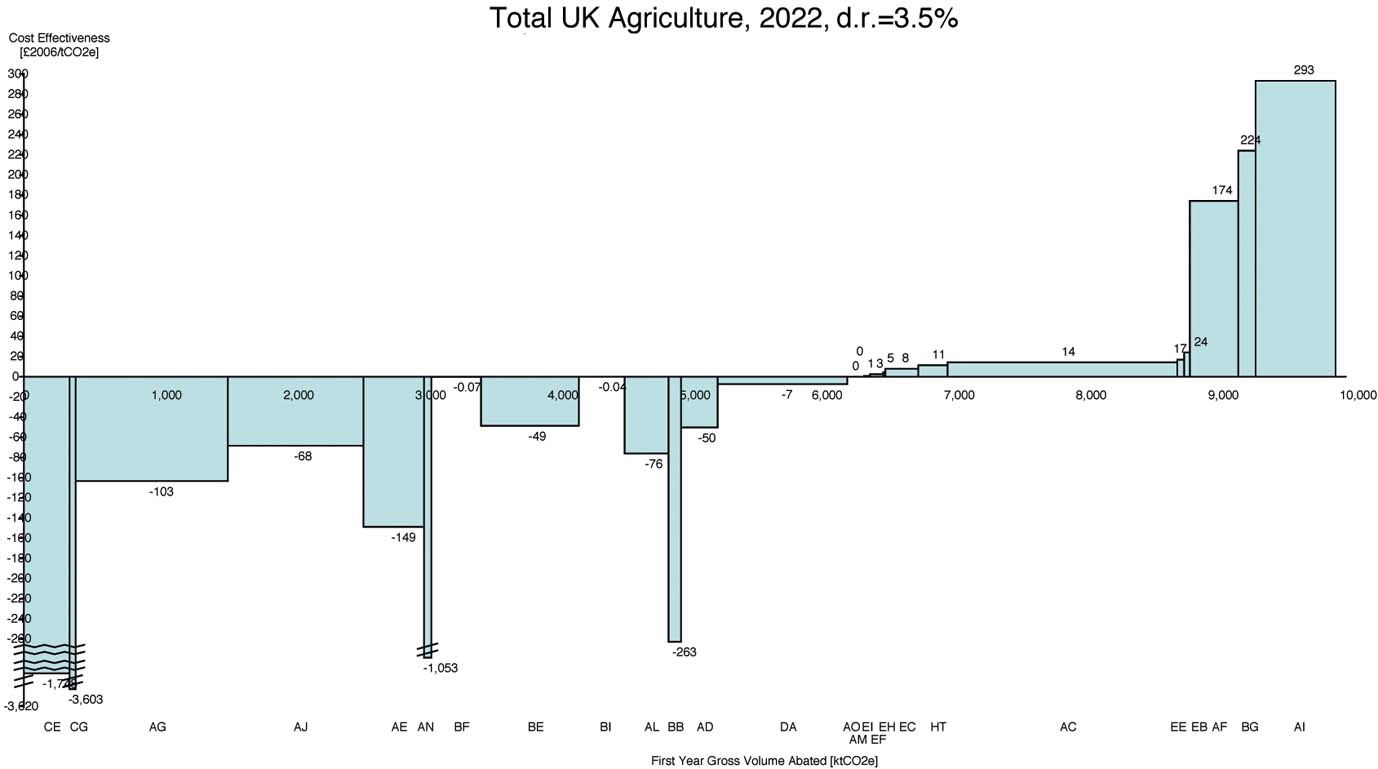
• New UK data for agriculture (Scottish Agricultural College 2008) with cost-saving options (Fig. 2)
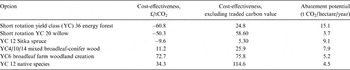
• New UK forestry data with cost effectiveness depending on the types of forest and yield class (Table 3)
Marginal Abatement Cost curve for UK farming. Source: SAC (2008).
Costs of reducing net emissions by forest planting. Source: Forestry Commission 2009 (Table 8.8).

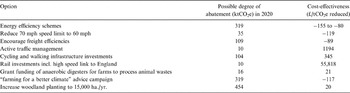
More recently, the Scottish Government has issued a listing of mitigation options (Scottish Government 2010) which might meet the target of reducing Scotland's emissions by 42% by 2020. Their projections show that current policies will only achieve a 33% reduction relative to 1990 by this date, and thus that new policies and emission reduction options are needed. These cost figures are considered to be “indicative and preliminary”. The figures omit electricity generation on the grounds that emissions from this sector will be measured by allocated emission permits, rather than actual emissions, and because the Scottish Government feels that sufficient mechanisms are in place in the electricity sector to achieve (a different) target in terms of renewable penetration. For some options in transport, waste, housing and other sectors, estimates are given in terms of cost-effectiveness (£/tCO2e reduced). However, many of the options considered are not costed (for example, waste). There is still much missing data on costs. Some illustrative options are shown in Table 4.
Sample information from Scottish Government (2010) – costing of mitigation options.

We are unclear about the precision or interpretation of the data behind Table 3, which only records averages and does not show how costs might alter as emissions change. It is also unclear whether offsetting benefits has been included, but the data do show the variability in positive marginal cost options and reveal some cost saving options, most notably in energy efficiency, speed limits and farming. Thus a market mechanism-based scheme could deliver large cost savings and, in practice, we know that many schemes overlap with co-benefits: incentives for renewable energy generation, landfill taxes, EU-ETS prices, agricultural policies, and fuel taxation to name a few.
1.2.1. Are current policies efficient?
The imposition of a carbon tax and any changes in the EU-ETS scheme are both outwith the powers of the Scottish Government and many incentives that impact on behaviour (such as fuel taxes) are set at UK levels. Furthermore, as SEPA reported to the Inquiry, although they are responsible for regulating the emissions of businesses and organisations, they have little or no power to enforce any reductions. Given limited evidence on the wide range of marginal abatement costs across Scotland, current policy imposes excessive costs in terms of how cheaply targets could be achieved. This is due to a piecemeal approach, multiple targets and the low level of use of economic instruments.
Setting annual targets for CO2 reductions clearly increases the costs of meeting a 2020 or 2050 target, since it imposes restrictions on the trajectory of emission reductions, which is unlikely to be consistent with the least-cost path. As technology embodied in the economy evolves (through carbon-intensive technology depreciating and being replaced by less carbon-intensive technology) and the structure of the economy changes, and as technological options for mitigation improve, the costs of emission reduction falls over time. This suggests a ‘start shallow, finish deep’ strategy for minimising the costs of emission reductions. Scottish Government officials could, of course, seek to recognise this in determining the trajectory of annual targets. But this line of argument could also be used as a justification for doing nothing now and evidence from the Inquiry suggests that some elements of society certainly adopt a wait-and-see attitude.
However, this discussion does not reflect what is happening to the marginal damage costs of current-period emissions as the stock of GHGs rises over time. As emissions increase, the stock of greenhouse gases in the atmosphere increases, with each additional unit imposing greater damage at the margin than previous emissions. This favours earlier mitigation. Furthermore, the delay of mitigation efforts could lead to investments that lock in more carbon-intensive technologies, which limits the possibility of achieving lower stabilisation levels in the future and intensifies the risks associated with climate change (IPCC Reference Metz, Davidson, Bosch, Dave and Meyer2007).
As part of climate policy, Scotland subsidises the expansion of renewable energy capacity, in order to reach renewables targets. A frequently heard argument is that such subsidies can lead to long-term job creation by creating a new industrial export base. But subsidising renewable manufacturing capacity development in Scotland only makes sense in terms of developing an industrial base in renewable production if Scotland can impose trade barriers. Otherwise, businesses will always import turbines from the cheapest source world-wide. For example, current expansion of wind energy in Texas is being achieved with turbines manufactured in China. However, whilst it is true that without trade barriers wind turbines will most likely be purchased from abroad, there still exists considerable potential for job creation in the area of maintenance of renewable energy infrastructure, or in the production of jackets for off-shore turbines. Furthermore, business areas other than technology could generate high value in the renewable energy sector including design, systems integration and marketing. In addition, the transition to electric cars will require an infrastructure of charging points throughout the country which offers further potential for job creation.
2. How should Scotland adapt to the impacts of climate change?
The paper by Werritty & Sugden in this volume (Werritty & Sugden Reference Werritty and Sugden2012) outlines some potential impacts of climate change across Scotland. Here we examine economic theory underpinning adaptation policy.
‘Adaptation’ is deliberate investment which reduces the costs or increases the benefits of climate change. In the language of IPCC (Reference Metz, Davidson, Bosch, Dave and Meyer2007), it includes actions which “reduce harm or exploit opportunities”. Adaptation actions might involve preventing losses (e.g., by investing in new flood defences), spreading losses (e.g., through insurance), changing activities (e.g., altering what crops are grown), changing locations of activities and restoring damages. Adaptation measures might include so-called ‘soft’ measures such as improving planning procedures, or improving the efficiency with which resources are currently allocated, for example by proper pricing of water resources.
Popular attention has recently been focused on the likely global costs of adaptation to climate change by publication of the World Bank's 2010 assessment for a range of case study countries. This put the global costs of adaptation (for 2°C of warming up to 2050) at around $70–100 billion per year for developing countries, compared with an earlier UNFCCC (2007) estimate of $27–66 billion (but only up to 2030). The OECD estimate that the Indian subcontinent and sub-Saharan Africa will shoulder the greatest adaptation costs (in % GDP terms), followed by low and middle income countries and Western Europe. In contrast, Japan, the US and China will have the lowest adaptation costs. It is important to note that studies on the likely costs of adaptation are in their infancy. Estimates of the costs of adaptation are fraught with difficulty and should be treated with caution, because accurate estimates require knowledge on future climate change and its likely impacts on the economy, the environment and responses to it, all of which are difficult to predict (Hanley Reference Hanley2007).
Economic analysis of adaptation investments suggests:
• Some adaptation will happen due to market forces: people and businesses anticipate future costs or benefits, and take actions which maximise their expected profits or expected utility.
• However, the degree of adaptation occurring in this way will be less than the socially optimal amount of adaptation. This is due to market failure (e.g. for some ecosystem services), government intervention in existing markets, constraints on ability to adapt (for example due to capital constraints, or information deficiencies), differences in risk perception and the costs of risk bearing between public and private sectors; and the partial failure of insurance markets since risks of climate change may be correlated across parties.
• As adaptation investments are costly (e.g. re-locating transport links, building new flood defences), an individual investment should be undertaken only up to the point where the marginal benefits of reductions in expected damages are equal to the marginal costs of investment.
• Benefits (pay-offs) from adaptation are uncertain, since the impacts of climate change are uncertain and future prices not known. It makes sense to search for adaptation strategies which are likely to offer positive net benefits in a wide range of circumstances.
• The impacts of climate change are inter-generational, but future generations are not represented in current climate change policy decisions. In the economic theory of welfare, increases in current consumption are worth more than increases in future consumption i.e. future consumption is discounted. The rate at which future consumption is discounted is crucial for calculating the expected costs and benefits associated with adaptation, and there is no clear agreement on what the correct rate of discount should be for public policy appraisal.
• The expected benefits of adaptation are likely to be significant, if we get it right. Scotland captures much of the benefits of its own investments in adaptation; this is in stark contrast to how much of the benefits of investments in mitigation accrue to the country. This is because Scotland's national emissions are a tiny share of global emissions, yet Scotland is affected by changes in global greenhouse gas levels.
• Timescales for a return on investments in mitigation and adaptation differ. Scotland will capture much of the benefit of adaptation investments in the short term and at the local level. But the expected benefits of mitigation investments are only likely to accrue over the long-term.
• Reducing global poverty is a key means of adaptation, since poverty increases people's exposure to climate change damages by reducing their ability to ‘self-protect’. A further implication is that as countries get richer, the relative costs of climate change to them fall. For example, health costs related to climate change are exacerbated by poverty: “In the health sector analysis, allowing for development reduces the number of additional cases of malaria, and thereby adaptation costs, by more than half by 2030 and more than three-quarters by 2050” (World Bank 2010, p. 15). However, increases in real income can also lead to rising national emissions, due to scale effects (Carson Reference Carson2010).
3. What are the incentives for behavioural change towards a low carbon economy?
Action on climate change depends on people altering their behaviour; whether they are the managers of transport businesses, building companies deciding where to build new homes, commuters travelling to work, or families deciding how to heat their houses. Much of the evidence submitted during the Inquiry recognised that changing behaviours is a key obstacle to tackling climate change. Economics has developed standard theoretical understandings of what motivates the behaviour of individuals and businesses, although some of these ‘standard theories’ are now being amended due to insights from behavioural economics.
Traditionally, prices are seen as the main incentives guiding behaviour. Thus, in thinking about how to encourage people to move away from using cars to travel to work and towards using public transport, an economist thinks first about changing the relative prices of these two options, by introducing higher car parking fees or subsidising bus fares, or by introducing road pricing. Similarly, if we want to encourage businesses to reduce carbon emissions, we think first about increasing the price of energy, or of subsidising low-carbon energy alternatives whilst taxing high-carbon options. There is good evidence that prices do, indeed, matter for decision making (Sorrell & Dimitropoulos Reference Sorrell and Dimitropoulos2007). For example, prices are among the most important factors determining households’ willingness to invest in more energy-efficient appliances (such as fridge freezers; Oxera 2006). So it is important that the market rewards energy-efficiency improvements in order to encourage more widespread up-take of energy-efficient strategies. But other factors also drive behaviour. Below, we briefly review these factors, and comment on which of these could be seen as ‘barriers’ to behaviour change in Scotland, both in terms of mitigation and adaptation.
3.1. Businesses
Businesses use energy and generate greenhouse gases in many ways. What determines their decisions over how much and what energy to use, and how much to invest in energy saving?
• In combining energy with other business inputs (labour, capital and materials), the optimal mix for a given level of output depends on their productivity and their relative prices. As energy increases in price relative to other factors, it will be partially substituted for. Moreover, as energy prices rise, businesses may change their decisions over how much output to produce. Changes in productivity of inputs can also change how is used. For example, a rise in energy efficiency will induce businesses to increase their use of energy (Allan et al. Reference Allan, Hanley, McGregor, Swales and Turner2007), possibly leading to a “rebound” or “backfire” effect from efficiency improvements. A number of respondents during the Inquiry showed an awareness of the possibility of a rebound effect.
• Businesses evaluate the attractiveness of investments in energy efficiency by considering the net present value (NPV) of such investments, i.e., the difference between discounted benefits and costs over time. Investments with a positive NPV would be expected to be undertaken. However, we know that there are examples of positive NPV investments in energy efficiency which businesses do not take up. Why might this be?
Possible explanations are:
• Gaps in businesses’ information regarding options and their likely future costs and benefits. Evidence submitted throughout the Inquiry indicated a lack of understanding regarding the bewildering variety and complexity of adaptation and mitigation options available. The information provided is often conflicting and product labelling insufficient at the point of purchase.
• There appears to be lack of financial incentive to undertake investment in energy efficiency. Businesses are primarily focused on short-term economic benefits and costs, and so investment spending is biased in favour of current growth rather than cost-saving measures that will accrue in the future. In particular, if energy costs are small relative to total costs, managers may rationally choose to defer consideration of energy saving options.
• Scarce managerial resources lead to an allocation of management effort to decisions over inputs, which account for the largest share of costs. It was noted during the Inquiry that small businesses in particular may lack managerial resources and expertise in the area of carbon management and energy efficiency.
• Competing budgetary priorities mean operational requirements are often prioritised above carbon management. This issue was highlighted during the Inquiry particularly in the context of local authorities. Furthermore, when compared to other legislation affecting business, carbon management is not always deemed a top priority.
• Capital constraints arising from imperfect capital markets. Businesses may be unable to raise funds for initial investment costs, even in projects with a positive NPV. This may be particularly true where revenues from such investments are distant in time. The one-off capital cost of installation was frequently cited during the Inquiry as a barrier to undertaking energy efficiency projects. This recognition is coupled with a strong belief that the government ought to provide the initial finance required for investment in carbon-reduction schemes, because of the lack of clear economic benefits in the short run. Suggestions for government-led incentives include loans for energy efficiency projects and renewable technology for businesses. The Scottish Government's “Green Bus” scheme, which provides up-front assistance with capital costs for purchasing low carbon buses, is a response to this type of problem. However, decreasing budgets at all levels of government make public funding problematic, meaning that much of the finance will have to come from the private sector.
• There may also be issues of economies of scale in energy efficiency. Many SMEs may find it unattractive or difficult to realise the potential savings in energy use that larger businesses would be able to realise. This suggests a niche for energy-saving specialist businesses which could identify and then undertake energy-efficiency saving investments on a revenue-sharing basis (i.e. sharing the benefits of energy savings realised over time) on behalf of SMEs. Such specialists would derive a greater pay-off from investments in learning about energy efficiency than SMEs in isolation.
In some sectors, learning-by-example may be an important means of information provision. For example, demonstration farms have long been seen as an effective means of promoting technological advancements in the agricultural sector. The same thinking applies to low-carbon farming in the future.
3.2. Households
Households contribute to greenhouse gas emissions through their decisions on travel-to-work, home heating and consumption. Again, prices matter: as oil prices rise, people find ways to reduce their petrol or diesel purchases for driving, or turn down their central heating thermostats. However, research shows that many other factors matter to the impact households have on net emissions, pointing up potential barriers to changes in behaviour.
• As with businesses, information matters. Acquiring new information is costly (e.g. in terms of time), and has uncertain pay-offs. Improving information flows to households on how they can reduce carbon emissions may be effective in changing behaviour. Oxera (2006) found evidence of considerable ignorance amongst UK households of the costs and benefits of possible home energy-efficiency improvements, and a lack of understanding of appliance rating schemes. It was frequently reported throughout the Inquiry that the public lacks information and understanding on the full range of energy-saving options and their relative advantages and disadvantages. Awareness raising on the options available and their net benefits over time is very effective in encouraging up-take (Oxera 2006). The Inquiry saw an important role for government and the energy industry in raising awareness and providing information to the public regarding the environmental and economic benefits associated with investing in renewable energy and reducing emissions. Another issue that appeared during the Inquiry concerned the confusion people feel regarding the variety of different energy saving options available.
• Appropriate and accurate information on energy consumption at the household level is crucial, with studies in Norway and Finland showing that information on domestic electricity consumption can decrease demand. The Inquiry revealed that information on the carbon content of electricity would help emissions reduction planning (i.e. the government needs to place a monetary value on carbon consumption at the household level, detailing the costs of various choices within the home). For example, if one puts a television on standby instead of switching it off completely, how much extra will this cost per year? As most people are cost conscious, this information can encourage people to change their behaviour.
• People also acquire information from the actions of others: the 2006 Oxera study showed that recommendations from family and friends were important predictors of intended up-take of loft insulation and cavity wall insulation.
• Investing in new energy-efficient technology imposes costs, since such investments are irreversible – consumers cannot change their minds once a new, more efficient boiler comes along if they have just purchased what was previously a market leader in efficiency terms. This means an optimal strategy can be to postpone purchasing decisions even when it would appear rational to go ahead and invest today (van Soest & Bulte Reference Van Soest and Bulte2001).
• Information acquisition is but one form of transactions cost; others include the “nuisance costs” of having cavity wall insulation installed. Again, evidence submitted during the Inquiry showed disruption of home life during installation to be an important predictor of uptake of home insulation schemes. The development of a range of cost-effective technologies that can be installed with little disruption is crucial for widespread uptake. It was also noted that some people have rejected free installation of insulation in their homes.
• Oxera (2006) also found that up-front costs were an order of magnitude more important than the value of future energy savings in evaluating people's choices. Evidence submitted during the Inquiry confirmed that, for some households, energy saving is too costly. This emphasises the role that investment subsidies (partly or wholly offsetting upfront costs) can play in improving up-take. Some respondents urged that the labour and materials for installing draught-proofing and insulation should be free to all households and funded through an increase in council tax. Other suggestions include rationing devices that allow for the possibility of personal carbon trading certificates.
4. Conclusions
At the UK and international level, it is important that a higher price for carbon is established, rising over time, through a greater use of carbon taxes and/or a more comprehensive system of tradeable pollution permits. The basic requirement is the establishment of a carbon price signal which impacts on the decision making of all firms and households for actions which contribute to emissions or emissions reduction. Furthermore, it is crucial that this policy exists into the future with certainty, so that businesses and households incorporate a firm estimate of future carbon prices into their decisions. It is also important that a target stabilisation level for emissions is determined, as priorities for action depend on the desired level of stabilisation. Making the EU ETS price act as more of an incentive to mitigate emissions will be important over time through the introduction of a price floor, as this will allowing more international trading in greenhouse gas emissions, provided such trading is properly reported, verified and monitored.
For Scotland the following priorities for action can be identified:
• Encourage energy efficiency uptake among businesses and households through improved information and subsidy schemes.
• Promote investment in clean technology through temporary innovation subsidies: Scotland could reap economic benefits in the future from job creation and the export potential of green technologies, although this depends on the evolution of trade barriers.
• Encourage adaptation: this is an important component of climate change policy in Scotland because the benefits of adaptation will be felt in the short term and at the local level.
• Allow a more flexible response to mitigation by widening the scope of those involved in carbon trading (to include forestry, transport and agricultural sectors).
• Undertake more research into marginal abatement costs across sources in Scotland in order to exploit the cost-saving mitigation options implied by differing marginal abatement costs.