1. INTRODUCTION
The recent resurgence of the physical object in contemporary sound-based art goes beyond the renewed popularity of modular synthesisers and tape releases. There exist a large number of artists working with sound in conjunction with physical media and material. Ranging from performance art and concerts to interactive installations and sculptures, such interdisciplinary sound-based practices are a recurring theme at various venues – academic and otherwise. In addition to conferences such as New Interfaces for Musical Expression (NIME) and journal publications such as this one, more mainstream new media art and music festivals (e.g., Prix Ars Electronica, Mutek and CTM) have also been gravitating towards a sensory augmented expression of sound. In parallel to this, independent artist-run online platforms such as Physical Editions Footnote 1 and leerraum Footnote 2 are prime examples of an increased tendency to promote sound-based artworks that are presented as physical artefacts.
The rapid advancements in computer-aided design and manufacturing technologies and increased accessibility of DIY and open-source tools, combined with wide-reaching access to online learning, have certainly played an important role in facilitating this transformation. At the same time, both scholarly and mainstream debate about technologically mediated sound-based art have remained largely focused on the analysis and improvement of the tools and technologies. Conference presentations and online forums provide extensive insight on how to best drive a dozen electromechanical motors or synchronise an array of moving lights with audio input in real time. Much less frequently, however, we come across comprehensive discourse on why an automated percussion apparatus is used instead of a digital synthesiser, or what conceptual or aesthetic roles these visibly present artefacts play in the process of artistic expression and reception. I other words, where the physical object is embodied as a key component of a sound-based work of art, there is ample discussion on the how, and very little scrutiny on the what and why queries.
It is the aim of this article to re-examine the significance of the physical material within contemporary works of sound-based art and to underscore their dramaturgical and perceptual weight in the process of artistic communication. In the following sections, I will first highlight the need to rethink the audiovisual and material paradigms within sound-based art, building on some of the analytical work carried out by fellow artists and researchers. Following this, I will then introduce Material Music – a newly completed artwork developed to provide a concrete example to support the arguments outlined in this article.
2. RETHINKING THE AUDIOVISUAL
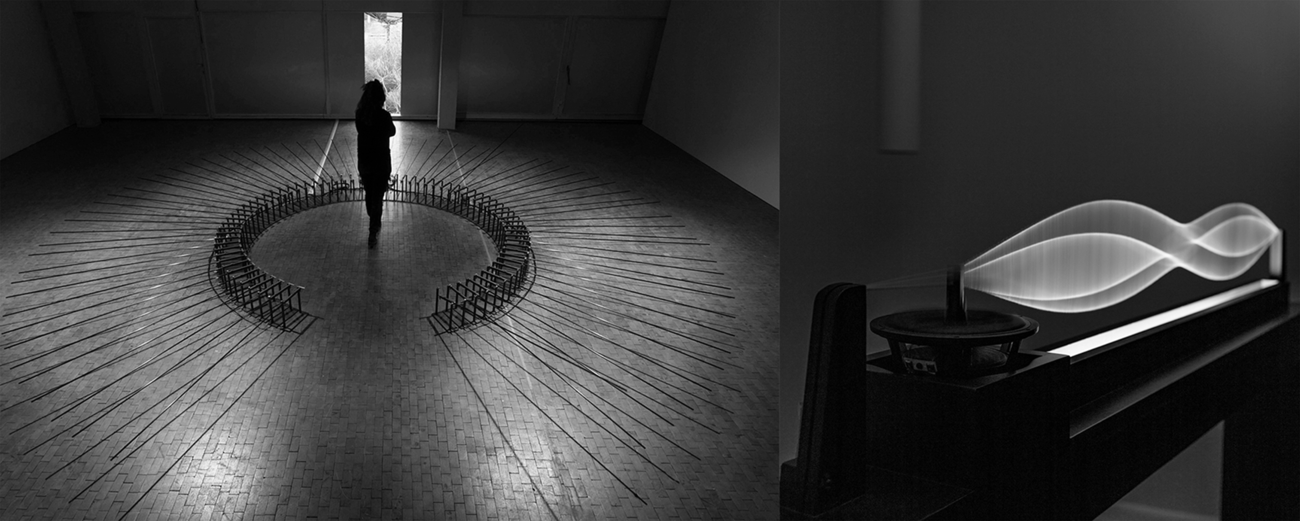
As discussed in the previous section, various forms of sound-based art with key material components have grown to occupy a notable space in the field. Over the past few decades, such works are increasingly showcased at major international venues and celebrated at prestigious award exhibitions. Examples include, but are not limited to, works of artists such as Zimoun, Nicolas Bernier, Adam Basanta, Alba Fernanda Triana, Quadrature, Martin Messier, Dmitry Morozov, Ted Apel, Sabina Hyoju Ahn, Lawrence Abu Hamdan, Svetlana Maras, The Quiet Ensemble, Michela Pelusio, Andreas Lutz, and more (Figure 1). While varied in terms of concept, aesthetics, execution, and modalities, such works are certainly connected by their shared employment of physical objects and material.
Left: Noise Signal Silence (2019) by Quadrature. The work is introduced as a ‘kinetic radio astronomical spectrometer’ on the online video documentation (Quadrature n.d.). Photo courtesy of Quadrature. Right: Music on a Bound String and Resonating Tubes (2018) by Alba Fernanda Triana. The artist describes the work as a ‘visible and audible sound installation’ (Triana Reference Triana2018). Photo by Anastasia Samoylova, courtesy of the artist.

2.1. The audiovisual object
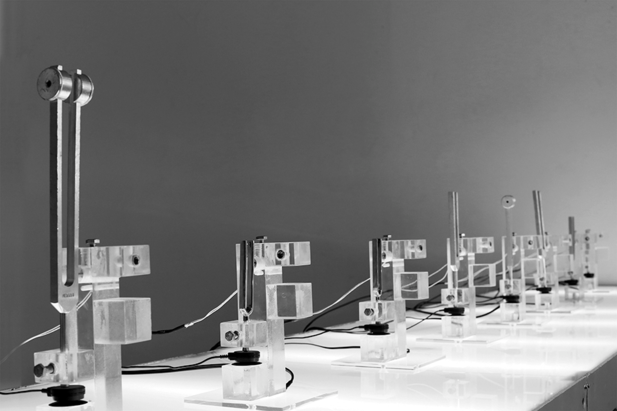
Let us focus for a moment on a particular example. Winner of the Golden Nica at the Prix Ars Electronica, Nicolas Bernier’s frequencies (a) (Reference Bernier2012) is a widely acclaimed audiovisual performance that blends acoustic amplification of electromechanically actuated tuning forks with digitally produced sound waves. The piece involves a series of carefully crafted sculptures, each comprising a tuning fork and a linear actuator (solenoid) that are held in place using sculptural blocks of clear acrylic (Figure 2). During the performance, the sculptures are affixed on top of a table enclosing controllable LED panels that emit synchronous bursts of light as the tuning forks are triggered. As far as the physical construction and visual manifestation of the work are concerned, Bernier’s attention to detail is remarkable. One could argue that even discounting the sonic element, the piece is a compelling work of fine art. The choice of materials, the arrangement of the objects, the configuration of the fasteners and wiring are all extremely well thought out. Even the table itself is custom-designed solely for the purpose of this particular performance.Footnote 3
frequencies (a) (Reference Bernier2012) by Nicolas Bernier. Winner of Golden Nica at Prix Ars Electronica 2013. Photo courtesy of the artist.

Considering all of this, it would be very difficult to argue that the material components within frequencies (a) are merely there to support the amplified and acoustic sound waves. What is visible and physically present here cannot be deemed as secondary to sound. The tuning forks, the solenoids, the acrylic blocks, LED panels, and the table are the work, and the work is about them as much as it is about the sound.
The case for the significance of physical and visual material in Bernier’s work can be extended to the aforementioned wave of contemporary sound-based artworks. Whether it is electromechanical machinery and robotic contraptions, industrial, scientific, and lab equipment, everyday objects, or organic matter, removing these physical materials from such works would alter their fundamental essence. In other words, a blindfolded reception of such works would lead to completely different perceptual results. This underlines the fact that the visual properties contribute towards the dramaturgy of these artworks as meaningfully as the sonic properties. When it comes to the creation of the work, the visual qualities of the physical materials are often as carefully considered as the composition of the sonic elements. Likewise, when the perception of the work is concerned, the waveforms interacting with one’s auditory mechanism do not prevail over those captured by one’s visual apparatus. Either due to direct and causal association, or through tight trans-sensory coupling and synchronisation, the visual object and the sonic one in such works form an isomorphic bond that enables a multisensory experience. This audiovisual phenomenon is best described by what Michel Chion refers to as synchresis: ‘the spontaneous and irresistible weld produced between a particular sound event and a particular visual event when they occur at the same time’ (Reference Chion2019: 64).
2.2. Towards a new audiovisual paradigm
While works of this nature engage their audience in a truly audiovisual manner, discussions around audiovisual art are almost exclusively limited to screen-based media. To give a few examples, on the glossary section of the ElectroAcoustic Resources Site (EARS), audiovisual theory is defined as the ‘study of how moving images and sound interact in audiovisual media such as film, animation, video art, music video, television’ (EARS n.d.). Chion’s analytical audiovisual frameworks are chiefly developed around sound design in film. Even the recently published Oxford Handbook of New Audiovisual Aesthetics (Richardson, Gorbman and Vernallis Reference Richardson, Gorbman and Vernallis2013) is wholly dedicated to screen-based scenarios. Given the fact that a growing number of the sound-based practices are adopting trans-medium modes of conception and presentation that comfortably inhabit the realm of the visual, expanding the scope of audiovisuality to include such practices is, to say the least, overdue.
An entire issue of the eContact! online journal guest-edited by Bernier (Reference Bernier2017) was recently dedicated to the combination of light and sound. When it comes to redefining audiovisual theory and its adaptation to non-screen-based settings, Adam Basanta’s contribution to this issue is significant. In his article, Basanta proposes a new analytical, and to an extent, compositional framework for ‘light and sound media installation works utilizing physical objects that appear to emit both light and sound’ (Basanta Reference Basanta2017). In constructing this framework, Basanta skilfully builds on Chion’s ideas of synchresis and ‘added value’ (Chion Reference Chion2019: 5), as well as John Coulter’s work on the relationship between joint media pairs (Coulter Reference Coulter2010). Using a number of examples, Basanta divides his analytical framework into various categories that span across a three-dimensional spectral space. While his framework remains entirely focused on luminescence, Basanta suggests – and I would agree – that ‘it may [also] be useful in the analysis of various object-based audiovisual practices in media arts’ (Basanta Reference Basanta2017). Continuing in a footnote, he points to ‘practices related to robotic or the activation of mechanical objects’ (ibid.) as examples of this.
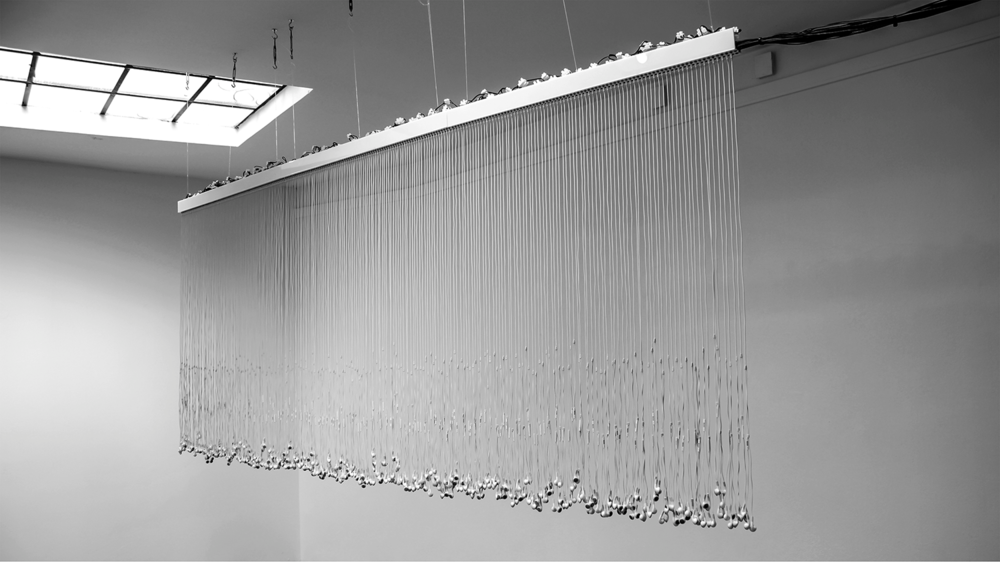
Although many of the works mentioned earlier in this article involve varying types of luminescent material, I would argue that light is itself not the primary linking element. Rather, it is the physical materiality – part of which might include a light emitting physical object – that can be noted as a characteristic component shared across the board. What connects Bernier’s frequencies (a) with the works of Zimoun or even much of Basanta’s work is their clear material presence (Figure 3). Indeed, Basanta’s typologies – for example, physical isomorphy and mapped isomorphy (ibid.) – can be comfortably applied as analytical and compositional tool for such materially conceived works. Nonetheless, while Basanta’s work does help make the case for the expansion of audiovisuality into the physical domain, the question of materiality still remains.
Curtain (white) (2016) by Adam Basanta. Sound installation (240 pairs white earbuds, acrylic, electronics, 24 channels sound). Winner of the Main prize at Aesthetica Art Prize 2017. Photo courtesy of the artist.

3. RETHINKING THE MATERIAL
Much of the discourse on materiality within the realm of contemporary sound-based art is interwoven with strenuous philosophical debate. Various scholars and theorists approach the quest to define sonic materialism from different angles and based on different ontologies. Notable examples include Christoph Cox’s (Reference Cox2011) efforts to establish a new materialist theory of sound art based on Deleuzian and Nietzschean schools of thought, Luc Döbereiner’s (Reference Döbereiner2014) counterpointing arguments built around Žižek and agential realism, and Salomé Voegelin’s (Reference Voegelin, Grimshaw-Aagaard, Walther-Hansen and Knakkergaard2019) expansion of speculative realism and new materialism into the domain of sound. Such contributions are certainly invaluable towards building a more robust theoretical base for sound-based arts – especially considering the lack thereof, as pointed out by Leigh Landy (Reference Landy, Cobussen, Meelberg and Truax2016: 22) and others. However, when it comes to the growing presence of physical material in sound-based arts, such efforts almost ironically overleap the very essence of what they are concerned with, at least in an etymological sense: matter.
3.1. The metallurgical perspective
In a recent Organised Sound article titled ‘Materiality in Sound Art’, Asbjørn Blokkum Flø (Reference Flø2018) investigates the resurgence of physical medium in sound art. He argues that ‘the renewed interest in materiality during recent years can be seen as a counter-reaction’ to the immateriality of the new technologies in the digital era (ibid.: 228). In the first half of the article, he provides a brief yet compelling survey of electromechanical music and kinetic art and the points at which they have overlapped. He then dedicates the second half of the article to his own artistic practice and discusses various technical considerations of the acoustic and physical qualities of metal rods and plates, adopting a quasi-spectromorphological approach. While Flø’s article provides useful insights into composing using such materials, these are largely narrowed down to the input/composer viewpoint. Consequently, there is little to no discussion of the aesthetic or perceptual properties of the resulting output/audience viewpoint. As a work of art, is the visual aspect of such material objects of interest or importance? Does it impact the ways in which the work is perceived by an audience? When it comes to the creation of the piece, should the ways in which these objects are visually constructed and displayed be considered alongside their acoustic features? These are some of the key questions that remain open for further debate.
3.2. The sculptural perspective
In a slightly older contribution to Organised Sound, Vadim Keylin (Reference Keylin2015) delivers an in-depth survey of sound sculpture. Recounting a series of remarkable works in the history of the field, Keylin’s article is an effort to establish sound sculpture as an art form. He traces the failure of sound sculpture’s taxonomical validity to the practice’s ‘misfortune of appearing at a time when genre boundaries were vehemently questioned in all the artistic disciplines’ (ibid.: 182). At the same time, he hypothesises that ‘we must focus on the traits of sound sculpture connecting it to music rather than on those separating the two’ (ibid.). Accordingly, much of his dissertation is devoted to drawing parallels between sound sculpture and score-based musical performance. As a result, the undeniable visual weight of such works is predominantly overlooked in Keylin’s remarks. In fact, he does admit that ‘the totality of aesthetic experience usually translates into the interplay between the visual and acoustic shapes that mutually define one another’ (ibid.: 188). However, he moves on to suggest that ‘works of the sculpted sound variety often downplay the visual element, substituting it with tactile experience’ (ibid.: 188–9). While this may be the case for a select number of examples discussed by Keylin, it certainly does not hold for the wide range of practices targeted in this article.
3.3. The electromechanical perspective
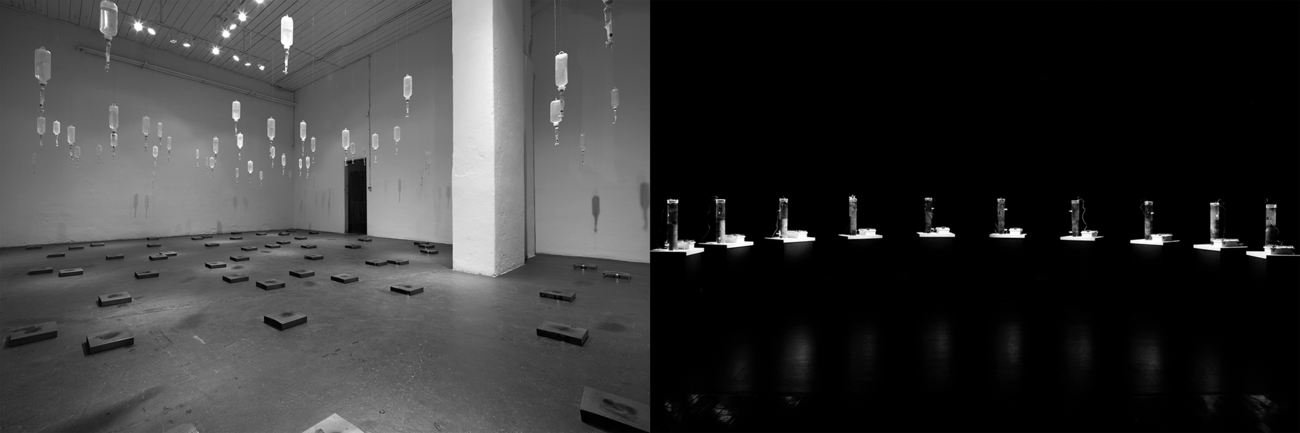
In addition to the worthwhile efforts above, there have been alternative approaches to provide an overarching framework to delineate technologically mediated object-based sound art. A notable example is the work of Jon Pigott (Reference Pigott2017), also published in Organised Sound. Pigott proposes a Science and Technology Studies approach to the study of what lies at the intersection of technology, sound and kinetic art, suggesting electromechanical transduction as the connecting thread. Citing numerous examples, Pigott describes the electromechanical process in such works as ‘a kind of non-human material performance’ (ibid.: 282). The visual significance of these works is evident in what Pigott explains as ‘the clear physical presence of the material behaviours’, which according to him ‘make up the creative process’ (ibid.). Nevertheless, not all materially based audiovisual art use electromechanical transduction. Some examples include Zimoun’s 60 medical infusion sets, water, fire, metal sheet 20x20x4 cm (2013), or Sonomatter (2016) by Sabina Hyoju Ahn (Figure 4).
Left: 60 medical infusion sets, water, fire, metal sheets 20x20x4cm (2013) by Zimoun. Photo courtesy of the artist. Right: Sonomatter (2016) by Sabina Hyoju Ahn. The work is built upon the conversion of bioelectrical signals from microorganisms to sound. Photo by Sey Parc, courtesy of the artist.

3.4. The object-based perspective
In support of the arguments for audiovisual materiality, Ethan Rose’s (Reference Rose2013) ‘object-based sound installation’ stands out. Noting the lack of compelling discourse on specific types of sound installation prior to his writing, Rose coins ‘object-based sound installation’ to describe artistic practices that ‘engage an audience by actuating a visibly present object’ (ibid.: 65). He lays out the basis of his argument by discussing three distinct works: Pendulum Music (1968) by Steve Reich, Music on a Long Thin Wire (1977) by Alvin Lucier, and 80 Prepared DC-motors, Cotton Balls, Cardboard Boxes 71x71x71 cm (2011) by Zimoun. Aligned with Pigott’s remarks on the visibility of ‘process’, Rose explains the audiovisual synergy in these works as: ‘what we see is inexplicably tied to what we hear’ (ibid.: 66), reaffirming the concept of synchresis. According to him, ‘[this] extremely intentional visual didacticism is important in the wake of modernism’s separation of the senses. In order to be understood, the process must be watched as well as listened to’ (ibid.).
3.5. Towards an audiovisual materialism
My suggestion is that we extend Rose’s ideas beyond the limited practice of installations, and reject dualisms such as performance and exhibition in order to focus on the issue of materiality. This is to better understand and analyse the growing presence of the physical material in a substantial portion of contemporary sound-based art – regardless of their varying degrees of autonomy, interactivity and reactivity. As I have argued, such an omnipresent audiovisual materiality has been largely overlooked in both audiovisual and materialist epistemologies. However, providing an all-encompassing theoretical framework would be beyond the scope of this article. The primary goals here are to identify an important trend within contemporary sound-based art and to invite further investigation and debate. To this end, I suggest the term audiovisual materialism to describe sound-based practices that integrate some form of physical material, objects or artefacts, and fully embrace their visual qualities to provide multisensory experiences that are rooted in a synergy between the audible and the visible.
To support and clarify the arguments I have laid out in this article in a more concrete manner, I now introduce an artwork that I have recently completed. Titled Material Music, I have developed this work over the past year, hoping that it would serve as an exemplar for audiovisual materialism in sound-based art.
4. MATERIAL MUSIC
4.1. Overview
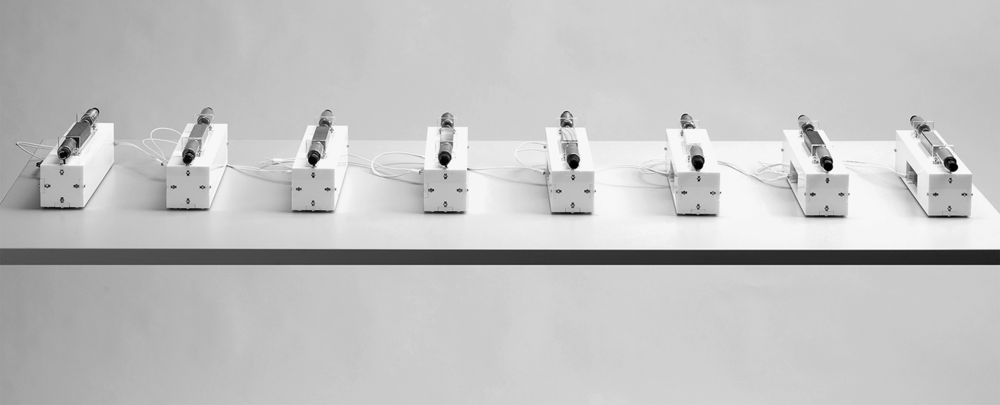
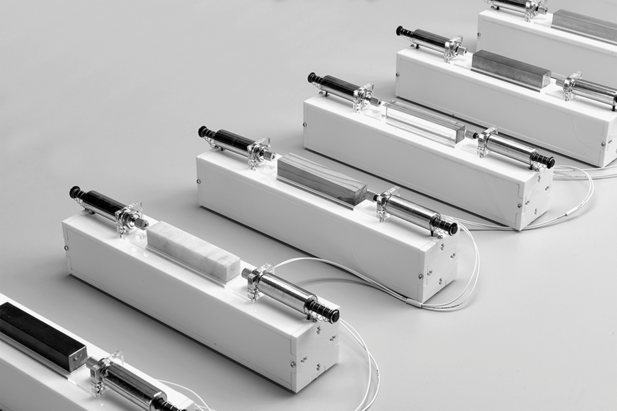
Material Music (Zareei Reference Zareei2020) is an audiovisual work developed to underscore the significance of physical materiality in the field of object-based sound art. The work consists of a linear array of eight sound sculptures, each of which comprises an electromechanically excited block of physical material (Figure 5). While all eight units are identical in terms of form and functionality, they each feature a different type of solid matter at their core. Manufactured in the form of a small rectangular block, the employed materials are hardwood, aluminium, brass, glass, copper, softwood, marble, steel and copper (Figure 6). By keeping every other component consistent across all eight sound sculptures, the visual and sonic qualities of the differing materials come to the fore.
Material Music (2019) by Mo H. Zareei. Photo by Gerry Keating © Mo H. Zareei.

Material Music (detail). Photo by Gerry Keating © Mo H. Zareei.

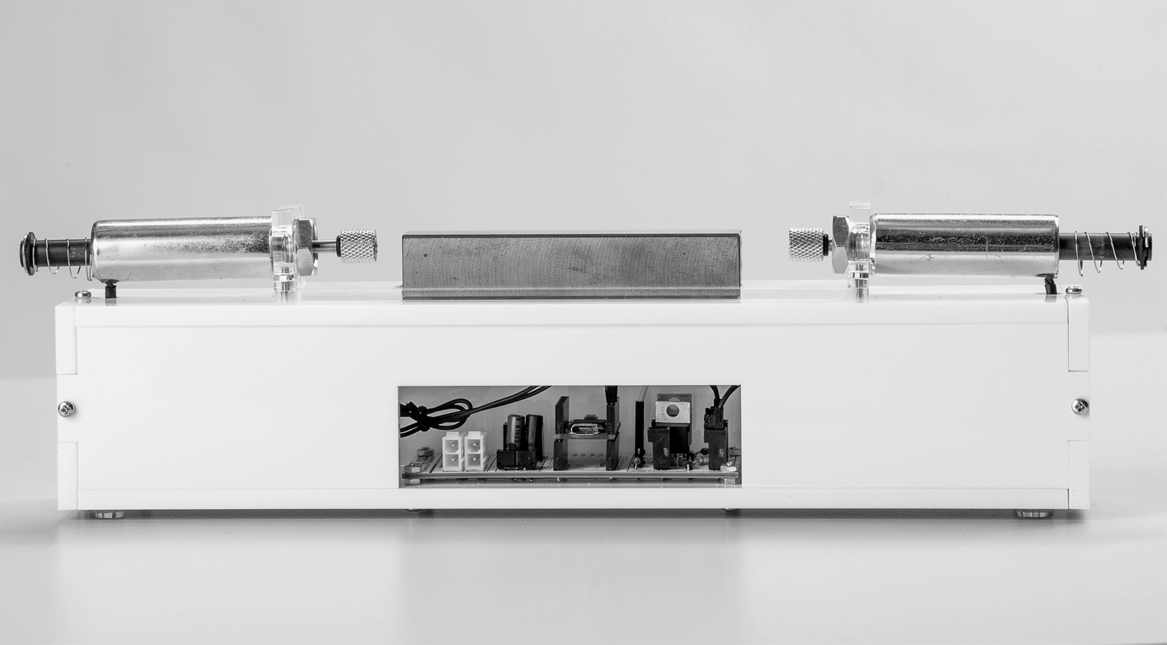
In each unit, the material block is affixed on top of a rectangular box, with an identical electromechanical actuator (push-type solenoid) mounted at both ends. The base box encloses the wiring, circuitry, and a custom-designed driver board that is connected to a micro-controller (Figure 7). The micro-controllerFootnote 4 is programmed to operate the solenoids. Once a solenoid receives a signal from the pre-programmed micro-controller, its plunger shoots out and the small hammer that is screwed to the end of the shaft makes audible contact with the material block. As such, the only sonic material used in the work is derived from the mechanical actuation of the materials. In parallel, the materials themselves – and the entire mechanical process leading to their acoustic excitement – are on full display (Movie example 1).Footnote 5
Material Music (detail). The actuation mechanism and enclosed electronics. Photo by Gerry Keating © Mo H. Zareei.

4.2. Background
The title of the work borrows from one of my earlier pieces named Rasping Music (Zareei, Kapur, and Carnegie Reference Zareei, Kapur and Carnegie2015). Recipient of the Sound Art prize in the last iteration of the Sonic Arts Award in 2015, Rasping Music reconstructs Steve Reich’s phase-shifting process in Clapping Music (1972), using a number of custom-designed audiovisual instruments titled Rasper (Zareei, Kapur and Carnegie Reference Zareei, Kapur and Carnegie2014). Similar to Rasping Music, Material Music builds on Reich’s process-based criteria using a gradual phase-shifting progression. Here, such a process is employed as a strategy for strengthening the audiovisual synchresis, in alignment with the arguments of Rose and Pigott on the significance of process in the context of object-based or electromechanical sound art.
To further emphasise the role of the constituent materials, the phase-shifting criterion in Material Music is itself a derivative of material properties. Here, the specific material property used to define the criterion is the speed of sound travelling through solid materials; a key sonic quality with a unique value for each matter. In this way, phase-shifting is implemented as a process not only to establish a sense of audiovisual synergy and synchresis, but also to further highlight the material qualities of the work.
4.3. The process
The phase-shifting process unfolds as follows. At the start of the piece, all sixteen actuators begin to excite the material blocks synchronously, at the rate of once per second (1 Hz). The left-hand side actuator in each unit continues to retain this rate during the piece. In contrast, the signals received by the actuators on the right-hand side of each block are subtly and continually delayed with each subsequent pulse. The delay time for each unit is directly determined by the material it incorporates; the delay times are all derived from the speed of sound travelling through each material type, and are programmed into the micro-controller on the driver board. Accordingly, each sound sculpture operates based on a unique delay time unit, and with every pulse, the delay time between the left and right actuation instances grows by an increasing multiple of this unit.
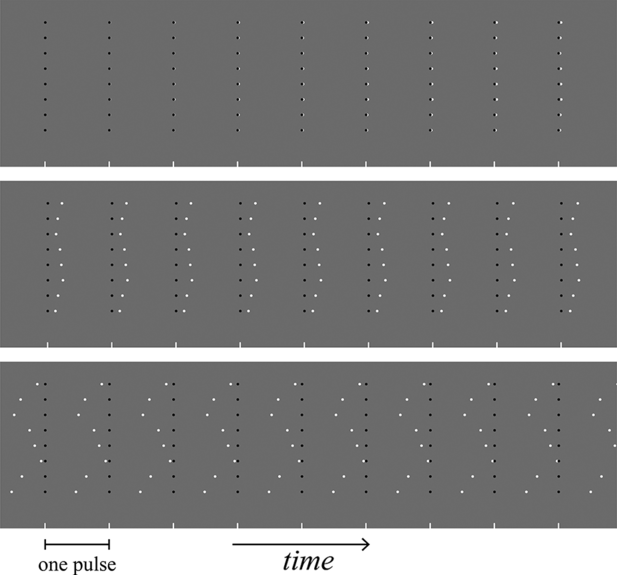
As the piece develops, the accumulating delay times gradually shift the actuation pulses out of phase. With the passing of time, the delay offsets become more and more audible and visible. As the actuators on the left-hand side of the unit lock the downbeat to the strict rate of 1 Hz throughout, the actuations of the right-hand side solenoids are increasingly delayed, producing rhythmic patterns that morph in and out of phase across all eight sound sculptures (Figure 8). In this way, the piece is a process-based composition that interlocks a steady pulse with ever-changing phasing audiovisual patterns that themselves derive from the very essence of the constituent audiovisual materials.
The evolution of the work’s rhythmic structure based on the increasing delay times. The eight points that are stacked vertically represent eight different actuation instances. Black dots demonstrate the fixed pulses of the left-hand solenoids, while white dots represent the delayed actuation on the right-hand solenoids. The top graphic represents the beginning of the piece where all sixteen actuation instances are in sync. The following two blocks display later stages of the piece. The impact of the continuously growing delay times in the creation of interlocking patterns across different units can be observed.

4.4. Audiovisual materialism and sound-based brutalism
Material Music continues the lineage of works I have developed over the past six years, with a mind to the explicit realisation of brutalist principles within sound-based art. In my previous contribution to Organised Sound, I coined the term ‘sound-based brutalism’ (Zareei, McKinnon, Carnegie, and Kapur Reference Zareei, McKinnon, Dale and Kapur2016), and suggested it as a frame of reference for ‘sound-based works which focus on the materiality of their “anti-beautiful” materials in sonic – and often also visual – forms, through a highly ordered, organised and often quantised mode of expression’ (ibid.: 59). I have argued that ‘sound-based brutalism embraces Pierre Schaeffer’s objet sonore through its focus on basic sound-objects, but rejects his concept of reduced listening through emphasis on the material thingness of the object itself’ (ibid).
As such, Material Music would fittingly sit under the sound-based brutalism umbrella. After all, the work can be boiled down to a sensory celebration of its undecorated raw material through reductionist, functional and clear audiovisual structures. However, and for the following reasons, sound-based brutalism is not to be equated with audiovisual materialism. First, sound-based brutalism signifies very specific aesthetic tendencies, ones that cannot be expanded to cover the entirety of audiovisual materialism or all of the examples discussed earlier. Second, sound-based brutalism may be used in reference to screen-based audiovisual and even solely audio works. Therefore, it does not always deal with the existence of the visibly present physical material.
The main goal of this article has been to address the question of corporeal materiality within the audiovisual domain. In doing so, I set out to present and assess the ways in which previously constructed frameworks – for example, brutalist (Zareei et al. Reference Zareei, McKinnon, Dale and Kapur2016), object-based (Rose Reference Rose2013) or electromechanical (Pigott Reference Pigott2017) – intersect, or can be differentiated. As stated in the following section, drawing strict lines and borders proposes numerous challenges. Notwithstanding, considering the provided arguments, examples and discussion of my own creative work, I hope to have conveyed the need to reconsider the role of physical and visual material in contemporary sound-based arts. To summarise, the term ‘audiovisual materialism’ is to be considered not as a clear-cut genre or style, but as a frame of reference to formalise a significant and growing practice within our field.
5. DISCUSSION
When it comes to finding a comprehensive definition for sound sculpture, Keylin notes that ‘[o]ne approach is to avoid the subject altogether, leaving the question of what all these practices have in common open’ (Keylin Reference Keylin2015: 182). He continues that ‘[t]he other is to provide a rigid and prescriptive definition, writing certain artists and works off as something else entirely’ (ibid.). In the Introduction section of The Routledge Companion to Sounding Art, Marcel Cobussen (Reference Cobussen, Cobussen, Meelberg and Truax2016) points out to the same problem. On defining ‘sound art’ (or ‘sounding art’), he writes that ‘[s]omehow it seems inevitable and indispensable to demarcate a relatively new concept, domain, or discipline, albeit temporarily, incompletely, unsatisfactorily, and even inelegantly’ (ibid.: 11).
In light of such classification challenges, and given the focus of this article, Laura Maes and Marc Leman’s remarks on their definition of sound art are certainly of interest:
In order to call it sound art we believe that there should be a material aspect involved. This material aspect can take the form of a tangible object, which either originates from the actual sound source, or from external visual elements not linked to the production of sound, or even from a location. (Maes and Leman Reference Maes, Leman, Cobussen, Meelberg and Truax2016: 28)
However, when it comes to defining audiovisual materialism, I would suggest the following in relation to Maes and Leman’s statement. In order to avoid an unhelpfully broad focus, ‘external visual elements’ are limited to physical objects and artefacts (as opposed to screen-based works), and ‘location’ is not included as a determining factor (as it might lead to inclusion of acousmatic works).
As I noted earlier, that new materialist frameworks devised by Cox (Reference Cox2011), Voegelin (Reference Voegelin, Grimshaw-Aagaard, Walther-Hansen and Knakkergaard2019) and others are not designed to help us assess the weight of this material corporeality, nor do they equip us with the necessary tools to do so. Where the visual object is the cause of sound, Rose (Reference Rose2013), Pigott (Reference Pigott2017) and Flø (Reference Flø2018) are undoubtedly more aligned with the objectives of this article. Still, none of the above fully account for what I have identified here as audiovisual materialism.
In unpacking her notion of sonic materialism, Voegelin (Reference Voegelin, Grimshaw-Aagaard, Walther-Hansen and Knakkergaard2019) uses three examples: Toshiya Tsunoda’s Scenery of Decalcomania (Reference Tsunoda2004), Reference SatzAura Satz’s Ventriloqua (n.d.) and Anna Raimondo’s Mediterraneo (Reference Raimondo2014). Scenery of Decalcomania is an album that uses glass bottles, vibration plates, and oscillators as sound-producing material. Voegelin writes on this work, that ‘[one] can think the individual sounds via their source, but this would mean to reduce the predicate to the noun and to retain it within its visual boundaries and possibilities’ (ibid.: 65). Nevertheless, the role of such physical objects in the conception and reception of the work is not completely negligible. Indeed, Tsunoda indicates that he used these objects ‘as material rather than what they produce as vibrations’ (Reference Tsunoda2004).
Satz’s work is a performance combining her pregnant body and a theremin performer. It is self-evident that the work – which is referred to as a ‘video-performance’ on the artist’s website (Reference Satzn.d.) – would not have been the same without its visual and material aspect: the visibly present pregnant body and the theremin in its proximity. Similarly, Raimondo’s work is an unquestionably audiovisual work, as also acknowledged by the author (Voegelin Reference Voegelin, Grimshaw-Aagaard, Walther-Hansen and Knakkergaard2019: 73). Voegelin’s arguments are of course aimed at dissecting the sonic aspect of these works, and are geared towards a phenomenological materialism that ‘builds on the groundlessness of an auditory imagination’ (ibid.: 75). However, considering the solid weight of the physical and visual material in works that are carefully selected to signify a sonic materialism, would it be unreasonable to also call for an audiovisual materialism, one that embraces the synchresis between the audible and the visible? Once characterised as the defining feature of a significant movement within the field, we can use frameworks such as the one crafted by Basanta (Reference Basanta2017) to further theorise, analyse and contribute creatively to this audiovisual materialism.
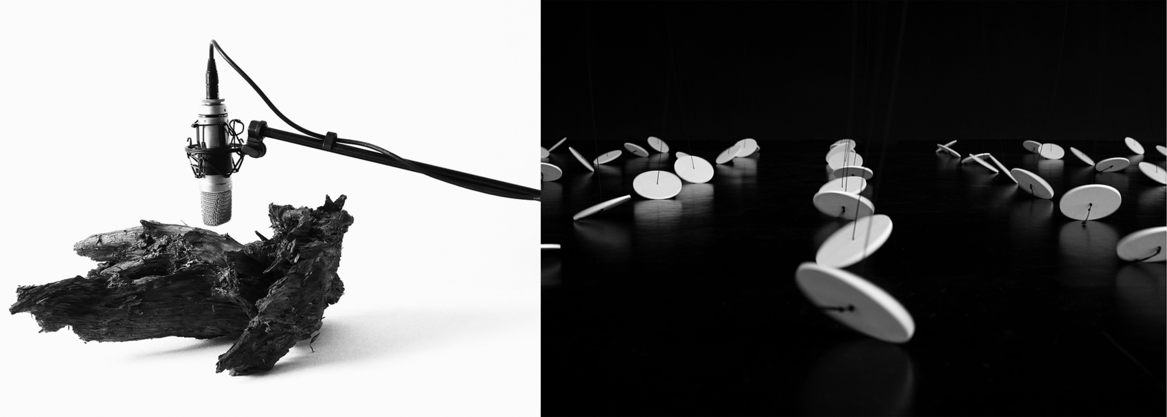
The cover page of Christoph Cox’s (Reference Cox2017) slideshow for his insightful talk on the history of sound art displays an image of 25 woodworms, wood, microphone, sound system (2009) by Zimoun. Although not mentioned during his talk, perhaps it is implicit in Cox’s choice that Zimoun’s work typifies the current state of sound art, or at least a noteworthy direction within it. As evident in all of his work titles, what has characterised Zimoun’s art for more than a decade is ‘an obsessive display of … materials [emphasis added]’ (Zimoun, n.d.) (Figure 9). Is this not, in and of itself, emblematic of the vitality of audiovisual materialism within contemporary sound-based art?
Left: 25 woodworms, wood, microphone, sound system (2009) by Zimoun. Right: 225 prepared dc-motors, 720 m rope, wooden discs ø 100 mm (2019) by Zimoun. Photos courtesy of the artist.

Supplementary material
To view supplementary material for this article, please visit https://doi.org/10.1017/S1355771820000321