I. INTRODUCTION
High entropy alloys (HEAs) Reference Yeh, Chen, Lin, Gan, Chin, Shun, Tsau and Chang1–Reference Zhang, Yang and Liaw3 and bulk metallic glasses (BMGs) Reference Wang, Dong and Shek4,Reference Inoue and Takeuchi5 are both potential candidate materials for industrial application. Because of the high entropy effect, HEAs always form simple solid solutions with face-centered cubic (FCC) and/or body-centered cubic (BCC) structures rather than intermetallic compounds. However, as the “confusion principle” is a necessary condition for glass formation, some HEAs can also form amorphous structure. Reference Guo, Ng, Lu and Liu6,Reference Zhang, Zhou, Lin, Chen and Liaw7 As a combination of HEAs and BMGs, the bulk metallic glassy alloys which consist of at least five principal elements in equimolar or near-equimolar ratios have been defined as high entropy metallic glasses. Reference Zhao, Xia, Bai, Zhao and Wang8,Reference Wang9
As HE-BMG is a new research topic, only a few HE-BMGs, such as Ti20Zr20Hf20Cu20Ni20, Reference Ma, Wang, Zhang and Inoue10 Sr20Ca20Yb20Mg20Zn20, Reference Gao, Zhao, Ke, Ding, Wang and Bai11 Zn20Ca20Sr20Yb20(Li0.55Mg0.45)20, Reference Zhao, Xia, Bai, Zhao and Wang8 and Pd20Pt20Cu20Ni20P20, Reference Takeuchi, Chen, Wada, Yokoyama, Kato, Inoue and Yeh12 have been developed and the glass-forming ability of most developed HE-BMGs is relatively low. So it is meaningful to develop an effective way for composition design of novel HE-BMGs with good glass-forming ability. In our previous study, Reference Ding and Yao13 a way for designing high entropy bulk glassy alloy has been proposed that HE-BMG can be derived from the existing BMG system with superior glass-forming ability (GFA). It is well known that many Zr–Ti–Cu–Ni–Be or Ti–Zr–Cu–Ni–Be quinary alloys possess superior glass-forming ability. Reference Peker and Johnson14–Reference Kim, Kim and Kim16 In this sense, the equiatomic and near-equiatomic alloys in Ti–Zr–Cu–Ni–Be system are probably good glass formers. Based on the above conception, a Ti20Zr20Cu20Ni20Be20 HE-BMG with a critical size of 3 mm has been successfully developed. Reference Ding and Yao13 Compared with other glass forming alloys in the same system, the glass-forming ability of Ti20Zr20Cu20Ni20Be20 HE-BMG is much lower.
For understanding the thermal stability and crystallization mechanism, it is meaningful to investigate the crystallization kinetics and thermodynamic properties of BMGs. Many papers have been published on the crystallization kinetics of BMGs, including Zr-based, Reference Cheng, Wang, Ma, Shan and Guo17 Ti-based, Reference Gong, Zhao, Wang and Yao18 Cu-based, Reference Song, Gargarella, Pauly, Ma, Kuhn and Eckert19 Fe-based, Reference Raval, Lad, Pratap, Awasthi and Bhardwaj20 Mg-based, Reference Sun, Shen, Li, Liu, Cong and Jiang21 Ni-based, Reference Qin, Zhang, Ding and Hu22 Ca-based, Reference Hu and Ye23 Al-based, Reference Chen, Chen and Lin24 and Ce-based BMGs, Reference Qiao, Pelletier, Wang, Jiao and Wang25 etc. However, very little information is available to date for HE-BMGs. In this study, the nonisothermal kinetics, kinetic fragility, and thermodynamic characteristics of Ti20Zr20Cu20Ni20Be20 HE-BMG have been systematically studied by differential scanning calorimetry (DSC). Zr41.2Ti13.8Cu12.5Ni10Be22.5 BMG, which is a typical representative of conventional BMGs with good glass-forming ability in Ti–Zr–Cu–Ni–Be quinary system, was chosen as a reference. Our research is an attempt to get a better idea of the characteristics of HE-BMGs.
II. EXPERIMENTAL PROCEDURE
The master ingots with a nominal composition of Ti20Zr20Cu20Ni20Be20 were prepared by arc-melting a mixture of Ti, Zr, Cu, Ni, and Be metals (purity ≥ 99.9%) in a Ti-gettered high purity argon atmosphere. The ingots were flipped and re-melted several times to ensure compositional homogeneity. Cylindrical rods with a diameter of 3 mm and a length of ∼30 mm were produced by copper mold suction casting. The as-cast 3 mm-diameter rod was sealed into a quartz tube under high vacuum and annealed at 753 and 813 K, respectively, for 1 h to find out the crystalline phases. The microstructure of the as-cast and annealed samples was examined by x-ray diffraction (XRD, Rigaku D/max-RB, Cu Kα radiation, Tokyo, Japan). Thermal analysis was carried out in a DSC (NETZSCH 404 F1 Pegasus, Selb, Germany) under a flow of purified argon at different heating rates in the range of 5–40 K/min using alumina crucibles. The DSC system was calibrated for temperature and enthalpy using indium and zinc standards. To avoid the influence of the sample size and sample mass, all the DSC samples were cut from the same 3 mm-diameter fully amorphous rod and the weight of each sample was around 15 mg.
III. RESULTS AND DISCUSSION
A. Continuous heating
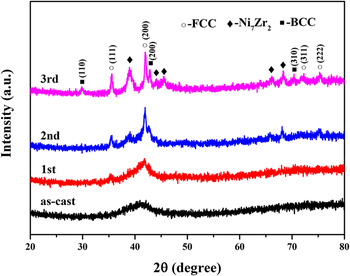
It was already known that HEAs do not always form simple solid solutions with FCC and/or BCC structures. This is entirely dependent on the chemistry of the alloy and the topology/atomic size differences of the alloy constituents. Based on the solid-solution phase formation rules for multicomponent alloys proposed by Zhang et al., Reference Zhang, Zhou, Lin, Chen and Liaw7 Ti20Zr20Cu20Ni20Be20 alloy is located in the BMG forming zone. Our previous study shows that Ti20Zr20Cu20Ni20Be20 alloy is a bulk glass former with a critical size of 3 mm. Reference Ding and Yao13 Correspondingly, as shown in Fig. 1, the XRD pattern of as-cast 3 mm-diameter Ti20Zr20Cu20Ni20Be20 alloy rod consists of only a broad halo and no other sharp peaks corresponding to crystalline phases can be observed, indicating that the alloy rod possesses fully amorphous structure.
XRD patterns of as-cast and annealed 3 mm-diameter Ti20Zr20Cu20Ni20Be20 rod samples.

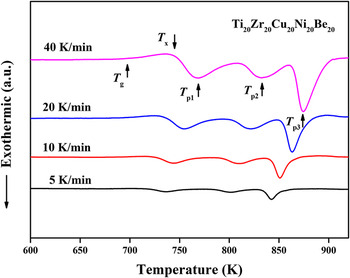
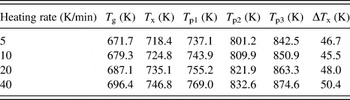
Figure 2 shows the typical nonisothermal DSC curves of the Ti20Zr20Cu20Ni20Be20 HE-BMG obtained at various heating rates of 5, 10, 20, and 40 K/min. All the DSC traces exhibit an endothermic event corresponding to the glass transition followed by three exothermic crystallization peaks. The characteristic temperatures (such as the glass transition temperature T g, the onset crystallization temperature T x, and the peak temperatures T p1, T p2, and T p3) and supercooled liquid region (defined as T x − T g) are listed in Table I. The crystallization of Ti20Zr20Cu20Ni20Be20 HE-BMG is a multiple stage process and rather complex.
Continuous DSC traces of the Ti20Zr20Cu20Ni20Be20 HE-BMG at different heating rates.

The thermal properties of the Ti20Zr20Cu20Ni20Be20 HE-BMG measured at different heating rates. The measurement errors lie within ±1 K for the temperatures.

To indentify the precipitated phases underlying various crystallization stages, the 3 mm-diameter Ti20Zr20Cu20Ni20Be20 fully glassy samples were heated in DSC furnace to selected temperatures (T p1 20 K/min, T p2 20 K/min, and T p3 20 K/min) at a heating rate of 20 K/min and cooled to room temperature subsequently without holding time. XRD measurements for samples after annealing treatments at various selected temperatures were carried out. As shown in Fig. 1, the primary crystalline phase was indexed as FCC solid solution appearing at T p1 20 K/min. When the annealing temperature increases to T p2 20 K/min, two crystalline phases FCC solid solution and Ni7Zr2 intermetallic compound were detected. Upon heating to the third exothermic peak, BCC solid solution was observed in addition to the FCC solid solution and Ni7Zr2 intermetallic compound. In contrast, there have been a number of reports on Ti and/or Zr containing BMGs showing the formation of icosahedral quasicrystals or Laves type-phases during crystallization. Reference Kim, Park, Lee, Bae, Kim and Kim26–Reference Zhou, Hou, Zhong and Li29 This indicates that the high entropy effect does play an important role on the crystallization behavior of HE-BMGs. With the increase of heating rate, all the characteristic temperatures of Ti20Zr20Cu20Ni20Be20 HE-BMG shift to higher temperature. This phenomenon has also been observed for other BMGs. Reference Cheng, Wang, Ma, Shan and Guo17–Reference Qiao, Pelletier, Wang, Jiao and Wang25
Based on the DSC data, the apparent activation energy for the glass transition and crystallization can be evaluated by the Kissinger and Ozawa equations, respectively. The Kissinger equation can be written as Reference Kissinger30 :
 $$\ln \left( {{\phi \over {{T^2}}}} \right) = - {E \over {RT}} + {b_1}\quad ,$$
where
 $\phi$
is the heating rate, R is the gas constant (8.314 J/mol K), and b
1 is a constant. T is a specific characteristic temperature, such as T
g, T
x, T
p1, T
p2, and T
p3, while E denotes the corresponding activation energy, such as E
g, E
x, E
p1, E
p2, and E
p3.
The Ozawa equation can be expressed as Reference Ozawa31 :
 $$\ln \left( \phi \right) = - 1.052{E \over {RT}} + {b_2}\quad ,$$
where b 2 is another constant.
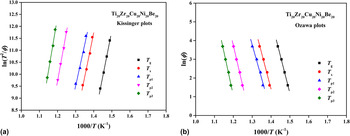
The Kissinger and Ozawa plots of Ti20Zr20Cu20Ni20Be20 HE-BMG at different heating rates are shown in Fig. 3(a) and 3(b), respectively. By linear fitting, the activation energies such as E g, E x, E p1, E p2, and E p3 for Ti20Zr20Cu20Ni20Be20 HE-BMG have been obtained and listed in Table II. The activation energies estimated from Kissinger and Ozawa methods are approximately equal to each other. It can be noticed that E p1 is smaller than E x, and this means that the grain growth process is easier to occur than the nucleation process for the first crystallization event. As E p3 > E p2 > E p1, the sequence of the difficulty during the crystallization is the first step, the second step, and the third step.
(a) Kissinger plots and (b) Ozawa plots of the Ti20Zr20Cu20Ni20Be20 HE-BMG.

The apparent activation energies derived with Kissinger and Ozawa methods for Ti20Zr20Cu20Ni20Be20 HE-BMG. The activation energies of Zr41.2Ti13.8Cu12.5Ni10Be22.5 (Vit 1) BMG obtained by Kissinger method are also listed as a Ref. Reference Song, Gargarella, Pauly, Ma, Kuhn and Eckert19.

To find the difference between HE-BMGs and conventional BMGs, the activation energies of Zr41.2Ti13.8Cu12.5Ni10Be22.5 (Vit 1) BMG, which is a typical alloy in Zr–Ti–Cu–Ni–Be quinary alloy system with nonequal atomic concentration, are also summarized in Table II. Reference Cheng, Wang, Ma, Shan and Guo17 By comparison, the E g value of Ti20Zr20Cu20Ni20Be20 HE-BMG is smaller than that of Zr41.2Ti13.8Cu12.5Ni10Be22.5 alloy, indicating that Ti20Zr20Cu20Ni20Be20 HE-BMG possesses less stable glassy structure. Reference Chen, Li and Yao32 Moreover, the relatively large value of E x means Ti20Zr20Cu20Ni20Be20 HE-BMG has a good stability in thermodynamics.
B. Nonisothermal crystallization kinetics
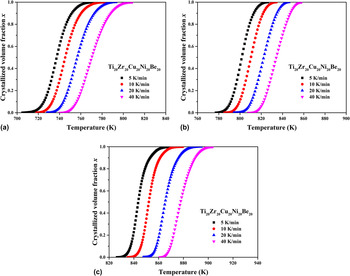
Figure 4 shows the crystallized volume fraction x of the first, second, and third exothermic peak for Ti20Zr20Cu20Ni20Be20 HE-BMG with a dependence of temperature T at different heating rates. All the curves exhibit a sigmoid shape, indicating that the crystallization rate is slower at the beginning and end of the crystallization process.
Plots of crystallized volume fraction x versus temperature T of the Ti20Zr20Cu20Ni20Be20 HE-BMG at different heating rates for the (a) first, (b) second, and (c) third crystallization events.

As the nucleation and growth always do not remain the same way during the whole crystallization process, the local Avrami exponent n(x) was used to study the crystallization mechanism of Ti20Zr20Cu20Ni20Be20 HE-BMG. In case of isothermal process, n(x) can be given as follows based on Johnson-Mehl-Avrami (JMA) equation Reference Málek33 :
 $$n\left( x \right) = {{d\ln \left[ { - \ln \left( {1 - x} \right)} \right]} \over {d\ln \left( {t - {t_0}} \right)}}\quad ,$$
where x is the crystallized volume fraction, t is the time corresponding to the crystallized volume fraction, and t 0 is the incubation time for nucleation.
Blazquez et al. Reference Blázquez, Conde and Conde34 extends the JMA equation to nonisothermal process under the approximation of iso-kinetic behavior, which gives the relation:
 $$n\left( x \right) = {1 \over {1 + \left( {{{{E_{\rm{a}}}} \mathord{\left/ {\vphantom {{{E_{\rm{a}}}} {RT}}} \right. \kern-\nulldelimiterspace} {RT}}} \right)\left( {1 - {T \mathord{\left/ {\vphantom {T {{T_0}}}} \right. \kern-\nulldelimiterspace} {{T_0}}}} \right)}} \cdot {{d\ln \left[ { - \ln \left( {1 - x} \right)} \right]} \over {d\ln \left[ {{{\left( {T - {T_0}} \right)} \mathord{\left/ {\vphantom {{\left( {T - {T_0}} \right)} \phi }} \right. \kern-\nulldelimiterspace} \phi }} \right]}}\quad ,$$
where T 0 is the onset temperature of crystallization for each exothermic peak and E a is the activation energy.
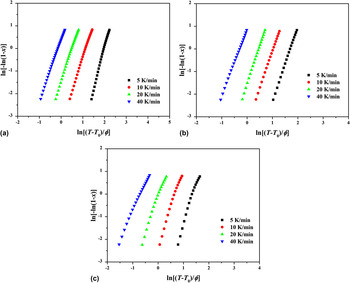
Figure 5 shows the plots of ln[−ln(1 − x)] versus ln[(T − T
0)/
 $\phi$
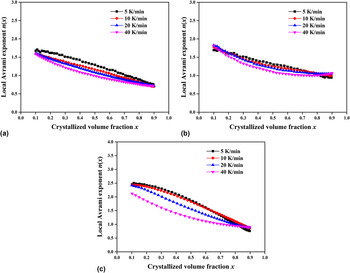
] of Ti20Zr20Cu20Ni20Be20 HE-BMG. Based on the JMA curves in Fig. 5 and Eq. (4), the local Avrami exponent n(x) of the first, second, and third crystallization events can be obtained and shown in Figs. 6(a)–6(c), respectively.
JMA plots of the Ti20Zr20Cu20Ni20Be20 HE-BMG at different heating rates for the (a) first, (b) second, and (c) third crystallization events.

Variations of the local Avrami exponent versus the crystallized volume fraction x at different heating rates calculated for the Ti20Zr20Cu20Ni20Be20 HE-BMG: the (a) first, (b) second, and (c) third exothermic peaks.

The Avrami exponent can be expressed as Reference Ranganathan and Von Heimendahl35 :
 $$n = a + bc\quad ,$$
where a is the nucleation index (a = 0 for zero nucleation rate; 0 < a < 1 for decreasing nucleation rate; a = 1 for constant nucleation rate and a > 1 for increasing nucleation rate), b is the dimensionality of the growth (b = 1, 2, and 3 for one-, two-, and three-dimensional growth, respectively), c is the growth index (c = 0.5 for diffusion-controlled and c = 1 for interface-controlled growth).
It can be seen from Fig. 6 that all the n(x) − x curves exhibit the same tendency that the value of n(x) gradually decreases as the crystallization fraction increases, which means the nucleation rate decreases. For the first and second crystallization processes, the local Avrami exponent begins from 1.5 <n(x) < 2, which indicates that both of the two crystallization processes are initiated by diffusion-controlled one-dimensional growth with a decreasing nucleation rate. As the crystallization proceeds, the local exponent start to decrease and the value of n(x) is below 1.5 in almost the whole crystallization process, indicating that the nucleation is saturated and there are lots of the crystal nuclei growing up directly. For the third crystallization process, the starting value of n(x) is larger than the values of the first and second crystallization processes under the same condition but still smaller than 2.5, and this means that the crystallization mechanism is the growth of primary crystal type and the nucleation rate decreases with time. In the next stage, n(x) also drops below 1.5, indicating that the concentration of pre-existing nuclei has already reached saturation.
S. Cheng et al. Reference Cheng, Wang, Ma, Shan and Guo17 have investigated the nonisothermal kinetics of Zr41.2Ti13.8Cu12.5Ni10Be22.5 BMG. For the first crystallization event, the local Avrami exponent curves at relatively high heating rates (20 and 40 K/min) increase slowly from ∼2.0 (x = 0.1) to ∼2.5 (x = 0.9), while the n(x) − x curves at lower heating rates (5 and 10 K/min) decrease first from ∼2.0 (x = 0.1) to the minimum and then increase to ∼2.5. The crystallization mechanism of Zr41.2Ti13.8Cu12.5Ni10Be22.5 BMG is quite different from that of Ti20Zr20Cu20Ni20Be20 HE-BMG.
As the activation energy during the crystallization process is not a constant, Kissinger–Akahira–Sunose (KAS) Reference Patel and Pratap36 method is used to calculate the local values of activation energy:
 $$\ln \left( {{\phi \over {T{{\left( x \right)}^2}}}} \right) = - {{{E_{\rm{a}}}\left( x \right)} \over {RT\left( x \right)}} + {d_1}\quad ,$$
where E a(x) and T(x) stand for activation energy and temperature corresponding to the given crystallized volume fraction x; d 1 is a constant.
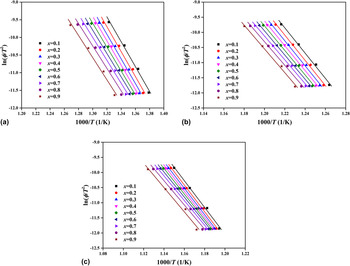
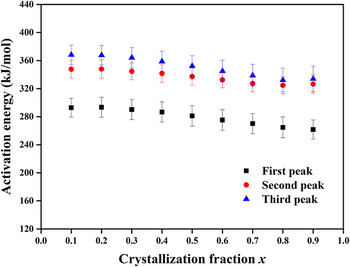
Figure 7 shows the KAS plots of the first, second, and third crystallization peaks for Ti20Zr20Cu20Ni20Be20 HE-BMG. By linear fitting, the evolution of E a(x) as a function of crystallized volume fraction x (ranging from 0.1 to 0.9) was determined (as shown in Fig. 8). As can be seen, for all the crystallization peaks, the value of E a(x) is almost stable and can be taken as a constant. The average E a(x) values for the first, second, and third crystallization peaks are 279.5 ± 14.3, 336.7 ± 12.3, and 351.1 ± 15.3 kJ/mol, respectively. In contrast, for Zr41.2Ti13.8Cu12.5Ni10Be22.5 BMG, Reference Cheng, Wang, Ma, Shan and Guo17 the value of E a(x) for the first crystallization peak increases dramatically from ∼170 kJ/mol (x = 0.1) to ∼230 kJ/mol (x = 0.9), which indicates that the crystallization process of Zr41.2Ti13.8Cu12.5Ni10Be22.5 BMG is more complex.
KAS plots for different crystallization volume fractions x (ranging from 0.1 to 0.9) for the Ti20Zr20Cu20Ni20Be20 HE-BMG: the (a) first, (b) second, and (c) third exothermic peaks.

Dependence of local activation energy E a(x) on the degree of crystallization volume fraction x.

C. Kinetic fragility
Kinetic fragility (m) presents the degree of deviations from the Arrhenius law above T g and is widely used to estimate the thermal stability or glass-forming ability of metallic glass. Reference Qiao, Pelletier, Wang, Jiao and Wang25 Angell introduced the kinetic fragility parameter m as a metric for the viscosity behavior of the undercooled liquid around the glass transition temperature. Reference Angell37
 $$m = \left( {{{{D^*}} \mathord{\left/ {\vphantom {{{D^*}} {\ln 10}}} \right. \kern-\nulldelimiterspace} {\ln 10}}} \right)\left( {{{T_{\rm{g}}^0} \mathord{\left/ {\vphantom {{T_{\rm{g}}^0} {{T_{\rm{g}}}}}} \right. \kern-\nulldelimiterspace} {{T_{\rm{g}}}}}} \right){\left( {{{1 - T_{\rm{g}}^0} \mathord{\left/ {\vphantom {{1 - T_{\rm{g}}^0} {{T_{\rm{g}}}}}} \right. \kern-\nulldelimiterspace} {{T_{\rm{g}}}}}} \right)^{ - 2}}\quad ,$$
where D* is the strength parameter, T
g
0 is the asymptotic value of T
g, which is usually approximated as the onset of the glass transition temperature at the limit of infinitely slow cooling, and T
g is the glass transition temperature at a heating rate of 20 K/min. The variation of T
g with the heating rate
 $\phi$
can be fitted by using Vogel–Fulcher–Tammann (VFT) equation
Reference Brüning and Samwer38
:
 $$\ln \left( \phi \right) = \ln C - {{{D^*}T_{\rm{g}}^0} \mathord{\left/ {\vphantom {{{D^*}T_{\rm{g}}^0} {\left( {{T_{\rm{g}}} - T_{\rm{g}}^0} \right)}}} \right. \kern-\nulldelimiterspace} {\left( {{T_{\rm{g}}} - T_{\rm{g}}^0} \right)}}\quad ,$$
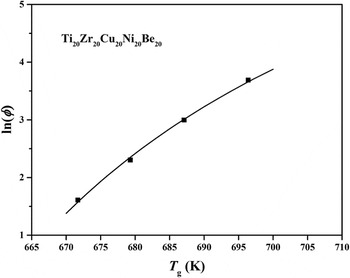
where C is a constant. The values of D* and T g 0 can be obtained by fitting the VFT equation from the heating rate dependence of the glass transition temperature, then the fragility index m can be calculated using Eq. (8).
Figure 9 shows the variation of ln
 $\phi$
with T
g fitted by VFT equation for Ti20Zr20Cu20Ni20Be20 HE-BMG. The m value of Ti20Zr20Cu20Ni20Be20 HE-BMG is calculated to be 23, which is much smaller than those of other BMGs in the same alloy system, such as Zr41.2Ti13.8Cu12.5Ni10Be22.5 (m = 44) and Zr46.75Ti8.25Cu7.5Ni10Be27.5 (m = 44.2).
Reference Cheng, Wang, Ma, Shan and Guo17
Glass forming liquids can be classified into three general categories based on the concept of fragility: strong glass formers (m < 30), intermediate glass formers (30 ≤ m < 100), and fragile glass formers (m ≥ 100).
Reference Angell37
In this sense, the studied Ti20Zr20Cu20Ni20Be20 HE-BMG can be classified to the strong glass former. However, it has been perceived that a low m value is not necessarily associated with a superior GFA.
Reference Senkov39–Reference Chattopadhyay, Sangal and Mondal41
VFT fit of the Ti20Zr20Cu20Ni20Be20 HE-BMG.

D. Thermodynamics
The Gibbs free energy difference (ΔG) between the supercooled liquid and crystalline states is the driving force of crystallization and plays an important role in predicting the glass-forming ability of multicomponent metallic alloys. The Gibbs energy difference ΔG can be calculated as follows Reference Busch, Kim and Johnson42 :
 $$\Delta G = \Delta H - T\Delta S\quad ,$$
where
 $$\Delta H = \Delta {H_{\rm{m}}} - \int_T^{{T_{\rm{m}}}} {\Delta C_{\rm{p}}^{{\rm{l}} - {\rm{s}}}{\rm{d}}T} \quad ,$$
and
 $$\Delta S = \Delta {S_{\rm{m}}} - \int_T^{{T_{\rm{m}}}} {\Delta C_{\rm{p}}^{{\rm{l}} - {\rm{s}}}} {{dT} \over T}\quad ,$$
where T m is the melting temperature, ΔS m is the entropy of fusion, and ΔH m is the enthalpy of fusion. They are related to each other by the following equation:
 $$\Delta {S_{\rm{m}}} = {{\Delta {H_{\rm{m}}}} \mathord{\left/ {\vphantom {{\Delta {H_{\rm{m}}}} {{T_{\rm{m}}}}}} \right. \kern-\nulldelimiterspace} {{T_{\rm{m}}}}}\quad .$$
Using Eqs. (10)–(12) in Eq. (9), we obtain the following expression for ΔG:
 $$\Delta G = \Delta {H_{\rm{m}}}{{{T_{\rm{m}}} - T} \over {{T_{\rm{m}}}}} - \int_T^{{T_m}} {\Delta C_{\rm{p}}^{{\rm{l}} - {\rm{s}}}{\rm{d}}T} + T\int_T^{{T_{\rm{m}}}} {{{\Delta C_{\rm{p}}^{{\rm{l}} - {\rm{s}}}} \over T}{\rm{d}}T} \quad ,$$
where
 $\Delta C_{\rm{p}}^{{\rm{l}} - {\rm{s}}}$
is the heat capacity difference between solid and liquid.
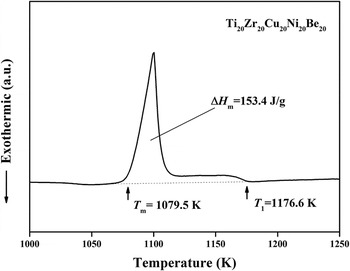
For Ti20Zr20Cu20Ni20Be20 HE-BMG, ΔH
m and T
m can be easily obtained by DSC (as shown in Fig. 10). However, it is difficult to measure the heat capacity of the supercooled liquid
 $\left( {C_{\rm{p}}^{\rm{l}}} \right)$
accurately. Based on the approximation of
 $\Delta C_{\rm{p}}^{{\rm{l}} - {\rm{s}}}$
, Lad et al.
Reference Lad, Raval and Pratap43
got the following equation to calculate ΔG for metallic alloys which have wide supercooled liquid region:
 $$\Delta G = {{\Delta {H_{\rm{m}}}\Delta T} \over {{T_{\rm{m}}}}}\left( {1 - {{\Delta T} \over {2T}}} \right)\quad ,$$
where ΔT = T m − T.
DSC curve of the Ti20Zr20Cu20Ni20Be20 HE-BMG around the melting temperature at a heating rate of 20 K/min.

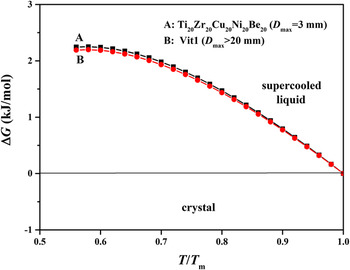
Figure 11 shows the Gibbs free energy difference as a function of temperature normalized to T m for Ti20Zr20Cu20Ni20Be20 HE-BMG. For comparison, the Gibbs energy difference curve of Zr41.2Ti13.8Cu12.5Ni10Be22.5 BMG is also provided. Reference Cheng, Wang, Ma, Shan and Guo17 It is found that the value of the Gibbs energy difference of Ti20Zr20Cu20Ni20Be20 HE-BMG is slightly higher than that of Zr41.2Ti13.8Cu12.5Ni10Be22.5 BMG. As Zr41.2Ti13.8Cu12.5Ni10Be22.5 BMG is a well-known alloy with high glass-forming ability, the Gibbs free energy difference of this alloy is lower than that of most other BMGs. Reference Busch, Kim and Johnson42 Correspondingly, Ti20Zr20Cu20Ni20Be20 HE-BMG shows relatively low Gibbs free energy difference.
Gibbs free energy difference curves for Ti20Zr20Cu20Ni20Be20 HE-BMG and Zr41.2Ti13.8Cu12.5Ni10Be22.5 BMG.

E. Glass-forming ability
In general, the alloys which possess high crystallization activation energy, small fragility index, and low Gibbs energy difference are probably good glass former. Based on the above results, Ti20Zr20Cu20Ni20Be20 HE-BMG is expected to have good glass-forming ability by comparison with Zr41.2Ti13.8Cu12.5Ni10Be22.5 BMG. However, Zr41.2Ti13.8Cu12.5Ni10Be22.5 BMG also exhibits a wider supercooled liquid region (82 K, heating rate 20 K/min), Reference Cheng, Wang, Ma, Shan and Guo17 implying a higher thermal stability. Moreover, the critical size of Ti20Zr20Cu20Ni20Be20 HE-BMG is only 3 mm, which is much smaller than that of Zr41.2Ti13.8Cu12.5Ni10Be22.5 BMG (over 20 mm). Reference Peker and Johnson14
This result can be explained from several aspects. First, by treating Ti–Zr–Cu–Ni–Be alloy system as a pseudo ternary system, it has been found that the good glass forming alloys in this quinary system always locates at the (Ti + Zr)-rich corner (60–65 at.%), while poor in (Cu + Ni), which is less than 25 at.%. Reference Ding and Yao13 Thus, Ti20Zr20Cu20Ni20Be20 alloy deviates from the good glass-forming area. As strong evidence of the above analysis, the liquidus temperature T l (also the melting temperature T m) of Zr41.2Ti13.8Cu12.5Ni10Be22.5 BMG (993 K) Reference Ding and Yao13 is obviously lower than that of Ti20Zr20Cu20Ni20Be20 HE-BMG (1176.6 K), resulting in a higher value of T rg (defined as T g/T l, heating rate: 20 K/min, 0.584 for Ti20Zr20Cu20Ni20Be20 HE-BMG and 0.629 for Zr41.2Ti13.8Cu12.5Ni10Be22.5 BMG). It should be noted that a higher melting point always corresponds to the presence of a higher volume fraction of high melting point phases, which would also well explain why the E p1, E p2, and E p3 values are considerably higher than those reported for Zr41.2Ti13.8Cu12.5Ni10Be22.5 alloy. Second, from the topological perspective, Zr41.2Ti13.8Cu12.5Ni10Be22.5 alloy satisfies ideal efficient atomic-packing conditions, which is beneficial to the glass formation. Third, based on Eq. (9), the high entropy of mixing is beneficial to decrease the Gibbs free energy difference. But meanwhile, according to Adam–Gibbs equation, Reference Adam and Gibbs44 the high entropy of mixing also leads to low viscosity and a high mobility of the atoms in the liquid. Reference Zhang, Zhou, Lin, Chen and Liaw7 So high entropy effect has both advantageous and disadvantageous to the glass-forming ability and the negative effect might play a greater role.
IV. CONCLUSIONS
-
(1) The crystallization of the Ti20Zr20Cu20Ni20Be20 HE-BMG exhibits three steps and the crystallization products are indexed as FCC and BCC solid solutions together with Ni7Zr2 intermetallic phase. The apparent activation energies of E g, E x, E p1, E p2, and E p3 have been estimated by Kissinger equation and Ozawa equation.
-
(2) The Avrami exponent is less than 1.5 in the whole process of the first and second crystallization events and most cases of the third crystallization event, indicating that the main crystallization mechanism of diffusion-controlled growth of pre-existing nuclei. The local activation energy keeps stable during the whole crystallization process with average values of 279.5 ± 14.3, 336.7 ± 12.3, and 351.1 ± 15.3 kJ/mol, respectively, for the first, second, and third crystallization events.
-
(3) According to the small value of fragility index (23), Ti20Zr20Cu20Ni20Be20 HE-BMG can be classified into “strong glasses”. Ti20Zr20Cu20Ni20Be20 HE-BMG also exhibits relatively low Gibbs free energy difference.
-
(4) By comparison with Zr41.2Ti13.8Cu12.5Ni10Be22.5 BMG, the larger values of activation energies for crystallization (E x and E p1), smaller fragility index, and similar Gibbs free energy difference of Ti20Zr20Cu20Ni20Be20 HE-BMG do not correspond to the better thermal stability and glass-forming ability. This might be attributed to the deviation of best glass forming region and the low viscosity induced by the high entropy effect.
ACKNOWLEDGMENT
This work was supported by the National Natural Science Foundation of China (Grant Nos. 51271095 and 51101090).