Implications
Freezing protocols for the semen of most of the species include a slow cooling phase to 5ºC. This phase requires from refrigeration units and comprises at least 85% of the total time cryopreserving sperm. In this study, we investigate whether treating bull and goat sperm with cholesterol-loaded cyclodextrins allows eliminating this cooling phase. Our results show that this treatment partially prevents the damage to the sperm when directly frozen from room temperature and with this technique the sperm cryopreservation protocols are simplified, which would allow the processing of more ejaculates per day or freezing ejaculates collected in the field.
Introduction
Successful sperm cryopreservation allows sperm to be preserved for long periods of time, permitting their use anywhere in the world and whenever a female is ready to be inseminated. However, the cooling and freezing processes can damage sperm ultimately impairing their fertilizing ability, unless specific precautions are taken. One of the precautions that is taken to avoid ‘cold shock’ is to cool the sperm slowly from room temperature to 5ºC (Amann and Pickett, Reference Amann and Pickett1987). This step may require refrigeration units, and may prevent from freezing samples in places where a refrigerator is not available. When the temperature of sperm is reduced from body temperature to 5ºC, partially irreversible changes occur in the membrane referred to as ‘cold shock’ and cooling damage (Amann and Pickett, Reference Amann and Pickett1987). Cold shock can induce direct injury to sperm, which is directly correlated to the cooling rate used, as well as indirect or latent damage, which is independent of cooling rate and is only manifest sometime after the temperature has been reduced (Amann and Pickett, Reference Amann and Pickett1987). To minimize cold shock damage, special techniques are used. First, sperm-freezing diluents contain compounds that protect the sperm membranes from damage (such as egg yolk or skim milk). Second, the sperm are cooled from room temperature to 5ºC slowly (requiring 1 h or longer; Leboeuf et al., Reference Leboeuf, Restall and Salamon2000). If one takes into account that the freezing step (from 5ºC to storage in liquid nitrogen) of a cryopreservation protocol usually requires 10 to 15 min, the cooling phase from room temperature to 5ºC (even with the fastest protocols) comprises at least 86% of the total time cryopreserving sperm, which results in a time-consuming protocol, and in turn limits the number of samples that can be processed in any 1 day. Such time expenditure in combination with the dependence on refrigeration equipment to cool the sperm slowly inhibits the ability of processing sperm in farm conditions.
The resistance of sperm membranes to cold shock damage depends on the plasma membrane composition. Sperm membranes from cold shock-resistant species present, in general, higher ratios of polyunsaturated to saturated fatty acids, and/or higher cholesterol to phospholipid molar ratios than sperm from cold shock-sensitive species (for an extensive review, see Watson, Reference Watson1981). Indeed, treating sperm from several cold shock-sensitive species with cholesterol-loaded cyclodextrins (CLC) before cryopreservation results in higher sperm cryosurvival rates and sperm quality after thawing than untreated sperm (for a review, see Mocé et al., Reference Mocé, Blanch, Tomás and Graham2010). However, in all these studies, sperm were frozen using standard protocols described for each species, which includes the slow cooling from room temperature to 5ºC. As cholesterol impacts a sperm’s resistance to cooling injury (for a review, see Watson, Reference Watson1981), adding cholesterol to sperm might permit reducing or even eliminating the cooling phase to 5ºC of a cryopreservation protocol, which could simplify the freezing protocols.
The objective of this study was to determine the effect of CLC treatment on goat and bull sperm quality after thawing when sperm were frozen using conventional protocols (including a slow cooling phase from room temperature to 5ºC) or using protocols in which the sperm were frozen directly from room temperature.
Material and methods
Animals
Mature Holstein bulls were housed at the Animal Reproduction Laboratory at Colorado State University, fed a diet providing 100% of their nutritional needs and provided water ad libitum. Ejaculates were collected using an artificial vagina. All animal care and procedures used to house and collect semen were approved by the Animal Care and Use Committee of Colorado State University. Mature Murciano-Granadina bucks (2 to 7 years of age) were housed in a common pen at the Centro de Tecnología Animal, Instituto Valenciano de Investigaciones Agrarias (CITA-IVIA; Segorbe, Castellón, Spain) and fed a diet containing hay ad libitum and 1 kg of complementary feed (CP 16.5%, crude oils and fat 4.5%) per male each day. Fresh water was provided ad libitum. Ejaculates were collected as described by Silvestre et al. (Reference Silvestre, Salvador, Sanchez and Gόmez2004). Animal housing, care and protocols for semen collection were approved by the Animal Care and Use Committee of CITA-IVIA and fulfilled the European regulations for the Care and Use of Animals for Scientific Purposes (EC Directive 86/609/ECC).
Materials and preparation of diluents
All chemicals were reagent grade and purchased from Sigma (St. Louis, MO, USA; Madrid, Spain), except for SYBR-14 and propidium iodide (PI), which were purchased from Molecular Probes (Eugene, OR, USA) or Invitrogen (Barcelona, Spain).
The basic solution to dilute sperm and to make the egg yolk-freezing diluents was a Tris-citrate diluent (250 mM of Tris[hydroxymethyl]aminomethane, 83 mM of citric acid anhydrous and 69 mM of D (+) glucose; 300 mOsm, pH=7; Mocé and Graham, Reference Mocé and Graham2006). Sperm from both species were frozen in a diluent containing two fractions. For samples frozen using the conventional cryopreservation protocol, the first fraction, which contains no glycerol, was used to dilute the sperm at room temperature and then cool the sperm to 5°C. After reaching 5°C, the samples were diluted with the second fraction, which contained glycerol. Both diluents were added at room temperature to samples that were frozen directly in liquid nitrogen vapor, without first cooling to 5ºC. The egg yolk–Tris (EYT) diluents were made by adding egg yolk from fresh eggs (20%; vol : vol) to the Tris diluent. For the glycerolated diluents, 8% (vol : vol) glycerol was added to the extender for freezing goat sperm, whereas 17.5% (vol : vol) glycerol was added to the glycerolated diluent for bull sperm. The diluents were clarified by centrifuging at 12 000 g for 20 min at 5ºC. The supernatant was recovered and filtered sequentially through 5, 3 and 1.2 µm filters.
CLC preparation
Methyl-β-cyclodextrin was preloaded with cholesterol as described by Purdy and Graham (Reference Purdy and Graham2004). Briefly, 200 mg of cholesterol was dissolved in 1 ml of chloroform. In a separate test tube, 1 g of cyclodextrin was dissolved in 2 ml of methanol and 0.45 ml of cholesterol was added to the cyclodextrin, the mixture stirred until the combined solution was clear, poured into a glass Petri dish and left to dry for 2 days at 37 to 39ºC. The resulting crystals were removed from the Petri dish and stored in capped glass tubes at 22ºC until use. A working solution of CLC was prepared by adding 50 mg of CLC to 1 ml of Tris diluent (Purdy and Graham, Reference Purdy and Graham2004) and mixing the solution using a vortex mixer.
Freezing-thawing protocols
Bull semen
Immediately after collection, the concentration of spermatozoa in each ejaculate was determined photometrically. Ejaculates were frozen according to the protocol described by Mocé and Graham (Reference Mocé and Graham2006). Briefly, spermatozoa were diluted to 60×106 cells/ml with EYT at room temperature and then cooled slowly to 5ºC (depending on the treatment) over 2 h (placing them into an 80 ml water bath at 22ºC and setting this into a 5ºC chamber for 2 h). Samples were then diluted 1 : 1 (vol : vol) with glycerolated EYT (17.5% glycerol; vol : vol) resulting in a final glycerol concentration of 8.75%. Sperm were equilibrated for 15 min packaged into 0.5 ml straws (IMV® Technologies, L’Aigle, France) and frozen in liquid nitrogen vapor, with the straws being suspended horizontally 4.5 cm above the liquid nitrogen, for 10 min before being plunged into the liquid nitrogen for storage. Two straws from each treatment were thawed in 37ºC water for 30 s before analysis. The contents of one straw were used to determine the percentage of motile sperm in each treatment, whereas that of the second straw was used to determine the percentage of viable sperm for each treatment.
Goat semen
Ejaculates were processed according to the protocol described by Konyali et al. (Reference Konyali, Tomás, Blanch, Gómez, Graham and Mocé2013). After collection, semen was washed twice by centrifugation to remove the seminal plasma. For washing, ejaculates were diluted 1 : 10 (vol : vol) with Tris diluent and centrifuged at 500 g for 15 min at 23ºC. After centrifugation, the supernatant was removed, the sperm pellet resuspended in 10 ml Tris diluent and samples centrifuged a second time. The supernatant was removed; the sperm pellets resuspended with 500 μl of Tris diluent and the sperm concentration determined using a spectrophotometer calibrated for goat sperm. Then, the sperm concentration in each sample was adjusted to 200×106 sperm/ml with EYT (at 22ºC). The samples were placed in 80 ml of water at 22ºC, which was placed in a chamber at 5ºC and allowed to cool to 5ºC over 2 h (depending on the treatment). When cooling was complete, the samples were diluted 1 : 1 (vol : vol) with glycerolated EYT (final glycerol concentration: 4%; vol : vol) that had been pre-cooled to 5ºC and the sperm equilibrated with the glycerol for 15 min before being packaged into 0.5 ml straws (IMV® Technologies). Straws were frozen in liquid nitrogen vapor, with the straws suspended horizontally 3 cm above the liquid nitrogen for 10 min. The straws were then plunged into liquid nitrogen for storage. Straws were thawed in 38ºC water for 30 s before analysis. The contents of the same straw were used to determine both the percentage of motile sperm and the percentage of viable sperm for each treatment.
Analysis of spermatozoa
Bull samples
The percentages of motile and progressively motile spermatozoa in each frozen-thawed sample were determined using a computer-assisted sperm analysis system (Hamilton Thorne Research, IVOS, Bedford, MA, USA) with settings of 30 frames acquired to avoid sperm track overlapping, minimum contrast 50. A sperm was defined as non-motile if head size <5 pixels, head intensity <90 and average path velocity (VAP) <25 µm/s. Sperm were considered progressively motile when they presented a VAP>60µm/s and a straightness index (STR) ≥80%. For each sample, 6 µl sub-samples were placed on slides and a minimum of 200 cells per subsample analyzed.
The percentages of viable spermatozoa in samples were determined using flow cytometry, as described by Purdy and Graham (Reference Purdy and Graham2004). Briefly, spermatozoa were stained for flow cytometric analysis by transferring a 0.1 ml aliquot from each sample into a tube containing 0.45 ml Tris-BSA (6 mg/ml) diluent, 8.5 µl SYBR-14 (10 µM solution in DMSO) and 5 µl PI (1 mg/ml solution in distilled water). The samples were incubated for 10 min at 22ºC and filtered through a 40 μm nylon mesh before being analyzed using an MoFloTM Legacy flow cytometer (Beckman-Coulter, Miami, FL, USA) equipped with an argon laser tuned to 488 nm at 100 mW power. Fluorescence from 50 000 cells was measured using a 515 nm long pass filter, a 525 nm band pass filter to detect SYBR-14, a 590 nm dichroic mirror and a 630 nm long pass filter to detect PI. The control settings were adjusted each day during the analyses by using two controls of fully dead sperm (one stained with PI and the other one with the two stains) and two controls of live sperm (one stained with SYBR-14 and the other one with both fluorochromes). Using this protocol, live cells stain with SYBR-14, permitting cells to be distinguished from egg yolk particles, but only non-viable cells stain with PI.
Goat samples
The percentages of total motile and progressively motile sperm were determined using a computer-assisted sperm analysis system (ISAS, version 1.0.17; Proiser, Valencia, Spain) operating at 25 video frames/s (25 Hz), with settings of particle area from 15 to 70 μm, and search radius=12 μm. A sperm was defined as non-motile if VAP<10 μm/s and sperm were considered progressively motile when they presented a VAP>75 μm/s and an STR≥80%. Sperm motility was assessed at 39ºC using a 10× negative phase contrast objective and a Nikon Eclipse 90i microscope (Nikon Corporation Instruments Company; IZASA, Barcelona, Spain) connected to the computer through a monochrome Basler A312f video camera (Basler Vision Technologies, Proiser, Paterna, Valencia, Spain). For each sample, the sperm concentration was adjusted with Tris-BSA (0.6%) to 15×106 sperm/ml and the samples incubated in a water bath at 38ºC for 10 min before evaluation. Then, 5 µl sub-samples were placed in a Makler chamber (Counting Chamber Makler, Sefi-Medical Instruments) pre-warmed at 39ºC on a thermal plate and a minimum of 200 sperm from three different fields were captured for analysis. Later each individual sperm track was visually assessed to eliminate possible debris and wrong tracks.
The percentage of viable (plasma membrane intact) sperm in each sample was evaluated by diluting the sperm to 15×106 sperm/ml with TRIS-BSA and transferring a 0.1 ml aliquot into a tube containing 0.45 ml Tris diluent, 2.5 µl SYBR-14 (10 µM solution in DMSO) and 2.5 µl PI (1.5 mM solution in distilled water). The samples were incubated for 10 min at 38ºC before being filtered through a 40 μm nylon mesh and analysis using an Epics XL-MCL flow cytometer (Beckman-Coulter; Izasa, Barcelona, Spain) equipped with an argon laser tuned to 488 nm at 15 mW power. Fluorescence from 10 000 cells was measured using a 550 nm long pass filter, a 525 nm band pass filter to detect SYBR-14, a 645 nm long pass filter and a 620 nm band pass filter to detect PI. In addition, for the bull samples, the control settings were adjusted each day during the analyses with control samples prepared according to the protocol previously described.
Experimental design
Bull semen
Five ejaculates from four bulls were used in this experiment. Each ejaculate was split into two treatment aliquots: one of the aliquots was used as a control (non-CLC treated) and the other was treated with 2 mg of CLC/120×106 sperm in accordance with the protocol described by Mocé and Graham (Reference Mocé and Graham2006). Samples were incubated for 15 min at 22°C, after which each sample was diluted to 60×106 cells/ml with EYT. Each aliquot was then split into two sub-samples, one of which was cooled slowly to 5ºC according to the freezing protocol previously described, whereas the other aliquot, from each treatment, was frozen directly from room temperature. The samples (control and CLC-treated) frozen directly from room temperature were diluted with glycerolated extender at room temperature, allowed to equilibrate with the glycerol for 15 min (at the same time, the sperm were loaded into 0.5 ml straws) and placed directly in liquid nitrogen vapor (according to the protocol described), avoiding the cooling phase of the protocol.
Goat semen
Ten ejaculates from five bucks (two ejaculates/male) were used in this experiment. Ejaculates were diluted with Tris extender and centrifuged, as previously described, to eliminate seminal plasma. After washing, each ejaculate was split into two treatment aliquots, one served as a control (non-CLC treated) and the other one was treated with 1 mg of CLC/120×106 sperm in accordance with the protocol described by Konyali et al. (2013). Samples were incubated for 15 min at 22°C, after which each sample was diluted to 200×106 cells/ml with EYT. Each aliquot was then split into two sub-samples, one was cooled slowly to 5ºC according to the freezing protocol previously described, whereas the other one was frozen directly from room temperature. The samples (control and CLC-treated) frozen directly from room temperature were diluted with glycerolated EYT at room temperature, allowed to equilibrate with the glycerol for 15 min (at the same time, the sperm were loaded into 0.5 ml straws) and placed directly in liquid nitrogen vapor (as described), avoiding the cooling phase of the protocol.
Statistical analyses
Data were analyzed by ANOVA, using a mixed model including ejaculate within male as random effect (The SAS System for Windows 9.0). The Tukey–Kramer adjustment was used to test the differences of least square means at a fixed 5% error level. For the analyses of total motile, progressive motile and plasma membrane integrity, the fixed effect of treatment (with four levels) was used.
Results
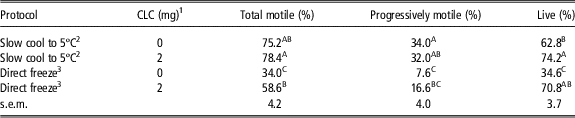
Bull sperm treated with CLC had higher percentages of live sperm in the samples, after cryopreservation, regardless of whether the sperm were frozen directly from room temperature or were cooled slowly to 5ºC, before freezing (P<0.01; Table 1). CLC treatment resulted in similar effects on the percentage of total sperm motility, when sperm were frozen directly from room temperature (P<0.01; Table 1). Control sperm frozen directly from room temperature exhibited lower percentages of motile and live cells than control sperm frozen using the conventional method, after cooling slowly to 5°C (P<0.01). However, CLC-treated sperm frozen directly from room temperature exhibited similar (P>0.05) percentages of motile and live cells as conventionally frozen control sperm.
Effect of cholesterol-loaded cyclodextrins (CLC) on bull sperm quality cryopreserved with slow or fast protocols (n=5)

Data are presented as least square means. The quality of the samples was evaluated 10 min after thawing.
A–CValues within a column with uncommon letters differ significantly at P<0.01.
1 Sperm were treated with 0 mg (control) or 2 mg of CLC/120×106 sperm before cryopreservation.
2 Sperm were cryopreserved after cooling slowly (in 2 h) to 5ºC.
3 Sperm were cryopreserved immediately after packaging into straws at 22°C.
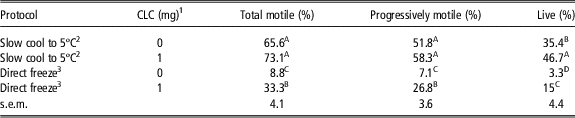
Goat sperm, treated with CLC, responded similarly to bull sperm, for samples frozen using the conventional method (slow cooling to 5°C before freezing), with CLC-treated samples exhibiting higher percentages of live cells after thawing (P<0.01; Table 2). Again, similar to bull sperm, untreated goat sperm frozen directly from room temperature had lower percentages of motile and live cells than control sperm frozen using the conventional procedure (P<0.01; Table 2). However, what is different about the goat sperm, compared with the bull sperm, is that although CLC treatment improved both the percentages of motile and live cells in the samples that were frozen directly from room temperature compared with the control sperm frozen this way (P<0.05), these percentages were also lower than control sperm frozen using the conventional procedure (P<0.01; Table 2).
Effect of cholesterol-loaded cyclodextrins (CLC) on goat sperm quality cryopreserved with slow or fast protocols (n=10)

Data are presented as least square means. The quality of the samples was evaluated 10 min after thawing.
A–DValues within a column with uncommon letters differ significantly at P<0.01.
1 Sperm were treated with 0 mg (control), or 1 mg of CLC/120×106 sperm before cryopreservation.
2 Sperm were cryopreserved after cooling slowly (in 2 h) to 5ºC.
3 Sperm were cryopreserved immediately after packaging into straws at 22°C.
Discussion
CLC treatment before freezing improved the cryosurvival rates of both the bull and goat sperm when the sperm were cooled slowly to 5ºC before freezing and if the sperm were frozen directly from room temperature. For sperm frozen after being cooled slowly to 5ºC, the benefits of CLC are similar to responses reported in previous studies for these species (for a review, see Mocé et al., Reference Mocé, Blanch, Tomás and Graham2010). This study provides the first evidence, however, that CLC treatment protects the bull and goat sperm when they are frozen directly from room temperature, without first cooling the sperm slowly to 5ºC. The cholesterol to phospholipid ratio is an important determinant of membrane fluidity and stability at low temperature (Ladbrooke et al., Reference Ladbrooke, Williams and Chapman1968; Rottem et al., Reference Rottem, Yashouv, Ne’eman and Razin1973; Ohvo-Rekilä et al., Reference Ohvo-Rekilä, Ramstedt, Lappimäki and Slotte2002). Cholesterol modulates the fluidity of membranes by interacting with the fatty acyl chains of the phospholipids (Watson, Reference Watson1981), keeping the phospholipids in a more fluid, lamellar arrangement as the temperature is reduced (Amann and Pickett, Reference Amann and Pickett1987). In model membranes, increasing the ratio of cholesterol to phospholipid broadens and eventually eliminates the phase transition (Ladbrooke et al., Reference Ladbrooke, Williams and Chapman1968; Ohvo-Rekilä et al., Reference Ohvo-Rekilä, Ramstedt, Lappimäki and Slotte2002), which reduces membrane leakage and membrane lipid phase separations (reviewed by Drobnis et al., Reference Drobnis, Crowe, Berger, Anchordoguy, Overstreet and Crowe1993). Therefore, treating sperm with cholesterol before cryopreservation reduces the sensitivity of sperm membranes to cooling damage, by minimizing or eliminating lateral phase separation of the lipids (Watson, Reference Watson1981). This could explain why the CLC effects were greater for samples frozen directly from room temperature, as cold shock damage should be more pronounced in these samples, which were cooled to 5ºC very rapidly (~2 min), than for samples frozen after cooling slowly to 5ºC (a technique used to minimize cold shock damage).
Although CLC treatment enhanced sperm cryosurvival for both the bull and goat sperm, sperm from the two species respond differently to cryopreservation. Bull sperm (control and CLC-treated) survive freezing better than the goat sperm, using conventional freezing methods (63% v. 35% live cells for control bull and goat sperm, respectively), but even more markedly after freezing directly from room temperature (35% v. 3% live sperm for the control bull and goat sperm, respectively). This is likely because of differences in plasma membrane composition of bull and goat sperm. Goat sperm plasma membranes contain more phosphatidylethanolamine (Rana et al., Reference Rana, Majumder, Misra and Ghosh1991) than bull sperm membranes (Watson, Reference Watson1981), and phosphatidylethanolamine is a lipid that aligns into the hexagonal-II phase orientation when cooled. This could create membrane defects through which ions or other small molecules might pass, inducing membrane disruption and ultimately cell death. In addition, the rapid temperature reduction that occurs in freezing sperm directly from room temperature likely induces more extensive membrane reorganization, which would lead to more sperm exhibiting membrane permeability, impaired metabolism, altered ion gradients and cell death (Amann and Pickett, Reference Amann and Pickett1987). It is important to point out that CLC treatment improved the cryosurvival rates of bull sperm frozen directly from temperature approximately twofold, increasing both total motility and viability to levels similar to control sperm frozen using a conventional protocol. Goat sperm frozen directly from room temperature were similarly benefitted by CLC treatment; however, although sperm total motility and viability were improved, they were only about half of the motility and viability of control sperm frozen using a conventional protocol. However, in both the species, CLC-treated sperm frozen directly from room temperature presented half of the percentage of progressively motile sperm of control sperm frozen with the conventional protocols. Although this may seem disappointing, it should be noted that CLC treatment improved cryosurvival rates of the goat sperm frozen directly from room temperature nearly fourfold and this treatment improved the percentage of progressively motile sperm in bull samples frozen directly from room temperature twofold. This difference, compared with the bull sperm, may again be because of the differences in lipid composition between the bull and goat sperm, with the added cholesterol being able to maintain phosphatidylethanolamine in a fluid state. Nevertheless, these results are promising, the cholesterol concentrations used in these experiments were those that optimized freezing sperm using conventional protocols, and it may be that cells cooled very rapidly to 5°C require higher cholesterol levels or higher glycerol concentrations to maximize cell survival. Therefore, additional studies should be conducted to optimize conditions for protocols in which sperm are frozen directly from room temperature.
In conclusion, treating bull and goat sperm with CLC, before cryopreservation, results in higher sperm quality after thawing, when straws are frozen in liquid nitrogen vapor directly from room temperature. This technique avoids the need and equipment necessary to cool the sperm slowly to 5ºC, before cryopreservation, and might be of interest to reduce the time of the freezing process by removing the cooling phase. Nevertheless, additional studies should be conducted to optimize these freezing protocols and determine the in vivo fertilizing potential of sperm frozen in this manner.
Acknowledgments
This work was supported partly by funds from Secretaría de Estado de Educación y Universidades y Fondo Social Europeo (Ref. EX 2003–1028). C. Tomás was supported by a scholarship from Ministerio de Ciencia e Innovación (Ref. BES-2007-17036, Madrid, Spain), E. Blanch was supported by a scholarship from Conselleria d’Agricultura, Pesca y Alimentació (DOGV no. 5324 the 14 August 2006, CAPA, Valencia, Spain) and E. Mocé is supported by funds from Ministerio de Ciencia e Innovación from Subprograma Ramón y Cajal co-financed by the European Social Fund (ref, RYC-2010-06162; Madrid, Spain).