Introduction
Aboriginal and Torres Strait Islander (Indigenous) Australians have more than double the prevalence of multimorbidity (presence of two or more chronic conditions) of other Australians (Randall et al., Reference Randall, Lujic, Havard, Eades and Jorm2018; Vos et al., Reference Vos, Barker, Begg, Stanley and Lopez2009). One of the common consequences of multimorbidity is the increased use of prescription medications, which also has the potential to cause harm through adverse drug reactions, misunderstandings, noncompliance, and inappropriate use of prescribed medications (Hamrosi et al., Reference Hamrosi, Taylor and Aslani2006). Polypharmacy, commonly defined as taking five or more medications (Gnjidic et al., Reference Gnjidic2012) and which increases the risk of taking an inappropriately prescribed medication, has been identified in 53% of older Aboriginal Australians living in remote areas (Page et al., Reference Page2019).
Dementia is a significant contributor to the disease burden of older Indigenous Australians (Radford et al., Reference Radford2015a; Smith et al., Reference Smith2008). The Beers Criteria (American Geriatrics Society Expert Panel, 2019) specifically recommends that anticholinergic medicines are avoided in older adults (65 years and older) with dementia, delirium, or cognitive impairment as they may exacerbate these conditions through cumulative adverse effects on both cognitive and physical function (Salahudeen et al., Reference Salahudeen, Duffull and Nishtala2015). Medications to treat urinary incontinence, Parkinson’s disease, and some mood disturbances also have strong anticholinergic properties, as do a wide variety of other medications, including analgesics, antipsychotics, antihistamines, and cardiovascular drugs (Gerretsen and Pollock, Reference Gerretsen and Pollock2011). Older individuals are more vulnerable to the effects of anticholinergic medications due to age- and comorbidity-related decline in organ function leading to reduced clearance of medicines, increased permeability of the blood–brain barrier, and degeneration of cholinergic neurons (Mintzer and Burns, Reference Mintzer and Burns2000). They are also more likely to be using multiple medications with potential anticholinergic side effects to treat comorbidities, which can contribute to a high overall anticholinergic load (Mate et al., Reference Mate2015).
The objectives of this study were to examine medication use and more specifically the anticholinergic burden (ACB) among a cohort of older Aboriginal and Torres Strait Islander Australians (Radford et al., Reference Radford2014) living in urban and regional areas and to determine the association of ACB with adverse health outcomes, including cognitive impairment, falls, hospitalization, and depressive symptoms.
Methods
Study design and setting
This study utilized data collected from the Koori Growing Old Well Study (KGOWS), designed to investigate aging, dementia, and related service needs of urban and regional dwelling Aboriginal and Torres Strait Islander peoples (hereon respectfully referred to as Aboriginal) aged 60 years and over (Radford et al., Reference Radford2014). The study was conducted in collaboration with local Aboriginal Elders and Aboriginal community-controlled health organizations across five Aboriginal communities, with two sites in metropolitan Sydney and three on the mid-north coast of New South Wales. Within each site, Aboriginal community organization lists formed the basis of a census to identify all Aboriginal and Torres Strait Islander residents aged 60 years or older. Aboriginal research assistants (ARAs) recruited from within each local study site community assisted with the identification of additional potential study participants using a snowballing technique. Overall, the number of people identified through the study census was similar to the Australian Bureau of Statistics population census reporting. The study participation rate was 62% of the eligible population identified.
Study population
All Aboriginal people identified in the census process who resided in the study area for at least 6 months and were aged 60 years or older were eligible to participate in the study. Exclusion criteria were current incarceration and stroke within the preceding 3 months. Participants gave written informed consent or verbal consent with written informed consent provided by their caregiver or other responsible person.
Ethics approval
This study has was approved by the Aboriginal Health and Medical Research Council (AHMRC; 615/07), the University of New South Wales Human Research Ethics Committee (HREC 08003), the NSW Population and Health Service Research Ethics Committee (AU RED Ref: HREC/09/CIPHS/65; Cancer Institute NSW Ref: 2009/10/187), and the University of Newcastle Human Research Ethics Committee (H-2016-0414).
Data collection
Participants completed a structured interview with a trained researcher (accompanied by the local ARA, as appropriate) covering life background, social, demographic, and well-being questions, and general health. A number of instruments were administered during the interview, including the Mini-Mental State Examination (MMSE) and modified Kimberly Indigenous Cognitive Assessment (mKICA), both clinically accepted tools for assessing cognitive status that have been validated for use with Aboriginal people (Radford et al., Reference Radford2015b). Depression was assessed using the modified Patient Health Questionnaire 9 (mPHQ9), a 10-item screening tool for depression modified and validated for use with Aboriginal Australians (Esler et al., Reference Esler, Johnston, Thomas and Davis2008). The Kilsyth Disability Rating Scale was used to assess activities of daily living (Akhtar et al., Reference Akhtar, Broe, Crombie, McLean, Andrews and Caird1973). Self-reported health and medical history was used to calculate an index of chronic conditions that included heart disease, high blood pressure, lung disease, diabetes, kidney disease, liver disease, cancer, depression, joint pain, and fractures. Participants were asked how many times in the past year they had experienced a fall, defined as an unexpected loss of balance resulting in coming to rest on the floor or an object below knee level. The number of times the participant had been admitted to hospital in the past year, excluding outpatient and emergency department visits was also recorded.
Dementia and mild cognitive impairment (MCI) were diagnosed using a two-stage protocol, with initial cognitive screening (MMSE/mKICA), followed by a comprehensive medical assessment for all participants identified as having possible cognitive impairment on screening, as well as a 20% random sample of those with intact cognitive screening performance. These medical data were reviewed by a panel of three or more clinicians, including at least one geriatrician and one clinical neuropsychologist, to determine a diagnosis according to standard international criteria (Radford et al., Reference Radford2014).
Medication use and ACB
Participants reported on all prescribed medications currently being used, including medication name, strength, dose, frequency, and indication. The interviewer asked to see a list or all bottles/containers of prescribed medicines for confirmation. This information was recorded using the Anatomical Therapeutic Chemical classification system (http://www.whocc.no/). Polypharmacy was defined as taking more than four regular medications. Medications were classified as anticholinergic based on their inclusion in previously published and validated scales, expert panel consensus, and comprehensive literature review (American Geriatrics Society Expert Panel, 2019; Duran et al., Reference Duran, Azermai and Vander Stichele2013). Each medication was ranked on a scale of 0–3; medications ranked 0 have no anticholinergic effects, medications ranked 1 possess some level of affinity for muscarinic receptors in vitro, and medications ranked 2 or 3 have well-demonstrated anticholinergic effects. A list of the anticholinergic medications and the ranking used in this study is provided as a supplementary file. An overall ACB for each participant, calculated by summing the scores for all of their medications, was used as the independent variable in the multivariate analysis.
Statistical analysis
Descriptive statistics were performed for all variables. Continuous variables are presented as mean and standard deviation (SD). Categorical variables are presented as number and percentage of the sample population. Odds ratio (ORs) and 95% confidence intervals (CIs) were calculated for all variables significantly associated with anticholinergic medication use. Multivariate analysis was performed using binary logistic regression to adjust for age, sex, and comorbidity. Data were analyzed using IBM Statistical Package for the Social Sciences (SPSS) version 25 and SAS 9.4.
Results
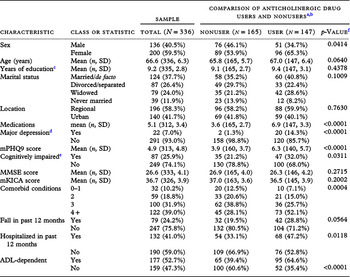
In total, 336 Aboriginal people participated in the study; their mean age was 66.6 years (SD 6.3) and 59.5% (n = 200) were female. Other participant characteristics are shown in Table 1.
Characteristics of the study population

SD, standard deviation; mPHQ9, modified Patient Health Questionnaire 9; MMSE, Mini-Mental State Examination; mKICA, modified Kimberly Indigenous Cognitive Assessment Tool; ADL, activities of daily living.
a Anticholinergic drug users are defined as those individuals taking at least one medication listed on the anticholinergic burden (ACB) scale.
b Total number of participants is 312 due to missing medication data.
c Includes years at school plus higher education.
d PHQ9 score ≥ 10.
e Cognitively impaired refers to participants with expert panel judgement of “dementia”, “mild cognitive impairment”, or “other cognitive impairment”.
f For categorical variables, p-value is from Chi squared test. For numeric variables, p-values are from t-test for means or Wilcoxon/Mann–Whitney test for medians.
Medication usage
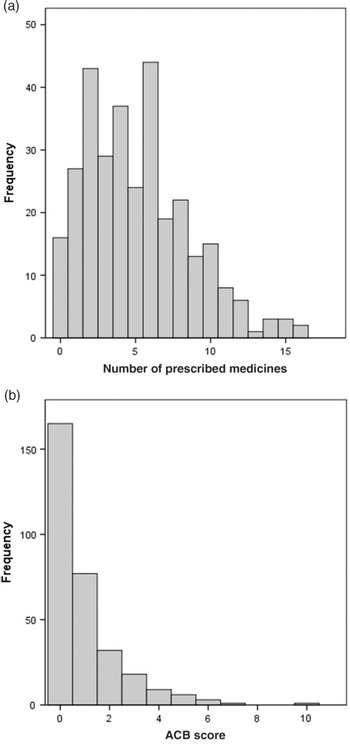
Medication data were available for 312 of the 336 study participants. Participants without medication data (n = 24) were older (70 vs. 66, p = .049) but did not differ from those with medication data in sex, education, MMSE, mKICA, depression, or number of comorbidities. Most participants (n = 296, 94.9%) were taking at least one regular medication (Figure 1), with the median number of medications 5.0 (interquartile range [IQR] = 5, range 1–17). Polypharmacy (≥5 medications) was observed for 43.6% of participants. The number of medications taken by people with dementia (5.83 ± 3.88, n = 40) or MCI (4.97 ± 3.41, n = 38) did not differ (p = .533) from other participants (5.02 ± 3.37, n = 230).
Frequency histograms showing (a) the number of medications used and (b) the anticholinergic burden (ACB) score for participants in the Koori Growing Old Well study.

Anticholinergic medications
Approximately, half of all participants (n = 147, 47.0%) reported regular use of at least one anticholinergic medication (Figure 1b). In the univariate analyses, anticholinergic users and nonusers differed with respect to sex, presence of major depression, presence of cognitive impairment (i.e. diagnosis of dementia or MCI), number of comorbid conditions, number of medications taken, hospitalization in the past year, and dependency in activities of daily living (Table 1). The distribution of ACB score did not differ significantly across categories of cognitive status (p = .162, Kruskal–Wallis), that is, people with dementia (ACB score, 1.2; SD, 1.70) or MCI (ACB score 1.08; SD, 1.32) had a similar anticholinergic load to other participants (ACB score 0.87; SD 1.39). An ACB score ≥ 3 was observed for 12.2% of participants (n = 38).
Highly anticholinergic (level 3) medications were being regularly taken by 18/312 participants (6%), including 7/82 people (8.5%) with cognitive impairment. The most common level 3 medications were antidepressants (amitriptyline, n = 7; paroxetine n = 5; doxepin, n = 1). Depression was the self-reported reason for use of amitriptyline in most cases; only one participant reported the use of amitriptyline for the treatment of chronic pain associated with arthritis, and none reported use for sleeping or urinary incontinence. The doses of amitriptyline used were generally low (50 mg or less, except for one participant on 100 mg). The other level 3 medications used were antimuscarinic drugs for urinary incontinence (oxybutynin, n = 2; solifenacin, n = 1; propantheline, n = 1) and antipsychotics (chlorpromazine, n = 1; quetiapine, n = 1). The most common level 2 drugs were ranitidine (n = 3) and the antiepileptic carbamazepine (n = 2). The most common level 1 drugs were cardiovascular drugs (furosemide, n = 32; metoprolol, n = 28; atenolol, n = 20) and the anticoagulant warfarin (n = 21, 8.0%).
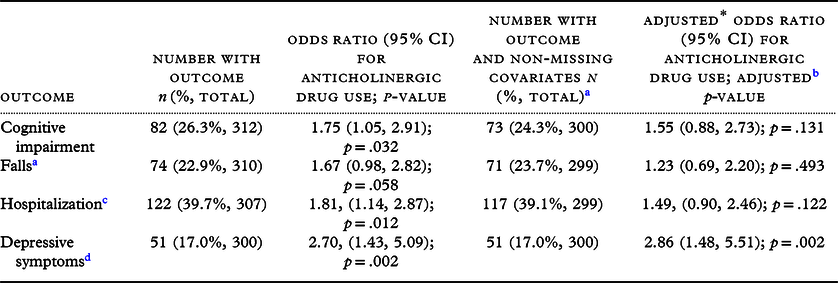
The use of anticholinergic medication was associated with cognitive impairment (p = .032), a fall in the previous 12 months (p = .058), hospitalization in the past year (p = 0.012), and depressive symptoms (p = .002) (Table 2). However, when adjusted for sex, age, and number of comorbidities, anticholinergic medication use was no longer associated with cognitive impairment, falls, or hospitalization during the past 12 months but was still associated with the presence of depressive symptoms (OR 2.86; 95% CI 1.48–5.51).
Association of anticholinergic drug use with negative health outcomes in a population of urban and regional Aboriginal Australians

a Data used to calculate adjusted odds ratio.
b Adjusted for sex, age, and number of comorbidities.
c In the previous 12 months.
d Patient Health Questionnaire 9 (PHQ9) score for depression ≥10.
Discussion
There is a high burden of noncommunicable chronic disease in Aboriginal Australians (Randall et al., Reference Randall, Lujic, Havard, Eades and Jorm2018), which increases the risk of polypharmacy and drug-related complications. Medications with anticholinergic properties are prescribed for a wide variety of conditions but are considered as potentially inappropriate in older people, particularly those with cognitive impairment or dementia, due to their adverse effects on the central nervous system.
In this population-based study of urban and regional Aboriginal Australians aged 60 years and older, most (95%) were taking at least one regular medication, with polypharmacy (≥5 medications) observed in 43% of participants. A slightly higher prevalence of polypharmacy (53%) was reported recently for Aboriginal people, aged 45 years or more, living in remote areas (Page et al., Reference Page2019). A significant ACB (≥3) was present in 12.2% of participants. This prevalence of anticholinergic use is consistent with previous studies; significant anticholinergic use has been reported for 5–28% of older participants depending upon the setting and methodology (Fox et al., Reference Fox2011; Mate et al., Reference Mate2015), and for 12–26% of people with cognitive impairment or dementia (Cross et al., Reference Cross2016; Green et al., Reference Green, Reifler, Boyd, Weffald and Bayliss2018; Mate et al., Reference Mate2015). Antidepressants, urologicals, and antipsychotics, the most commonly used classes of strong anticholinergic medications used in this study, have been linked to future cognitive decline and dementia (Richardson et al., Reference Richardson2018) in addition to their potential for immediate short-term harms (American Geriatrics Society Expert Panel, 2019).
Approximately, one-third of participants with a significant ACB accumulated this burden as the result of additive effects of multiple medications, which is also consistent with previous studies (Reference CrossCross et al., 2016; Mate et al., Reference Mate2015). Low-level anticholinergic medications, including furosemide, beta blockers, warfarin, temazepam, venlafaxine, and digoxin, were often concurrently prescribed. Although these drugs have not been linked to an increase in dementia incidence (Richardson et al., Reference Richardson2018), their potential short-term and cumulative anticholinergic effects are often overlooked or underestimated in older patients whose tolerance for such effects is lower.
Anticholinergic medication use was associated with the presence of depressive symptoms but not cognitive impairment, falls, or hospitalization in our study (in adjusted models). While large population-based studies have consistently reported an association of cognitive impairment with anticholinergic use, some smaller studies with lower statistical power have not (Cross et al., Reference Cross2016; Tannenbaum et al., Reference Tannenbaum, Paquette, Hilmer, Holroyd-Leduc and Carnahan2012). The association between ACB and depressive symptoms is almost certainly confounded by indication, as tricyclic antidepressants were a major contributor to anticholinergic but are also indicated for the treatment of depression. It does, however, raise concerns about the effective treatment of depression in Aboriginal people and highlights a potential area for minimization of risk to brain health.
Non-pharmacological interventions are the preferred option for the treatment of mild to moderate depression in older people, either alone or in combination with a selective serotonin uptake inhibitor with low anticholinergic activity (Pruckner and Holthoff-Detto, Reference Pruckner and Holthoff-Detto2017). Due to their adverse effects, tricyclic antidepressants are not recommended as first-line treatment for older people with depression but can play an important role in refractory disease (Pruckner and Holthoff-Detto, Reference Pruckner and Holthoff-Detto2017). Low doses of tricyclic antidepressants are sometimes used to treat other conditions, including pain, insomnia, or urinary incontinence, but most participants in this study self-reported using amitriptyline, at relatively low doses, for depression. General practitioners, who are responsible for the prescription of most antidepressants, consistently prescribe lower than recommended doses of tricyclic antidepressants for extended periods for depressive disorders (McManus et al., Reference McManus, Mant, Mitchell, Britt and Dudley2003). Antidepressant treatment should include regular follow-up visits to monitor efficacy, tolerance, and compliance, with consideration given to de-prescribing if there is minimal benefit or the potential for harm. The cross-sectional nature of this study limits any firm conclusions, but the association of anticholinergic medication use and depressive symptoms is suggestive of inappropriate choice of antidepressant and/or undertreatment of chronic depressions with subtherapeutic doses of antidepressant.
Although there were no prescribing differences observed between the urban and regional communities in this study, socioeconomic disparities between Aboriginal Australians and the general population may also be a factor in their relatively high use of tricyclic antidepressants. A recent study from Finland (Halonen et al., Reference Halonen, Koskinen, Kouvonen, Varje, Pirkola and Vaananen2018) reported socioeconomic differences in the use of newer (mainly selective serotonin reuptake inhibitors) and the older tricyclic antidepressants; those with lower education and living outside the capital were likely to be using tricyclic antidepressants. Access to services, cultural appropriateness of services, and disparities in health literacy (Hamrosi et al., Reference Hamrosi, Taylor and Aslani2006) are other factors for consideration with respect to improved treatment and prescribing for Aboriginal Australians. Improved communication between health care professionals and Aboriginal Australians at the time of prescribing and dispensing medicines may help to reduce the negative outcomes that can occur with high levels of ACB.
External validity was achieved through selecting study sites where the Indigenous population distribution was similar to that throughout the rest of urban and regional Australia. The relatively small sample size, however, reduced the statistical power to detect differences in outcomes between the exposed and nonexposed groups. Medications listed as being used only when necessary by participants were excluded from this analysis and to this extent, the ACB within this population may be understated. In addition, nonprescription medications, such as antihistamines, some of which have anticholinergic adverse effects may have been used but not recorded. The cross-sectional nature of the study is an additional limitation that precludes identification of putative causal relationships.
Conclusions
This study has identified several key areas for the improvement of prescribing practice for older Aboriginal Australians, most importantly, the inappropriate use of tricyclic and other highly anticholinergic antidepressants has been identified as a major contributor to the ACB of older Aboriginal Australians. An improvement in the management of dementia and depressive symptoms in this population is required to improve treatment and quality of life outcomes and minimize the adverse effects associated with the use of anticholinergic medicines.
Conflict of interest
None.
Source of funding
The KGOW study was supported by the Australian National Health and Medical Research Council (NHMRC) project grant (510347). KR is supported by an NHMRC-ARC Dementia Research Development Fellowship (1103312). KD is supported by an NHMRC Career Development Fellowship (1105106).
Description of authors’ roles
KM, KK, GB, KD, and KR designed the study, supervised the data collection and coding and wrote the paper; AP and HR-K collated and coded the data and assisted with writing the article; NW was responsible for the statistical design of the study and for carrying out the statistical analysis; GD assisted with study design, data collection, and writing the paper; BD and RC assisted with study design, clinical decision-making, and writing the paper.
Acknowledgments
This work relied on the support of many individuals and organizations. We are extremely grateful to our participants, local Elder guidance groups, KGOWS Aboriginal Reference Group, the Aboriginal Health and Medical Research Council, and our Aboriginal community partners (Durri Aboriginal Corporation Medical Service and Booroongen Djugun in Kempsey, Darrimba Maarra Aboriginal Health Clinic in Nambucca, Galambila Aboriginal Health Service in Coffs Harbour, La Perouse Local Aboriginal Land Council, La Perouse Aboriginal Community Health Centre, and Tharawal Aboriginal Corporation in Campbelltown). We recognize the work of our research team, including Aboriginal research assistants, investigators, project officers and interviewers, medical doctors, and knowledge translation and support team (Koori Dementia Care Project).
Supplementary material
To view supplementary material for this article, please visit https://doi.org/10.1017/S104161022000174X