Background
Informal caregiving is the mainstay of dementia care (Knapp et al., Reference Knapp2007; Gallagher-Thompson et al., Reference Gallagher-Thompson2012). Family members comprise the greater proportion of the “workforce” of informal carers for people living with dementia. As a group they are unique in that, very often, they are older and can be frail themselves (Pickard, Reference Pickard1999). In the United States alone, 14.9 million people currently care for someone who has dementia (Family Caregiver Alliance, 2011), while the number in Australia is in the region of 200,000 (Australian Institute of Health and Welfare, 2012) and these numbers are anticipated to rise. This global trend has given rise to policy initiatives that seek to examine and address the support needs of family carers (Knapp et al., Reference Knapp2007; Nolan et al., Reference Nolan, Bauer, Nay, Nay and Garratt2009) and those people living with dementia who are being cared for at home (World Health Organisation, Reference Davies and Higginson2004; Department of Health, 2009).
Caregiving can be rewarding, but it is generally understood that caring for a person living with dementia has significant negative effects on the physical and emotional health of carers (Carr et al., Reference Carr, Kimberley and Mercieca2013). The high levels of stress commonly experienced in undertaking daily routines of support and care are primarily caused by the behavioral symptoms associated with dementia such as physical and non-physical aggression and verbal agitation (Cohen-Mansfield et al., Reference Cohen-Mansfield, Marx and Rosenthal1989; Carr et al., Reference Carr, Kimberley and Mercieca2013). The overwhelming burden of care is also often associated with social isolation and carer depression as the level of vigilance required in looking after a person living with dementia limits the carer's opportunities to undertake other activities (Croog et al., Reference Croog, Burleson, Sudilovsky and Baume2006; Stirling et al., Reference Stirling, Andrews, Croft, Vickers, Turner and Robinson2010).
Poor quality of life for the carer is an important precedent to institutionalization for the person with dementia (Argimon et al., Reference Argimon, Limon, Vila and Cabezas2004). Support to carers is, therefore, crucial for maintaining home care arrangements, and strategies that alleviate the agitation of the care recipient are central to the way support needs to be designed.
Pharmacological therapies, while potentially effective in controlling some behavioral symptoms associated with dementia, have been recognized to have long-term deleterious side-effects and have been criticized for use as first-line therapies (Rapoport et al., Reference Rapoport, Mamdani, Shulman, Herrmann and Rochon2005; Lee et al., Reference Lee, Gill and Rochon2006; Schneider et al., Reference Schneider2006). The literature surmises on the whole that music is a good non-pharmacological support strategy in the everyday functioning of people affected by dementia, (Hulme et al., Reference Hulme, Wright, Crocker, Oluboyede and House2010) with positive effects on mood (Gerdner, Reference Gerdner2005), and general functioning when the music selections played are aligned to the preferences of the person living with the dementia (Sung and Chang, Reference Sung and Chang2005; Wall and Duffy, Reference Wall and Duffy2010; Trappe, Reference Trappe2012). Music is reported to enrich the lives of people with dementia and improve wellbeing by enabling social interaction and providing a degree of control over their lives (Sixsmith and Gibson, Reference Sixsmith and Gibson2007). It has, moreover, been shown to positively affect the social and emotional difficulties people with dementia can experience by reducing agitation, aggression, wandering, restlessness, and irritability (Sung et al., Reference Sung, Chang and Abbey2006; Hulme et al., Reference Hulme, Wright, Crocker, Oluboyede and House2010; Janata, Reference Janata2012).
While music has been shown to have a positive impact on a range of the behavioral and psychological symptoms of dementia, the impact on carers of providing personalized music to people living with dementia has not been reported. The authors identified no literature that considers the extent to which music could be used as a strategy to support the family carers of people living with dementia. It is evident that the advent of digital technology, particularly for solitary acousmatic listening (i.e. with the use of headphones), has made portable, readily accessible and easy to use MP3 technologies increasingly a part of everyday life such that “any music can be taken anywhere and experienced in any context” (Clarke, Reference Clarke2007).
In collaboration with an aged care service provider, this study sought to determine whether individualized musical content delivered through an MP3 player with headphones, presented an effective strategy to allow family carers some respite time from the carer role, while the person with dementia enjoyed the experience of listening to their preferred music.
A pre/post mixed methods design was implemented involving:
-
1. A self-report questionnaire with validated measures of key constructs, completed by carers at the commencement of the study (Time 1) and after four weeks of using the MP3 player (Time 2);
-
2. A diary to indicate when, where, how long and a brief statement of the purpose for which the MP3 device was used each time and;
-
3. A short semi-structured phone interview within three weeks of completing the second questionnaire to explore participants’ experiences of using the MP3 player.
This paper reports on the questionnaire data to test two key hypotheses:
-
• That the mental health and wellbeing of carers of people living with dementia in the community would be improved after four weeks using the MP3 player.
-
• That carers of people living with dementia in the community would feel better able to cope with their caring role after four weeks using the MP3 player.
Interview data is reported in full elsewhere; only some indicative quotes are provided here. The project received University Human Ethics Committee approval (FHEC approval 11/183).
Method
Participants
Participants were informal caregivers of people with old-age-onset dementia providing care in their own home, or the home of the person with dementia. As was usual practice, caregivers’ needs were assessed during routine visits by Care Managers from the participating aged care service provider. During this assessment a range of strategies for dealing with the behavioral and psychological symptoms of dementia, including the use of a small personal MP3 player, were discussed. It was not necessary for carers or the person with dementia to have a prior interest in music. All caregivers who expressed an interest in using an MP3 player were followed up by the organization's Dementia Consultant (DC) who demonstrated the device and explained the study and data collection activities. The choice of musical content to be uploaded to the MP3 player was individualized and determined by the study participants on the basis of their knowledge of what the person with dementia had previously enjoyed listening to. The preferred music was generally provided to the DC by the caregivers in the form of CDs for uploading to the MP3 player. After one week the DC delivered the MP3 player uploaded with the preferred audio content to study participants and at this time explained how to use the device and how it could be used to support care-giving needs. A laminated card which showed the player's basic functions was provided. The frequency and timing of MP3 player use was not prescribed, but rather left up to each caregiver to use according to their particular needs.
Procedure and measures
Participants were also given Time 1 and Time 2 surveys and a daily MP3 diary recording sheet in the form of a booklet. Recruitment occurred over 10 months until 50 carers had completed the trial.
A number of mental health and wellbeing constructs were assessed before and after use of the MP3 player. Measures were selected on the basis of their demonstrated psychometric properties and their brevity, as well as availability of comparison data for some measures (K10 and Life Satisfaction measures). The following dependent measures were included in questionnaires at Time 1 and Time 2:
-
• Mental health and wellbeing:
-
• Kessler-10 (K10) measure of Psychological Distress (ten items) (Kessler et al., Reference Kessler2002). Psychological distress (anxiety and depression) was measured with the K10. Each of the ten items is scored from 1 (“none of the time) to 5 (“all of the time”). A high score indicates a greater level of psychological distress. The sum of the responses to the ten items gives a total score ranges from 10 to 50.
-
• General Health Question (one item) (Goldberg et al., Reference Goldberg1997).
-
• Life satisfaction questions – covering seven domains used in several national surveys including the Household Income and Labour Dynamics in Australia [HILDA] study (Wooden and Watson, Reference Wooden and Watson2007). Respondents were asked to indicate on a scale of 1–11 (where 1 = very dissatisfied and 11 = very satisfied) the level of their satisfaction with different aspects of life, and life in general. Domains included were those that were considered to be of potential relevance to older people with significant caregiving duties who are living in their homes, and which may be affected by the MP3 intervention: personal safety, current sleep pattern, amount of free time, relationships with spouse/partner (if applicable), relationship with children (if applicable), and relationship with person for whom they care.
-
-
• Coping with caregiving role:
-
• Family Caregiver Self-efficacy Scale (four items) (Fortinsky et al., Reference Fortinsky, Kercher and Burant2002). Four items assess the symptom management self-efficacy of carers. Respondents indicate “how certain were you right now that you can. . .
-
1. Handle any problems like memory loss?
-
2. Deal with the frustrations of caring?
-
3. Handle problems that come up in the future?
-
4. Do something to keep your relative independent?”
Responses to the four items (on a scale where 1 = “not at all certain” and 10 = “very certain”) were summed to give a total Symptom Management Self-Efficacy score.
-
-
• Caregiving and Stress Measure (selected items from three subscales) (nine items). (Pearlin et al., Reference Pearlin, Mullan, Semple and Skaff1990). Given the wish for brevity to reduce participant burden, a subset of items was selected from each subscale about caregiving and stress. The items were selected on the basis of their face validity in the context of the MP3 intervention and the reported psychometrics of the scale.
-
A measure of health-related behaviors was included; as one of the minor hypotheses of the study was that the time afforded by using the MP3 player may lead to more health-promoting behaviors and better self-care by caregivers.
-
• Self-care and healthy behavior– eight items used in past health program evaluation and monitoring that reflect key domains of health promotion, including frequency of health promoting behaviors (exercise, nutrition, sleep, recreation activities, time with family, emotional support), use of support services and (because of the age of the participants) use of medication to sleep (Lewis et al., Reference Lewis, Gardner and Parslow2010).
Data were collected between March 2012 and January 2013.
Data analysis
Descriptive analyses were conducted to describe the characteristics of the sample. Repeated measures t-tests were used to assess the differences in scores on the continuous measures from Time 1 to Time 2, and non-parametric tests (Wilcoxon signed ranks test) were used for categorical data. Questionnaire data were analyzed using IBM SPSS Statistics 20.
Diary data were entered into an Excel 2007 file and the content was later categorized by multiple researchers and counted to provide a summary description of the way in which participants used the MP3 player.
Twenty-five caregivers (half of all participants) were randomly selected following completion of the four-week period using the MP3 player and contacted by telephone to ask about their experiences. Interview data were transcribed and content analysis was undertaken to identify the key themes described by caregivers. These data will be reported in full elsewhere; some representative examples of the main themes are described below.
Results
Fifty-nine caregivers commenced using the MP3 player. Eight participants withdrew from the study before the four weeks had passed. Reasons for withdrawal included: finding the device too difficult to use (n = 2), reluctance of the person with dementia to wear headphones (n = 2), death of the carer or person with dementia, or deterioration in health status and/or transfer to residential care, (n = 4). Fifty-one carers completed the four week trial.
All participants listened to music only, with the type of music including classical music, country and western music, and artist such as André Rieu, Vera Lynn, and the Beatles.
Participant description
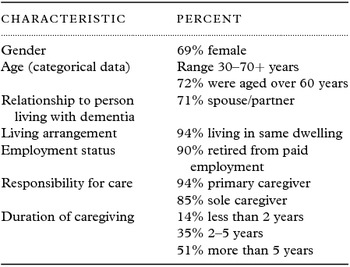
Table 1 provides an overview of the demographic information about the sample. Overall, respondents were most likely to be the sole caregiver of a spouse living with dementia and to have cared for the person for more than five years.
Participant demographic information

Use of the MP3 player
The MP3 players were used across the day and night, with peaks in the middle of the day (11–3) and afternoon (3–6 pm). One quarter of participants used the player between 3 and 6 pm, a time when the phenomenon of “sundowning” – when people with dementia can become more confused or restless – is commonly reported. The player was used most frequently in the home or garden (91%). Other locations where the player was used included waiting rooms and while driving in the car. The average time spent listening to the MP3 player was approximately one hour (range 10 minutes to 4.5 h).
Carers were asked to comment on what they were able to achieve in the time during which the person with dementia was listening to the MP3 player. Diary comments related predominantly to chores, cooking, shopping, and outdoor activities (46%). Relaxation (reading, watching television), socializing, and personal time accounted for approximately 29% of diary entries; followed by studying or computer work (6%); and eating and sleeping (3%).
Broadly classifying comments with respect to the utility of the MP3 player after each episode of use into positive, negative, or neutral, it was found that 65% of all comments were positive and 12% were negative in nature. Most positive comments described the perceived beneficial effects of listening to the MP3 player on the person with dementia. Benefits to the carer included less interruptions and an increase in the availability of time. Eighty four percent of participants made at least one positive comment about the player.
Negative comments were mostly about technical issues including difficulties with operating the player, flat batteries, the person with dementia removing their headphones, or the player not having the desired “settling” effect. Half (51%) of all respondents made at least one negative comment after using the MP3 player.
Changes in mental health and wellbeing
Psychological distress
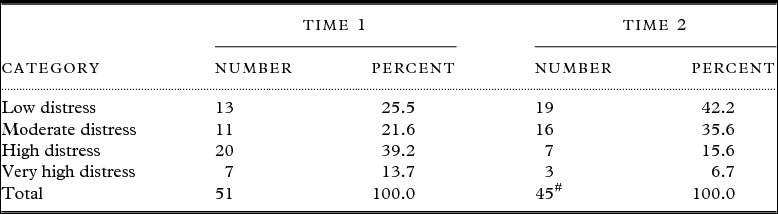
There was a significant decrease in psychological distress over the period (t = 4.7 df = 44 p < 0.001) (Table 2). The mean at Time 1 was 21.6 (SD = 6.8) and at Time 2 was 17.6 (SD = 5.8) (n = 45 matched cases; six participants were excluded because of missing data).
Distribution across categories of psychological distress at time 1 and time 2

#6 instances missing data, so total not created.
The total score on the K10 is often interpreted in relation to categories, where a score of 10–15 indicates low distress, 16–21 indicates moderate distress, 22–29 indicates high distress, and 30–50 indicates very high levels of distress (ABS, 2012). People with scores in the high or very high category are assumed to require support or care for depression and/or anxiety.
For those individuals with data at both time points (n = 45), there was a significant shift in the level of distress experienced as reflected by these categories (Wilcoxon signed ranks test; z = −3.4, p < 0.001), with 21 respondents moving to a lower category, 19 remaining the same, and only five moving to a higher category.
General health
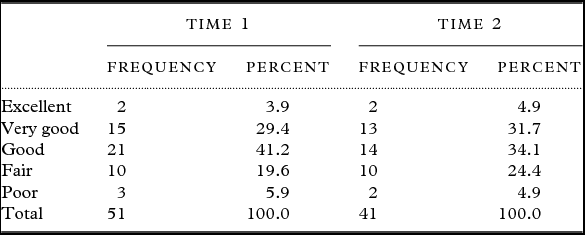
Carers who took part in the MP3 study were more likely to indicate their health was fair or poor; however, there was no change in self-rated general health observed for those respondents who provided data for both surveys (Time 1 and Time 2) (Table 3).
Self-reported general health at time 1 and time 2

Satisfaction with aspects of life
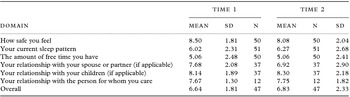
Across the six specific domains of life (Table 4), there were two in which the mean satisfaction score changed significantly, decreasing from Time 1 to Time 2. For those individuals with data at both time points, the change in the mean satisfaction rating from Time 1 to Time 2 was significant for “how safe you feel” (Time 1 mean = 8.5 (SD = 1.8); Time 2 mean = 8.1 (SD = 2.0); p < 0.05) and for “your relationship with your spouse or partner (Time 1 mean = 7.7 (SD = 2.1); Time 2 mean = 6.9 (SD = 2.9); p < 0.04).
Satisfaction with domains of life at time 1 and time 2

There was no change to overall life satisfaction and no difference between overall level of satisfaction from Time 1 to Time 2.
Changes in coping with caregiving role
Self-efficacy for managing dementia
There was a significant increase in the total Symptom Management Self-Efficacy score (a measure how confident the caregiver is that they will be able to manage problems that come up and deal with the frustrations of caring) from Time 1 (prior to use of MP3 player) to Time 2 (after using the MP3 player for four weeks) (Table 5). Mean at Time 1 was 23.5 (SD = 6.1) and 27.0 at Time 2 (SD = 7.5) (t = −3.1, df = 47, p < 0.01).
Self-efficacy for managing dementia at time 1 and time 2

Symptom management self-efficacy was significantly negatively correlated with K10 scores (pearson r = −0.568, p < 0.001): the greater the level of self-efficacy for managing dementia, the less the psychological distress.
Caregiving stress
There were no significant changes from Time 1 to Time 2 in caregiver stress (overload, role captivity, and loss of self) as measured by the (Pearlin et al., Reference Pearlin, Mullan, Semple and Skaff1990) Caregiving and Stress Measure.
Other changes
Self-care and healthy behavior
When comparing responses for individuals who indicated whether or not they did any of the things described as “the things you might do to take care of yourself,” there was a significant decrease in the reported use of support services from Time 1 to Time 2 (Wilcoxon signed ranks test; z = −2.2, p < 0.05), but no other reported changes in health promoting behaviors.
Telephone interviews
Carers were generally very positive about the effects of the MP3 player for themselves and the person living with dementia. Most described it as a useful additional strategy to occupy or distract the person living with dementia. Three major themes emerged from the interview data:
-
• Benefits of time and reduced stress for the carer: “It basically gives you a good break”
-
• Perceived benefits for the person living with dementia: “It put him in another happy space”
-
• Benefits, sometimes unexpected, of music as a strategy for coping with the caring role: “It's just like an added sort of tool that I can use.”
Discussion
While being a carer can be rewarding, there is clear evidence in the literature that caring for a person living with dementia can have negative effects on the physical and emotional wellbeing of carers (Etters et al., Reference Etters, Goodall and Harrison2008), and that the transition to institutional care is more likely when the burden of care remains unattended to, particularly when the behavioral and psychological symptoms of dementia become more significant. Consistent with this evidence, the levels of psychological distress observed in carers taking part in the MP3 study were higher at both time points than would be expected based on data from the general population. Data from a representative population sample in the state in which the study took place (Department of Health, 2012) indicated the distribution across the K10 categories for females aged 65+ in the general population was: low distress = 64.3%, moderate = 21%, high = 5.9%, and very high = 1%. The distribution observed in the study sample (Table 2) is likely to reflect the consequences of taking on a significant caring role for a person living with dementia.
Similarly, the self-reported general health of the study sample was also poorer than indicated in a population health survey for residents in the same state (Department of Health, 2012). Compared with the current sample where 25–30% said their health was fair or poor at either time point, 16.7% of people aged 65 years and over in the general population said their health was fair or poor. The mean self-reported life satisfaction overall and in different domains for the carers participating in this study was also lower than those generally observed in the population samples used in the HILDA study (Ambrey and Fleming, Reference Ambrey and Fleming2012). These findings are consistent with research which suggests that caring for sick or frail parents or partners may be detrimental to post-retirement plans and life satisfaction (Vinck and Ekerdt, Reference Vinick and Ekerdt1991; Szinovacz and Davey, Reference Szinovacz and Davey2004). These findings in combination demonstrate a need to support the mental health and wellbeing of carers of people living with dementia so that they can cope with the stresses of their caring role.
Given the reported low use of community support services by people caring for someone with dementia despite high levels of caregiver burden (Brodaty et al., Reference Brodaty, Thomson, Thompson and Fine2005), the provision of a simple and low cost in-the-home initiative can become an important strategy to help carers meet their demanding role. Portable digital music devices are now widely available; however, their use by people with dementia and their impact on the burden experienced by family carers has to date been unexplored. Southern Cross Care introduced a systematic approach for supporting carers to use an MP3 player with the person with dementia for whom they cared, and incorporated a robust evaluation study of the program.
This study found that using an MP3 player for a four week period resulted in a significant decrease in psychological distress and a significant increase in symptom management self-efficacy for the carer of a person living with dementia. Caregivers also described the positive effects of the MP3 player for themselves and the person with dementia. Listening to music was perceived to have a calming effect on the person with dementia, which in turn reduced the caregiver's need for vigilance and, therefore, stress levels.
Gerdner (Reference Gerdner2005) notes that while verbal language abilities are lost in people with dementia, receptive and expressive musical abilities are often preserved. Because distant memory also remains relatively intact, listening to music which has been chosen based on known preferences can, thus, provide a meaningful and interpretable stimulus for people with dementia. In a world where environmental stimuli can become increasingly overwhelming and confusing for people with dementia, music may mask unpleasant environmental stimuli and have a soothing effect, thereby preventing or reducing certain types of behaviors (Cuddy and Duffin, Reference Cuddy and Duffin2005) and so offering carers welcome respite.
Life satisfaction rating scores decreased significantly from Time 1 to Time 2 for two domains: “how safe you feel” and “your relationship with your spouse or partner.” The reasons for this decline are not clear; however, the positive changes to psychological wellbeing and self-efficacy in the context of these decreases should be considered particularly meaningful. There were no significant changes in caregiver stress (overload, role captivity, and loss of self) and self-rated general health, and no changes in the extent to which carers behaved in a way that would be considered health promoting. There was a reported decrease in the use of support services from Time 1 to Time 2 which could indicate that family carers were not requiring as much external professional support as before; however, it could also reflect a return to routine after an increase in engagement with SCC around participation in the project. The potential relationship between carer stress and service use could be explored further in future.
As carers were largely responsible for the operation of the MP3 player, many of the difficulties associated with the use of technology by people with dementia (Nygård and Starkhammer, (Reference Nygård and Starkhammer2007) were avoided in this study. A number of carers did, however, express some degree of frustration when the person living with dementia could not operate the device themselves. It is not clear whether this could be a problem related to unrealistic expectations of the carer, finding the optimal time for using this strategy with someone with dementia, and/or a lack of carer training in using some of the functions of the device. While some carers were able to draw on the expertise of other family members (children or grandchildren), or friends to overcome player operation difficulties, a number of participants withdrew from the study, citing “technical” issues as insurmountable ones for them. This does highlight the importance of selecting MP3 players which are “user friendly” and the importance of providing sufficiently detailed instructions and training in the use of the technology for users.
Conclusion
Many aged care service providers provide support services to people living with dementia in their homes and are looking for new ways to support carers. This study has confirmed the hypothesis that introducing personalized content delivered via a portable digital music device (MP3 player) into the informal home care setting has a positive impact on the quality of life and wellbeing of the carers of people living with dementia living in the community.
The use of an MP3 player with a person living with dementia is an effective additional strategy that can provide respite for caregivers. The demonstrated positive impact of the use of MP3 technology on caregivers of people living with dementia supports further research into the use of this and other contemporary technologies.
This was a small study using a pre-post design, without the benefits of a control or comparison group. It is possible that participating caregivers were motivated to report positive results to the service provider; however, the consistency between the findings of the quantitative and qualitative components of the study (with telephone interviews undertaken by an independent researcher) support the validity of the results. The study provides initial confirmation of the hypotheses about the potential benefits of using personalized music as a strategy to cope with a caring role. Further research may investigate whether there are differential effects according to whether music or other sounds are played (e.g. voice), or at what stage of disease progression for the person living with dementia the intervention is best introduced.
Conflict of interest declaration
None
Description of authors’ roles
V. Lewis, M. Bauer, and M. Winbolt conceptualised and designed the study. M. Bauer and M. Winbolt supervised data collection. V. Lewis and C. Chenco conducted the statistical analysis. V. Lewis, M. Bauer, and M. Winbolt wrote the paper, assisted by F. Hanley.
Acknowledgments
This work was supported by Southern Cross Care (Vic); in particular Ms Therese Desmond, Executive Manager, Community Services and Mr Ben Gatehouse, Dementia Care Consultant.
We thank them for their vision, drive, generosity and commitment to the research. We also thank the many family caregivers who donated their valuable time to the project.