Bacteriophages are a common and constant threat to proper milk fermentation. In the modern dairy industry, the disruption of lactic acid fermentation by bacteriophages can lead to serious economic losses. Particularly in cheese manufacturing, phage attack has become a significant problem over recent years, especially for those technologies where the cheese curd and whey may contain high levels of active bacteria, thus providing ample opportunity for the growth and spreading of phage through the plant environment. The effects may range from outright failure of acid production through a pronounced decrease in activity to no visible effect at all (Cogan et al. Reference Cogan, Peitersen and Sellars1991).
Phages of thermophilic dairy LAB have received less attention than those of lactococci. The biology, genetics, taxonomy, ecology, and origin of isolated phages of Lactobacillus delbrueckii subsp. lactis, Lb. delbrueckii subsp. bulgaricus, and Streptococus thermophilus, however, have been the subject of a number of investigations in the past few years (Desiere et al. Reference Desiere, Lucchini, Canchaya, Ventura and Brüssow2002). In contrast, although Lb. helveticus is the dominant species present in starter cultures used in Italian, French, and Swiss cheese manufacturing, phages attacking this species still remain relatively neglected. An earlier study (Sozzi & Maret, Reference Sozzi and Maret1975) describes the characteristics of Lb. helveticus phages isolated from Emmental starters. A comparative study on 35 Lb. helveticus bacteriophages was carried out on 23 phages isolated from cheese whey in French factories and 12 temperate phages (Séchaud et al. Reference Séchaud, Rousseau, Fayard, Callegari, Quénee and Accolas1992). Quiberoni et al. (Reference Quiberoni, Suarez and Reinheimer1999) studied the inactivation of Lb. helveticus phages by thermal and chemical treatments. More recently Zago et al. (Reference Zago, Comaschi, Neviani and Carminati2005) demonstrated the presence of Lb. helveticus phages in natural whey starters.
PCR-based approaches are increasingly used to detect bacteriophages because of their high sensitivity, specificity, and speed. The availability of PCR-based phage detection tools could lead to a rapid phage monitoring or be used to confirm the cause of acidification problems in cheese production. PCR methods are presently available for the detection of dairy bacteriophages and prophages infecting lactococci, Strep. thermophilus, and Lb. delbrueckii (Brussow et al. Reference Brüssow, Frémont, Bruttin, Sidoti, Constable and Fryder1994; Labrie & Moineau, Reference Labrie and Moineau2000; O'Sullivan et al. Reference O'Sullivan, Ross, Fitzgerald and Coffey2000; Craven et al. Reference Craven, Goodridge, Hill and Griffiths2006; Zago et al. Reference Zago, De Lorentiis, Carminati, Comaschi and Giraffa2006, Reference Zago, Suarez, Reinheimer, Carminati and Giraffa2007; del Rio et al. Reference Del Rio, Binetti, Martín, Fernández, Magadán and Alvarez2007). However, no PCR methods have been developed to identify phages infecting Lb. helveticus. This work was therefore aimed at optimizing a PCR-based method to detect Lb. helveticus phages. The procedure was applied to evaluate phage presence in 53 whey starter cultures used for the production of Grana cheese.
Materials and Methods
Bacterial strains, bacteriophages, and culture conditions
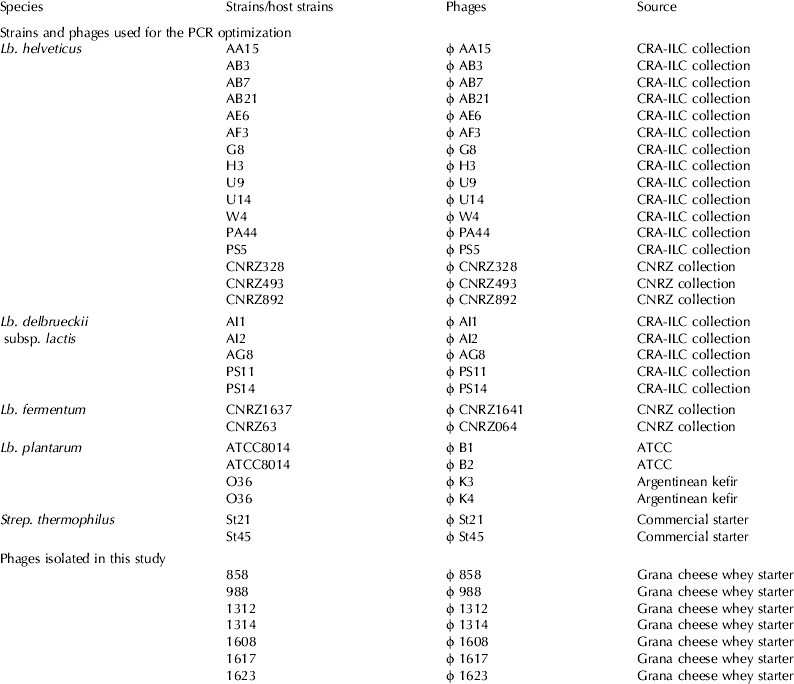
Sixteen phages and their respective host strains used in this study are listed in Table 1. A further 40 Lb. helveticus strains from the CRA-FLC collection were used as indicators to search for phages in Grana cheese whey starters (see below). Cells were maintained as frozen stocks at −80°C in the presence of 150 ml glycerol/l as cryoprotective agent. Phage stocks were prepared by the addition of phages to an actively growing culture of the appropriate host in MRS (Merck, Germany) broth that had been supplemented with 10 mm-CaCl2 (MRS-Ca++ when specified). Host cultures were incubated at 42°C until lysis was complete. Unlysed cells were removed by centrifugation at 4000 g for 10 min at 4°C. Cell-free phage lysates were prepared by filtration using a 0·45 μm syringe filter unit (Millipore S.p.A, Milano, Italy). Lysates were neutralized to pH 7·0 with 1 m-NaOH and stored at 4°C for a maximum of two weeks. Phage titres were determined in MRS agar (14 g/l) and soft agar (2·5 g/l) by the agar spot test and the double layer plaque titration test (Svensson & Christiansson, Reference Svensson and Christiansson1991). Titres were expressed as plaque-forming units/ml (PFU/ml).
Bacteriophages and bacterial strains used in this study
Extraction of phage DNA
Total phage DNA was extracted and purified from high titre, cell-free phage lysates by the method previously described (Zago et al. Reference Zago, De Lorentiis, Carminati, Comaschi and Giraffa2006). The same protocol was applied to extract total phage DNA from 53 whey starters. Before DNA extraction, cell-free whey starters (CFWS) were prepared by neutralizing whey starters to pH 7·0 with 1 m-NaOH. Neutralised samples were then pre-filtered through a Whatman Polycap 75 SPF with porosity of 1μm (Arbor Technologies Inc., MI, USA) and sterilized by filtration through a 0·22 μm Nalgene filter unit (Nalgene Company, Rochester, USA).
PCR amplification
PCR primers were designed on the basis of the lys gene sequence (accession no. AF495798) of Lb. helveticus temperate bacteriophage Φ-0303 (Deutsch et al. Reference Deutsch, Guezenec, Piot, Foster and Lortal2004). The primers had the following sequences (5′-3′): GGGTAGCATCTTATAAAGTTAGCGG (endolys for, nucleotide position 482 to 506 of the lys gene) and CACTTGACTACGGGATGCTGAGA (endolys rev, nucleotide position 704 to 682).
Amplifications were performed in 25 μl volumes with 0·5 μm of each primer (Biotez, Berlin, Germany), 2·5 units/100 μl of AmpliTaq Gold DNA polymerase (Applera Italia, Monza, Italy), 1·5 mm-MgCl2, 25 ng of total DNA, and 200 μm of each dNTP. DNA amplifications were performed in a Perkin Elmer thermal cycler (mod. 9700; Applied Biosystems) under the following conditions: initial denaturation at 95°C for 10 min; 35 cycles of denaturation at 95°C for 30 sec, annealing for 30 sec at 60°C, and extension at 72°C for 1 min; final extension at 72°C for 7 min. PCR products were analysed by electrophoresis through 1·2% (w/v) agarose gels at 10 V/cm for 1 h in Tris-acetate EDTA (TAE) buffer (TAE: 40 mm-Tris acetate, 1 mm-EDTA, pH 8·0).
Specificity and detection limit of the PCR
PCR specificity was tested by amplifying phage DNAs extracted from Lb. plantarum, Lb. fermentum, Lb. delbrueckii subsp. lactis, and Strep. thermophilus phages (Table 1). In order to determine limits of detection of PCR, DNA of bacteriophage Φ-CNRZ 892 was extracted from an MRS broth lysate with a known titre (approx. 108 PFU/ml) and from decimal dilutions of the lysate and PCR was applied using 1 μl DNA. The lowest concentration visible on the gel was set as the detection limit of the PCR.
Phage detection in Grana cheese whey starters
PCR was applied to phage DNA extracted from 53 whey starter cultures according to previously described methods, primers, and amplification conditions. The presence of replicating phage particles was verified by the microtitre plate method on about half of the whey starter cultures which had resulted positive after PCR. To this end, a total of 40 Lb. helveticus strains were used as indicators in a microtitre plate assay (Zago et al. Reference Zago, De Lorentiis, Carminati, Comaschi and Giraffa2006). Briefly, 5 μl of an overnight culture from different host bacteria and 25 μl CFWS were used. CFWS were inoculated in microtitre plates, which had been filled with 170 μl MRS-Ca++ broth containing bromcresol purple as growth indicator. All plates were incubated at 42°C under anaerobic conditions and, after 8 h, scored for lysis of indicator strains (no colour change of the indicator). Because low phage concentrations could give false negative results, different subcultures were performed and scored for lysis of the indicator strains. Control wells, i.e. wells without addition of CFWS samples, were always included.
DNA sequencing
DNA sequencing of 11 of the 222-bp PCR-amplified products of the lys gene was performed using an ABI PRISM 310 automated DNA sequencer (Applied Biosystems, Foster City, CA) as previously described (Zago et al. Reference Zago, De Lorentiis, Carminati, Comaschi and Giraffa2006). The sequences obtained were compared together and with the sequence of the reference phage Φ-0303 and grouped into clusters according to the sequence distance between all pairs. Clusters were aligned as pairs and then collectively as sequence groups to produce the overall alignment. After the multiple-sequence alignment was completed, the neighbour-joining method and the bootstrap analysis were used to construct a dendrogram showing the phylogenetic relationships. Sequence alignments were performed with the Sequence Navigator software using ClustalW algorithm (Applied Biosystems). Cluster analysis, neighbour-joining, and bootstrap analysis were performed with the MEGA software, version 3.1 (http://www.megasoftware.net).
Results and Discussion
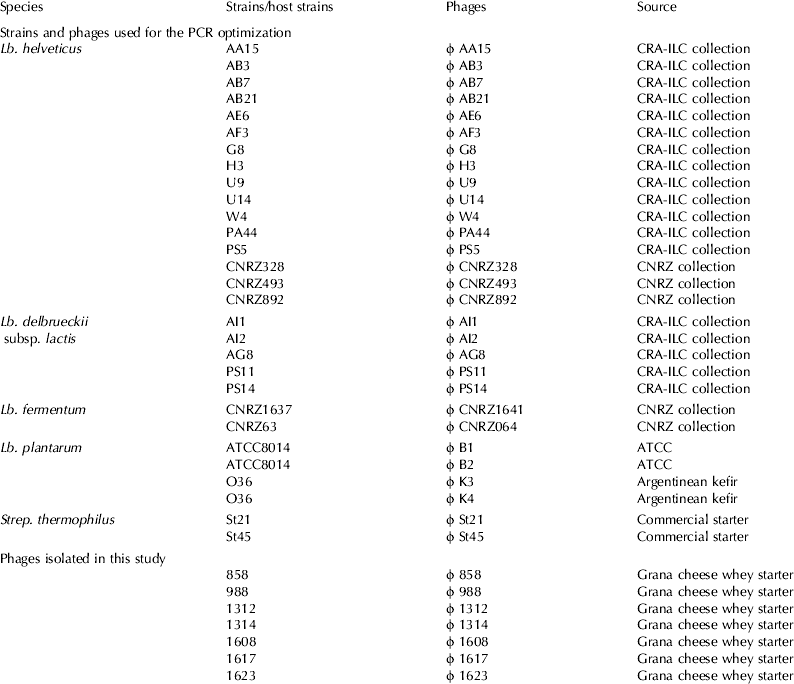
Lactobacillus phage (both lytic and temperate) sequence data are available from five distinct species of lactobacilli (Lb. delbrueckii, Lb. gasseri, Lb. plantarum, Lb. casei, and Lb. johnsonii) but not from Lb. helveticus (Desiere et al. Reference Desiere, Lucchini, Canchaya, Ventura and Brüssow2002). Therefore we optimized a PCR aimed at detecting Lb. helveticus phages on the basis of the available DNA sequence of the lysin-encoding lys gene of Lb. helveticus temperate phage Φ-0303 (Deutsch et al. Reference Deutsch, Guezenec, Piot, Foster and Lortal2004). The PCR was sensitive because amplicons of the expected size (222 bp) were always obtained using DNA from 16 phages of Lb. helveticus (Fig. 1), 13 of which came from our collection and were shown to be highly diverse according to restriction analysis and phage host range (Zago et al. Reference Zago, Comaschi, Neviani and Carminati2005) and three were reference phages (Table 1). The PCR was also specific because no amplification products were observed from phages of Lb. plantarum and other LAB species, such as Lb. delbrueckii, Lb. fermentum, and Strep. thermophilus (Fig. 1; lanes 17–24 showing some of the non-Lb. helveticus phages). These are, together with Lb. helveticus, the four major species components of the Grana and Provolone cheese whey starters (Giraffa et al. Reference Giraffa, Rossetti, Mucchetti, Addeo and Neviani1998; Beresford et al. Reference Beresford, Fitzsimons, Brennan and Cogan2001; Gobbetti, Reference Gobbetti, Fox, McSweeney, Cogan and Guinee2004; Parente & Cogan, Reference Parente, Cogan, Fox, McSweeney, Cogany and Guinee2004). When DNA from serial dilutions in MRS broth of the purified phage Φ-CNRZ 892 were amplified, the detection limit of the method was 102–103 PFU/ml (data not shown). Since phage concentration below 105 PFU/ml in whey or milk is not considered a threat to fermentation (McIntyre et al. Reference McIntyre, Heap, Davey and Limsowtin1991; Suarez et al. Reference Suarez, Quiberoni, Binetti and Reinheimer2002), the proposed PCR is well above the minimum sensitivity requirements.
Agarose gel electrophoresis of the products from PCR amplification of total phage DNA extracted from different phages of the CRA-FLC collection. Primers were directed against a 222-bp intragenic fragment of the lys gene of Lactobacillus helveticus temperate bacteriophage Φ-0303 (accession no. AF495798). Lanes 1–16: Lb. helveticus phages; lanes 17–18: Lb. delbrueckii subsp. lactis phages; lanes 19–20: Lb. fermentum phages; lanes 21–22: Lb. plantarum phages; lanes 23–24: Streptococcus thermophilus phages; lane 25: negative control (no DNA added). M: molecular size DNA marker (1 Kb plus DNA ladder; Invitrogen Italia, Milan, Italy). Arrows highlight the PCR product.

The optimized PCR was tested to ascertain if Lb. helveticus bacteriophages could be detected directly from Grana cheese whey starters. Fifty-three cultures were sampled from different Grana cheese plants and DNA was extracted as described in the methods. After amplification, all the samples were confirmed positive for the presence of the 222-bp lys gene fragment (data not shown), indicating a presumptive presence of Lb. helveticus phages. About half of the 53 PCR positive whey cultures were searched for the presence of active phage particles. Proliferating phages were found in five cultures and a total of seven new lytic phages (named Φ858, Φ988, Φ1312, Φ1314, Φ1608, Φ1617, and Φ1623; Table 1) were isolated from them. The finding of Lb. helveticus phage DNA in all the starters confirms previous studies on Lb. delbrueckii subsp. lactis phages (Zago et al. Reference Zago, De Lorentiis, Carminati, Comaschi and Giraffa2006) and suggests a frequent presence of phages in these cultures even without apparent performance failures. In natural whey cultures used for Grana Padano and Provolone cheeses, which did not show evidence of failures in acidifying activities, a coexistence of phages and sensitive strains of Lb. helveticus and Lb. delbrueckii subsp. lactis has been demonstrated (Zago et al. Reference Zago, Comaschi, Neviani and Carminati2005).
The PCR assay reported here has the advantage of detecting phage DNA directly from artisanal whey starter samples of undefined composition. Therefore the proposed method, together with already published PCR protocols for detection of phage active against Lb. delbrueckii (and its subspecies ‘lactis’ and ‘bulgaricus’) and Strep. thermophilus (Zago et al. Reference Zago, De Lorentiis, Carminati, Comaschi and Giraffa2006; del Rio et al. Reference Del Rio, Binetti, Martín, Fernández, Magadán and Alvarez2007), allows us to have a full diagnostic PCR package to detect dairy bacteriophages attacking the dominant thermophilic LAB species present in milk and cheese starters. Like all the other PCR-based phage detection assays, however, PCR can not establish whether the phages are able to infect and lyse sensitive bacterial cells. This aspect has particular relevance concerning Lb. helveticus since defective phages and phage particles with killer activity against this species have been described in natural whey starters for Grana and Provolone cheeses (Carminati et al. Reference Carminati, Mazzucotelli, Giraffa and Neviani1997). In this regard, the low incidence of cultures containing actively growing phage particles can be explained by either the lack of effective host to be used as indicators or the presence of defective Lb. helveticus phage particles.
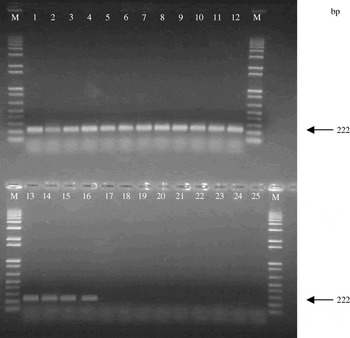
Most of the partial lys gene fragments, including two of the seven newly isolated phages (i.e. Φ-1608 and Φ-1617), were sequenced. After alignment and BLAST analysis they appeared to be 99% similar to the portion of the lys gene of Φ-0303 extending from nucleotide position 482 to 704 (data not shown). The comparison with muramidase genes of other taxonomically related species available from the Genbank enabled allocation of Lb. gasseri (accession no. AJ131519), Lb. delbrueckii subsp. lactis (accession no. EF455602), Lb. delbrueckii subsp. bulgaricus (accession no. Z26590), Lb. johnsonii (accession no. AY459535), and all the Lb. helveticus sequences into four separated branches within the phylogenetic tree (Fig. 2). The relatively low sequence similarity with other Lactobacillus muramidases is explained by the choice, especially in reverse primer designing, of the C-terminal region of the protein which has poor homology score with Lactobacillus endolysins (Deutsch et al. Reference Deutsch, Guezenec, Piot, Foster and Lortal2004). This low sequence similarity suggests that the Φ-0303-like lys gene is highly conserved within Lb. helveticus. Sequence variability of the lys gene enabled the Lb. helveticus phages to be subdivided into three subclusters. One included the phage Φ-0303, chosen as reference for PCR design, and the phage Φ-CNRZ 892; a second subcluster included the two phages Φ-AB3 and Φ-AB7; finally, a third subcluster grouped all the other phages, including the newly isolated phages Φ-1608 and Φ-1617 (Fig. 2).
Phylogenetic tree of the partial lys gene amplified from different Lactobacillus helveticus phages as inferred by the neighbour joining method and the ClustalW algorithm. Sequence alignment was performed with the Sequence Navigator software (Applied Biosystems, Foster City, CA). Consensus sequences were compared with the lys gene of Lb. helveticus temperate bacteriophage Φ-0303 (accession no. AF495798). Distance matrix and phylogenetic tree were calculated with the MEGA software, version 3.1 (http://www.megasoftware.net). Bootstrap probability values (percentages of 1000 tree replications) are indicated at branch-points. Bar, 5% sequence divergence. The phylogenetic distance between sequences is the sum of the horizontal segments.

Taken together, data showed that whey starter cultures are complex ecosystems where lytic bacteriophages may play an active role in microbial composition and population dynamics. In particular, data of both the present study and a previous investigation (Zago et al. Reference Zago, De Lorentiis, Carminati, Comaschi and Giraffa2006) demonstrate that Lb. helveticus and Lb. delbrueckii subp. lactis lytic phages can be frequently present in whey starter cultures, although their number is not known and lytic effectiveness is demonstrated for only a fraction of PCR positive cultures tested. Because the lys gene codes for a broad-spectrum endolysin of Lb. helveticus and was sequenced from a temperate bacteriophage (Deutsch et al. Reference Deutsch, Guezenec, Piot, Foster and Lortal2004), the proposed PCR could be applied to also detect lysogenic Lb. helveticus strains. Preliminary data in our laboratory seem to substantiate this possibility.