

Introduction
A revolution is afoot in the world of disclosure. ‘Old-school’ disclosures, which are lengthy, complex and largely ignored, are giving way to ‘smart disclosures’. This new wave of disclosures – like genetically modified (GM) food labels, restaurant hygiene grades, nutrition labels, cigarette warnings and the Schumer box (the tabular, summary disclosure that must accompany credit card solicitations) – promises to breathe new life into a regulatory technique that had fallen into disrepute. Unlike their predecessors, smart disclosures are effective. They influence behavior.Footnote 1
As a powerful regulatory technique, smart disclosure must be carefully scrutinized. I identify three concerns about smart disclosure: a concern about false inferences; a concern about undisclosed (yet still important) information; and a concern about System 1 disclosures. These concerns are illustrated using real-world examples and supported by recent research findings. In many cases, regulators can respond to the identified concerns and work to alleviate or minimize them. I detail several promising responses.
Disclosure mandates have been traditionally viewed as minimally paternalistic – facilitating informed, autonomous choice, rather than imposing some regulatory agenda. This traditional view does not sit well with smart disclosure. When promulgating these new disclosure mandates, regulators make choices that have predictable behavioral effects. Disclosure is losing its aura of benign neutrality. Smart disclosure regulations must be carefully evaluated in light of the three concerns that are identified here. It can no longer get a free pass. This is not a critique of smart disclosure. It is a call to treat smart disclosure like any other powerful regulatory technique.
The rise of smart disclosure
Disclosure mandates have long occupied large swaths of the regulatory landscape. But, until recently, these disclosure mandates consisted largely of poorly designed and generally ignored fine print. Ben-Shahar and Schneider (Reference Ben-Shahar and Schneider2014) provide a detailed account of the inadequacies of traditional disclosure mandates, which are lengthy and complex to an extent that consumers have little choice but to ignore them. A prominent example is contracting for a mortgage loan, where consumers often face lengthy disclosures of more than 100 pages, including 50 signature lines. Another example can be found in online shopping, where consumers often click ‘I Agree’ to lengthy ‘terms and conditions’ without reading any of them (Marotta-Wurgler et al., Reference Marotta-Wurgler, Baskos and Trossen2014).
The spectacular failure of ‘old-school’ disclosure mandates precipitated the move to ‘smart disclosure’. This catchy phrase, ‘smart disclosure’, represents a new disclosure paradigm, one that takes seriously the intended audience of the disclosure mandate and pays close attention to questions of disclosure design. For instance, if the disclosure is intended to inform busy and boundedly rational consumers, it must be simple in substance and salient in format. (See, e.g., Memorandum from Cass R. Sunstein, Administrator, Office of Information and Regulatory Affairs, for the Heads of Executive Departments & Agencies, Disclosure and Simplification as Regulatory Tools (June 18, 2010), devising guidelines and principles for disclosure practices to be adopted by governmental agencies, focused on making disclosed information more simple and accessible.)
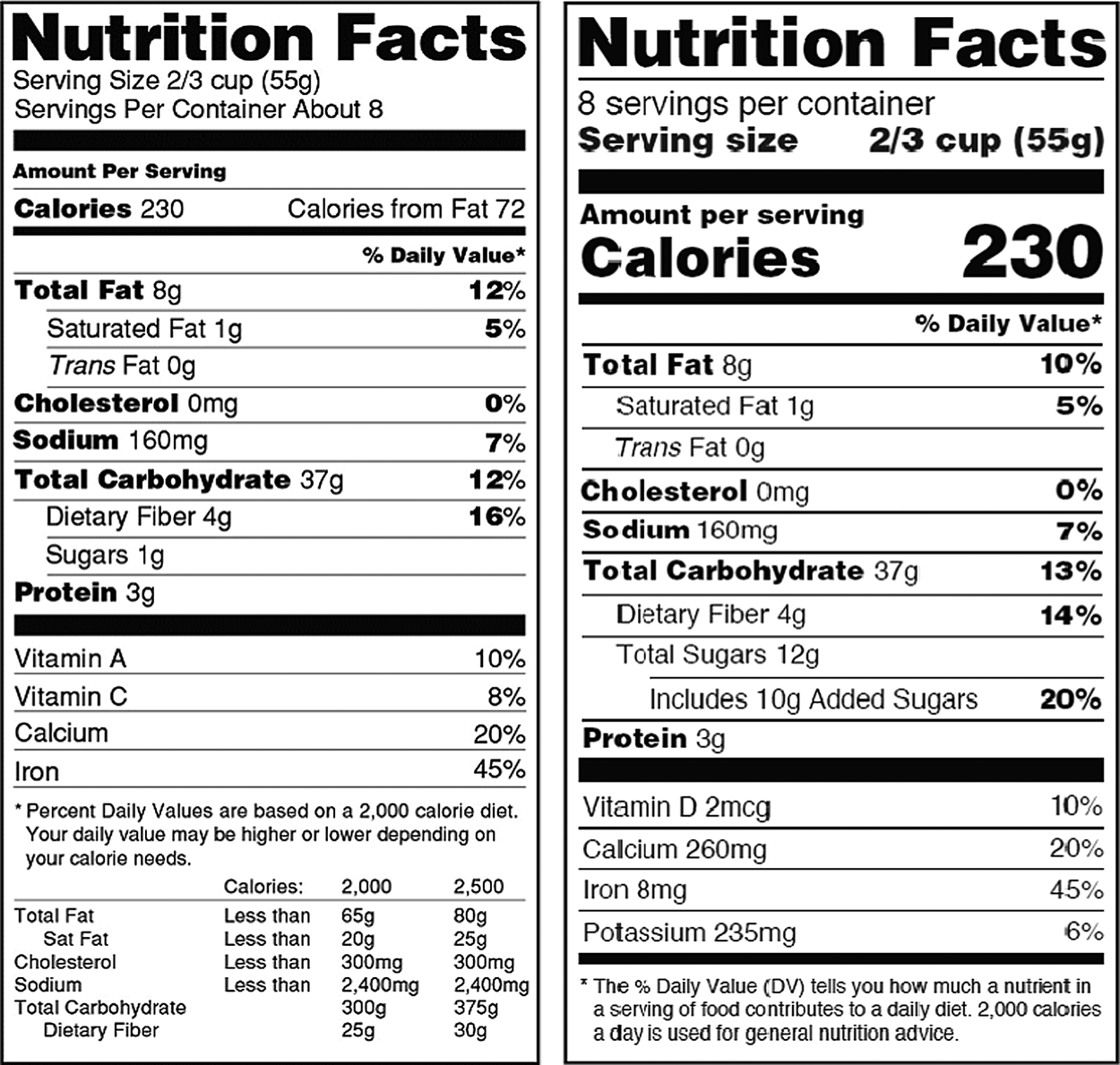
Perhaps the most prominent example of smart disclosure is the requirement to label packaged food with nutritional information. (In this and other examples, I focus on disclosure regulation in the USA.) The mandate was ordered by the Nutrition Labeling and Education Act of 1990 (NLEA) (21 U.S.C. § 343) and its implementing regulations (21 C.F.R. § 101.9). The design of the nutrition label is specifically prescribed, leaving almost no discretion to producers. The key features appearing on all labels are the total caloric content per serving and a list of both harmful and beneficial food components, their amount per serving and their percentage of the recommended total daily amount. Additionally, the regulations define, for each type of food, what amount constitutes a ‘serving’, both to prevent manipulation by manufacturers and to facilitate comparison between different brands of a similar product. Figure 1 shows examples of two nutrition labels – one in the older, pre-2016 format and the other in the newer, post-2016 format. The new regulation requires that the amount of calories appear in bold and eliminates the requirement to display the amount of ‘Calories from Fat’ next to total calories (because “research shows the type of fat is more important than the amount” – see FDA, Changes to the Nutrition Facts Label, https://www.fda.gov/Food/GuidanceRegulation/GuidanceDocumentsRegulatoryInformation/LabelingNutrition/ucm385663.htm).Footnote 2
Nutrition labels – pre-2016 format (left) and post-2016 format (right).

GM labels, notifying consumers that a food product contains GM ingredients, provide another example of smart disclosure. Among the countries that enacted laws mandating GM disclosures are Australia, Russia, China and most European countries (Gruère & Rao, Reference Gruère, Guillaume and Rao2007). In the USA, several states passed similar bills, most notably Vermont, and more recently a federal statute was enacted (Pub. L. No. 114-216, § 1, 130 Stat. 834 (2016)). The statute refrains from prescribing specific disclosure rules and does not even define the category of food products to which the mandate applies; it leaves these crucial implementation decisions to the Secretary of Agriculture. One of the fiercely disputed issues is the shape and form of the required GM label. The law allows for three alternative types of labeling: a predefined textual disclosure; a graphic symbol; or a scannable barcode requiring the active use of smartphones to gain access to the disclosed information.
Another example of smart disclosure is the restaurant hygiene letter-grade system, introduced in Los Angeles (in 1998), in New York City (2010) and in other cities around the country (Ho, Reference Ho2012; Jin & Leslie, Reference Jin and Leslie2003). In essence, each restaurant is examined and given a numeric score based on the severity and scale of observed violations of the sanitation code. The numeric score is then converted to a letter grade, ‘A’, ‘B’ or ‘C’, and the restaurant receives a card with its letter grade, which it must post in a visible location (N.Y., N.Y. Health Code § 81.51(c) (2011); see Figure 2).
Restaurant hygiene grades.

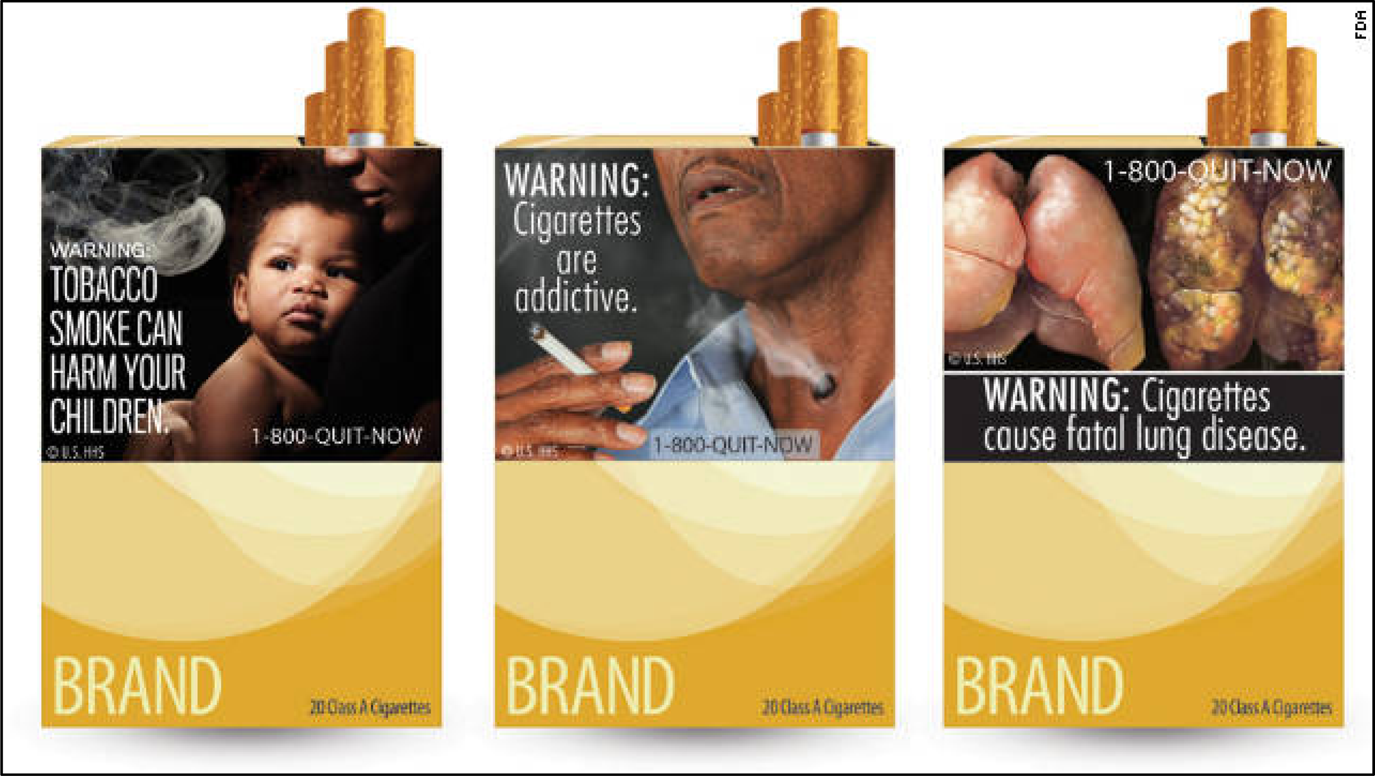
Cigarette health warning labels provide yet another intriguing example of smart disclosure. The 2009 amendment to the Cigarette Labeling and Advertising Act (15 U.S.C. § 1333(a)) requires that all cigarette packages bear one of nine predefined textual health warnings on the front of the package and in large font. Additionally, the 2009 law gave the US Food and Drug Administration (FDA) 2 years to issue regulations “that require color graphics depicting the negative health consequences of smoking to accompany the label statements.” The FDA released its proposed graphic warnings in 2011 (see Figure 3). However, the proposal was challenged by several tobacco companies, and on August 2012 the United States Court of Appeals for the District of Columbia Circuit vacated the regulations, ruling that the proposed mandate violated the tobacco companies’ First Amendment rights (R.J. Reynolds Tobacco Co., et al., v. Food & Drug Administration, et al., 696 F.3d 1205 (D.C. Cir. 2012)). According to the majority opinion, while the textual warning conveyed factual information to consumers, “the graphic warnings are not ‘purely’ factual because … they are primarily intended to evoke an emotional response, or, at most, shock the viewer into retaining the information in the text warning.” Graphic warnings are mandated in other countries, including Canada, the UK, France, Spain and many countries in Asia and South America (Cunningham, Reference Cunningham2014).
The FDA's proposed cigarette graphic health warning labels.

In consumer credit markets, the Truth in Lending Act of 1968 (15 U.S.C. §§ 1631–49) has long required the disclosure of a loan's annual percentage rate (APR). The APR is meant to facilitate consumer choice by incorporating several complex price dimensions into a single value that represents the total cost of the loan. The APR disclosure is a rare example of a smart disclosure that was devised in a time when most disclosure mandates were not so smart. (This is not to say that the APR disclosure is perfect. For a review of the APR's shortcomings, see Bar-Gill, Reference Bar-Gill2012.) Since 2000, credit card issuers have been required to provide a ‘Schumer box’ disclosure (12 C.F.R. Part 226), which presents the APR as well as a few other important features of the credit card contract in a salient, tabular fashion (see Figure 4).
The ‘Schumer box’ disclosure.

We are witnessing the rise of the art and science of disclosure. Old-school disclosure focused on identifying information that people needed and naively mandated the disclosure of this information. Smart disclosure understands that design matters – that the art of disclosure matters. In addition, smart disclosure subjects potential designs to empirical testing, to confirm that the information is effectively communicated to its intended audience. This is the science of disclosure. The result is disclosures like GM labels, restaurant hygiene grades, nutrition labels, cigarette warnings and the Schumer box. These disclosures are effective. They influence behavior.
Bar-Gill et al. (Reference Bar-Gill, Schkade and Sunstein2018) showed experimentally that consumers are significantly less likely to purchase food products with a GM label, especially when they believe that the decision to mandate such labeling was based on scientific evidence that GM foods are harmful. Jin and Leslie (Reference Jin and Leslie2003) found that mandating the disclosure of restaurants’ hygiene scores in Los Angeles had a substantial effect on consumer demand, increasing the revenue of A-grade restaurants and decreasing the revenue of C-grade restaurants. Neuhouser et al. (Reference Neuhouser, Kristal and Patterson1999) showed that 80% of consumers read nutrition labeling when purchasing packaged food and that reading nutrition labeling is associated with a lower fat intake. Similarly, Mathios (Reference Mathios2000) found that introducing mandated nutrition labeling led to a decrease in sales of salad dressings with higher fat contents. Lee and Hogarth (Reference Lee and Hogarth2000) found that 72% of mortgage borrowers search for the APR when comparing mortgages. Finally, Hammond et al. (Reference Hammond, Fong, McNeill and Cummings2006) showed that a higher reported exposure to cigarette warning labels among smokers is associated with a more accurate understanding of the risks of smoking.
But now that we have disclosures that actually influence behavior, unlike the blissfully ignored old-school disclosures, we need to make sure that we are influencing behavior in the right way.
Perils of effective disclosure
There are three major concerns about effective, smart disclosure. First, the disclosure might result in false inferences and thus distort decisions and behavior. Second, since not all information can be effectively communicated, policy-makers, by deciding to elevate some information through smart disclosure, push individuals and markets to pay excessive attention to the disclosed information and not enough attention to undisclosed, yet still important information. Third, ‘System 1’ disclosures that affect behavior by triggering emotional responses might result in suboptimal decisions. I discuss these concerns in turn. I also suggest regulatory responses to these concerns.
False inferences
Disclosure is about the provision of information. We generally think that more information is better than less, but this is not always true. More information might harm consumers when it interacts with or triggers inaccurate beliefs, resulting in false inferences.
Consider the GM label example. What does a consumer think when faced with such a label? The consumer might believe that the government mandated the GM label because it received credible scientific evidence on the harm caused by GM foods – to health or to the environment. Based on this belief, the consumer would infer from the disclosure that GM foods are harmful and decide not to purchase them. But the underlying belief – about the government's motive for mandating the disclosure – turns out to be inaccurate and thus the resulting inference is false. The GM disclosure was not based on scientific research; rather, it was based on interest group politics and on a general belief that consumers have a right to know what they are eating. When consumers hold an inaccurate belief about the motive behind the disclosure mandate, they will draw false inferences from the disclosure. These false inferences will distort purchasing decisions and reduce welfare.
Bar-Gill et al. (Reference Bar-Gill, Schkade and Sunstein2018) found that up to 54% of consumers falsely believe that the government's motive in mandating GM labels is based on the risks entailed in GM foods (either because the government had scientific evidence that GM foods are risky or because the government believes in a general ‘right to know’, which consumers often conflate with a ‘right to know that what I am buying is harmful’). More importantly, Bar-Gill et al. (Reference Bar-Gill, Schkade and Sunstein2018) found that consumers draw false inferences based on these perceived motives, resulting in overestimation of the risk associated with GM foods.
The nutrition label, with its focus on calories, might result in a similar false inference problem. Consumers who see calorie information displayed in large font and bold type might believe that scientific research has established a strong link between calorie intake and health outcomes, and this inference will likely be false. Several studies have found that, when controlling for other measures, caloric intake has minimal or no effect on health outcomes; for example, see Fang et al. (Reference Fang, Wylie-Rosett, Cohen, Kaplan and Alderman2003) (caloric intake does not affect cardiovascular mortality) and Braitman et al. (Reference Braitman, Adlin and Stanton1985) (caloric intake does not affect obesity).
Restaurant hygiene ratings provide another example. Here, the concern is that consumers might misunderstand the ratings and put too much faith in the ratings. What does an A rating mean? And a B rating? And a C rating? In a given inspection, a restaurant's letter grade will go down from A to B if it accumulates 14 violation points, and to C if it reaches 28 violation points. Consumers are unlikely to be aware of these point thresholds, and they are even less likely to know how specific transgressions translate into violation points. For example, when hot food is not stored at a sufficiently high temperature or when canned food is observed to be leaking, the restaurant can get up to 28 violation points. But when a restaurant is not vermin-proof, it gets a maximum of 5 violation points, keeping it safely within the A-grade range (Ho, Reference Ho2012). Perhaps even more troubling: Do consumers have accurate beliefs about the inspection and enforcement apparatus that implements the rating system? Evidence suggests that inspections and enforcement are spotty and cannot always be relied upon to catch even serious violations (Ben-Shahar & Schneider, Reference Ben-Shahar and Schneider2014). Ho (Reference Ho2012) found that in San Diego 99.9% of restaurants receive an A grade, such that the grading bears no signaling power. In New York grades vary, but discontinuity in the threshold points – between A and B grades and between B and C grades – suggests a reluctance by inspectors to lower a restaurant's grade. Ho also found that in New York scores are extremely inconsistent from one inspection to the next, suggesting limited reliability of the inspections. If consumers overestimate the credibility of the restaurant ratings system, then they will draw false inferences from the disclosed ratings, and, again, the false inferences will distort consumers’ decisions and reduce welfare.
The preceding examples demonstrate that disclosure mandates might lead to false inferences and thus reduce consumer welfare. False inferences are most likely when the significance of the disclosed information depends on undisclosed, background information – the government's motive in mandating the GM label and the calorie label and the violation points and enforcement practices in the restaurant hygiene grades example – and consumers systematically misperceive this background information. To minimize the false inference problem, law-makers should identify any background information that might affect how consumers respond to the disclosed information. And, if lawmakers conclude that important background information is misperceived by consumers, they should revise the mandated disclosure to correct this misperception. In some cases, when such correction is impracticable, law-makers should consider whether the disclosure does more harm than good.
Undisclosed information
Disclosed information can also harm consumers when it crowds out other important information. In many consumer markets decisions are complex and the amount of relevant information is staggering. If all of this information is disclosed, consumers would ignore it. To avoid information overload, smart disclosure must be selective. Some facts are disclosed; others are not. Consumers will naturally focus on the disclosed information. The concern is that consumers will place too much weight on the disclosed information and ignore other important but undisclosed information. Moreover, as markets respond to the skewed demand and competition focuses on the disclosed attributes, the content of products and services will change. Given these distortions, will the disclosure mandate produce a net benefit for consumers?
Nutrition labels provide a vivid example. These disclosures elevate the calorie count as the most prominent feature among multiple nutritional facts. At least some experts believe that counting or at least accounting for calories is important. Cutler et al. (Reference Cutler, Glaeser and Shapiro2003) and Rashad (Reference Rashad2006) show that caloric intake is associated with obesity. Luchsinger et al. (Reference Luchsinger, Tang, Shea and Mayeux2002) find that higher caloric intake by the elderly may be associated with a higher risk of Alzheimer's disease. But how much weight should the calorie measure get? The prominence of the calorie disclosure raises a concern that consumers will focus excessively – even exclusively – on calories, and that other important nutrition facts, most notably whether the source of the caloric content is conducive for their health, will receive insufficient weight and might be ignored altogether. Lucan and DiNicolantonio (Reference Lucan and DiNicolantonio2014) discuss the common misperceptions that make consumers focus on calorie counting at the expense of other, more telling nutritional facts, and they argue that the salient labeling of calorie counts is probably exacerbating the problem.
Or consider the APR disclosure example. The APR is supposed to provide a total cost of credit measure. But cost of credit is subject to interpretation. What fees are included and what fees are excluded? What formula should be used to aggregate different, temporally disparate cost dimensions? These regulatory choices carry significant implications. A loan's APR can vary substantially depending on the regulator's answers to these questions, and the pricing structure of offered loans will adjust to the chosen APR formula. In particular, creditors will reduce fees that are included in the APR and increase price dimensions that are excluded from the APR. It is not clear that such market adjustments benefit consumers (Bar-Gill, Reference Bar-Gill2012).
Faced with selective disclosure, sophisticated consumers draw rational inferences about undisclosed information. Less sophisticated consumers make biased inferences, or falsely assume that the partial disclosure contains all relevant information. (Therefore, the nondisclosed information problem is related to – and perhaps can even be subsumed by – the false inference problem.) For both groups of consumers, the selection of information for disclosure affects outcomes.
Selective disclosure is inevitable. Bounded rationality and the concern about information overload imply that an effective disclosure must be selective. Law-makers should require the disclosure of the most important information. They should also evaluate the effect of the disclosure on consumer beliefs about undisclosed information. When a new disclosure mandate is being considered, law-makers now know to test whether the disclosed information is understood by consumers.Footnote 3 The preceding analysis suggests that law-makers should also measure consumer beliefs and decision-making on the undisclosed dimensions. For example, law-makers should ask whether a nutrition label that emphasizes calorie count, using large font and bold face, achieves the goal of reducing calorie intake. But they should also ask whether this label shifts consumption to foods with a lower calorie count but with a less healthy source of the calorie content.
System 1 disclosures
The smart disclosure examples discussed thus far still share a common element with the ‘old-school’ disclosures – they are intended to inform consumers and facilitate a deliberative decision-making process. For example, the calorie disclosure is supposed to inform consumers about the calorie content of a food product, enter the consumer's cost–benefit analysis and thus affect the ultimate decision on whether to purchase the product. But not all smart disclosures work in this way. Some are designed to affect behavior through an emotional rather than deliberative channel. These disclosures engage the consumer's intuitive System 1 process, rather than the deliberative System 2 process (Bubb, Reference Bubb2015; Kahneman, Reference Kahneman2011).
Consider graphic warnings on cigarette labels. These labels are designed to elicit emotion – specifically, fear and disgust – and thus reduce the likelihood that the consumer will purchase and smoke cigarettes. The channel from disclosure to behavior passes through emotional rather than rational deliberation. This is not to say that the graphic warnings are not informative. They do provide information about possible risks of smoking (e.g., the picture of the blackened lungs). Indeed, consumers who have seen the warnings report more accurate risk estimates. Jolls (Reference Jolls2013) shows, for example, that a picture of a man in a casket or a gravestone compared to a textual warning that “Smoking can kill you” is significantly more effective in strengthening the belief that smoking increases the chances of getting cancer or a fatal lung disease; and it also makes smokers express a greater concern for their own health. Hammond et al. (Reference Hammond, Fong, McNeill and Cummings2006) similarly show that smokers who live in countries where disclosure mandates require more salient or graphic warnings possess more accurate knowledge of the diverse negative effects of smoking. And Evans and colleagues (Evans & Peters Reference Evans and Peters2017; Evans et al., Reference Evans, Peters, Strasser, Emery, Sheerin and Romer2015) argue that the emotional response triggered by the graphic warnings serves to focus smokers’ attention on the warning and thus improve their understanding of the risks associated with smoking. System 1 disclosures can facilitate informed choice. Still, the behavioral change does not follow from a conventional System 2 process that is traditionally associated with disclosure mandates.Footnote 4
Using disclosure mandates to trigger an emotional response and thus influence behavior can be socially desirable, but such use of regulation deserves serious scrutiny. We can no longer pretend that we are just providing an input into an individual's autonomous decision-making process. We must own up to the fact that the regulator decided which behavior is desirable and paternalistically set out to achieve this behavioral objective.Footnote 5 As a practical matter, when assessing the desirability of a System 1 disclosure, the regulator has two options. First, the regulator could measure the disclosure's effect on consumers’ risk estimates (Jolls, Reference Jolls2013). A disclosure mandate that produces more accurate estimates is more likely to help consumers make better purchasing decisions, even if the epistemic advantage is achieved through an affective channel. Second, the regulator could measure the behavioral effect of the disclosure (e.g., a reduction in the number of smokers). This behavioral effect, coupled with data on the health risks of smoking to both smokers and nonsmokers, can justify the System 1 disclosure within a broader cost–benefit framework. Finally, the regulator should account for the emotional cost incurred by smokers who must face the graphic warning time and time again.
Conclusion
There are two main arguments in favor of disclosure regulation. First, disclosure mandates are often considered to be the least paternalistic of all regulatory techniques. Second, disclosure mandates enhance both autonomy and efficiency by facilitating more informed decision-making; the underlying premise being that more information is better than less information. These arguments turn out to be closely linked, and both need to be revisited.
With respect to ‘old-school’ disclosure, the argument that disclosure is not paternalistic is an empty argument: disclosure is not paternalistic only because it has no effect on behavior. Moreover, if such ‘old-school’ disclosure is ignored, then it cannot facilitate informed decision-making, and thus the argument that disclosure mandates enhance autonomy and efficiency fails.
‘Smart’ disclosure does affect behavior, but not necessarily in a good way. The notion that more information is better than less information does not capture the subtleties of smart disclosure. The false inference problem, the undisclosed information problem and the use of System 1 disclosures suggest that disclosure mandates can bias choices and distort market outcomes, potentially undermining both autonomy and welfare. And, since these potentially detrimental behavioral effects are a direct function of disclosure design, the argument that disclosure mandates are not paternalistic also fails.
My conclusion from the aforementioned discussion is not that smart disclosure is bad and should be abandoned as a regulatory tool – not at all. The shift to smart disclosure should be applauded. Rather, my conclusion is that smart disclosure is a powerful tool that needs to be harnessed. Unlike ‘old-school’ disclosure, it can meaningfully affect consumer behavior and market outcomes. But there is no a priori guarantee that these effects will be beneficial. Therefore, we cannot simply label smart disclosure as not paternalistic and give it a ‘free pass’ – a reprieve from serious scrutiny. Regulators should be mindful of the three concerns about smart disclosure and work to minimize them. With respect to the false inference and selective disclosure concerns, the preceding analysis suggests that, when assessing the desirability of a disclosure mandate, regulators should consider beliefs and behavioral effects related to undisclosed information. And with respect to System 1 disclosures, regulators should use both epistemic measures and behavioral measures to justify the mandate.
Acknowledgments
For helpful comments and discussions, I thank Omri Ben-Shahar, Ryan Bubb, Florencia Marotta-Wurgler and Cass Sunstein. I am also grateful to the editors, Adam Oliver and Lionel Page, for helpful comments and suggestions. Haggai Porat provided excellent research assistance.