Introduction
Many plant invasion studies focus on the impact of invasive plants on ecosystem functions, such as nutrient and hydrological cycles (Morris et al. Reference Morris, Esler, Barger, Jacobs and Cramer2011, Yelenik & D‘Antonio Reference Yelenik and D’Antonio2013). Invasive plant species can also modify edaphic properties, including soil pH (Kourtev et al. Reference Kourtev, Ehrenfeld and Haggblom2003), organic matter content and nutrient concentrations (Inagaki et al. Reference Inagaki, Kamo, Miyamoto, Titin, Jamalung, Lapongan and Miura2011, Koutika et al. Reference Koutika, Epron, Bouillet and Mareschal2014), and their impact on soil properties vary due to inherent soil differences even at small scales. Studies have reported increased soil nutrients availability in invaded areas (Liao et al. Reference Liao, Peng, Luo, Zhou, Wu and Fang2008), the opposite or no change patterns (Tanaka et al. Reference Tanaka, Kano, Lat, Mohd Effendi, Tan, Arifin, Sakurai and Kendawang2015) or the same invasive species may have different impacts depending on local conditions (Dassonville et al. Reference Dassonville, Vandrhoeven, Vanparys, Hayez, Gruber and Meerts2008). Further, modifications in soil properties in invaded areas are influenced by the composition of invasive species and pre-invasion state of the soil (Ehrenfeld Reference Ehrenfeld2003).
Among invasive plants, the genus Acacia contains some of the top plant invaders worldwide (Richardson & Rejmanek Reference Richardson and Rejmánek2011). Exotic Acacia species have spread and established in tropical Southeast Asia, where they were widely utilised in timber plantations (Koutika & Richardson Reference Koutika and Richardson2019, Peh Reference Peh2010). The ability of Acacia to fix atmospheric N (Nsikani et al. Reference Nsikani, van Wilgen, Bacher and Gaertner2018, Perreira et al. Reference Perreira, Zagatto, Brandani, Mescolotti, Cotta, Goncalves and Cardoso2018) enable them to grow and establish in acidic soils with poor nutrient conditions (Peh Reference Peh2010). Invasive Acacias alter soil nutrient availability (Wang et al. Reference Wang, Xiao, Liu, Wang and Du2015), enriching resources in nutrient-poor invaded habitats (Marchante et al. Reference Marchante, Kjoller, Struwe and Freitas2009, Nsikani et al. Reference Nsikani, van Wilgen, Bacher and Gaertner2018), resulting in a competitive advantage over native species.
Acacia invasion often increase organic matter and total N concentrations and elevates inorganic N availability in soils (Yelenik et al. Reference Yelenik, Stock and Richardson2007). Although most Acacia-invaded habitats have nutrient-poor soils characterised by low pre-invasion levels of N (Marchante et al. Reference Marchante, Kjoller, Struwe and Freitas2009), nutrient-rich soils can also become prone to invasion (Witkowski Reference Witkowski1991, Zefferman et al. Reference Zefferman, Stevens, Charles, Dunbar-Irwin, Emam, Fick, Morales, Wolf, Young and Young2015). In nutrient-rich soils, invasive species preferentially utilise available resources first rather than manufacturing their own nutrients through N-fixation and Rhizobium or microbes do not initiate N-fixing as the plants are not nutrient-deprived (Morris et al. Reference Morris, Esler, Barger, Jacobs and Cramer2011, Witkowski Reference Witkowski1991).
In Brunei Darussalam, Northwest Borneo, Acacia species were introduced in the 1990s and currently have an established population, often present as the dominant tree species along major highways and roadsides (Osunkoya et al. Reference Osunkoya, Othman and Kahar2005). Since this initial introduction, Acacias have spread into degraded, burnt areas and secondary forest habitats in both tropical heath and mixed dipterocarp forests (Jambul et al. Reference Jambul, Limin, Ali and Slik2020, Osunkoya & Damit Reference Osunkoya and Damit2005, Tuah et al. Reference Tuah, Tenakoon, Jaafar and Sukri2020). Heath forests (HFs) and mixed dipterocarp forests (MDFs) are two lowland tropical rain forest types in Borneo, with the latter comprising the main forest type in Brunei Darussalam (Ashton et al. Reference Ashton, Kamariah and Idris2003). Heath forest soils are sandy, well-drained with low nutrient and organic matter content and poor water-holding capacity (Jaafar et al. Reference Jaafar, Sukri and Procheş2016, Metali et al. Reference Metali, Salim, Tennakoon and Burslem2015). In contrast, mixed dipterocarp forest soils are clayey, poorly drained with high nutrient content and water-holding capacity (Jaafar et al. Reference Jaafar, Sukri and Procheş2016, Sukri et al. Reference Sukri, Wahab, Salim and Burslem2012).
Investigating the impacts of invasion on soil properties is a key first step into quantifying Acacia invasion effects on these two distinct tropical forests. Within Brunei Darussalam, most studies to date focus on the impact of Acacia invasion on HFs (Ibrahim et al. Reference Ibrahim, Sukri, Tennakoon, Le and Metali2021, Jambul et al. Reference Jambul, Limin, Ali and Slik2020, Le et al. Reference Le, Tennakoon, Metali and Sukri2018, Osunkoya et al. Reference Osunkoya, Othman and Kahar2005, Suhaili et al. Reference Suhaili, Tennakoon and Sukri2015, Tuah et al. Reference Tuah, Tenakoon, Jaafar and Sukri2020, Yusoff et al. Reference Yusoff, Tennakoon, Jaafar, Zaman and Sukri2019) which are highly vulnerable to fire and drought and are increasingly disturbed for urbanisation (Din et al. Reference Din, Metali and Sukri2015). However, the spread of Acacia mangium into disturbed MDFs in Brunei (RS Sukri, unpubl. data) indicate an urgent need to study the effects of invasive Acacias on MDF soils. Our study therefore aimed to assess the impact of Acacia invasion on soil physicochemical properties of HFs and MDFs in Brunei Darussalam. We formulated two research questions:
1. Does Acacia invasion alter soil physicochemical properties (gravimetric water content, organic matter, bulk density and concentrations of total N, P, K, Ca and Mg) in heath and mixed dipterocarp forests?
2. Does the magnitude of changes in soil properties caused by Acacia invasion differ between heath and mixed dipterocarp forests?
Methods
Study sites
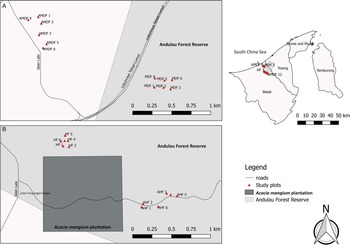
Four habitat types within the Andulau Forest Reserve (4°37’60.00”N, 114°31’60.00”E) in Brunei Darussalam were compared: heath forest (HF), Acacia-invaded heath forest (AHF), mixed dipterocarp forest (MDF) and Acacia-invaded mixed dipterocarp forest, (AMDF; Figure 1). The Andulau Forest Reserve primarily contains MDFs with undulating topography and elevation range of 2.7° – 27.6° (Sukri et al. Reference Sukri, Wahab, Salim and Burslem2012) with pockets of HFs (Davies & Becker Reference Davies and Becker1996). The climate of Brunei Darussalam is aseasonal with mean monthly rainfall of 162.6 mm and mean monthly temperature of 28.2°C recorded at the Sungai Liang Agricultural station (c. 2 km away from Andulau) in 2016 (Department of Agriculture and Agrifood, unpubl. data).
Locations of the study sites consisting six plots in the intact heath forest (HF 1-6), six plots in Acacia-invaded heath forest (AHF 1-6), six plots in intact mixed dipterocarp forest (MDF 1-6) and six plots in Acacia-invaded mixed dipterocarp forest (AMDF 1-6), within compartments 7 and 8 of the Andulau Forest Reserve in the Belait District, Brunei Darussalam. AHF plots were set up along the Jalan Empangan Kargu roadsides, whereas AMDF plots were set up along Jalan Labi roadsides and both AHF and AMDF plots were invaded by Acacia trees. Distances between plots within the same habitat type range from c. 50 to 100 m. A represents the inset of plots MDF 1-6 and AMDF 1-6 and B represent the inset of plots HF 1-6 and AHF 1-6.

Intact forest (HF and MDF) plots represented areas with no Acacia invasion and were selected from within primary forest areas with no previous history of logging or man-made disturbance (Forestry Department, pers. comm.). The Acacia-invaded (AHF and AMDF) plots were selected based on the presence of Acacia trees inside and outside the study plots. Both AHF and AMDF plots selected showed comparatively similar degree of invasion, with similar density and total number of Acacia trees (n = 4 to 7 trees) of the same estimated age (≤ 20 years) in all the established plots. AHF and AMDF plots had more open canopies than HF and MDF plots (SM Jaafar, pers. obs.). Plots within the same forest type (i.e. MDF and AMDF plots and HF and AHF plots) were located c. 1 km apart.
Soil sampling
Fieldwork was carried out in February until March 2016 during the wet season (rainfall ≥ 100 mm, Becker Reference Becker1992). To investigate habitat variation in soil physicochemical properties, six 20 × 20 m plots were randomly set up within accessible locations in each habitat type. Distances between plots within the same habitat range from c. 50 to 100 m. The 20 × 20 m plots were further subdivided into 10 × 10 m subplots. Within each subplot, one soil core was sampled at a random position using a soil auger at two depths: topsoil (0 – 15 cm) and subsoil (30 – 50 cm). The litter layer was cleared prior to soil sampling. A total of 192 soil samples were collected (n = 96 subplots × 2 depths) from 24 plots at the four habitat types.
Measurements of soil parameters
Fresh soils were analysed for pH in distilled water, gravimetric water content (GWC) and bulk density (Allen et al. Reference Allen, Grimshaw, Parkinson and Quarmby1989). The remaining fresh soil samples were air-dried, ground and passed through a 2.0 mm sieve and stored at room temperature. Air-dried soil samples were analysed for concentrations of total N, P, K, Ca and Mg as well as organic matter (OM) content (Allen et al. Reference Allen, Grimshaw, Parkinson and Quarmby1989). Total N and P concentrations were determined using the Kjeldahl method by digesting each soil sample in concentrated H2SO4 and analysed using a Flow Injector Analyser (FIAstar 5000, Hoganas, Sweden). For analysis of total K, Ca and Mg concentrations, air-dried soil samples were acid-digested using a block digestor with 70% H2SO4 and H2O2, following a procedure modified from Allen et al. (Reference Allen, Grimshaw, Parkinson and Quarmby1989) and measured using a Flame Atomic Absorption Spectrophotometer (AAS; Thermo Scientific iCE 3300, Sydney, Australia).
Statistical analyses
All statistical analyses were conducted in R 3.5.1 software (R Development Core Team 2018). The effects of forest type, habitat type and sampling depth on nine soil physicochemical properties (GWC, OM, bulk density, pH and nutrient concentrations; total N, P, K, Ca and Mg) were tested via a linear mixed-effects (LME) model using the nlme version 3.1-137 package (Pinheiro et al. Reference Pinheiro, Bates, DebRoy and Sarkar2018). Where necessary, soil physicochemical variables were either arcsine or log10-transformed prior to analysis. Forest type, habitat type and sampling depth were modelled as fixed-effects, the transformed values of soil physicochemical properties were modelled as response variables and sampling points were modelled as random effects. Each response variable was tested using separate LME models. In each LME model, pair-wise comparisons between habitat type within each forest type were performed by obtaining the least-square means using the lsmeans version 2.3 package (Lenth Reference Lenth2018).
All nine soil physicochemical variables (GWC, OM, bulk density, pH and nutrient concentrations; total N, P, K, Ca and Mg) for only the topsoil depth (0 – 15 cm) between the four different habitat types were then subjected to a principal component analysis (PCA) to determine which variables account for most of the variation in the data set. Since most soil nutrients accumulate in the first 15 cm of soil depth (Jaafar et al. Reference Jaafar, Sukri and Procheş2016), only the topsoil variables were subjected to PCA and presented.
The changes in soil physicochemical properties (Δ GWC, Δ OM, Δ bulk density, Δ pH and Δ nutrient concentrations; total N, P, K, Ca and Mg) were calculated by subtracting mean values of the intact habitat from mean values of the invaded habitat for each soil physicochemical variable. The variable Δ thus represents how different the invaded habitat was from the intact habitat in terms of mean values of soil variables, as a way of expressing the change in soil properties caused by the presence of Acacia in invaded habitats while taking into account potential variation in localities, age range and vegetation type, following Majalap (Reference Majalap2000). Similarly, the effects of forest type and sampling depth on changes in soil physicochemical properties were tested separately using LME models. Transformed values of changes in soil physicochemical properties were modelled as response variables, forest type and sampling depth as fixed effects with sampling points included as random effects. All LME models’ selection followed Pinheiro and Bates (Reference Pinhero and Bates2004) and Zuur et al. (Reference Zuur, Ieno, Walker, Savaliev and Smith2009). In each of the LME model, pair-wise comparisons between forest type and between sampling depth were performed by obtaining the least-square means. Although sampling depth was included in the LME models, most soil physicochemical variables did not show significant effects for sampling depth (Supplementary Table 1), and so we focussed on presenting and discussing findings on the main effects of forest and habitat types.
Results
Soil physicochemical properties
Acacia invasion either increased or decreased soil physicochemical properties in both forest types. Significant effects of forest type were detected on soil OM, bulk density, pH and concentrations of total N, P, K and Mg (P < 0.05; Supplementary Table 1). Habitat type significantly influenced GWC, bulk density and concentrations of total P, K, Ca and Mg (P < 0.05; Supplementary Table 1). Soil OM, pH and concentrations of total N, K, Ca and Mg displayed significant forest type by habitat-type interactions (P < 0.05; Supplementary Table 1).
Within HF, regardless of sampling depth, AHF plots recorded significantly higher GWC, pH and concentrations of total P, K and Ca than plots in the intact habitat (P < 0.05; Table 1), while the intact habitat plots exhibited significantly higher OM content than the invaded habitat plots (P < 0.05; Table 1). In contrast, within the MDF, also regardless of sampling depth, AMDF plots recorded significantly higher soil OM and concentrations of total N, P, K and Mg compared to its intact habitat plots (P < 0.05; Table 1). The intact habitat, however, recorded significantly higher values of soil bulk density and pH than its invaded habitat (P < 0.05; Table 1).
Mean values for nine soil physicochemical properties (gravimetric water content, organic matter, bulk density, pH and nutrient concentrations; total N, P, K, Ca and Mg) at forest type and habitat type levels regardless of the sampling depth of the soil samples at heath and mixed dipterocarp forests of two habitat types (intact or Acacia-invaded). Values are means ± standard error, SE. The mean values presented in this table were calculated averaging the 48 samples per habitat type. Significant differences between each forest and within each habitat types were detected after a linear mixed effects (LME) analysis followed by an lsmeans pairwise comparisons test at α = 0.05 level (* P < 0.05; ** P < 0.01; *** P < 0.001)

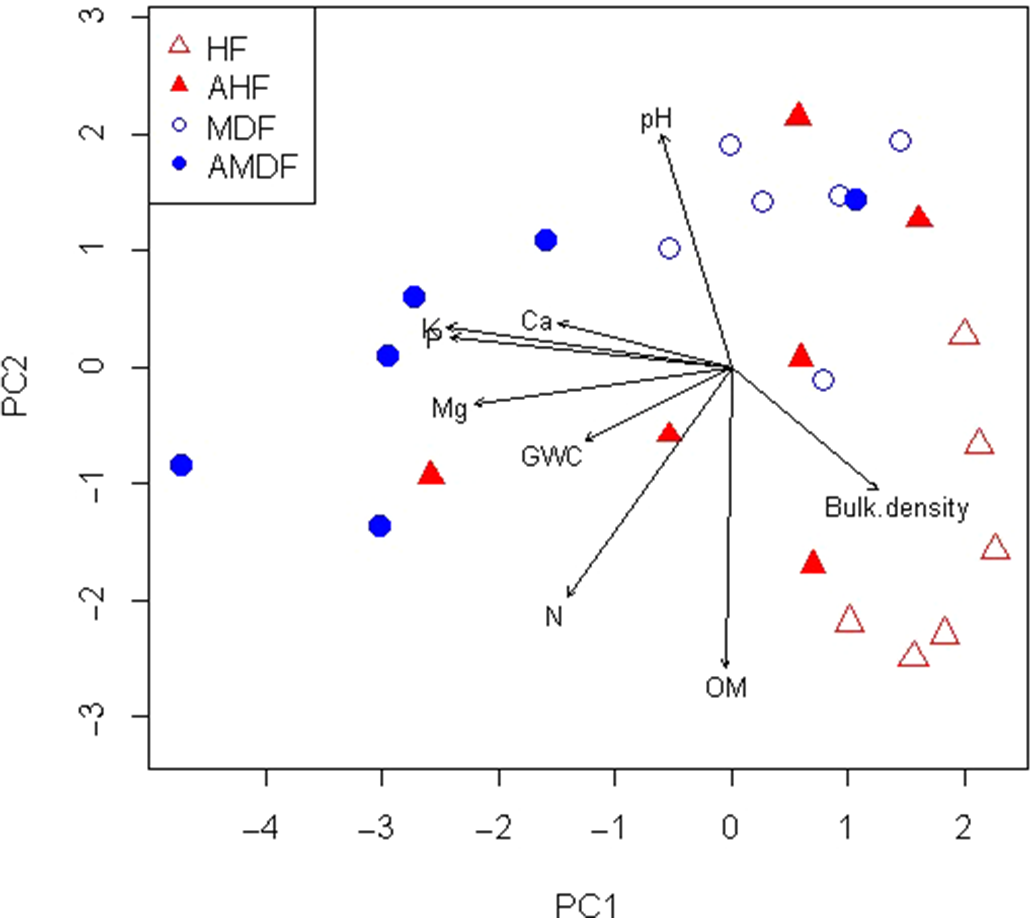
Topsoil (0 – 15 cm) variation in physicochemical properties created a clear separation of plots from HF and MDF into two distinct clusters (Figure 2). The MDF plots were strongly influenced by PC2 (pH), while the HF plots were strongly influenced by PC1 (Bulk density) and PC2 (OM; Supplementary Table 2). In contrast, AHF and AMDF plots were scattered within the biplot (Figure 2), indicating that Acacia-invaded plots were equally influenced by most of the topsoil physicochemical variables.
Biplot of principal component (PC) axes 1 and 2 from principal component analysis (PCA) of nine topsoil (0 – 15 cm) physicochemical variables (gravimetric water content, organic matter, bulk density, pH and nutrient concentrations; total N, P, K, Ca and Mg) across 24 plots from heath forest (HF), Acacia-invaded heath forest (AHF), mixed dipterocarp forest (MDF) and Acacia-invaded mixed dipterocarp forest (AMDF). PC1 and PC2 accounted for 41.7% and 23.4% of the total variation, respectively. The arrows show the loadings of each variable on the first two PC axes. GWC, OM, nulk density, pH, N, P, K, Ca, Mg are gravimetric water content, organic matter, bulk density, pH, total N, P, K, Ca and Mg concentrations, respectively. Note the overlapping arrows for the loadings of K and P.

Changes in soil properties (Δ) in each forest type
Acacia-invaded HF and AMDF soils showed significant changes in all soil properties (Δ OM, Δ pH and, Δ total N, P, K, Ca and Mg concentrations; P < 0.05) except for Δ GWC and Δ bulk density (P > 0.05; Supplementary Table 3). Changes in soil properties (Δ) in both forest types were either positive or negative (Table 2). Heath forest, when invaded by Acacia species, decreased in OM, bulk density and total N concentration (negative change; Table 2), but increased in GWC, soil pH and total P, K, Ca and Mg (positive change; Table 2). In contrast, MDF decreased in bulk density and soil pH (negative change; Table 2) but increased in GWC, soil organic matter and total N, P, K, Ca and Mg (positive change; Table 2) when invaded by Acacia. The positive changes of total P, K and Mg were greater in MDF than HF by threefold, threefold and fourfold, respectively, while only positive change of total Ca concentration was greater in HF than MDF by fourfold (Table 2).
Mean values for the change of soil properties (Δ gravimetric water content, Δ organic matter, Δ bulk density, Δ pH and Δ nutrient concentrations; total N, P, K, Ca and Mg) between two forest types (heath and mixed dipterocarp forests) and between two sampling depths (topsoil 0 – 15 cm and subsoil 30 – 50 cm). Values were calculated by subtracting the average values of the intact habitat from the values of invaded habitat for each of the soil physicochemical variable. Values are means ± standard error, SE. The mean values presented in this table were calculated averaging the 24 samples per forest type and per sampling depth. Significant differences between each forest type and sampling depths were detected after a linear mixed effects (LME) analysis followed by an lsmeans pairwise comparisons test at α = 0.05 level (* P < 0.05; ** P < 0.01; *** P < 0.001). Note the NA (not available) for Δ bulk density column at sampling depth level. Bulk density was only sampled at topsoil depth (0 – 15 cm), hence sampling depth was not used as part of the fixed effects in the model. The (−) sign before the mean values indicates a decrease and no sign before the mean values indicate an increase in soil physicochemical properties in the presence of Acacia

Discussion
Effects of Acacia invasion on heath forest soils
For HF soils, Acacia invasion significantly increased soil pH, GWC and concentrations of total P, K and Ca and significantly decreased soil OM content. Increased soil pH was similarly recorded in invaded coastal HF in Brunei (Ibrahim et al. Reference Ibrahim, Sukri, Tennakoon, Le and Metali2021). The significant increase in soil pH in our AHF plots may reflect the impact of Acacias on the balance between soil nitrification and ammonification processes in tropical heath soils, resulting in changes to soil pH (Xiong et al. Reference Xiong, Xia, Li, Cai and Fu2008). Our AHF plots recorded higher soil GWC, which is inconsistent with findings of Yusoff et al. (Reference Yusoff, Tennakoon, Jaafar, Zaman and Sukri2019) and Ibrahim et al. (Reference Ibrahim, Sukri, Tennakoon, Le and Metali2021) in coastal HF in Brunei. Acacia typically reduce soil GWC (Ibrahim et al. Reference Ibrahim, Sukri, Tennakoon, Le and Metali2021, Le Maitre et al. Reference Le Maitre, Gaertner, Marchante, Ens, Holmes, Pauchard, O’Farrell, Rogers, Blanchard, Blignaut and Richardson2011, Matali & Metali Reference Matali and Metali2015), as their large aboveground biomass requires more water from soil (Morris et al. Reference Morris, Esler, Barger, Jacobs and Cramer2011). Here, we suggest that instead of an effect caused by Acacia invasion, our finding was more likely due to waterlogged conditions at three out of six plots during our wet season sampling (SM Jaafar, pers. obs.). It is crucial that future studies should consider sampling soils during both the dry and wet seasons, as these can impact soil properties (Xiong et al. Reference Xiong, Xia, Li, Cai and Fu2008).
Regardless of sampling depths, intact HF recorded significantly higher OM content compared to AHF. The PCA biplots clearly showed a separation of the HF and AHF plots due to the high influence of bulk density and organic matter. Bulk density and OM content are interrelated (Shiri et al. Reference Shiri, Keshavarzi, Kisi, Karimi and Iturraran-Viveros2017), and lower OM content in AHF may be due to changes in the physical structure of these invaded soils caused by the extensive Acacia root systems. These changes could have impacted soil texture and porosity, resulting in further modifications to bulk density and OM content.
Our findings of significantly higher soil nutrient concentrations (total P, K and Ca) in AHF are consistent with observations of soil nutrient enrichment within Acacia plantations or Acacia-invaded habitats (e.g. Castro-Diez et al. Reference Castro-Díez, Godoy, Alonso, Gallardo and Saldaña2014, Perreira et al. Reference Perreira, Zagatto, Brandani, Mescolotti, Cotta, Goncalves and Cardoso2018, van Bich et al. Reference van Bich, Eyles, Mendham, Dong, Ratkowsky, Evans, Hai, Thanh, Thinh and Mohammed2018). However, our findings of no difference in total N concentrations and higher total Ca concentrations contradict those of Matali and Metali (Reference Matali and Metali2015) who compared soil properties at the same intact HF site as our study, versus soil properties in an adjacent A. mangium plantation, located approximately c. 500 m away from our AHF plots. Their A. mangium plantation soils recorded significantly higher total N concentrations and reduced total Ca concentrations (Matali & Metali Reference Matali and Metali2015). These contradicting results could be attributed to tree abundance and diversity differences between the two habitats, as A. mangium trees dominated the plantation (about 80%), while the AHF showed a mix of A. mangium and native shrub HF tree species (RS Sukri, unpubl. data). Elsewhere in Brunei, no significant differences in soil properties between coastal HF and AHF were reported, except for increased topsoil available P and subsoil exchangeable Ca concentrations (Yusoff et al. Reference Yusoff, Tennakoon, Jaafar, Zaman and Sukri2019). Heath forest soils or soil solutions are typically richer in total Ca (Jaafar et al. Reference Jaafar, Sukri and Procheş2016) and exchangeable Ca concentrations (Metali et al. Reference Metali, Salim, Tennakoon and Burslem2015) than other nutrients. Here, we reported that Acacia invasion increased Ca concentrations in HF soils, which could further impact these forests.
Interestingly, our study did not record increased soil total N concentration when the HF was invaded by these N-fixing Acacia species. Similarly, no significant increase in total soil N concentration was recorded in Acacia-invaded coastal HF (Yusoff et al. Reference Yusoff, Tennakoon, Jaafar, Zaman and Sukri2019). We suggest the absence of soil total N increase was because our invaded HF plots contained young Acacia seedlings and saplings, rather than older and more established trees. Uptake of soil N by Acacia trees is generally higher during the first three years after planting (Huong et al. Reference Huong, Nambiar, Quang, Mendham and Dung2015), possibly contributing to the lack of elevated soil N. Pre-invasion soil nutrient status of heath soils could have further affected the N-fixing ability of invasive Acacia (Ehrenfeld Reference Ehrenfeld2003). Additionally, allelochemicals produced by invasive Acacia species (Ismail & Metali Reference Ismail and Metali2014, Lorenzo et al. Reference Lorenzo, Pereira and Rodríguez-Echeverría2013) may inhibit activities of soil decomposer organisms, affecting soil mineralisation (Xiong et al. Reference Xiong, Xia, Li, Cai and Fu2008), thus further reducing N release from litter into soil in invaded HF habitats.
Effects of Acacia invasion on mixed dipterocarp forest soils
Acacia invasion effects on MDF soils contrasted with those observed on nutrient-poor HF soils. Invaded MDF soils were more acidic with decreased bulk density and increased organic matter content and total N, P, K and Mg concentrations. The biplots of PCA also supported this result and clearly showed a separation of intact MDF plots from the AMDF plots.
Acacias increased soil nutrient (total N, P, K and Mg) concentrations in invaded MDF plots, consistent with soil nutrients enrichment following Acacia invasion (Pereira et al. Reference Perreira, Zagatto, Brandani, Mescolotti, Cotta, Goncalves and Cardoso2018, van Bich et al. Reference van Bich, Eyles, Mendham, Dong, Ratkowsky, Evans, Hai, Thanh, Thinh and Mohammed2018). The increase in total soil N concentration in MDF was expected due to the N-fixing ability of Acacia, leading to the production of N-rich litter and elevated total soil N concentration (Jeddi & Chaieb Reference Jeddi and Chaieb2012, Morris et al. Reference Morris, Esler, Barger, Jacobs and Cramer2011). Increased total P concentrations in invaded MDF are important as these forests are P-limited (Paoli et al. Reference Paoli, Curran and Zak2006, Sukri et al. Reference Sukri, Wahab, Salim and Burslem2012), and Acacia invasion can potentially impact their P balance. Increased total soil K concentrations in the AMDF may be due to leaching of this highly mobile ion via throughfall from Acacia foliar biomass, accumulation of K-rich leaf litter and K deposition into soil (Ampitan et al. Reference Ampitan, Ampitan, Muhammad and Ibrahim2021, Dent et al. Reference Dent, Bagchi, Robinson, Majalap-Lee and Burslem2006). AMDF soil also recorded higher total Mg concentrations than its intact habitat. Decomposing materials are usually high in total Mg (Powers et al. Reference Powers, Motgometry, Adair, Brearley, DeWalt, Castanho, Chave, Deiner, Ganzhorn, Gilbert, Gonzalez-Iturbe, Bunyavejchewin, Grau, Harms, Hiremath, Iriarte-Vivar, Manzane, de Oliveira, Poorter, Ramanamanjato, Salk, Varela, Weiblen and Lerdau2009), and the presence of several dead and fallen Acacia trees in our AMDF plots, coupled with the naturally nutrient-rich soil, could have resulted in high Mg accumulation.
Bulk density of MDF soil was decreased by Acacia invasion. The increase in organic matter content in the AMDF soil likely contributed to lower bulk density (Lindsay & French Reference Lindsay and French2005). Further, faster leaf litter decomposition in AMDF than invaded HF (Jaafar Reference Jaafar2020) could have released more OM into the soil. This increase in OM could further elevate total N concentrations (Lindsay & French Reference Lindsay and French2005) as seen in our AMDF soils. Additionally, higher accumulation of OM content often occurs in nutrient-rich soil, such as MDF soil, due to high abundance and diversity of decomposer organisms (Tsukamoto & Sabang, Reference Tsukamoto and Sabang2005).
Contrasting magnitude of impacts of Acacia invasion on soils
We found that Acacia invasion either positively or negatively impacted several soil variables, as quantified by changes in soil properties (Δ) for OM, pH, total N, P, K, Ca and Mg concentrations. The magnitude of changes differed between forest types, with up to 1.4-, 1.6-, 1.9-, 3.2-, 1.3- and 2.7-folds increase in OM, total N, P, K, Ca and Mg concentrations, respectively, for MDF soils and the magnitude of changes for HF soils were up to 1.8-, 22.7-, 3.0- and 1.3-folds increase in total P, K, Ca and Mg concentrations, respectively, and up to 1.3-fold decrease in OM.
Consistent with the significantly higher mean pH values in AHF than in AMDF, we recorded increased pH for the former but decreased pH for the latter. Habitats with the lowest bulk density often show lower soil pH (Lindsay & French Reference Lindsay and French2005), and MDF soils are generally less sandy, and thus have lower bulk density, than HF soils (Jaafar et al. Reference Jaafar, Sukri and Procheş2016). Further, nitrification process that generates H+ can affect soil acidity (Li et al. Reference Li, Peng, Rae and Zhou2001, Majalap Reference Majalap2000), and increased soil acidity for our AMDF could be caused by relatively high nitrification processes (Yamashita et al. Reference Yamashita, Ohta and Hardjono2008). Indeed, nitrification process in our MDF soils was 45-fold higher than in our HF soils (Jaafar Reference Jaafar2020).
Acacia invasion consistently increased total P, K, Ca and Mg concentrations in both forest types, but the positive effects of total soil P (threefold), K (threefold) and Mg (fourfold) additions were greater in MDF soil than in HF soil. In contrast, the positive effect of addition of total Ca concentration was four times greater in HF soil than MDF soil. Plant invasions often result in elevated nutrient levels (Keet et al. Reference Keet, Ellis, Hui, Novoa and Le Roux2021). Additionally, tropical lowland rain forest soils are strongly P-limited (Paoli et al. Reference Paoli, Curran and Zak2006, Sukri et al. Reference Sukri, Wahab, Salim and Burslem2012), and Acacia may overcome this limitation by enriching soils with P.
Interestingly, Acacia invasion showed contrasting effects of increased OM and total N concentration for AMDF, but decreased OM and total N for AHF. This may be linked to slower litter decomposition rates in HF compared to MDF, which remained slower in the presence of invasive Acacia (Jaafar Reference Jaafar2020). Notably, we detected a significant decrease in total N (as measured by Δ total N) for AHF compared to the intact HF, despite not recording a significant difference in mean values of total N concentrations between intact and AHF. This suggests that Acacia invasion did cause a decrease in total N concentrations for HF in our study. We highlight that this finding illustrates the importance of quantifying Δ change in soil properties as a direct measure of the impact of Acacia invasion on soil properties, rather than only relying on comparing mean values between intact and invaded habitats.
The greater magnitude of nutrient increase in MDF than HF soils might reflect differences in pre-invasion soils (Stock et al. Reference Stock, Wienand and Baker1995), with MDF being inherently nutrient-rich compared to HF soils (Jaafar et al. Reference Jaafar, Sukri and Procheş2016). The three- to fourfold increases in nutrients for MDF soils may reflect higher litterfall production and nutrient release triggered by Acacia invasion. Further, low resource utilization by native HF species adapted to nutrient-poor conditions could have benefitted nutrient uptake by invasive Acacia species (Werner et al. Reference Werner, Zumkier, Beyschlag and Maguas2010).
The higher magnitude of changes in soil nutrients recorded for the nutrient-rich MDF soils compared to the nutrient-poor HF soils provides further evidence that nutrient-rich sites may be more impacted by plant invasions than nutrient-poor sites (Witkowski Reference Witkowski1991, Zefferman et al. Reference Zefferman, Stevens, Charles, Dunbar-Irwin, Emam, Fick, Morales, Wolf, Young and Young2015). This is an important finding as it is often presumed that nutrient-rich MDF are more resistant to Acacia invasion because of differences in species diversity, soil physicochemical properties, topography and underlying geology compared to HF. We suggest that Acacia may be able to easily utilise the readily available nutrients in nutrient-rich MDF soils, and in the process, significantly modify soil properties to facilitate their own growth, to the detriment of native plant species.
Conclusion
Our study provides evidence of distinct impacts of Acacia invasion on soil properties at two contrasting lowland forest sites in northwest Borneo, which appear to be influenced by pre-invasion soil nutrient status as well as by inherent pre-invasion differences in other soil properties. Associated differences include elevated gravimetric water content, pH and total P, K and Ca concentrations in AHF and higher organic matter content and concentrations of total soil N, P, K and Mg in AMDF. We detected stronger effects of Acacia invasion in the MDF soil via higher magnitude of nutrient additions (except for total Ca), compared to HF soil, indicating that nutrient-rich forests may be more vulnerable to invasive Acacia. With increasing urban development and extensive road networks where invasive Acacia can readily establish, intact MDFs in Brunei and elsewhere in Borneo face increasing pressure from Acacia invasion and subsequently may be more affected than the nutrient-poor HFs.
Supplementary material
To view supplementary material for this article, please visit https://doi.org/10.1017/S0266467422000141
Acknowledgements
The authors thank the Brunei Forestry Department for granting entry permit (Ref no. [99]/JPH/UND/17 PT.1), the Department of Agriculture and Agrifood for providing rainfall data, Nur Khalish Hafizhah Ideris and Muhammad Abdul Hakeem Julaihi for field assistance, David Burslem for advice and Dennis Ting for assistance with the map. We are grateful to the Associate Editor and reviewer for critical feedback that have significantly improved our paper.
Financial support
The research was funded by the Brunei Research Council [Grant No. UBD/BRC/11] and Universiti Brunei Darussalam [Grant Nos. UBD/RSCH/1.4/FICBF(b)/2018/005 and UBD/PNC2/2/RG/1(204)]). SMJ was supported by a University Graduate Scholarship (UGS) from Universiti Brunei Darussalam.
Competing interest
The authors declare that we have no conflicts of interest.