INTRODUCTION
Sorghum is one of the most important cereal crops in the semi-arid tropics. It is the fifth most important cereal crop worldwide after wheat, rice, maize and barley (FAO 2004). Sorghum fits very well into sustainable agricultural systems because of its ability to survive in water-limiting conditions, and so provides an option for marginal farmers. The development and release of new sorghum hybrids and varieties marked a genetic breakthrough in the previously stagnant yield levels in India. It quickly became apparent that one of the most important constraints in popularizing these hybrids was their high susceptibility to various pests and diseases. The sorghum crop is damaged by many pests, from seedling stage through to harvest; the sorghum shoot fly, Atherigona soccata (Rondani), is an important pest in Asia, Africa and the Mediterranean Europe (Dhillon et al. Reference Dhillon, Sharma and Ram Singh & Naresh2005). Sorghum shoot fly is one of the major pests that destabilizes the performance of sorghum cultivars and ultimately reduces sorghum production in many parts of the world. On average, 0·50 of sorghum crop in India is lost due to sorghum shoot fly (Jotwani Reference Jotwani, Krishnamurthy Rao and Murthy1983).
Shoot flies of the genus Atherigona are known to cause ‘deadhearts’ in a number of tropical grass species (Deeming Reference Deeming1971). They attack sorghum 5–25 days after emergence. The shoot fly larvae cut the growing tip, resulting in deadheart formation. Infestation causes deadhearts in seedlings as well as in tillers of older plants, resulting in considerable damage to the crop. Its incidence is higher in late-sown crops in the rainy season and early-sown crops in the post-rainy season (Jotwani et al. Reference Jotwani, Marawaha, Srivastava and Young1970). Advancing the date of sowing may help to reduce its impact during the rainy season. However, in some areas and under certain situations early sowing is not feasible (Mote Reference Mote1986). Recently, the monsoon pattern has become erratic and uneven, resulting in delayed sowings of high-yielding rainy season sorghum hybrids and varieties, and such crops are severely affected by shoot fly.
The seriousness of the shoot fly problem in sorghum, combined with the high costs and toxicity hazards of using chemical control, renders it necessary to develop new varieties or hybrids that possess resistance to this pest. Also, despite a clear increase in pesticide use in different crops worldwide, crop losses have not significantly decreased during the last 40 years (Oerke Reference Oerke2006), which emphasizes the need for host plant resistance. The systematic search for sources of resistance to shoot fly through field evaluation in different locations was started with the screening of the world germplasm collection under the All India Co-ordinated Sorghum Improvement Project (AICSIP) in the 1960s (Singh et al. Reference Singh, Vedamoorthy, Thobbi, Jotwani, Young, Balan, Srivastava, Sandhu and Krishnananda1968). A number of genotypes with resistance to shoot fly have been identified, but the levels of resistance are low to moderate (Pradhan & Jotwani Reference Pradhan and Jotwani1978; Taneja & Leuschner Reference Taneja, Leuschner, Leuschner and Teetes1985; Sharma et al. Reference Sharma, Taneja, Kameshwara Rao and Prasada Rao2003). However, these varieties have poor productivity due to a physiologically inefficient plant type. A primary objective of sorghum breeding programmes is therefore to transfer the resistance of such types into an improved agronomical background (Rana et al. Reference Rana, Jotwani and Rao1981).
A detailed study of the underlying genetic basis of resistance through the use of appropriate breeding material is important to formulate breeding strategies. Various authors have reported that characters such as glossiness of leaves, presence of trichomes and plants with fewer sorghum fly eggs are important attributes that confer resistance to shoot fly and hence can be used as marker traits to select for resistance to shoot fly in sorghum (Maiti & Gibson Reference Maiti and Gibson1983; Jadhav et al. Reference Jadhav, Mote and Bapat1986; Sharma et al. Reference Sharma, Nwanze, Subramanian, Sharma, Singh and Nwanze1997; Deshpande et al. Reference Deshpande, Kamatar, Kathnalli, Malleshappa and Nayakar2003; Kamatar & Salimath Reference Kamatar and Salimath2003; Dhillon et al. Reference Dhillon, Sharma and Ram Singh & Naresh2005).
As most of the sorghum area in Asia, Australia and the Americas is planted with hybrids, it is important to identify and transfer genes conferring resistance to shoot fly into both male sterile and restorer lines in order to develop shoot fly resistant hybrids (Sharma et al. Reference Sharma, Abraham, Vidyasagar and Stenhouse1996, Reference Sharma, Dhillon, Naresh, Singh, Pampapathy, Reddy, Fisher, Turner, Angus, McIntyre, Robertson, Borrell and Lloyd2004; Dhillon Reference Dhillon2004). This requires an understanding of the genetic make up of the shoot fly resistant sources. Combining ability studies help in the selection of suitable parents for hybridization programmes, besides elucidating the nature and magnitude of gene action involved in the inheritance of a character. Such information is required to design efficient breeding programmes for rapid crop improvement. Dhillon (Reference Dhillon1975) suggested that the combining ability of parents gives useful information on the choice of parents in terms of expected performance of the hybrids and progenies. It is essential to know the genetic architecture of traits related to shoot fly tolerance and their mode of inheritance.
Knowledge of diversity in the resistant sources and genetic relationships in the breeding material is an invaluable aid in planning appropriate strategies for crop improvement with increased level of resistance. The present study was carried out to assess the usefulness of different shoot fly resistant sources in developing sorghum varieties and hybrids with shoot fly resistance.
MATERIALS AND METHODS
The material consisted of 12 shoot fly resistant lines, three male sterile lines and their 36 hybrids crossed in a line×tester mating design, grown during the rainy season in both 2005 and 2006. The crosses were made during the post-rainy seasons of 2004 and 2005 to produce the required hybrids for the study. The shoot fly resistant lines include the resistant lines from germplasm, viz., IS 18551, IS 2312, IS 2122 and improved sources of resistance such as PS 35805, B 55299, B 55301, RSE 03, ICSV 705, SFCR 1047, SFCR 1143, SPSFR 94032, RSSV 9. Of these, PS 35805, B 55299, B 55301, ICSV 705, SFCR 1047, SFCR 1143 and SPSFR 94032 are the improved sources with moderate level of resistance for shoot fly (AICSIP 2002) developed at the International Crops Research Institute for Semi-Arid Tropics (ICRISAT). RSE 03 is an improved shoot fly resistant line developed at Rahuri, India, and RSSV 9 is a sweet sorghum line with resistance to shoot fly developed at Rahuri. The shoot fly susceptible male sterile lines included in the study were 27A, 296A and 463A. 27A and 296A are the female parents of the popular hybrids CSH 16 and CSH 9, respectively. 463A is the female parent of SPH 1148, a promising hybrid tested in AICSIP trials in India. The experiments were conducted in the shoot fly nursery at the National Research Centre for Sorghum (NRCS), Rajendranagar, Hyderabad. The material was planted in a randomized block design with three replications under rainfed conditions. The crop was sown in rows 0·6 m apart. Plots consisted of parallel single rows 4 m long. One week after seedling emergence, thinning was carried out to maintain a spacing of 100 mm between the plants. To attain uniform shoot fly pressure under field conditions, the fish meal technique (Nwanze Reference Nwanze, Sharma, Singh and Nwanze1997) was adopted to ensure shoot fly infestation in the experimental material. Plant protection measures were avoided.
Observations were made in each replication during both the years. The number of eggs in five plants was recorded at 21 days after emergence (DAE) and expressed as mean number of eggs per plant. The intensity of glossiness was recorded at 10 DAE on a scale of 1–5, where 1=high intensity of glossiness and 5=non-glossy. Leaf glossiness was observed in the morning hours when there was maximum light reflection. Seedling vigour was scored at 10 DAE on a scale of 1–5, where 1=high vigour (plants showing maximum height, leaf expansion and robustness) and 5=low vigour (plants showing minimum growth, less leaf expansion and poor adaptation). In order to record leaf trichome density, the central portion of the 5th leaf from the base was taken from three randomly selected seedlings in each entry at 12 DAE. Leaf samples (c. 5 mm2) were placed in 20 ml of acetic acid:alcohol (2:1) in small vials overnight. The cleared samples were transferred into 0·9 lactic acid and stored for observation. The leaf samples were mounted on a slide in a drop of lactic acid and observed under the microscope at a magnification of ×20 (Maiti & Bidinger Reference Maiti and Bidinger1979). The number of trichomes was counted in three microscopic fields selected at random and expressed as trichome density/mm2. The proportion of plants with deadhearts was recorded twice, at 21 and 28 DAE. The total number of plants in each entry and the number of deadhearts were recorded and the proportion calculated.
Statistical analysis
The data were subjected to analysis of variance to test the significance of differences between the hybrids. Combining ability analysis was carried out using the method developed by Kempthorne (Reference Kempthorne1957).
The genetic divergence among the parents used was computed by means of Mahalanobis’ D 2 technique (Mahalanobis Reference Mahalanobis1930, Reference Mahalanobis1936). The genotypes were grouped into clusters following Tocher's method as described by Rao (Reference Rao1952) and principal component analysis was carried out (Rao Reference Rao1964) using the statistical software Windostat (Indostat Services 2004).
RESULTS
Performance of genotypes
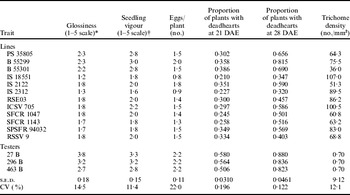
The mean performance of the genotypes used in the study (Table 1) shows that IS 18551 was the line with lowest proportion of deadhearts, followed by IS 2312. These two lines had high trichome numbers and desirable scores for glossiness, seedling vigour and the lowest number of eggs per plant, which are highly correlated with shoot fly resistance (Dhillon et al. Reference Dhillon, Sharma and Ram Singh & Naresh2005). The genotypes IS 2122, RSE 03, ICSV 705, SFCR 1047, SFCR 1143, SPSFR 94032 and RSSV 9 recorded moderate levels of shoot fly infestation. The three female lines used in the study were found to be highly susceptible to shoot fly, with a high proportion of deadhearts.
Per se performance of the sorghum genotypes for traits associated with shoot fly resistance over two environments

DAE=days after emergence.
* 1=high intensity of glossiness and 5=non-glossy.
† 1=high vigour and 5=low vigour.
Genetic divergence studies
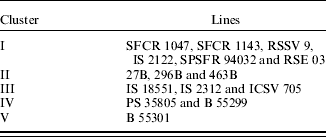
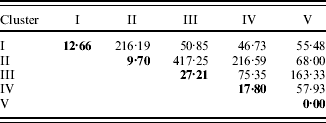
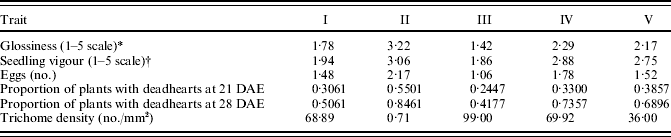
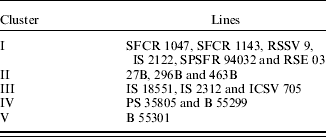
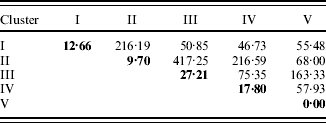
The 12 shoot fly resistant lines and the three female parents included in the study were grouped into five clusters based on D 2 values (Table 2). Cluster I was largest with six genotypes, comprising the resistant lines SFCR 1047, SFCR 1143, RSSV 9, IS 2122, SPSFR 94032 and RSE 03. Cluster II consisted of the three parental lines, 27 B, 296 B and 463 B, which were highly susceptible to shoot fly, demonstrating there was little diversity with regard to shoot fly resistance and associated traits. The lines with high levels of resistance (Table 1), i.e. IS 18551 and IS 2312, were in Cluster III along with ICSV 705. The lines PS 35805 and B 55299 were included in Cluster IV. Cluster V consisted of the single genotype, B 55301. The cluster distance ranged from 9·70 to 27·21 within clusters and from 50·85 to 417·25 between clusters (Table 3), and there is a large variability in the cluster means for different characters (Table 4). Cluster II, comprising the susceptible lines, was different from other clusters. The maximum diversity of 417·25 was evident between Cluster II (susceptible genotypes) and Cluster III (resistant genotypes).
Grouping of lines into different clusters
Average intra (bold) and inter cluster distances for 15 genotypes of sorghum
Cluster mean values for shoot fly resistance and associated characters
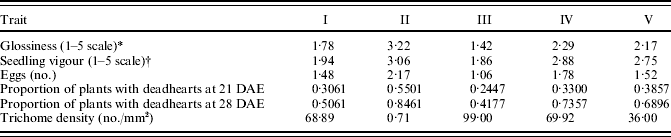
DAE=days after emergence.
* 1=high intensity of glossiness and 5=non-glossy.
† 1=high vigour and 5=low vigour.
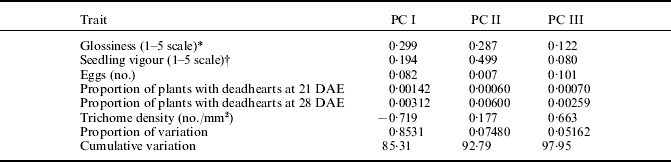
Principal component analysis gave supplementary information on the usefulness of the characters for definition of the groups (Table 5). The first two principal vectors contributed to 0·93 of the variance. In the first vector, which accounts for 0·85 of the variance, the most important character responsible for genetic divergence in the major axis of differentiation was trichome density. In the second vector (0·07 of the variation), the important characters responsible for genetic divergence were the proportion of deadhearts at 28 DAE, seedling vigour and glossiness.
Matrix of principal components of six variables for 15 sorghum genotypes
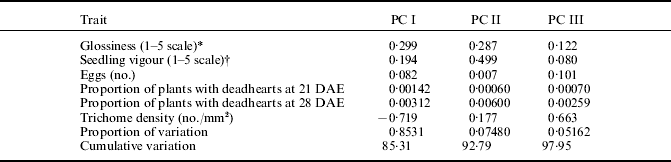
DAE=days after emergence.
* 1=high intensity of glossiness and 5=non-glossy.
† 1=high vigour and 5=low vigour.
Combining ability studies
The analysis of variance for combining ability (line×tester mating design) pooled over environments indicated significant differences among testers for all the characters except eggs per plant, which indicated the existence of genetic diversity in the shoot fly resistant genotypes included in the study. Variations among the line×tester interactions were significant for all the traits except deadheart proportion at 28 DAE. This indicated parental genetic variability in their crosses. The significance of mean squares due to testers×environment for seedling vigour and proportion of deadhearts at 28 DAE, and significance of mean squares due to (line×tester)×environment interactions for glossiness, proportion of deadhearts at 21 DAE and trichome density, suggested that the testers and the interaction variances for these traits were influenced by the environment.
The variance due to specific combining ability (σ2 SCA) was significant for the traits glossiness, seedling vigour and proportion of deadhearts at 28 DAE, which revealed the importance of non-additive components of genetic variance (Table 6). For trichome density, variances due to both general combining ability and specific combining ability were significant, showing the importance of both additive and non-additive components. The variance σ2 SCA was greater than the variance due to general combining ability (σ2 GCA), for all the traits except for the proportion of deadhearts at 21 DAE. The additive and dominance variances also followed similar trends, showing the predominance of σ2D over σ2A for all the traits studied.
General and specific combining ability variances for traits related to shoot fly resistance

* 1=high intensity of glossiness and 5=non-glossy.
† 1=high vigour and 5=low vigour.
‡ DAE=days after emergence.
GCA and SCA effects
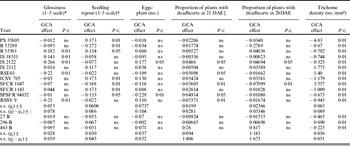
The estimates of general combining ability effects (Table 7) for the shoot fly resistant sources revealed that none of the 12 lines showed desirable, significant GCA effects for all the traits together. However, some lines exhibited desirable and significant GCA effects: B 55299 (seedling vigour), RSE 03 (glossiness, proportion of deadhearts at 21 DAE and trichomes density), SPSFR 94032 (seedling vigour and eggs per plant), RSSV 9 (for glossiness and proportion of deadhearts at 21 DAE). SFCR 1047 exhibited desirable GCA effects for the traits seedling vigour, proportion of deadhearts at 21 DAE and at 28 DAE and trichome density. IS 2312 had significant GCA effects for trichome density.
Estimates of GCA effects of lines and testers for different traits associated with shoot fly resistance in sorghum over 2 years

* 1=high intensity of glossiness and 5=non-glossy.
† 1=high vigour and 5=low vigour.
‡ DAE=days after emergence.
§ s.e. (gj)=standard error of GCA for lines/testers.
∥ s.e. (gj−gk)=standard error of difference in GCA for lines/testers.
DISCUSSION
Since sorghum varieties and hybrids with a high yield potential are already available in the market, it is important that insect and disease resistance be used as criteria to identify varieties and hybrids for use by farmers for sustainable crop production (Sharma et al. Reference Sharma, Reddy, Dhillon, Venkateswaran, Singh, Pampapathy, Folkertsma, Hash and Sharma2005). The shoot fly resistant lines identified in the germplasm are poor in productivity and hence cannot be used directly as varieties or as parents of the hybrids. The objective of any resistance breeding programme is to incorporate resistance into an agronomically elite genotype.
Despite efforts to manipulate resistance utilizing the existing sources, the level of resistance achieved is low. This is because several components are involved for resistance to shoot fly, and each is controlled by one or more genes and further influenced by environment, thus affecting the efficiency of selection and improvement of resistance in an elite background. The level of resistance to shoot fly was higher when both glossy and trichome traits occurred together (Agrawal & House Reference Agrawal and House1982; Dhillon et al. Reference Dhillon, Sharma and Ram Singh & Naresh2005). Principal component analysis in the present study showed that trichome density is the important trait contributing for genetic divergence, supporting the earlier report by Omori et al. (Reference Omori, Agrawal and House1983). The inheritance of trichome density was reported to be complex and it differed with the type of parents involved and with seasons (Jayanthi et al. Reference Jayanthi, Reddy, Gour and Reddy1999).
In the present study, the diversity in the material studied is demonstrated in the cluster analysis. The inter-cluster distances were higher than the intra-cluster distance, which indicated wider genetic diversity among the genotypes of different groups than those of the same cluster. In general, Cluster II showed a high inter-cluster distance from all other clusters. Maximum inter-cluster distance was observed between Clusters II and III. Cultivars from the different clusters, if chosen for hybridization programme, may give a broad spectrum of variability in segregating generations. The diversity in the present material was also supported by the appreciable amount of variation among cluster means for different characters.
The results of the analysis of variance for combining ability suggested the existence of significant variation between the genotypes for all the traits studied. Significant mean squares due to line×tester interaction for all the traits, except the proportion of deadhearts at 28 DAE, indicated the significant contribution of SCA. For all the traits studied, predominance of variance due to SCA was observed, indicating the importance of non-additive gene action in the control of these characters. This can be improved by breeding methods such as recurrent selection for SCA. For trichome density, both additive and non-additive gene effects were important. The dominance variance (σ2D) was found to be larger than the additive variance (σ2A) for all the traits studied, showing the importance of non-additive gene action in the control of these traits. Non-additive gene effects for different traits associated with shoot fly resistance have previously been reported (Sharma et al. Reference Sharma, Jotwani, Rana and Rao1977; Kulkarni et al. Reference Kulkarni, Hussain Sahib and Murthy1978; Halalli et al. Reference Halalli, Gowda, Kulkarni and Goud1982; Agrawal & Abraham Reference Agrawal and Abraham1985). Kumar & Singh (Reference Kumar and Singh1996) reported significant additive and dominance gene effects with predominance of additive gene effects in the inheritance of shoot fly resistant characters.
The GCA effect is considered as the intrinsic genetic value of the parent for a trait, which is due to additive gene effects and it is fixable (Simmonds Reference Simmonds1979). To get outstanding recombinants in segregating generations, the parents of the hybrids must be good general combiners for the characters to which improvement is sought (Gravois & McNew Reference Gravois and McNew1993). The parents with high GCA effects are desirable for obtaining useful segregants in early generations (Manonmani & Fazullah Khan Reference Manonmani and Fazullah Khan2003). Hence, the potentiality of parents to produce better offspring with a reservoir of superior genes was evaluated based on their GCA effects.
In the present study, some genotypes in different clusters with good general combining ability for shoot fly resistance and associated traits were identified. The genotype SFCR 1047 (Cluster I) was the best combiner for many traits such as seedling vigour, proportion of deadhearts and trichome density. The line RSE 03 (Cluster I) was a good combiner for glossiness, proportion of deadhearts and trichome density. SPSFR 94032, again belonging to Cluster I, was a good combiner for seedling vigour and eggs per plant. RSSV 9 (Cluster I) was a good combiner for glossiness and proportion of deadhearts at 21 DAE. The best resistant sources as per the mean values are grouped into Cluster III. Breeding programmes can be designed to utilize these lines for improving shoot fly resistance, and multiple crosses involving these parents would result in identification of superior segregants with favourable genes for most of the traits associated with shoot fly resistance. Biparental mating in early segregating generations of the crosses involving these parents for simultaneous exploitation of both additive and non-additive gene action can be recommended to develop sorghum genotypes with improved resistance to shoot fly. The genotypes in Clusters I and III can also be used to improve the level of resistance in the genotypes of Clusters IV and V.
The elite parents in the present study belong to Cluster II, showing that they are diverse from the resistant genotypes included in the study. Hence, the shoot fly resistant lines from Clusters I, III, IV and V can be utilized to diversify the genetic base of the parents and also to improve the parents for shoot fly resistance. It is likely that if good combiners from Clusters I, III, IV and V are selected for the improvement of male and female parents separately, it would lead to shoot fly resistant hybrids because for obtaining shoot fly resistant hybrids, resistance is required in both male and female parents (Jayanthi et al. Reference Jayanthi, Reddy, Reddy and Gour2000; Dhillon et al. Reference Dhillon, Sharma, Reddy, Singh and Naresh2006). Exploitation of genetic diversity within and among these clusters may provide a rich source of shoot fly resistant genotypes. It is suggested that intermating of randomly selected progenies in early segregating generations (especially in F2 and F3) obtained by crossing these parents will release the hidden genetic variability through breakage of undesirable linkages involved in different characters. It may produce an elite population for selection of lines with good level of shoot fly resistance in advanced generations.
Even though the resistant sources from germplasm IS 18551 and IS 2312 are the best resistant genotypes available as of today, they are not good combiners for shoot fly resistance and associated traits. This may be one of the reasons for lower improvement in the level of resistance to shoot fly in the cross derivatives of these lines. Based on the earlier finding that host immunity is absent and inheritance of shoot fly resistance is quantitative (polygenic) in nature, governed by additive and non-additive genes, the resistance can gradually be built up by conventional breeding methods through accumulation of desirable alleles (Rana et al. Reference Rana, Jotwani and Rao1981). Since the non-additive gene effects were predominant, direct selection for shoot fly resistance may not be effective. Breeding for shoot fly resistance is a slow process that requires several cycles of crossing to combine high level of resistance with yield (Rana et al. Reference Rana, Singh and Rao1985). Population breeding, where there is a chance to accumulate genes from different genotypes, can be one of the approaches to improve the level of shoot fly resistance. The diverse genotypes can be utilized to develop composite cross populations, which provide dynamic gene pools, which in turn provide a means of conserving germplasm resources (Phillips & Wolfe Reference Phillips and Wolfe2005).
The main conclusions from this study are (i) both additive and non-additive gene effects are important, with a predominance of non-additive gene effects in governing shoot fly resistance and associated traits in sorghum and (ii) multiple crosses involving the best combiners identified in the study would result in obtaining superior segregants with favourable genes for most of the traits associated with shoot fly resistance. Thus, breeding for shoot fly resistance in sorghum is likely to be difficult. Crossing between the resistant or moderately resistant lines endowed with different resistant mechanisms is likely to produce stable lines with desirable traits. Breeding sorghum hybrids with shoot fly resistance can take advantage of the dispersal of different resistant mechanisms among the diverse parents to permit the moderately resistant parental lines to produce more highly resistant hybrids. Crossing between resistant or moderately resistant lines with good combining ability for different resistance mechanisms is likely to be a successful strategy. Developing high yielding varieties and hybrids of sorghum with better resistance to shoot fly is very useful and needs further emphasis. It is hoped that commercial cultivars possessing high level of resistance to shoot fly will be available to the sorghum farmers for late plantings.
We thank Drs B. V. S. Reddy and H. C. Sharma of ICRISAT, India for providing the seed material included in the study.