In psycholinguistics, a very fruitful method for investigating syntactic representations has been the structural priming method. Structural priming refers to the finding that the processing of a syntactic structure is facilitated by recent exposure to the same or a similar structure. In language comprehension, this facilitation usually manifests itself as a reduced reading time for a primed sentence. In language production, it manifests itself as a tendency to repeat the same or a similar structure across utterances. Structural priming mostly occurs without awareness, reflecting an implicit effect on the choice among possible structures to convey the same message (see Pickering & Ferreira, Reference Pickering and Ferreira2008 and Branigan & Pickering, in press, for overviews). Most studies focus on two structural alternatives that are meaning equivalent such as prepositional object (PO) and double object (DO) ditransitive structures, active and passive structures, or adjectival and relative clause modifiers. Various experimental methods have been employed. One of the most popular methods is the picture description task, in which participants are asked to describe a picture and their choice of syntactic structure is analysed relative to the structure of a prime sentence that is processed before the picture. For example, Bock (Reference Bock1986) showed that after repeating either PO prime sentences such as A rock climber sold some cocaine to an undercover agent or DO primes such as A rock climber sold an undercover agent some cocaine, participants tended to use the same structure as in the prime to describe a target picture (e.g., a man reading a story to a boy). The influence on language users’ structural choice has also been investigated using sentence fragment completion and picture description in a dialogue task where a participant and a confederate describe pictures to each other.
Critically, research suggests that this type of priming has indeed a strong structural component, as it is not due to sound repetition and is not purely due to semantic or lexical repetition between the prime and target (Bock, Reference Bock1989; Bock & Loebell, Reference Bock and Loebell1990), though both semantic similarity and lexical repetition can enhance structural priming (Cleland & Pickering, Reference Cleland and Pickering2003; Pickering & Branigan, Reference Pickering and Branigan1998). Initially, the structural priming method was used to investigate monolingual syntactic representations, but more recently, it has become a popular method for investigating bilingual representations as well. We will review the research on bilingual structural priming here.
The shared-syntax model
Much of the work on structural priming in bilinguals has been inspired by Hartsuiker, Pickering and Veltkamp (Reference Hartsuiker, Pickering and Veltkamp2004), who found that Spanish–English bilinguals produced more passive picture descriptions in English after they had just heard a Spanish passive sentence than after either a Spanish active or intransitive sentence. Thus, they observed cross-linguistic structural priming. Hartsuiker et al. concluded that structural representations in different languages (e.g., the Spanish and English passive) are shared and proposed the shared-syntax model to account for their findings. Following Pickering and Branigan's (Reference Pickering and Branigan1998) residual activation model of monolingual structural representations, they assumed that the lemmas of words, which contain syntactic information, are linked to combinatorial nodes, which contain information about the structures with which the words can co-occur. For example, the lemmas for hit in English and golpear “hit” in Spanish are linked to both an active and a passive combinatorial node. Critically, words from different languages are connected to the same, shared combinatorial nodes such that there is only a single representation for the passive structure and only a single representation for the active structure in the languages. This explains why priming occurred between languages: When participants heard a passive in Spanish, they activated the shared passive structure, and when they subsequently had to produce a transitive sentence in English, they tended to choose a passive due to residual activation of the shared passive structure. (Note that this assumes that structural priming is due to residual activation of structural entries in the mental lexicon rather than due to the activation of syntactic rules as assumed by, for instance, Bock, Reference Bock1986 and Chang, Dell & Bock, Reference Chang, Dell and Bock2006).
The shared-syntax model is supported by several early studies showing cross-linguistic structural priming. Generally, these studies examined ditransitive PO/DO structures: Loebell and Bock (Reference Loebell and Bock2003) found priming between German and English PO/DO structures, Salamoura and Williams (Reference Salamoura and Williams2006) between Dutch and Greek and Salamoura and Williams (Reference Salamoura and Williams2007) between Greek and English PO/DOs, while Meijer and Fox Tree (Reference Meijer and Fox Tree2003) observed priming of PO/DO structures between Spanish and English as well as priming of verb-pronoun order between English and Spanish.
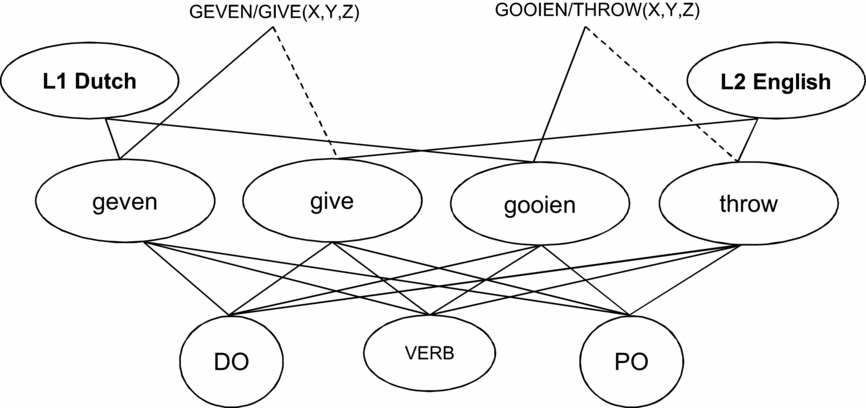
Schoonbaert, Hartsuiker and Pickering (Reference Schoonbaert, Hartsuiker and Pickering2007) tested the shared-syntax model further by investigating how structural priming in bilinguals is affected by their conceptual representations. Fig. 1 shows the model for ditransitive PO/DO structures. As argued by Hartsuiker et al. (Reference Hartsuiker, Pickering and Veltkamp2004), word lemmas are connected to structures with which they occur (e.g., give can occur with a PO or DO) and structural representations are shared between languages (here, English and Dutch). In addition, conceptual representations (e.g., the meaning of a giving event, geven/give (X,Y,Z)) are also shared between languages.
The shared syntax model for Dutch (L1) and English (L2) bilinguals, reproduced from Schoonbaert, Hartsuiker and Pickering (Reference Schoonbaert, Hartsuiker and Pickering2007).

Schoonbaert et al. observed a meaning-equivalence boost in bilingual structural priming: Priming between L1-Dutch and L2-English was larger when the verb in the target (e.g., give) was a translation equivalent of the prime verb (e.g., geven) than when the two verbs were semantically unrelated (e.g., give and gooien “throw”). This supports the shared-syntax model: In the model, the production of a target sentence with give also activates geven because both lemmas are connected to the same conceptual representation. If geven occurred with (let's say) the DO structure in the prime, then the connection between geven and the DO structure retains some of its activation and becomes reactivated during the production of the target verb give, resulting in strong priming. In contrast, if the DO structure occurred with a semantically unrelated verb in the prime (e.g., gooien), the connection between the DO and gooien is not reactivated by the production of the (semantically unrelated) target verb give, so priming is weaker. Interestingly, the meaning-equivalence boost was not bidirectional; it only occurred in priming from L1 to L2, not from L2 to L1. Schoonbaert et al. argued that this is consistent with Kroll and Stewart's (Reference Kroll and Stewart1994) revised hierarchical model of bilingual lexical representations, which claims that L2 words are less strongly connected to conceptual representations than L1 words are. This is indicated by broken vs. full lines in Fig. 1. In L2-L1 priming, when speakers produce the L1 target verb (e.g., geven), the conceptual representation may only weakly activate the L2 translation (e.g., give), and therefore, the structure with which the L2 translation occurred in the prime is also only weakly reactivated. In contrast, in L1-L2 priming, the conceptual representation strongly activates the L1 verb when the L2 target is produced.
Are L1 and L2 structural representations fully shared?
An important assumption of the shared-syntax model is that structures are fully shared between languages; that is, there is only a single combinatorial node. However, Kantola and Van Gompel (Reference Kantola and Van Gompel2011) noted that much of the early evidence for cross-linguistic structural priming is also consistent with the view that syntactic representations in different languages are merely connected rather than fully shared. Cross-linguistic priming may arise because a structural representation in one language activates a related but separate representation in another language. This account predicts that priming between languages should be smaller than within languages, because priming between languages occurs indirectly due to the connection between related structures, whereas priming within a language is due to the residual activation of a single combinatorial node. In contrast, the shared-syntax account predicts that priming within and between languages should be equally strong (when prime and target have different verbs), because in both cases it is due to residual activation of a single combinatorial node shared between languages.
Several studies provide evidence for the fully-shared syntax account. Kantola and Van Gompel (Reference Kantola and Van Gompel2011) found that PO/DO priming between L1-Swedish and L2-English and between L2-English and L1-Swedish was equally strong as within English and within Swedish. The PO/DO structures in this study (and other studies) differ in surface constituent structure (NP PP vs. NP NP following the verb), suggesting that constituent structure is fully shared between languages. Hartsuiker, Beerts, Loncke, Desmet and Bernolet (Reference Hartsuiker, Beerts, Loncke, Desmet and Bernolet2016) found similar results with relative clause attachment structures, where the clause was attached to a noun either high or low in the hierarchical structure (the students of the professor who was/were ill), indicating that hierarchical structure information is also fully shared between languages. They investigated structural priming in trilingual speakers of Dutch (L1), English (L2) and French (L3) and found that priming was the same regardless of whether it was within L1, within L2, between L1 and L2 or between L2 and L3, suggesting that all languages fully share their representations. This conclusion is further supported by between-experiment comparisons on PO/DO structures in Schoonbaert et al. (Reference Schoonbaert, Hartsuiker and Pickering2007) and high/low relative clause attachment in Desmet and Declerq (Reference Desmet and Declercq2006).
Based on these studies, it seems clear that for proficient L2 learners, between and within language priming are equally strong when structures in the two languages are identical in their surface constituent and hierarchical structure, suggesting that such structures are fully shared. To our knowledge, the only exception is Cai, Pickering, Yan and Branigan (Reference Cai, Pickering, Yan and Branigan2011). Although they found that PO/DO ditransitive priming between L2-Mandarin and L1-Cantonese was the same as within Cantonese, they also found that priming within Mandarin was larger than between Cantonese and Mandarin. One possibility is that within language priming was larger because within Mandarin, the particles (gei, le) were the same in the prime and target, resulting in a lexical repetition boost, whereas the particles were phonologically different in Cantonese and Mandarin.
More controversial is whether cross-linguistic priming occurs when the surface constituent structure and hierarchical structure are similar but not fully identical in two languages. For example, Loebell and Bock (Reference Loebell and Bock2003) did not find priming between English and German passives and argued that this is because the by-phrase in English passives is sentence final whereas it is sentence-medial in German (In addition, the underlying or deep structure is also different, but this does not affect priming, suggesting that it is not psychologically represented, Bock, Loebell & Morey, Reference Bock, Loebell and Morey1992). However, Weber and Indefrey (Reference Weber and Indefrey2009) showed comprehension priming between German and English passives in both self-paced reading and fMRI and in production experiments, Bernolet, Hartsuiker and Pickering (Reference Bernolet, Hartsuiker and Pickering2009) found that Dutch by-phrase medial passives did prime English by-phrase final passives (though priming was smaller than from Dutch by-phrase final passives). They argued that this priming occurs because by-phrase medial and -final passives have a similar information structure (see also Fleischer, Pickering & McLean, Reference Fleischer, Pickering and McLean2012; Heydel & Murray, Reference Heydel, Murray, de Vincenzi and Lombardo2000 for cross-linguistic priming of information structure).
Bernolet, Hartsuiker and Pickering (Reference Bernolet, Hartsuiker and Pickering2007) found no priming of relative clause structures (the shark that is red) between English and Dutch, which differ in word order (Dutch is verb final), but this may have been due to a ceiling effect, as participants virtually always produced the alternative adjective-noun structure (the red shark). Their results contrast with those of Desmet and Declerq (Reference Desmet and Declercq2006) and Hartsuiker et al. (Reference Hartsuiker, Beerts, Loncke, Desmet and Bernolet2016), who showed that priming of relative clause attachment to a noun either high or low in the hierarchical structure does occur between English and Dutch even though the internal word order is different. One explanation for the contrasting findings is that there was no strong preference for either high or low relative clause attachment in the latter studies, resulting in higher susceptibility to priming. However, another explanation is that in Bernolet et al. (Reference Bernolet, Hartsuiker and Pickering2007), which investigated priming of relative clause vs. adjective modifiers, the internal relative clause structure itself was being primed (DET N COMP V ADJ vs. DET ADJ N), whereas in Desmet and Declerq (Reference Desmet and Declercq2006) and Hartsuiker et al. (Reference Hartsuiker, Beerts, Loncke, Desmet and Bernolet2016), which tested priming of hierarchical structure, it was not (NPi NP RCi vs. NP NPi RCi).
In a target picture selection task, Kidd, Tennant and Nitschke (Reference Kidd, Tennant and Nitschke2015) found that English object relatives primed German object relatives (both have object-subject-verb order), but English subject relatives did not prime German subject relatives relative to controls (English has subject-verb-object order, German has subject-object-verb order), suggesting that identical order of the subject and object relative to the verb is critical. However, the controls were presented at the beginning of the experiment. It is possible that the preference for subject relatives became weaker later in the experiment due to the presentation of many object relative primes (normally the less preferred interpretation), so relative clause preferences after controls at the beginning of the experiment may not be directly comparable to those after subject relative primes later on.
Other results suggesting that cross-linguistic priming may need fully identical structure comes from Jacob, Katsika, Family and Allen (Reference Jacob, Katsika, Family and Allen2017), who found no evidence for ditransitive PO/DO priming between German subordinate clauses (verb-final) and English subordinate clauses (verb-medial). In fact, they did not even find priming from German main to English subordinate clauses, which do have the same verb position. They concluded that not only the primed structure, but also the level of embedding, needs to be identical. However, this conclusion is difficult to reconcile with monolingual studies that show that structural priming does occur between main and subordinate clauses in both English and German (Branigan, Pickering, McLean & Stewart, Reference Branigan, Pickering, McLean and Stewart2006; Chang, Baumann, Pappert & Fitz, Reference Chang, Baumann, Pappert and Fitz2015, though in both studies priming was slightly smaller when the clause type in prime and target was different). Furthermore, Chen, Jia, Wang, Dunlap and Shin (Reference Chen, Jia, Wang, Dunlap and Shin2013) found priming between Chinese verb-final and English verb-medial passives and Shin and Christianson (Reference Shin and Christianson2009) showed priming between Korean ditransitives with prepositional phrase-noun phrase-verb order and English noun phrase-prepositional phrase-verb order (though Korean noun phrase-prepositional phrase-verb order did not prime).
On balance, the evidence suggests that cross-linguistic priming can be observed when the structure of the prime and target is not fully identical, but it may be more restricted or weaker than between structures with identical internal structure. Thus, when structures are not fully identical, they may be connected rather than fully shared.
The representation of cognates
Structural priming has also been used to investigate lexical representations and processes. One example of this is the Schoonbaert et al. (Reference Schoonbaert, Hartsuiker and Pickering2007) study mentioned earlier, which supports the idea that L1 words are more strongly connected to conceptual representations than L2 words are. Two other studies have investigated cognates, words that are both semantically and phonologically similar in two languages and that have frequently been used to investigate bilingual word production (e.g., Costa, Caramazza & Sebastian-Galles, Reference Costa, Caramazza and Sebastián-Gallés2000; Hoshino & Kroll, Reference Hoshino and Kroll2008).
Cai et al. (Reference Cai, Pickering, Yan and Branigan2011) showed that the meaning-equivalence boost (stronger priming when the verbs in prime and target have the same rather than a different meaning) in PO/DOs was smaller when the prime and target verb were cognates (e.g., di “pass” in Mandarin prime and dai “pass” in Cantonese target) than when the prime and target verb were in the same language and were therefore fully identical (e.g., Cantonese dai in both prime and target). Furthermore, priming was unaffected by the degree of phonological overlap between the verbs in the two languages (after partialling out cognate status), suggesting that the priming boost with cognates was smaller than with fully identical verbs because cognates have separate lemma representations with separate connections to combinatorial nodes, rather than because their phonological overlap is smaller than that of two fully identical verbs in the same language.
Bernolet, Hartsuiker and Pickering (Reference Bernolet, Hartsuiker and Pickering2012) used cognates to investigate whether grammatical encoding is affected by phonological encoding. They found that cross-linguistic structural priming between L1-Dutch and L2-English was larger when the prime and target contained cognates than when they had non-cognate translation equivalents (note that Cai et al., Reference Cai, Pickering, Yan and Branigan2011 did not test the latter condition). Bernolet et al. concluded that when the bilingual participants produced a target with a cognate (e.g., fork), the shared phonemes feed back activation to the lemma of the translation equivalent in the other language (e.g., vork) and this, in turn, reactivates the structure with which the latter occurred in the prime (e.g., vork occurred with a DO), resulting in a priming boost.
Long-term effects on bilingual representations and syntactic transfer
In the monolingual literature, it has been argued that structural priming reflects implicit learning of syntactic structures and therefore persists across multiple sentences (Chang et al., Reference Chang, Dell and Bock2006). This temporal durability is important because it indicates that structural priming reflects adaptation of linguistic representations in the language user's mind rather than transient activation of grammatical information. As support for this, research has shown that structural priming within L1 occurs when several trials intervene between the prime and target (e.g., Bock & Griffin, Reference Bock and Griffin2000; Hartsuiker, Bernolet, Schoonbaert, Speybroeck & Vanderelst, Reference Hartsuiker, Bernolet, Schoonbaert, Speybroeck and Vanderelst2008) and can even persist for a week (Luka & Choi, Reference Luka and Choi2012).
Research investigating the duration of structural priming effects in bilinguals has mainly investigated priming within L2. This research suggests that structural priming within L2 may also reflect long-term learning of syntactic structures. Nitschke, Serratrice and Kidd (Reference Nitschke, Serratrice and Kidd2014; Nitschke, Kidd & Serratrice, Reference Nitschke, Kidd and Serratrice2010) presented German relative clauses that were ambiguous between a subject and object relative interpretation to L2-German speakers, both before and after a set of object relative clause primes (interspersed between fillers). The L2 speakers selected more object relative clause interpretations after than before this set, suggesting that the set resulted in a cumulative, relatively long-lasting priming effect. Interestingly, under some conditions, L2-speakers were more prone to priming than L1-speakers, perhaps because L2-speakers had had less exposure to object relatives, so activation levels may be more malleable. Shin and Christianson (Reference Shin and Christianson2012) showed even longer lasting effects: L1-Korean speakers were primed by L2-English ditransitive structures when one day intervened between prime and target, suggesting that L2 priming reflects long-term learning of structures in L2. This raises the possibility that structural priming can be used in future studies to study how bilinguals learn syntax in L2.
It is less clear whether cross-linguistic priming is similarly long lasting, though Salamoura and Williams (Reference Salamoura and Williams2006, Reference Salamoura and Williams2007) showed priming between L2-Dutch and L1-Greek and between L1-Greek and L2-English ditransitives with one intervening trial. Research has also demonstrated that the frequency of a structure in L1 can affect the likelihood with which a similar L2 structure is produced, indicating long-term, cumulative exposure effects or syntactic transfer from L1 to L2. Kootstra and Doedens (Reference Kootstra and Doedens2016) showed that PO/DO verb bias in L1-Dutch affected the likelihood of a PO or DO with an L2-English translation equivalent verb (but see Flett, Branigan & Pickering, Reference Flett, Branigan and Pickering2013 for absence of a transfer effect between L1-Spanish and L2-German ditransitives). Kidd, Chan and Chiu (Reference Kidd, Chan and Chiu2015) showed transfer from English on the processing of object relative clauses in Cantonese in simultaneous Cantonese–English bilingual children. Runnqvist, Gollan, Costa and Ferreira (Reference Runnqvist, Gollan, Costa and Ferreira2013) found that Mandarin–English bilinguals (Mandarin does not have a pre-nominal possessive) produced more post-nominal possessives in English than monolingual English speakers and Spanish–English bilinguals (Spanish does not have a postnominal possessive), though Spanish–English bilinguals did not produce more pre-nominals than monolingual English speakers, suggesting that there is no full transfer between L1 and L2. Together, the L1-L2 transfer effects suggest that not just short-term structural representations, but long-term representations and perhaps more implicit syntactic knowledge is shared between languages as well, allowing linguistic representations in one language to influence those in the other language in an adaptive manner.
Long-term cross-linguistic priming may even be a driver of language change. Fernández, de Souza and Carando (Reference Fernández, De Souza and Carando2017) found that contact-setting bilinguals (bilinguals whose first language was Spanish but whose dominant language was English) sometimes produced “innovative” structures in Spanish that are normally considered ungrammatical, but that have a parallel structure to English sentences. For example, they sometimes omitted the accusative marker a in Spanish, in particular when exposed to English prime sentences. Fernández et al. suggested that the use of such innovations may ultimately spread to other language users, resulting in language change. Thus, cross-linguistic structural priming may have a profound effect not just on the syntactic representations of individual bilinguals, but also on the syntax of languages themselves.
The development of bilingual structural representations
Most cross-linguistic structural priming studies have tested proficient, late bilinguals. However, bilingual structural representations may be different depending on the specific developmental stage that L2-learners are in. A few studies have investigated this. In one of the few cross-linguistic priming studies on children, Vasilyeva, Waterfall, Gámez, Gómez, Bowers and Shimpi (Reference Vasilyeva, Waterfall, Gámez, Gómez, Bowers and Shimpi2010) tested 5–6 year old bilingual children and found cross-linguistic priming of passives from L1-Spanish to L2-English, though there was no priming from L2-English to L1-Spanish. The priming effect between Spanish and English mirrors that in Hartsuiker et al. (Reference Hartsuiker, Pickering and Veltkamp2004) with adult bilinguals, suggesting that children have similar bilingual structural representations to adults. Hsin, Legendre and Omaki (Reference Hsin, Legendre, Omaki, Baiz, Goldman and Hawkes2013) showed that in 4–5 year old children, repeated exposure to grammatical primes in one language (adjective-noun order in English) even led to ungrammatical productions in another language (the same word order in Spanish).
Bernolet, Hartsuiker and Pickering (Reference Bernolet, Hartsuiker and Pickering2013) and Hartsuiker and Bernolet (Reference Hartsuiker and Bernolet2017) examined to what extent bilingual structural representations are affected by proficiency in L2. Both studies showed that cross-linguistic structural priming was larger with more proficient L2-speakers, with no evidence for structural priming with the least proficient L2-speakers (but see Hartsuiker et al., Reference Hartsuiker, Beerts, Loncke, Desmet and Bernolet2016 for an absence of proficiency effects). Stronger priming with more proficient speakers was observed both when the head of the structure (e.g., the verb in a PO/DO) was a translation equivalent and when it was not. The results suggest that L2 learners initially have separate structural representations in L1 and L2 and that structures become shared when they become more proficient. Hartsuiker and Bernolet (Reference Hartsuiker and Bernolet2017) proposed a developmental account that integrates these findings. During the first stage of L2 learning, L2 words are represented without connections to structures (e.g., no connection from verb lemmas to PO and DO structures). Next, bilinguals connect L2 words to structural representations, but the structural representations are not shared between languages and are fully lexically specific. For example, there are multiple PO and DO nodes, so that each L2 ditransitive verb lemma is connected to a different L2 PO and L2 DO node. In the subsequent stage, abstract syntactic representations in L2 develop, so there is now only one L2 PO and one L2 DO node connected to all L2 ditransitive verbs, but the structural representations in L2 are still separate from those in L1. Finally, L2 and L1 structural representations become shared between languages, resulting in the representation in Fig. 1 that is assumed by the shared-syntax model of Hartsuiker et al. (Reference Hartsuiker, Pickering and Veltkamp2004).
Conclusions
The structural priming method has revealed much about how bilinguals represent structural information. Most evidence suggests that when L1 and L2 have structures that are completely identical, then there is only a single mental representation for this structure across the two languages (e.g., Kantola & Van Gompel, Reference Kantola and Van Gompel2011, Hartsuiker et al., Reference Hartsuiker, Beerts, Loncke, Desmet and Bernolet2016). However, when L1 and L2 have similar, but not fully identical structures, then they may merely be connected in the mental representation rather than fully shared.
It has been demonstrated that structural priming can also be a useful method for investigating lexical representations, in particular, cognate words (Cai et al., Reference Cai, Pickering, Yan and Branigan2011, Bernolet et al., Reference Bernolet, Hartsuiker and Pickering2012). There is a limited number of studies on this topic, so future research should examine whether these results replicate in other languages and whether they depend on the nature of the cognate words (e.g., whether the cognates are phonological identical and their degree of semantic overlap). Similarly, there is some evidence that cross-linguistic structural priming is a long-lasting effect, but more evidence is needed to establish whether or to what extent it reflects long-lasting exposure and implicit learning effects.
Finally, researchers have started to investigate how L2 structural representations develop. Initial research suggests that L2 learners initially start off with separate representations in L1 and L2, and integrate them when they become more proficient (Bernolet et al., Reference Bernolet, Hartsuiker and Pickering2013; Hartsuiker & Bernolet, Reference Hartsuiker and Bernolet2017). Hartsuiker and Bernolet (Reference Hartsuiker and Bernolet2017) have recently proposed a developmental model that accounts for these findings and makes several novel claims about L2 development. It is likely that testing this model will bring about significant progress in the investigation of L2 structural development.