Background
Older adults in Canada, as elsewhere, typically wish to remain independent and living in their own homes for as long as possible (Carstairs, & Keon, Reference Carstairs and Keon2009; Premier’s Council on Aging and Seniors’ Issues, 2006). When people become frail and need assistance with activities of daily living or with health conditions, remaining at home is frequently possible if assistance can be provided through a combination of support from visiting nurses, personal support workers, and family/friends. Eventually, however, some people need more personal assistance than is possible from home-based health services; other people (or their families or caregivers) may feel that living at home is no longer viable because of safety or other concerns. And yet, these individuals may not need the intensity of services commonly offered in long-term residential care facilities (nursing homes).
Congregate housing, supportive housing, and assisted living are among the Canadian “middle options” between independent living (with some limited support) in one’s own home, and living in a long-term care facility (Canadian Centre for Elder Law, 2008). These are relatively new “housing with care” phenomena, originating in the 1990s. There is no consistency in terminology, formulation, or regulation within Canada or beyond, but there are some common elements that characterize assisted living: (a) on-site staff and all-hours’ access to emergency services; (b) maximizing of residents’ independence, autonomy, privacy, choice, and dignity; and (c) provision of a home-like environment (Phillips, et al., Reference Phillips, Munoz, Sherman, Rose, Spector and Hawes2003; Wright, Reference Wright2004). Arrangements in assisted living facilities vary, but the standard suite, located within a supervised building, is usually private and includes a bathroom and some kitchen capacity. These independent apartments are sometimes part of multiple acuity-level facilities designed to facilitate aging in place (Lum, Ruff, & Williams, Reference Lum, Ruff and Williams2005). These facilities range from being fully privately funded to fully publicly funded. Most provide a mix of options.
The British Columbia (BC) Ministry of Health services, along with many other health system policy-makers, supports community-based care that can simultaneously help individuals retain independence while reducing the use of other health care services (BC Ministry of Health, 2012). In particular, the Ministry is striving to decrease needs for both residential long-term care and acute in-patient care, the two most expensive sites of care in the health care system.
The impact and burden on caregivers when individuals move to institutional forms of care such as assisted living is well documented (Mittelman et al., Reference Mittelman, Haley, Clay and Roth2006). In addition, many studies have tried to create predictive models for the likelihood of placement in institutional forms of care, most frequently nursing homes (Gaugler et al., Reference Gaugler, Duval, Anderson and Kane2007; Miller & Weissert, Reference Miller and Weissert2000). Surprisingly little research exists, however, on the impact of institutional placement on the use of other health care services. One study from Germany found that an increase in acute hospitalizations preceded nursing home admission, followed by a decline of hospitalizations after admission although not as far as the rate before the increase (Ramroth et al., Reference Ramroth, Specht-Leible and Brenner2005). Another study found that inappropriate medication prescribing declined somewhat after admission to a nursing home (Dhalla et al, Reference Dhalla, Anderson, Mamdani, Bronskill, Sykora and Rochon2002). No studies were identified that considered the impact of facility placement on the use of physician services, nor were any found that considered the impact on service use after individuals moved into a facility such as assisted living, which does not provide 24-hour nursing care to residents.
The study described in this article aimed to fill that gap, providing a first look at the use of assisted living and use of health care services in the Province of British Columbia, Canada.
Assisted Living in British Columbia, Canada
British Columbia was the first province in Canada to regulate assisted living. In 2002, the BC Ministry of Health Services and BC’s health authorities announced a three-year plan for home and community care redesign (BC Ministry of Health Services, 2002). The objectives included increasing the number of clients served at home relative to those in facilities and reducing the use of acute care beds by individuals who could be served in the community. Criteria defining “complex care” were set out in April 2002, and only those who met these criteria were to be eligible for publicly funded long-term residential (nursing home) care (BC Ministry of Health, n.d.c). These changes created a potential gap in care for people who were no longer able to live independently in their own homes, but who did not meet these more restrictive long-term care eligibility criteria. Assisted living was conceived as a service option that would fill this gap.
An approved assisted living facility in British Columbia is “a premises or part of a premises in which housing, hospitality, and … prescribed services are provided by or through the operator to three or more adults who are not related by blood or marriage to the operator” (Community Care and Assisted Living Act, 2002). The Office of the Assisted Living Registrar has jurisdiction over all assisted living residences in British Columbia, regardless of the source of payment (public or private) for those facilities (BC Ministry of Health, n.d.a).
By law (specifically the Community Care and Assisted Living Act), assisted living operators in British Columbia must offer five hospitality services: one to three meals a day plus snacks; weekly light housekeeping; weekly laundering of flat linens; social and recreational opportunities (leisure pursuits, social interaction, and community involvement); and a 24-hour emergency response system. Assisted living facilities must also provide at least one, and not more than two, “prescribed services”, as defined in section two of the Community Care and Assisted Living Regulation (2008). These prescribed services are as follows: (a) regular assistance with activities of daily living, including eating, mobility, dressing, grooming, bathing, or personal hygiene; (b) central storage of medication, distribution of medication, administering medication, or monitoring the taking of medication; (c) maintenance or management of the cash resources or other property of a resident or person in care; (d) monitoring of food intake or of adherence to therapeutic diets; (e) structured behaviour management and intervention; and (f) psychosocial rehabilitative therapy or intensive physical rehabilitative therapy.
Although assisted living operators may offer all six of these service areas as “support”, they may provide only two at the “prescribed” level. The difference is in degree. For example, operators may offer intermittent or occasional reminders about medications to their residents as a “support” service, but organizing, administering, and recording the taking of medication is a “prescribed” service. The vast majority of assisted living facilities in British Columbia have chosen to offer assistance with activities of daily living and central storage of medication ([a] and [b] above) as their two prescribed services.
To be considered for public funding, candidates must first be assessed by a case manager (often a registered nurse or social worker) from one of the province’s regional health authorities. The case manager uses formal criteria to determine whether the individual has a need for support and personal assistance, can no longer live independently in the community, and is able to make decisions on his or her own behalf (or lives with a spouse who is able to do so) (BC Ministry of Health, n.d.b). By implication, people with moderate to advanced dementia or other forms of cognitive impairment and who do not have an able spouse are generally not considered suitable candidates for assisted living.
As of 31 March 2009, the end of our study period, there were 6,436 assisted living units in 185 separate physical residences in British Columbia. Of these, 4,351 units (69%) were publicly subsidized; the rest were fully private-pay. These units were located in a mix of fully private, fully publicly subsidized, and mixed buildings.
Methods
Data
The data for this study were provided by the BC Ministry of Health through Population Data BC (www.popdata.bc.ca). Virtually all (> 99%) of the records used here arrive at Population Data BC with personal health numbers attached, making this truly population-based information. Each individual whose data were provided to the research team was assigned a unique, anonymous identifier making it possible to link and track information about the individual across data files and over time without revealing any identifying information. Ethics approval for the study was obtained through the University of British Columbia Behavioural Research Ethics Board.
We accessed the following data files for each of the fiscal years 2003/04 to 2008/09: (1) the registry file; (2) continuing care data; (3) hospital separations; (4) fee-for-service physician payments; (5) publicly paid pharmaceutical information; and (6) vital statistics death information. The registry file is the central demographics file, and it provided us with information on year and month of birth, sex, and variables – part of the Johns Hopkins Adjusted Clinical Groups case-mix system – which provide a summary measure of health status (Reid et al., Reference Reid, Macwilliam, Verhulst, Roos, Atkinson and Care2008). The continuing care data files provided information on individuals’ admission and discharge dates from publicly funded assisted living and whether they received publicly funded home health services in the year prior to moving to assisted living.
One of British Columbia’s five health authorities switched to a new data reporting system, which meant that we had information on assisted living clients who were residents of that health authority only for 2004/05. Like other health authorities, the one excluded after 2004/05 had a mix of rural and urban areas. It had about 16 per cent of the total provincial population and about 20 per cent of all assisted living units. A comparison of 2004/05 data showed that assisted living residents from the excluded region were slightly older and slightly more likely to be male, reflecting the general demographic characteristics of that region, but were not different in health status. The fact that this information was missing thus decreased our sample size but was not expected to affect the results or interpretation of these analyses.
The hospital separations file contained data on all acute care separations (discharges and deaths) and day surgeries at hospitals in British Columbia. The fee-for-service physician data included dates of service and physician specialty. For purposes of analysis, we created four broad groupings of physicians: general practitioners, medical specialists,Footnote 1 surgical specialists,Footnote 2 and laboratory/imaging specialists.Footnote 3 This categorization is consistent with previous analyses using these data (see, for example, McGrail, Evans, Barer, Kerluke, & McKendry, Reference McGrail, Evans, Barer, Kerluke and McKendry2011).Footnote 4 Pharmaceutical data were for publicly paid prescriptions only. Our focus here is on prescriptions for antipsychotics and benzodiazepines, two drug classes that are associated with care quality among older adults (Dhalla et al., Reference Dhalla, Anderson, Mamdani, Bronskill, Sykora and Rochon2002; Rochon et al., Reference Rochon, Normand, Gomes, Gill, Anderson and Melo2008; Stevenson et al., Reference Stevenson, Decker, Dwyer, Huskamp, Grabowski and Metzger2010).
Study Population, Variables, and Analysis
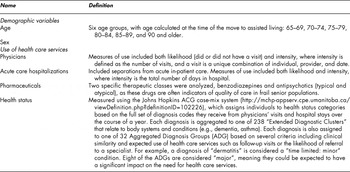
This study included all British Columbians aged 65 and older who moved to a publicly funded assisted living unit between 2004/05 and 2007/08 (subject to the data limitations just described). We excluded people (n = 5) who did not have a full year of observation in the year prior to moving to assisted living. These data reflect first admissions to publicly funded assisted living, since the program’s start and our study period coincided. Data from 2003/04 and 2008/09 were used to assess health care services use before and after admission to assisted living. Analytic variables included demographics (age, sex, vital status), health status, and health care services use (physician, hospital, pharmaceutical). Details on construction of analytic variables are provided in Table 1.
Definitions of variables

Health care services use before and after admission to assisted living was examined using a single-cohort time series approach (Shadish, William, Cook, & Campbell, Reference Shadish, William, Cook and Campbell2001). We opted for this approach in order to take advantage of the longitudinal nature of the data and because it was not possible to create a robust comparison group for the assisted living cohort. People who enter assisted living are likely to be different, with respect to unmeasured variables, from people who do not enter assisted living. Those variables may also influence health care services use, which would introduce confounding to any comparisons.
The time series analyses were limited to individuals who could be followed fully for 12 months prior to and 12 months after moving to assisted living. Creating this kind of balanced cohort ensures that any trends observed are not attributable to differences in underlying characteristics of the population at different points in the study period. This restricted the cohort to people who did not die or transfer to residential care (a nursing home) within the first year after their move. All utilization variables outlined in Table 1, such as visits to a general practitioner and admissions to acute care, were calculated on a monthly basis for the twelve months prior to and twelve months following admission.
We modelled the data using segmented, ordinary, least-squares regression (Wagner, Soumerai, Zhang, & Ross-Degnan, Reference Wagner, Soumerai, Zhang and Ross-Degnan2002) in the form:
 $$Y_{\rm{t}} = {\rm{\beta }}_0 + {\rm{\beta }}_1 {\rm{*time}}_{\rm{t}} + {\rm{\beta }}_2 *{\rm{move to AL}}_{\rm{t}} + {\rm{\beta }}_3 *{\rm{time after move to AL}}_{\rm{t}} + {\rm{\varepsilon }}_{\rm{t}} $$
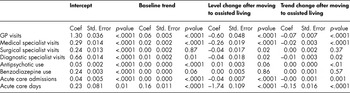
where Y t is the average health care services utilization per person per month. β0 is the intercept, which can be interpreted as the mean value of the outcome in the pre-intervention period (e.g., the average number of general practitioner visits per person per month). β1 estimates the change in outcome (e.g., GP visits) per month in the pre-AL (assisted living) period (i.e., the baseline trend). β2 estimates the change in monthly utilization at the point of the move to AL. β3 estimates the change in trend of monthly utilization after the move to AL compared to the trend before. The sum of β1 and β3 is the post-intervention slope. εt is the error term. Statistically significant values for β2 and/or β3 would indicate that the move to assisted living had an impact on health care services use. Separate models were run for each of the utilization variables, specifically: number of GP visits; number of medical specialist visits; number of surgical specialist visits; number of laboratory/imaging specialist visits; number of antipsychotic users; number of benzodiazepine users; numbers of acute care admissions; and number of acute care days. Analyses were completed using the autoreg procedure in SAS version 9.0 software.
Results
Who Are the Assisted Living Clients?
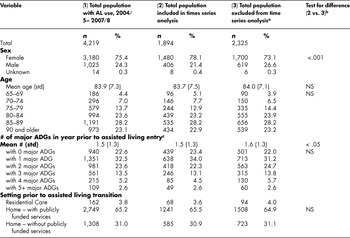
The cohort had 4,219 individuals, 1,894 of whom did not move to residential care or die in the 12-month follow-up period and thus were included in the time series analysis. Table 2 summarizes the demographic and health status variables for the total cohort, for the 1,894 in the time series analysis and for those excluded because of the lack of a full year of follow-up. A little over one-half (51.3%) of publicly subsidized assisted living clients were 85 or older, and three-quarters (75.4%) were women. Nearly all of those in the cohort (96%) moved to assisted living from the community. The 4 per cent who did not came from residential care, driven largely by the re-labelling of some units from residential care to assisted living (i.e., the residents did not move but the service environment changed). Two-thirds of individuals moving from the community had been receiving publicly funded home health services prior to their admission to assisted living.
Characteristics of the assisted living (AL) cohort, and the cohort in the time series analysis compared to those excluded

a The “Total population excluded from time series analysis” comprised those individuals who either moved to residential care or died in the first 12 months following admission to assisted living.
b t-tests for means, χ2 for per cent distributions
c Individuals were excluded from the ADG analysis if they were not registered for health insurance for at least 275 days in the fiscal year prior to their move to assisted living (n = 62). ADG = Aggregated Diagnosis Groups NS = not signifcant
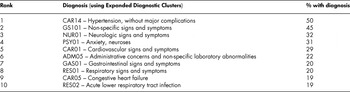
Just over one in five (22.6%) individuals who entered assisted living did not have any diagnoses considered “major”, and a further third (32.5%) had only one major condition.Footnote 5Table 3 shows the 10 most common diagnostic categories for this cohort. Half had a diagnosis of hypertension, 32 per cent had neurologic signs and symptoms, and 29 per cent had cardiovascular signs and symptoms. Nearly half (45%) had diagnoses indicating general but non-specific signs and symptoms.
Common diagnoses in the year prior to admission to assisted living
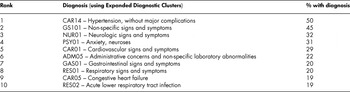
Expanded Diagnostic Clusters = these are part of the Johns Hopkins ACG system. There are about 250 clusters, based on body systems (e.g., cardiovascular, gastrointestinal) and are simple aggregations of diagnosis (International Classification o Diseases, or ICD) codes.
The only major difference in variables comparing the subset included in the time series analysis and those dropped because of lack of follow-up (i.e., who either transferred to residential care or died within the first year after moving to assisted living) was that the latter included a higher proportion of males (26.6% vs. 21.4%, p < .001).
What Other Health Care Services Do Assisted Living Residents Use?
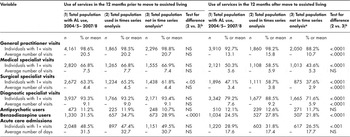
Table 4 provides a summary of health care services used in the year before and the year after admission to assisted living. These services were those used by the total cohort, those included in the time series analysis, and those excluded because they moved to residential care or died in the 12-month follow-up period. For most measures, there were no differences among the groups. In the year prior to moving to assisted living, nearly all individuals (> 98%) saw a GP at least one time, and the mean number of visits was just over 20. Nearly all (> 93%) also had at least one visit for a laboratory test or diagnostic imaging, and about two-thirds saw a medical specialist (> 66%). More than one in 10 cohort members had at least one prescription for an antipsychotic. Nearly half (> 47%) had at least one acute care admission, and the cohort overall had an average of 31.5 acute in-patient days. The only significant differences between those who were and were not included in the time series analyses were that the included group were more likely to see a surgical specialist (65.2% vs. 61.8%, p < .05) and more likely to receive a prescription for benzodiazepines (34.7% vs. 28.9%, p < .0001).
Descriptive results for health care services use, 12 months prior to and after move to assisted living (AL), 2004/05 – 2008/09

a The “Total population not in time series analysis” comprised individuals who either moved to residential care or died in the first 12 months following admission to assisted living.
b t-tests for means, χ2 for per cent distributions NS = not signifcant
In the year after the move to assisted living, all of these measures decreased with the exception of antipsychotic users, which went up marginally. Significant differences in utilization occurred in the year after the move between the groups included and excluded from the time series analyses. In all cases, utilization was lower in the excluded group or the difference was not statistically significant. The likely reason for this pattern is that the excluded group consisted of individuals for whom we did not have a full 12 months of follow-up; it is not surprising that a shorter observation period would produce lower rates of health care services utilization.
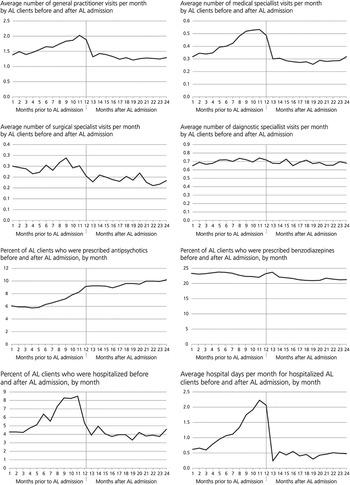
Figure 1 shows the more detailed picture of average monthly health care services utilization for the cohort subset of the time series analysis. The different types of health care services show quite different patterns and trends of use. Visits with GPs increased from an average of 1.5 per person per month to two visits per month over the year prior to moving to assisted living. That average use dropped below 1.5 immediately after entry to assisted living and stayed at that lower average for the full year of follow-up. This increasing trend followed by a drop and lower steady level was the same for medical specialists, hospital admissions, and days of hospitalization.
[fx1] Monthly patterns of health care services use before and after moving to assisted living

In contrast, the average per-person per-month number of visits with surgical specialists and average number of benzodiazepine users appeared to fall somewhat over time, unrelated to entry to assisted living. The number of visits with laboratory/imaging physicians remained stable over the 24 months. The number of antipsychotic users increased steadily in the 12 months prior to the move to assisted living, and then appears to have increased but at a slower rate after the move.
Table 5 shows the results of the models, and confirms the trends seen with the visual inspection of the data. The upward trend prior to the move to assisted living was significant for GP and medical specialist visits, antipsychotic use, acute care admissions, and acute care days. The move to assisted living significantly lowered the level of health care services use for all service types except the two drug classes. There was a significant decrease in slope for the trend after the move to assisted living for all service types except surgical specialists and benzodiazepine users.
Regression coefficients, standard errors, and p-values from time series analysis

Discussion
Assisted living is a relatively new, publicly funded care model in Canada that combines housing and health care. In British Columbia, this is a formally structured service mode with regulations that distinguish it from other types of care, such as long-term care or home-based services. A few formal principles define assisted living, the most fundamental of which is providing supports for seniors (and in some jurisdictions, also disabled adults) who need assistance with certain activities but not necessarily complex care, in a less formal institutional setting than would be available in a long-term care facility.
Individuals who move to assisted living are older – half are over age 85 – and are predominantly women. Many have health conditions, but the health status variable used here confirms that less than half have multiple complex chronic conditions. This is as expected, since in British Columbia assisted living is a housing option intended for people who can direct their own care and who do not require 24-hour nursing or supervision.
Results suggest that for many entering assisted living, the period prior to entry was characterized by medical instability with increased services use. This was most marked in the six months prior to entry and may well have been the triggering event for these seniors to enter assisted living.
The use of health care services declined after the move to assisted living for many types of care examined here, most substantially for GP visits, medical specialist visits, and hospital care. The findings here are consistent with existing research on transitions to nursing homes (Dhalla et al., Reference Dhalla, Anderson, Mamdani, Bronskill, Sykora and Rochon2002; Ramroth et al., Reference Ramroth, Specht-Leible and Brenner2005; Stevenson et al., Reference Stevenson, Decker, Dwyer, Huskamp, Grabowski and Metzger2010), but the information expands to encompass physician services and an analysis of the relationship between housing and service use in a less service-intensive environment.
The impact of these changes in health care services use is substantial. This cohort of 1,894 individuals had more than 800 fewer medical specialist visits in the year after moving to assisted living compared to the year before, more than 8,000 fewer GP visits, and more than 18,000 fewer acute hospital days.
Limitations
Our work has several important limitations. We were missing data after 2004/05 for one health authority. We did not have information on physician services paid for outside the fee-for-service system. We had information only on publicly paid pharmaceutical use and publicly paid home and community care services, including assisted living. Our measure of health status was based on need for services and not functional ability. We also did not have access to assessment data, which might have provided additional contextual and functional information.
These analyses were also limited by the absence of a comparison group. It is not likely that a comparable group could be constructed given the unmeasured characteristics that can influence admission to assisted living, such as the availability of a caregiver at home. The lack of a comparison group made it impossible to rule out the possibility that acute care use (for example) would have declined in any case, even if these individuals had stayed in their own homes. This “regression to the mean” interpretation seems unlikely given the rising pattern of acute care use many months prior to the move to assisted living, but it remains a concern.
The biggest threat to validity in a time series analysis that follows a stable cohort would come from some other change that happened at the same time as the move to assisted living and that was related both to that move and to health care services use (Shadish et al., Reference Shadish, William, Cook and Campbell2001). Such a confounder seems unlikely; there were no other major policy changes at this time, and the “time” in fact was adjusted to reflect each individual’s move date and not a calendar date.
Conclusions
The decline and then stabilization in the use of hospital and physician services after entry to assisted living suggests a positive effect of this form of care on individuals’ health and function. The effects are not trivial. If we estimate the cost of a day in acute care as $1,000, the move to assisted living appears to be associated with more than $18,000,000 in acute hospital cost avoidance. Assisted living, or similar forms of supportive care, may thus be one way to achieve the policy objective of decreasing reliance on the acute care sector. Medication use does remain a concern, especially use of drugs such as benzodiazepines and antipsychotics which are known to carry significant risks in the elderly population (Fick et al., Reference Fick, Cooper, Wade, Waller, Maclean and Beers2003; Rochon et al., Reference Rochon, Stukel, Bronskill, Gomes, Sykora and Wodchis2007). It is also important to acknowledge that assisted living as currently implemented in British Columbia is not suitable for all populations. The most significant of these is individuals with cognitive impairments, since a requirement for assisted living placement is an ability to direct one’s own care. This population is predicted to increase substantially (Alzheimer Society of Canada, 2010), so suitable housing options for this group will continue to be a research and policy priority.
These findings suggest that patterns of health care services utilization can be altered. The question remains whether or how inserting assisted living into the continuum of care affects the overall longer-term pathway of care for older adults and ultimately their function and quality of life. Does assisted living alter the likelihood of admission to or length of stay in long-term care? How does it affect overall costs of care and overall satisfaction with the system? Does assisted living promote or hinder goals related to aging in place? These are important areas for future research.
Authors’ contributions
All authors were involved in the conception, design, and interpretation of the data. KMM and RM were responsible for data acquisition. SP was responsible for implementation of data analysis. KS was responsible for gathering and synthesizing background literature. All authors contributed to drafting and revising the manuscript, and all approved the final version.