Introduction
People, especially elderly people, are likely to develop some kind of mental health problems after a disaster has occurred (Hansson et al., Reference Hansson, Noulles and Bellovich1982). Although older people may be equipped with effective coping strategies after having experienced life-long stressors (Bell, Reference Bell1978), they also have several economic, psychosocial, and physical disadvantages (Brattberg et al., Reference Brattberg, Parker and Thorslund1996; Ticehurst et al., Reference Ticehurst, Webster, Carr and Lewin1996; Hancock, Reference Hancock1998). Minority older people have been found to be especially vulnerable to post-traumatic mental problems (Lee, C.-S. et al., Reference Lee2009).
Typhoon Morakot struck southern Taiwan, which includes many aboriginal communities, on 8 August 2009. It was one of the worst disasters to hit Taiwan. Nearly 25,000 residents were forced to evacuate, 408 people went missing, 924 people were injured, and 619 people died. It also caused damage costing more than US$3 billion. Because the damaged area was located near the higher mountains in Taiwan, where its aboriginal people live, access difficulties hindered rescue and reconstruction efforts. The indigenous aboriginal Taiwanese are an Austronesian people with linguistic and genetic links to other Austronesian ethnic groups, such as the people of the Philippines, Malaysia, and Indonesia. Currently, the aboriginal Taiwanese aboriginal people compose about 2% of the total Taiwan population. They are a minority group in Taiwan politically, economically, culturally, and even with regards to health (Cheng and Hsu, Reference Cheng and Hsu1992; Ko et al., Reference Ko, Liu and Hsieh1994; Ralph-Campbell et al., Reference Ralph-Campbell, Pohar, Guirguis and Toth2006). Their average income is in the lowest third in Taiwan and their education level is lower than the national average. They also have a higher mortality rate, including accidental death, as a result of fewer medical resources and transportation difficulties (Hong and Lin, Reference Hong and Lin2010). This disadvantageous status is more salient for the older members of the aboriginal community. Because lower socioeconomic status is related to mental disorders, including post-traumatic stress disorder (PTSD), it is worth investigating the mental changes that occur among the aboriginal elderly people in Taiwan.
This study had two purposes. The first purpose was to examine the rate of significant PTSD symptomatology in aboriginal elderly people after Typhoon Morakot in Taiwan. The second purpose was to explore the risk factors for PTSD symptomatology in elderly people.
Methods
The study was conducted from November 2009 to February 2010, just 3–6 months after the flooding disaster struck. Because life expectancy is about ten years shorter among the Taiwanese aboriginal population than among the general population, we lowered our age inclusion criteria to 55 years. Three major areas that had been struck by the typhoon were selected for investigation: Namaxia, Taoyuan, and Maolin in Kaohsiung County. In total, there were an estimated 500 people aged 55 years and over living in these three areas during the study period.
We enrolled study participants who participated in ordinary physical examinations at local medical units and those who were temporally relocated to other safe areas, usually military camps. With a refusal rate of about 10%, there were 120 people recruited for this study. The main reasons for refusal were potential participants being unavailable or being unwilling to sign informed consent forms. Psychiatrists or clinical psychology trainees conducted the interviews. Interviewers participated in a training course which included an introduction to interview techniques especially designed for use with the aboriginal population, presentation of the research questionnaire, and repeated practice interviews.
A semi-structured interview schedule, the PTSD Symptom Scale – Interview (PSS-I), was used for the assessment of PTSD symptoms (as defined by DSM-IV) and took about 20 minutes to administer. After being trained to understand the salient features of the PSS-I, even lay interviewers could use it to screen the PTSD symptoms. The PSS-I contained 17 items (e.g. “Have you had recurrent or intrusive distressing thoughts and recollections about Typhoon Morakot?”), with each item rated on a 4-point scale: 0 = not at all, 1 = a little bit, 2 = somewhat, and 3 = very much. A higher score indicated more severe PTSD symptomatology. A score of 15 or greater on the PSS-I indicated presence of significant PTSD symptomatology (Foa et al., Reference Foa, Riggs, Dancu and Rothbaum1993). The PSS-I has shown good internal consistency reliability (Cronbach's α = 0.85; Foa et al., Reference Foa, Riggs, Dancu and Rothbaum1993). Depression was assessed using the 10-item short form of the Center for Epidemiological Studies Depression Scale (CES-D), which used a 4-point scale (with a range of 0 to 3). A higher number indicates more severe depression symptoms, and a score of 10 or more on the CES-D indicates depression (Boey, Reference Boey1999). The short-form CES-D was revised and translated into Mandarin Chinese by the Bureau of Health Promotion of the Taiwan Department of Health, and has shown good internal consistency reliability (Cronbach's α = 0.78) in older adults (Lee, K.-L. et al., Reference Lee, Ou, Chen and Weng2009).
Other data were collected including (a) demographic characteristics: age, gender, and educational level; (b) traumatic experiences: personal injury (yes or no), death of a relative (yes or no), and property damage (yes or no); (c) relocation status: whether the participant was relocated to a temporary shelter; (d) self-perceived health: the subject's health condition compared to others of similar age. These used a 5-point scale: 1 = much worse, 2 = worse, 3 = not different, 4 = better, and 5 = much better. Interviews were conducted in Mandarin Chinese; however, when participants spoke their aboriginal language, a local research assistant helped with translation.
To make comparisons with another natural disaster which occurred in a non-aboriginal area of Taiwan, we used the Disaster Severity Scale (DSS) to define the severity of individual disasters (de Boer, Reference de Boer1990). The DSS assesses the severity of disasters using seven dimensions: the effect on the surrounding community (1 = simple, where local resources are able to cope alone; 2 = compound, where the involvement of national and international organizations is required), the number of casualties (0 = 25–100 casualties alive or dead, or 10–50 casualties requiring admission to a hospital; 1 = 100–500 casualties alive or dead, or 50–250 casualties requiring admission to a hospital; 2 = more than 500 casualties alive or dead, or more than 250 casualties requiring admission to a hospital), the type of disaster (0 = man-made, 1 = natural), the duration of the disaster (0 = less than one hour, 1 = 1–24 hours, 2 = more than 24 hours), the radius of the impact site (0 = less than 1 km, 1 = 1–10 km, 2 = more than 10 km), the injuries sustained by living victims (0 = there are a relatively large number of people slightly injured or sick, requiring no hospitalization, 1 = the standard number of cases, requiring hospitalization, 2 = the disaster resulted in a relatively large number of seriously injured or very ill people), and rescue time (0 = less than 6 hours, 1 = 6–24 hours, 2 = more than 24 hours). Scores on the DSS range from 1 to 13 with a higher score indicating a more severe disaster (de Boer, Reference de Boer1990).
Data analysis
To examine the association of each risk factor with PTSD symptomatology, we used χ2 analysis and Student t-tests to deal with categorical and continuous variables, respectively. Multivariate logistic regression was used to determine the risk factors for participants with PTSD symptomatology.
Results
One-hundred-and-twenty participants, comprising about 24% of the total elderly population (estimated to be 500 people) in the area struck by the typhoon, participated in this study. Of the study participants, 72 (60%) were female, and the average age of study participants was 67 years. According to government census data the mean age of local residents aged 55 or above was 66.1 years, and the male-to-female ratio of local residents was 47: 53. Thus, our sample's average age was similar to the local average, but the gender distribution was somewhat different. The education level was primary school or below for 85 (86.7%) of the participants. Twelve (10%) participants were injured, and seven (5.8%) experienced death of close family members in this disaster. Twenty-five (20.8%) reported having damage to their housing, and 30 (25%) were relocated to temporary shelters. Thirty-seven (30.8%) assessed their health status as being worse than other people of similar age. Of the 120 participants, 35 (29.2%) had PTSD symptomatology, and among these people with PTSD symptomatology, 24 (68.6%, 24/35) had concurrent depression.
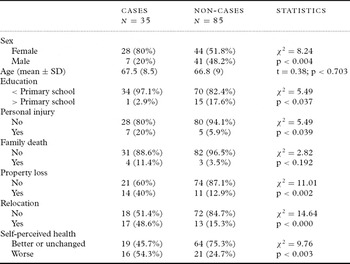
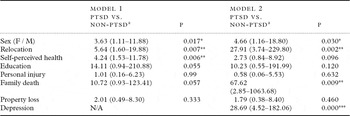
Univariate analysis revealed that there were associations between PTSD symptomatology and gender, education level, personal injury, property damage, relocation, and self-perceived health (Table 1). The variables with statistical significance in the univariate analysis were entered into controlling multivariate logistic regression analyses (Table 2). In Model 1, we found that female gender (OR = 3.63, 95% CI = 1.11–11.88, p < 0.05), self-perceived health (OR = 4.24, 95% CI = 1.53–11.78, p < 0.01), and relocation (OR = 5.64, 95% CI = 1.60–19.88, p < 0.01) were independent risk factors for PTSD symptomatology. Lower education level and family death showed marginal statistical significance. In Model 2, we added the depression variable to Model 1. The variable of self-perceived health was no longer statistically significant. From the risk factors identified using Model 1, only female gender and relocation remained as risk factors after controlling for depression in Model 2, and there were two new risk factors identified in Model 2: family death (OR = 67.62, 95% CI = 2.85–1063.68, p < 0.01) and depression (OR = 28.69, 95% CI = 4.52–182.06, p < 0.001). We further examined the seven participants who experienced family death, and among them five had PTSD symptomatology and three had concurrent depression.
Demographic characteristics and trauma experiences of 120 older people in Taiwan who experienced Typhoon Morakot

Summary of logistic regression of risk factors for PTSD in 120 older people in Taiwan who experienced Typhoon Morakot

Model 2 added the depression variable to Model 1. PTSD = post-traumatic stress disorder.
*p < 0.05; **p < 0.01; ***p < 0.001
a Presented with odds ratio (95% confidence interval).
We used DSS to compare the severity of Typhoon Morakot to another huge disaster, the Chi-Chi earthquake which occurred ten years ago. Data were collected from official government documents and a consensus meeting (Ministry of the Interior, 2010). The scores on the DSS for both Typhoon Morakot and the Chi-Chi earthquake were 13, the highest score on the DSS. This indicated that the disaster severity levels of these two natural disasters in Taiwan were both extremely high and comparable.
Discussion
This study showed that the proportion of participants with PTSD symptomatology was 29.2% among the mid- to old-age population who experienced Typhoon Morakot. The risk factors identified were female gender, poorer self-perceived health, relocation, family death, and depression.
In this study, we found that 29.2% of the middle- to old- aged, mostly aboriginal, participants had PTSD symptomatology during the 3–6 months after a flooding disaster. The rate of PTSD was possibly affected by culture and the nature of trauma. The study area was located in Taiwanese aboriginal communities, and relevant studies, especially of Taiwanese aboriginal elderly people, are scant. Two epidemiological studies on the prevalence of PTSD after a natural disaster, both conducted in Taiwan, showed that PTSD prevalence after the Chi-Chi earthquake in Taiwan was 7.6% and 11.3% respectively among the affected population (Yang et al., Reference Yang2003; Chou et al., Reference Chou2004). More specifically, one of the studies divided participants into three groups based on age, and it found the prevalence of PTSD in elderly people to be 19.3% (Yang et al., Reference Yang2003). According to our study, the occurrence rate of PTSD symptomatology among the older population after Typhoon Morakot seems higher than in the Chi-Chi earthquake. As the severity (based on the DSS) of the two disasters was the same, the difference in occurrence rate does not seem to be explained by the disaster severity.
Instead, the higher rate of PTSD symptomatology may result from the minority status of the aboriginal older people, who are disadvantaged socioeconomically and receive fewer resources (Lee, C.-S. et al., Reference Lee2009). Furthermore, Typhoon Morakot reduced tourism in the affected areas, contributing to a worsening of the economy in aboriginal communities. The social disadvantages of elderly Taiwanese aboriginals made it more difficult for them to recover from enormous losses after the disaster.
The risk factors for PTSD symptomatology in this study were self-perceived health, depression, female gender, family death, and relocation. Female gender and family death have been demonstrated to be risk factors in previous studies (Lai et al., Reference Lai, Chang, Connor, Lee and Davidson2003; Yang et al., Reference Yang2003; Chou et al., Reference Chou2007). A relatively novel risk factor of this study was relocation. Relocation can be a “temporary” relocation until the damaged area has been reconstructed, or can be a “permanent” resettlement. It is usually involuntary, even compulsory, which may profoundly disrupt the people affected both on a sociocultural and economic level (Oliver-Smith, Reference Oliver-Smith1992). Some studies did not find that relocation worsened the effects on PTSD (Najarian et al., Reference Najarian, Goenjian, Pelcovttz, Mandel and Najarian1996; Reference Najarian, Goenjian, Pelcovitz, Mandel and Najarian2001; Chen et al., Reference Chen, Hung, Lin and Tseng2002), while other studies did (Galante and Foa, Reference Galante and Foa1986; Goto et al., Reference Goto, Wilson, Kahana and Slane2006). The effect of relocation on mental health after an earthquake has been examined in a study of women and their children, which indicated that a group who had been relocated from a city did not fare worse than a comparison group, but that they were more susceptible to depression (Najarian et al., Reference Najarian, Goenjian, Pelcovttz, Mandel and Najarian1996; Reference Najarian, Goenjian, Pelcovitz, Mandel and Najarian2001). There are few studies that have directly examined the relationship between relocation and PTSD in elderly people.
Our results support the finding that those people who were relocated had more severe symptoms of PTSD. The findings might be explained if those people being relocated to temporary shelters were also those who experienced more property damage or personal injury, which were the main causes of PTSD symptoms. However, our analysis controlled for these confounding factors and showed that they still had more severe PTSD symptoms. Because the study participants who had been relocated were mostly compulsorily moved to temporary shelters on a military campus, we speculated that they may have received additional psychological distress and disruption to their pre-existing social support networks. The social networks of elderly people are harder to re-establish than those of younger adults after relocation (Lieberman, Reference Lieberman1974). Also, there is a central belief in Taiwanese aboriginal culture that ancestors’ spirits exist in their homeland or in nearby forests (Tang and Tang, Reference Tang and Tang2010), and that it is necessary to protect and remain physically with the ancestors’ spirits. This belief is more important for elderly people because they possess more traditional beliefs than young adults. Therefore, the effect of relocation on the emergence of PTSD symptomatology in aboriginal elderly people could possibly be explained by broken social networks, adjustment to an unfamiliar environment, and psychological conflicts related to traditional beliefs. The results suggest the need for a special psychological rehabilitation program for those being relocated in the future.
There were some limitations to this study. First, the sample size of this study was small, causing the confidence intervals for the odds ratio for some risk factors to be too high. Second, the occurrence rate of PTSD symptomatology in this study only reflects the time of data collection, 3–6 months after the disaster, and cannot be generalized to other time frames. Finally, not all possible risk factors have been included in this study (e.g. intelligence, social support).
Conclusions
In this study, we found that the occurrence of PTSD symptomatology was not uncommon among mid- to old-age people in Taiwanese aboriginal communities. Risk factors for presentation of PTSD symptoms were female gender, family death, low self-perceived health, depression, and relocation. We suggest that elderly people who are relocated require accompanying special psychological support services.
Conflict of interest
None.
Description of authors’ roles
Cheng-Sheng Chen, Wu-Tsung Chen, Chung-Sheng Lai and Wen-Yau Hsu designed the study. Cheng-Sheng Chen, Wen-Yau Hsu, Wu-Tsung Chen, Peng-Wei Wang, Yi-Cheng Wu and Yi-Lung Chen collected the data and assisted with writing the paper.
Acknowledgments
This work was supported by a grant from the National Science Council, Taiwan (NSC98-2420-H-004-182).