1. Introduction
In the economics mainstream, competition promotes efficiency. Nevertheless, exceptions apply. First, internal economies of scale in production, or restrictions limiting the number of players (e.g. patents) may restrain competition. Second, asymmetric information, e.g. in the markets for labor (Spence, Reference Spence1973) and credit (Diamond, Reference Diamond1984; Stiglitz and Weiss, Reference Stiglitz and Weiss1981), can make competition unworkable. Third, network economies (i.e. when the economies of scale or the value of a product depend positively on the extent of the network of users) imply that cooperation could achieve efficiency where competition would not (Katz and Shapiro, Reference Katz and Shapiro1994). In those situations, market structure will affect actual outcomes.
Thus, considering the Italian banking market, one cannot assume that competition is by definition efficiency-enhancing within the Banche di Credito Cooperativo (henceforth BCCs), a system of a few hundred cooperative firms organized in a banking network. Here, two of the principles making competition potentially undesirable concur. Belonging to a network – where some products/services are jointly produced – may generate sizable scale economies, thus pointing to cooperation – rather than competition – as the avenue for achieving efficiency. Besides, BCCs operate in the credit market, where untamed competition could be suboptimal (Boot and Thakor, Reference Boot and Thakor2000): competition could impair relationship banking – based on long-term bank–firm rapports – thus increasing lender–borrower information asymmetries and credit rationing, a less desirable outcome for both borrowers and banks.
Specifically, we know that credit cooperatives can reduce borrowers’ credit rationing – both at any given time (Angelini et al., Reference Angelini, Di Salvo and Ferri1998) and through the business cycle (Meriläinen, Reference Meriläinen2016) – and the loan rates paid by marginal borrowers (Cornée and Szafarz, Reference Cornée and Szafarz2014). However, to achieve that, credit cooperatives must structure in ways that enhance their ability to screen and monitor borrowers. That seems to require (Grillo, Reference Grillo2013): (1) high homogeneity among members (belonging to the same local community and/or social group); (2) that new memberships be subject to explicit acceptance by extant members; (3) that borrowers typically be members of the cooperative; (4) dispersed ownership (e.g. on the ‘one head, one vote’ principle with a ceiling to any member's shareholding). These four requirements suggest that the optimal size and the territorial extension of a BCC should be limited, to make the most of their cooperative ethos.
Nonetheless, staying small may also damage credit cooperatives in cases where producing (some of) their services entails economies of scale – e.g. in payments services. Hence, a tradeoff emerges for credit cooperatives between growing larger to exploit scale economies but weakening their ties to the local communities versus staying small and focused on local communities but operating on an inefficient scale.
One-level-thinking would suggest that the tradeoff may only be solved in two alternative ways: (1) if we let the credit cooperative grow, it could reduce its unit production costs but at the price of drifting away from its original mission of serving its marginal clientele; (2) if we keep it small, allowing the credit cooperative to stick to its mission toward marginal customers but at the cost of becoming progressively less efficient and underperforming. Neither solution would be palatable.
Nevertheless, the tradeoff disappears if we adopt two-level rather than one-level-thinking. Namely, credit cooperatives, which are independent of each other at the lower-level, can cooperate among themselves at a higher level. In all countries throughout Europe and beyond, credit cooperatives have developed over time an upper-level structure as service provider to its member credit cooperatives, which operates at a lower level. In this way, credit cooperatives engineer upper-level networks where economies of scale are exploited. This has happened with Italy's BCCs.
Evaluating the relative merits of competition versus cooperation among BCCs is thus non-trivial: competition looks beneficial as it should expel inefficient BCCs from the market, but cooperation might boost BCCs’ efficiency, as it enhances their network economies. Above all, via network cooperation, BCCs cancel the tradeoff between efficient performance and mission effectiveness.
There seems to be a gap in the literature in terms of studies of how credit cooperative networks function and how competition may interfere with the stability of these networks. Two exceptions are Barbetta et al. (Reference Barbetta, Colombo, Colombo and Grillo2016) and Coccorese et al. (Reference Coccorese, Ferri, Lacitignola and Lopez2016). Both papers address the impact on BCCs’ performance of ‘outer competition’ – i.e. when a BCC competes with other bank types but not with peer BCCs – versus ‘inner competition’ – when a BCC competes with one or more peer BCCs. Barbetta et al. (Reference Barbetta, Colombo, Colombo and Grillo2016) empirically support the hypothesis that outer (inner) competition benefits (damages) BCCs. Namely, studying the BCCs operating in the province of Trento (northeast Italy) they find that loans-to-deposits and loans-to-assets (bad-loans-to-total-loans) ratios are significantly higher (lower) for those BCCs engaged in outer but not in inner competition. They interpret this evidence as suggesting that both ‘local effectiveness’ – i.e. the ability to transform local savings into local loans – and ‘mission efficiency’ – i.e. the ability to manage credit risk – of the BCCs are better achieved when the degree of outer competition is high, but the degree of inner competition is low. In turn, Coccorese et al. (Reference Coccorese, Ferri, Lacitignola and Lopez2016) address analogous issues on data for the whole of Italy. They show that branch productivity drops moving: (1) from a BCC monopoly to a BCC duopoly, and (2) from outer competition only to both inner and outer competition. Though innovative, both papers fail to explain the channels through which inner competition damages BCCs’ performance.Footnote 1
This paper aims to fill the gap by studying how inner competition impacts the functioning of the BCCs’ network. To understand the channels through which that impact materializes, we innovate on previous studies by distinguishing between aggressor BCCs and incumbent BCCs and tracking the strategic interactions between them. Namely, we consider three main strategic outcomes of a competitive attack:
(1) It is successful, and the incumbent is pushed out of the market. Here the performance loss is only temporary: over time the incumbent leaves the market while the aggressor then recovers higher performance. In that case, the sum of the strategic game between the two BCCs could be zero or even positive if, for example, an efficient aggressor drives an inefficient incumbent out of the market.
(2) It is unsuccessful, with only the aggressor suffering a worsened performance. Here, the strategic attack was ill advised and the survival of the aggressor could even be endangered.
(3) It is unsuccessful, with both the aggressor and the incumbent suffering a lower performance.
In cases (2) and (3), the sum of the game would be either zero or negative.
Building on these considerations, we accomplish two tasks. First, we enlarge the performance measures to detect the effects of inner competition within the BCC network. Second, and most importantly, we track performance separately for aggressor versus incumbent BCCs. Specifically, we measure the extent of overlap in the same municipality between any pair of BCCs and classify each BCC in the pair as either aggressor – a BCC that enters a municipality where the other BCC in the pair operated previously – or incumbent – a BCC that was previously active in a municipality and saw the other BCC entering that municipality. Next, each BCC in the sample is assigned two measures of its being AGGRESSOR and/or INCUMBENT (the modal value is by far ‘neither AGGRESSOR nor INCUMBENT’ BCC; the value of AGGRESSOR BCC is less than half that of INCUMBENT BCC). Finally, our regressions estimate whether the two measures affect performance.
Our findings are most consistent with case (2), i.e. performance worsens more evidently for the aggressor (attacking) BCCs, with mild effects on the incumbent (attacked) BCCs. We also show that performance deteriorates less when an aggressor (incumbent) BCC starts competing with (is rivaled by) a comparable non-BCC bank. Overall, our evidence supports the view that inner competition – likely damaging BCCs’ network economies – is a negative sum game. In addition, we show that inner competition damages BCCs even when we look at traditional performance measures.
Our findings bear policy implications. Limits to inner rivalry appear welfare improving, at least in cooperative banking networks. And the grounds for limiting inner competition seem to go beyond efficiency.
In the rest of the paper, section 2 recaps the literature and frames testable hypotheses, section 3 presents our data and empirical approach, and section 4 reports the main econometric results. Section 5 closes, points avenues for future research, and draws the chief policy implications of our findings.
2. Background literature and hypothesis formulation
Some authors cast serious doubts on the efficacy and desirability of the ‘level the playing field’ mantra that seems to shape the current approach to banking regulation (e.g. Admati and Hellwig, Reference Admati and Hellwig2013; Ferri and Neuberger, Reference Ferri and Neuberger2014).
According to the New Institutional Economics (NIE; e.g. Coase, Reference Coase1937), firms are coordination forms substituting the market to minimize transactions costs. Firms usually bear costs due to their organization to be in the market (‘costs of contracting’) as well as costs related to relationships within the firm (‘costs of ownership’) (Hansmann, Reference Hansmann1996). Moreover, controlling agents’ behavior in a context of asymmetric information is crucially important (Bacchiega and Borzaga, Reference Bacchiega, Borzaga, Borzaga and Defourny2001).
Traditionally the production of goods and services by investor-owned capitalist firms (shareholder firms) is deemed more efficient than that by non-investor-owned firms (stakeholder firms). However, in various industries a prominent role is played by non-investor-owned firms (particularly cooperatives),Footnote 2 which are viewed by the NIE as an alternative efficient way to organize production. In reality, cooperative firms: (1) generally do not distribute profits as dividends to cooperative members, thus lessening the profit motivation and the exploitation of information asymmetries, (2) compared to investor-owned firms, they are more closely controlled by their member-owners, given the substantial share of transactions between members and the cooperative, and (3) members’ benefits are not only monetary, but relate also to the quality of goods and services. Moreover, cooperative firms often benefit from network economies, i.e. the beneficial spillovers deriving from belonging to a network.
At the same time, it is usually recognized that scale and scope economies promote integration for reasons of efficiency (e.g. integration can avoid contracting frictions and allow internalizing the transfer of some tangible good or service), and strategic motives (integration helps consolidate or extend market power). However, many networks have huge potential for scale economies.
In a network economy, value is created and shared by all network members, rather than by individuals, and economies of scale arise from the size of the network. Furthermore, value arises from connectivity. Thus, an open system is preferable to a closed system because the former has more nodes. In this respect, firms’ competitive advantage increases with their interconnectedness, and cooperation may boost interconnectedness.Footnote 3 In turn, besides a network's size, its structure (feasibility of transactions, centrality of members, structural holes, network ties, number of roles each member plays) and conduct (opportunistic behavior, reputation signaling, perceptions of trust) also significantly impact the value of a network to users and providers (Afuah, Reference Afuah2013; Skilton and Bernardes, Reference Skilton and Bernardes2015). Moreover, cooperative versus rival behavior in strategic networks may be asymmetric depending on the relative size of individual participating firms (Mas-Ruiz et al., Reference Mas-Ruiz, Ruiz-Moreno and Ladrón De Guevara Martínez2014).
Therefore, studying competition within a cooperative banks’ network requires a specific approach, something mainstream economics fails to do by prescribing market-enhancing regulations.Footnote 4 Those regulations are believed to benefit society via efficiency gains, but, together, they likely reduce the scope for cooperative firms and their aim of reducing the deadweight loss in imperfectly competitive – and informationally opaque – markets. So, the impact of those regulations on both the working of cooperatives and social efficiency is ambiguous.Footnote 5
Also, credit cooperatives can effectively reduce their financial exclusion: via relationship banking (Boot, Reference Boot2000; Boot and Thakor, Reference Boot and Thakor2000), BCCs are better equipped to deal with borrowers’ moral hazard (Angelini et al., Reference Angelini, Di Salvo and Ferri1998). Essentially, they face a tradeoff. On one hand, they are disadvantaged by their small size, specialization, and high concentration of credit risks. On the other hand, they are largely not substitutable providers of loans to local borrowers.
Over time, this tradeoff may be significantly exacerbated. Having been created as cooperative groups among self-producers to escape credit rationing, BCCs were normally ‘natural monopolists’ in their own territory. Indeed, before 1993, this market structure was enforced by Italy's Banking Law of the time – e.g. legal and financial barriers to entry in local markets limited banks’ size and branching network. Thereafter, territorial overlapping among BCCs became lawful, and both the Bank of Italy and the Italian Competition Authority repeatedly argued that competition among BCCs (‘inner competition’) was a valuable component of the competitive process in banking markets, along with competition between BCCs and other (non-mutual) banks (‘outer competition’).
However, Barbetta et al. (Reference Barbetta, Colombo, Colombo and Grillo2016) and Coccorese et al. (Reference Coccorese, Ferri, Lacitignola and Lopez2016) maintain that, on the contrary, one should worry about territorial overlapping, since BCCs’ competitive behavior should be evaluated differently than that of other banks. Both document that inner competition worsens BCCs’ performance while outer competition does not.
As to how competition affects individual banks’ performance, many papers consider strategic interactions among banks (Carletti, Reference Carletti, Thakor and Boot2008). Since traditional banks – like BCCs – still largely rely on a branch-based supply of services (Gilje et al., Reference Gilje, Loutskina and Strahan2016), we may identify those strategic interactions between any pair of banks when their branches overlap. It is thus useful to survey papers studying banks’ branching decisions.
Several works study the issue with data for the US. Focusing on post-deregulation rural banking markets, Cohen and Mazzeo (Reference Cohen and Mazzeo2010) find that: (1) market structure and product differentiation play a major role, and (2) banks’ branch investments seem to seek a potential entry-deterring effect. This also concurs with Adams and Amel (Reference Adams and Amel2016) and Berger and Dick (Reference Berger and Dick2007). The former find that the threat of entry matters when evaluating the potential competitive effects of proposed mergers and acquisitions, while the latter detect a clear market share advantage for early entrants. Among others, Dinger and von Hagen (Reference Dinger and von Hagen2011), studying the strategic positioning of branches in the newly liberalized banking industries of Central and Eastern Europe, find that incumbent banks, due to their preferential position in the deposit market, can generate higher margins than new entrants, who instead can fund their lending-oriented expansion in the area. In Italy, examining the determinants of entry into local banking markets during 1991–2002, Felici and Pagnini (Reference Felici and Pagnini2008) show that banks more likely expanded into those markets that were closest to their pre-entry locations, while large-sized banks were also better able than small-sized banks to cope with distance-related entry costs.
Bank entry decisions may also reflect the macroeconomic cycle. For instance, on a sample of 124 countries for 1991–2000, Mandelman (Reference Mandelman2006) shows that ex-post bank markups are strongly countercyclical, explaining this pattern via the highly procyclical entry of (foreign) banks that occurs mostly at the wholesale level and signals an intention to spread to the retail level.
A partially different strand of literature addresses the specificity of incumbent-aggressor strategic interactions in banking, which is viewed as an industry characterized by entrenched information asymmetries. Bouckaert and Degryse (Reference Bouckaert and Degryse2006) argue that, for strategic reasons, incumbent lenders release information about only a portion of their profitable borrowers. This would allow incumbents to capture a pool of unreleased borrowers featuring severe adverse selection problems and reduce the scale of entry by preventing aggressors from bidding for all the incumbent's profitable borrowers. Similarly, Bofondi and Gobbi (Reference Bofondi and Gobbi2006) test whether asymmetric information between incumbents and aggressors limits entry into credit markets. Specifically, incumbents’ superior information about their own customers and the overall economic conditions of the local credit market may lead aggressors to suffer higher loan default rates than incumbents. They find that, indeed, default rates are significantly higher for those banks that entered local markets without opening a branch, suggesting that having a branch on site may reduce the informational disadvantage. In their view, these informational barriers can explain why entry into many local credit markets by domestic and foreign banks was slow, even after substantial deregulation. In turn, Dell’Ariccia et al. (Reference Dell'Ariccia, Igan and Laeven2012) find that the deterioration in lending standards before the subprime mortgage crisis was more intense where fiercer competition led more banks to open branches.
In view of the surveyed literature, we can formulate the following three hypotheses.
Hypothesis 1:
Performance will worsen at both the aggressor and the incumbent BCCs when the two engage in inner competition.
This effect descends from the fact that inner competition depletes network economies (Afuah, Reference Afuah2013; Barbetta et al., Reference Barbetta, Colombo, Colombo and Grillo2016; Coccorese et al., Reference Coccorese, Ferri, Lacitignola and Lopez2016; Mas-Ruiz et al., Reference Mas-Ruiz, Ruiz-Moreno and Ladrón De Guevara Martínez2014; Skilton and Bernardes, Reference Skilton and Bernardes2015). Specifically, when two BCCs compete with each other the aggressor will likely defect from the BCC network and use alternative external service providers. Though alternative providers normally charge higher fees, defection is meant to avoid peer pressure by other BCCs accusing the aggressor of inappropriate behavior and/or to diversify the aggressor's products vis-à-vis the incumbent. In turn, defections reduce the size of the BCC network and curb the scale economies the network can achieve. Thus, both aggressors and incumbents end up with higher costs and worse performance.
Hypothesis 2:
Performance will worsen relatively more for the aggressor BCC than for the incumbent BCC when the two engage in inner competition.
This stems from considering that aggressors stand at a potential disadvantage with respect to incumbents as the latter enjoy some insider benefit, possibly based on deeper customer relationships (Berger and Dick, Reference Berger and Dick2007; Cohen and Mazzeo, Reference Cohen and Mazzeo2010; Dinger and von Hagen, Reference Dinger and von Hagen2011), which may be particularly beneficial in overcoming asymmetric information and moral hazard problems in the credit market (Bofondi and Gobbi Reference Bofondi and Gobbi2006; Bouckaert and Degryse, Reference Bouckaert and Degryse2006; Dell’Ariccia et al., Reference Dell'Ariccia, Igan and Laeven2012).
Hypothesis 3:
Performance will worsen less, both at an aggressor BCC and an incumbent BCC, when the two compete with a comparable non-BCC bank with respect to when the two engage in inner competition with each other.
This is postulated by the fact that – unlike inner competition – outer competition doesn't undermine network economies (Afuah, Reference Afuah2013; Barbetta et al., Reference Barbetta, Colombo, Colombo and Grillo2016; Coccorese et al., Reference Coccorese, Ferri, Lacitignola and Lopez2016; Mas-Ruiz et al., Reference Mas-Ruiz, Ruiz-Moreno and Ladrón De Guevara Martínez2014; Skilton and Bernardes, Reference Skilton and Bernardes2015). Namely, the network defection mechanism described under Hypothesis 1 is not triggered when a BCC competes with a comparable non-BCC bank.
3. Data and methodology
Our starting point was a confidential dataset (source: Federcasse, the Italian Federation of BCCs) on branch-level customer loans from BCCs from 1996 to 2012, where LOANS ibmt denotes the total amount of loans from branch i, belonging to bank b, in municipality m at year t. Then, we matched the above data with those drawn from the Bank of Italy (geographical distribution of branches; branch entry/exit flows across municipalities and banks during the sample period) and with balance sheet data provided by ABI (Italian Banking Association). This database is built on that of Coccorese et al. (Reference Coccorese, Ferri, Lacitignola and Lopez2016), to which we point readers for more details.
To identify new banks entering local markets, we created a dummy variable, AGGRESSOR ibmt, valued 1 when a local office i appears in municipality m at time t by BCC b (if the bank was not previously present there but one or more other BCCs already operated in the municipality).
Correspondingly, we constructed another dummy variable, INCUMBENT ibmt, valued 1 for every branch i belonging to BCC b that was already operating in municipality m at time t before the above entry, i.e. for all local branches experiencing entry by another BCC.
The variable AGGRESSOR ibmt is valued 1 also for new branches i’s that BCC b opens in the same municipality m in the years following its first entry. Likewise, the variable INCUMBENT ibmt equals 1 also for new branches i’s that BCC b opens in the same municipality m in the years following the ‘aggression’ by another BCC. Actually, we interpret both events as parts of an overall strategic action of BCCs aimed at expanding in local markets on one side, and defending their own business position on the other side.
Since we had to match information from different datasets, we first assessed: (1) whether, for each municipality and year, the number of observations regarding BCCs’ offices (from the Federcasse dataset) was equal to the number of BCC branches (as reported by the Bank of Italy); and (2) whether, for each BCC and year, the number of observations on branches in each municipality (from the Federcasse dataset) was equal to the number of municipality branches (as reported by the Bank of Italy). If even one of the above conditions failed, we dropped those observations.
Afterwards, we generated the variable  $TOTLOANS_{bmt} = \sum\limits_{i = 1}^N {LOANS_{ibmt}}$, measuring the overall volume of loans supplied by BCC b at time t through its N branches in municipality m (with N ≥ 1). We dropped all observations for which TOTLOANS bmt exceeded 5% of customer loans as reported in the official ABI balance sheets (which ensured some flexibility in the data management).
We also created the variable  $TOTLOANS_{bt} = \sum\limits_{m = 1}^M {} \sum\limits_{i = 1}^N {LOANS_{ibmt}} $, quantifying the overall volume of loans supplied by BCC b at time t through its N branches in the M municipalities where it had branches. Here, we skipped all observations for which TOTLOANS bt exceeded 15% of customer loans as reported in the ABI dataset.
For any ‘aggressive’ BCC b (i.e. when AGGRESSOR ibmt = 1) and for any year t, we calculated the average volume of loans managed in those municipalities where it entered (up to the considered year) as a share of its total loans (as published in the balance sheets), by the following formula:
 $$AGGR\_SHARE_{bt} = \displaystyle{{\sum\nolimits_{i = 1}^N {\sum\nolimits_{m = 1}^M {\lpar {LOANS_{ibmt} \times AGGRESSOR_{imbt}} \rpar }}} \over {LOANS_{bt}}}.$$
For any ‘incumbent’ BCC b (i.e. when INCUMBENT ibmt = 1) and for any sample year t, we calculated the average amount of loans managed in those municipalities where it suffered an entry from other BCCs (up to the considered year) as a share of its total loans, by the following formula:
 $$INCUMB\_SHARE_{bt} = \displaystyle{{\sum\nolimits_{i = 1}^N {\sum\nolimits_{m = 1}^M {\lpar {LOANS_{ibmt} \times INCUMBENT_{imbt}} \rpar }}} \over {LOANS_{bt}}}.$$
When AGGR_SHARE bt = 0, at year t in cooperative bank b operated only in municipalities where it was already established, or where it entered but no other BCC was operating, while AGGR_SHARE bt = 1 indicates that at year t cooperative bank b operated only in municipalities where it entered while there was at least another incumbent BCC. Similarly, INCUMB_SHARE bt = 0 implies that at year t cooperative bank b operated only in municipalities where no entry of other BCCs had occurred, while INCUMB_SHARE bt = 1 suggests that at year t cooperative bank b operated only in municipalities where it experienced entry by at least another BCC.
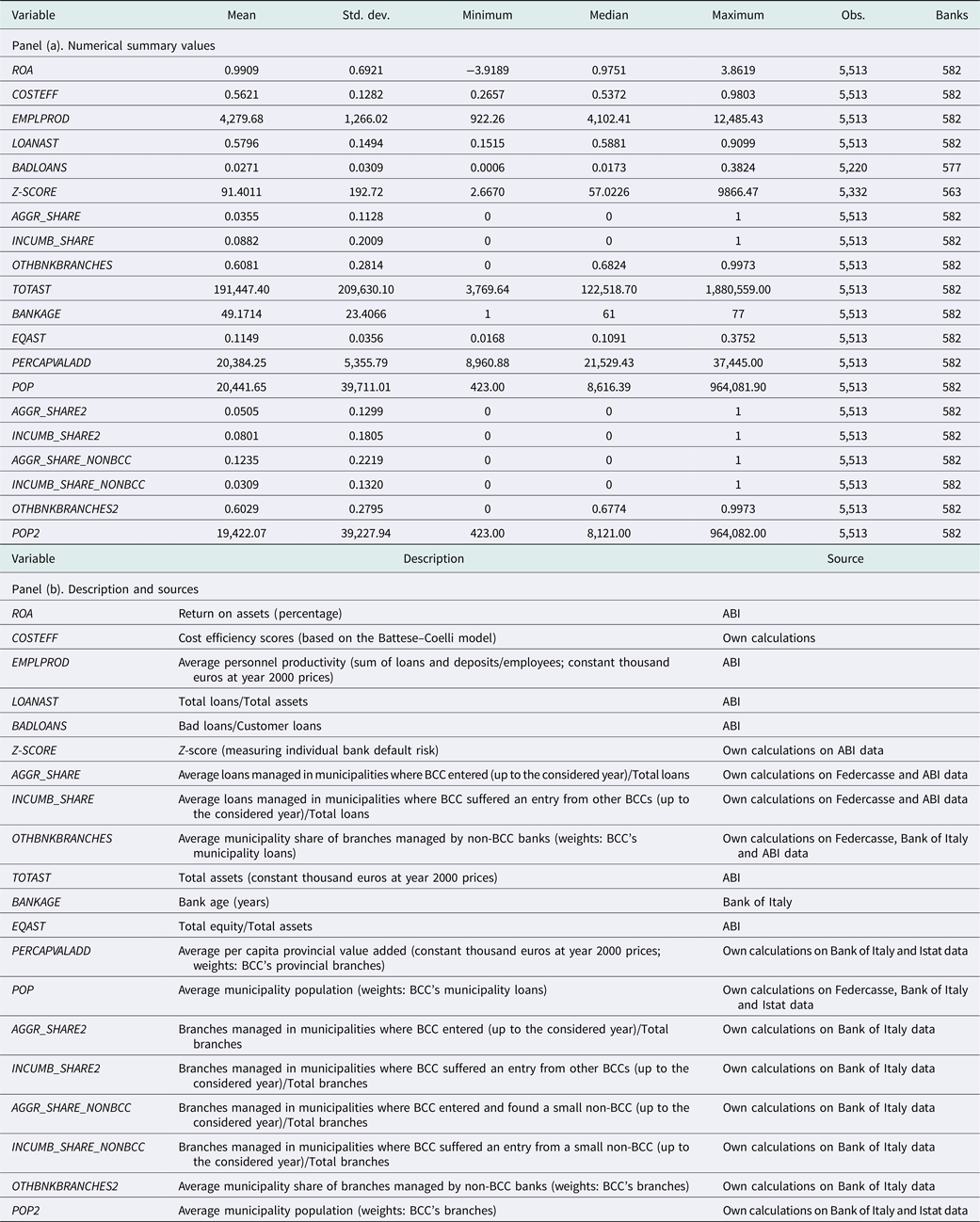
The descriptive statistics (Table 1) show that the average sample values of AGGR_SHARE and INCUMB_SHARE are 0.0355 and 0.0882, respectively: therefore, during the period 1996–2012 ‘aggressive’ banks collected about 3.6% of their overall loans in the municipalities where they entered and found another BCC, while in the same municipalities, BCCs that faced one (or more) entry managed about 8.8% of their global loans. It should be noted that 23% of observations exhibit a positive value of AGGR_SHARE, corresponding to 200 BCCs that entered municipalities where at least another cooperative bank was active. Analogously, 26% of observations show a positive value of INCUMB_SHARE, meaning that 216 BCCs suffered the entry of another cooperative bank in a municipality where they were already operating.
Descriptive statistics

The yearly averages of both variables show an upward trend, due to both the entrants’ progressive penetration of local markets and the increase in the number of BCCs entering new municipalities during time (Figure 1).
Average share of loans managed by entering and incumbent BCCs in municipalities with new entries (fraction of BCCs’ overall loans)

We can now estimate the following equation:
 $$PERFORM_{bt} = \alpha _0 \times AGGR\_SHARE_{bt} + \alpha _1 \times INCUMB\_SHARE_{bt} + {\bi \beta} \times {\vector {\bi X}^{\prime}} + \gamma _b + \delta _p + \eta _t + \varepsilon _{bt},$$
where: PERFORM bt is a measure of performance of the BCCs; AGGR_SHARE bt and INCUMB_SHARE bt are calculated as above; X is a vector of (both bank-level and environmental) control variables; γ b, δ p and η t are vectors of fixed effects for banks (with b = 1,…,B), provinces where banks operate (with p = 1,…,P) and years (with t = 1,…,T), respectively; ε bt is the random error term.
Assessing the sign and significance of coefficients α 0 and α 1 helps understand the effects of both tackling and enduring other BCCs on a BCC's outcome. If α 0 < 0 and/or α 1 < 0, the evidence shows that rivalry among members of the cooperative credit network worsens performance for challengers and/or incumbents. Actually, if α 0 < 0, the greater the share of loans that ‘aggressive’ BCCs earn in municipalities where they have entered and rival preexisting BCCs, the lower the aggressors’ performance; equally, if α 1 < 0, the greater the share of loans that ‘incumbent’ BCCs hold in municipalities where they have faced the entry of other BCCs, the lower their own economic result.
The dependent variables – i.e. the measures of BCCs’ performance – that we aim at explaining with our analysis, are:
(1) return on assets (ROA), the ratio between pre-tax profit and total assets;
(2) a measure of cost efficiency of BCCs (COSTEFF), derived from ad hoc estimated Battese and Coelli (Reference Battese and Coelli1992) scores;Footnote 6
(3) average personnel productivity (EMPLPROD), proxied here by the sum of loans and deposits divided by the number of employees;
(4) loans-to-assets ratio (LOANAST), an indicator of the extent to which BCCs focus on their traditional activity of loan granting (normally based on relationship lending);
(5) ratio of bad loans to customer loans (BADLOANS), a proxy for credit risk management.
Finally, besides the above partial measures of performance, we consider (the natural logarithm of) the Z-score. This is a widely used global measure of bank stability (Beck et al., Reference Beck, De Jonghe and Schepens2013; Boyd and Graham, Reference Boyd and Graham1986; Boyd and Runkle, Reference Boyd and Runkle1993; Delis and Kouretas, Reference Delis and Kouretas2011; Demirgüç-Kunt and Huizinga, Reference Demirgüç-Kunt and Huizinga2010; Fang et al., Reference Fang, Hasan and Marton2014; Hannan and Hanweck, Reference Hannan and Hanweck1988; Laeven and Levine, Reference Laeven and Levine2009; Lepetit and Strobel, Reference Lepetit and Strobel2015; Maechler et al., Reference Maechler, Mitra and Worrell2007). In particular, it assesses a bank's distance to default, i.e. its individual default risk: a bank's insolvency risk is higher (i.e. the bank is less stable) when its Z-score is lower, and vice versa.
We calculated this index as:
 $$ZSCORE_{bt} = \displaystyle{{\overline {ROA_b} + \overline {EQAST_b}} \over {\sigma _{ROA}}},$$
where  $\overline {ROA_b} $ is the average ROA of BCC b over the years t-2, t-1 and t, while
 $\overline {EQAST_b} $ and σ ROA are the average ratio of total equity to total assets and the standard deviation of ROA for BCC b, respectively, over the same years.
The vector of control variables X includes:
(1) average municipality share of branches managed by non-mutual banks (OTHBNKBRANCHES), which captures the influence of outer competition on the performance of BCCs. For cooperative banks managing branches in more than one municipality, it is calculated as a weighted mean (with BCC's municipality loans as weights);
(2) natural logarithm of BCC total assets (TOTAST), which accounts for a bank's size;
(3) natural logarithm of the BCC age (BANKAGE), a proxy of its business experience and length of relationship with borrowers;
(4) equity-to-assets ratio (EQAST), controlling for the level of a BCC's capitalization;
(5) natural logarithm of the average real per capita value added of the province where the BCC is located (PERCAPVALADD), gauging the impact of local economic conditions on banks’ performance (for multi-province banks, weights are given by BCCs’ branches);Footnote 7
(6) natural logarithm of the average municipality population (POP), which proxies for the size of the reference market (weights are BCC's municipality loans).
In Table 1, panel (a) reports some descriptive statistics for the variables entering the empirical models while panel (b) provides their description and the specific data sources.
Overall, for the sample period (1996–2012) the dataset contains 5,513 observations on 582 BCCs (some observations are lost when estimating our model using BADLOANS and lnZSCORE as dependent variables, because of missing data), 12.9% of which are located in the northwest, 44.4% in the northeast, 17.3% in the center, and 25.4% in the south and Islands. On average they managed 6.7 branches each year, but differences emerge according to the geographical location: northwestern BCCs are the largest (10.8 branches on average), followed by northeastern (7.2 branches per bank) and central BCCs (6.2 branches), while those situated in the south and Islands operated 4.1 branches each. Also, our dataset reflects a steady drop in Italian BCCs during the years under inspection (from 415 in 1996 to 223 in 2012) as well as an increase in the number of operated branches, at least up to 2011 (from 1,832 to 2,653).
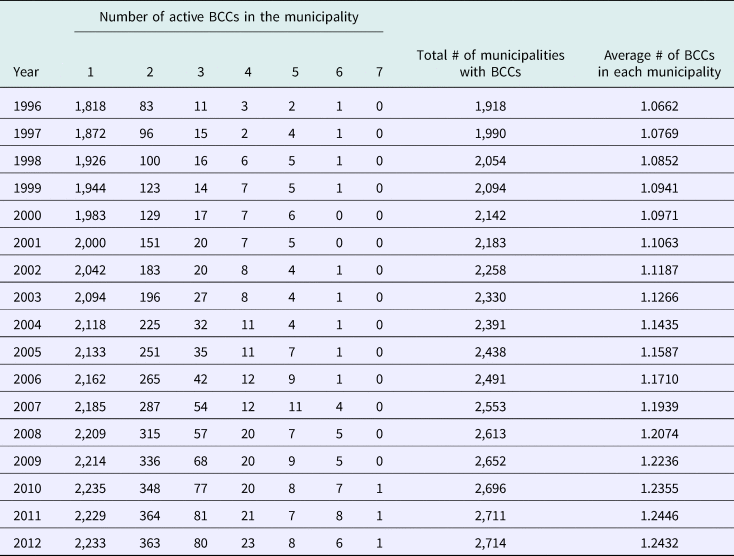
Table 2 presents the distribution of Italian municipalities according to the number of active BCCs for each of the sample years. As it is evident, over time in Italy local competition among cooperative banks has notably increased: for example, the number of municipalities with two operating BCCs increased by more than 300%, those with three and four BCCs rose by more than 600%. In general, the number of towns with two or more BCCs rose from 100 in 1996 to 481 in 2012, while in the same period the average number of cooperative banks per town increased from 1.07 to 1.24. In spite of this, data inspection reveals that no M&As occurred between cooperative banks that were operating in the same municipality (i.e. mergers have always characterized BCCs that had no territorial contact beforehand).
Yearly distribution of Italian municipalities according to the number of active BCCs

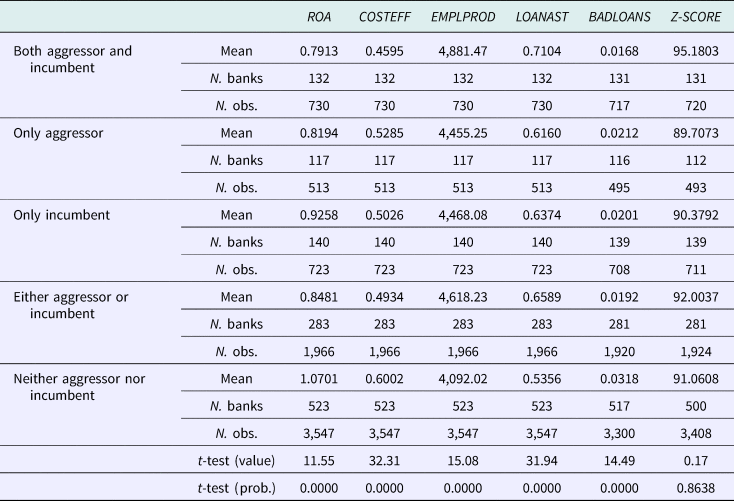
Finally, Table 3 reports the sample means of our dependent variables according to whether cooperative banks were both aggressor and incumbent, only aggressor, only incumbent, either aggressor or incumbent (representing the inner competition outcome and recapping the first three statuses), or neither aggressor nor incumbent. A simple t-test of the equality of means (reported in the last two rows of Table 3) suggests that BCCs facing inner competition have significantly lower ROA, cost efficiency, and bad loans than the other BCCs, but higher labor productivity and loans-to-assets ratio, while the two groups do not differ in terms of stability (as measured by the Z-score). Such aspects will be deepened through our empirical investigation.
Sample means of dependent variables for status groups of BCCs

In the last two rows, both the value and the probability level of the t-statistic for differences in means between the “either aggressor or incumbent” group and the “neither aggressor or incumbent” group are provided.
As regards the rows containing the number of banks, the sum of the first three cells does not equal the value of the fourth cell due to BCCs that have changed their status (even more times) during the sample years. The same holds for the sum of the fourth and fifth cells versus the overall number of BCCs included in the sample (see the last column of Table 1).
4. Empirical analysis
Baseline estimates
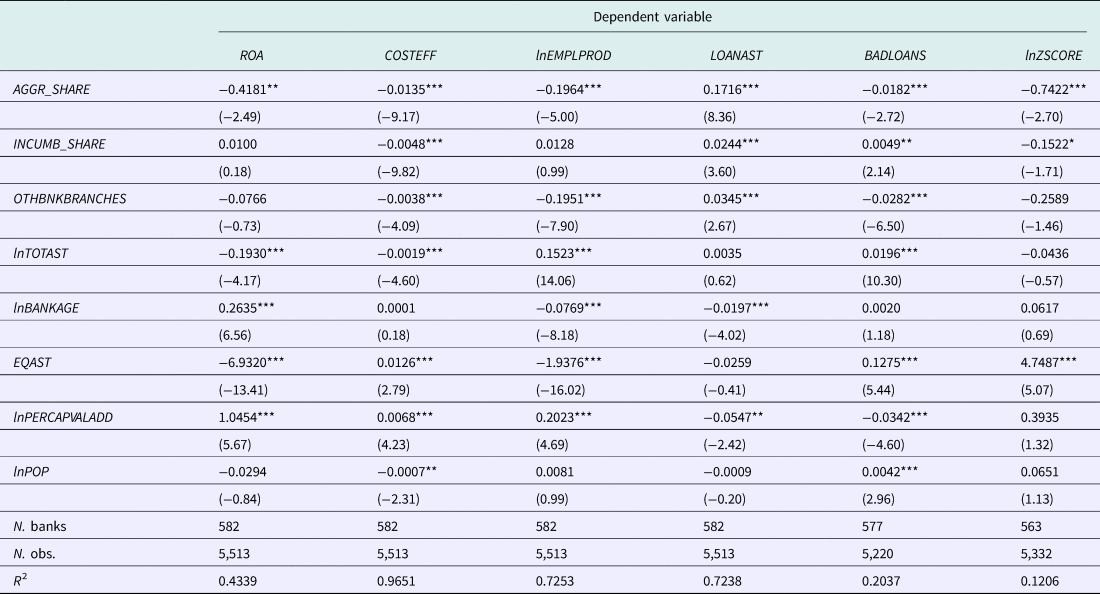
The empirical results of our six regressions are shown in Table 4.
Baseline model: estimation results

***, **, * denote 1%, 5% and 10% significance levels, respectively.
The variables AGGR_SHARE, INCUMB_SHARE, OTHBNKBRANCHES and lnPOP are based on the amount of loans provided in each municipality where banks operate.
t-values in parentheses. Provincial, year and bank dummies are included in all estimations but are not reported.
Overall, we find support for Hypothesis 1. Indeed, we observe that the more loans issued by BCCs that entered municipalities where other mutual banks were already operating (measured as a share of their own overall loans), the lower their ROA, COSTEFF, and EMPLPROD. In addition, we notice a drop of BADLOANS and Z-SCORE, and an increase in LOANAST. Therefore, adjusting the composition of loan portfolios through an expansion of credit allowance in markets with other BCCs can increase the loans-to-assets ratio and reduce non-performing loans, but also has adverse effects on profitability, cost efficiency, labor productivity, and overall stability.
Regarding incumbent BCCs, when the portion of their total loans that is managed in municipalities shared with other cooperative banks rises, we still find evidence of a deterioration in cost efficiency and an upsurge in the LOANAST ratio, while no significant effects are found on profits or employee productivity. Yet they suffer an increase in bad loans as well as individual bank default risk (although the estimated coefficient of the latter variable is significant only at the 10% level).
We thus deduce that, if a BCC enters municipalities where other cooperative banks already operate, it suffers a worsening in ROA, cost efficiency, employee productivity, and default risk; this negative outcome is higher for larger acquired market shares. Entry seems to have no significant effect on both profits and personnel productivity of incumbent BCCs, but it deteriorates both their cost efficiency and stability, which nonetheless drop less than half on entering BCCs.
On the positive side, both ‘aggressive’ and ‘attacked’ BCCs achieve a significant increase in their loans-to-assets ratio (fourth estimation), a positive outcome considering the main mission of such credit institutions. However, for the same level of municipal market share, BCCs belonging to the first group obtain a much higher growth in the loans-to-assets ratio than those included in the second group. Finally, it emerges that ‘aggressive’ BCCs reduce their share of bad loans, while the opposite happens with incumbent BCCs (fifth estimation). This evidence predicts “cherry-picking” behavior on the part of aggressive mutual banks (Canales and Nanda, Reference Canales and Nanda2012; Sengupta, Reference Sengupta2007), which target their loans to catch “good” customers from established BCCs, leaving them with the worse ones.
To assess the magnitude of these effects, let us suppose that a BCC is not currently competing with any other cooperative bank, but has decided to enter one or more municipalities where other mutual banks are presently doing business. Let us also imagine that our BCC is planning to provide 10% of its own loans in such towns, corresponding to the (sample) median share of banks that have already made this choice (i.e. ΔAGGR_SHARE = +0.10). Finally, let us assume that this BCC is representative of those that do not meet other cooperative banks in their reference markets, so its performance indices correspond to the median figures of this group: ROA = 1.0083%; COSTEFF = 0.5596; lnEMPLPROD = 8.2739 (i.e. EMPLPROD = 3,920.21 euro); LOANAST = 0.5518; BADLOANS = 0.0189; lnZSCORE = 4.0329 (i.e. ZSCORE = 56.4243).
Based on the estimated coefficients, if AGGR_SHARE moves from 0 to 0.10, our BCC will experience the following drops: ROA down to 0.9665 (-4.1%); cost efficiency score down to 0.5582 (-0.3%); average labor productivity down to 3,844.12 euros (-1.9%); share of non-performing loans down to 0.0171 (-9.5%); and Z-score down to 52.3892 (-7.2%). Moreover, the loans-to-assets ratio will grow to 0.5690 (+3.1%).
Likewise, let us analyze the outcome for an incumbent BCC that has so far had no rival mutual banks in its reference towns but experiences entry by one or more BCCs. We now conjecture that the incumbent ends up holding 25% of its overall loans in such markets (municipalities) after entry – i.e. the (sample) median value for the group of BCCs facing other cooperative banks in the towns where they operate – so that ΔINCUMB_SHARE = +0.25, while its indices of performance equal the median values of the said cluster (ROA = 1.0086%; COSTEFF = 0.5663; lnEMPLPROD = 8.2662, i.e. EMPLPROD = 3,890.16 euros; LOANAST = 0.5442; BADLOANS = 0.0192; lnZSCORE = 4.0286, i.e. ZSCORE = 56.1822).
The empirical evidence now indicates that, if INCUMB_SHARE moves from 0 to 0.25, our incumbent BCC will not be hit by significant drops in profitability or employee productivity. However, we note that the cost efficiency score will fall to 0.5651 (-0.2%) and the Z-score to 55.3347 (-1.5%), while the ratio between loans and total assets will increase to 0.5503 (+1.1%), and the ratio between non-performing loans and total loans will rise to 0.0204 (+6.3%).
Summing up, consistently with our Hypothesis 2, the negative effects of inner competition seem larger for the aggressors than for the incumbents. In particular, local competition among mutual banks has an adverse effect on the stability, profitability, and labor productivity of entrant banks. The bank default risk of incumbent banks also rises, but the magnitude of this effect is much smaller. The cost efficiency of both newcomer and incumbent banks is negatively affected as well, even if the size of this impact can be judged negligible. For both groups the amount of loans (calculated as a fraction of total assets) increases, more so for entrant BCCs, presumably due to the need to establish links with new borrowers as well as capturing significant market shares. Regarding bad loans, we record opposite effects for entrants versus incumbents, with both magnitudes being also remarkable: the first group gets significant improvements at the expense of the second group, an outcome that we have ascribed to the ‘cream-skimming’ or ‘cherry-picking’ behavior of entrants, which may capture a share of low-risk borrowers from the incumbent banks.
Overall, it emerges that competition among BCCs worsens performance and stability for both incumbents (whose efficiency is relatively harmed and whose best clients are at risk) and challengers (whose only significantly good result is a reduction in the portion of non-performing loans, but at the expense of the incumbents): hence, inner competition among cooperative banks is a negative sum game and, thus, limiting it would be desirable.
Regarding the bank control variables, the presence of other types of banks in the municipalities (OTHBNKBRANCHES) causes a fall in cost efficiency and business productivity, but is beneficial to the loans-to-assets and bad loans ratios. Thus, outer competition affects the performance of incumbent BCCs in a qualitatively similar way to that deriving from inner competition by newcomer BCCs (in the regression using ROA as the dependent variable, the sign of the coefficient of OTHBNKBRANCHES is again the same as that of AGGR_SHARE, but the coefficient is not significantly different from zero). Regarding bank size (lnTOTAST) and bank age (lnBANKAGE), we find that smaller and older BCCs enjoy higher ROA but lower labor productivity; moreover, bigger BCCs are less cost-efficient but have fewer non-performing loans, while newer banks tend to lend a larger fraction of their assets. More capitalized BCCs (EQAST) feature lower profits and productivity as well as a higher fraction of non-performing loans, but exhibit also better cost efficiency scores and a higher Z-score, hence a lower default risk.Footnote 8
Regarding the market control variables, mutual banks doing business in wealthier regions (lnPERCAPVALADD) – not surprisingly – exhibit higher profits and personnel productivity, higher cost efficiency, and have both lower loans-to-assets ratios and fewer non-performing loans. Finally, the size of the business market (lnPOP) exerts a negative influence on cost efficiency and the number of bad loans.
Robustness checks
In this section we perform two robustness checks so as to corroborate our evidence on the impact of inner competition on BCC performance, on one side, and to compare the above results with those characterizing the interaction between cooperative banks and other non-mutual banks of similar size, on the other side.
The first test consists in using alternative measures of market shares of both ‘aggressive’ and ‘incumbent’ BCCs. Specifically, we build them starting from the number of branches in the various municipalities (a publicly available figure) rather than from the (confidential) number of local loans. Of course, changing the reference aggregates misses the information on the business size of each branch, as we are going to implicitly assume that all offices manage the same number of loans.
The first new variable is:
 $$$AGGR\_SHARE2_{bt} = \displaystyle{{\sum\limits_{i = 1}^N {\sum\limits_{m = 1}^M {AGGRESSOR_{imbt}}}} \over {BRANCHES_{bt}}}.$$
Since AGGRESSOR ibmt equals one when at time t BCC b opens local office i in municipality m (where it was not previously operating), AGGR_SHARE2bt represents the average market share (in terms of branches) that the ‘aggressive’ BCC b has managed at year t in those municipalities where it has entered (up to the considered year).
Likewise, the second new variable is:
 $$INCUMB\_SHARE2_{bt} = \displaystyle{{\sum\limits_{i = 1}^N {\sum\limits_{m = 1}^M {INCUMBENT_{imbt}}}} \over {BRANCHES_{bt}}}.$$
It refers to the ‘incumbent’ BCC b that was already operating in one or more municipalities where it suffered an entry by another BCC, and measures its average market share (again in terms of branches) in the above municipalities at year t (up to the considered year).
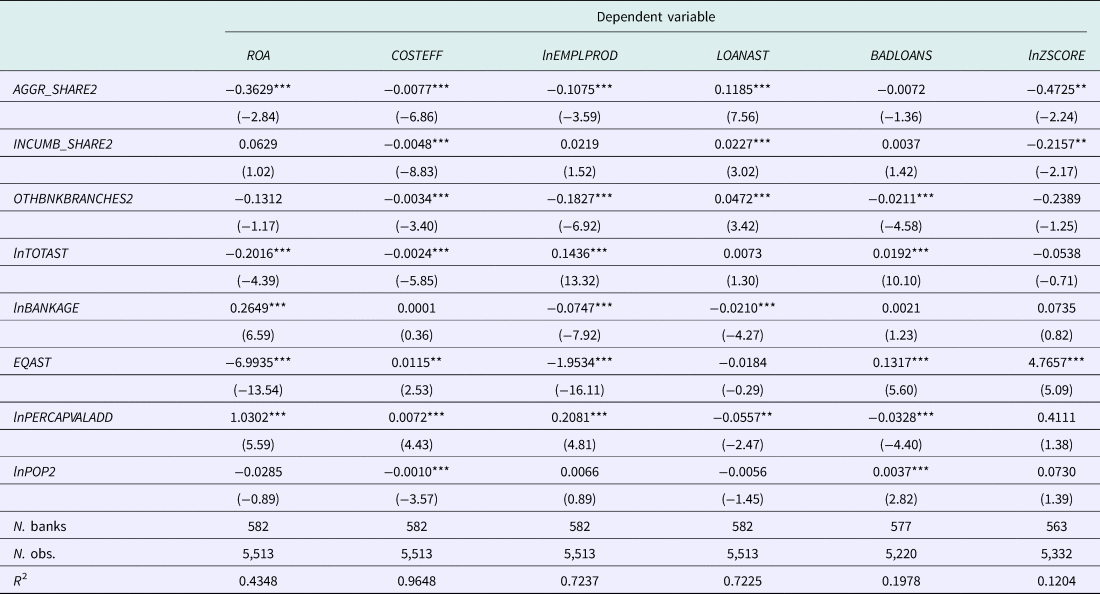
As the average values of AGGR_SHARE2 and INCUMB_SHARE2 are, respectively, 0.0505 and 0.0801 (see Table 1), in the sample period ‘aggressive’ BCCs had about 5% of their branches in the municipalities where they entered and found another cooperative bank, while in the same municipalities ‘incumbent’ BCCs managed about 8% of their branches.
We have then estimated equation (3) with the new variables, also replacing OTHBNKBRANCHES and POP with OTHBNKBRANCHES2 and POP2, where the municipality share of branches managed by non-mutual banks and the average municipality population have been both weighted again by BCC's branches.
Table 1 reports some descriptive statistics also for our new variables, while the estimation results of this alternative baseline model are shown in Table 5.
Alternative baseline model: estimation results

***, **, * denote 1%, 5% and 10% significance levels, respectively.
The variables AGGR_SHARE2, INCUMB_SHARE2, OTHBNKBRANCHES2 and lnPOP2 are based on the number of branches managed in each municipality where banks operate.
t-values in parentheses. Provincial, year and bank dummies are included in all estimations but are not reported.
They are clearly quite comparable to those of Table 4. The only difference is that in the new estimations both AGGR_SHARE2 and INCUMB_SHARE2 lose their statistical significance in the regression with BADLOANS as the dependent variable. A plausible explanation for this outcome is the missing link between the above regressors and local loans, which may reverberate on their estimated relationship with the ratio between bad loans and customer loans.
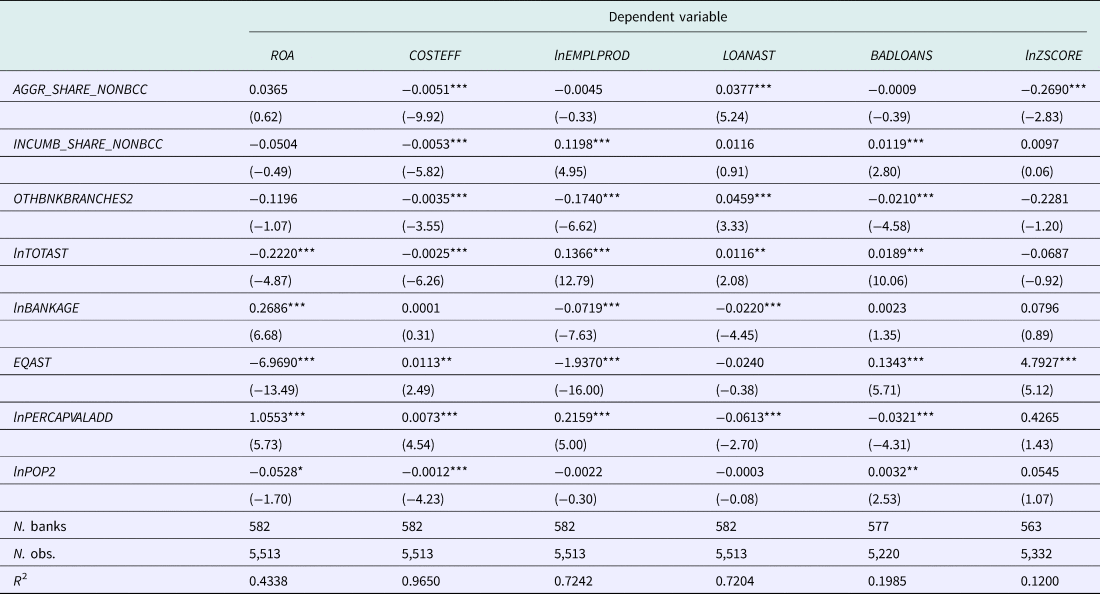
A second robustness test involves assessing whether the results change if we consider the competitive interaction between BCCs and other small non-mutual banks. To identify the latter group of credit institutions in Italy during the sample years, we use the following criteria: (1) eligible banks must be characterized by a ratio between interest margin and intermediation margin higher than 0.25; (2) they must have a ratio between customer loans and total assets higher than 0.40; (3) they must have managed less than 24 branches over the sample period (we set this value by adding to the sample mean of branches – 7.56 – twice the corresponding standard deviation, i.e. 8.02). In our opinion, such criteria guarantee that the bank is a financial institution mainly providing retail banking services, and has a size comparable to the sample BCCs.
As a result, we identified 108 banks, and performed the analysis exposed in section 3 to create two additional variables. The first is:
 $$AGGR\_SHARE\_NONBCC_{bt} = \displaystyle{{\sum\limits_{i = 1}^N {\sum\limits_{m = 1}^M {AGGRESSOR\_NONBCC_{imbt}}}} \over {BRANCHES_{bt}}},$$
measuring the average market share at time t (in terms of branches) of an ‘aggressive’ BCC b in those municipalities where it has entered (up to the considered year) and found an already-operating small non-mutual bank. The second variable is:
 $$INCUMB\_SHARE\_NONBCC_{bt} = \displaystyle{{\sum\limits_{i = 1}^N {\sum\limits_{m = 1}^M {INCUMBENT\_NONBCC_{imbt}}}} \over {BRANCHES_{bt}}},$$
delivering the average market share at time t (again in terms of branches) of an ‘incumbent’ BCC b in those municipalities where it was established and suffered an entry by a small non-mutual bank (up to the considered year).
We have re-estimated equation (3) using the above variables – whose statistics are also displayed in Table 1 – along with OTHBNKBRANCHES2 and POP2. Table 6 portrays the empirical evidence.
BCC vs small non-mutual banks: estimation results

***, **, * denote 1%, 5% and 10% significance levels, respectively.
The variables AGGR_SHARE_NONBCC, INCUMB_SHARE_NONBCC, OTHBNKBRANCHES2 and lnPOP2 are based on the number of branches managed in each municipality where banks operate.
t-values in parentheses. Provincial, year and bank dummies are included in all estimations but are not reported.
If we compare Table 6 with Table 5, we discover that an ‘aggressive’ BCC will face a loss of neither profitability nor labor productivity when it enters a municipality where non-mutual banks are already active. Moreover, the loss of cost efficiency is lower, and the adverse impact on the Z-score is less than in the case of inner competition. Regarding incumbent BCCs, when non-mutual banks enter their current local markets they suffer a drop of efficiency and an increase in bad loans, but are also able to increase labor productivity. Moreover, their individual default risk – as measured by the Z-score – is not affected by such entry.
Overall, consistently with our Hypothesis 3, we confirm that for the Italian BCCs ‘inner competition’ causes more damage than ‘outer competition’ (i.e. competition with non-mutual banks).
5. Conclusions
For various reasons, unlike in a standard market set-up, we cannot assume that competition is by definition efficiency-enhancing when dealing with a network of cooperative banks. Two reasons stand out prominently: the existence of network economies – which could be damaged by rivalry among network members – and the presence of asymmetric information in credit markets – which generates adverse selection and moral hazard problems between lenders and borrowers.
The Italian Banche di Credito Cooperativo (BCCs) – a system of mutual cooperative banks – have been successful over time, typically adopting the relationship banking business model to cope with those problems. Yet heightened competition might make this model unsustainable. In particular, this would descend from competition inside the BCCs’ banking network, possibly destabilizing its functioning.
Hence, evaluating the relative merits of competition versus cooperation is non-trivial for BCCs. On one side, competition could be beneficial when it helps to expel the least efficient BCCs from the market. But, on the other side, cooperation might work to the advantage of BCCs’ efficiency by both enhancing their network economies and supporting relationship banking.
We have tried to confirm that ‘inner competition’ – when a BCC competes with one or more other BCCs – is harmful to BCCs’ performance, enlarging the measures of performance considered relative to previous studies (Barbetta et al., Reference Barbetta, Colombo, Colombo and Grillo2016; Coccorese et al., Reference Coccorese, Ferri, Lacitignola and Lopez2016). Moreover, we have examined inner competition, distinguishing between the incoming BCC and the incumbent BCC, and contemplating the strategic actions at play between them.
Building on these considerations, our paper accomplished two chief tasks. First, we expanded the performance measures to detect the effects of inner competition. Second, and most importantly, we tracked performance separately for incoming versus incumbent BCCs. Our main results are that inner competition worsens BCC performance even when we look at additional measures. Furthermore, our findings are most consistent with the strategic case in which performance worsens more evidently for incoming (attacking) BCCs, with minor effects on incumbent (attacked) BCCs. In addition, our robustness check of a specification where BCCs strategically compete with attacking or incumbent non-mutual banks of equivalent size identified much smaller effects than those found in our baseline – inner competition – specification (AGGR_SHARE versus INCUMB_SHARE). Thus, overall, our empirical evidence supports the view that inner competition turns out to be a negative sum game.
Future research might investigate the ultimate outcomes of inner competition, which may represent an unstable equilibrium that is unlikely to be sustainable over time. Indeed, the findings of its detrimental impact on performance suggest that inner competition might not last forever. It would therefore be interesting to address some further questions. Will it be the incoming or the incumbent BCC that exits the local market because of inner competition? Is performance worsened to the point of provoking distress in one of the two BCCs? And, possibly related to this, are the BCCs entangled with inner competition more likely to be the targets of acquisitions by other BCCs or other banks? Answering these questions would add to an understanding of the consequences of rivalry among mutual banks. That would be complementary to the analysis we carried out here. In fact, the present paper strove to pinpoint the distributional effects of a negative sum game between incoming and incumbent BCCs in a short–medium-run framework. However, the ultimate implications of this inner rivalry – something that was unnatural among mutual banks until two decades ago – remain to be explored. We leave this to future research.
Some policy implications stem from our analysis. Limits to inner rivalry appear welfare improving, at least in cooperative banking networks – where various types of market failures combine to question the virtues of competition. And the grounds for limiting inner competition seem to go beyond efficiency. In light of the reform of BCCs passed in Italy in the spring of 2016, the Holding Company(ies) at the heart of the network should pursue a phasing out of inner competition among participating BCCs.
Acknowledgements
We are grateful to the editor, two anonymous referees, and the seminar audience at the 7th EURICSE Workshop on Cooperative Finance and Sustainable Development (Trento, Italy, June 2016) and ICA 2018 Research Conference (Wageningen, the Netherlands, July 2018) for their constructive comments and helpful suggestions on earlier versions of the paper.