

Introduction
Interest in bioactive peptides supplementation in poultry diets has increased over the past decade. Bioactive peptides can be produced from a variety of food ingredients (of animal or plant origin) by microbial fermentation, enzymatic, alkali or acid hydrolysis (Muir et al., Reference Muir, Lynch, Williamson and Cowieson2013). Enzymatic hydrolysis is extensively used in the food industry for detoxification, improvement of nutrient quality, elimination of allergens and production of flavours (Lahl and Braun, Reference Lahl and Braun1994; Rolle, Reference Rolle1998; Dust et al., Reference Dust, Grieshop, Parsons, Karr-Lilienthal, Schasteen, Quigley, Merchen and Fahey2005; Sathe et al., Reference Sathe, Teuber and Roux2005). The end products of protein hydrolysis include oligopeptides, small peptides, and free amino acids (Kamnerdpetch et al., Reference Kamnerdpetch, Weiss, Kasper and Scheper2007). Alashi et al. (Reference Alashi, Blanchard, Mailer and Agboola2013) reported that peptides which are produced during protein hydrolysis have a different amino acid composition and can deliver an array of functional properties. Some proteins or their peptide derivatives manifest biological benefits through direct or indirect effects on physiological functions (Meisel, Reference Meisel2007). Such biological benefits can be delivered through antioxidative, hypocholesterolemic, antimicrobial, antihypertensive, antiobesity, cytomodulatory and immunomodulatory activities (Yang et al., Reference Yang, Gu, Zhang, Wang and Xu2009; He et al., Reference He, Girgih, Malomo, Ju and Aluko2013; Singh et al., Reference Singh, Vij and Hati2014). Hancock and Sahl (Reference Hancock and Sahl2006) stated that bioactive peptides can act as antimicrobial agents by interacting with microbial host invaders or by suppressing or stimulating certain immune responses.
Bioactive peptides are found in different food sources including eggs, fish, oysters, cereal (barley, maize, rice and wheat), soybean, canola, and meat and bone meal (Matsui et al., Reference Matsui, Matsufuji, Seki, Osajima, Nakashima and Osajima1993; Li et al., Reference Li, Matsui, Matsumoto, Yamasaki and Kawasaki2002; Muir et al., Reference Muir, Lynch, Williamson and Cowieson2013). Of these, peptides from canola (Pan et al., Reference Pan, Jiang and Pan2011; Aachary and Thiyam, Reference Aachary and Thiyam2012), meat and bone meal (Muir et al., Reference Muir, Lynch, Williamson and Cowieson2013) and soybean (Feng et al., Reference Feng, Liu, Xu, Wang and Liu2007; Karimzadeh et al., Reference Karimzadeh, Rezaei and Teimouri Yansari2016) have been evaluated in broiler chicken studies.
Soybeans contain 360–566 g/kg of protein (Singh et al., Reference Singh, Vij and Hati2014), and its nutritional value is almost equal to animal protein. Glycinin and ß-conglycinin, which comprise 65–80% of total soy proteins, are the precursors of most of the isolated peptides (Wynstra, Reference Wynstra1986). It is well accepted that the consumption of soy protein can reduce the risk of coronary heart disease in humans (Singh et al., Reference Singh, Vij and Hati2014). Aglycin, a natural bioactive peptide isolated from soybeans, is stable in digestive enzymes and has anti-diabetic potential. Lu et al. (Reference Lu, Zeng, Hou, Zhang, Li, Luo, Xi, Chen and Xiang2012) reported that oral administration of aglycin can potentially reduce or prevent hyperglycaemia by increasing insulin receptor signalling pathway in the skeletal muscle of diabetic mice.
Although it is recognised that bioactive peptides can influence physiological functions, information on their use as functional ingredients in broiler nutrition is scarce. The purpose of the present study was to evaluate the effects of different levels of a soybean bioactive peptide (SBP), produced by enzymatic hydrolysis, on performance, nutrient and energy utilisation, development of digestive tract and intestinal histology in broiler starters.
Materials and methods
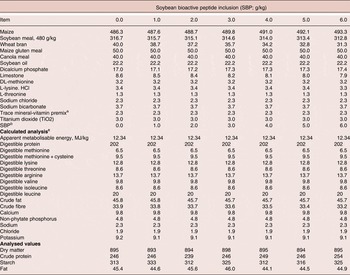
Seven broiler starter diets, based on maize and soybean meal, were formulated to meet Ross 308 strain recommendations for major nutrients (Ross, 2014) and were equivalent in respect of energy density, and digestible protein, amino acids, and other nutrients. The diets were formulated to contain 0.0, 1.0, 2.0, 3.0, 4.0, 5.0 and 6.0 g/kg of a commercial bioactive peptide (Fortide, Chengdu Mytech Biotech Co. Ltd., Chengdu, Sichuan, China; Table 1) in powder form. Titanium dioxide (TiO2; 3.0 g/kg) was added to all diets as an indigestible dietary marker. Diets were mixed in a single-screw paddle mixer (Bonser Engineering Co. Pty. Ltd., Merrylands, Australia) and then steam-conditioned at 70°C for 30 seconds and pelleted using a pellet mill (Model Orbit 15; Richard Sizer Ltd., Kingston-upon-Hull, UK) capable of manufacturing 180 kg of feed/h and equipped with a die ring with 3-mm holes and 35-mm thickness.
Composition and analysis (g/kg as fed) of the diets.

aSupplied per kilogram of diet: antioxidant, 100 mg; biotin, 0.2 mg; calcium pantothenate, 12.8 mg; cholecalciferol, 60 µg; cyanocobalamin, 0.017 mg; folic acid, 5.2 mg; menadione, 4 mg; niacin, 35 mg; pyridoxine, 10 mg; trans-retinol, 3.33 mg; riboflavin, 12 mg; thiamine, 3.0 mg; dl-α-tocopheryl acetate, 60 mg; choline chloride, 638 mg; Co, 0.3 mg; Cu, 3.0 mg; Fe, 25 mg; I, 1 mg; Mn, 125 mg; Mo, 0.5 mg; Se, 200 µg; Zn, 60 mg. bFortide, Chengdu Mytech Biotech Co. Ltd., Chengdu, Sichuan, China. cNRC (1994) feed ingredient tables were used for calculation, except for digestible amino acid values. Bryden et al. (Reference Bryden, Li, Ravindran, Hew and Ravindran2009) feedstuffs digestibility values were used for calculation of digestible amino acids. The following values (g/kg) were used for calculation of digestible amino acids and other components for SBP: protein, 411; arginine, 36.4; cysteine, 5.8; isoleucine, 13.0; leucine, 21.9; lysine, 24.6; methionine, 6.4; threonine, 11.4; valine, 15.6; calcium, 30.9; phosphorus, 9.4; crude fat, 23.4 and crude fibre, 65.0.
Experimental procedures were conducted in accordance with Massey University Animal Ethics Committee guidelines. A total of 336, one-day-old male broilers (Ross 308), obtained from a commercial hatchery, were individually weighed and allocated to 42 cages in electrically heated battery brooders so that the average bird weight per cage was similar. Each of the seven dietary treatments was randomly assigned to six cages, each housing eight birds. On d 12, birds were transferred to grower cages and continued on the same diets until d 21. Battery brooders and grower cages were housed in an environmentally controlled room with 20 h of fluorescent illumination per d. The temperature was maintained at 31°C on d 1, and was gradually reduced to 22°C by 21 d of age. Diets and water were offered ad libitum. Body weight and feed intake were recorded on a cage basis at weekly intervals. Mortality was recorded daily. FCR values were corrected for the body weight of any bird that died or was culled during the experiment. Excreta was scored on days 20 and 21 for consistency on a scale of 1–5, with a score of 1 representing normally formed excreta and 5 representing watery and sticky excreta. The scoring was done by the same individual.
Feed intake and total excreta output of each cage were quantitatively measured from d 18 to 21 post-hatch. Daily collections from each cage were pooled, mixed in a blender and sub-sampled. Sub-samples were lyophilised (Model 0610, Cuddon Engineering, Blenheim, New Zealand), ground to pass through a 0.5 mm sieve and stored in airtight plastic containers at 4°C pending analysis. The diets and excreta samples were analysed for dry matter (DM), nitrogen (N) and gross energy (GE).
On d 21, six birds per cage were euthanised by intravenous injection (1 ml per 2 kg live weight) of sodium pentobarbitone (Provet NZ Pty Ltd., Auckland, New Zealand), and digesta were collected from the lower half of the ileum, as described by Ravindran et al. (Reference Ravindran, Hew, Ravindran and Bryden2005). The ileum was defined as that portion of the small intestine extending from the Meckel's diverticulum to a point ~40 mm proximal to the ileo-caecal junction. The ileum was then divided into two halves and the digesta was collected from the lower half towards the ileo-caecal junction. Digesta from birds within a cage were pooled, lyophilised (Model 0610, Cuddon Engineering, Blenheim, New Zealand), ground to pass through a 0.5-mm sieve and stored at 4°C until laboratory analysis. The diets and digesta samples were analysed for DM, titanium (Ti), N, starch, fat, calcium (Ca), phosphorus (P) and ash.
On day 21, middle toes of birds (six per cage), euthanised for ileal digesta collection, were obtained by severing the toe through the joint between the second and third tarsal bones from the distal end, and pooled per cage. Toe samples were ashed at 550°C for 16 hours and ash content reported as percent of toe.
Dry matter content was determined using standard procedures (Methods 930.15 and 925.10; AOAC, 2005). Ash was determined by standard procedures (method 942.05; AOAC, 2005) using a muffle furnace at 550°C for 16 hours. Gross energy was determined by adiabatic bomb calorimetry (Gallenkamp Autobomb, London, UK) standardised with benzoic acid. Samples were assayed for Ti on a UV spectrophotometer following the method of Short et al. (Reference Short, Gorton, Wiseman and Boorman1996). Nitrogen content was determined by combustion (Method 968.06; AOAC, 2005) using a carbon nanosphere-200 carbon, N and sulphur auto analyser (LECO Corporation, St. Joseph, MI). Total starch content was determined using the assay procedure (Megazyme Total Starch Assay Procedure; Megazyme International Ireland Ltd., Wicklow, Ireland) based on thermostable α-amylase and amyloglucosidase. Fat content was determined using the Soxhlet extraction procedure (Method 991.36; AOAC, 2005). Calcium and P concentrations were determined by colorimetric methods after ashing the samples at 550°C and acid digestion in 6.0 M HCl using standard procedures (Method 968.08D; AOAC, 2005).
All data were expressed on a DM basis, and the apparent metabolisable energy (AME) was calculated using the following formula:
 $$\eqalign{&{\rm AME} \left( {\rm MJ}/\hbox{ kg diet} \right)\cr & \quad = \left[\left( \,\hbox{feed intake}\, \hbox{x} \hbox{GE}_{\rm diet} \right)\right.\cr & \left. \quad - \left( \hbox{excreta output}\, \hbox{x} \hbox{GE}_{\rm excreta} \right)\right] / \hbox{feed intake}}$$
Correction for zero nitrogen retention was made as described by Hill and Anderson (Reference Hill and Anderson1958), using a factor of 36.54 kJ per gram nitrogen retained in the body and N-corrected AME (AMEn) was calculated. Total tract retention (TTR) of nutrients, as a percentage of intakes, was determined as follows:
 $$\eqalign{&\hbox{TTR}(\%)=100 \,\hbox{x} \left[((\hbox{feed intakex nutrient}_{\rm diet})\right.\cr & \left. -(\hbox{excreta output x nutrient}_{\rm excreta}))/\right. \cr & \left. (\hbox{feed intake x nutrient}_{\rm diet})\right]}$$
Coefficient of apparent ileal digestibility (CAID) of nutrients was calculated using the following formula:
 $$\eqalign{& \hbox{CAID of diet component} = {\rm [}\left( {\hbox{diet component}/\hbox{Ti}} \right)_{{\rm diet}} \cr & - \left( {\hbox{diet component}/\hbox{Ti}} \right)_{{\rm ileal}}{\rm ] }/\left( {\hbox{diet component}/{\rm Ti}} \right)_{{\rm diet}}} $$
Where (diet component/Ti)d = ratio of diet component to Ti in the diet, and (diet component/Ti)i = ratio of diet component to Ti in the ileal digesta.
Cage mean values were considered the experimental unit. Data were analysed by a one-way ANOVA using the General Linear Models procedure of the SAS Institute Inc. (2004) in a completely randomised design. Significant differences between means were separated by the Least Significant Difference test. Differences were considered to be significant at P < 0.05.
Results
Mortality during the performance experiment was low. Only eight out of the 336 birds died and the deaths were not related to any specific treatment.
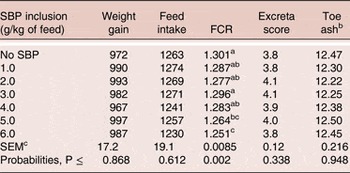
The effects of different inclusion rates of SBP on performance (1–21 d), excreta score and toe ash are summarised in Table 2. There was no significant (P > 0.05) effect of SBP on weight gain and feed intake of the birds. A significant (P < 0.01) effect of SBP was observed for the feed per gain of birds. While inclusion of 1.0, 2.0, 3.0 and 4.0 g SBP/kg of feed resulted in similar FCR values to the diet with no SBP, addition of SBP to the diets at 5.0 and 6.0 g/kg of feed resulted in lower (P < 0.05) FCR compared to the diet with no SBP. Addition of SBP had no effect (P > 0.05) on the excreta score and toe ash.
Influence of different inclusion rate of soybean bioactive peptide (SBP) on the weight gain (g/bird), feed intake (g/bird), FCR, excreta score and toe ash (%) of broiler starters (d 1 to 21)a

Means in a column not sharing a common letter (a,b,c) are significantly different (P < 0.05).
a Each value represents the mean of six replicates (eight birds per replicate).
b Each value represents the mean of six replicates (six birds per replicate, one toe per bird).
c Pooled standard error of mean.
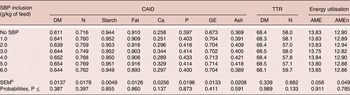
Influence of different inclusion rates of SBP on coefficient of apparent ileal digestibility (CAID) of nutrients, total tract retention (TTR) and energy utilisation is presented in Table 3. There was no significant (P > 0.05) effect of SBP on any of these parameters. Though not statistically significant, SBP inclusion, regardless of the level, resulted in an average 5.7% and 6.3% increase in CAID of DM (from 0.611 to 0.646) and N (from 0.716 to 0.761), respectively. Inclusion of SBP at 6.0 g/kg of feed numerically increased TTR of N by 3% from 58.0 to 59.7%.
Influence of different inclusion rate of soybean bioactive peptide (SBP) on coefficient of apparent ileal digestibility (CAID)a of dry matter (DM), nitrogen (N), starch, fat, calcium (Ca), phosphorus (P), gross energy (GE), ash, total tract retention (TTR; %)b of DM and N, apparent metabolisable energy (AME, MJ/kg DM) and N-corrected metabolisable energy (AMEn, MJ/kg DM)b in broiler starters

a Each value represents the mean of six replicates (six birds per replicate).
b Each value represents the mean of six replicates (eight birds per replicate), measured from d 18 to 21.
b Pooled standard error of mean.
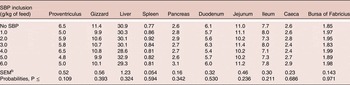
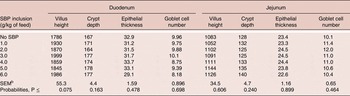
Influence of different inclusion rates of SBP on the relative weight of the organs and digestive tract, and the morphometry of the duodenum and jejunum of 21-d old broilers is shown in Tables 4 and 5, respectively. There was no significant (P > 0.05) effect of SBP on the relative weight of the organs and digestive tract. The effect of SBP on villus height in duodenum tended (P = 0.075) to be significant. Birds fed the diet without SBP had the lowest and the birds with SBP inclusion at 3.0 and 6.0 g/kg of feed showed the greatest villus height, with the other treatments being intermediate. The crypt depth, epithelial thickness and goblet cell number in duodenum were not affected (P > 0.05) by dietary treatments. No significant (P > 0.05) effect of SBP was observed for villus height, crypt depth, epithelial thickness and goblet cell number in jejunum.
Influence of different inclusion rate of soybean bioactive peptide (SBP) on relative (g/kg body weight) organ weights and empty weight of the digestive tract of 21-d old broilersa

a Each value represents the mean of six replicates (two birds per replicate).
b Pooled standard error of mean.
Influence of different inclusion rate of soybean bioactive peptide (SBP) on villus height (μm), crypt depth (μm), epithelial thickness (μm) and goblet cell number (per 100 µm villus height) of the duodenum and jejunum of 21-d old broilersa

a Each value represents the mean of six replicates (two birds per replicate, 10 readings per bird).
b Pooled standard error of mean.
Discussion
Either an intact protein or small peptide fractions released proteolytically from a parent protein can have various bioactive characteristics (Kitts and Weiler, Reference Kitts and Weiler2003). Peptides that are released during the hydrolysis practice generally contain from two to 20 amino acid residues. It has been reported that amino acid composition, sequence and size can cause different bioactivities and functionalities in peptides (Dziuba et al., Reference Dziuba, Minkiewicz and Nalecz1999; Pihlanto-Leppälä, Reference Pihlanto-Leppälä2001).
Results from the current study showed that diet supplementation with different levels of SBP had no effect on weight gain and feed intake but improved FCR. Addition of 5.0 and 6.0 g/kg SBP to the diets resulted in significantly lower FCR values compared to the diet with no SBP. This is consistent with previous studies which demonstrated that dietary supplementation of chickens with bioactive peptides resulted in higher weight gain and better FCR (Wang, Reference Wang2005; Wang et al., Reference Wang, Liua, Songa, Qin and Ma2011; Mateos et al., Reference Mateos, Mohiti-Asli, Borda, Mirzaie and Frikha2014). Feng et al. (Reference Feng, Liu, Xu, Wang and Liu2007) and Karimzadeh et al. (Reference Karimzadeh, Rezaei and Teimouri Yansari2016) stated that bioactive peptides can increase the intestinal enzyme activities, which may have contributed to the improvements observed in feed efficiency.
In the current study, SBP supplementation had no significant effect on any ileal digestibility parameters; but its inclusion, regardless of level, resulted in numerical increases in CAID of DM and N (5.7 and 6.3%, respectively). Furthermore, SBP inclusion at 6.0 g/kg of feed increased TTR of N by 3% from 58.0 to 59.7%. These results are in agreement with the results of Kiers et al. (Reference Kiers, Meijer, Nout, Rombouts, Nabuurs and Van der Meulen2003), who showed that bioactive peptides in soybean increased nutrient solubility and in vitro digestibility. Feng et al. (Reference Feng, Liu, Xu, Wang and Liu2007) reported that fermented soybean meal increased the activation of intestinal trypsin, lipase and protease enzymes during the starter period, and enhanced the protease activity during the grower period in broiler chickens. The improvements in nutrient digestibility and retention in broilers fed bioactive peptides have been attributed to the modulation of gut environment, increased digestive enzymes activity, improvement of beneficial intestinal microbial balance, improved small intestinal morphology or stimulation of the mucosal immune system (Jin et al., Reference Jin, Yang, Choi, Shinde, Yoon, Hahn, Lim, Park, Hahm, Joo and Chae2008; Tang et al., Reference Tang, Yin, Zhang, Huang, Sun, Li, Chu, Kong, Li, Geng and Tu2009; Karimzadeh et al., Reference Karimzadeh, Rezaei and Teimouri Yansari2016).
As villus height and crypt depth of duodenum and jejunum are indicative of gut health and development, it is important to measure the intestinal histology parameters to reveal possible mechanisms of bioactive peptides. In the current study, birds fed the diet without SBP had the lowest and the birds with SBP inclusion at 3.0 and 6.0 g/kg of feed showed the greatest villus height. The positive effect of bioactive peptides on small intestinal morphology in broilers is not without precedent and has been reported in several studies (Liu et al., Reference Liu, She, Wang, Bao, Zang, Luo, Hu, Ding, Wang and Peng2008; Bao et al., Reference Bao, She, Liu, Zhang, Peng, Luo, Yue, Ding, Hu, Liu and Zhai2009; Wen and He, Reference Wen and He2012). Karimzadeh et al. (Reference Karimzadeh, Rezaei and Teimouri Yansari2016) reported that supplementation of broiler diets with 200 and 250 mg/kg canola bioactive peptides linearly increased villus height, villus height: crypt depth ratio and decreased crypt depth of duodenum, jejunum, and ileum in 42 days old broiler chickens. An increase in the number and size of villi increases the amount of surface area available for nutrient absorption, which in turn can improve FCR (McCalla et al., Reference McCalla, Waugh, Lohry, Pasupuleti and Demain2010). This may be, at least in part, explain the better FCR achieved by SBP inclusion in the current study.
The findings of this study support the need for additional experimentation designed to identify the particular bioactive proteins/peptides or other biologic agents in soybean which can influence the gut health and development. Such bioactivity could be the result of a particular constituent protein or protein/peptide combinations.
Conclusions
Identification of bioactive peptides in soybean could be used to benefit the animal production through several mechanisms. In the current study, SBP improved feed efficiency, DM and N digestibility (though not significant) and tended to increase villus height. In the future, it might be possible to further isolate the bioactive peptides and evaluate their targeted feeding to poultry and possibly other intensively raised livestock, with the aim of enhancing production efficiency. Further research is warranted to define the biological characteristics and mode of action of soybean bioactive peptides.
Acknowledgments
The authors would like to thank Chengdu Mytech Biotech Co. Ltd, China for their financial support of this research.
Declaration of Interest
Yan Gu, Weiwei Xiao and Jing Jia are employees of Chengdu Mytech Biotech Co. Ltd, China.