Introduction
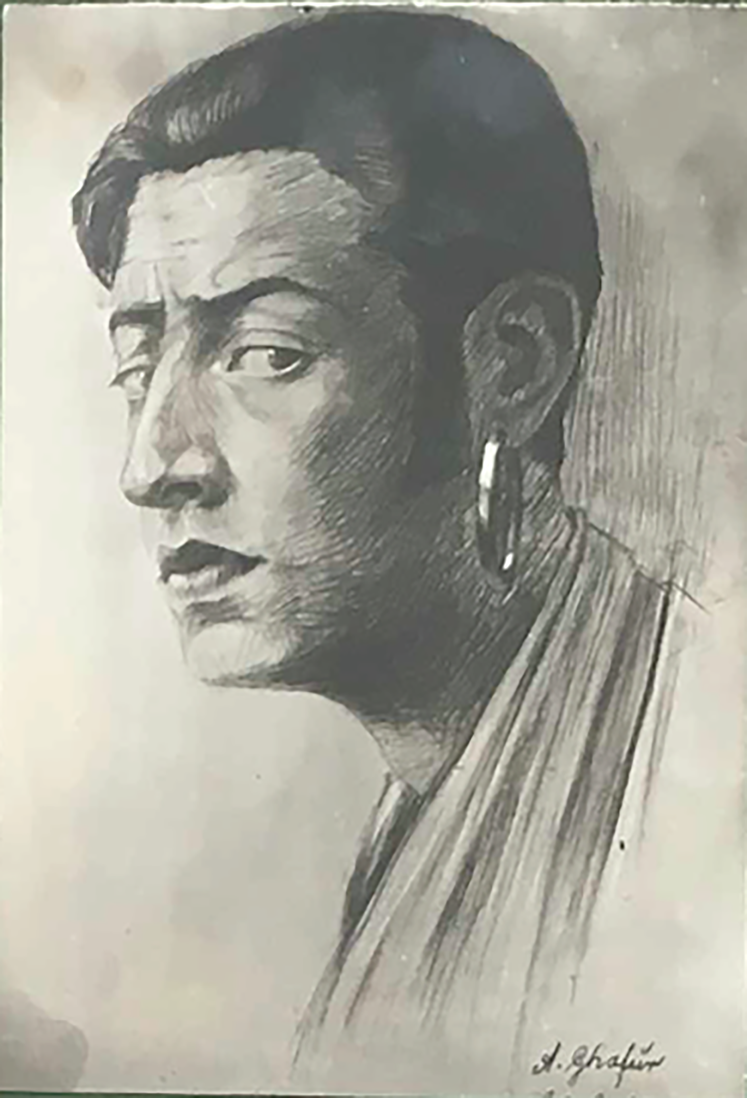
Acts of self-portrayal, whether done through words or images, are rarely simple and innocent. The art historian T. J. Clark has suggested viewing self-portraiture as not merely an opportunity for the viewer see the artist, but also to look ‘back to the place from which one is looking’.Footnote 1 The Afghan artist Abdul Ghafur Brechna's self-portrait from the mid-1920s is filled with ambiguous emotions and conveys a sense of control, discomfort, and experimentation (see Figure 1).Footnote 2 He presumably painted this portrait as part of a class assignment at an art academy in Germany, which he most likely drew from either a photograph or a reflection in the mirror. As Clark has argued, self-portraiture offers artists the opportunity to exert control over the ways in which they wanted to be represented to the viewer. The discomfort in Brechna's look seems to allude to the divided self-perception of a migrant in Germany, prompting the viewer to rethink the racial and cultural categories by which Asian students were commonly categorized in Europe.Footnote 3 After all, studies have shown how such racial typologies were documented and depicted in the case of Muslim students living in France.Footnote 4
Abdul Ghafur Brechna, ‘Self-portrait “disguised as a Maha Raja”’, Germany, late 1920s. Source: Brechna Archive, Germany.

Exerting mastery in and control over processes of knowledge production or the development of knowledge-related practices are rarely associated with Asian artists working within European media. It may seem especially difficult to probe in this case of an Afghan student who clearly travelled to Germany to learn the latest and most up-to-date technologies in support of the newly independent Afghan state. The logic that juxtaposes European superiority with Asian mystical, religious, or tribal inferiority has been echoed in diffusionist historiographies that construe innovation, technology, and science as a key sign of Western modernity. Proponents of this argument understood science as moving from its centre in Europe in an immutable and systematic manner to the rest of the world, without any engagement or input from Asian thinkers.Footnote 5 These views are further reinforced by a series of earlier and ongoing studies that depict Afghan state-building as a European-led process instead of an autochthonous one that also drew on local conditions and Islamicate traditions.
To move beyond simplified assumptions and the perceived rupture between modernity and a traditional Islam, this article seeks to trace out the dialogic and open-ended circulation of artistic technologies and media between Europe and Asia. The case study of Abdul Ghafur Brechna shows that Asian-European intellectual exchanges did not inevitably imply the inferiority of the Asian counterpart, nor compel the eradication of non-Western artistic elements. While Brechna's exchange was situated in a period of open diplomacy between the Afghan and German states (1921–1941), with the goal of developing a central Afghan state and strengthening its industries, the main aim of this article is to examine how Brechna translated, then connected, his Western education into reviving recognizably and distinctively Afghan artistic and literary traditions. I define these traditions as a set of historically contingent knowledge forms that articulated the cultural, social, and geographical position of Afghanistan in relation to regional networks. Artistically, Brechna accomplished this translation by smoothing the perceived rupture between the past and the present, specifically by tying his work to the Timurid painter Kamāl al-Dīn Bihzād (circa 1440–1535). In his writings, he participated in the movement that sought to revive the genre of qissah (story) and afsānah (fiction), both of which had been deemed obsolete in addressing pressing societal and cultural changes, in favour of translating European novels and short stories advocated by influential figures such as Maḥmud Tarzī.Footnote 6
The study of Brechna's oeuvre is important, then, not merely because his career spanned four different Afghan regimes (1929–1974), but also because it offers us a less fragmented view of the relationship of the role of Islam in modern state-building. I argue against the inclination to categorize Brechna's art and writings as either ‘modern’ or ‘traditional’, ‘Islamic’ or ‘pre-Islamic’, and combine the scholarly perspectives of the history of migration, science, and visual studies to consider the ways in which Brechna created malleable mediums that did not simply conform to Western art media, nor purely reflect the modernizing agendas of Afghan state-sponsored literary and cultural institutions. The framework of circular migration, which set Brechna off to study in Europe then return to Afghanistan, is especially useful in understanding how actors transformed knowledge or knowledge-related practices across geographic, intellectual, and temporal terrains. A holistic view emerges when considering his art and his writings as sources. In his paintings, Brechna engaged extensively with the broad category of antiquity and its potential to offer historical continuity and to break with binary models of artistic representation such as modern and traditional, Eastern and Western, Afghan and German, and even point to a blurry pre-Islamic/Islamic historical demarcation. His writings came in the form of folkloric tales designed for younger children and ekphrastic writings (or stories designed to accompany his paintings or narrate an action in the painting). Aside from its contribution to the study of Afghan intellectual history, an understanding of the body of work developed by Brechna enables us to reconsider the relationship between Islam and modernity, and the process of knowledge exchange in a non-European context.Footnote 7
In the modern era, art education in Afghanistan was not formalized until the creation of new secondary and vocational schools in the mid-1920s. A select number of privately trained artists, who excelled in calligraphy, were typically brought into the dynastic courts of the Afghan state. For example, the calligrapher, poet, and historian Muḥammad Ibrāhīm Khālīl (1896–1984) was trained within his family. He subsequently joined the expanding state bureaucracy of Habīb Allāh Khān, Amān Allāh Khān, and Muḥammad Nādir Khān, and worked in various positions that the regimes required. This private and localized form of training began to change in 1921 when Ghulām Muḥammad Maymanagī (1873–1934), the eventual founder of the Kabul School of Fine Arts (Maktab-i Sanā’ī-yi Nafīsāh) (f. 1924), received a diplomatic visa to study at a German vocational art school in Berlin.Footnote 8 Following in Maymanagī's footsteps, Brechna was one of some 250 Afghan students who trained in German technical universities between 1921 and 1941. Participation in this exchange programme became a means to enter the Afghan state bureaucracy. Upon his return, Brechna engaged in a series of professional appointments: as Maymanagī's replacement directing the Kabul School of Fine Arts (1930–1939), director of the state's main editorial organ (Maṭbaʿ-i Māshīn Khānah) (1938–1943), and subsequently co-director of Radio Kabul (1943–1953). After 1955, Brechna oversaw the creation of other Fine Arts colleges across Afghanistan, which, in some cases, were run by his former students or even funded through the sale of his portraits. The majority of these portraits were purchased by ordinary Afghans, in one case by a small shopowner from Kabul at an auction.Footnote 9 These appointments certainly contributed to the spread and influence of his work, leading him to become a national icon responsible for multiple renditions of Afghanistan's founding figure Aḥmad Shāh Durrānī (r. 1742–1772) and composing the national anthem of Afghanistan in 1970. Although Brechna came to be identified with his homeland of Afghanistan, he has remained an international figure. His work was exhibited widely beyond the boundaries of Afghanistan.Footnote 10 Long after his training in Germany ended in 1930, he maintained a close connection to the country, earning him the West German Distinguished Service Cross for his service to German culture and language in the 1960s.Footnote 11
In an attempt to chart the relationship between his earlier training during his migrant years and his subsequent oeuvre as a professional, the following sections will first situate Brechna within the larger geopolitical contours that put in motion his itinerancy between Afghanistan and Germany. In particular, I will focus on the efforts of the newly minted Afghan Ministry of Education (f. 1921), which trained and selected students for study abroad. Despite mounting European influence in the Afghan court, the Ministry remained determined to accommodate educational reforms within a Muslim curriculum. The second part locates Brechna in specific German artistic institutions, with the goal of explaining why certain sites of knowledge and their wider analogous artistic programmes spoke to him (as opposed to others that did not). Brechna's translation of German art was especially manifest in his desire to explore religious themes and employ contrasting scales in his paintings. These translations can be found throughout his art, music, stories, and plays, and made his work recognizable and meaningful to a wide-ranging Afghan audience and set of cultural contexts that expanded well beyond the literati.
Beyond stagnation and failure: towards a new history and historiography of circulation and exchange
In 1919, with the ascension of the Afghan sovereign Amān Allāh Khān (r. 1919–1929), Afghanistan was proclaimed an independent state poised to pursue a sovereign foreign policy, officially ending the country's status as a British protectorate. This declaration and the ensuing formation of diplomatic relations with various foreign countries are best understood in the context of mounting imperial influences in the region from India's integration into the British Raj in 1858. Following the end of the First World War, British and French powers expanded and created various protectorates in the Middle East. Afghanistan's own troubled relations with Britain had involved a series of disputes fought over resources, sovereignty, and the North-West Frontier, resulting in three Anglo-Afghan wars (1839–1842, 1878–1880, and 1919). The new Afghan regime thus perceived the nearby British as a threat and sought to maximize its independence by launching a policy that promoted new international treaties and sponsored the institutional development of the Afghan state.Footnote 12 These programmes included the development of new roads, dams, schools, and hospitals.
The new treaties resulted in the creation of embassies as well as calls on each foreign state to send technocrats to assist the regime's goals of centralization. Just as foreign technocrats arrived to oversee state-sponsored projects in Afghanistan, the Afghan government simultaneously sponsored the studies of students abroad where they were trained according to the strengths of each destination. Compared to the more modest involvement of some other nations, the German state sent over 300 German scientists and technocrats. Likewise, between 1921 to 1941, over 250 Afghan students travelled to train in higher education at German universities. The fledging Afghan state discouraged students from settling down in Germany and on their return required them to take up positions in different sectors of the industrializing state.
It is tempting to succumb to teleological tropes, especially when considering the historical context that drove Afghanistan's aims to centralize and develop. After all, the idea that modern science emerged in the West in an era of Muslim decline has long been echoed in much of the historiography.Footnote 13 A case in point is an understanding of the history of Afghanistan's exchange with the German state which relies on such an argument. From the vantage of the present historiography, the German state made its technological resources available to the Afghan state, but the latter could not successfully facilitate the shift from a fractured tribal system to a centralized ‘modern’ state. Regardless of how cleverly designed the flow of German expertise and technology was, ultimately the Afghan sovereigns Amān Allāh and his successor Nādir Khān (r. 1929–1933) ‘failed’ both ideologically and in terms of infrastructure to centralize and standardize factional laws.Footnote 14 The inward-looking values and loose kinship structures intrinsic in Afghan tribes are often faulted for preventing the Afghan state's modernization schemes.Footnote 15 Some successful transmission of German influence is measured in the development of Afghanistan's ethno-nationalist pursuits and its employment of Aryanism as an ideology to promote Pashto as the country's official language.Footnote 16 The complex forms of exchange that developed between the Afghans and the outside world are, in this paradigm, boiled down to two opposing dichotomous viewpoints of the ‘modern’ and the ‘religious’.Footnote 17
Such perspectives ignore intellectual dialogues that took shape between Afghans and their Indian or Iranian counterparts, in particular within intellectual ‘contact zones’, where they interacted, studied, and critically exchanged ideas. In the field of Afghanistan studies, the past few decades have seen a surge of new studies that have not only ‘de-nationalized’ Afghan history and blurred the divide between the modern and the traditional, but also questioned the notion that reform and change was an external force acting on Afghans and subsuming them within supra-hegemonic imperial structures.Footnote 18 Anthropologically and sociologically oriented histories have pointed at rich kinship structures and religious organizations that Afghans drew upon to respond to reform or to regulate the parameters of interchange with European counterparts.Footnote 19 As historian Wali Ahmadi succinctly reminds us, there is not one telos to modernity, nor does it necessarily have a European inception:
[Afghan] intellectuals did not mount a discourse of wholesome imitation of the West and hardly saw modernization as an inexorable process of social transformation ending in direct importation and far-reaching reproduction of Western paradigms. They believed, rather paradoxically, that tradition and change could, and indeed do, coexist and effectively work together. Afghan modernity, in the process of its own self-legitimation, maintained a resilient and supple ambivalence towards tradition.Footnote 20
Engaging in large part with these works, as well as recent histories of science and migration studies, this article seeks to address the practical and intellectual implications of artistic interchange. While the study of Afghan students may not fit within traditional frameworks of ‘migration’, seeing them as migrants opens new avenues through which to understand migration and the circulation of knowledge and people as interconnected processes, rather than one-way travel. Defining Afghan students in interwar Germany as migrants expands our understanding of the term and ensures that circular (or non-sedentary) and voluntary patterns of mobility are recognized as part of the framework of ‘migration’. This reformulation also problematizes the present image of Muslim mobility as merely a product of involuntary push or pull forces compelling displacement and exile, and points at heterogenous ways in which migrant experiences can be historicized.Footnote 21 The emphasis on circulation, then, delineates a process by which ideas and methods about science and technology underwent important transformative changes at the hands of Afghan migrants, who rather actively participated in intercultural knowledge production.Footnote 22
The transcultural geopolitics of Brechna's education and state-career
While the emphasis on Brechna's independence vis-à-vis larger diplomatic arrangements remains an important theme throughout much of this article, it is still important to examine the geopolitical parameters that put his studies in motion. The geopolitics help chart out the structural dimension of his itinerancy, allowing us to see which institutions he visited and what the Afghan government expected these exchange programmes to accomplish for those it sent out. A close look at the activities of the Afghan Ministry of Education is especially useful to show how all levels of society, not merely its students in the diaspora, maintained a priority of preserving Afghan knowledge systems, despite (or in concurrence with) European reformers in the Afghan court. These exchanges were executed, first, through a careful selection process by which students were sent abroad and, secondly, by closely monitoring and working with European pedagogues. After all, the goal was not to replicate Western ideas but to produce new kinds of educational systems that fitted the state's needs.
The Afghan Ministry of Education housed 18 bureaus, one of which was exclusively designated to oversee and regulate daily interactions with foreign-born reformers. From Ministry publications, we know of the array of different responsibilities, which included (among others) overseeing the detailed translation of foreign textbooks into Persian, evaluating requests for new disciplines, and even sifting through archaeological discoveries and cataloguing them at the Muzīyam-i millī-yi Afghānistān (the National Museum of Afghanistan).Footnote 23
In 1921, as pedagogues from France, Germany, and Turkey arrived at the Kabul court to draft preliminary proposals for secondary schools, the Ministry set specific standards that conformed to religious educational traditions. Dr Walter Iven, the German petitioner, noted in a letter to the German Foreign Office that after presenting multiple versions of his proposal, ultimately the one written in Persian and in accordance with a classical Perso-Islamic study secured him the vote of the Afghan Ministry.Footnote 24 His proposal led to the creation of the first German-run secondary school in 1924, the Ämani Oberrealschule or Maktab-i Amānī in Kabul. While introducing Western educational practices, vernacular conventions were not to be forgotten. The school set up a special parallel curriculum (Sonderprogramm) that kept students immersed in Arabic, Persian, and Islamic history and thought, and at the same time prepared them for higher education in Germany. Matriculation exams were a crucial assessment tool by which students were approved for their studies abroad. Here, again, the Ministry hired Afghan superintendents to invigilate the exams and hand-pick students for higher education in Germany.Footnote 25
Once students were selected for the study abroad programme, the Afghan Ministry considered the strengths of each destination. Each country represented a key piece in a larger puzzle and an opportunity to interweave a specific set of abilities into various sectors of the industrializing Afghan economy. The earliest destinations in 1921 included Turkey, Germany, France, and Russia, followed by Japan and Italy in the 1930s. The programme even came to include a small number of Afghan girls who, after 1928, predominantly travelled to Turkey to study medicine and nursing.Footnote 26 While the Soviet Union and Italy primarily received Afghans for training in aviation, Turkey and France were seen as ideal places to receive an education in medicine and the military. There was an overlap with Iranian students who also arrived in France for medical training.Footnote 27 Due to Afghanistan's long historic ties to the former Ottoman empire, and in part because the Turkish state helped subsidize the financial costs, the new Turkish Republic remained one of the most popular destinations up to 1941. For instance, between 1925 to 1927 roughly 50 per cent of the Afghan students were sent to Turkey, while Russia welcomed 27 per cent and France 17 per cent.Footnote 28
Within these larger educational reform movements, the German university system offered a multitude of unique incentives that were accompanied by financial, practical, and political advantages. Starting in the second half of the nineteenth century, the German state promoted the study of technology (Technik) as a field concerned with ‘the useful arts, manufacturing, industry, invention, applied science and the machine’. Germany's distinction was especially highlighted in relation to its British counterpart, where ‘science’ as a field remained restricted to the natural sciences and where considerations of ‘practical utility’ could diminish the role of science as ‘subordinate to industrial progress, a culturally powerful symbol in Victorian England’.Footnote 29 Many developing or formerly colonized states viewed this practical dimension of German education as an advantage and sent its youth for training well into the era of decolonization.Footnote 30
Germany's advantages to Afghan reformers in the Ministry were not only educational. Germany's financial struggles with inflation following the First World War provided favourable exchange rates, easing the financial burden placed on students by the need to rent apartments and expand their libraries. In addition, Germany's lack of imperial power in the Middle East (in contrast to France and Britain) made it an attractive partner. During the First World War, many Afghan Pashtuns who had served in the British Army ended up in Germany either after being captured and brought to Germany as prisoners of war (POWs) or arrived voluntarily in Germany after deserting from the British Army. Through collaborative training by Ottoman and German officers, Muslim POWs were eventually remobilized to confront their former colonizers, while a large number of them settled as migrants in Germany.Footnote 31 In the context of the First World War, the German Foreign Office supported the creation of places of worship, the celebration of religious holidays, the formation of clubs and organizations, and the printing of diasporic journals and newspapers. By the 1920s, roughly 400–500 Indians also lived in Germany, resulting in the development of widespread anti-colonial networks that connected Berlin to San Francisco, Paris, Kabul, and London.Footnote 32 Afghan students who arrived in the course of the early twentieth century were privy to these many institutional and cultural spaces that had originally been founded by former Indian and Afridi prisoners of wars.
The Afghan Ministry of Education capitalized on German support for its Muslim sojourners and requested that Afghan students be closely monitored by the German Foreign Office and the Afghan legation in Berlin. Younger students who lived with their cohort in a newly purchased dormitory were regularly sent a tutor to ensure their local immersion. The German Foreign Office accommodated many of the Afghan Ministry of Education's concerns. For instance, it worked with the Prussian Ministry of Culture and Education to admit Afghans mid-semester and, more astonishingly, allowed Afghan students to replace the usual linguistic prerequisites of French and Latin with Persian.Footnote 33 Older Afghan students who had already begun their higher education at technical universities were encouraged to visit the Institute for Oriental Studies at the University of Berlin (Seminar für Orientalische Sprachen zu Berlin) (f. 1887), where Persian-language courses had originally been designed for diplomats. All of this was congruent with the goal of students returning to Afghanistan and serving the state after their training abroad. These special accommodations also highlight the extent to which the German Foreign Office worked to fortify its geopolitical relations with Afghanistan through the educational exchange programme. It invested considerable resources in overseeing various aspects of the students’ lives in Germany. Internal correspondence explains the reason: ‘[I]t is of utmost importance for Germany that the students are trained in Germany so that upon their return to their homeland they can function as advocates for German culture.’Footnote 34
It was in this this context that, in 1922, at just 15 years of age, Abdul Ghafur Brechna arrived in Berlin to train in engineering. However, soon after his arrival, Brechna decided not to pursue the ‘useful arts’ and petitioned the local Afghan legation in Berlin to study art and painting instead. After multiple exchanges, in which the Afghan legation warned him that a ‘career in painting would not feed him’, it finally approved Brechna's studies in painting (naqqāshī) on the condition that he incorporate a ‘useful’ component into his curriculum.Footnote 35 To that end, Brechna studied lithography alongside art and painting. Lithography was highly sought after in Afghanistan and the wider region, because it kept intact some aspects of the manuscript traditions of Arabic, Persian, and Urdu calligraphy. Furthermore, when he became director of the state's printing press (Maṭbaʻ-i Māshīn Khānah), lithography eventually allowed Brechna a much more portable and cost-effective system of reproducing prints, which manifested in designing some of the covers of the monthly Kābul journal for the literary association, Anjuman-i Adabī-yi Kābul.Footnote 36
Brechna's training began with a short stint at a small arts and crafts school in Berlin, followed by his entrance into the Prussian Academy of Arts (Akademische Hochschule für die bildenden Künste), where he studied under the German modernist Otto Bartning (1883–1959) and the famous German impressionist painter Max Liebermann (1847–1935). It was here that Brechna first encountered European paintings with realistic scenes and emphasis on daily life. His artistic development was to shift significantly during the course of his training in Germany, which also took him to the Academy of Fine Arts in Munich (Akademie der Bildenden Künste), the School of Arts and Crafts (Kunstgewerbeschule Barmen/Elberfeld) in the western German town of Barmen, and finally to the Academy of Fine Arts in Leipzig (Akademie für graphische Künste und Buchgewerbe).
At the School of Arts and Crafts in Barmen, Brechna not only met his future wife Lisette Marguerite Neufeind, but also began to develop his own distinctive style. Like many of the other Muslim migrants who had pushed against the ban on interracial marriages, Brechna and Neufeind were able to circumvent the interdiction by reassuring the German Foreign Office that they would not remain permanently in Germany. In an exchange of letters, he assured the German Foreign Office of his return to Afghanistan because the Afghan government had promised him a position in the government's editorial printing press, Māshīn Khānah.Footnote 37 Internal correspondence suggests that the German Foreign Office made inquiries at the Afghan legation in Berlin and only thereafter approved the pair's departure to Afghanistan.Footnote 38
Just as Brechna and Neufeind were making their way back to Afghanistan in 1929, a coup instigated by the usurper Habīb Allāh Kalakānī (r. January 1929–October 1929) broke out and deposed the pro-German King Amān Allāh. Amid these developments, many Afghan students in Germany broke off their educational programmes and returned to Afghanistan to support the deposed Amān Allāh. Kalakānī's rule lasted for roughly nine months until Muḥammed Nādir Khān, one of Amān Allāh foremost generals, defeated him and re-established order. Rather than welcoming back the ousted king, however, Nādir Khān announced the formation of a new dynasty under his Musāhibān family.
Starting in 1933 a series of German-educated students and teachers contested Nādir Khān's rule, including plotting a series of conspiracies and assassinations. Among these political assassinations was the murder of British officials at the British Legation in Kabul, as well as the murder of the king himself in 1933. The role of Brechna and his wife in these turbulent political events is unclear from the sources. Abiding by their promise to the German authorities, the couple lived in Afghanistan during these political changes and soon began their long careers in the arts and education. Neufeind assumed a teaching position at the Maktab-i Āmānī, where she illustrated and translated several German books for the Afghan curriculum. For his part, Brechna became the director of the Kabul School of Fine Arts (1930–1939), where he replaced its founder Ghulām Muḥammad Maymanagī. Under Brechna's leadership the School added new courses in architecture, ceramics, lithography, and stone carving.Footnote 39 From 1938 to 1943 Brechna assumed the role of director of the Māshīn Khānah, taking charge of the Afghan government's printing press which published government pamphlets and, most notably, the monthly and annual publications of the Anjuman-i Adabī-yi Kābul (Kabul Literary Society) and the Afghan Historical Society (Anjuman-i Tārīkh-i Kābul). Brechna followed this by acting as the co-director of Radio Kabul from 1943 to 1953. It was in this position that he most clearly engaged with the complex problems facing the new Afghan state, now headed by King Nādir Shāh's son Muḥammad Zāhir Shāh (r. 1933–1973).
Ambitions and limitations: reframing Brechna's engagement with German art
Having traced the institutional dimensions of Brechna's education in Germany, this section examines the overlapping intellectual and artistic networks that he encountered in Germany to trace his intellectual development. It may be possible to reduce Brechna's art to little more than pastiches or imitations of European art, with suggestions that his paintings in his own Afghan setting were merely diffusionist representations lacking in originality. It is certainly true that Brechna devoted his course of study in Germany to bringing back new techniques for his nation-in-the-making. Yet, clues within his paintings and texts offer evidence of a much more complex process of translation of the artistic techniques, themes, and traditions he encountered in Germany. His activities cannot be reduced to the modernizing agenda of his patrons in Berlin. Instead, his work reveals an attempt to create historical continuity between the Afghan past and the world he experienced upon his return through an active process of translation and adaptation rather than any passive form of imitation of German masters.
The work of art historian Partha Mitter is especially useful here, as he reminds us to consider the complexity involved in studying artistic exchanges between the West and East. Mitter suggests that cultural interchange does not always reflect ‘the inferiority of the borrower’.Footnote 40 He questions the conventional notion of ‘influence’ to reconstruct a dialogic relationship between the colonial language and vernacular artistic representations. Building on Mitter's work means considering Brechna's exchange with European artists as one defined neither through ‘domination and dependence nor a loss of self’.Footnote 41 Instead, we should focus on Brechna's active process of translation, which can be done by first asking why the small, out-of-the-way art school of Barmen offered Brechna a moment of dialogue and negotiation.
The reconstruction of Brechna's life and work poses a challenge to the interested scholar. Unlike his German contemporaries who travelled and researched in Afghanistan and carefully documented their observations in their published ethnographies and scientific accounts, Afghan students in Germany did not systematically record their experiences during their sojourn. As problematic as the use of state and institutional sources (including matriculation records) can be in recovering individual agency, these records can help to locate Brechna's intellectual development within the ideological currents of the numerous art schools at which he studied. This approach seeks to consider the qualitative significance of institutional sources, recasting them as distinctive sites of knowledge production and exchange within the otherwise seemingly ‘flat’ diplomatic spaces between Afghanistan and Germany, thereby acknowledging the agency that individual students possessed in this exchange.
Brechna's particular agency in the knowledge exchange between Afghanistan and Germany can be pieced together through his artistic work in Germany and upon his return to his homeland. In addition, his memoir of his travels to Germany, written in 1959–1960, well after the described activities took place, provides Brechna's own interpretation of his experience. The memoir must be read within the new social and political contexts as a self-conscious retelling, designed to present Brechna's experience and sojourn as he wished them to be remembered. Nevertheless, the memoir helps to tease out Brechna's expectations of a German education and ultimately hints at the ways in which he reconceptualized his art training into new Afghan subject matter.
Brechna's later work and recollections from his memoir make it possible to connect his intellectual and artistic development to different art institutions in Germany, enabling us to identify specific methods that he would subsequently draw on. For example, Brechna's introduction to the Berlin art scene must have been quite unfamiliar to the young adolescent, yet his memoir depicts him as largely unimpressed by it and by his teachers. He struggled not only to appreciate the art scene of Berlin, but also expressed frustration in his memoir about the difficulty of specific techniques in anatomy and animal paintings. In fact, he very much dismissed the training he received from Max Liebermann at the Prussian Academy of Arts. Liebermann was a famous impressionist artist, but he only showed up to class when absolutely necessary, leaving his teaching duties to fellow professors, such as Otto Bartning and a certain Herr Fischer, presumably Arthur Fischer (1872–1948), the German painter and photographer.
While Brechna failed to find his place in Berlin, his experience at the small School of Arts and Crafts in the western city of Barmen (modern-day Wuppertal) after 1925/26 proved to be much more influential. Brechna described how the topography of Barmen reminded him of his homeland (‘tappahā-yi sabz-i vatan’). It became a place where he was finally able, in his own words, to be ‘happy’.Footnote 42 Unlike his rather unfulfilling experience with the famous Liebermann, Brechna also found a true mentor and inspiration in the person of Ludwig Fahrenkrog (1867–1952). Thematically and methodologically he seemed particularly intrigued by his teacher's ability to paint something so inherently evil and dark as the figure of the Satan (iblīs) in the most ‘romantic’ and flattering way.
Professor Fahrenkrog was our Professor of anatomy and portraits, besides being trained in painting, he was also a poet and literary scholar. His famous work is called Lucifer, meaning the devil, which is also reflected in his latest paintings, depicted in the techniques of Romanticism. In contrast to how my imagination views the devil, which is analogous with frightening wings and tail, he drew the devil in the most beautiful manner.Footnote 43
Having struggled with anatomy and animal depictions while in Berlin, Brechna saw in Fahrenkrog's work the ability to depict something unpleasant in a stunning and inspiring way. Fahrenkrog challenged the limits of Brechna's imagination, while also pushing his technical abilities to actualize his expanded imagination.
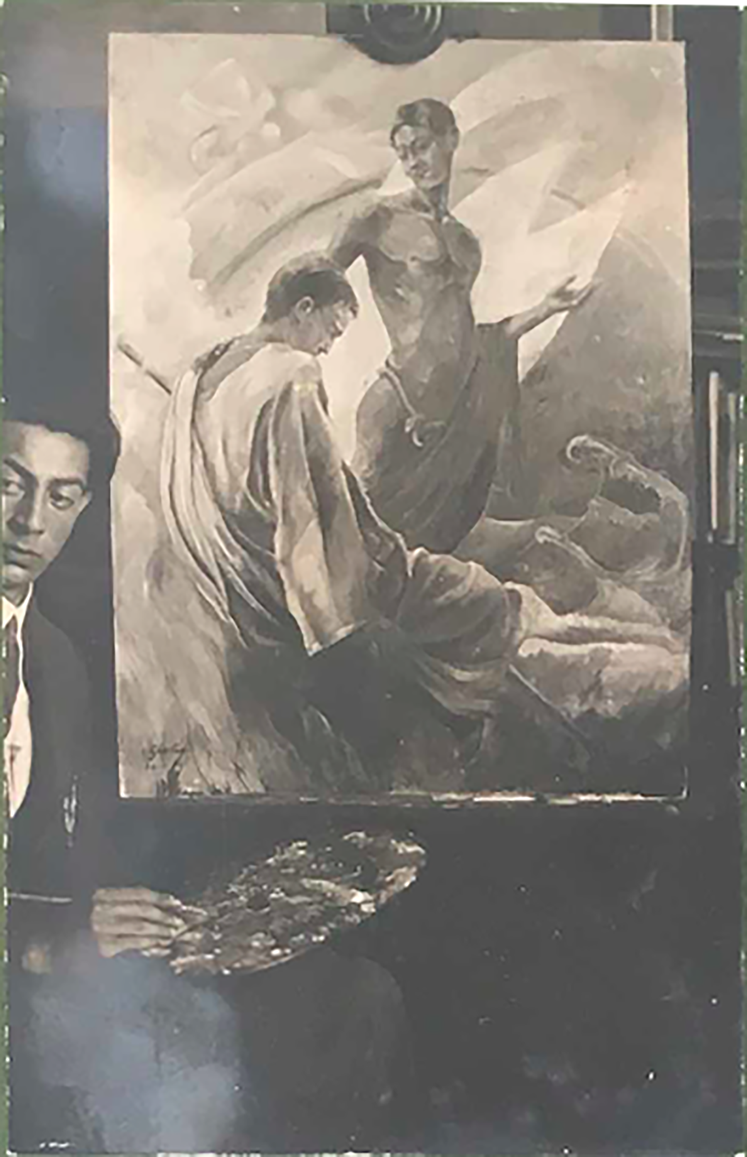
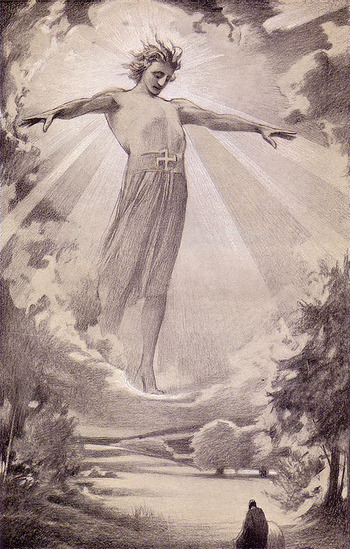
The striking conversations that Brechna had with Fahrenkrog is best illustrated in a work he produced in the mid-1920s, most likely while he was a resident at the Academy of Fine Arts in Leipzig. The painting is only known from a photograph in which Brechna can be seen at work (see Figure 2). Viewing this painting alongside Fahrenkrog's ‘Baldur’ (see Figure 3) shows the thematic overlap in both content and technique. Given that Brechna's painting is only able to be seen in a photograph, it is not clear whether Brechna, like Fahrenkrog, painted in black-and-white or if he used a variety of colours. The latter is more plausible, given that Brechna is shown holding a colour palette. Both painters made use of similar brush strokes, emanating in both cases away from the main subjects in the paintings, accentuating the centrality of the figures. The scenes depict a spiritual setting; in Brechna's example the toga-like robes and the reference to the ocean may be connected to a sort of blessing or baptism, while in Fahrenkrog's painting a Christ-like figure is shown descending from the skies.
Abdul Ghafur Brechna, title unknown, Germany, circa 1920s. Source: Brechna Archive, Germany.

Ludwig Fahrenkrog, ‘Baldur’, place unknown, 1908. Source: Galleria d'arte Thule.

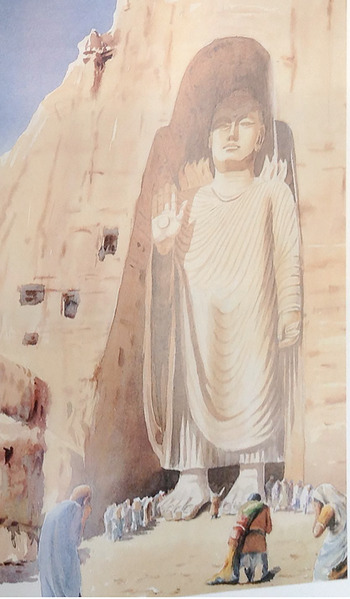
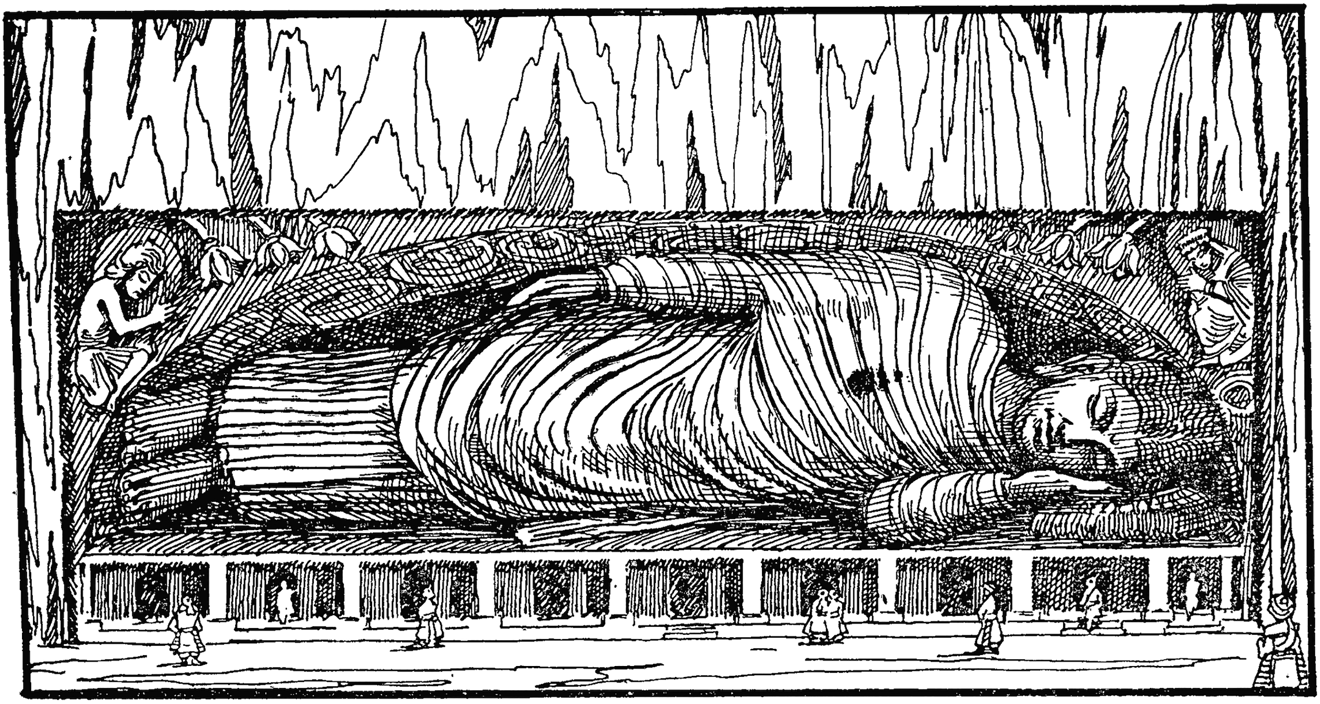
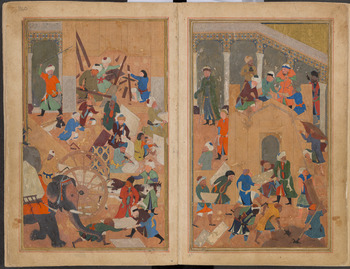
Each painting experiments with contrasting depictions of scale. Fahrenkrog's painting featured an oversized figure wearing a manji sign (or Hackenkreuz) on his belt as a reference to the pagan Germanic emblem of the god of adventure, Donner (Thor). Such a contrast in scale between a central figure and smaller peripheral ones featured quite prominently in Brechna's later paintings (see Figures 4 and 5). Yet, while we can see Brechna's initial experiment with contrasting scale in dialogue with Fahrenkrog, the imbalance in proportion and scale, and the distribution of individuals across the scope of the painting, directly connect to the Herati painter Kamāl al-Dīn Bihzād and his painting of the Timurid Great Mosque in Samarqand (see Figure 6). The monumental presence of figures commonly featured in Persianate paintings may have been ‘miniatures’ in scale but served to accentuate figures as larger than life.Footnote 44 Thus, there is no reason to believe that Brechna's experiments with scale solely derived from the examples of his German teacher and may have embodied an attempt to produce historical continuity.
Abdul Ghafur Brechna, ‘The large Buddha in the pre-Islamic era’, Kabul, 1960s.
Source: Habibo Brechna, Roland Steffan and Abdullah Breshna, Buddhas und Menschen in Bamiyan: Begleitschrift zur Ausstellung ‘Der Bazaar von Kabul–Schnittpunkte der Kulturen’ (St Gallen: Historisches und Völkerkundemuseum, 2001).

Abdul Ghafur Brechna, ‘The resting Buddha of Bamiyan’, Kabul, 1972.
Source: Habibo Brechna et al., Buddhas und Menschen in Bamiyan.

Kamāl al-Dīn Bihzād, ‘The building of the great mosque of Samarkand’, Herat, circa 1480. Source: Johns Hopkins University, Baltimore, John Work Garrett Collection, ff. 359v–360r.

In Brechna's words, ‘[Fahrenkrog's] artistic style was in the techniques of Max Klinger—[and Anselm] Feuerbach and in certain images in the methods of Arnold Böcklin, the famous German painter.’Footnote 45 Fahrenkrog came out of the tradition of a previous generation of German artists, like Arnold Böcklin (1827–1901) and Max Klinger (1857–1920), who introduced bold and contrasting colours into German art. Their style did not attract much interest from their contemporaries. Their neo-pagan and romantic landscapes did not fit within the modernist art movements in the rapidly modernizing post-fin de siècle Germany. Yet, recent studies have revisited the role of these largely forgotten figures in shaping debates around cultural politics and the place of art in Germany. One scholar places these artists under the larger umbrella of Phantasiekunst (‘art of the imagination’) and points at their desire to return to classical antiquity with the aim of attaining spiritual renewal.
This conception of art precipitated out of German reactions against French impressionism in the 1880s and 1890s. Its advocates diverged from theories of modern painting, emerging with mid-nineteenth-century realism…[They] sought to advance an art that would be somehow ‘modern’ and yet conceive of its function as the awakening of content of consciousness in the viewer…through the stimulation of his imagination (Phantasie).Footnote 46
Böcklin and his cohort were among the first German-speaking painters to draw from the full range of available genres and canvases, explicitly trying to connect the themes and techniques of the past with those of the present. They thus proposed their own responses to the same anxieties that troubled their fellow artists at the turn of the twentieth century. The end of the nineteenth century was a particularly tumultuous period in Germany that saw rapid industrial, social, and political transformation. Artists offered a range of reactions to these changes, including a turn to the past in search of stability in an ever-changing age.Footnote 47 It was not uncommon for German artists to seek inspiration from Greek mythology. This was particularly the case for Böcklin, who promoted an art that he saw as Grecian in form but ‘modern’ in colour.Footnote 48
In the same vein, then, we will see that Brechna's oeuvre played with ‘modern’ techniques, especially as these were manifested in experimenting with bold new colours. He did so within a framework that rooted the Fine Arts in an ancient Greco-Buddhist genealogy that he saw as unique artistic features of Afghanistan's history. The stark similarities between Fahrenkrog and Brechna should not be reduced to a simplistic master-teacher relationship, especially considering the numerous teachers Brechna had during his stay in Germany. Rather, his artistic education took place within a wider context that led Brechna to find inspiration specifically in Fahrenkrog and his artistic networks. Having situated Fahrenkrog's own intellectual circle, as well as how Brechna thematically and methodologically drew from the master, the next task is to see how these earlier encounters materialized in Brechna's art as he returned to Afghanistan.
A new meaning in a new master: the rediscovery of the old in the new
In an effort to show how Brechna's artistic circulation contributed to intercultural dialogues, the next part of this article discusses Brechna's engagement with his intellectual milieu after he returned to Afghanistan. What he found were ongoing debates among state-sponsored cultural and literary associations, which sought to promote Afghanistan as an heir of the ancient notion of Arya, thus linking the past with the present. It seems, then, that Brechna's interest in Fahrenkrog's style would be linked to the general idea that viewed the development of Afghan Aryanism with the concurrent growing presence of Germans across Afghanistan. Despite his German art training, Brechna deviated from such conversations, even though, through professional affiliation, his career depended on state support. Unlike his colleagues, Brechna rarely employed terms such as Arya or Ariana and focused, instead, on fostering a kind relationship with the past that not only spoke to the Afghan elite circles associated with the Afghan state but embodied the heterogenous forms of national identities intrinsic to the country.
Scholars of Afghan nationalism connect a renewed interest in the past to the close relationship between Afghanistan and Germany, especially the growing involvement of Nazi pedagogues and diplomats in Afghanistan after 1933. Historians have argued that the ‘development of modern nationalism in Europe had a tremendous influence on the emergence of nationalism in Afghanistan’, tracing the issue further to Europe's encounter with the Rig Veda.Footnote 49 Perhaps it is the idea that when Europeans discovered these ancient texts, Afghanistan became aware of them too, leading Afghan scholars to examine other ‘Aryan texts’, that is, Vedic and Avestan texts, to locate Afghanistan's linguistic, literary, and religious importance within the development of Vedic and Avestan civilizations. Certainly, in specific Afghan national identities there were ethnocentric movements to adopt Pashto as the national language, or to create a separate Pashto state, manifested in the Pashtunistan movement, although it remained unrealized. As in Nazi Germany, these movements have had oppressive consequences and assumed the supremacy of one group of Afghans over others, most notably over the Hazara ethnic minority.Footnote 50
There is, however, little evidence of how intercultural exchange and historical encounters between Germany and Afghanistan materialized and produced this putative one-sided diffusion of European ideas into Afghan modernism. Such assumptions also rest on the problematic notion that Afghans were passive recipients of German ideas—an assertion that cannot be substantiated, especially when taking into consideration the earlier discussion regarding the Afghan Ministry of Education.
Comparative studies of the region, too, trace the development of the concept of ‘Aryanism’ as a response to imperial relationships and British formulations of the term. In the Iranian case, the argument has been made that although Aryanism was not a European import, the concept played an important role in Iranian identity politics as a way to manage the trauma wrought by the experience of European imperialism.Footnote 51 Thomas Trautmann's Aryans and British India extends the study to British intellectuals who colonized the notion. Trautmann notes that the British study of Sanskrit led to ‘the discovery of its similarity to Latin and Greek’, thus institutionally impacting on ethnology and philology in England.Footnote 52 Subsequently, Tony Ballantyne highlights Aryanism as ‘central to constituting colonial subjects and fashioning the very structures of colonialism’.Footnote 53 His well-known ‘web of empire’ framework (or ‘bundle of relationships’ as he calls its variation) conceptually strings together disparate regions and communities across the British empire, pointing especially at multiple reconfigurations that the idea of Aryanism underwent across the empire. Aryanism provided a flexible construct that could be used to highlight similarities between Indians and the British, unite the colonized, or even draw lines between communities. Ballantyne argues that Aryanism was not only a tool of imperialist aspirations but factored in the development of modern Hindu nationalism. Projit Bihari Mukharji has shown how Aryanism was used to create a distinctive Bengali identity that distinguished itself from northern Indians.Footnote 54
The ongoing Buddhist-Greco archaeological excavations and the urgency with which Afghan intellectuals engaged with Afghanistan's past through the framework of Aryanism in the 1930s and 1940s placed Afghanistan at the centre of these debates. Yet, Afghan employment of Aryanism beyond the bilateral Nazi-Pashto link has not been sufficiently addressed in the historical scholarship. Afghanistan is tangentially referenced in Phiroze Vasunia's The Classics and Colonial India, where he discusses the travels of veterinarian and horse-trader for the East India Company William Moorcroft (1767–1825), who found an altar of Alexander while travelling through Samangan, formerly Aibak.Footnote 55 Vasunia tells of a number of other British agents in Afghanistan and across the northwest frontier who modelled their journeys on that of their ancient hero. However, Vasunia's main focus is on the ways in which the colonial encounter between the British and Indians gave rise to an exploration of the Greco-Roman past of India. This involved, on the one hand, the British positing themselves as heirs to Alexander and Augustus, using them as blueprints by which the empire was to be consolidated and developed, and, on the other hand, Indian responses that looked to the past to develop a modern anti-colonial India.
How, then, are we to understand the overlooked development of Aryanism in a context where there was no direct colonial order? As an occasional contributor to state-run journals and director of the Maṭbaʻ-i Māshīn Khānah, Brechna was embedded in the intellectual culture around state-sponsored literary and historical associations, yet it was equally important to maintain the salient boundary which eventually ensured his contribution to an evolving public sphere. His colleagues in institutions such as Mūzīyam-i millī-yi Afghānistān (National Museum, f. 1931), the Anjuman-i Adabī-yi Kābul (Kabul Literary Society, f. 1931), and the Anjuman-i Tārīkh-i Kābul (Afghan Historical Society, f. 1942) had been exploring Afghanistan's pre-Islamic past and specifically employed ‘Aryanism’ as an interpretive tool for reformulating a new Afghan past. This past was intimately linked to the revival of Afghanistan's centrality as the ancient ‘cradle’ of Vedic and Avestan civilizations.Footnote 56 The tasks of these institutions cannot be homogenized, and different aspects of each have been studied. Generally, what we know is that through these associations the ‘government succeeded in establishing an active and prolific, though largely conformist group of intelligentsia that dominated the literary and cultural scene during the period’.Footnote 57 Nile Green's recent work has argued that some intellectuals used these institutions as infrastructural networks to engage with and adapt European intellectual disciplines.Footnote 58
These networks were designed not merely to search for Afghanistan's deeper Aryan literary and artistic national culture, but also to explore Afghanistan's role as a regional hub and exporter of culture.Footnote 59 For example, the author ʿAlī Aḥmad Nʿaīmī depicted Afghanistan as the wellspring of knowledge about art and science (une série d'arts and le foyer de la science), which were transformed and re-emerged elsewhere across the world. Over the course of several essays that study the Herati School of Art and its export to Safavid Iran and Mughal India, N‘aīmī described a series of influential networks and artistic methods that he collectively defined as a family of artists—‘une famille d'artistes’—a series of followers, and trained protégés who were both in and beyond the court.Footnote 60 ‘Like the Greco-Buddhist art, whose home was in the east of our country, before Islam, the art of miniature painting, inlaying, calligraphy, the art of bookbinding, which was born in Herat in the 9th and 10th centuries (hijri), are the arts specific to Afghanistan.’Footnote 61
Bihzād had primarily been seen within an Iranian or Mughal context and many tied his artistic accomplishments to the beginning of a unique artistic lineage developed in the Mughal court.Footnote 62 However, in Nʿaīmī's contributions, Bihzād and his school in Herat acted as a gravitational centre, from which Nʿaīmī traced various techniques, such as manuscript illuminations using specifically ‘Afghan’ objects (such as lapis lazuli), to elsewhere across the world.Footnote 63
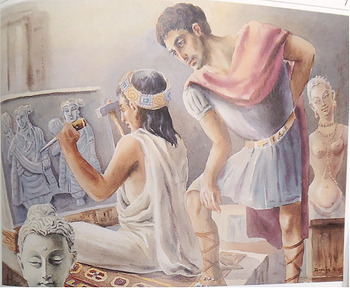
As historian Tapati Guha-Thakurta has shown, it was not out of the ordinary for South Asians to ‘objectify their past’ and attach material objects to cultural authenticity and the development of nationalist identities.Footnote 64 Brechna, too, understood this and therefore engaged with the state literati but with significant limitations. Government-sponsored projects sought to bring the artistic past closer to the present, while also employing Aryanism as an ancient signifier that showed Afghanistan's centrality. In contrast, Brechna sought to connect to the past through religious themes inspired by his training in Germany with Fahrenkrog. On the one hand, he connected his work to archaeological projects that sought to claim Aryana's past cultural significance, but he remained committed to exploring the commensurability of modern art with religion. ‘In Agesilaos’ Atelier’ (see Figure 7), painted in 1967, reflects the need to combine a wide range of artistic media and even temporal registers. The strong references to Greek influences are visible in the clothing style of the master and in the reference to Greek sculptural traditions. Along with Greek influences, the painting also features Buddhist elements through the use of a Buddhist head and a bust, two important archaeological finds in the art history of Afghanistan. The head of the Buddha was found accidentally in 1912 and had been part of the Hadda monastery. Located in eastern Afghanistan, it was one of the largest monasteries in the region. The other Buddhist figure (with a torso) referred to a goddess at a Buddhist monastery in a medieval region called Fondukistan (north of Kabul). The site, excavated by Joseph Hackin and his team of the Délégation archéologique française en Afghanistan (DAFA) in 1936, predates the seventh century ce.
Abdul Ghafur Brechna, ‘In the atelier of Agesilaos’, Kabul, 1967. Source: Habibo Brechna et al., Buddhas und Menschen in Bamiyan.

The painting depicts a master-disciple relationship and features a noticeable amalgamation of different components and styles of the sort that Brechna was promoting among his own students. Given the resemblance between the master's face and a younger Brechna, it is possible that this image is another example of self-portraiture. If this is in fact the case, his audience may be privy to another illustration in which Brechna sought to control a set of emotions accompanying the painting. Brechna—like the Timurid court painter Kamāl al-Dīn Bihzād—was somehow always available to the viewer, not merely visible and present in the work, but performing a narrative duty as well.Footnote 65 In this instance, he was possibly styling himself as an ancient master, who was equipped with various instructional methods and themes.
To Brechna, archaeology merely complemented his findings and kept him connected to the state associations that employed him, but his emphasis remained on exploring the connections between the history of the fine arts and religion. In fact, when Brechna addressed Alexander the Great's arrival in Afghanistan, he described him not as a warrior or ancient hero, but as someone who had promoted the ‘development of the arts’. To Brechna, the lesson in recording these histories was less about proving how Afghan cultural and literary influence had shaped its neighbours, but how artists and writers in the country could take inspiration from previous intercultural encounters. He wrote: ‘Without a doubt the arrival of the teachers and experts of Greece like Aesop brought a new change in the development and style of Koshanide art. But the Koshanide artists were not totally affected by the Greeks for they kept their classic designs and superiority.’Footnote 66
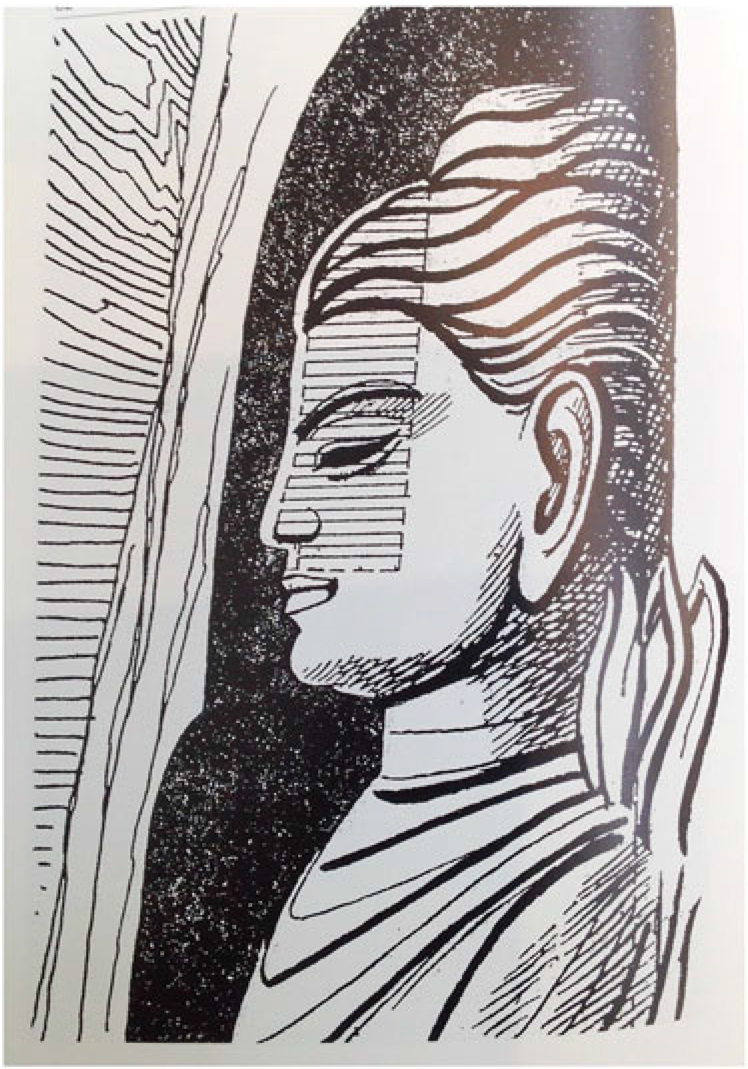
The return to ancient themes served two purposes for Brechna. First, it allowed him to extend a narrative of Afghanistan's history to beyond the onset of Islam and to a much earlier Greco-Buddhist past. And second, doing so allowed him to allude to themes (especially religion) and to practical methods (such as accentuated scale) that reflected his broader training with Fahrenkrog. For instance, in his 1940s rendition of ‘the Big Buddha's Facial Structure’ (see Figure 8), Brechna replaced the neat cuts on the Buddha's face with a reconstruction based on the account of Xuanzang (circa 602–664), the Chinese Buddhist monk and pilgrim.
Abdul Ghafur Brechna, ‘The facial feature of the large Buddha’, Kabul, 1940.
Source: Habibo Brechna et al., Buddhas und Menschen in Bamiyan.

Just as Fahrenkrog had done in ‘Baldur’, Brechna featured an oversized spiritual figure in which the side elements accentuate or point to the relevance of the figure. Brechna enclosed in the painting a historical argument that brought modern Afghanistan closer to its Buddhist roots through his theory regarding the cuts on the Buddha's face. Brechna argued that:
… everyone says that the orthodox people, probably the Moslems had cut the faces to disfigure the Buddhas. But in my opinion this was done by the artists at the time [it was constructed]. Otherwise, had it been cut because of religious fanaticism, without any doubt the cut would not look so clean and arranged standing at a height of more than fifty meters. But instead, the cut would look like the Buddha's feet which was destroyed by Auwrang Zayb [sic], son of Shah-e-Jahan, with a cannon, during his march to Balkh. It seems that this clean vertical cut was done very carefully by the expert builders and the upper part of his lips, nose, cheeks and forehead up to the top of its head was built with bricks and then covered by clay from the back. Since this part of the face was not cut like the other parts of the Buddha's body from the mountain; but built from bricks with the inside empty, it might have been ruined by time or easily destroyed from the back.Footnote 67
Brechna never explicitly assessed the assumed relationship between Afghanistan’s fine arts and the onset of Islam, but treated it with ambivalence. On the one hand, he critiqued the faltering progress of art during the reign of the Mughals and the pillage of South Asian cities, and on the other, he challenged the claim that in his rage against the Shiʿi Hazaras the (Muslim) Afghan Amir ʿAbd al-Rahmān Khān (r. 1880-1901) had deformed the standing Buddha’s face. By clearing Muslim Afghan rulers of any accusations that they had desecrated the Buddha, Brechna was, in a way, softening the sense of a ‘break’ with the pre-Islamic past in Afghanistan. Whatever the validity of Brechna’s claims, it is intriguing to note his impulse to ‘sell’ the idea of a pre-Islamic history. Instead of seeing the death of Bihzād as a rupture leading to the decline of Afghan arts, as was the scholarly consensus among his contemporaries, Brechna smoothed out many of the bumps between the past and the present.Footnote 68
Brechna’s blending of multiple themes and methods continued across his literary oeuvre, which exhibited a similar tendency to comment on the role of more traditional lifestyles and their place in ongoing debates in the context of the changing global economy. Just as we observe a range of artistic styles, his writings, too, span short stories, folk materials in the form of afsāna (tales), theatrical plays, and music compositions.Footnote 69 His writings can be classified into two categories: those written for state journals and those he wrote in a private capacity with a much wider audience in mind. An example of the former would be the 1970 play titled ‘Haji Mirwais Khan: A Historical Play in 3 Scenes, 17 Acts’. Clearly designed for his patrons in the Afghan government, the play portrays the military campaign of Mīr Vays Khān Hūtak (1673-1715), the founding head of the Ghilji Pashtun from Qandahar. The play traces Hūtak’s revolt against the Safavid dynasty and conquest of Qandahar in 1709.Footnote 70
An example of a perhaps much more independent form of writing is a 1967 short story, Jādah-yi Āfyūn (Road to Opium), passed on to Brechna during one of his travels.Footnote 71 The story recounts how an Afghan traveller made the acquaintance of a former British agent and became familiar with his activities on the North-West Frontier of Afghanistan. Mr Knox, known by his undercover name of Muhmān Khān to the villagers, had initially received in-depth training in Pashto and was resident in a small village near Peshawar. His task was to learn about the internal kinship structures of this village, befriend the leader, and persuade the village to abandon wheat and maize, and instead grow rapeseed (gul-i sharsham) (commonly used to fuel biodiesel in Europe). When he succeeded, and had earned the trust of the town elders, the town made money from selling their harvest in nearby Peshawar to the British companies there.
When the practice of growing rapeseed became common, the companies stopped buying from this village, demanding that its residents allow the British to construct roads instead. The villagers were told that rather than having their seeds transported by animal stock (damaging the seeds in the process), newly constructed roads would enable safer transport via caravans and cars. The story traces the internal struggle of the British agent who, on the one hand, feels obligated to continue concealing his identity and work undercover for the British Crown, but is also conscience-stricken about guiding the villagers to contribute to British mercantile activities.
Brechna used the story as a lens through which to assess how the arrival of modern infrastructure disrupted the villagers’ way of life, focusing instead on the ways in which village life was organized, the community’s knowledge of the land, and their unique agricultural practices (in many cases developed by women of those towns). Through these internal descriptions, Brechna reconceptualized what was considered ‘modern’ and what was not. Most importantly, Brechna used the inversion of gender roles as a moment to consider the role of women and mothers in agrarian economies. For example, when the villagers’ lands were threatened by internal strife, men fulfilled domestic tasks, forcing women to work the land and manage their staff, knowing that competitors would not commit violence against women.
In Jādah-yi Āfyūn, Brechna explored Afghan themes and offered commentary on the kind of lifestyles considered ‘traditional’ and detached from Kabul or other metropolitan areas in the 1960s. Among Brechna’s contemporaries, novels about British engagement in Afghanistan were commonly set in urban areas, yet he made an explicit stylistic choice to locate the novel outside that often-used literary feature.Footnote 72 His story, especially in the attempt to capture historic memory through folktales and through an Afghan village’s experience of British imperialism, points to his desire to revive traditional narratives such as the qissah, afsānah, and rivāyāt (novels), but permeate a classical genre with commentaries on an ever-changing political and economic landscape. These revivals are especially important in the context of the 1960s, which saw the diminishment of vernacular forms of stories.Footnote 73 ‘A rapidly expanding urban social state, with a new conception of leisure time, were overwhelmingly receptive to the emergent forms of prose fiction.’Footnote 74 New channels for printing and distributing led to the publication of new books, including the translation of European genre novels and short stories into Persian, and their importation from neighbouring places, resulting in a larger readership throughout the country.
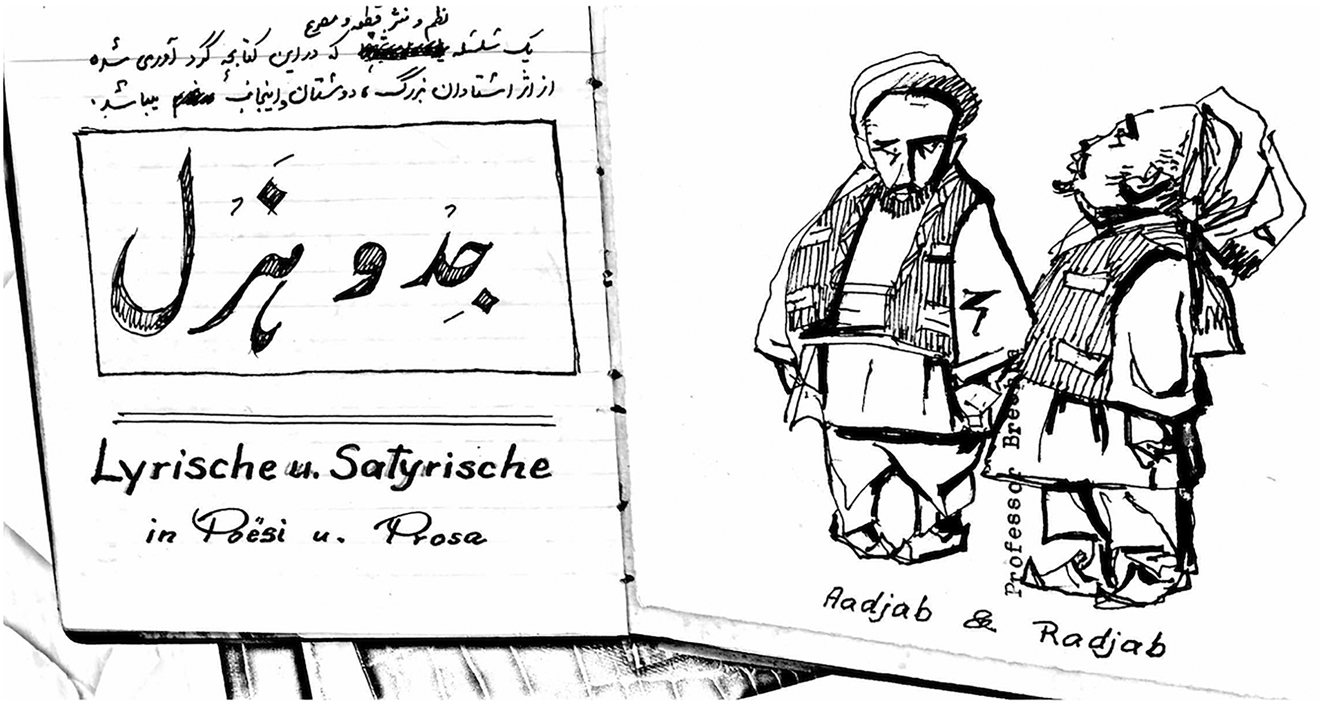
It may be too much to say that Brechna developed a fully fermented public sphere. However, both his official and non-official activities worked to create a space for artists and the public to communicate—significantly a public that extended beyond urban areas. Brechna offered a social and political critique that worked to develop new national identities that did not always fit with official goals. He pushed against the status quo, for example, when in 1950, as co-director of Radio Kabul, he broadcast for the first time the voice of Mīrman Parvīn, a trained midwife whose musical aspirations had previously found no support in the class-conscious and male-dominated musical milieu.Footnote 75 Similarly, various humorous figures, such as ‘Ajab and Rajab’ (see Figure 9), critiqued the social hierarchies within Afghan bureaucratic systems.
Abdul Ghafur Brechna, ‘Djad wa Hazal’, Kabul, circa 1940s. Source: Brechna Archive, Germany.

Such examples shed light on Brechna as mediating a new historical practice, redrawing the multiple boundaries of the Afghan artistic past and yet critically managing to maintain some independence from the various intellectual institutions collected under the Afghan nation's cultural and literary umbrella. During his student years, he seems to have been mostly drawn to the work of painters who sought a return to the ancient past in the search for solutions to the myriad crises facing artists in the fin-de-siècle period. Brechna began by following the conventions of romantic paintings, only to later depart from them on his own terms. These departures or translations were manifested in his desire to not merely connect to medieval figures such as Bihzād, but also to interweave themes and methods that a wider range of Afghans recognized in the context of distinctively Afghan knowledge systems. His interventions included coming to terms with urban changes and wielding these through sophisticated agrarian-based kinship structures, for example. He rethought and subverted the dichotomy between the modern and traditional, and blurred their implicit boundaries to reflect his own imperatives and own local choices.
Conclusion
This case study, with an emphasis on the global and regional circulation and translation of art, shows one of the many ways in which young Afghans in the 1930s and 1940s grappled with state-building, history making, and knowledge production. Tracing the journey of the itinerant Afghan student Abdul Ghafur Brechna suggests a different approach to studying the role of non-diplomatic actors in crucial processes of building a new state. Brechna's journey to Europe may have begun as a state-sponsored programme that aimed to train a new class of technocrats, but what this article has shown is that the students’ ambitions exceeded and reworked the terms of the geopolitical arrangements. The Afghan Ministry and authorities in Berlin were not so firm in their steering of Brechna's journey, nor were they able to manage how he engaged with European art.
Rather, Brechna selectively and carefully identified the kinds of influences that echoed his own vision for the fine arts. A bilateral emphasis on Afghan-German internationalism does not fully account for how Afghan students forged and moved through transcultural spaces where they met, collaborated, and negotiated the limits of modernity. In this, I do not suggest ignoring the significance of state and nation-building to the history of modern Afghanistan, nor to simply repackage the historiography of this process with a new transnational focus, as if the two could be so easily divorced. Rather, the examination of a non-diplomatic actor who played such a crucial role in the process of knowledge transfer, while embodying contradictory fears about national decline and renewal, demonstrates that skills and expertise accrued from Western training do not necessarily translate into the erasure of the past. Mediating between a variety of media, colours, political regimes, and even cultures, Brechna responded to global fears concerning state- and nation-building inherent in the early twentieth century. He did so by ‘rediscovering’ and translating an artistic legacy that was not merely for the purpose of cultural preservation but also for public consumption and memory. Specifically, by refusing to classify his work within neat categories of ‘modern’ and ‘traditional’, he declined to work within them and instead proposed a conceptual framework that argued for a revival and amalgamation of different artistic traditions that were recognizably and distinctively Afghan, even though they were enriched by external dialogue.
This article provided snapshots of a wide range of political, cultural, and literary activities seeking to restore Afghanistan to it supposed rightful place at the centre of regional cultural production. As many new studies on Afghanistan have shown, the country was embedded in wider circulatory patterns, especially with its neighbours. By investigating Brechna's use of modern artistic themes and techniques in reintegrating (or rediscovering) the fine arts in the history of Afghanistan, this article has taken the conversation into more global terrain and outlined the circulation and translation of knowledge between Europe and Afghanistan. Yet, it has also addressed the somewhat classical conundrum of working with European sources about innovation, technology, and science—about modernity, in other words—without attributing to ‘the West’ the role of master or confining ‘the Rest’ to the role of disciple.