1. Introduction
Similar languages arise due to language variations and changes. Language variations are the different ways language is used, including by different speakers and by same speaker in different contexts. Thomason (Reference Thomason1997) claims that language changes always lead to language variations, which of course include the existence of similar languages. Language variations, however, can also lead to language changes when a specific variant form becomes widely accepted or when two varieties become sufficiently different. This complex interplay between variations and changes underlines several inherent challenges to the processing of similar languages. The first is how to define “similar languages”? Note that classic variables relating to the language producer are geographical, stylistic, and social in nature (Krug, Schlüter, and Rosenbach Reference Krug, Schlüter and Rosenbach2013). Which variable should be used as the primary criteria for similar languages? And if geopolitical or other variable is taken as the principle criteria, should different versions of the “same” language through the history be considered as similar languages? The second challenge follows from the first one. Can classification of similar languages be done effectively when each variety contains a wide range of variations, including variables that may in fact favor treating subsets of texts from both varieties as more similar to each other than with others in the “same” language? The third challenge involves data and hypothesis, especially given the predominance of machine learning and other data-driven approaches in natural language processing. That is, when two similar languages (defined by, say, geopolitical differences) are successfully classified, how do we know that our classifier is in fact classifying this difference and not, for instance, genre or register differences? This paper attempts to tackle these foundational issues in similar language processing by classifying different genre variants in two Chinese varieties from Mainland and Taiwan. In other words, texts can differ from each other both based on geopolitical and genre differences. Such design is possible, and text-type bias from training data is eliminated by selecting texts from comparable balanced corpora of Mandarin Chinese from both regions.
The new approach we propose in this paper is based on the following observation: A linguistic unit containing the linguistic feature used for automatic classification may or may not occur in a text depending on the topic, style, etc. of the text. Hence, there is no guarantee that a linguistic feature-based system can effectively classify language varieties. However, the distributional relation between a linguistic unit and its constituents will always be there. Hence, a classification model based on such distributional patterns in a text should be more robust and more effective. This observation can be elaborated with the issues involving selection of features for classification. Although feature selection is less crucial in fully automatic machine learning, yet such classifiers cannot automatically differentiate types of differences. That is, they do not know if two texts are different because they are from two different varieties, or genres, or authors, or historical periods, etc. Hence, it does not have advantage in a specific task such as classification of similar languages. Other typical textual classification approaches, however, do rely on selection of parametric features. Yet it is challenging to identify features with differentiating powers that are at the same time linguistically significant, frequent enough to be found in all textual types regardless of text size, and cannot be either highly topic-dependent or easily manipulated conscientiously.
1.1 Quantitative approaches to classification of linguistic texts
Quantitative methods have proven to be efficient in resolving many practical questions (Pawłowski and Eder Reference Pawłowski and Eder2015) in spite of the lack of ontological and linguistic justification for the selection of these parameters. For classification of linguistic texts, length distribution of different linguistic units has been the most widely utilized linguistic properties since the end of the 19th century. Most crucially, these features are present in any text regardless of textual type, and they are not to be consciously manipulated in the variations among similar languages. Most investigations on sentence length before the beginning of the 20th century focused on stylistics. This trend persisted until studies directed their interest toward searching for models of sentence length distribution (Köhler Reference Köhler2012). Sigurd, Eeg-Olofsson and Van (Reference Sigurd, Eeg-Olofsson and Van2004) found that the relative frequency distribution of sentence length in English could be approximated by formula (1), where L is the sentence length, F is the relative frequency of sentences with the corresponding length, and a, b, and c are the parameters. What the model in formula (1) captures is, in fact, that the length of sentence is an equilibrium between competing textual factors.
 $$\begin{equation}F = a{L^b}{c^L}\end{equation}$$
In other words, what Sigurd et al. (Reference Sigurd, Eeg-Olofsson and Van2004) postulate is that there is a parameterized relation between sentence length and frequency of sentence with that particular length. In adopting this formula, we further hypothesize that the parameters a, b, and c are the features that will vary and with unique values for each language or language variety.
1.2 Language as complex self-adaptive system
An emergent and synergetic perspective that accounts for the two above challenges in a single theoretical model is the view that language is a complex adaptive system, where both internal and external factors contribute to self-organization (Beckner et al. Reference Beckner, Blythe, Bybee, Christiansen, Croft, Ellis, Holland, Ke, Larsen-Freeman and Schoenemann2009). This complex adaptive system view provides a direct way to model language variations and changes (Wang Reference Wang2006). Complex adaptation with self-organization allows a system to maintain defining commonalities, while allowing subsystem or subunit variations. When the aggregation of adaptation and self-organization reaches a certain threshold, changes (e.g., formation of two different systems) occur. Given this view that each language variety is a complex adaptive system, different varieties can be identified either parochially by specific linguistic characteristics or globally by system-wide characteristics. Our hypothesis is that direct comparison of the system-wide characteristics is more effective than comparing selected specific features in each system for the identification of similar languages. Given that similar languages share many salient linguistic characteristics and behaviors, a feature-based classification system cannot simply compute similar versus different features. It has to be able to identify distinct features that are variety-dependent (and not topic or style-dependent) as well as frequent enough to be found in all textual types regardless of text sizes or topics. One of the most attested and best studied self-organizing features of language as complex system is the power function based on the Menzerath–Altmann law describing distributional features of constituents at different levels. Altmann (Reference Altmann1993) argues that this power function discovered in the study of language is also shared by other complex systems. This view is supported by several recent studies of other complex systems (e.g., Ferrer-I-Cancho and Núria Reference Ferrer-I-Cancho and Núria2010; Li Reference Li2011; Ferrer-I-Cancho et al. Reference Ferrer-I-Cancho, Núria, Antoni, Gemma and Baixeries2012; Eroglu Reference Eroglu2014).
However, the targeted testing data for real-world application in language technology tasks are typically not big enough to build a full model of complex system for comparison. Hence, we propose to use model fitting based on established (pre-trained) models. We fitted the clause length and word length distributions using the power function based on the Menzerath–Altmann law, which has been applied in Hou et al. (Reference Hou, Huang, Ahrens and Lee2019) to classify texts from different Chinese registers.
Formula (1) is a continuous model and is used to fit the sentence length distribution which is a discrete phenomenon. Wimmer and Altmann (Reference Wimmer and Altmann2005, Reference Wimmer and Altmann2007) demonstrated an effective way to model discrete phenomenon using continuous models and vice versa. Hou, Huang, and Liu (Reference Hou, Huang and Liu2019) showed that the sentence/clause length in Chinese texts can also be fitted by Formula (1) in variations of the Chinese language based on data from Mainland China.
Word length has been proven to be a crucial property of language as a complex system in corpus and quantitative linguistics (Grzybek Reference Grzybek2007), in spite of its being viewed as trivial in theoretical linguistics. Zipf (Reference Zipf1935) firstly showed that the high-frequency words are mostly short, and word length and word frequency are inversely related. Sigurd et al. (Reference Sigurd, Eeg-Olofsson and Van2004) showed that Formula (1) can fit the word length distribution reasonably well. This formula incorporates both the fact that the number of possible words increases with word length, and the fact that longer words tend to be avoided presumably because they are uneconomic for word length distribution. Deng and Feng (Reference Deng and Feng2013) showed that the word length distribution can be fitted by the exponential power function, y=ax -b, and the fitted parameters can distinguish the written and conversational texts of Mandarin. Hou, Yang, and Jiang (Reference Hou, Yang and Jiang2014) showed that word length can be used as the distinctive linguistic feature of the three registers which are News Broadcasting, TV Conversation, and Daily Conversation. In this paper, we propose to use both sentence and word length distributions to classify similar languages. This introduction of corpus and quantitative linguistics approach based on complex adaptive systems to language technology allows us to better understand that linguistic significance of similar languages and also to avoid potential biases introduced by either the variations contained in the training data or the nature of parameters.
1.3 Literature review
Language changes (as in historical linguistics and language evolution) and variations (as varieties of language and dialects) have been main concerns of linguists for centuries in many parts of the world and are the topics of research for classical linguistic studies. However, these early works tend to focus on sound and sound changes, tracing back to work by Pāṇini in 4th century BCE and Yang Xiong’s work in 1st century BCE (which established the Chinese term fangyan “dialect”). More recent theoretical studies are greatly influenced by seminal works by William Labov, who also started with sound changes. Labov (Reference Labov1969) was among the earliest theoretical work that addresses language varieties based on grammatical features. Following Labov, Tony Kroch (e.g., Kroch Reference Kroch1994) pioneered corpus-based quantitative approaches to language changes and variations. The focus of these studies, however, is on the generalizations accounting for how language changes and vary. Biber (Reference Biber1995) expanded the corpus-based approach to a general account to differentiate different language variants focusing on register-based differences. Ke et al. (Reference Ke, Minett, Au and Wang2002) was one of the earlier work to apply theory of complex adaptive system to language changes focusing on vocabulary. Similarly, earlier language engineering work on identification of language varieties also focused on vocabulary (e.g., Peirsman, Geeraerts and Speelman Reference Peirsman, Geeraerts and Speelman2010). There was scarcely any published automatic detection and classification work before the first VarDial worshop (Zampieri et al. Reference Zampieri, Tan, Ljubešić and Tiedemann2014) brought attention to computational work on similar languages and dialects, and the recent volume (Zampieri and Preslav Reference Zampieri and Preslav2019) showed that this research direction has made significant progress within a very short time. Most recently, in the 6th VarDial workshop, there are five shared tasks to classify similar languages and/or dialects, and Mainland and Taiwan Mandarin Chinese was one of the new tasks (Zampieri et al. Reference Zampieri, Malmasi, Scherrer, Samardžic, Tyers, Silfverberg, Klyueva, Pan, Huang, Ionescu and Butnaru2019).
Studies on Chinese as a group of similar language (e.g., dialects) can be traced back at least to Yang Xiong and lasted for nearly 21 centuries now. Studies of modern Chinese variations, especially between Mainland and Taiwan, have been ongoing for 20 plus years (Lin et al. Reference Lin, Shi, Jiang and Huang2018). Thirty-eight years of total isolation from each other between China Mainland and Taiwan did allow the language to develop into different varieties, which have become a popular topic for mainly lexical studies (Huang et al. Reference Huang, Lin, Jiang and Xu2014). A number of studies were carried out on lexical variations between these two varieties of Chinese, including variations in the meaning of the same word or using different words to express the same meaning (Xu Reference Xu1995; Zeng Reference Zeng1995; Wang and Li Reference Wang and Li1996). For example, in Taiwanese Mandarin, you (有) can function as a perfective marker indicating the actualization of a situation, especially in conversations, as shown in (1).

Speakers of Mainland Mandarin find this usage odd and even ungrammatical (Christensen Reference Christensen1994). Huang et al. (Reference Huang, Lin, Jiang and Xu2014) pointed out that there are few studies for the grammatical variations of Mainland and Taiwan Chinese partly because of the near identity of their grammatical systems and examined the differences of light verb usage in the Mainland and Taiwan Chinese. In the meantime, only a few studies were corpus-driven, and earlier ones also focused typically on vocabulary (Hong and Huang Reference Hong and Huang2008, Reference Hong and Huang2013) or linguistic accounts of grammatical variations (Huang and Lin Reference Huang and Lin2013). The first quantitative study to examine the differences between Mainland and Taiwan Chinese variations was most likely Huang and Lee (Reference Huang and Lee2008), which interestingly also adopted the system-wide properties of most frequent words in a text to differ sources of texts. This approach is effective but only applicable to larger texts and not applicable to the more commonly seen texts of a few hundred or thousand words. The first comprehensive feature-based classification was probably Huang et al. (Reference Huang, Lin, Jiang and Xu2014) from the first VarDial workshop. They applied the mono- and multivariate analysis approaches and focus on the classification of the usages of a specific linguistic construction (e.g., light verbs). This result was incorporated in Xu et al.’s (Reference Xu, Jiang, Lin, Shi and Huang2019) automatic classification with machine learning approaches. This approach was further developed into a hybrid clustering and classification method in Xu et al. (Reference Xu, Jiang, Lin and Huang2020) and is shown to be very effective for identification of linguistically significant subtle changes at the early stage of language variations. It remains to be seen if this minimal contrast driven approach can be leveraged for effective identification of big data. The main reason is that the feature-based linguistic differences between two varieties are often based on preferences instead of grammaticality. Finally, seven systems participated in the Discriminating between Mainland and Taiwan variation of Mandarin Chinese (DMT) shared task to classify Mainland and Taiwan Mandarin sentences in VarDial 2019. It is interesting to note that for classification of linguistic units, the best two teams apply very different strategies. Jauhiainen, Lindén and Jauhiainen’s (Reference Jauhiainen, Lindén and Jauhiainen2019) naïve Bayesian classifier using character n-gram has similar results as Hu et al.’s (Reference Hu, Li, Zhou, Tian, Zhang and Zou2019) ensemble word-embedding approach. Both report best result at precision of just above 0.90.
Quantitative linguistics is one of main streams of Mathematical linguistics. In Chinese, mathematical and quantitative aspects of language were observed and considered. For example, Huang (Reference Huang1989) explored the basic mathematical properties of Chinese in terms of complexity. Huang, Chen and Gao (Reference Huang, Chen and Gao1998) showed that mathematical properties in natural languages have both theoretical and application implications. Ke et al. (Reference Ke, Minett, Au and Wang2002) modeled vocabulary development as an adaptive system. And Neergaard and Huang (Reference Neergaard and Huang2019) model the phonological/syllabic structure in Chinese as a complex system of small world.
In terms of modeling language, it is common to model the frequency distribution of the length of a linguistic construct in quantitative linguistics (Feng Reference Feng2012, Liu and Huang Reference Liu and Huang2012). This was both intuitive and practical, especially considering the fact that quantitative linguistics developed before language corpora with linguistically felicitous annotations are available for multiple languages. Several probability models of linguistic construct length distribution were proposed in the 20th century. As noted by Best (Reference Best2002), “if length is a variable, its different values occur in texts in certain proportion, that is, they are lawfully organized.” Sigurd et al. (Reference Sigurd, Eeg-Olofsson and Van2004) was the first to tackle the representation and interpretation of the relationship between frequency and language unit length. His formula F = aL b c L , as introduced earlier, can approximate the observed frequency distributions of sentence and word length reasonably well. Subsequent works related to modeling sentence length include Popescu, Best and Altmann (Reference Popescu, Best and Altmann2014). They studied the lengths of different linguistic units and proposed a model based on the Zipf–Alekseev function. The model represents the state of language and the force of the speaker/writer controlling the changes and captures the equilibrating effort of the hearer/community.
Previous researches on Chinese sentence length and word length have established its relevance to the prediction of Chinese register in Mainland variety of Chinese. For example, Liu and Hu (Reference Liu and Hu2011) studied the sentence length distribution in terms of words and concluded that this distribution can differentiate spoken news texts from written-to-be-read news. Hou et al. (Reference Hou, Yang and Jiang2014) examined sentence length distribution in terms of words and word length distribution in terms of Chinese characters in order to distinguish formal written style and daily informal style based on text clustering. Hou, Huang, and Liu (Reference Hou, Huang and Liu2019) modeled the sentence length using Formula (1) and proved that the fitted parameters of the sentence length distribution can differentiate different register texts in Mainland variety of Chinese.
1.4 Research question and methodology
We propose an approach based on distribution of length of linguistic units to classify Mainland and Taiwan varieties of Mandarin Chinese with three important goals in mind. The first is to take on the challenge of identification and classification of language varieties in a language with little morphosyntactic cues. Note that although by convention, Mainland and Taiwan do use different orthographic variants: simplified versus traditional Chinese. Yet on one hand, recent opening up allows mutual influence and frequent citation and adaptation of sources from the other varieties, hence the orthography is no longer a reliable criteria for identifying varieties. On the other hand, using orthography will render the task trivial and irrelevant as a linguistic study. Thus, we do convert both sets of data to the same orthography convention, just like the DMT task reported in Zampieri et al. (Reference Zampieri, Malmasi, Scherrer, Samardžic, Tyers, Silfverberg, Klyueva, Pan, Huang, Ionescu and Butnaru2019). This setup means that our study will be among the first to focus on identification and classification of similar languages with minimal conventionalized linguistic cues. Second, as mentioned above, we model a language as complex adaptive systems and hence use system adaption features instead of parochial linguistic differences to classify two varieties. If successful, we will not only enhance this synergetic view of language sciences but also establish a robust, versatile, and language-independent approach to the identification of language varieties. And following this approach, we can also begin to tackle a third and hitherto not addressed issue: the relation between concept of varieties of language and registers/genre of the same language. Traditionally, linguists treat variants of the same language (dialects, non-standard varieties) and registers/genre as different conceptually. Yet, from an empirical and corpus-driven perspective, it is not necessarily so a priori. In this study, we will classify two varieties of Chinese in two different genres (as extracted from two balanced corpora). This two-by-two design will allow us to take a first look into the possible correlation between varieties and genres in language.
More specifically, the power function of length distribution of linguistic units is adopted to model Mandarin Chinese varieties in Mainland and Taiwan and for their comparison. The sentence length distribution and word length distribution were calculated and were used to represent the texts from these two varieties. The text classification was used to examine whether there are differences between these two varieties. The correspondence analysis was selected to verify the conclusion from the classification analysis and demonstrated the differences. At the same time, texts from two genres were selected from both varieties as compounding factor for classification. Then, these distributions were fitted by Formula (1). The texts were represented by the fitted parameters and classified.
We use the open source programming language and environment R (R Core Team 2016) to realize text classification, correspondence analysis, and the fitting procedure experiments. Text classification is a supervised learning method and determines categories, which have been set, of the texts whose categories are unknown. If the classification model based on some linguistic characteristics performs well, these characteristics have distinctiveness for the categories that have been known. The categories of the texts are Chinese Mainland and Taiwan varieties in this paper. The linguistic characteristics are clause and word length distributions and their fitted parameters. Correspondence analysis can show the distances between texts from different and similar Chinese varieties and the differences of the usage of linguistic characteristics.
Support vector machine (SVM) was used to classify the texts, and twofold cross-validation was used to validate the classification results. If the classification model can yield a reasonable classification performance, we can expect that there are some differences between these two Chinese varieties in corresponding linguistic characteristics. In order to avoid the contingency, the twofold cross-validation was run 10 times repeatedly. The average value of classification error rates (Stamatatos, Fakotakis, and Kokkinakis Reference Stamatatos, Fakotakis and Kokkinakis2001), that is, erroneously classified texts/total texts, was used to validate the classification result. The visualization was to demonstrate the result of correspondence analysis. Nonlinear regression analysis, a machine learning method, is used to fit the frequency distributions of sentence/clause length and word length in the different Chinese varieties from Mainland and Taiwan.
2. Comparable balanced corpora as experimental data: Lancaster Corpus of Mandarin Chinese and Sinica Corpus
Previous NLP studies on classification of similar languages typically either only control regional variations or tightly control the data on similar languages to one single text type. For instance, the most comprehensive task on similar languages, reported in Malmasi et al. (Reference Malmasi, Zampieri, Ljubešić, Nakov, Ali and Tiedemann2016), focused on short news texts. In this study, we would like to go beyond current methods by 1) comparing the effectiveness of classification of similar languages with previous studies on classification of texts from different genres/registers and 2) exploring the possibility of having the same algorithm to identification and classification of language similarity across different variables. To achieve these two goals, we propose to study a pair of similar languages based on two comparable balanced corpora. The use of balanced corpora allows us to compare different text types in parallel to the comparison of regional variants as well as to directly compare the results of classifying regional variants with or without matching genres.
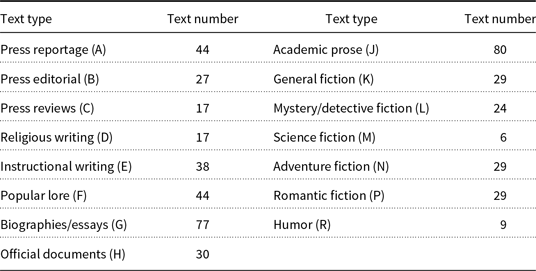
The Lancaster Corpus of Mandarin Chinese (LCMC) is a Chinese match for the Freiburg-Lancaster-Oslo/Bergen Corpus (FLOB) and Frown corpora of British and American written English (McEnery and Xiao Reference McEnery and Xiao2004). LCMC is a one-million-word balance corpus of written Mandarin Chinese. It contains five hundred 2000-word samples of written Chinese texts sampling from 15 text categories published in Mainland China around 1991, totaling one million words. The corpus is segmented and POS (Part of Speech) tagged with a tagging precision rate of over 98%. There are three categories of news texts in LCMC which are Press reportage, Press editorial, and Press reviews. Press editorial and review have similar language usage because both of them are the comments of news events. A summary of the LCMC corpus is presented in Table 1. The three news text types were selected to represent the Chinese variety of Mainland. The texts from press editorial and press review were combined to represent the press review.
Type and token of texts in the LCMC

Academia Sinica Balanced Corpus of Modern Chinese (Chen et al. Reference Chen, Huang, Chang, Hsu, Park and Kim1996) contains five million words of Mandarin Chinese as used in Taiwan in the 1990 s. The texts of this corpus were segmented and POS tagged. The two genres texts, reportage and review, were selected to represent the Taiwan varieties of Chinese. These two genres texts from LCMC and Sinica corpus were selected for this study to explore the robustness of our approach and to explore the issue of nature of regional varieties versus generic differences. Previously, Štajner and Mitkov (Reference Štajner and Mitkov2012) compared the diachronic stylistic changes of same genre in the different varieties of English in the 20th century based on the assumption that cross-genre comparison could lead to invalid results. By selecting texts from two genres from these two varieties of Chinese, we will be able to rule out that compare the classification results to ensure that our classifier is indeed differentiating the texts according to their regional varieties and not by other coincidental features similarities, such as genre. Accordingly, 88 texts, including 44 reportage texts and 44 review texts, were selected from Sinica Corpus and LCMC, respectively, to compare the corresponding text types in Chinese Mainland and Taiwan varieties.
3. Experiments
3.1 Sentence length as the linguistic characteristics to differentiate texts from the two varieties
The sentence, as the maximal grammatical unit and minimal statement unit, is considered to be a basic linguistic unit in all languages. A sentence in Chinese text, however, is not easily delineated for lack of a reliable convention to mark the end of sentence, and because of frequent omission of sentential components, such as subjects and predicates (Huang and Shi Reference Huang and Shi2016). Consequently, Chinese sentences are often defined in terms of characteristics of speech rather than texts (Lu Reference Lu1993, Huang and Shi Reference Huang and Shi2016). Chao (Reference Chao1968) and Zhu (Reference Zhu1982) offer similar definitions that rely on pauses and intonation changes at the boundaries of sentences. A common approach for identifying sentences in syntactically annotated corpora (e.g., Chen et al. Reference Chen, Luo, Chang, Chen, Chen, Huang and Gao2003 for Sinica TreeBank) is to mark all segments between punctuation marking pauses in utterances as sentences. Such punctuation marks include commas, semicolons, colon, periods, exclamation marks, and question marks. Wang and Qin (Reference Wang and Qin2014) and Chen (Reference Chen1994) also adopt this operational definition and call such units sentence segments. Wang and Qin (Reference Wang and Qin2014) considered the lengths of sentence segments to be relevant to language use in Chinese. In fact, these sentences (by Chen et al. Reference Chen, Luo, Chang, Chen, Chen, Huang and Gao2003) and sentence segments (by Chen Reference Chen1994; Wang and Qin Reference Wang and Qin2014) are roughly equivalent to clauses (Hou et al. Reference Hou, Huang, Do and Liu2017). With the units of clauses determined, it is necessary to next define operational criteria for measure their lengths in Chinese. In quantitative linguistics, it is common to measure the length of a linguistic construct (in this case, the clause) as the number of its direct or indirect constituents (i.e., words, Hou et al. Reference Hou, Huang, Do and Liu2017). Although word boundaries are not conventionally marked in Chinese texts, they are clearly delineated in tagged Chinese corpora such as Sinica Corpus and LCMC.
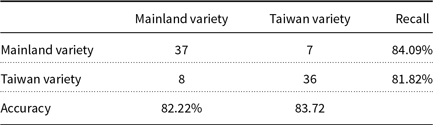
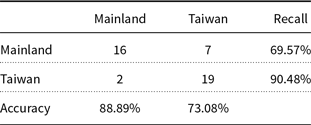
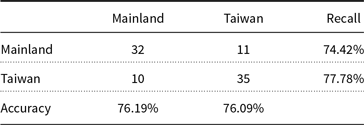
Clause length frequency distribution, measured as the number of words, was studied firstly. The texts from two geographical varieties were represented by clause length distribution. The classification model was established using SVM algorithm. In Holdout validation of the classification result, the rate between training texts and testing texts was set to be 1:1. The classification result is as shown in Table 2, in which the classification accuracy rate is 82.95%. The classification result has big contingency in holdout validation. Then, the twofold cross-validation was used to validate the classification result. The average accuracy rate was 79.54%. The twofold cross-validation was repeated 10 times in order to avoid the contingency. The average value of classification error rates was 21.7%, the maximum value was 26.7%, and the minimum value was 18.18%, respectively. From these two validations, the classification result is satisfactory.
The classification result of the texts from Mainland and Taiwan varieties of Chinese

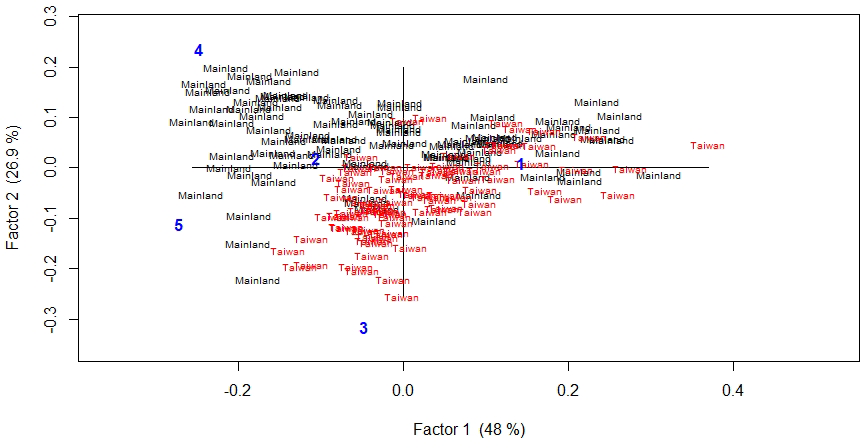
Correspondence analysis was used to provide a low-dimensional map of the data (Baayen Reference Baayen2008). In correspondence analysis, the distances between rows, and the distances between columns, were calculated firstly. The so-called chi-squared distance was used to compute the distance between texts. Then, these distances were represented as faithfully as possible in a two-dimensional scatterplot: a low-dimensional map. The larger the distance between two rows (columns), the further these texts should be apart in the map for rows (columns). Similar rows and columns should be near to each other. The attractiveness of correspondence analysis resides in the possibilities it offers for visualization. From the visualization, we can explore whether there are differences of clause length usage between these two Chinese varieties from Mainland and Taiwan.
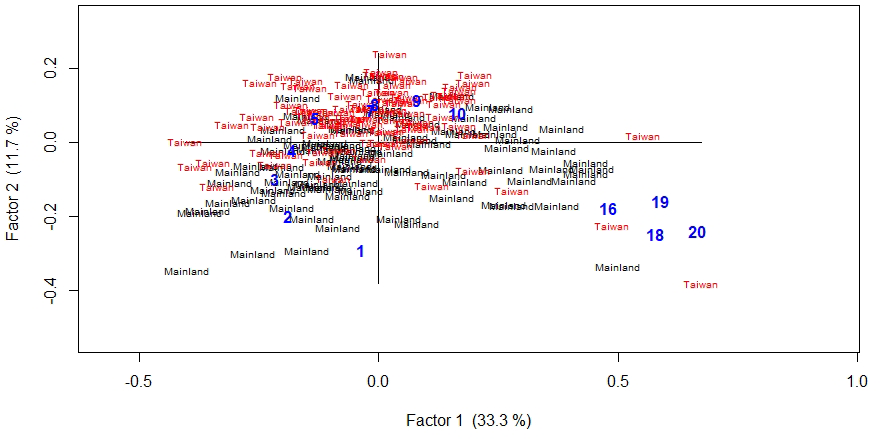
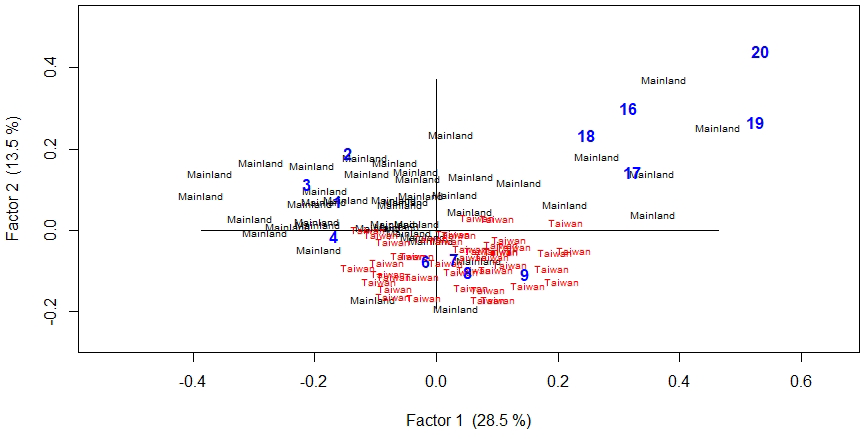
Then, correspondence analysis was used to analyze these texts represented by the clause length distributions. The result of analysis is shown in Figure 1.
The correspondence analysis result of the texts represented by the clause length distribution (Mainland and Taiwan refer to Mainland and Taiwan varieties of Chinese, respectively, all figures).

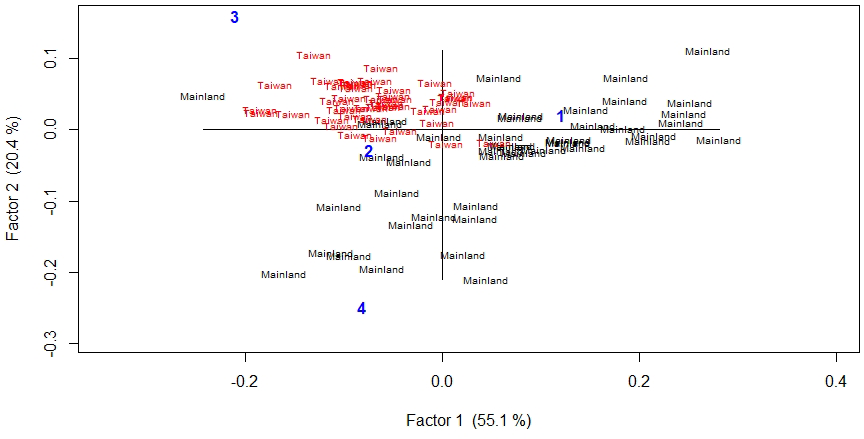
From Figure 1, we can see that there are not clear boundaries between these two varieties texts. The clause lengths concentrated on 6, 7, and 8 words in Taiwan variety texts, while the clause lengths are relatively disperse in Mainland variety texts.
We then test whether such classification results are genre-dependent. Reportage texts from both varieties are selected. They are represented by the clause length distribution and correspondence analyzed. The result of correspondence analysis of reportage texts from Chinese Mainland and Taiwan varieties is shown in Figure 2. From Figure 2, there is a relative clear separation boundary between these two varieties texts from the same genre, that is, reportage. The clause length concentrated on 6, 7, 8, and 9 words in reportage texts from Taiwan variety of Chinese.
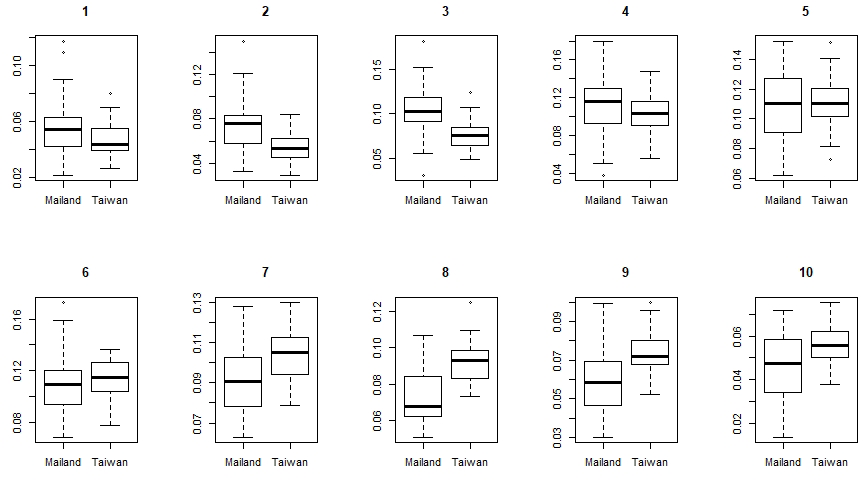
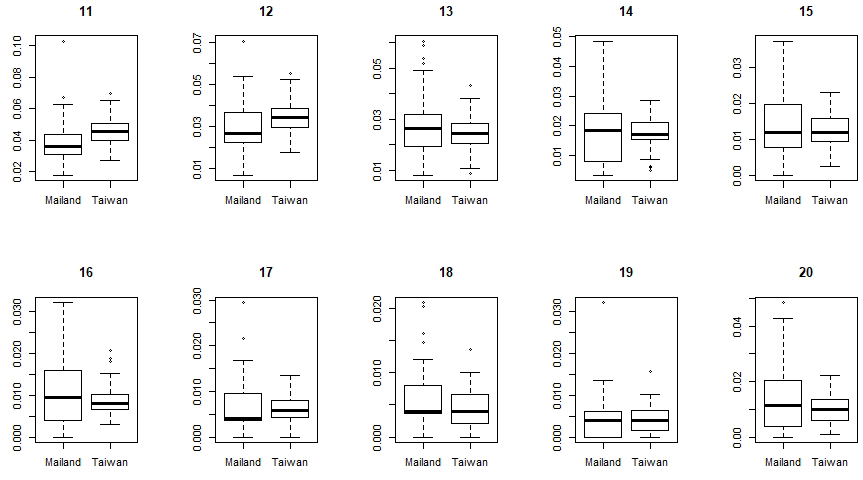
The clause length distribution is represented by the matrix with 88 rows and 20 columns because there are 88 reportage texts in two Chinese varieties from Mainland and Taiwan. The boxplots were used to demonstrate the relative occurrence frequencies of the clauses with certain length in texts from each variety, as shown in Figure A1 and A2 in Appendix 1. There is a larger change in the relative occurrence frequency of clause with each length in reportage texts from Mainland than that from Taiwan. This means that the clause length distributions in reportage texts from Taiwan variety are consistent. Combined with Figure 2, compared with the reportage texts from Mainland variety, the clause length distributions in reportage texts from Taiwan variety are more concentrated and consistent. Maybe the reportage texts from Taiwan are more formal than the reportage texts from Mainland. The different formality between these two varieties reportage texts leads to the differences of clause length distributions.
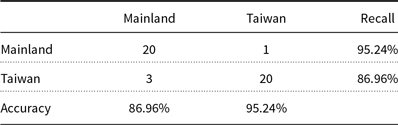
SVM was again used to establish classification model for reportage texts from Mainland and Taiwan. The holdout method was used to validate the classification result firstly. The rate between training texts and testing texts was set to be 1:1. The classification result is shown in Table 3. The accuracy rate was 93.18%. Then, the twofold cross-validation was used to validate the classification result, and the average accuracy rate was also 93.18%. The twofold cross-validation was repeated 10 times. The value of average classification error rates was 8.41%. The maximum and minimum values of classification error rates were 10.23% and 6.82%, respectively. The classification result, in which the two varieties texts were from the same genres, was better than the above classification result. This result shows that classification of regional variants of similar language could be compounded by different genres.
The classification result of the reportage texts from Mainland and Taiwan

The result of correspondence analysis of reportage texts of the Chinese varieties from China Mainland and Taiwan.

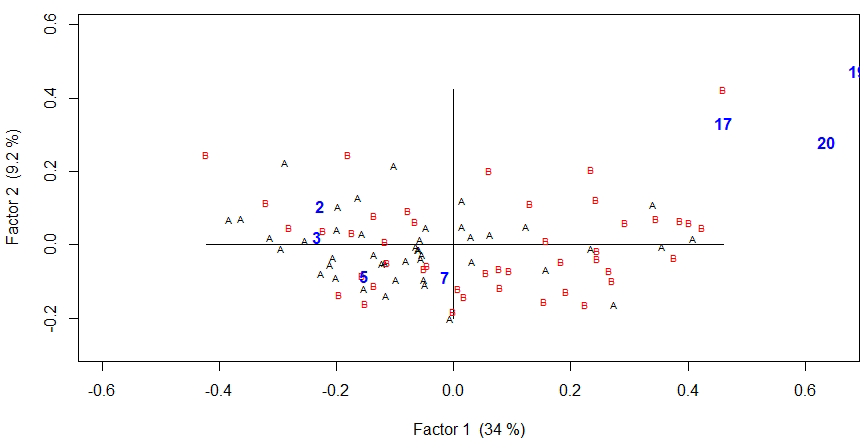
Then, we considered the differences between the reportage texts and review texts in LCMC representing the Chinese Mainland variety. Similarly, correspondence analysis was used to analyze the difference between reportage and review texts from Mainland in terms of clause lengths. The visualization of correspondence analysis in Figure 3 shows that clause length distribution cannot differentiate these two genres from Mainland China. The fact that clause length distribution fails to differentiate two types of press texts within the same variety of Mandarin suggests that they are more similar to each other than two varieties. It also suggests that the classification of two Mandarin varieties by clause length is not accidental and that the classification is capturing some systematic differences that are not necessarily present between other types of variations.
The result of correspondence analysis of the texts from Mainland (“A” represents the reportage texts and “B” represents review texts).

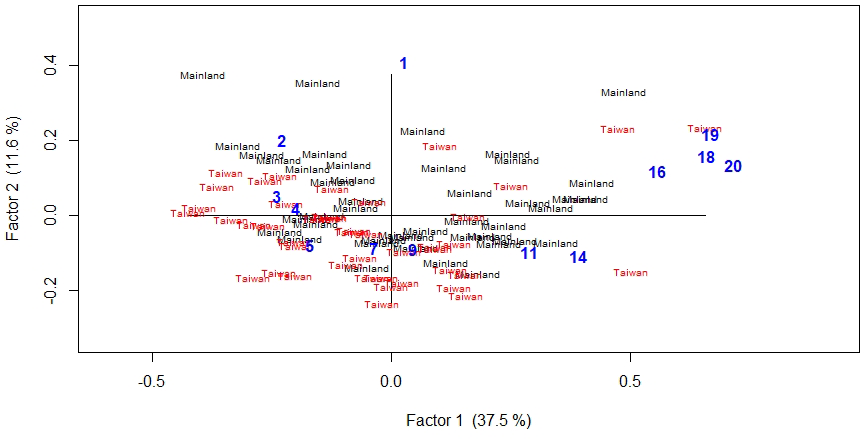
Lastly, we examine the differences of clause length distributions of review texts from the Chinese Mainland and Taiwan varieties. Correspondence analysis was used to analyze the texts represented by the clause length distribution. The result was shown in Figure 4.
The result of correspondence analysis of review texts of the Chinese varieties from China Mainland and Taiwan.

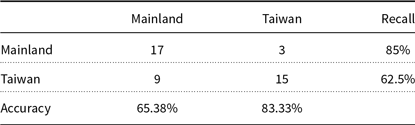
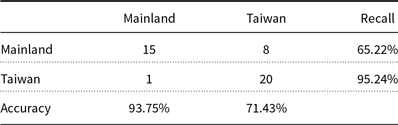
SVM was used to establish classification model to classify review texts according to their varieties. The rate between training texts and testing texts was also set to be 1:1 when holdout method was used to validate the classification result. The holdout was repeated more times. The maximum value of the classification accuracy rates was 72.73% as shown in Table 4.
The twofold cross-validation was repeated 10 times. The average classification error rate was 33.52%. The maximum and minimum values of classification error rates were 48.86% and 27.27%, respectively. The classification result shows that the clause length distribution performs worse with review texts, compared with the classification results of reportage texts as well as overall results. It is reasonable to assume that the better classification results of reportage text compensated the result of review texts in the general task. The differences in these classification results suggest that our classifier classified the texts according to their nature as regional varieties, and not according to other characteristics such as genre. However, the results also showed that not all genres are equal and the degree of variations between these two varieties may vary across different types of texts. That is, each variety is a complex system as an aggregation of different genres, registers, topical areas, etc. As a complex system, the two varieties do not evolve in parallel and some types of texts may vary greater and faster than other types. Hence, text types, such as genres, should not be ignored for finer-grained studies on classifications of similar languages.
3.2 Fitted parameters of the clause length distribution
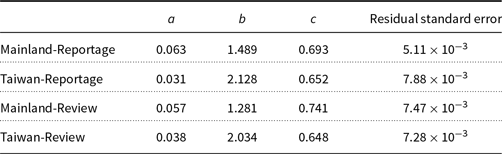
The clause length distribution in Chinese Mandarin can be fitted by Formula (1) from Hou, Huang and Liu (Reference Hou, Huang and Liu2019). Then, the texts can be represented by the fitted parameters, a, b, and c, of the clause length distribution. The fitted parameters can further reveal the deep characteristics of language usage. For example, b determines the clause length in which maximum frequency of clause is highest, and c represents the decreasing effect of clause length where 0 < c < 1. It is not controlled by the speaker consciously. Sigurd et. al (Reference Sigurd, Eeg-Olofsson and Van2004) expected the fitted parameters are of values in stylistic studies. We will examine whether the fitted parameters can differentiate these two Chinese varieties from Mainland and Taiwan, respectively.
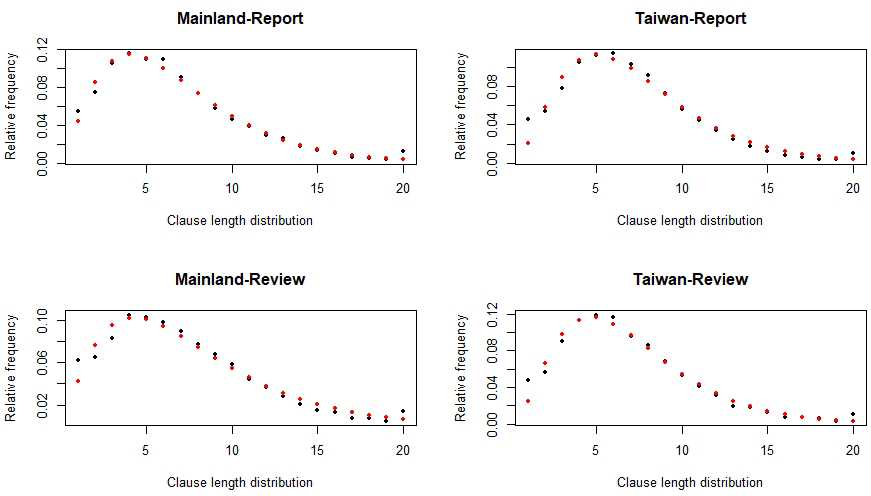
Formula (1) was used to fit the clause length distributions of the reportage and review texts in the two Chinese varieties, respectively, using nonlinear regression. The fitted results were shown in Figure 5 and Table 5. Figure 5 showed that there are small differences between the fitted and observed values of the relative frequency of clause. Table 5 showed the fitted parameters of clause length distribution in different genres and different Chinese varieties in China Mainland and Taiwan. Figure 5 and Table 5 showed that the clause length distribution can be fitted by Formula (1) fairly well.
The classification result of the review texts from Mainland and Taiwan (maximum classification accuracy rate, 72.73%)

The fitted results of the clause length distribution in the two Chinese varieties.

The fitted results of the clause length distribution in the two Chinese varieties

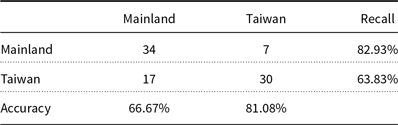
The fitted parameters, a, b and c, were used to represent the texts from the two Chinese varieties in Mainland and Taiwan. The fitted parameters show that distance between two regional varieties is greater than the distance between two genre varieties of the same regional variant. The SVM was used to establish the classification model. Holdout method was used to validate the classification result firstly. The accuracy rate of classification was 72.73% when the rate of training texts and testing texts was set to be 1:1, as shown in Table 6.
The classification result of the texts in two Chinese varieties

The twofold cross-validation was also used to validate the classification result. The average accuracy rate of classification was 76.7%. The twofold cross-validation was repeated 10 times, and the average classification error rate was 28.30%. The maximum and minimum classification error rates were 30.68% and 25.57%, respectively. Compared with the clause length distribution, the fitted parameters of them do not better differentiate these two Chinese varieties from Mainland and Taiwan.
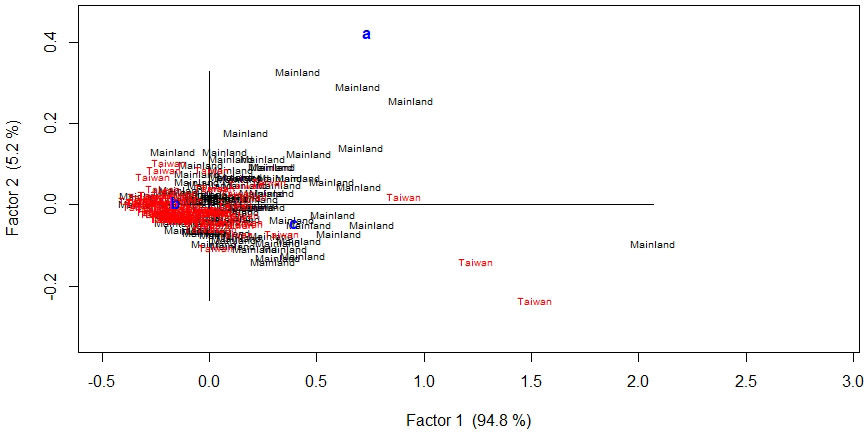
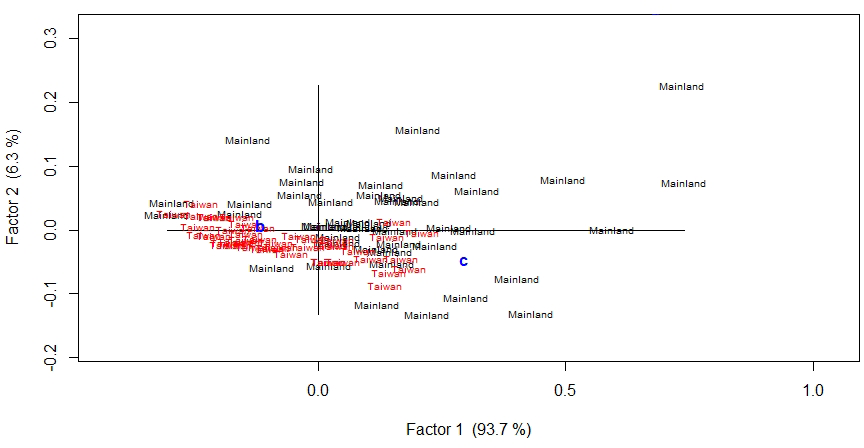
The correspondence analysis was used to analyze the texts from Chinese Mainland and Taiwan varieties. The result of correspondence analysis was shown in Figure 6. From that, there are differences of the fitted parameters of the clause lengths distributions in Chinese Mainland and Taiwan varieties. This difference was reflected in three parameters from Figure 6.
The result of correspondence analysis of all texts from the two Chinese varieties.

Then, we selected the reportage texts from the two Chinese varieties from Mainland and Taiwan. Similarly, the fitted parameters of clause length distribution were used to represent each text. The SVM was used to establish the classification model. The rate between training and testing texts was set to be 1:1 when holdout method was selected to validate the classification results. The accuracy rate value of classification was 79.55%. The classification result of each variety is shown in Table 7. The average classification accuracy rate was 81.82% when twofold cross-validation method was used to validate the classification result. The twofold cross-validation was repeated 10 times, and the average value of classification error rates was 21.02%. The maximum and the minimum values of the classification error rates were 25% and 15.91%, respectively. Similarly, there are clear differences of fitted parameters of clause length distribution in reportage texts from these two Chinese varieties from Mainland and Taiwan. Compared with the above classification result of all the texts from Taiwan and Mainland varieties, this classification is better. It showed that there are more differences of fitted parameters of clause length distributions in reportage genre from the two varieties.
The classification result of the reportage texts from Mainland and Taiwan varieties

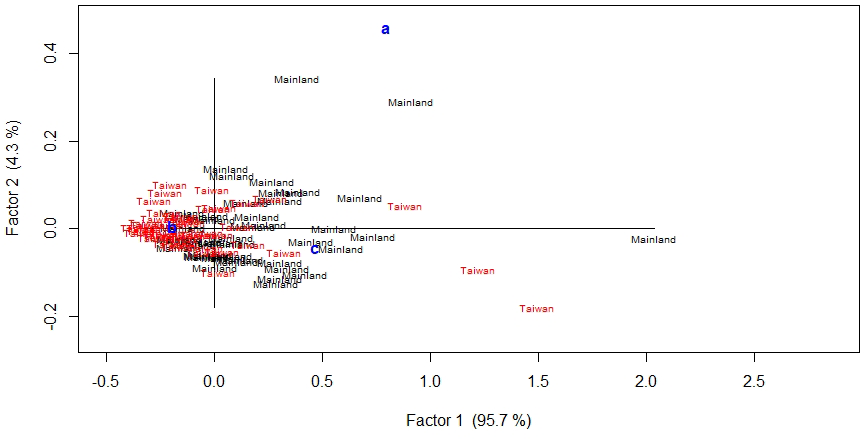
The visualization of correspondence analysis of the reportage texts from these two Chinese varieties verified the above conclusion, as shown in Figure 7. Compared with Figure 6, the overlap field between two varieties texts became smaller. This showed that the texts from two varieties with the similar fitted parameters became less.
The visualization of correspondence analysis of reportage texts represented by the fitted parameters of clause length distribution.

The review texts from the two varieties were also represented by the fitted parameters of clause length distribution. The SVM was used to establish the classification model to classify these texts. The twofold cross-validation was repeated 10 times. The average, maximum, and minimum values of classification error rates were 33.30%, 42.05%, and 28.41%, respectively. The classification result was not as satisfactory as the classification result of reportage texts from two Chinese varieties.
Correspondence analysis was used to analyze the review texts from the two varieties. The visualization was shown in Figure 8. Figure 8 showed that there are similarities of the fitted parameters between the two varieties review texts. The poor classification result of review texts and the overlap review texts in Figure 8 showed that the differences of fitted parameters of clause length distribution between review texts were less than those between reportage texts from Mainland and Taiwan.
The visualization of correspondence analysis of review texts represented by the fitted parameters of clause length distribution.

3.3 The word length as the characteristics to differentiate varieties
The definition of “word” has been given the long and controversial discussions. There are also controversies in the definition of Chinese words. We do not discuss the definition of Chinese words but regard the segments delineated by blank spaces in the texts, segmented by the Chinese lexical analysis system, as words.
There are different methods to define word length, for example, from the perspective of pronunciation, duration. According to the Chinese language, we defined word length as the number of Chinese characters included (Hou et al. Reference Hou, Yang and Jiang2014, Hou et al. Reference Hou, Huang, Ahrens and Lee2019).
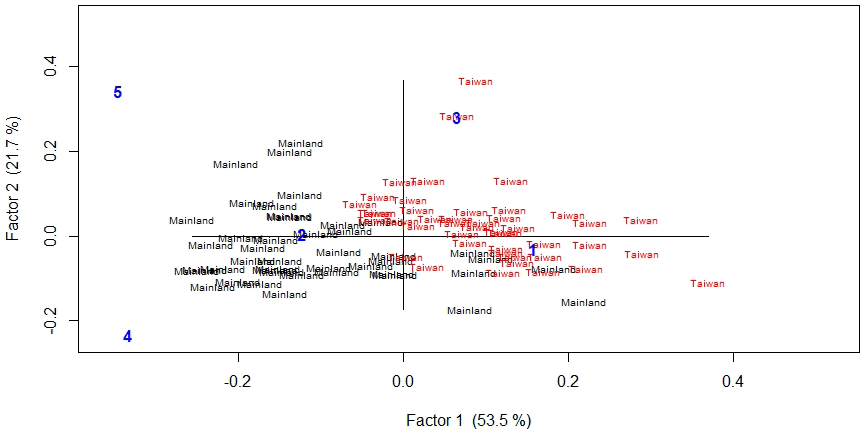
The relative occurrence frequencies of words with each length were calculated to establish the word length distributions. Then, the texts were represented by the word length distributions using vector space models. The correspondence analysis was used to analyze the Chinese varieties texts from Mainland and Taiwan. The visualization of correspondence analysis is shown in Figure 9.
From Figure 9, there are differences of word length usage between the two Chinese varieties from Mainland and Taiwan. The differences concentrated on the usage of words whose lengths are 3 and 4, respectively. Four-character words are more often used in Mainland than in Taiwan. One reason is perhaps that Mainland Chinese uses more four letter proper nouns to represent political terms, such as 社会主义 (SHEHUIZHUYI, socialism), 国民经济 (GUOMINJINGJI, citizen economy), and 民主党派 (MINZHUDAGPAI, democratic parties). In contrast, three-character words are used more often in Taiwan than in Mainland. This is probably due to the popularity of two three-character compound constructions: the traditional one-character family name + two-character given name template (e.g., 林怀民Lin, Huai-ming), and the neologism of two-character proper noun + one-character head noun (e.g., 草莓族 caomei-zu “strawberry generation, e.g., those who cannot survive any pressure”). There are similar usages of one-character and two-character words.
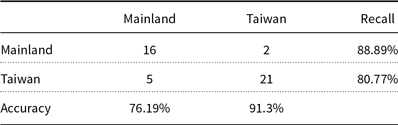
The SVM was used to establish the classification model to classify the two Chinese varieties texts. The rate between training and testing text was set to be 1:1 when using the holdout method to validate the classification result. The holdout validation was repeated more times. The maximum value of classification accuracy rates was 92.05%, as shown in Table 8, and the minimum value was 76.13%, as shown in Table 9. The twofold cross-validation was repeated 10 times in order to validate the classification model. The average value of classification error rates was 18.13%, the maximum value was 21.59%, and the minimum value was 14.77%. From the results of classification and correspondence analysis, the word length distribution is an effective linguistic mean to differentiate the Mainland and Taiwan varieties of Chinese.
Correspondence analysis was used to analyze the reportage texts from two Chinese varieties in Mainland and Taiwan. The result of correspondence analysis is shown in Figure 10.
The classification result of the two Chinese varieties texts, represented by the word length distribution, in Mainland and Taiwan (maximum classification accuracy rate, 92.05%)

The classification result of the two Chinese varieties texts, represented by the word length distribution, in Mainland and Taiwan (minimum classification accuracy rate, 76.13%)

The result of correspondence analysis of the Chinese varieties texts represented by the word length distributions from Mainland and Taiwan.

Figure 10 shows that there is a clear boundary between the reportage texts from Mainland and Taiwan varieties of Chinese. It is concluded that there are clear differences of word length usage between these two Chinese varieties reportage texts. The one-character words and four-character words are more used in reportage texts in Mainland varieties relative to Taiwan varieties. On the contrary, the three-character words are more used in reportage texts in Taiwan. There are similar usages of two-character words in reportage texts in both varieties. There are long words in these two varieties reportage texts. In Mainland, most long words are proper nouns, for example, the country names. Many long words in Taiwan are English words. In this study, the word length is calculated as the number of characters included. It is a question to define the length of English word in Chinese texts. The examination of long words in these reportage texts showed that the foreign words have been translated into Chinese words in Mainland, while they generally remain as they are in Taiwan.
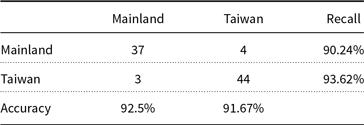
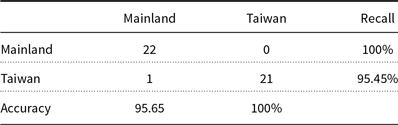
These reportage texts were classified according to their varieties. The SVM was used to establish the classification model. In holdout validation of classification result, the rate between training and testing texts was set to be 1:1. The maximum and minimum values of classification accuracy rates were 97.73% and 84.9%, respectively, when the holdout validation was repeated more times. They are shown in Tables 10 and 11, respectively.
The classification result of the reportage texts, represented by word length distribution, from Mainland and Taiwan Chinese varieties of Chinese (maximum classification accuracy rate, 97.73%)

The classification result of the reportage texts, represented by word length distribution, from Mainland and Taiwan varieties of Chinese (minimum classification accuracy rate, 84.9%)

The result of correspondence analysis of the reportage texts, represented by the word length distribution, from two Chinese varieties.

The twofold cross-validation was repeated 10 times to validate the classification result. The average value of the 10 classification error rates was 9.77%, the maximum value was 11.36%, and the minimum value was 7.95%, respectively. The classification result is fairly well. This showed that there are big differences of the word length usage between the reportage texts from Mainland and Taiwan varieties.
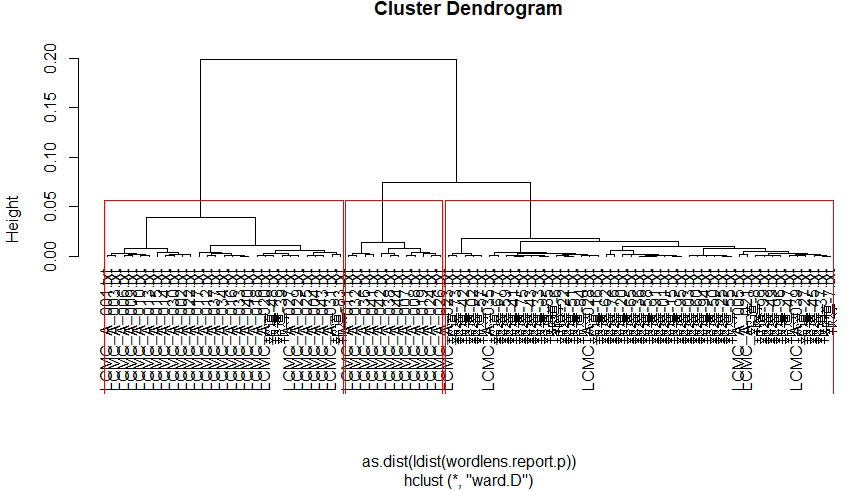
The reportage texts from these two varieties were agglomerative hierarchical clustered when using word length distribution to represent the texts. In this clustering analysis, the relative entropy was used to calculate the distance between different texts (Hou, Yang, and Jiang Reference Hou, Yang and Jiang2014). The clustering result is shown in Figure 11.
The clustering result of the reportage texts, represented by word length distribution, from the two Chinese varieties (the left two clusters represent the Mainland reportage texts, and the right one cluster represents the Taiwan reportage texts).

From Figure 11, the reportage texts from Taiwan variety of Chinese were clustered into one group. So there are similarities of word length usage between them. The reportage texts from Mainland variety of Chinese were clustered into two clusters. But they are both far from the cluster of Taiwan reportage texts. Thus, the word length distribution can be used to differentiate these two Chinese varieties reportage texts.
Then, we examined whether there were differences of word length usage between the review texts of Chinese varieties from Mainland and Taiwan. The Chinese Taiwan and Mainland review texts were represented by the word length distribution. The correspondence analysis result of the review texts was shown in Figure 12. From Figure 12, there is also a clear boundary between the review texts of Chinese varieties from Mainland and Taiwan. One-character and three-character words are more used in Taiwan review texts, while two-character words are more used in Mainland review texts. Four-character and five-character words can differentiate these two varieties review texts as the obvious distinguishing features.
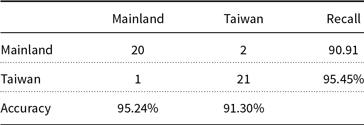
The classification model was established using SVM algorithm to classify the Chinese Mainland and Taiwan review texts. The rate between training review texts and testing review texts was set to be 1:1 when using the holdout method to validate the classification result. The maximum and minimum values of classification accuracy rate were 90.91% and 79.55%, respectively, when the holdout validation was repeated more times. These two classification results were shown in Tables 12 and 13, respectively.
The classification result of the review texts, represented by the word length distribution, from Mainland and Taiwan varieties (maximum classification accuracy rate, 90.91%)

The classification result of the review texts, represented by the word length distribution, from Mainland and Taiwan varieties (minimum classification accuracy rate, 79.55%)

The correspondence analysis result of Chinese Mainland and Taiwan review texts represented by the word length distribution.

The twofold cross-validation was repeated 10 times to validate the classification model reliably. The average value, maximum value, and minimum value of the classification error rates were 14.77%, 22.73%, and 9.09%, respectively. We can say that the word length distribution can differentiate the review texts from Mainland and Taiwan varieties. However, this difference of word length usage between Taiwan and Mainland review texts is less than that between Taiwan and Mainland reportage texts. At the same time, this difference between Taiwan and Mainland review texts is more than that between Taiwan and Mainland varieties texts when regarding the reportage and review texts as a whole. Thus, this comparison also proved that it is necessary to distinguish different genres when classifying the Chinese Mainland and Taiwan varieties.
3.4 The fitted parameters of word length distribution
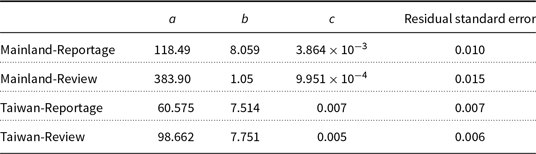
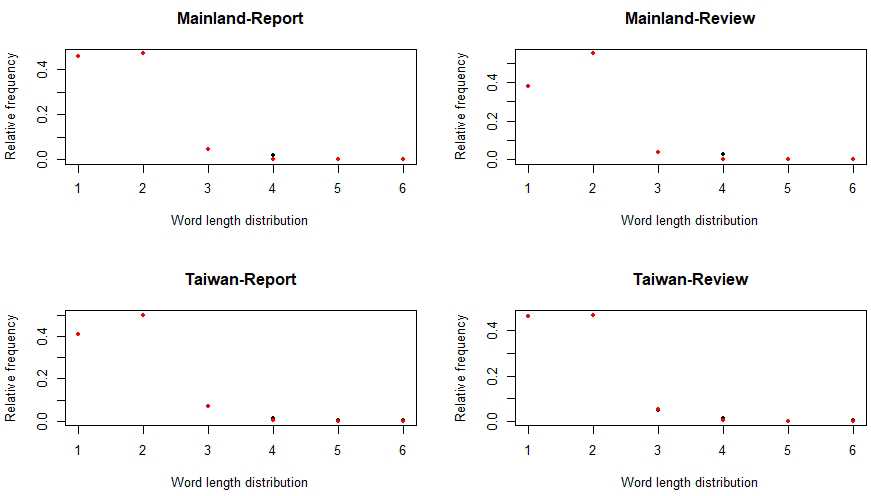
The word length distributions in the two varieties texts of Chinese were fitted by Formula (1), respectively. The fitted results are shown in Figure 13 and Table 14, respectively.
The fitted result of the word length distribution in Chinese varieties texts

The fitted results of the word length distributions in Chinese varieties texts.

Figure 13 and Table 14 show that Formula (1) can fit the word length distributions in two Chinese varieties texts fairly well, and there are differences of the fitted parameters between these two Chinese varieties from Mainland and Taiwan. Similar with the fitted result of clause length distributions, distance between two regional varieties is greater than the distance between two genre varieties of the same regional variant.
The texts from Mainland and Taiwan varieties of Chinese were represented by the fitted parameters of word length distributions. The SVM was used to establish the classification model. The twofold cross-validation was repeated 10 times to validate the classification result. The maximum, minimum, and average values of classification error rates were 33.52%, 24.43%, and 28.18%, respectively. The classification result was not as satisfactory as the classification model when using word length distribution to represent the texts.
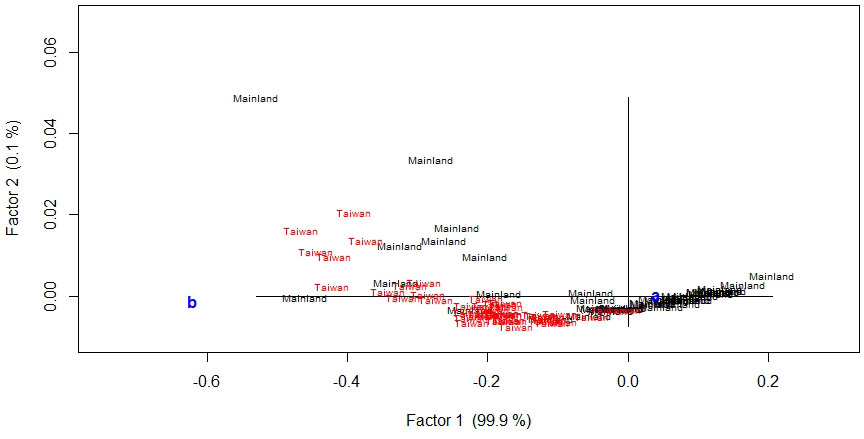
The fitted parameters of word length distributions were selected to represent the reportage texts in Taiwan and Mainland varieties. The classification model was established using SVM algorithm to classify these two Chinese varieties reportage texts. The twofold cross-validation was repeated 10 times to validate the classification performance reliably. The classification result was not as satisfactory as the classification model when using word length distribution to represent the texts. The maximum, minimum, and average values of classification error rates were 25%, 12.5%, and 18.29%, respectively. The result of correspondence analysis is shown in Figure 14. Figure 14 demonstrates that the values of parameter a in Mainland variety reportage texts are similar. The differences between the reportage texts from Mainland and Taiwan focused on the a values.
The result of correspondence analysis of reportage texts represented by the fitted parameters of word length distribution.

Then, the fitted parameters of the word length distribution were used to represent the review texts from Chinese Mainland and Taiwan varieties. The SVM was used to establish the classification model to classify the review texts. The twofold validation was repeated 10 times to validate the classification result. The average value, maximum value, and minimum value of classification error rates were 21.14%, 27.27%, and 15.91%, respectively. The difference of the fitted parameters of word length distribution between the two varieties review texts was less than that between the two varieties reportage texts.
3.5 The combination of word length distribution and clause length distribution
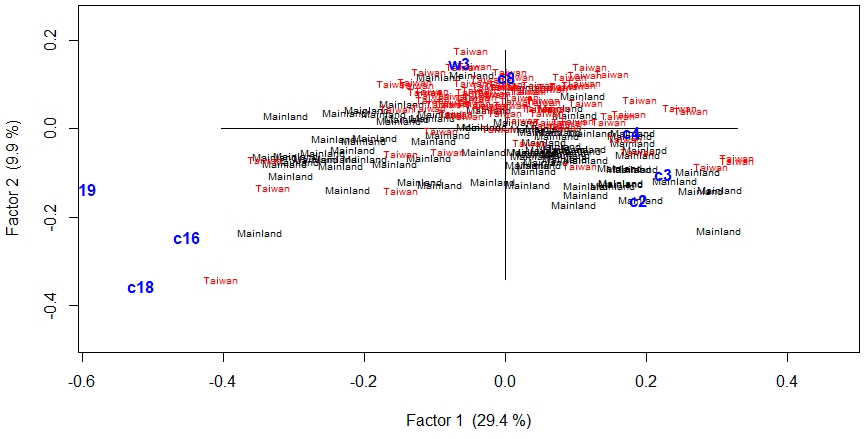
The combination of word length distribution and clause length distribution was selected to represent the Chinese varieties texts from Mainland and Taiwan. The correspondence analysis result, as shown in Figure 15, demonstrated that there are not clear boundaries to separate the different Chinese varieties texts from Mainland and Taiwan. In other words, the correspondence analysis confirms our assumption that the difference between two varieties texts is less than that between two varieties texts in same genre.
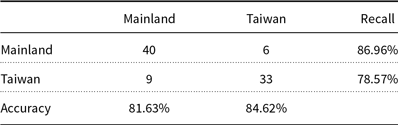
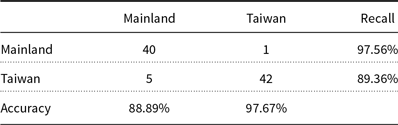
The texts were represented by this combination of word length and clause length distributions and classified. The classification model was established using the SVM algorithm. The rate between training and testing texts was set to be 1:1 when the holdout method was used to validate the classification result. The minimum and maximum values of classification accuracy rates were 82.95% and 93.18%, respectively, when the holdout validation was repeated more times. The corresponding classification results were shown in Tables 15 and 16, respectively.
The classification result of the texts from Taiwan and Mainland varieties (minimum classification accuracy rate, 82.95%)

The classification result of the texts from Taiwan and Mainland varieties (maximum classification accuracy rate, 93.18%)

The correspondence analysis result when using the combination of word length distribution and clause length distribution to represent these two varieties texts.

The twofold cross-validation was repeated 10 times to validate the classification result. The average value of classification error rates was 12.84%, the maximum value was 15.34%, and the minimum value was 10.23%. From these values, the classification result was very good and the combination of word length and clause length distributions can differentiate these two Chinese varieties texts including reportage and review genres fairly well.
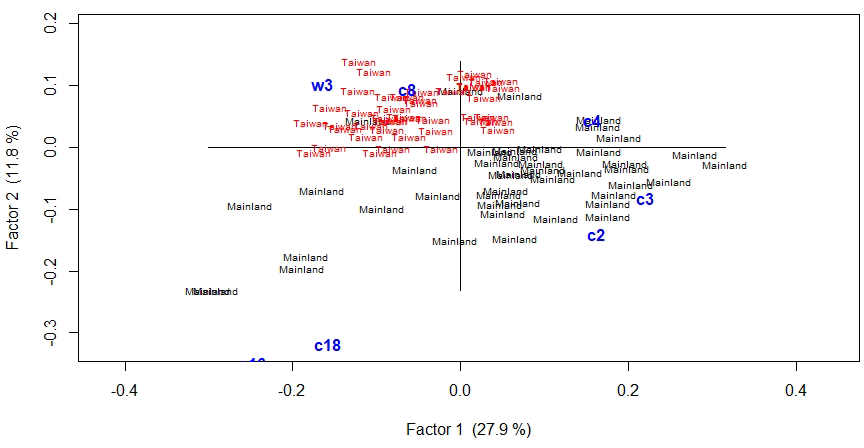
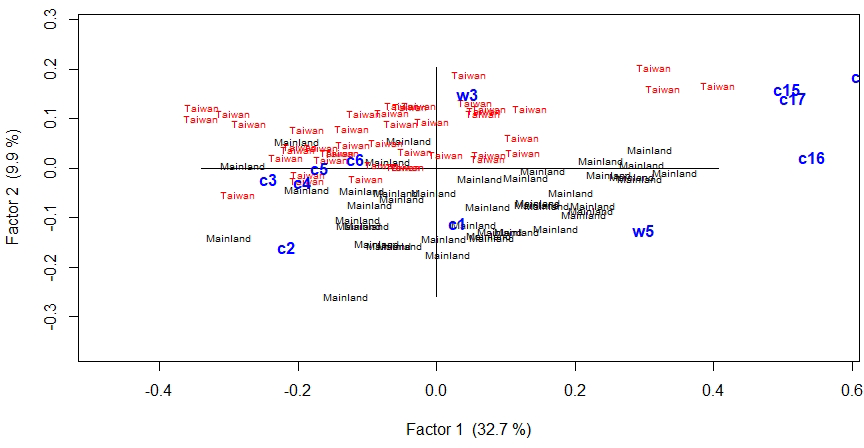
Correspondence analysis was used to analyze the reportage texts, represented by the combination of word length and clause length distributions, from Taiwan and Mainland varieties. The result of correspondence analysis is shown in Figure 16. There is a relative clear boundary between the two varieties of Chinese when the texts are from the same genre. It is necessary to take genre into consideration when classifying the Chinese Mainland and Taiwan varieties. From Figure 16, the clauses, whose lengths are 2 and 3 words, are more used in Mainland reportage texts, while the clauses whose length is 8 words are more used in Taiwan reportage texts. The three-character words are more used in Taiwan reportage texts than in Mainland.
The correspondence analysis result of the reportage texts represented by the combination of word length distribution and clause length distribution from the two Chinese varieties (“w3” represents the three-character word and “c3” represents the three-word clause).

The SVM was used to establish classification model to classify the reportage texts according to their variety types. The classification accuracy rate was 100% in holdout validation when the rate between training texts and testing texts was 1:1. The classification result was also good even if the training texts were less than the testing texts, for example, the rate between them was 2:3. The twofold cross-validation was repeated 10 times to validate the classification result. The average value of classification error rates was 2.84%, the maximum value was 5.68%, and the minimum value was 1.13%. From these two validations, the classification result was very good. The combination of the clause length and word length distributions can differentiate the Mainland and Taiwan reportage texts perfectly.
The review texts from Taiwan and Mainland varieties were also represented by the combination of the word length and clause length distributions. The visualization of the correspondence analysis of the review texts is shown in Figure 17. There is a relative clear boundary to separate the review texts from Chinese Mainland and Taiwan varieties. The differences between these two varieties review texts focused on the one-word clauses, three-character words, and five-word clauses, and so on.
The correspondence analysis result of the review texts, represented by the combination of word length and clause length distributions, from the two Chinese varieties.

The SVM was used to establish the classification model to classify the two varieties review texts. The rate between training texts and testing texts was set to be 1:1 when the holdout method was used to validate the classification result. The holdout method was repeated more times. The maximum classification accuracy rate was 95.45% and the minimum value was 86.36%. The twofold cross-validation was repeated 10 times to validate the classification result reliably. The average value, maximum value, and minimum value of classification error rates were 13.06%, 19.31%, and 9.09%, respectively. From the classification result, the combination can differentiate the two Chinese varieties review texts. There are differences of this linguistic characteristic between the Mainland and Taiwan review texts. These differences were less than that between the Mainland and Taiwan reportage texts.
Based on the results of correspondence analysis and text classification, we show that the combination of word length and clause length distributions effectively differentiates these two Chinese varieties, especially when the genre is fixed to news reportage texts, the same genre chosen in Malmasi et al. (Reference Malmasi, Zampieri, Ljubešić, Nakov, Ali and Tiedemann2016). The classification also performs reasonably well for two classes specifying both regional and genre varieties but does perform slightly worse for regional varieties when only review genre is considered. This result offers strong supporting evidence of the self-adaptive complex system hypothesis. On one hand, we show that the power function model based on unit and constituent lengths works well for classification of varieties. On the other hand, we also show that when genre varieties are mixed, this simple model could encounter some challenge, especially with review texts in both varieties. This result is in fact predicted by the complexity theory of self-adaptation, the formation of any variety may involve multiple factors. Most crucially, models of power function may involve different linguistic features, including but not limited to sentence/clause/word lengths, rime, and tone motifs. Hou and Huang (Reference Hou and Huang2019), for instance, used contextual patterns of sub-lexical linguistic information, that is, rime and tone motifs, in addition to word length motifs to successfully classify authorships, suggesting that different types of linguistic features to optimize the model. We suspect that perhaps the same approach could also be applied to the classification of similar languages. In other words, simple power function model based on one feature is robust when applied to binary classification of complex adaptive systems. Yet, classification of compounded multiple categories may require additional features in the model.
4. Conclusion
This paper deals with classifications of similar languages in terms of both regional and genre variations as complex adaptive systems. The two varieties of language are Mandarin Chinese from Mainland China and Taiwan, and the genres of reportage and review are considered for both varieties. To ensure that regional and genre variations do not unnecessarily confound each other, our test data are taken from two comparable balanced corpora that are annotated for both genres. The first goal of this study is to propose a robust technology to classification of any language variations with minimal preprocessing requirements. We take advantage of well-known power function laws between linguistic units and constituents and propose to use clause and word length distributions, as well as their fitted parameters to represent each text. In addition to the standard regional varieties from Mainland and Taiwan, we compounded the task by including two genre variations from both regional varieties: reportage and review.
The text classification and correspondence analysis showed that our proposed methodology achieves very good results when using the combination of clause and word length distributions to represent the texts, with the classification accuracy being 100% for the reportage genre. Hence, differences of this combination between reportage texts of two Chinese varieties are most salient. However, when both reportage and review texts are included in classification, the accuracy is lower. In particular, correspondence analysis showed that the two varieties in news genre overlapped in a continuous space. These results are in fact consistent with the hypothesis of languages as complex self-adaptive systems and variations are results of internally or externally induced adaptations. In this view, the power functions laws are global characterizations of the complex system, which is the sum of parochial adaptive steps. In particular, any single reaction to internal or external influence may not propagate through different parts of the complex system at the same speed (as predicted by, for instance, the lexical diffusion theory (Wang Reference Wang1969), and explored in Ke et al.’s Reference Ke, Minett, Au and Wang2002 study of lexical change). Hence, the power relation law is that at the same time a good model to differentiate different language varieties yet varying degree of accuracy should also be expected with different textual types.
In conclusion, our current study demonstrates the robustness of a new approach to classification of similar languages based on modeling these varieties on overall textual organizational characteristics instead of linguistic characteristics of individual subtextual units. In particular, we used distributional information of two universally available and easily accessible textual features and their power function relation: clause length and word length. Our innovative use of comparable balanced corpora in our experiments also allows us to tease apart possible interaction between different dimensions of variations. In particular, we showed that classification of regional varieties can be compounded by genres. This result suggests that robust identification technology of similar and related languages must also take into consideration other dimensions of textual variations such as gender, genre, or register. In fact, in a series of study we did take register into consideration (Hou et al. Reference Hou, Huang, Do and Liu2017, Hou, Huang and Liu Reference Hou, Huang and Liu2019; Hou et al. Reference Hou, Huang, Ahrens and Lee2019; Hou and Huang Reference Hou and Huang2019). In addition to show that fitted power function model between linguistic units and their constituents is an effective tool for classification of similar languages, we also showed that single feature works better with binary classification. However, since Hou and Huang (Reference Hou and Huang2019) show that finer-grained classification such as author identification can also be carried out successfully when complex set features are used, it is important to expand the current studies to two dimensions: the first is to experiment on a wider range of genres and more regional varieties; and the second is to model variations based on other intratextual distributional features. These studies will improve robustness in the automatic identification of similar languages and dialects as well enhance our knowledge of how to model language as multidimensional complex adaptive systems.
Acknowledgements
We would like to thank the anonymous NLE reviewers and Guest Editor for their insightful and helpful comments.
Financial support
Research on this paper was funded by National Natural Science Key Foundation in China (61433015), National Social Science Fund in China (Grant no. 16BYY110), and The Hong Kong Polytechnic University Grant 4-ZZFE.
Appendix 1
The distributions of clause length (1-10) in reportage texts from Mainland and Taiwan Chinese varieties.

The distributions of clause length (11-20) in reportage texts from Mainland and Taiwan Chinese varieties.