Introduction
Consanguineous marriage is marriage between a man and a woman having a common ancestor or blood relation. The term is, however, conventionally used to describe marriages between couples who are related as second cousins or closer (Bittles, Reference Bittles1994, Reference Bittles2001a; Modell & Darr, Reference Modell and Darr2002; Tadmouri et al., Reference Tadmouri, Nair, Obeid, Al Ali, Al Khaja and Hamamy2009). The most commonly found form of consanguineous union is between first cousins. Consanguineous marriages have been practised in many communities throughout the world since the early existence of modern humans with varying rates depending on religion, culture and geography (Bittles, Reference Bittles1994, Reference Bittles1995, Reference Bittles2001a; Jaber et al., Reference Jaber, Halpern and Shohat1998).
Consanguinity was relatively uncommon in the past in North America, Europe and Australia, and declined even more in the past century (Lebel, Reference Lebel1983). On the other hand, it is still highly prevalent in many regions, particularly in the Muslim countries of North Africa, Central and West Asia, and in most parts of South Asia (Bittles et al., Reference Bittles, Mason, Greene and Rao1991; Bittles, Reference Bittles1994; Rajab & Patton, Reference Rajab and Patton2000; Hussain & Bittles, Reference Hussain and Bittles2004; Tadmouri et al., Reference Tadmouri, Nair, Obeid, Al Ali, Al Khaja and Hamamy2009). In these regions, marriage to biological relatives accounts for from 20% to over 50% of all marriages (Bittles, Reference Bittles1994; Bener et al., Reference Bener, Abdulrazzaq, Al-Gazali, Micallef, Al-Khayat and Gaber1996; Gunaid et al., Reference Gunaid, Hummad and Tamim2004). Although the frequency of consanguineous marriages is generally declining, most Middle Eastern Arabs have a custom of preferring consanguineous marriages, particularly among first cousins (Bener et al., Reference Bener, Abdulrazzaq, Al-Gazali, Micallef, Al-Khayat and Gaber1996; Jaber et al., Reference Jaber, Halpern and Shohat1998), and in some Arab countries it is even increasing (Jurdi & Saxena, Reference Jurdi and Saxena2003; Bener & Alali, Reference Bener and Alali2006). However, some Arab countries such as Jordan (Hamamy et al., Reference Hamamy, Jamhawi, Al-Darawsheh and Ajlouni2005), Lebanon (Khlat, 1998), Bahrain (Al-Arrayed & Hamamy, Reference Al-Arrayed and Hamamy2011) and Palestinian Territories (Assaf & Khawaja, Reference Assaf and Khawaja2009), show declining trend in consanguineous marriages. Increasing female education levels, declining fertility resulting in lower numbers of suitable relatives to marry, women's participation in the work force, women's empowerment, urbanization and the improving economic status of families may be related to declining trends in consanguinity in these countries.
Generally, the highest rates of consanguineous marriage have consistently been associated with low socioeconomic status, illiteracy and rural residence (Bittles et al., Reference Bittles, Mason, Greene and Rao1991; Bittles, Reference Bittles1994). In some populations a high prevalence of consanguineous marriages has also been reported among land-owning families (Rami & Chandrasekhar, Reference Rami and Chandrasekhar1979), and in traditional ruling groups and the highest socioeconomic strata (Al-Thakeb, Reference Al-Thakeb1985). Social, religious, cultural, political and economic factors still play roles in favouring consanguineous marriages among the new generations just as strongly as they did among the older generations, particularly in rural areas.
Consanguinity rates are not declining in some Arab countries because it is generally accepted that the social advantages of consanguinity outweigh the disadvantages (Jaber et al., Reference Jaber, Halpern and Shohat1998; Weinreb, Reference Weinreb2008), and consanguinity is regarded as a deeply rooted cultural trend (Bundey & Alam, Reference Bundey and Alam1995). It is believed that the practice of consanguinity has significant social and economic advantages. Consanguineous marriages among Arabs are respected because it is thought that they strengthen family ties and promote family stability, reduce dowry or bridewealth payment requirements, simplify premarital negotiations, offer greater compatibility between spouses and other family members, offer a lesser risk of hidden financial and health issues, and keep family property within in the parental families (Dahl, Reference Dahl1997; Bittles, Reference Bittles2001b, Reference Bittles2002, Reference Bittles2008).
Consanguineous marriages are generally thought to be more stable than marriages between non-relatives, though there are no studies to compare divorce rates of consanguineous and non-consanguineous marriages among Arabs. Consanguinity is characterized by early-age marriage and early-age childbearing in females (Bittles et al., Reference Bittles, Mason, Greene and Rao1991; Hussain & Bittles, Reference Hussain and Bittles1999). However, many studies have demonstrated that consanguineous marriages are associated with a higher risk of autosomal recessive diseases and congenital malformations, mental retardation, and higher pre-reproductive deaths and postnatal mortality among offspring (Al-Awadi et al., Reference Al-Awadi, Naguib, Moussa, Farag, Teebi and El-Khalifa1986; Khlat, Reference Khlat1988; Madhavan & Narayan, Reference Madhavan and Narayan1991; Lufti et al., Reference Lufti, Merlob, Xiangdong, Rotter and Shohat1992; Bittles et al., Reference Bittles, Grant and Shami1993; Bittles & Neel, Reference Bittles and Neel1994; Bundey & Alam, Reference Bundey and Alam1995; Al Husain & Al Bunyan, Reference Al-Husain and Al-Bunyan1997; Stoltenberg et al., Reference Stoltenberg, Magnus, Skrondal and Lie1999; Mokhtar & Abdel-Fattah, Reference Mokhtar and Abdel-Fattah2001; Saadat, Reference Saadat2007; Tadmouri et al., Reference Tadmouri, Nair, Obeid, Al Ali, Al Khaja and Hamamy2009).
Like most other Arab and Muslim countries, Oman has a high rate of consanguineous marriage. Despite marked urbanization and modernization, recent population-based health and demographic surveys, as well as a clinic-based survey, consistently show that the prevalence of consanguineous marriages in Oman remains high. According to the latest available national-level survey, the 2000 Oman National Health Survey, 52% of marriages in Oman are consanguineous (Al-Riyami et al., Reference Al-Riyami, Afifi, Al-Kharusi and Morsi2000). Rajab & Patton (Reference Rajab and Patton2000) conducted a clinic-based study on consanguinity in Oman among 60,895 couples who visited antenatal clinics for antenatal and delivery services between October 1994 and January 1997. The study is one of the largest and most comprehensive so far conducted in Oman. It demonstrated that 35.9% of marriages were between first or second cousins and another 20.4% were between members of the same tribes, which were blood related to some degree (F<0.0156), giving a rate of consanguineous marriage of over 50%. The average inbreeding coefficient was calculated as 0.0198. The high rate of consanguineous marriage in Oman may have important ramifications for demographic factors, health of offspring and social and economic status. As consanguinity is likely to be associated with a higher risk of autosomal recessive diseases and congenital malformations, mental retardation and ill health of offspring, information on the dynamics of consanguinity is important for public health strategy. Some studies conducted in Oman have demonstrated negative health consequences of consanguinity for offspring (Rajab et al., Reference Rajab, Freeman and Patton1996, Reference Rajab, Freeman and Patton1997, Reference Rajab, Vaishnav, Freeman and Patton1998; Rajab & Patton, Reference Rajab and Patton1997).
Although marriages between close biological kin are common in Oman, there is still a great lack of knowledge of this central feature of human kinship structure and dynamics in the country owing to a paucity of reliable data in the past. However, the availability of the recent national-level surveys in Oman, particularly the 1995 Oman Family Health Survey (OFHS) and the 2000 Oman National Health Survey (ONHS), allows this gap to be filled and our understanding of the pattern of marriage in Oman to be improved. The objective of this study is to examine the levels, trends and determinants of consanguineous marriage in Oman using population-based, national-level survey data.
Methods
Setting
The Sultanate of Oman is a country on the south-east coast of the Arabian Peninsula in South-West Asia with a total area of 309,500 square kilometres. It is bordered by the United Arab Emirates from the north-west, the Kingdom of Saudi Arabia from the west, the Republic of Yemen from the south-west, Hormoz Strait from the north and the Arabian Sea from the east. The country is composed of varying topographic areas consisting of plains (about 3%), mountain ranges (15% area) with granite and limestone and the remaining area (82%) is mainly desert and wadis (dry river beds) (Sulaiman et al., Reference Sulaiman, Al-Riyami and Farid2000). Oman's climate is hot and dry in the interior and humid along the coast.
The country has had a turbulent past characterized by internal tribal strife throughout the 19th and early 20th centuries. Modernization began in the early 1970s with the commercial exploitation of oil and natural gas and thereby increased government revenues. In recent years, massive economic and social developments have taken place in Oman. The present government, aided by oil export revenues, is implementing various economic and social development programmes. Prior to the commercial exploitation of oil in late 1960s, the economy of Oman consisted of subsistence agriculture and fishing. Social and economic infrastructure was almost non-existent. By the late 1980s, Oman had been transformed into a modern state with modern facilities and infrastructure. The standard of living improved enormously after the mid-1980s. Urbanization has profoundly changed the spatial distribution of the population. Intensive migration, mainly from rural to urban areas and from interior to more developed areas, has been important in shaping the contemporary social structure of the Omani population.
As part of the modernization drive, the government of Oman has put much emphasis on expansion of education for both males and females. As a result the net enrolment rate for females aged 6–10 has increased from 5% (Zurayk, Reference Zurayk1979) in the 1970s to 92% in the mid-1990s and the gender gap in education at all levels has reduced. In recent time, due to the increase in women's education and social status in Oman, women's control over their own reproductive lives has increased (Al-Riyami & Afifi, Reference Al-Riyami and Afifi2003). Women's participation in paid labour is increasing in Oman. According to the 2000 National Health Survey results, about 13% of Omani women are working for cash outside the home.
According to preliminary results of the third and latest population Census in Oman, which was conducted in December 2010, the total population of Oman is about 2.7 million, of which 27% are non-Omanis (www.census.gov.om). Nearly one-fifth of the total population live in vast rural areas and nearly 5% live in mountains and other hilly areas where rugged terrain impedes the provision of health and basic services, and the remaining three-quarters live in urban or semi-urban areas. The crude birth rate was estimated at 27.3 per thousand population, the crude death rate at 3.3 per thousand and the population growth rate at 2.0% since the last census in 2003 (Ministry of Health, 2010).
In Arab society, the family is the unit in which reproduction is authorized and is expected to occur through marriage. Marriage and establishing a family are treated as essential and sacred. In the past, the main and the most important roles of women were to bear and raise children. This attitude still prevails in Arab society, but is gradually losing ground due to modernization and the empowerment of women.
Like most Arab countries, the socio-cultural life in Oman is structured around the family and is linked to traditional and religious teachings that consider family formation to be the basic function of the society. Families are the main social security system for the elderly, sick or disabled; they also provide economic refuge for children and youth, the unemployed and other dependants. In Omani and Arab culture, parents are responsible for children well into those children's adult lives, and children reciprocate by taking responsibility for the care of their ageing parents – responsibilities that Arabs generally take on with great pride. Marriage for Arabs is thus both an individual and a family matter. This is still central, but has been modified somewhat given the increasing participation of women in higher education and in the paid labour force. In Arab culture, marriage is also a well-defined turning point that bestows prestige, recognition and societal approval on both partners, particularly the bride. While young men and women generally choose their own spouses, marriage in Arab societies remains a social and economic contract between two families. It is also a rite of passage to a socially, culturally and legally acceptable sexual relationship.
In the past, as Omani society was totally segregated by gender, the process of choosing a bride for a young man was a bit tricky. Before the prospective groom meets the bride formally, he must ask his family's permission to see her. If they consent, a meeting has to be arranged wherein the girl serves a meal to members of the man's family. If the girl is deemed appropriate, negotiations take place between the groom or the groom's father, in order to decide upon the brideprice (mahr) that the man will pay. This price is usually based on the beauty of the girl, her ancestry, employment and virginity. Men who select a bride whose family is of higher status than their own must pay a higher price; while marrying a relative may cost the groom less or nothing at all. The above process of bride selection, particularly the process of determining the brideprice, is still vital, but has been modified somewhat given the increasing participation of women in higher education in a co-education system at all levels and in the paid labour force, and increasing women's mobility and social status.
Socioeconomic changes, which are likely to carry on in the near future in Oman, have had profound effects on individuals' lives. These various macro-societal changes have had an impact on fertility behaviour and health status. Recent national-level survey data indicate marked increases in age at first marriage and modern contraceptive use.
Oman is still a high-fertility country (about 5 births per woman) with a high population growth rate (about 2% per annum) (Al-Riyami, Reference Al-Riyami, Afifi, Al-Kharusi and Morsi2000). The government of Oman considers the current fertility rate to be high, but would like to maintain it (Sulaiman et al., Reference Sulaiman, Al-Riyami and Farid2000). There is no official population policy in Oman (Sulaiman et al., Reference Sulaiman, Al-Riyami and Farid2000). Contraceptive use rate is also low (32%) (Al-Riyami et al., Reference Al-Riyami, Afifi, Al-Kharusi and Morsi2000). Nevertheless, Oman has experienced a dramatic decline in period fertility rates in recent time. The total fertility rate (TFR), which was more than 8 births per woman in the late 1980s, declined to about 5 births per woman in 2000 (Eltigani, Reference Eltigani2001; Islam et al., Reference Islam, Atsu and Al-Qasmi2011). On the other hand, infant mortality has declined from a very high rate of 140 per 1000 live births in the early 1970s (UNDP, 1998) to 9.6 per 1000 live births in 2009 (Ministry of Health, 2010). As a result, Oman is passing through a critical phase of demographic transition. The age structure of the population indicates a very young population with more than 30% of the population below the age of 15 and, thus, having high potential for future population growth. Persistent high fertility and considerable decline in mortality have resulted in high population growth in Oman. According to the United Nations population estimates and projections, the population of Oman will increase to 5.4 million (double the current size of 2.7 million) by 2025 (United Nations, 2008).
Data
Oman has a short history of national-level population surveys. The first population census of Oman was conducted in 1993. Since then a few national-level surveys have been conducted under the authority of the Ministry of Health and the Ministry of National Economy. The 1988/89 Oman Child Health Survey was the first national-level survey on health and population, followed by the 1995 Oman Family Health Survey (OFHS 1995) and the 2000 Oman National Health Survey (ONHS 2000). This study utilizes data extracted from the ONHS 2000. The details of the survey may be seen in Al-Riyami et al. (Reference Al-Riyami, Afifi, Al-Kharusi and Morsi2000). The survey was conducted by the Ministry of Health of the Government of the Sultanate of Oman with the collaboration of UN Organizations such as UNFPA and UNICEF, WHO and the UN Statistics Division. The survey considered the households of Omani nationals only. Ever-married women under 50 years of age were considered as eligible respondents.
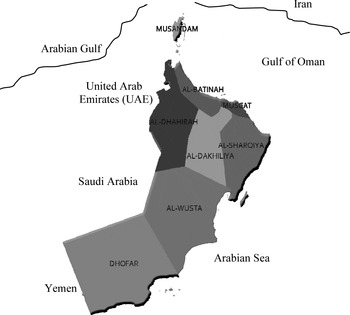
The ONHS 2000 covered a nationally representative sample of 2013 Omani households. From the selected households 2037 eligible women were successfully interviewed. The sample households were selected following a two-stage stratified cluster sampling design. Administratively, Oman is divided into eight governorates (or regions) (Fig. 1) and regions are divided into wilayat. Each wilayat is divided into Census Enumeration Areas (EAs) consisting of an average of 100 households. The EAs were considered as the primary sampling units (PSUs). The 1993 Oman Population Census provided the sampling frame for the EAs and households. Enumeration areas and wilayats were selected following a probability proportional to size (PPS) sampling scheme.
Map of Oman showing geographical regions.

The survey contains a wide range data on general health of the household members and reproductive health characteristics of ever-married women including their nuptiality pattern. The ONHS 2000, however, did not consider household assets or economic variables. As a result no analysis in terms of economic status was possible. Access to the data set for the present study has been made possible by the Ministry of Health of Oman.
Data analysis
The dependent variable in this study is ‘consanguinity’ and is derived from a question that asked women about their relationship with their husband. The response categories to this question in both the ONHS and OFHS were: 1) first cousin, father's side; 2) first cousin, mother's side; 3) other relation; and 4) no relation. The ‘first cousin, father's side’ include father's brother's son (patrilateral parallel cousin) or father's sister's son (cross-cousin Type I). Similarly, the ‘first cousin, mother side’ include mother's brother's son (matrilateral parallel cousin) or mother's sister's son (cross-cousin type II). However, data from the ONHS and OFHS cannot be disaggregated according to these categories. Clearly, the first two categories of responses comprise ‘first cousin marriages’. The third category includes second cousins and beyond second cousins (distant relatives), but no distinction can be made between second cousins and distant relatives, because data were collected under a single code. By definition, distant relative marriages are also consanguineous but with a degree of relatedness less than that of second cousin (F<0.0156). In this study, the third category of responses is defined as ‘other degree cousins’ and ‘all consanguineous marriages’ are defined by combining the first three categories. Since first cousin marriages are a well defined category of consanguineous marriages, data are analysed considering ‘first cousin marriages’ as a separate category along with ‘all consanguineous marriages’ for better interpretation.
Social and demographic characteristics of women, including current age, age at marriage, women's education, marriage cohort, urban/rural place of residence, region of residence, work status, etc., are considered as explanatory variables. The variable ‘marriage cohort’ enables the time trend in consanguineous marriage. To measure the trend of consanguineous marriage, respondents were categorized into marriage cohorts according to their year of first marriage.
Administratively, Oman is divided into eight regions or governorates, namely: Muscat, Al-Batinah, Dhofar, Al-Sharqiyah, Al-Dakhliyah, Al-Dhahirah, Musandam and Al-Wusta (see Fig. 1). Among these eight regions, Musandam is a small island with huge rocky hills, and Al-Wusta is a desert-prone area and less populated. The ONHS 2000 considered only 30 and 20 households, respectively, from Musandum and Al-Wusta, which is not suitable for separate regional analysis of data. So, in this paper, Musandum is merged with nearby Al-Batinah region and Al-Wusta is merged with nearby Al-Dakhliyah region, leaving six major regions for separate analysis.
The data were analysed using univariate (frequency distribution), bivariate and multivariate methods. Bivariate analysis was done to obtain the percentage of consanguineous and non-consanguineous marriages for each category of explanatory variables and thus identify the statistically significant correlates of consanguinity. The statistical significance was tested by a χ2 test for categorical data, and ANOVA (analysis of variance) for continuous-level data. A p-value of <0.05 was considered significant. A multivariate statistical analysis was carried out to ascertain the determinants of consanguinity. For multivariate analysis, logistic regression was performed with consanguinity as dichotomous dependent variable and socioeconomic and demographic variables as explanatory variables.
Results
Prevalence of consanguineous marriage
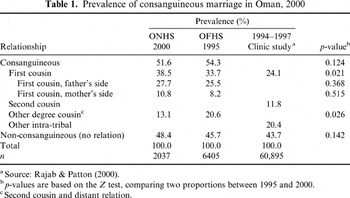
The percentage distribution of women by types of consanguinity groups, as reported in the ONHS 2000, is presented in Table 1. The data indicate that, like in most other Arab and Muslim countries, consanguineous marriage is very common in Oman, as more than half (51.6%) (95% confidence interval (CI): 51.6±3.0) of the ever-married women under 50 years of age reported that they had a blood relationship with their husbands, i.e. that the marriage was consanguineous. First cousin marriages were the most common type of consanguineous marriage constituting 38.5% (95% CI: 38.5±3.5) of all marriages and 75% of all consanguineous marriages. Of the first cousin marriages, 72% are patrilateral first cousin marriages, while 27.7% (95% CI: 27.7±4.1) are matrilateral first cousin marriages. Other degree cousin marriages (second cousins or distant forms of blood relation) constitute 13% of all marriages.
Prevalence of consanguineous marriage in Oman, 2000

a Source: Rajab & Patton (Reference Rajab and Patton2000).
b p-values are based on the Z test, comparing two proportions between 1995 and 2000.
c Second cousin and distant relation.
Trends in consanguineous marriage
Oman has a limited and short history of national-level demographic surveys that can be used for time trend analysis of consanguineous marriage. Before the ONHS 2000, national-level information on consanguinity is available from the 1995 OFHS. Rajab & Patton's (Reference Rajab and Patton2000) clinic-based study also provides information on level of consanguinity in Oman during 1994–1997. The results of these surveys are compared in Table 1 to see the changes in consanguinity in Oman over the period 1994 to 2000. The results indicate that the overall prevalence of consanguineous marriages declined from 54.3% in 1995 to 51.6% in 2000, while the prevalence of first cousin marriages increased from 33.7% in 1995 to 38.5% in 2000, and the prevalence of other degree cousin marriages declined from 20.6% in 1995 to 13.1% in 2000. A comparison of the results of Rajab and Patton's clinic-based study and the ONHS 2000 also confirm the increase in the prevalence of first cousin marriages and decrease in the prevalence of other degree cousin marriages. Thus, the apparent decline in consanguineous marriage is mainly due to the decline in other degree cousin marriages. It may be mentioned here that all these changes are statistically insignificant except for first and other degree cousin marriages (Table 1). However, these results are somewhat contaminated since the unit of analysis used here was all ever-married women regardless of their marriage cohorts or age cohorts.
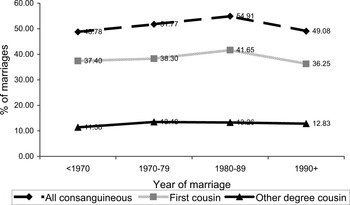
In order to obtain a clear picture on the changes in the prevalence of consanguineous marriage in Oman, analysis was done by marriage cohorts and age cohorts of ever-married women considered in the survey. The results are presented in Figs 2 and 3. Different marriage cohorts were examined to assess the changes in the prevalence of consanguineous marriages in Oman over the last few decades. It appears that there have been no appreciable changes in the prevalence of all categories of consanguineous marriage in Oman over the past four decades despite rapid urbanization and modernization. The prevalences of all categories of consanguineous marriages show slightly increasing trends during the 1970s and 1980s. However, since the 1990s it shows a declining trend in all categories of consanguineous marriages. The prevalence of overall consanguineous marriage is found to be in the vicinity of 49% for women married before 1970 and during the 1990s. The prevalences of first cousin marriage and marriage with other degree cousins also show no substantial change over the period.
Prevalence of consanguineous marriage by marriage cohort of women in Oman, 2000.

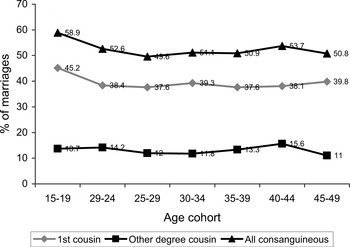
Prevalence of consanguineous marriage by age cohort of married women in Oman, 2000.

Analysis of the prevalence of consanguineous marriage by age cohort of women (Fig. 3) reveals that the prevalences of all consanguineous marriages are almost same (in the vicinity of 51%) for all age cohorts, except the 15–19 year age cohort. The first cousin marriages also follow the same pattern. The results thus confirm the almost stable state of consanguineous marriages in Oman over the last few decades. Both first cousin marriages and all consanguineous marriages appear to be higher among women of age cohort 15–19 years than for any other age cohort. The rate of consanguinity in the 15–19 age cohort may be exaggerated due to the fact that many women married before the age of 15 are included in this cohort, as the survey considered ever-married women under the age of 50. However, the possibility of increased rate of consanguineous among young women in recent time cannot be ruled out.
Correlates of consanguineous marriage
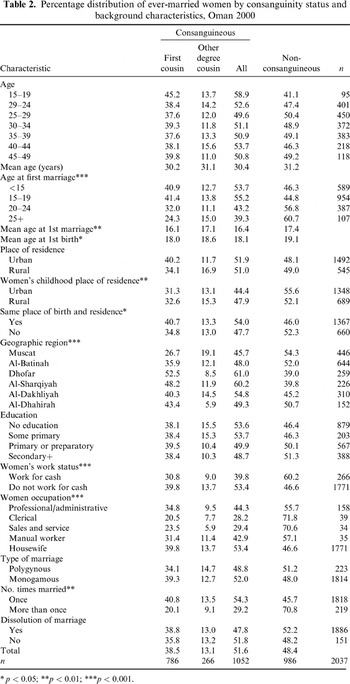
Table 2 shows the socioeconomic and demographic correlates of consanguineous marriage in Oman. To examine the association between consanguinity and socioeconomic and demographic factors, bivariate analysis was done by categorizing the response variable (i.e. consanguinity) into three categories: first cousin marriages, other degree cousin marriages and no relation, i.e. non-consanguineous marriages. Bivariate analysis provides percentage of marriages with different levels of consanguinity for each category of the explanatory variables and thus identifies the statistically significant correlates of consanguinity. The statistical significance was tested using a χ2 test for categorical data and ANOVA for continuous-level data.
Percentage distribution of ever-married women by consanguinity status and background characteristics, Oman 2000

*p<0.05; **p<0.01; ***p<0.001.
In terms of the correlates of consanguinity, the inverse of the expected association with consanguinity was found for some of the explanatory variables, particularly current urban/rural place of residence, woman's age, women's occupation and women's education. The following section discusses the impact of each predictor in explaining the variability in the response variable (i.e. consanguinity).
The results in Table 2 (also depicted in Fig. 3) show that there is no consistent pattern of relationship between age and consanguineous marriage. There are no substantial variations in the proportion of first cousin marriage and all consanguineous marriage across age cohorts except for the youngest age cohort of 15–19 years. It appears that younger women under 20 years of age are more likely to be in a consanguineous marriage, especially first cousin marriage, than their older counterparts. However, one must be cautious in interpreting the result of age cohort 15–19 because, as mentioned earlier, the result may be biased due to misclassification of age. The χ2 test shows no significant association between age of women and consanguinity status.
Women with first cousin marriages are relatively younger than those with other degree cousin marriages or their non-consanguineous counterparts. The mean ages of women with first cousin marriages, other degree cousin marriages and non-consanguineous marriages are 30.2 years (±7.8), 31.1 years (±7.9) and 31.2 years (±7.7), respectively. The mean age of women does not show a significant difference in terms of consanguinity status. However, age at first marriage and age at first birth appear to be significantly correlated with consanguinity in Oman. Age at first marriage shows a negative association with both first cousin and all consanguineous marriages, and the effect is statistically significant (p<0.001). First cousin marriage and all consanguineous marriage are more prevalent among the women with a lower age at marriage, particularly under the age of 20, i.e. during the adolescent period. For example, about 41% of the women with an age at marriage of less than 20 had first cousin marriages compared with 24.3% among the women with an age at marriage of 25 and above. Other degree cousin marriage shows no consistent pattern of relationship with age at marriage. On average consanguineous marriages occur at a lower age than do non-consanguineous marriages. The average age at marriage for those who had a first cousin marriage is 16.1 years (±3.4), while it is 17.1 years (±4.2) for other degree cousin marriages and 17.4 years (±4.0) for non-consanguineous marriages (Table 2). The result is consistent with the age pattern of consanguineous marriage as the prevalence of consanguineous marriages is higher among young ever-married women. Thus women in consanguineous marriage are more likely both to be married and to start childbearing at an earlier age.
Contrary to the findings of earlier studies in the Arab world (Al-Gazali et al., Reference Al-Gazali, Bener, Abdulrazzaq, Micallef, Al-Khayat and Gaber1997; Al-Abdulkareem & Ballal, Reference Al-Abdulkareem and Ballal1998; Jurdi & Saxena, Reference Jurdi and Saxena2003), while the incidence of first cousin marriages and overall consanguineous marriages is higher in rural than in urban areas, data from Oman show a higher rate of first cousin marriages in urban areas than in rural areas (40.2% vs. 34.1%). On the other hand, other degree cousin marriages show a higher incidence in rural areas than in urban areas. As a result, overall consanguineous marriage rate shows little difference between urban and rural areas (51.9% vs. 51%), and urban/rural place of residence is not a significant correlate of consanguinity in Oman. The anomalous position of urban areas in term of consanguinity is presumably caused by the inclusion of the recent high rate of rural to urban migrants due to rapid urbanization in Oman in recent times. According to the United Nations' World Population Prospects 2008 Revision, the percentage of urban dwellers increased from 47.6% in 1980 to 72% in 2010 (United Nations, 2008). Thus, a substantial proportion of urban dwellers who have migrated from rural areas are likely to have migrated to urban areas after having a consanguineous marriage in rural areas. Besides, rural-to-urban migrants may maintain the tradition of consanguineous marriage after migration in urban areas due to their low socioeconomic status. This proposition is supported by the finding that consanguineous marriage is significantly higher among women whose childhood place of residence was in rural (48%) areas than among those whose childhood place of residence was in urban areas (44%) (p<0.001).
Couples who have the same place of birth and residence, who may be defined as non-migrants, have higher rates of first cousin marriage and overall consanguineous marriage compared with couples having different places of birth and residence (i.e. migrants). This implies that the migrant may face a shortage of potential first cousin partners and/or available first cousins are not suitable, so they opt for second cousin or distant cousin marriage. The association between consanguineous marriage and same place of birth and residence is statistically significant (p<0.05).
Geographical regions show strong differential effects on consanguineous marriage. Among six major administrative regions (governorates) considered in this study, the all consanguineous marriage rate varies from 45.7% in Muscat region to 61% in Dhofar region. Al-Sharqiyah governorates closely follow the Dhofar region with 60% of marriages being consanguineous marriages (Table 2). The prevalence of all consanguineous marriages is highest in the least developed Dhofar region and lowest in the most developed Muscat region, where the capital city of Oman is situated. First cousin marriage shows a similar pattern of regional variation as all consanguineous marriage, but the pattern of regional variations of other degree cousin marriages is slightly different from first cousin marriages. The incidence of other degree cousin marriage is highest in Muscat (19.1%) and lowest in Al-Dhahirah (5.9%). The association between region and consanguineous marriage is statistically significant (p<0.001).
The inverse association between consanguinity and women's educational status has been well documented in many previous studies in Arab and other Muslim counties (Bener & Hossain, Reference Bener and Hussain2006). But, in Oman, women's education shows little or no effect on consanguinity. It shows no effects on first cousin marriages, as the rates of first cousin marriages are almost same (about 38%) for different level of education. However, it shows negative effects on other degree cousin marriages, as the rates of other degree cousin marriages decrease with education. Overall, the differences in the rates of all consanguineous marriages across the different levels of education are very modest, as about 54% of the women with no education or some primary level of education have consanguineous marriages compared with 49% of the women with secondary and above level of education. The χ2 test shows no significant association between level of education and consanguinity at the 5% level of significance (p=0.088). However, the association is significant at the 10% level of significance.
Women's work status shows a significant association with all types of consanguineous marriage (p<0.001). Women who are engaged in gainful employment and earning cash are less likely to have a consanguineous marriage than those who are housewives (39.8% vs. 53.4%) (Table 2).
The results in Table 2 show that the prevalences of first cousin marriage, other degree cousin marriage and overall consanguineous marriage vary significantly across occupational groups of women. Housewives or non-working women show a higher prevalence of first cousin marriage and all consanguineous marriage than any other occupational group. However, an unexpected finding is that the prevalence of first cousin marriage, as well as all consanguineous marriage, is higher among women who are professionals or administrators than those doing clerical job or jobs in sales and services. For example, the prevalence of first cousin marriage is 34.8% among the women who are professionals/administrators compared with 20.5% among women engaged in clerical jobs. Even manual workers have lower rates of first cousin or all consanguineous marriage than professionals/administrators, who are likely to have higher levels of education. Perhaps because of their higher level of education, for women who are working as professionals/administrators, their family may choose for them a cousin to marry as a way of preserving family property or keeping a good son/daughter within the family.
Consanguineous marriages are more likely to be stable than non-consanguineous marriages, as indicated by the lower proportion of polygynous marriage and divorce among consanguineous couples than among non-consanguineous couples (Table 2). However, the difference is not statistically significant. The stability of consanguineous marriages is also evident from the lower rate of more than once marriage among women with a consanguineous marriage than among their non-consanguineous counterparts. For example, 29% of women having a consanguineous marriage were married more than once compared with 71% among women with a non-consanguineous marriage. The effect is statistically significant (p<0.001).
The above differential effects of some socio-demographic factors may further be explained by looking at the economic status of consanguineous and non-consanguineous households. Since no information was collected on household income or economic status in the ONHS 2000, the effects of household economic status on consanguinity could not be investigated.
Determinants of consanguineous marriage
The previous section analysed the association of some predictor variables on consanguineous marriage using the bivariate statistical analysis technique, which gives the unadjusted effects of the predictor variables on the response variable, consanguineous marriage. Unadjusted effects of a predictor variable may or may not be determinants of the outcome variable in the presence of other predictors. The adjusted effects of a predictor variable are obtained through multivariate analysis. Thus the multivariate logistic regression technique is applied to identify the determinants or significant covariates of consanguineous marriage in Oman. The logistic model was chosen because the response variable is a categorical variable that is dichotomized as follows: y=1 if the marriage is consanguineous, and y=0 otherwise (meaning non-consanguineous marriage).
Thus the following regression model is fitted:

where p=prob(y=1) and bi values (i=1, 2,…, k) are the linear regression coefficients, indicating the effects of the predictor variables xi and b 0 is the intercept.
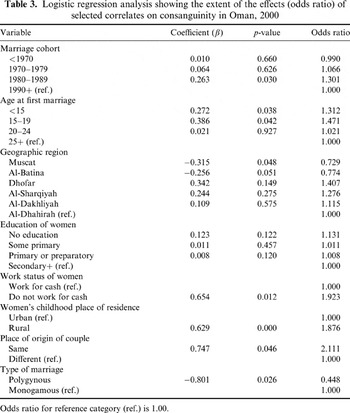
Table 3 presents the results of the logistic regression analysis showing the extent of the effects (odds ratio) of selected correlates on consanguinity in Oman. Among the selected predictors, marriage cohort, women's age at first marriage, geographic region, work status, women's childhood place of residence, common place of birth and residence of couple (i.e. geographic endogamy) and types of marriage appeared as significant covariates of consanguinity in Oman.
Logistic regression analysis showing the extent of the effects (odds ratio) of selected correlates on consanguinity in Oman, 2000

Odds ratio for reference category (ref.) is 1.00.
Compared with those marrying after 1990, marriage with a blood relation was 1.3 times more likely for those married in 1980–89 and 1.10 times more likely for those married during 1970–1979, but remained the same for those married before 1970. This indicates a curvilinear relationship between consanguinity and time. This suggests that the socioeconomic development that took place after 1990 in Oman may have had a negative effect on consanguinity. The incidence of consanguineous marriage was significantly higher (p=0.030) for the period 1980–1989 compared with the most recent period of 1990 and above (Table 3). However, there is no significant difference in the incidence of consanguinity during 1970–1979 and before 1970 compared with marriage after 1990. Overall, it may be said that the incidence of consanguinity started declining in recent time.
Women's age at first marriage appeared to be an important determinant of consanguineous marriage. Consanguinity is negatively associated with women's age at first marriage. Young women under the age of 20 have a significantly higher (1.31–1.47 times) likelihood of consanguineous marriage than women married at ages 25 and above. Geographic region also shows significant effects on consanguinity in Oman. Among the six major regions, women from Al-Batinah and Muscat regions are 23–27% less likely to have a consanguineous marriage than those from other regions. Women's educational levels show no significant association with consanguinity when the effects of other factors are adjusted for. Work status of women is a very strong determinant of consanguinity in Oman. Women who are not working for cash earnings are almost two times (OR=1.923) more likely to have a consanguineous marriage than those who are working for cash earnings. Women's occupation, however, does not have an independent effect on consanguinity. Although current place (urban/rural) of residence shows no significant effects on consanguinity, women's childhood place of residence appears to be a significant determinant of consanguinity in Oman. Women with a rural childhood place of residence are 1.87 times more likely to have a consanguineous marriage than those with an urban childhood place of residence. Consanguineous marriage is significantly higher among couples who have the same place of birth and residence (OR=2.11) than among couples who have different places of birth and residence. It appears that consanguineous marriages are less likely to be polygynous.
Discussion and Conclusion
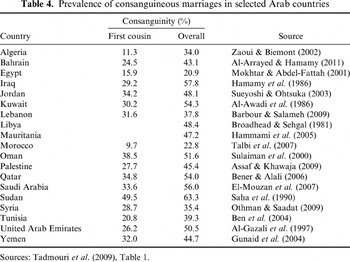
The Sultanate of Oman is passing through a critical phase of socioeconomic and demographic transition. Oman is a new modern state with all modern facilities and infrastructures. Standard of living and health status have improved enormously since the mid-1980s. The per capita GNP (Gross National Product) of Oman has increased from US$5719 in 1999 to US$16,939 in 2009 (Ministry of National Economy, 2010; p. 291). Oman is now more urbanized; people are more educated and are living longer. Despite all these developments, the prevalence of consanguineous marriages in Oman is still high, as more than half (52%) of the marriages in Oman are consanguineous, and levels are comparable to those reported in other Arab countries (Table 4). The rate of consanguineous marriage in Oman is higher than observed in most Arab countries, including Egypt (21%), Morocco (22.8%), Algeria (34%), Syria (35.4%), Lebanon (37.8%), Tunisia (39.3%), Bahrain (43.1%), Yemen (44.7%), Palestine (45.4%), Mauritania (47.2%), Jordan (48.1%), Libya (48.4%) and the United Arab Emirates (50.5%), but lower than in Qatar (54%), Kuwait (54.3%), Saudi Arabia (56%), Iraq (57.8%) and Sudan (63.3%) (see Table 4 for sources).
Prevalence of consanguineous marriages in selected Arab countries

In Oman, first cousin marriages constitute the majority of all consanguineous marriages (38.5%), with paternal first cousin marriages being most common (27.7%). Thus, first cousin unions constitute 75% of all consanguineous marriages. Other degree cousin marriages (second cousins or distant forms of blood relation) constitute 13% of all marriages. This is similar to other Arab countries, where first cousin unions are more prevalent. This reflects prevailing religious and cultural practices in the region. Modernization has changed many aspects of Omani society, but several dimensions of family organization, particularly the marriage custom, have changed little.
This study observed various patterns of consanguinity in Oman; some of them are common with other Arab countries and some are unique in nature. Those who are young, illiterate or a lower level of education, have a rural childhood place of residence, are not working for cash earnings or have a low age at marriage are more likely to marry their biological relative. These are patterns that have commonly been found in several other Arab and Muslim countries (Bittles, Reference Bittles1991; Khoury & Massad, Reference Khoury and Massad1992; Radovanovic et al., Reference Radovanovic, Shah and Behbehani1999).
The incidence of consanguineous marriage varies substantially across the six major regions or governorates under study. The rate of consanguineous marriage varies from 46% in the most developed Muscat region to 61% in the least developed Dhofar region. The regional variations in consanguineous marriages in Oman are not only dependent on their level of economic development, but also on their ethnicity. Oman has a multi-ethnic society. More than half of the population is Arab. Several large Arab groups predominate along Dhofar's coastal plain. The inhabitants of the Dhofar Mountains are known as jibālīs, or ‘people of the mountains’. They are ethnically distinct from the coastal Arabs and are thought to be descendants of people from the Yemen Highlands. Large numbers of ethnic Baloch – who migrated to Oman from Iran and Pakistan over the past several centuries – live near the coast in Al-Batinah. The Muscat urban area has long been home to significant numbers of ethnic Persians and to merchants of South Asian ancestry, some of whom also live along Al-Batinah. Notable among the latter are the Zanzibarian – who came from Africa and Liwātiyah – who originally came from Sindh (now in Pakistan) but have lived in Oman for centuries. Each ethnic group has its own cultural and social context and thus specific level of consanguineous marriage that they maintain. The significantly high prevalence of consanguineous marriage among couples born and brought up in the same locality might have some relation with ethnicity in Oman. However, due to lack of data in the ONHS 2000, it was not possible to analyse consanguinity by ethnicity. More in-depth studies are needed to understand the effect of ethnicity on consanguinity in Oman.
Although it might have a direct impact on consanguinity, current rural–urban residence shows no significant effect on consanguinity in Oman. Current urban place of residence shows a slightly higher rate of consanguineous marriage than that of rural residence, which contradicts the findings of most previous studies demonstrating higher prevalence of consanguineous marriage among rural inhabitants than urban inhabitants. A lack of a statistically significant difference in the prevalence of consanguinity by current urban/rural place of residence has also been reported by Judi & Saxsena (Reference Jurdi and Saxena2003) in Yemen, a neighbouring country of Oman. In Oman, it might be that rural–urban migration, education, occupation and characteristics of the household interact with this variable. This would mean that despite living in urban areas, the low socioeconomic profile of respondents contributes to maintaining traditional practices. Due to the rapid recent urbanization in Oman, a large majority of urban inhabitants are rural-born and many of them may be migrated after marriage, which is more likely to be consanguineous. These rural–urban migrants are likely to maintain their rural traditions; migration to urban area does not necessarily imply an immediate change in values or life style.
Multivariate analysis has confirmed the dominant influence of work status of women on consanguinity. Women's work status is closely related to the socioeconomic status of the women in terms of education, economic status and women's autonomy. The data indicate that more than 80% (83%) of the women who work for cash have some education, compared with 17% of the women who do not work for cash. Nearly two-third (64%) of working women have secondary and above level of education. The corresponding figure for non-working women is 12% (Table not shown). Thus most of the women who work for cash are literate and, therefore, are more likely to have autonomy and decision-making power. It may be argued that women's work status in Oman acts as a proximate determinant of consanguineous marriage, and that education exerts a negative effect on consanguineous marriage through work status. This may be a possible explanation for the lack of statistically significant association between women's education and consanguinity. Perhaps education as a modernized variable had little effect on cultural factors in Oman. Similar findings have been reported by some studies in other Arab countries (Khlat & Halabi, Reference Khlat and Halabi1986; Pedersen, Reference Pedersen2002). Abbasi-Shavazi et al. (Reference Abbasi-Shavazi, McDonald and Hosseini-Chavoshi2008) also observed that the practice of marriage to biological relatives has remained stable in the face of modernization in Iran. It may be argued that the observed trend in modernization in Oman has had little negative effect on consanguineous marriages, and raises the question whether endogamy in this context is a structural trait that is resistant to change.
Analysis of consanguinity by marriage cohort indicates that consanguineous marriage in Oman has been on the rise during the 1970s and 1980s, and that since the 1990s it started declining. However, the consanguinity rates for marriages contracted before 1970 and after 1990 were almost at the same level (49%). Thus, the time trend and stability of consanguinity in Oman suggest that consanguinity is likely to remain stable in the future, or decline at a slow rate. This is supported by the fact that the level of consanguinity is still high among the young and educated generation. The apparent stability of consanguineous marriage can also be attributed to the multi-ethnic nature of the society as there are several ethnic groups in Oman with their own family structures, dynamics and values. Further, an endogamous marriage is more likely to improve a wife's relations with her husband's kin from the beginning of the marriage, giving her more decision-making authority. In addition, at the familial level, it will cost less to arrange the marriage, and the wealth to which the wife will eventually have access will remain within the family, formally if the marriage is patrilateral, and informally in a matrilateral consanguineous marriage. All these factors may act as a positive catalyst to keep consanguinity at a higher level. As Rajab & Patton (Reference Rajab and Patton2000) observed, ‘… historically the levels of consanguinity in Oman may have been higher because of rigorous tribal endogamy and limited opportunities for travel’.
Whatever factors currently influence the maintenance of consanguinity at a high persistent level in Oman, there appear to be some emerging constraints that may play an important role for future prospects of declining trends in the practice of consanguinity. The long-term prospects of consanguinity look less attractive as Omani society, like that in other Arab countries, undergoes socioeconomic and demographic transitions, and improvements in modern communication network. As Weinreb (Reference Weinreb2008) argued:
Arab societies are increasingly monetized, and partly because of this and because of increases in women's schooling and demands for independence, there is an emerging preference for wives who can work. In the medium or long-term, work, especially extra familial work, will likely generate some measure of independence from family members and their authority, both by bringing unwed males and females into some contact with non-familial strangers, and by reducing their financial dependence on family.
Even if a cultural preference to wed cousins remains strong in the future, the ability to exercise that preference will inevitably be affected by current demographic transition in Oman, since that determines the extent to which extended families will produce enough cousins of roughly equivalent age. The ongoing declining fertility trend in Oman means that within one generation, there will be many fewer cousins available in the appropriate age groups. Also, the increasing awareness about the negative health impact of consanguineous marriage on offspring may act as a constraint for preference of consanguinity in the future in Oman.
Since a high degree of consanguinity, especially first cousin marriages, is a prevailing cultural practice in Oman and will probably continue in the future, this might have implications for public health. Some studies conducted in Oman by Rajab and others have shown that consanguinity plays a role in the incidence of haemoglobinopathies (Rajab & Patton, Reference Rajab and Patton1997), hydrocephalus (Rajab et al., Reference Rajab, Vaishnav, Freeman and Patton1998), Hirschsprung's Disease (Rajab et al., Reference Rajab, Freeman and Patton1997) and posterior urethral valves (Rajab et al., Reference Rajab, Freeman and Patton1996). The high level of consanguinity and its negative health consequences for offspring need to be considered in public health strategy in Oman. However, considering the cultural and social acceptability of consanguineous marriage, any advocacy discouraging consanguinity at the population level would not bring any fruitful result. Nevertheless, to minimize the negative health effects of consanguinity on child health, specific health education and genetic counselling should be followed in line with WHO recommendations (WHO, 2006).
Due to a paucity of national-level, population-based data in Oman in the past, very little was known about the issue of consanguineous marriage and its dynamics. The analysis undertaken in this study may fill this gap and improve the literature. However, the study is based on limited data from the 2000 National Health Survey using quantitative methods to understand the pattern of consanguineous marriage in Oman. For further understanding of the processes of consanguineous marriage in Oman, its dynamics and relationship with socio-political economy, ethnic relationships, wealth and property ownership, as well as power structures within each ethnic group, more careful qualitative or anthropological research, in conjunction with quantitative research, is required.
Acknowledgments
The author would like to thank the Ministry of Health of Oman, especially the director of planning and research, for providing the raw data file of the 2000 National Health Survey of Oman.