





Highlights
-
• IC-based predictability increases name use for unexpected objects.
-
• Grammatical role robustly affects pronominalization.
-
• L2 learners use fewer pronouns overall than L1 speakers.
-
• Findings are compatible with a memory-interference account.
1. Introduction
When making reference, one must select appropriate forms so that addressees can identify the intended referent and that coherence is maintained in discourse. Referential form choice is influenced by multiple factors, including structural, semantic and discourse-pragmatic cues (Lindemann & Ariel, Reference Lindemann, Ariel and Aronoff2024). Among them, structural properties such as grammatical role consistently influence referential form choice: Previous subjects (Mary saw Lisa. She [= Mary]…) are more likely to be pronominalized than non-subjects (Mary saw Lisa. Lisa…; Arnold, Reference Arnold2001; Rohde & Kehler, Reference Rohde and Kehler2014).
However, there is ongoing debate about whether and to what extent speakers consider predictability, the likelihood that a particular entity will be mentioned next (Bott & Solstad, Reference Bott and Solstad2023; Demberg et al., Reference Demberg, Kravtchenko and Loy2023; Fukumura & van Gompel, Reference Fukumura and van Gompel2010; Hwang et al., Reference Hwang, Lam, Ni and Ren2022; Ye & Arnold, Reference Ye and Arnold2025). Predictability is determined by multiple sources of information (e.g., lexical-semantic, discourse-structural and event-based sources). The present study focuses on verbs’ implicit causality (IC) bias, one of the most widely studied semantic sources of next-mention predictability (Bott & Solstad, Reference Bott and Solstad2023; Fukumura & van Gompel, Reference Fukumura and van Gompel2010; Kehler et al., Reference Kehler, Kertz, Rohde and Elman2008). IC is a property of certain interpersonal verbs that biases expectations toward the causally implicated entity, especially in explanation contexts. For example, after Mary annoyed Lisa because, speakers typically expect Mary to be mentioned next (e.g., Mary spoke loudly) because the event denoted by annoyed is usually understood as being caused by the subject. Conversely, after Mary liked Lisa because, speakers tend to expect Lisa to be mentioned next (e.g., Lisa was a kind person) because liked attributes the cause to the object. In such contexts, continuations may or may not follow the verb’s IC bias, a distinction referred to as bias-congruent and bias-incongruent continuations.Footnote 1 This study examines how IC-based predictability influences referential production by second language (L2) learners, using grammatical role as a baseline structural cue.
Producing appropriate referential forms is often difficult for L2 learners primarily because it requires integrating information from multiple sources. Linguistic features located at the interface between syntax and discourse semantics/pragmatics are particularly problematic for L2 learners, compared to features without this interface (Sorace, Reference Sorace2011). The choice of referential forms is considered a prime example of such an interface operation (Contemori & Dussias, Reference Contemori and Dussias2016; Hendriks et al., Reference Hendriks, Koster and Hoeks2014; Quesada & Lozano, Reference Quesada and Lozano2020).Footnote 2 Here, the relevant interface computation concerns mapping grammatical and discourse-semantic cues onto referential form choice in production, rather than syntax-discourse processing in general. Existing L2 work shows that L2 learners often display production patterns that differ from L1 speakers: Some studies report that learners overuse pronouns (Contemori & Dussias, Reference Contemori and Dussias2016; Zou & Yang, Reference Zou and Yang2026), while others find greater reliance on explicit forms such as proper names (Liu et al., Reference Liu, Sorace and Smith2025; Pashkova & Allen, Reference Pashkova and Allen2025; Quesada & Lozano, Reference Quesada and Lozano2020).
At the same time, it remains unresolved how grammatical role and IC-based predictability jointly influence L2 referential form choice and how these cues are used relative to each other in L2 production. Investigating this gap is theoretically important because mapping structural and semantic properties onto referential forms is located at the syntax–semantics interface, where L1–L2 differences are likely to emerge.
Building on this background, this study examines effects of grammatical role and IC-based predictability on referential form choice in L2 production. Importantly, this study is not intended to replicate well-established grammatical role effects. Rather, it aims to explore how IC-based predictability influences referential form choice relative to grammatical role and how these structural and semantic cues interact in L2 referential production.
To this end, the present study investigates L1-Japanese learners of L2 English. Japanese is a null-subject language, in which reference is maintained via a null pronoun, in contrast to English, where overt pronouns are the most reduced forms. These cross-linguistic differences provide a valuable test case for examining how cross-linguistic differences influence L2 referential production. The findings of this study will contribute to our understanding of how L2 referential production may differ from L1 patterns and to clarifying the difficulties learners experience at the syntax-discourse interface.
1.1. Theoretical accounts of referential production
Referential production is generally assumed to be guided by entity prominence (also referred to as salience or center of attention). Building on this notion, referential form choice has also been discussed within frameworks of accessibility and audience design, where multiple factors (e.g., grammatical role, topicality and predictability) jointly determine prominence, which in turn guides the choice of referential forms (e.g., Arnold, Reference Arnold2008; Gundel et al., Reference Gundel, Hedberg and Zacharski1993; Lindemann & Ariel, Reference Lindemann, Ariel and Aronoff2024; Weatherford & Arnold, Reference Weatherford and Arnold2021). Referential production thus involves the interplay of structural, semantic and communicative cues, with prominence not reducible to any single factor.
Within this framework, one entity stands out as more prominent than others, influenced by grammatical role (Rohde, Reference Rohde2008; Stevenson et al., Reference Stevenson, Crawley and Kleinman1994), thematic role (Arnold, Reference Arnold2001; Vogels, Reference Vogels, Goel, Seifert and Freksa2019) and predictability (Bott & Solstad, Reference Bott and Solstad2023; Rosa & Arnold, Reference Rosa and Arnold2017), among other discourse-related factors (topicality, recency). Speakers tend to use reduced referential forms (e.g., a null pronoun in a null-subject language or an overt pronoun in a non-null-subject language) for the prominent entity, assuming that addressees will interpret the pronominal expression as referring to the most likely next-mentioned entity.
Two competing accounts have been proposed to explain referential production. On the one hand, structural accounts (e.g., the Bayesian model, Kehler et al., Reference Kehler, Kertz, Rohde and Elman2008; Rohde & Kehler, Reference Rohde and Kehler2014; the Centering Theory, Grosz et al., Reference Grosz, Joshi and Weinstein1995) hold that speakers select referential forms primarily on the basis of structural properties. In particular, research consistently shows strong grammatical role effects (Bott & Solstad, Reference Bott and Solstad2023; Rohde & Kehler, Reference Rohde and Kehler2014; Stevenson et al., Reference Stevenson, Crawley and Kleinman1994): Speakers pronominalize previous subjects more than non-subjects. This arises because subjects tend to be interpreted as discourse topics, hence more prominent.
On the other hand, predictability accounts (e.g., the expectancy hypothesis, Arnold, Reference Arnold2001; the listener-oriented account, Contemori & Dussias, Reference Contemori and Dussias2016) suggest that, in addition to structure, speakers consider semantic or pragmatic expectations about the next mention. Predictability arises from multiple sources, including lexical-semantic, discourse-structural and event-based information. For example, transfer-of-possession (ToP) verbs, as in (1), bias continuations toward the Goal referent (Bob and John in 1a and 1b, respectively), reflecting event-based expectations about the endpoint of the transfer (Arnold, Reference Arnold2001; Rosa & Arnold, Reference Rosa and Arnold2017).
-
(1)
-
a. John handed a book to Bob.
-
b. John received a book from Bob.
-
Similarly, speakers typically continue a story with IC verbs, such as those in (2), with the referent responsible for the cause of the event (Garvey & Caramazza, Reference Garvey and Caramazza1974; Kehler et al., Reference Kehler, Kertz, Rohde and Elman2008). For example, subject-biasing IC verbs such as annoy (2a) elicit continuations about the subject (Mary), whereas object-biasing IC verbs such as like (2b) elicit continuations about the object (Lisa).
-
(2)
-
a. Mary annoyed Lisa because
-
b. Mary liked Lisa because
-
Crucially, verb-based biases such as IC do not operate in isolation. Kim and Chun (Reference Kim and Chun2023) showed that entity topicality interacts with implicit consequentiality bias (a verb-based bias in result contexts) in L1-Korean referential interpretation, suggesting that verb-based predictability is only one of several cues to discourse prominence and does not directly correspond to prominence itself. The present study therefore focuses on IC as one specific source of predictability, without independently operationalizing prominence as a separate construct.
According to predictability accounts, the likely next mention becomes more prominent and is therefore more likely to be pronominalized. Nevertheless, empirical findings on predictability effects are mixed. Table 1 summarizes the results of relevant studies alongside their experimental designs. Overall trends are as follows:
-
- ToP verbs tend to yield clearer predictability effects than IC verbs.
-
- Effects are more likely to emerge when referents share the same gender (e.g., Mary annoyed Lisa) than when they differ in gender (e.g., John annoyed Lisa) because in same-gender contexts, pronouns cannot readily disambiguate the intended referent, thereby increasing variation in referential forms.
-
- Effects are more likely for object than for subject references, as object references typically allow greater variation in referential forms; subject references are often pronominalized at near ceiling due to grammatical role effects.
-
- Effects are easier to detect when contextual support is provided or when a task requires interaction with an addressee.
Summary of studies on predictability effects in the production of referential forms

Table 1. Long description
The table consists of six columns: Study, Language, Task, Verb type, Interaction or contextual support, and Predictability effects found?
Key entries include:
* Arnold 2001: English, free story continuations, T o P verbs, no interaction, predictability effects found.
* Fukumura and van Gompel 2010: English, free and constrained story continuations, I C verbs, no interaction, no predictability effects found.
* Rohde and Kehler 2014: English, free story continuations, I C verbs, no interaction, no predictability effects found.
* Rosa and Arnold 2017: English, constrained retelling and continuation, T o P verbs, yes interaction, predictability effects found.
* Vogels 2019: Dutch, constrained story continuation, T o P plus I C verbs, no interaction, predictability effects found.
* Weatherford and Arnold 2021: English, constrained story retelling, I C verbs, yes interaction, predictability effects found.
* Lam and Hwang 2022 and Hwang et al. 2022: Mandarin, free story continuation, I C or T o P plus I C verbs, no interaction, no predictability effects found.
* Bott and Solstad 2023: German, constrained story continuation, various verb types including I C, T o P, A E, and I Con, no interaction, predictability effects found for specific objects.
* Demberg et al. 2023: English, free and constrained story continuation, T o P plus I C verbs, no interaction (Ex. 1 and 2) and yes interaction (Ex. 3), predictability effects found only in Ex. 3.
* Ye and Arnold 2025: English, constrained story continuation, I C verbs, yes interaction, predictability effects found.
Initialisms: T o P (Transfer of Possession), I C (Implicit Causality), A E (Agent-Evocator), I Con (Implicit Consequentiality).
Note: Ex. = Experiment.
Verb type: AE = agent-evocator verbs; IC = implicit causality verbs; ICon = implicit consequentiality verbs; ToP = transfer of possession verbs.
Task: (free) = participants freely produce a natural continuation; (constrained) = participants were instructed which referent to continue about.
Interaction or contextual support: Yes = richer context and/or addressee interaction; No = minimal context, no addressee interaction (beyond a single prompt sentence).
In addition to these accounts, speakers often produce more informative expressions than are strictly required for referent identification, a phenomenon known as overspecification (Engelhardt et al., Reference Engelhardt, Bailey and Ferreira2006; Koolen et al., Reference Koolen, Gatt, Goudbeek and Krahmer2011). Overspecification has traditionally been discussed in terms of semantic redundancy (e.g., an unnecessary modifier such as blue when only one shirt is present). Crucially, such redundancy is not necessarily inefficient but may reflect speakers’ adaptation to uncertainty, cognitive constraints or communicative demands (Koolen et al., Reference Koolen, Gatt, Goudbeek and Krahmer2011; Rubio-Fernández, Reference Rubio-Fernández2016). Although primarily focused on semantic content, similar pressures may also operate in referential form selection, where speakers sometimes use explicit forms even when reduced forms would suffice (Liu et al., Reference Liu, Sorace and Smith2025; Zou & Yang, Reference Zou and Yang2026). In particular, when predictions about the next mention are weak or violated, speakers may resort to more explicit forms to ensure successful reference (e.g., Bott & Solstad, Reference Bott and Solstad2023). This raises the possibility that predictability influences how explicitly referents are expressed, an issue remaining underexplored in L2 production.
1.2. Referential production by L2 learners
Selecting referential forms requires integrating syntactic with discourse-level (semantic/pragmatic) information. In this context, the interface computation involves mapping grammatical role and semantic predictability onto referential form choice. Two influential accounts explain how L2 learners choose referential expressions at this syntactic–discourse interface. On the one hand, the Interface Hypothesis maintains that phenomena at this interface pose persistent difficulty for L2 learners because integrating information from different sources is cognitively demanding and L2 processing is less efficient (Sorace, Reference Sorace2011). Thus, this account predicts that L2 learners will differ from L1 speakers when referential choice requires integrating semantically driven expectations with syntactic realization.
On the other hand, the memory-interference model argues that L1–L2 differences do not straightforwardly result from an interface-specific deficit. Instead, it suggests that L2 processing is more vulnerable when cue retrieval is demanding (Cunnings, Reference Cunnings2017; Cunnings et al., Reference Cunnings, Fotiadou and Tsimpli2017). Specifically, this account predicts that learners can integrate discourse cues when those cues are readily available and reliable, but they struggle to do so as retrieval demands increase―such as when multiple referents share similar features (gender, number or role), context is complex, time pressure is high, or L2 representations are underspecified (Contemori et al., Reference Contemori, Asiri and Perea Irigoyen2019; Cunnings & Sturt, Reference Cunnings and Sturt2018).
Empirically, L2 learners often show different distributions of referential forms from L1 speakers (e.g., overuse of reduced or explicit forms, compared to L1 speakers). Importantly, cross-linguistic influence from the L1 often modulates the direction of deviation. For example, learners with a non-null-subject L1 (e.g., English, French and German) acquiring a null-subject L2 (e.g., Italian, Japanese and Spanish) tend to overuse names or overt pronouns where L1 speakers prefer more reduced forms (Belletti et al., Reference Belletti, Bennati and Sorace2007; Nakahama, Reference Nakahama2009; Quesada & Lozano, Reference Quesada and Lozano2020). Conversely, learners with a null-subject L1 acquiring a non-null-subject L2 show the reverse pattern by overusing pronouns (Contemori et al., Reference Contemori, Tsuboi and Armendariz Galaviz2024; Contemori & Dussias, Reference Contemori and Dussias2016; Contemori & Ivanova, Reference Contemori and Ivanova2021). Cross-linguistic influence on IC processing has also been reported. Kim and Grüter (Reference Kim and Grüter2019) showed that L1-Korean learners exhibit stronger IC effects for verbs whose Korean counterparts more transparently encode causality with morphosyntactic marking, suggesting that IC biases are constrained by L1 morphosyntactic properties.
Recent studies further suggest variation in the explicitness of referential expressions. Liu et al. (Reference Liu, Sorace and Smith2025) reported increased use of explicit forms by bilingual speakers even in contexts where monolinguals prefer reduced forms, whereas Pashkova and Allen (Reference Pashkova and Allen2025) showed that such increases are form-specific rather than general. Conversely, Zou and Yang (Reference Zou and Yang2026) found that L2 learners may overuse reduced forms, suggesting reduced sensitivity to audience-related considerations. Together, these findings indicate that referential production is not uniformly shifted toward either more explicit or more reduced forms, but varies in how speakers coordinate available cues, often resulting in form-specific or asymmetric patterns. This is particularly relevant to IC-based prediction, where referential choice depends on integrating verb-based biases with discourse-level expectations.
Despite these variations, existing L2 studies converge on a robust influence of grammatical role: L2 learners typically use reduced forms for previous subjects and more explicit forms for non-subjects. This effect has been observed with both ToP and IC verbs (Cheng & Almor, Reference Cheng and Almor2019; Grüter et al., Reference Grüter, Rohde and Schafer2017) and across tasks (story continuation: Cheng & Almor, Reference Cheng and Almor2019; Grüter et al., Reference Grüter, Rohde and Schafer2017; story narration: Miyao, Reference Miyao2018), indicating that grammatical role constitutes a relatively accessible cue for L2 learners.
By contrast, few studies have directly tested predictability effects on L2 referential production. Notably, although Grüter et al. (Reference Grüter, Rohde and Schafer2017) included ToP verbs and Cheng and Almor (Reference Cheng and Almor2019) manipulated IC bias, both studies targeted interpretation rather than production; whether IC/ToP-based predictability modulates L2 referential form selection remains unclear.
Investigating L2 referential production is theoretically informative for at least two reasons. First, it bears on phenomena at the syntax–discourse interface. If interface computations are costly for L2 learners, as proposed by the Interface Hypothesis, referential form selection should be vulnerable, yielding attenuated predictability effects. Conversely, under the memory-interference model, predictability effects are expected to be graded, emerging when cues are accessible but weakening as retrieval demands increase.
Second, L2 referential production provides a testbed for cross-linguistic influence, as differences depend on L1–L2 properties of referential systems. L1-Japanese learners are particularly informative because Japanese overt pronouns are typologically distinctive among null-subject languages, as discussed in Section 1.3.
1.3. Properties of Japanese overt pronouns
Japanese is a null-subject language, in which prominent referents are typically maintained with null pronouns. Conversely, Japanese overt pronouns show no strong inherent preference for prominent or non-prominent referents, nor for sentence topics or focus (though relative to null pronouns, they are more likely to refer to less prominent referents; Kanno, Reference Kanno1997; Shoji et al., Reference Shoji, Dubinsky and Almor2017; Ueno & Kehler, Reference Ueno and Kehler2016).
One reason for these properties of Japanese overt pronouns lies in their low frequency of referential use. Gundel et al. (Reference Gundel, Hedberg and Zacharski1993) reported that a null pronoun is used to refer to 70% of focused referents in Japanese, while overt pronouns appear in only 3% of such cases. This contrasts sharply with other null-subject languages such as Spanish and Mandarin, where overt pronouns are used to refer to focused referents in 50% and 44% of cases, respectively.
It is also notable that Japanese personal pronouns (kanojo [she], kare [he]) are more frequently used as lexical nouns, meaning girlfriend and boyfriend, respectively, rather than as referential expressions. Reflecting this, Noguchi (Reference Noguchi1997) classified Japanese overt pronouns as a non-functional noun category, in contrast to English pronouns, which are categorized as functional determiners.
In summary, Japanese overt pronouns are infrequent, belong to a lexical noun class and are relatively insensitive to entity prominence. These features distinguish Japanese from other null-subject languages and make it an intriguing testing ground for exploring cross-linguistic influence in L2 referential production. If these properties transfer to L2 production, L1-Japanese learners are expected to use English pronouns less frequently than L1-English speakers. This reduction may be particularly pronounced for object references, as subject references tend to show near-ceiling pronominalization due to grammatical role effects (Bott & Solstad, Reference Bott and Solstad2023).
2. The present study
2.1. Goal and research questions
This study examined L1-Japanese learners’ choice of referential forms in English, focusing on how grammatical role and IC-based predictability jointly influence L2 referential production, and how learners’ production differs from that of L1 speakers. The following research questions (RQs) were addressed:
RQ1: Do L1-Japanese learners of English take grammatical role and IC bias into account when choosing referential forms in L2 English?
RQ2: How does L2 referential production by L1-Japanese learners differ from that of L1-English speakers?
2.2. Predictions from theoretical models
2.2.1. Grammatical role effects
Both the Interface Hypothesis and the memory-interference model predict similar grammatical role effects in L1 and L2 production. Mapping grammatical role onto referential forms is largely structure-driven and requires relatively limited integration with discourse-semantic information. Consistent with prior studies, L2 learners are expected to pronominalize previous subjects more than objects (Contemori & Dussias, Reference Contemori and Dussias2016; Contemori & Ivanova, Reference Contemori and Ivanova2021; Grüter et al., Reference Grüter, Rohde and Schafer2017). Accordingly, a main effect of grammatical role and no significant Group × Grammatical Role interaction are expected.
2.2.2. Predictability effects
Unlike grammatical role, IC-based predictability may be demanding for L2 learners; it requires integrating verb semantics with discourse-level coherence relations and mapping these expectations onto referential form choice. The Interface Hypothesis posits that such integration is vulnerable in L2 processing. By contrast, the memory-interference model attributes potential difficulty to the accessibility of the relevant cues: IC-based expectations may be harder to retrieve, particularly when they are weaker, compete with other cues (e.g., grammatical role) or rely on less robust lexical representations.
Accordingly, the two accounts make partially different predictions. The Interface Hypothesis predicts weaker IC-based predictability effects in L2 learners than in L1 speakers, yielding a Group × IC Bias interaction in pronominalization (i.e., learners show a smaller increase in pronoun use for bias-congruent continuations than L1 speakers). By contrast, the memory-interference model predicts that sensitivity to predictability is conditional on the ease with which the cue is retrieved. If IC bias robustly influences next-mention prediction, predictability should function as a usable cue in referential form choice, yielding a main effect of IC bias across groups. Conversely, if learners struggle to generate IC-based predictions, effects should be attenuated, yielding a Group × IC bias interaction.
Importantly, this study employs an offline story continuation task with a causal connective (because) and no time pressure, which likely reduces processing demands. Under such conditions, both accounts may plausibly predict similar production patterns in L1 and L2 speakers. The presence or absence of a Group × IC Bias interaction should therefore not be taken as a decisive test between these accounts, but as evidence informing the extent to which their predictions apply under the present task conditions.
3. Method
3.1. Participants
Forty-seven Japanese university students participated (29 females; mean age = 18.71 years; age range: 18–20). L1-Japanese learners were included as a theoretically informative group, given differences between Japanese and English in overt pronoun frequency and properties. They were majoring in esthetics, education, English, history or mass communication. None of them had any study-abroad experience in English-speaking countries. Their L2 proficiency was estimated to fall within the CEFR A2–B2 range or correspond to a TOEFL iBT score between 28 and 80, based on their performance on the TOEIC IP test (M = 624.04, SD = 105.72), which had been administered three weeks prior to the study.
Forty-seven monolingual English speakers were recruited on Prolific (20 females; mean age = 21.80 years; age range: 19–42). All participants reported having completed university-level education. Two were excluded from the study for failing an instructional manipulation check designed to ensure they carefully read the instructions or for providing incorrect responses to “catch” items, which were intended to verify their attention to the stimuli. The final analysis included 45 L1 speakers, each of whom received US$7.00 for their participation.
3.2. Materials
3.2.1. Verbs and the story continuation task
Twenty-four IC verbs and 24 non-IC verbs were selected, drawn from Ferstl et al. (Reference Ferstl, Garnham and Manouilidou2011). Twelve of the IC verbs were stimulus-experiencer (subject-biasing) verbs, while the other 12 were experiencer-stimulus (object-biasing) verbs. All verbs were confirmed to be within the top 3,000 entries of the New JACET (Japan Association of College English Teachers) 8,000 list (JACET Basic Word Revision Committee, 2016).
A pilot study with 33 Japanese university students confirmed referential biases using a story continuation task in Japanese and English. Verbs that elicited 70% or more subject continuations in both languages were categorized as subject-biasing, while those with 30% or fewer subject continuations were classified as object-biasing, following previous L2 IC studies (Cheng & Almor, Reference Cheng and Almor2017; Hosoda, Reference Hosoda2025b). Thus, the IC verbs elicited biases of similar strength and direction in the participants’ L1 Japanese and L2 English, indicating that cross-linguistic differences in the IC bias would not influence the results. Verbs eliciting fewer than 65% subject or object continuations in both languages were categorized as non-IC verbs.Footnote 3 Crucially, IC bias is gradient (e.g., Solstad & Bott, Reference Solstad and Bott2022). In this sense, verbs categorized as non-IC do not entirely lack referential bias but show relatively weaker biases. Here, these verbs were grouped into a non-IC category to provide a baseline condition with weak predictability, against which the effects of stronger IC-based expectations could be assessed. This categorization was intended to facilitate comparison across conditions, although it necessarily simplifies the gradient nature of IC bias.
The context sentences were built from the 48 experimental verbs in the frame Subject verb-ed Object because____. Examples are presented in Table 2. Each sentence used two familiar English names of the same gender. Same-gender referent pairs were used so that gendered pronouns (he, she) would not trivially disambiguate the referent; with different-gender referents, a gendered pronoun uniquely identifies the intended referent, often driving pronoun use to ceiling and masking predictability effects (Bott & Solstad, Reference Bott and Solstad2023; Rohde & Kehler, Reference Rohde and Kehler2014). Half of the items had female characters and half had male characters.
Example stimuli in the three experimental conditions

Table 2. Long description
The table consists of two columns and two rows.
Row 1 (Header):
- Left column: Context
- Right column: I C bias
Row 2 (Data):
- Left column contains three sentence fragments: Mary annoyed Lisa because; Mary liked Lisa because; Mary saw Lisa because.
- Right column contains the corresponding bias types for each fragment: Subject bias; Object bias; Non-I C.
All context sentences included the causal connective because, which encouraged participants to construct an explanation relation and thereby strengthened IC-based next-mention predictions. This choice was motivated by prior findings showing that L2 learners do not generate IC-based predictions, particularly for subject-biasing verbs, in the absence of because (e.g., Hosoda, Reference Hosoda2025b, Reference Hosoda2026). Including because therefore ensured that IC-based predictability was consistently elicited across items.
Participants wrote an English continuation naturally following each context sentence. Notably, this was a genuinely free continuation task: Participants were not constrained to continue with a particular referent but could freely choose whether to refer to the previous subject or object. This design was intended to capture more naturalistic referential production, in contrast to constrained or forced-reference paradigms, although it may result in an uneven distribution of referents, as discussed later.
Participants were instructed to focus on content, not to worry about grammar or spelling mistakes and to avoid humor. They were also asked to write a complete English sentence with a subject and a verb, rather than a phrase. The instructions were provided both verbally and in written form. The exact instructions, presented in English for L1 speakers and in Japanese for L2 learners, were as follows:
You will create continuations of stories in English. Please read the English sentences carefully to understand the story. Then, write a continuation of the story that comes to mind. Do not worry about grammar and spelling mistakes. Focus on the content of the continuation and avoid humor. Make sure to write a complete English sentence with a subject and a verb, rather than a phrase.
Two counterbalanced sets were prepared, each containing 48 experimental items and 48 filler items from a separate study on relative clause interpretation. The gender of referents was counterbalanced across sets. Items were presented in a randomized order for each participant.
3.2.2. Translation task
A translation task verified that L2 participants knew the meanings of the experimental verbs. This was essential because the effects of IC bias presuppose the knowledge of verb semantics. On each trial, participants were presented with a context sentence (e.g., Mary annoyed Lisa) and were instructed to translate it into L1 Japanese. The task included 48 items in total, comprising 24 IC verbs and 24 non-IC verbs.
3.2.3. Procedure
The L1 participants completed the experiment on Qualtrics. They first filled out a demographic questionnaire and completed an instructional manipulation check. Afterward, they proceeded to the story continuation task. The experiment for the L1 group took 45 min on average. For the L2 group, testing sessions involved one to four participants at a time. They first completed the story continuation task in English, followed by the translation task. The experiment for L2 learners took 70 min on average.
3.3. Coding and data treatment
3.3.1. Translation task
Two raters (including the author) independently coded each translation as correct or incorrect according to whether it conveyed the verb’s target meaning. For subject-biasing IC verbs, raters verified that the translation expressed a causative reading, given differences in how this meaning is realized in Japanese, as opposed to English (Hosoda, Reference Hosoda2021, Reference Hosoda2025b). Alternative readings/usages (e.g., passive) were coded as incorrect. Lexical variation was allowed provided the core meaning was preserved (e.g., for disappointed, shitsubou-saseta [made X disappointed] and gakkari-saseta [made X feel let down] were coded as correct). Ambiguous responses were coded as incorrect. Inter-rater agreement was 92%. All discrepancies were resolved through discussion.
3.3.2. Story continuation task
Before coding, continuations were excluded if they were nonsensical (fewer than 1% of the data) or if L2 learners provided incorrect translations (9% of the L2 data). Each continuation was coded for (a) the referent (previous subject or object) and (b) the referential form (pronoun or name).
Referent. Two raters (including the author) independently determined whether the continuations referred to the previous subject or object. Following previous IC studies on referential interpretation and production (Bott & Solstad, Reference Bott and Solstad2023; Fukumura & van Gompel, Reference Fukumura and van Gompel2010; Kehler et al., Reference Kehler, Kertz, Rohde and Elman2008), coding focused on the first re-mentioned referent; IC-based prediction primarily concerns the likely next-mentioned entity, which is usually equivalent to the first-mentioned referent in continuations. Later mentions were not considered, as they may also be influenced by developing discourse representations and therefore do not directly index IC-based next-mention expectations. When continuations contained multiple clauses, coding was based on the first clause and the first explicit mention of the previous subject or object. Overt subject expressions in the dataset were overwhelmingly realized as either pronouns or repeated names, with no systematic use of alternative referential strategies.
Continuations were coded as unclear if the intended referent was ambiguous or if neither the previous subject nor object was mentioned (e.g., referring to an entity absent from the stimuli, using a conjoined noun phrase like Mary and Lisa or a plural pronoun they). Fragmentary (L1: n = 10, L2: n = 8) or subject-omitted responses (L1: n = 26, L2: n = 3) were also coded as unclear. These responses were rare, likely because participants were instructed to produce a complete English sentence with a subject and verb rather than a phrase (see the Materials section [Section 3.2]). Unclear responses were excluded from further analysis (14% of the data). The inter-rater agreement reached 93%, with all disagreements resolved through discussion.
Referential form. The two raters coded the continuations for whether the mention used a pronoun (she or he) or name (e.g., Mary or Bob). In the present data, no response contained a noun phrase (e.g., that woman) or other referential expressions. Accordingly, the binary coding in this study was based on the empirical distribution of the data rather than imposing an a priori restriction. Continuations that were deemed unclear at the referent-coding stage were not entered into this coding. The inter-rater agreement was 95%. All disagreements were resolved through discussion.
3.4. Statistical analysis
Mixed-effects logistic regression models were fit in R with the lme4 package (Bates et al., Reference Bates, Maechler, Bolker and Walker2015). Fixed effects were evaluated with Wald z tests, and significant interactions were followed up with emmeans (Lenth, Reference Lenth2024). Following Barr et al. (Reference Barr, Levy, Scheepers and Tily2013), this study specified the maximal random-effects structure that converged. When the maximal model (including all random slopes and their interactions permitted by the design) did not converge, random slopes were simplified in a stepwise manner by removing the smallest-variance slope(s) until convergence was achieved.
Additionally, Bayesian multilevel regression models were fit as complementary analyses. The frequentist mixed-effects models constituted the primary analyses because they are the standard analytical approach in psycholinguistics and facilitate comparison with previous studies. The Bayesian models served as complementary robustness analyses. The two approaches provide different inferential information: The frequentist analyses evaluated the effects using sampling distributions and p values, while the Bayesian analyses estimated posterior distributions, permitting direct probability interpretation of parameter estimates given the data and priors. The Bayesian analyses were particularly useful because the free continuation paradigm yielded unbalanced data, and weakly informative priors can stabilize estimation in sparsely populated cells (Gelman et al., Reference Gelman, Carlin, Stern, Dunson, Vehtari and Rubin2013). Agreement in the direction and magnitude of the key effects across the two approaches would provide converging evidence that the conclusions were not dependent on a single framework.
The Bayesian models used the same fixed- and random-effects structure as the frequentist models to facilitate direct comparison. The models were estimated using MCMC sampling with four chains (4,000 iterations each, 2,000 warm-up). Sampling was performed in Stan using the No-U-Turn Sampler (NUTS; Hoffman & Gelman, Reference Hoffman and Gelman2014). Weakly informative priors were specified, with normal priors for population-level coefficients and Student-t priors (Student-t(3, 0, 2.5)) for intercepts and group-level standard deviations. Convergence was satisfactory (all R̂ ≈ 1.00, high effective sample sizes). Posterior estimates are reported on the log-odds scale with 95% credible intervals (CrIs).
3.4.1. Referent
As a preliminary analysis, this study confirmed that IC bias caused next-mention expectations. The binary choice of referents (previous subject vs. object) was analyzed with a mixed-effects logistic regression, complemented by a Bayesian model with the same fixed- and random-effects structure. Fixed effects were IC bias (subject, object, non-IC), group (L1, L2) and an IC Bias × Group interaction. Group was sum-coded to facilitate the interpretation of group differences in the presence of interactions. IC bias was dummy-coded with non-IC as the reference (IC-subject vs. non-IC, IC-object vs. non-IC). For random effects, a maximal random-effects structure converged and was therefore retained, including random intercepts for participant and item as well as a by-participant random slope for IC bias and a by-item random slope for group (Referent choice ~ IC bias * group + [1 + IC bias | participant] + [1 + group | item]).
3.4.2. Referential form
The binary referential-form data (pronoun vs. name) were analyzed with a mixed-effects logistic regression model, complemented by a Bayesian model with the same fixed- and random-effects structure. Fixed effects were referents’ grammatical role (subject, object), IC bias (subject, object, non-IC), group (L1, L2) and a Grammatical Role × IC Bias × Group interaction. Grammatical role and group were sum-coded. IC bias was dummy-coded with non-IC as the reference (IC-subject vs. non-IC, IC-object vs. non-IC) to test whether IC-bias-congruent and IC-bias-incongruent continuations elicited higher and lower pronominalization, respectively, relative to the non-IC baseline. Crucially, the inclusion of the non-IC condition allows the detection of asymmetries in predictability effects (e.g., increased name use for bias-incongruent continuations without increased pronominalization for bias-congruent continuations), which would be less detectable when comparing only IC-subject and IC-object contexts (see Appendix A for a direct comparison of IC contexts).Footnote 4
For random effects, the model with a maximal random-effects structure failed to converge (including random intercepts for participant and item, by-participant random slopes for grammatical role, IC bias, and their interaction and by-item random slopes for grammatical role, group and their interaction). The random-effects structure was hence simplified stepwise. The final model included random intercepts for participant and item as well as by-participant random slopes for grammatical role and IC bias (Referential form ~ group * grammatical role * IC bias + [1 + grammatical role + IC bias | participant] + [1 | item]).
4. Results
4.1. Included and excluded trials
Before presenting the statistical results, this section reports included and excluded trials to provide an overview of the data. Table 3 presents the total number of observations and the number and proportion of pronominalization across conditions. Bias-incongruent continuations occurred less frequently than bias-congruent ones, resulting in fewer observations in some conditions, particularly for object references following subject-biasing verbs. This pattern is typical of free continuation paradigms with IC, in which participants tend to follow IC next-mention biases (Garvey & Caramazza, Reference Garvey and Caramazza1974; Kehler et al., Reference Kehler, Kertz, Rohde and Elman2008). This distribution is taken into account in interpreting the results and is revisited in the Discussion.
Total observations and number and proportion of pronominalization as a function of group, IC bias and referent

Table 3. Long description
The table is divided into two main horizontal sections based on the referent.
Section 1: Referent: Subject.
This section contains three categories of I C bias:
1. I C-subject bias: L 2 group has 307 pronominalizations out of 363 observations (84.6 percent). L 1 group has 478 out of 488 (98.0 percent).
2. I C-object bias: L 2 group has 48 pronominalizations out of 51 observations (94.1 percent). L 1 group has 38 out of 40 (95.0 percent).
3. Non-I C: L 2 group has 401 pronominalizations out of 492 observations (81.5 percent). L 1 group has 515 out of 524 (98.3 percent).
Section 2: Referent: Object.
This section contains the same three categories:
1. I C-subject bias: L 2 group has 9 pronominalizations out of 42 observations (21.4 percent). L 1 group has 9 out of 19 (47.4 percent).
2. I C-object bias: L 2 group has 197 pronominalizations out of 454 observations (43.4 percent). L 1 group has 401 out of 479 (83.7 percent).
3. Non-I C: L 2 group has 145 pronominalizations out of 329 observations (44.1 percent). L 1 group has 207 out of 263 (78.7 percent).
Note: Proportions of pronominalization are calculated relative to the total observations within each condition.
Table 4 shows the number of excluded trials across conditions. Non-IC verbs tended to yield more excluded trials than IC verbs, which is unsurprising given that they constrain next-mention expectations less strongly than IC verbs. Importantly, apart from translation errors, which were limited to the L2 group and were especially frequent in the IC-subject condition (as detailed in Section 4.2), no systematic differences between L1 and L2 participants were observed. This suggests that the exclusion procedure did not disproportionately affect one group over the other.
Number of excluded trials across conditions

Table 4. Long description
The table consists of seven columns: Condition, Ambiguous, Nonsensical, Subject omission, Other, Incorrect translation, and Excluded trials/total trials. Data is categorized by three main conditions, each split into L 2 and L 1 groups.
* I C-Subject Condition:
- L 2: 12 (2.1 percent) Ambiguous, 5 (0.9 percent) Nonsensical, 1 (0.2 percent) Subject omission, 19 (3.4 percent) Other, 122 (21.6 percent) Incorrect translation. Total excluded: 159/564 (28.2 percent).
- L 1: 10 (1.9 percent) Ambiguous, 5 (0.9 percent) Nonsensical, 8 (1.5 percent) Subject omission, 10 (1.9 percent) Other. Total excluded: 33/540 (6.1 percent).
* I C-Object Condition:
- L 2: 4 (0.7 percent) Ambiguous, 11 (2.0 percent) Nonsensical, 0 (0.0 percent) Subject omission, 14 (2.5 percent) Other, 30 (5.3 percent) Incorrect translation. Total excluded: 59/564 (10.5 percent).
- L 1: 0 (0.0 percent) Ambiguous, 2 (0.4 percent) Nonsensical, 8 (1.5 percent) Subject omission, 11 (2.0 percent) Other. Total excluded: 21/540 (3.9 percent).
* Non-I C Condition:
- L 2: 98 (8.7 percent) Ambiguous, 14 (1.2 percent) Nonsensical, 2 (0.2 percent) Subject omission, 134 (11.9 percent) Other, 59 (5.2 percent) Incorrect translation. Total excluded: 307/1128 (27.2 percent).
- L 1: 123 (11.4 percent) Ambiguous, 2 (0.2 percent) Nonsensical, 10 (0.9 percent) Subject omission, 158 (14.6 percent) Other. Total excluded: 293/1080 (27.1 percent).
Note: Incorrect translation was only coded for L 2 participants.
Note: Percentages are calculated relative to the total number of responses within each condition. Ambiguous = unclear referent. Nonsensical = responses that did not make sense. Subject omission = subject was absent. Incorrect translation = incorrect translation in the translation task (coded only for L2 participants). Other = references to entities not present in the stimuli, plural or conjoined referents, or fragmentary continuations.
4.2. Translation task
L2 participants made more errors for subject-biasing IC verbs (22%) than for object-biasing IC verbs (5%; β = −2.40, SE = 0.89, z = −2.71, p = .007) and non-IC verbs (5%; β = 2.11, SE = 0.74, z = 2.85, p = .004). Error rates did not differ between object-biasing and non-IC verbs (β = −0.29, SE = 0.80, z = −0.37, p = .715). These results suggest that L2 participants had weaker knowledge of subject-biasing IC verb semantics than of the other verb types, consistent with prior studies with Japanese learners (Hijikata, Reference Hijikata2021; Hosoda, Reference Hosoda2021, Reference Hosoda2026).
One possible explanation is that subject-biasing verbs are less frequent in English input, particularly in Japan’s textbooks and tests (Hosoda, Reference Hosoda2025a). In addition, differences in how causative meanings are lexicalized in Japanese and English (Japanese subject-biasing verbs often have explicit causative markings [e.g., shitsubou-saseru ], whereas their English counterparts do not [e.g., disappoint]) may make these verbs less transparent for Japanese learners. This result is also consistent with prior observations that stimulus-experiencer predicates are difficult for L2 learners to acquire.
4.3. Referent
To confirm that IC bias influenced next-mention predictions, participants’ choice of referents was first analyzed. Rates of subject continuations are displayed in Figure 1. All statistical results are available in Appendix B. IC bias consistently influenced participants’ referent choice: Relative to the non-IC baseline, continuations mentioned previous subjects more often in the IC-subject-biasing context (β = 2.36, SE = 0.40, z = 5.90, p < .001) and less often in the IC-object-biasing context (β = −4.05, SE = 0.39, z = −10.31, p < .001). Additionally, the IC-Subject Bias × Group interaction was significant (β = −0.54, SE = 0.25, z = −2.16, p = .031).
Rates of subject continuations.

Figure 1. Long description
The X-axis is labeled I C Bias with three categories: I C-Subject Bias, I C-Object Bias, and Non-I C. The Y-axis is labeled Rate of Subject Continuations plus or minus S E, ranging from 0.00 to 1.00. A legend at the top identifies two groups: L 1 Speakers in salmon pink and L 2 Learners in teal. Each bar includes a numerical value and an error bar representing standard error.
* I C-Subject Bias: L 1 Speakers have a rate of 0.96. L 2 Learners have a rate of 0.90.
* I C-Object Bias: L 1 Speakers have a rate of 0.08. L 2 Learners have a rate of 0.10.
* Non-I C: L 1 Speakers have a rate of 0.67. L 2 Learners have a rate of 0.60.
The data shows that both groups follow the same trend, with the highest continuation rates in the Subject Bias category and the lowest in the Object Bias category.
Follow-up tests showed IC-bias-consistent patterns in both groups: Relative to the non-IC baseline, subject continuations increased in the IC-subject-biasing (L1: β = 2.90, SE = 0.50, z = 5.80, p < .001; L2: β = 1.82, SE = 0.44, z = 4.13, p < .001) and decreased in the IC-object-biasing context (L1: β = −4.40, SE = 0.47, z = −9.33, p < .001; L2: β = −3.70, SE = 0.46, z = −8.01, p < .001). Meanwhile, learners showed reduced IC-subject bias, producing fewer subject continuations than L1 speakers in the IC-subject-biasing context (β = −1.36, SE = 0.46, z = −2.95, p = .003). No group differences were found in the IC-object-biasing (β = 0.40, SE = 0.47, z = 0.86, p = .391) or non-IC contexts (β = −0.29, SE = 0.27, z = −1.08, p = .278).
The Bayesian analysis yielded converging evidence with the logistic regression results. Across groups, IC next-mention biases were robustly observed: Relative to the non-IC baseline, subject continuations increased in the IC-subject-biasing context (L1: estimate = 2.83, 95% CrI [1.84, 3.87]; L2: estimate = 1.75, 95% CrI [0.82, 2.66]) and decreased in the IC-object-biasing context (L1: estimate = −4.20, 95% CrI [−5.20, −3.27]; L2: estimate = −3.52, 95% CrI [−4.45, −2.58]).
Additionally, the analysis showed evidence for an IC-Subject Bias × Group interaction (estimate = −0.55, 95% CrI [−1.07, −0.05]). Posterior contrasts showed that learners exhibited a reduced IC-subject bias, compared to L1 speakers (estimate = −1.36, 95% CrI [−2.33, −0.45]), whereas no reliable group differences were found in the IC-object-biasing (estimate = 0.41, 95% CrI [−0.56, 1.39]) or non-IC contexts (estimate = −0.28, 95% CrI [−0.83, 0.27]).
Both frequentist and Bayesian analyses showed that IC bias affected next-mention expectations across groups, although IC-subject bias was reduced in learners. This study next asks whether IC-based predictability and grammatical role modulated referential form choice.
4.4. Referential form
Rates of pronominalization are displayed in Figure 2. Overall, L1 speakers used more pronouns than L2 learners (a main effect of group: β = −1.46, SE = 0.25, z = −5.72, p < .001). Previous subjects were more pronominalized than previous objects (a main effect of grammatical role: β = −1.64, SE = 0.21, z = −7.88, p < .001). Grammatical role did not interact with group (β = 0.04, SE = 0.18, z = 0.21, p = .836), indicating that the grammatical role effects held for both groups. Crucially, the IC-Subject Bias × Grammatical Role interaction was significant (β = −0.92, SE = 0.32, z = −2.92, p = .003).
Rates of pronominalization.

Figure 2. Long description
The chart consists of two side-by-side panels. The Y-axis represents the Rate of Pronominalization plus or minus S E, ranging from 0.00 to 1.00. The X-axis is labeled I C Bias with three categories: I C-Subject Bias, I C-Object Bias, and Non-I C. A legend at the top identifies L 1 Speakers in salmon and L 2 Learners in teal.
Left Panel: Subject References.
* I C-Subject Bias: L 1 Speakers at 0.98, L 2 Learners at 0.85.
* I C-Object Bias: L 1 Speakers at 0.95, L 2 Learners at 0.94.
* Non-I C: L 1 Speakers at 0.98, L 2 Learners at 0.82.
Right Panel: Object References.
* I C-Subject Bias: L 1 Speakers at 0.47, L 2 Learners at 0.21.
* I C-Object Bias: L 1 Speakers at 0.84, L 2 Learners at 0.43.
* Non-I C: L 1 Speakers at 0.79, L 2 Learners at 0.44.
All bars include vertical error bars representing standard error. Rates for Subject References are consistently higher than for Object References across all groups and conditions.
Follow-up tests showed different predictability effects between subject and object references. For subject references, pronominalization did not differ across IC-bias conditions (all contrasts, ps > .05). For object references, pronominalization was lower (thus name use was greater) in the IC-subject-biasing context than in the non-IC baseline (β = −1.73, SE = 0.50, z = −3.49, p = .001). Conversely, pronominalization did not increase from the non-IC to the IC-object-biasing context (β = 0.23, SE = 0.22, z = 1.01, p = .571). These results indicate that IC-based predictability increased name use specifically for IC-bias-incongruent object references.
The Bayesian analysis again yielded converging evidence with the logistic regression results. The model indicated a clear effect of grammatical role (estimate = −1.67, 95% CrI [−2.07, −1.29]), with higher pronominalization for subject than for object references, and a clear group difference (estimate = −1.41, 95% CrI [−1.92, −0.92]), with L1 speakers producing more pronouns than L2 learners. Crucially, the IC-Subject Bias × Grammatical Role interaction was also supported (estimate = −0.89, 95% CrI [−1.47, −0.35]).
Posterior contrasts confirmed that IC effects were restricted to object references. For subject references, no reliable differences were found across IC-bias conditions, with all 95% credible intervals overlapping zero (see Appendix B.2 for full results). For object references, however, greater name use was observed in the IC-subject-biasing context, relative to the non-IC baseline (L1: estimate = −1.21, 95% CrI [−2.40, −0.17]; L2: estimate = −1.99, 95% CrI [−3.50, −0.52]). No reliable difference was found between the non-IC and IC-object-biasing contexts (L1: estimate = 0.06, 95% CrI [−0.50, 0.63]; L2: estimate = 0.46, 95% CrI [−0.20, 1.10]).
Finally, to examine potential proficiency effects, an additional model including centered L2 proficiency test scores was fit to the L2 data and compared with the base model. Model comparison revealed that including proficiency did not improve model fit (χ2(6) = 8.77, p = .187). Furthermore, proficiency showed no significant main effect (β = 0.0003, SE = 0.0027, z = 0.12, p = .905). A small Grammatical Role × Proficiency interaction reached significance (β = −0.002, SE = 0.001, z = −2.04, p = .041). However, the effect size was negligible, and the model comparison above did not support including proficiency. Furthermore, this effect was not supported by additional analyses testing non-linear proficiency effects (reported below). Given its minimal magnitude and lack of robustness across analyses, this interaction is unlikely to represent a meaningful proficiency effect. No other interactions involving proficiency approached significance (all ps > .05).
To explore potential non-linear proficiency effects, an exploratory analysis including a quadratic proficiency term was conducted. The quadratic model did not significantly improve model fit (χ2(4) = 8.71, p = .069) and provided no reliable evidence for non-linear effects: Neither the linear (β = −0.06, SE = 0.26, z = −0.24, p = .807) nor quadratic term (β = −0.002, SE = 0.21, z = −0.01, p = .991) was significant. Together, these analyses provide no reliable evidence that referential form choice was modulated by L2 proficiency.
5. Discussion
5.1. Effects of grammatical role and IC-based predictability in referential production
Overall, L2 learners used fewer pronouns than L1 speakers, consistent with cross-linguistic influence (Nakahama, Reference Nakahama2009; Quesada & Lozano, Reference Quesada and Lozano2020; for IC, Kim & Grüter, Reference Kim and Grüter2019). Japanese has a much lower rate of overt pronoun use than English (Gundel et al., Reference Gundel, Hedberg and Zacharski1993), and its personal pronouns rarely serve anaphoric functions, often behaving more like non-functional lexical nouns (Noguchi, Reference Noguchi1997). These properties likely reduced L1-Japanese learners’ pronoun use in English. Thus, the present findings support a cross-linguistic influence explanation of L2 referential production, suggesting that pronoun use is quantitatively reduced when pronouns are infrequent in L1.
In addition to the pronominal system, broader discourse-organizational patterns in Japanese may also underlie the L2 results. Japanese frequently omits arguments and relies on null anaphora when referents are recoverable from context, and discourse continuity is usually maintained with minimal overt reference (Clancy, Reference Clancy and Chafe1980; Noguchi, Reference Noguchi1997). In addition, person reference in Japanese is guided by discourse-pragmatic factors such as topic structure and politeness, which may further limit use of overt pronouns (Ide, Reference Ide1989; Kuno, Reference Kuno1973). These characteristics may also explain the reduced use of overt pronouns observed in L2 learners here. Nevertheless, this study did not include a direct comparison group (e.g., L1 Japanese speakers or learners with a different L1), and the explanation of cross-linguistic influence is thus inferential, based on prior literature. Future studies including appropriate comparison groups are warranted to more directly examine L1 transfer effects.
Regarding grammatical role, both L1 speakers and L2 learners pronominalized previous subjects more often than objects. This replicates the robust grammatical role effect reported in prior studies (Arnold, Reference Arnold2001; Stevenson et al., Reference Stevenson, Crawley and Kleinman1994). The particularly low rate of object pronominalization may reflect the lower discourse prominence of object referents, which are less strongly maintained and thus more likely to be expressed with explicit forms (names) to ensure successful reference. This finding meshes with structural accounts of referential production, in which subjecthood correlates with discourse prominence and in turn greater use of reduced forms (Grosz et al., Reference Grosz, Joshi and Weinstein1995; Kehler et al., Reference Kehler, Kertz, Rohde and Elman2008; Rohde & Kehler, Reference Rohde and Kehler2014).
Most importantly, IC-based predictability affected referential form choice asymmetrically. When continuations re-mentioned previous objects, pronoun use was reduced, and thus name use was increased after subject-biasing IC verbs (Mary annoyed Lisa because Lisa …) compared to the non-IC baseline (Mary saw Lisa because she …), whereas no corresponding pronominalization increase was observed in the IC-object-biasing context, a finding that held for both L1 speakers and L2 learners. Furthermore, IC bias did not affect subject references, likely because subject pronominalization was already high, leaving little room for IC to come into play (Bott & Solstad, Reference Bott and Solstad2023; Weatherford & Arnold, Reference Weatherford and Arnold2021). Crucially, the Bayesian analyses confirmed these key effects, suggesting that the results are robust and unlikely to be driven by data imbalance.
These results converge to provide partial support for predictability accounts of referential production: Participants used a more explicit form (name) for less expected referents but did not increase a reduced form (pronoun) for more expected ones. This pattern is consistent with Bott and Solstad’s (Reference Bott and Solstad2023) results, where predictability effects emerged primarily as increased name use for unexpected referents. It is also consistent with recent findings that the use of referential expressions in bilingual or heritage speakers is not uniformly shifted toward either more or less explicit forms but varies across conditions and contexts, resulting in form-specific or asymmetric patterns (Liu et al., Reference Liu, Sorace and Smith2025; Pashkova & Allen, Reference Pashkova and Allen2025; Zou & Yang, Reference Zou and Yang2026). Combined, these findings suggest that predictability may be more readily reflected in increased use of explicit forms than in reduced forms.
The form-specific predictability effects may further relate to overspecification, whereby speakers increase explicitness under uncertainty (Koolen et al., Reference Koolen, Gatt, Goudbeek and Krahmer2011; Rubio-Fernández, Reference Rubio-Fernández2016). Here, the observed increase in name use may relate to speakers’ uncertainty about whether a reduced form (pronoun) would be successfully interpreted. This interpretation suggests that predictability effects in referential production may, in part, reflect broader communicative strategies for managing uncertainty.
One explanation is that referring to an unexpected entity involves overriding the default prominence assigned by the bias. When producing a continuation referring to a bias-incongruent referent, speakers must foreground a less-prominent referent at the expense of the more prominent, bias-congruent one. This reconfiguration may prompt speakers to more carefully select referential forms and, in turn, encourage explicit forms (names in English) to signal the unexpected entity. Consider, for example, Mary annoyed Lisa because… At the point of comprehending this context, the IC-subject bias, coupled with the explanation relation signaled by because, makes Mary the likely next mention, rendering Mary more prominent than Lisa. To continue about Lisa against this expectation, speakers must suppress the activation of Mary and elevate Lisa; in doing so, they may be more likely to select a name than a pronoun to overtly mark this shift.
By contrast, when referring to a bias-congruent referent, speakers proceed in line with the initial expectation, with no need to boost a less-prominent referent. Consequently, there may be less pressure to monitor referential form choice. Note that the present study employed an offline production task. Therefore, it does not provide direct evidence regarding monitoring processes or processing costs. This account should hence be considered tentative.
A remaining question is why the present continuation task without contextual support or interaction detected predictability effects (albeit partial). One possible explanation is the inclusion of the connective because in the experimental items. By making an upcoming explanation relation explicit, because may have directed participants’ attention to causal relations between event participants and facilitated the use of IC-based predictability in production. Support for this account is provided by the strong IC effects on referent choice: Both L1 speakers and L2 learners preferentially produced IC-bias-congruent continuations. Although the effect of IC-subject bias was weaker for L2 learners than for L1 speakers, learners still produced subject references at 90% after subject-biasing verbs (vs. 96% for L1 speakers), which is higher than the 70–80% range reported in prior L2 studies (e.g., Cheng & Almor, Reference Cheng and Almor2017; Hosoda, Reference Hosoda2021). This fact suggests that the explanation relation was activated sufficiently strongly to yield 90% or more selection of the causally implicated entity across groups. A comparison with Fukumura and van Gompel (Reference Fukumura and van Gompel2010), which did not observe IC-based predictability effects with because, is discussed in Appendix C.
The relatively high error rate for subject-biasing verbs also suggests that IC-based predictability might not be equally reliable across verb types for L2 learners. In this sense, subject-biasing verbs might provide a weaker predictive cue than object-biasing verbs. At the same time, the observed predictability effects in bias-incongruent object references indicate that even relatively weak predictability can, at least partially, influence referential form choice, further supporting its role in referential production.
Together, these findings suggest that IC-based predictability influences L2 learners’ referential form choice, specifically when they refer to unexpected objects. Given the scarcity of work on predictability in L2 referential production, these findings provide rare evidence showing that L2 learners do use predictability―beyond grammatical role―when selecting a referential expression.
5.2. Implications for theoretical accounts of L2 referential production
The present findings indicate broadly similar referential patterns for L1 and L2 speakers. In both groups, grammatical role is a dominant cue, whereas IC-based predictability exerts more limited effects, both in scope (primarily affecting object references) and form (promoting name use for unexpected referents yet not increasing pronoun use for more expected ones).
The absence of group differences in predictability effects is more readily compatible with the memory-interference model (Cunnings, Reference Cunnings2017; Cunnings et al., Reference Cunnings, Fotiadou and Tsimpli2017), which posits that L2 processing is unsuccessful when cue retrieval is demanding (e.g., when cues are weak, in competition or insufficiently supported by context), than with the Interface Hypothesis, which would predict attenuated IC-based predictability effects in L2 production. The present results suggest that the phenomena at the syntax–discourse interface are not uniformly vulnerable in L2 processing. Rather, attenuation is likely task- or context-dependent.
One important factor plausibly responsible for the present findings is the offline nature of the task. This may have reduced time pressure and afforded additional planning, allowing participants to reflect on the preceding context (see Grüter et al., Reference Grüter, Rohde and Schafer2017, for discussion of offline tasks). Furthermore, in the present design, grammatical role functioned as a readily accessible cue (evidenced by the strong subject-pronoun preference across groups), and IC generated strong next-mention expectations (as reflected in the high rate of IC-bias-congruent continuations). Because both cues were retrievable at production, both groups showed similar overall patterns. This also explains the selective predictability effects on increased name use for bias-incongruent object references: When speakers must override a default next-mention expectation, they appear to be more cautious in selecting referential forms and recruit explicit forms to signal a discourse shift, a strategy available to both L1 and L2 speakers when IC yields robust expectations and the time pressure is modest, as in this study.
Importantly, these task characteristics also bear on the theoretical implication of the findings. Because the task involved explicit cues and relatively low processing demands, both the Interface Hypothesis and the memory-interference model can, in principle, predict similar patterns of performance. At the same time, the present findings may be more readily accommodated by the memory-interference model under such conditions, as, under this model, predictability effects are expected to emerge when relevant cues are explicit and retrieval demands are relatively low. The results should therefore be interpreted as evidence for how grammatical role and IC-based predictability influence referential choice under these conditions, rather than as a decisive test between the accounts.
This account yields clear, testable predictions. If non-L1-like patterns reflect memory retrieval limitations, then L1–L2 differences should widen when (a) similarity-based interference is increased (e.g., adding more feature-matching competitors in the prior context; Contemori & Ivanova, Reference Contemori and Ivanova2021; Contemori et al., Reference Contemori, Tsuboi and Armendariz Galaviz2024), (b) time pressure is increased (speeded production, early time windows in eye-tracking; Cunnings et al., Reference Cunnings, Fotiadou and Tsimpli2017) and (c) the cue is weaker (e.g., replacing because with other connectives that counter the explanation relation [e.g., and, although] or using verbs with weaker IC bias, Ferstl et al., Reference Ferstl, Garnham and Manouilidou2011; Hartshorne & Snedeker, Reference Hartshorne and Snedeker2013). Testing these predictions is an important direction for future research. Conversely, when cues are strong and planning time is ample, L1 and L2 performance should converge, with predictability effects likely concentrating on explicit forms (e.g., names) rather than reduced forms (e.g., pronoun). Overall, the present findings are broadly compatible with a graded, memory-interference account, in that L2 speakers can use predictability to select referential forms when processing demands are low and cues are explicit and reliable. The consistency of these effects appears to depend on cue reliability, (cross-linguistic) interference and time.
5.3. Limitations
The primary limitation of this study concerns the task design. The study employed an offline story continuation task without time pressure and used same-gender referent pairs. The findings therefore cannot rule out more subtle L1–L2 processing differences that may emerge under greater time pressure or in online measures, nor can they inform how gender, a strong cue in natural discourse, may influence referential production. The findings may thus reflect a constrained version of the referential system. In addition, the context sentences consistently included because, which strongly cues an upcoming explanation relation and may facilitate predictability effects. This factor should be considered when interpreting the present findings.
Testing conditions also differed across groups: L2 participants were tested in person, whereas L1 participants completed a web-based task. Although prior research suggests that web-based and lab-based experiments yield largely comparable results (Gastmann et al., Reference Gastmann, Schimke and Poarch2026), such differences may introduce variability in attention, fatigue or writing style. Future research that systematically controls testing conditions across groups is warranted.
Some data limitations should also be noted. Bias-incongruent continuations were infrequent, resulting in fewer observations in some conditions. Research using a forced-reference task would provide more balanced observations across conditions. Additionally, a non-negligible number of trials were excluded from the L2 data. Crucially, excluded responses may reflect cases where mapping verb semantics onto referential choice was particularly difficult for L2 learners. If so, the present analysis may underestimate L1–L2 differences. Because this study used an offline task, it cannot determine whether such difficulties directly influenced referential production. Future research using online measures (e.g., eye-tracking, ERP) will be important for examining item-level variation in processing difficulty.
Furthermore, the observed referential forms in the present data consisted of pronouns and proper names, with no other referential expressions (e.g., descriptive noun phrases). Although the binary coding here reflects the data distribution, it may limit the generalizability of the findings, as it does not capture the full range of referential strategies that speakers may employ. Research examining a broader set of referential forms would be valuable.
Finally, the relatively broad proficiency range of the L2 group (CEFR A2–B2) may have introduced additional variability, particularly in the quality of lexical representations of IC verbs. While this reflects the heterogeneity typical of university EFL populations and enhances ecological validity, future research would benefit from more tightly controlled proficiency groups.
6. Conclusion
The present study investigated how grammatical role and predictability influence L2 learners’ referential form choice. Grammatical role consistently affected referential production in both L1 speakers and L2 learners. By contrast, IC-based predictability influenced referential form choice only for object references, specifically increasing name use when the object was unexpected given IC bias. Additionally, L2 learners produced fewer pronouns overall than L1 speakers, consistent with cross-linguistic influence from the low frequency and distinct properties of Japanese overt pronouns.
These findings provide new evidence that L2 learners can use predictability in referential production, with effects emerging specifically as increased use of explicit forms (names) for unexpected objects. They further suggest broadly similar referential patterns across groups, with L1–L2 differences being primarily quantitative rather than qualitative in nature. Overall, the findings are consistent with a graded, memory-interference account: Predictability effects emerge when cues are accessible and retrieval demands are modest.
Data availability statement
All materials, data, analysis code and statistical results are available at https://osf.io/dshqr/.
Funding statement
This study was supported by JSPS KAKENHI Grant-in-Aid for Early-Career Scientists (Grant No. 24K16137).
Competing interests
The author declares none.
A. Appendix A: Direct comparison of subject- and object-biasing IC verbs in referential form choice
Additional analyses were conducted to directly compare subject- and object-biasing IC verbs, excluding non-IC verbs. A mixed-effects logistic regression model with the same fixed- and random-effects structure as in the main analysis was fit to the subset of IC data. The results revealed a pattern consistent with the main findings: A significant IC Bias × Grammatical Role interaction was observed (β = −0.60, SE = 0.21, z = −2.91, p = .004), indicating that IC-based predictability effects differed across referential positions.
Follow-up analyses using the emmeans function showed that predictability effects were specific to object references: Pronominalization for object references was lower in the bias-incongruent (subject-biasing) context than in the bias-congruent (object-biasing) context (β = −1.59, SE = 0.55, z = −2.88, p = .004), whereas no significant difference was observed for subject references (β = 0.82, SE = 0.72, z = 1.15, p = .252).
The Bayesian analysis showed a similar pattern for the IC Bias × Grammatical Role interaction (estimate = −0.40, 95% CrI [−0.81, 0.03]), although the 95% credible interval slightly overlapped zero. These results converge with the analyses reported in the main document, demonstrating that the observed selective predictability effects (i.e., effects were limited to object references) do not depend on the inclusion of non-IC verbs as a baseline. Full model outputs and pairwise contrasts are reported in Tables A1–A4.
Logistic regression results for referential form choice (IC verbs only)

Table A1. Long description
A data table with five columns: Fixed effect, beta, S E, z, and p.
* Intercept: beta 1.94, S E 0.32, z 6.07, p less than .001.
* I C bias: beta minus 0.19, S E 0.24, z minus 0.79, p .429.
* Group: beta minus 1.11, S E 0.28, z minus 3.91, p less than .001.
* Grammatical role: beta minus 1.72, S E 0.28, z minus 6.23, p less than .001.
* I C bias times group: beta minus 0.19, S E 0.21, z minus 0.93, p .351.
* I C bias times grammatical role: beta minus 0.60, S E 0.21, z minus 2.91, p .004.
* Group times grammatical role: beta minus 0.36, S E 0.24, z minus 1.54, p .124.
* I C bias times group times grammatical role: beta 0.29, S E 0.19, z 1.49, p .136.
Note: Double asterisk indicates p less than .01, triple asterisk indicates p less than .001. Formula: Referential form tilde I C bias times group times grammatical role plus (1 plus I C bias plus grammatical role | participant) plus (1 | item).
Note: **p < .01, ***p < .001. Formula: Referential form ~ IC bias * group * grammatical role + (1 + IC bias + grammatical role | participant) + (1 | item).
Results of contrasts (emmeans) for IC bias × grammatical role interaction for referential form choice (IC verbs only)

Table A2. Long description
The table consists of five columns: Contrast, beta, S E, z, and p.
Row 1 Header: Contrast, beta, S E, z, p.
Row 2: Object reference: I C-subject versus I C-object bias. beta is minus 1.59. S E is 0.55. z is minus 2.88. p is .004 with two asterisks indicating significance.
Row 3: Subject reference: I C-subject versus I C-object bias. beta is 0.82. S E is 0.72. z is 1.15. p is .252.
A footer note specifies that two asterisks indicate p is less than .01.
Note: **p < .01.
Results of contrasts (emmeans) for grammatical role within IC conditions for referential form choice (IC verbs only)

Table A3. Long description
The table consists of five columns: Contrast, beta, S E, z, and p.
Row 1 Header: Contrast, beta, S E, z, p.
Row 2: I C-subject bias: Object versus subject reference. beta is minus 4.64. S E is 0.68. z is minus 6.88. p is less than .001 (indicated with three asterisks).
Row 3: I C-object bias: Object versus Subject reference. beta is minus 2.23. S E is 0.71. z is minus 3.16. p is .002 (indicated with two asterisks).
A footer note specifies that two asterisks indicate p is less than .01 and three asterisks indicate p is less than .001.
Note: **p < .01, ***p < .001.
Bayesian logistic regression results for referential form choice (IC verbs only)

Table A4. Long description
The table consists of four columns: Fixed effect, Estimate, Est. Error, and 95% C r I.
* Intercept: Estimate 2.17, Est. Error 0.33, 95% C r I [1.55, 2.86].
* I C bias: Estimate minus 0.42, Est. Error 0.24, 95% C r I [minus 0.90, 0.04].
* Group: Estimate minus 1.07, Est. Error 0.29, 95% C r I [minus 1.66, minus 0.50].
* Grammatical role: Estimate minus 1.97, Est. Error 0.27, 95% C r I [minus 2.53, minus 1.48].
* I C bias times group: Estimate minus 0.12, Est. Error 0.21, 95% C r I [minus 0.55, 0.28].
* I C bias times grammatical role: Estimate minus 0.40, Est. Error 0.21, 95% C r I [minus 0.81, 0.03].
* Group times grammatical role: Estimate minus 0.29, Est. Error 0.24, 95% C r I [minus 0.77, 0.16].
* I C bias times group times grammatical role: Estimate 0.32, Est. Error 0.20, 95% C r I [minus 0.09, 0.70].
Note: Estimates are on the log-odds scale. C r I stands for credible interval. The reference level for I C Bias is I C-subject bias.
Note: Estimates are on the log-odds scale. CrI = credible interval. The reference level for IC Bias is IC-subject bias.
B. Appendix B: Statistical results for referent choice and referential form choice
B.1. Referent choice (subject vs. object)
Logistic regression results for referent choice (subject vs. object)

Table B1. Long description
The table contains five columns: Fixed effect, beta (represented by the Greek letter beta), S E, z, and p.
* Intercept: beta 0.89, S E 0.20, z 4.34, p less than .001.
* I C bias subject: beta 2.36, S E 0.40, z 5.90, p less than .001.
* I C bias object: beta minus 4.05, S E 0.39, z minus 10.31, p less than .001.
* Group: beta minus 0.14, S E 0.13, z minus 1.08, p .278.
* I C bias subject multiplied by group: beta minus 0.54, S E 0.25, z minus 2.16, p .031.
* I C bias object multiplied by group: beta 0.35, S E 0.25, z 1.37, p .170.
Note: Asterisks indicate significance levels where one asterisk means p is less than .05 and three asterisks mean p is less than .001. The reference level is I C Bias non-I C.
Note: *p < .05, ***p < .001. Reference Level = IC Bias (non-IC). Formula: Referent choice ~ IC bias*group + (1+ IC bias|participant) + (1 + group|item).
Results of contrasts (emmeans) on the IC bias (subject) × group interaction for referent choice

Table B2. Long description
A table with five columns: Contrast, beta, S E, z, and p.
* L 1: I C-subject bias versus non-I C: beta 2.90, S E 0.50, z 5.80, p less than .001.
* L 1: I C-object bias versus non-I C: beta minus 4.40, S E 0.47, z minus 9.33, p less than .001.
* L 1: I C-subject versus I C-object bias: beta 7.29, S E 0.63, z 11.51, p less than .001.
* L 2: I C-subject bias versus non-I C: beta 1.82, S E 0.44, z 4.13, p less than .001.
* L 2: I C-object bias versus non-I C: beta minus 3.70, S E 0.46, z minus 8.01, p less than .001.
* L 2: I C-subject versus I C-object bias: beta 5.53, S E 0.57, z 9.68, p less than .001.
* Non-I C: L 2 versus L 1: beta minus 0.29, S E 0.27, z minus 1.08, p .278.
* I C-subject bias: L 2 versus L 1: beta minus 1.36, S E 0.46, z minus 2.95, p .003.
* I C-object bias: L 2 versus L 1: beta 0.40, S E 0.47, z 0.86, p .391.
Note: Double asterisks indicate p less than .01 and triple asterisks indicate p less than .001.
Note: **p < .01, ***p < .001.
Bayesian logistic regression results for referent choice (subject vs. object)

Table B3. Long description
The table consists of four columns: Fixed effect, Estimate, Est. Error, and 95% C r I.
* Intercept: Estimate 0.87, Est. Error 0.22, 95% C r I [0.43, 1.33].
* I C bias (I C-subject bias vs. non-I C): Estimate 2.30, Est. Error 0.42, 95% C r I [1.47, 3.12].
* I C bias (I C-object bias vs. non-I C): Estimate minus 3.86, Est. Error 0.41, 95% C r I [minus 4.67, minus 3.06].
* Group: Estimate minus 0.14, Est. Error 0.14, 95% C r I [minus 0.42, 0.14].
* I C bias (I C-subject bias) times group: Estimate minus 0.55, Est. Error 0.26, 95% C r I [minus 1.07, minus 0.05].
* I C bias (I C-object bias) times group: Estimate 0.35, Est. Error 0.26, 95% C r I [minus 0.16, 0.86].
Note: Estimates are on the log-odds scale. C r I stands for credible interval. The reference level for I C bias is non-I C.
Note: Estimates are on the log-odds scale. CrI, credible interval. The reference level for IC bias is non-IC.
Results of Bayesian pairwise contrasts for referent choice

Table B4. Long description
The table consists of three columns: Contrast, Estimate, and 95 percent C r I.
Row 1: L 1: I C-subject bias versus non-I C. Estimate 2.83. C r I 1.84 to 3.87.
Row 2: L 1: I C-object bias versus non-I C. Estimate minus 4.20. C r I minus 5.20 to minus 3.27.
Row 3: L 1: I C-subject versus I C-object bias. Estimate 7.04. C r I 5.82 to 8.36.
Row 4: L 2: I C-subject bias versus non-I C. Estimate 1.75. C r I 0.82 to 2.66.
Row 5: L 2: I C-object Bias versus non-I C. Estimate minus 3.52. C r I minus 4.45 to minus 2.58.
Row 6: L 2: I C-subject versus I C-object bias. Estimate 5.26. C r I 4.10 to 6.48.
Row 7: Non-I C: L 2 versus L 1. Estimate minus 0.28. C r I minus 0.83 to 0.27.
Row 8: I C-subject bias: L 2 versus L 1. Estimate minus 1.36. C r I minus 2.33 to minus 0.45.
Row 9: I C-object bias: L 2 versus L 1. Estimate 0.41. C r I minus 0.56 to 1.39.
Note: Estimates are on the log-odds scale. C r I stands for credible interval.
Note: Estimates are on the log-odds scale. CrI, credible interval.
B.2. Referential form choice (name vs. pronoun)
Logistic regression results for referential form choice (name vs. pronoun)

Table B5. Long description
The table contains five columns: Fixed effect, beta, S E, z, and p.
* (Intercept): beta 2.36, S E 0.28, z 8.40, p less than .001.
* I C bias (subject): beta minus 0.81, S E 0.34, z minus 2.36, p .018.
* I C bias (object): beta minus 0.06, S E 0.35, z minus 0.16, p .871.
* Group: beta minus 1.46, S E 0.25, z minus 5.72, p less than .001.
* Grammatical role: beta minus 1.64, S E 0.21, z minus 7.88, p less than .001.
* I C bias (subject) times group: beta 0.33, S E 0.28, z 1.18, p .239.
* I C bias (object) times group: beta 0.38, S E 0.32, z 1.18, p .237.
* I C bias (subject) times grammatical role: beta minus 0.92, S E 0.32, z minus 2.92, p .003.
* I C bias (object) times grammatical role: beta 0.28, S E 0.32, z 0.89, p .373.
* Group times grammatical role: beta 0.04, S E 0.18, z 0.21, p .836.
* I C bias (subject) times group times grammatical role: beta 0.10, S E 0.28, z 0.37, p .711.
* I C bias (object) times group times grammatical role: beta minus 0.48, S E 0.31, z minus 1.55, p .121.
Note: Reference level is I C bias (non-I C). Formula: Referential form tilde group times grammatical role times I C bias plus (1 plus grammatical role plus I C bias | participant) plus (1 | item).
Note: *p < .05, **p < .01, ***p < .001. Reference level = IC bias (non-IC). Formula: Referential form ~ group*grammatical role*IC bias + (1 + grammatical role + IC bias|participant) + (1 |item).
Results of contrasts (emmeans) on the IC bias (subject) × grammatical role interaction for referential form choice

Table B6. Long description
The table consists of five columns: Contrast, beta, S E, z, and p.
* Subject reference: I C-subject bias versus non-I C: beta 0.11, S E 0.43, z 0.26, p .965.
* Subject reference: I C-object bias versus non-I C: beta minus 0.34, S E 0.63, z minus 0.54, p .853.
* Subject reference: I C-subject versus I C-object bias: beta 0.45, S E 0.69, z 0.66, p .788.
* Object reference: I C-subject bias versus non-I C: beta minus 1.73, S E 0.50, z minus 3.49, p .001.
* Object reference: I C-object bias versus non-I C: beta 0.23, S E 0.22, z 1.01, p .571.
* Object reference: I C-subject versus I C-object bias: beta minus 1.96, S E 0.50, z minus 3.90, p less than .001.
* Non-I C: object versus subject reference: beta minus 3.28, S E 0.42, z minus 7.88, p less than .001.
* I C-subject bias: object versus subject reference: beta minus 5.12, S E 0.63, z minus 8.16, p less than .001.
* I C-object bias: object versus subject reference: beta minus 2.72, S E 0.65, z minus 4.18, p less than .001.
Note: Double asterisks indicate p less than .01 and triple asterisks indicate p less than .001.
Note: **p < .01, ***p < .001.
Bayesian logistic regression results for referential form choice

Table B7. Long description
The table consists of four columns: Fixed effect, Estimate, Est. Error, and 95% C r I.
* Intercept: Estimate 2.37, Est. Error 0.28, 95% C r I [1.84, 2.96].
* I C bias (subject vs. non-I C): Estimate minus 0.72, Est. Error 0.32, 95% C r I [minus 1.33, minus 0.08].
* I C bias (object vs. non-I C): Estimate 0.15, Est. Error 0.35, 95% C r I [minus 0.52, 0.86].
* Group: Estimate minus 1.41, Est. Error 0.25, 95% C r I [minus 1.92, minus 0.92].
* Grammatical role: Estimate minus 1.67, Est. Error 0.20, 95% C r I [minus 2.07, minus 1.29].
* I C bias (subject) times group: Estimate 0.30, Est. Error 0.28, 95% C r I [minus 0.24, 0.84].
* I C bias (object) times group: Estimate 0.26, Est. Error 0.32, 95% C r I [minus 0.39, 0.89].
* I C bias (subject) times grammatical role: Estimate minus 0.89, Est. Error 0.29, 95% C r I [minus 1.47, minus 0.35].
* I C bias (object) times grammatical role: Estimate 0.11, Est. Error 0.32, 95% C r I [minus 0.52, 0.69].
* Group times grammatical role: Estimate 0.07, Est. Error 0.18, 95% C r I [minus 0.27, 0.42].
* I C bias (subject) times group times grammatical role: Estimate 0.08, Est. Error 0.27, 95% C r I [minus 0.45, 0.60].
* I C bias (object) times group times grammatical role: Estimate minus 0.46, Est. Error 0.32, 95% C r I [minus 1.07, 0.17].
Note: Estimates are on the log-odds scale. C r I stands for credible interval. The reference level for I C Bias is non-I C.
Note: Estimates are on the log-odds scale. CrI, credible interval. The reference level for IC Bias is non-IC.
Bayesian pairwise contrasts for referential form choice (subject references)

Table B8. Long description
A table with three columns: Contrast, Estimate, and 95 percent C r I. The data is organized into six rows.
* Row 1: L 1: I C-subject bias versus non-I C. Estimate is -0.38. C r I is [-1.09, 0.22].
* Row 2: L 1: I C-object bias versus non-I C. Estimate is -0.74. C r I is [-2.36, 0.58].
* Row 3: L 1: I C-subject versus I C-object bias. Estimate is 0.35. C r I is [-1.08, 2.01].
* Row 4: L 2: I C-subject bias versus non-I C. Estimate is 0.05. C r I is [-1.09, 1.12].
* Row 5: L 2: I C-object bias versus non-I C. Estimate is 0.72. C r I is [-1.39, 2.51].
* Row 6: L 2: I C-subject versus I C-object bias. Estimate is -0.67. C r I is [-2.56, 1.51].
Note: Estimates are on the log-odds scale. C r I stands for credible interval.
Note: Estimates are on the log-odds scale. CrI, credible interval.
Bayesian pairwise contrasts for referential form choice (object references)

Table B9. Long description
The table consists of three columns: Contrast, Estimate, and 95 percent C r I. It contains six rows of data divided into L 1 and L 2 categories.
* Row 1: L 1: I C-subject bias versus non-I C. Estimate is -1.21. 95 percent C r I is [-2.40, -0.17].
* Row 2: L 1: I C-object bias versus non-I C. Estimate is 0.06. 95 percent C r I is [-0.50, 0.63].
* Row 3: L 1: I C-subject versus I C-object bias. Estimate is -1.27. 95 percent C r I is [-2.51, -0.21].
* Row 4: L 2: I C-subject bias versus non-I C. Estimate is -1.99. 95 percent C r I is [-3.50, -0.52].
* Row 5: L 2: I C-object bias versus non-I C. Estimate is 0.46. 95 percent C r I is [-0.20, 1.10].
* Row 6: L 2: I C-subject versus I C-object bias. Estimate is -2.45. 95 percent C r I is [-3.95, -0.94].
A footer note indicates that estimates are on the log-odds scale and C r I stands for credible interval.
Note: Estimates are on the log-odds scale. CrI, credible interval.
C. Appendix C: Discussion of differences between Fukumura and van Gompel (Reference Fukumura and van Gompel2010) and this study
Fukumura and van Gompel (Reference Fukumura and van Gompel2010) also included because in their materials yet did not observe IC-based predictability effects among English speakers. One possible explanation for the difference between the studies relates to how the context is structured. In their design, an IC verb and its arguments were followed by a subordinate temporal clause (e.g., Gray scared Anna after the long discussion ended in an argument), which did not elaborate the causal relations. In addition, continuations were elicited with a separate sentence (This was because…). Compared to the present materials, this structure is more complex but not causally elaborative, which likely increased the cognitive demands of building a causally coherent mental model. Consistent with this view, their subject-reference rates showed weaker IC bias (76.5% after subject-biasing verbs and 23.1% after object-biasing verbs) than in the present study (94% and 9%, respectively), suggesting that constructing a causal mental model was more demanding in their paradigm.
At the same time, the two studies differ in several aspects of task design that were not controlled (e.g., same- vs. different-gender referents, free- vs. forced-reference tasks). In particular, Fukumura and van Gompel used different-gender referents, which may have made pronoun interpretation more transparent and reduced the need for explicit reference. The present explanation is therefore one possible account rather than a definitive one.

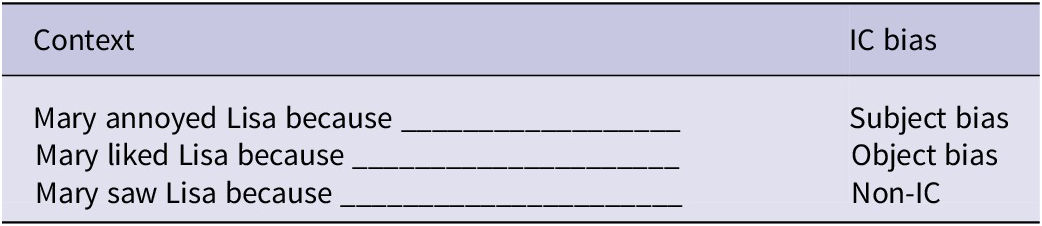


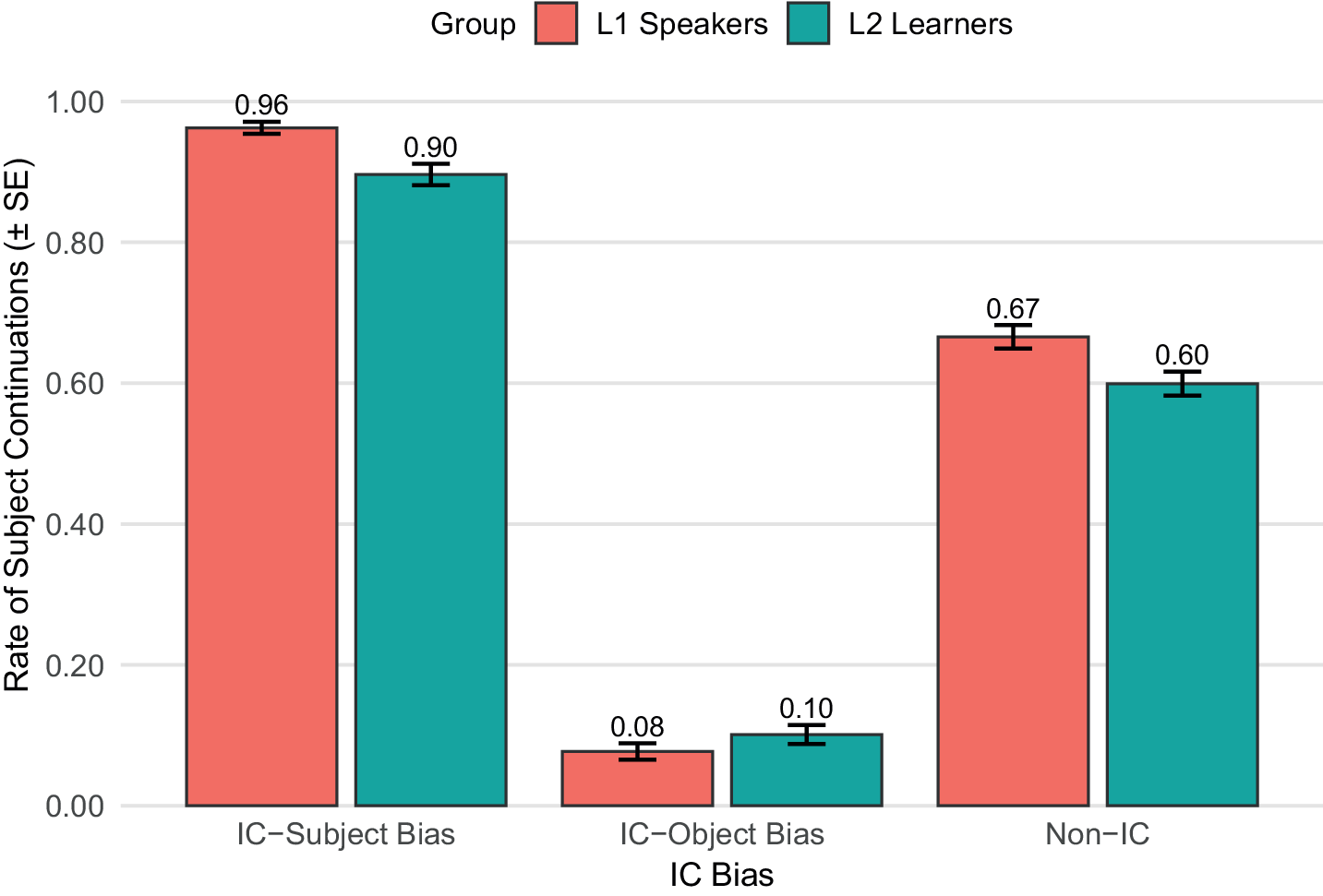
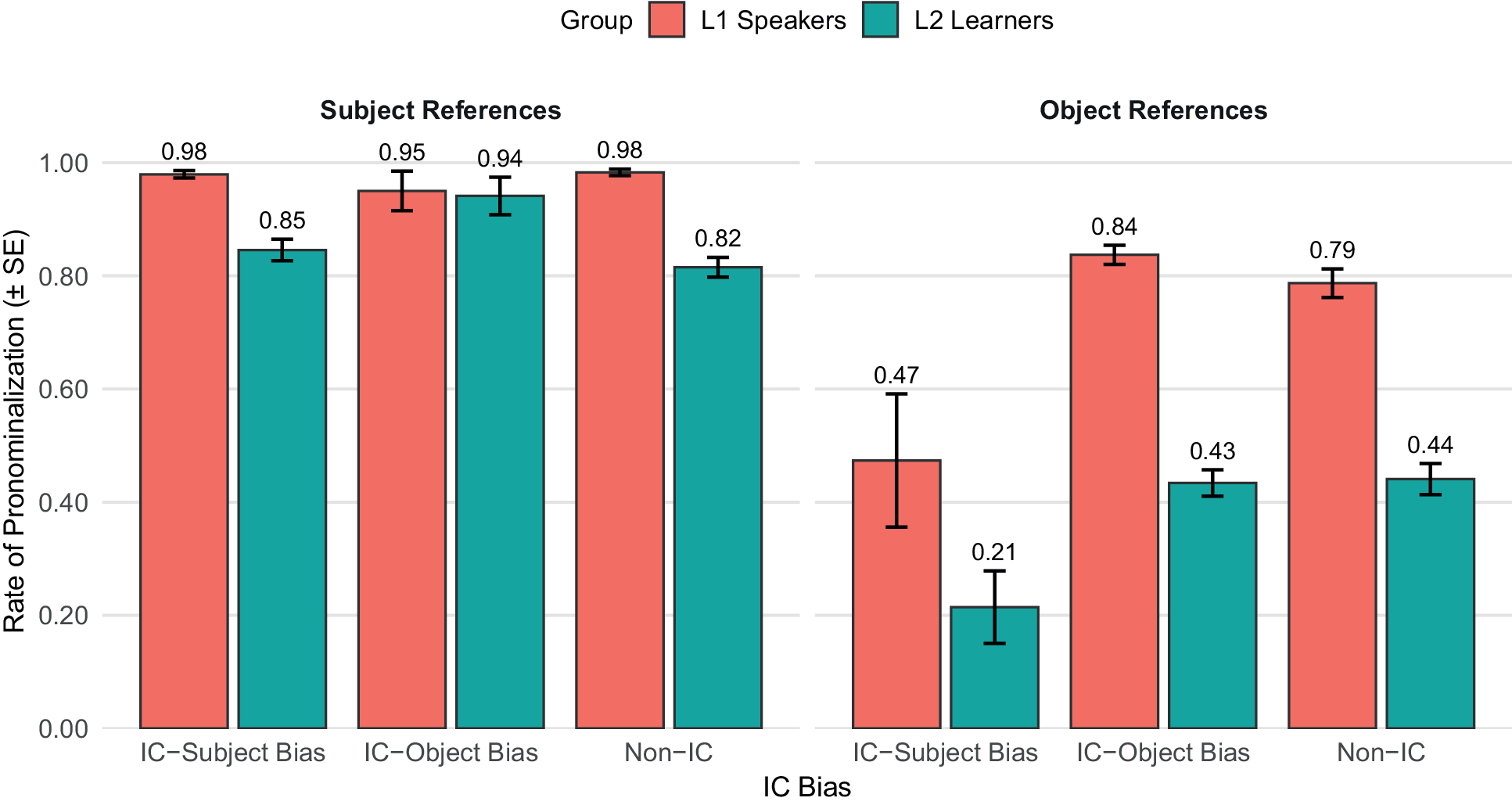

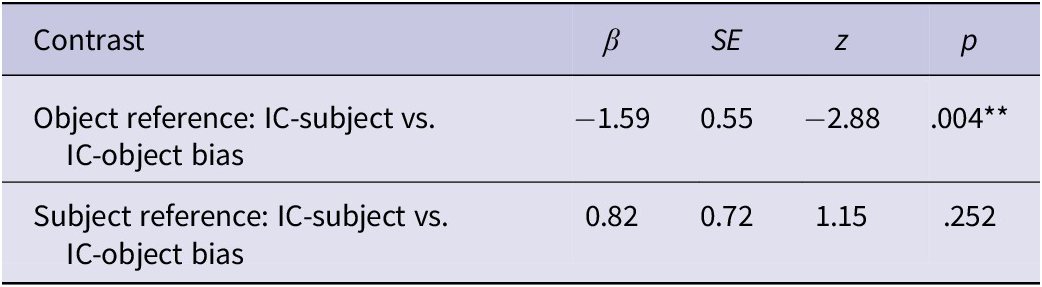
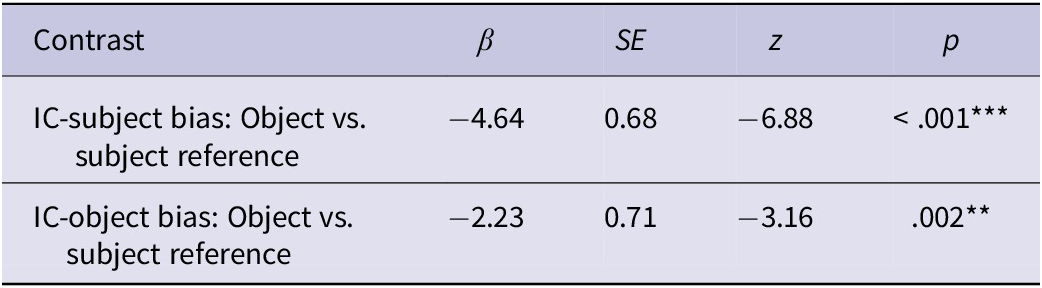

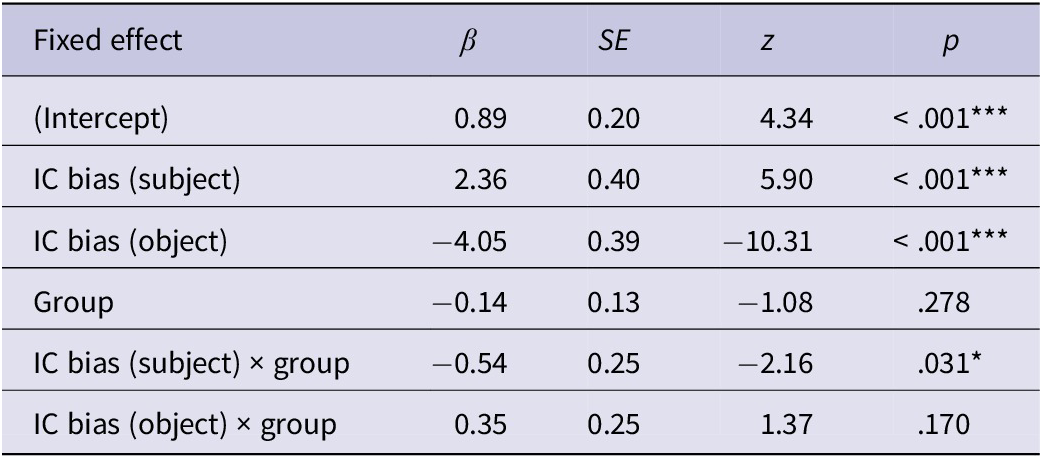


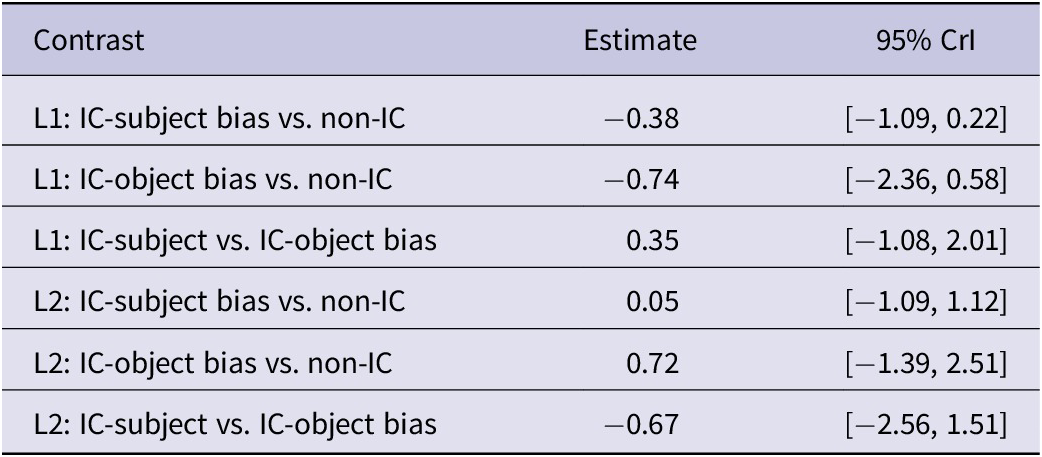
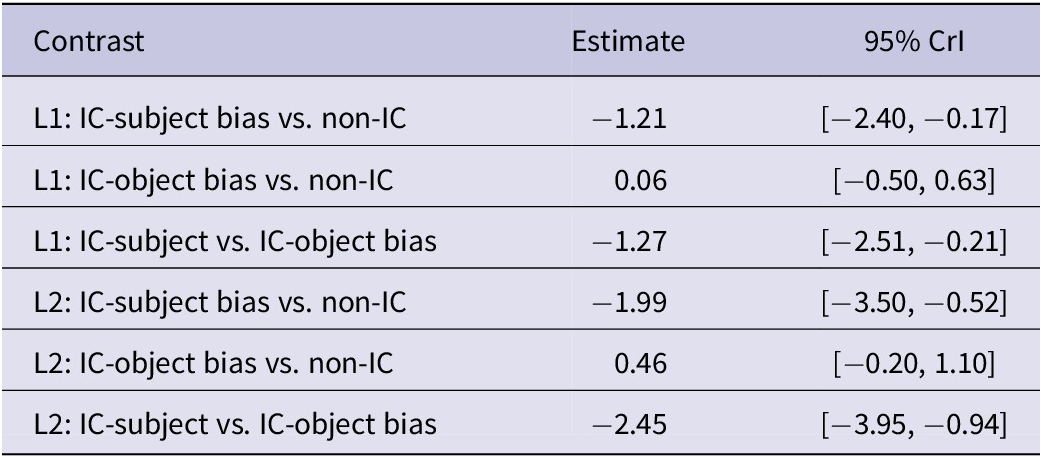

 Open access

