1. Introduction
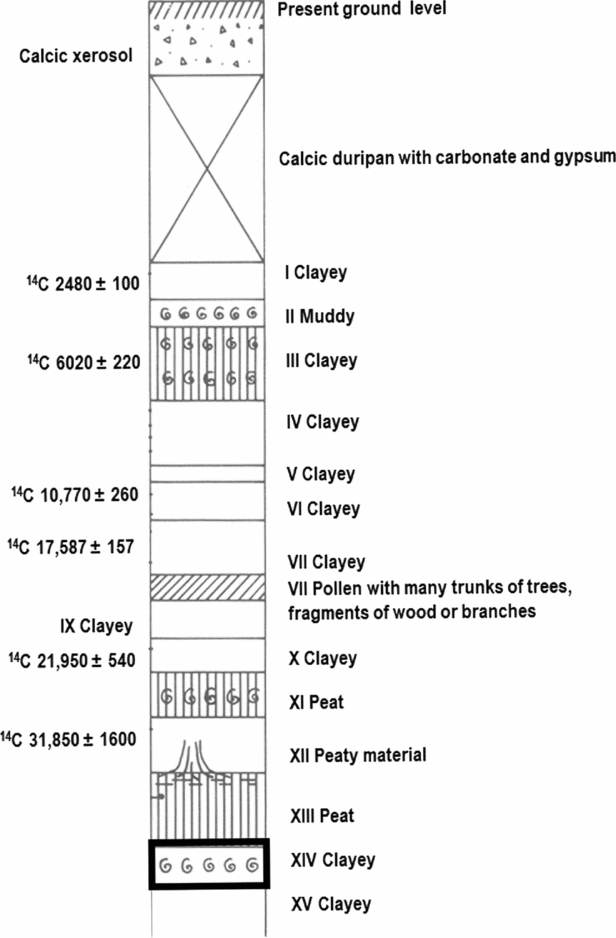
In México, many Late Pleistocene palaeontological localities are distributed all over the country. A few of them appear to be archaeological sites with evidence of human activity (Mirambell, Reference Mirambell and Mirambell1982; Mirambell & Lorenzo, Reference Mirambell, Lorenzo and Mirambell2012; Sánchez et al. Reference Sánchez, Holliday, Gaines, Arroyo-Cabrales, Martínez-Tagüeña, Kowler, Lange, Hodgins, Mentzer and Sánchez-Morales2014). One of those is Cedral, San Luis Potosí (México), where the earliest evidence of human presence in México has been found (Lorenzo & Mirambell, Reference Lorenzo, Mirambell and Bryan1986; Mirambell & Lorenzo, Reference Mirambell, Lorenzo and Mirambell2012). Remains of molluscs, reptiles, birds and mammals are associated with such evidence. These remains have been the objective of several studies, mainly focused on the identification and taxonomic studies of the different taxa, especially the mammals that inhabited the Cedral region (Alberdi, Arroyo-Cabrales & Polaco, Reference Alberdi, Arroyo-Cabrales and Polaco2003; Álvarez, Ocaña & Arroyo-Cabrales, Reference Álvarez, Ocaña, Arroyo-Cabrales and Mirambell2012; Alberdi et al. Reference Alberdi, Arroyo-Cabrales, Marín-Leyva and Polaco2014). In addition, environmental conditions have been inferred for the site during the time range in which the birds and mammals occurred (Corona-M, Reference Corona-M. and Mirambell2012; Olivera-Carrasco, Reference Olivera-Carrasco and Mirambell2012). The presence of three fossiliferous levels is based on stratigraphically controlled excavations with associated radiocarbon dates (modified from Lorenzo & Mirambell, Reference Lorenzo, Mirambell and Bryan1986). These levels are: (1) between 30000 and 25000 years bp (before present); (2) between 17000 and 11000 years bp, and (3) between 10000 and 8000 years bp (Fig. 1). Some studies have inferred the diet and habitat of five megaherbivore mammal species (horses (Equus conversidens, E. mexicanus and E. cedralensis), glyptodont (Glyptotherium sp.) and mammoth (Mammuthus columbi)) using either the carbon/oxygen isotopic relationships found in dental enamel (Pérez-Crespo et al. Reference Pérez-Crespo, Sánchez-Chillón, Arroyo-Cabrales, Alberdi, Polaco, Santos-Moreno, Benammi, Morales-Puente and Cienfuegos-Alvarado2009, Reference Pérez-Crespo, Arroyo-Cabrales, Benammi, Johnson, Polaco, Santos-Moreno, Morales-Puente and Cienfuegos-Alvarado2012 b) or micro/mesowear analyses (Barrón-Ortíz, Theodor & Arroyo-Cabrales, Reference Barrón-Ortíz, Theodor and Arroyo-Cabrales2014).
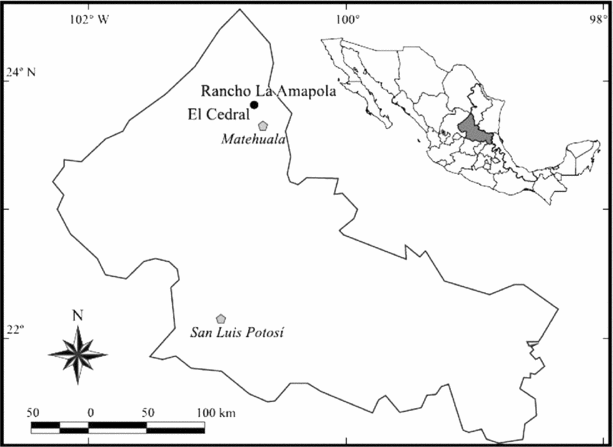
Geographic location of the Pleistocene locality at Cedral, San Luis Potosí, México.

In this study, the diet and habitat of several large herbivore and carnivore species from Cedral are inferred using carbon/oxygen isotopic relationships. This information is added to the other mammal data. The combined data are contrasted with data from previous studies using birds and molluscs to infer the palaeoenvironmental conditions that were present at Cedral during Late Pleistocene time.
1.a. Stable isotopes
Three main approaches are used for inferring the diet and habitat of Pleistocene extinct mammals: biological actualism, morphofunctional analyses and biochemical carbon/oxygen markers (Wing et al. Reference Wing, Sues, Potts, Dimicheli, Behrensmeyer, Behrensmeyer, Damuth, DiMicheli, Potts, Sues and Wing1992; Andrews & Hixson, Reference Andrews and Hixson2014). Carbon is incorporated into plants through photosynthesis via the three pathways of C3, C4 and CAM (Crassulacean Acid Metabolism) (O'Leary, Reference O'Leary1988).
The C3 photosynthetic pathway is present in trees and shrubs, and some temperate grasses, with carbon isotopic values ranging between −34‰ and −22‰ (van der Merwe & Medina, Reference Van Der Merwe and Medina1989; Cerling et al. Reference Cerling, Harris, MacFadden, Leakey, Quade, Eisenmann and Ehleringer1997; Koch, Reference Koch1998; Drucker & Bocherens, Reference Drucker, Bocherens, Creighton and Roney2009). On the other hand, the C4 photosynthetic pathway has δ13C values between −14‰ and −10‰, and is usually found in grasses as well as trees and shrubs from warm regions (Smith & Epstein, Reference Smith and Epstein1971; Koch, Reference Koch1998; Cerling, Reference Cerling, Sage and Monson1999; Medrano & Flexas, Reference Medrano, Flexas, Azcón-Bieto and Talón2000). Several factors may affect the abundance of C3 and C4 plants in the ecosystems. At localities with temperatures lower than 25°C, C3 plants increase in numbers while C4 plants diminish (Medrano & Flexas, Reference Medrano, Flexas, Azcón-Bieto and Talón2000). Also, C4 plants are able to cope with lower atmospheric CO2 and humidity levels than C3 plants (McInerney, Strömberg & White, Reference McInerney, Strömberg and White2011). Ehleringer & Monson (Reference Ehleringer and Monson1993) have shown that in desert areas of the southern USA and northern México, where rain is plentiful in winter, C3 plants are more abundant while C4 plants are more abundant during summer. In temperate areas, both kinds of plants coexist throughout the year, but at locations with different microhabitat conditions for temperature and humidity. Furthermore, several factors like saline soils, low light intensity and lack of nutrients may influence the carbon isotopic composition of C3 plants (Bocherens, Reference Bocherens2003).
The third photosynthetic pathway, CAM, is found in succulent plants, like cacti, bromeliads or agaves, with δ13C values between −35‰ and −12‰ (Decker & de Wit, Reference Decker and De Wit2005; Andrade et al. Reference Andrade, De La Barrera, Reyes-García, Ricalde, Vargas-Soto and Cervera2007).
Herbivores eat plants, incorporating the carbon from those plants into their tissues and structures such as dental enamel. As such, the isotopic values are correlated with those of the plants, but with a 14.1‰ increment (Cerling & Harris, Reference Cerling and Harris1999). Based on that difference, modern animals that eat C4 plants will have δ13C values between −2‰ and 2‰. Carbon isotopic values between −9‰ and −19‰ will be found in herbivores eating C3 plants, while those eating both types of plants will have δ13C values between −2‰ and −9‰ (MacFadden & Cerling, Reference MacFadden and Cerling1996). These carbon isotope values are based on modern atmospheric CO2 in which the δ13C value has decreased from −6.5‰ to −8.0‰ owing to anthropocentric released CO2 (Marino & McElroy, Reference Marino and McElroy1991; Marino et al. Reference Marino, McElroy, Salawitch and Spaulding1992). The δ13C values of dental enamel for Late Pleistocene animals, therefore, are between 0.5 and 1.3 more positive than in current herbivorous mammals (Koch, Hoppe & Webb, Reference Koch, Hoppe and Webb1998).
Based on the above, Feranec (Reference Feranec2004) pointed out that carbon isotopic values for Pleistocene herbivore dental enamel greater than −1.3‰ are typical for C4 plants; those lower than −7.9‰ indicate C3 plants; and those feeding on both types of plants show values between −1.3‰ and −7.9‰. In the case of carnivores, carbon isotopic values will depend upon the prey eaten, as well as the part of the carcass eaten, like muscle, organs or bone (Coltrain et al. Reference Coltrain, Harris, Cerling, Ehleringer, Dearing, Ward and Allen2004; Kohn, McKay & Knight, Reference Kohn, McKay and Knight2005; Palmqvist et al. Reference Palmqvist, Pérez-Claros, Janis, Figueirido, Torregrosa and Gröcker2008; Feranec & DeSantis, Reference Feranec and Desantis2014). As such, carnivore values will show enrichment between 1.3‰ and −2‰ in relation to the isotopic values of the herbivores they feed upon (Clementz et al. Reference Clementz, Fox-Dobbs, Wheatley, Koch and Doak2009). On the other hand, oxygen is mainly ingested via the water that is drunk. Additionally, some oxygen is ingested via the eaten and inhaled food oxygen. All these ways of ingestion are in equilibrium with water lost from exhalation, sweating, urine and faeces (Koch, Fogel & Tuross, Reference Koch, Fogel, Tuross, Lajtha and Michener1994). Factors like physiology, climate and habitat can modify such a balance (Sánchez, Reference Sánchez, Alcorno, Redondo and Toledo2005). The ingested oxygen mostly comes from the ingested water that is derived from rain water, which is affected by latitude, longitude and rain quantity, but mainly temperature (Dansgaard, Reference Dansgaard1964; Castillo, Morales & Ramos, Reference Castillo, Morales and Ramos1985). Oxygen isotopic composition is frequently used for palaeoclimatic and palaeoecological studies (Bocherens et al. Reference Bocherens, Koch, Mariotti, Geraads and Jeager1996; Sponheirmer & Lee-Thorp, Reference Sponheirmer and Lee-Thorp1999; Schoeninger, Kohn & Valley, Reference Schoeninger, Kohn, Valley, Ambrose and Katzemberg2000).
2. Materials and methods
2.a. Study area
The Cedral site is located in the state of San Luis Potosí, México, at 23°49′N and 100°43′W, and 1700 m asl (metres above sea level) (Fig. 2). This site contains several ancient source water springs that could have been used as drinking water by Late Pleistocene mammals and others (Álvarez, Ocaña & Arroyo-Cabrales, Reference Álvarez, Ocaña, Arroyo-Cabrales and Mirambell2012; Corona-M, Reference Corona-M. and Mirambell2012).
Stratigraphic column for Cedral (modified from Lorenzo & Mirambell, Reference Lorenzo, Mirambell and Bryan1986).

2.b. Sample preparation and analyses
The preparation of the samples and analyses were performed in the Stable Isotopes Mass Spectrometry Lab at the Geology Institute, National Autonomous University of México. The preparation procedure followed the method proposed by Koch, Tuross & Fogel (Reference Koch, Tuross and Fogel1997). First, 20 mg of enamel was ground and screened with a 125 μm mesh to obtain a fine and uniform dust. As sloths lack dental enamel, 20 mg of osteodentine was taken from their molariforms for analysis. Then, 10 ml of 30% hydrogen peroxide (H2O2) was added to eliminate the organic matter and was left for a period of 2 hours. Subsequently, the samples were centrifuged and the hydrogen peroxide decanted and washed with distilled water three times. Once this wash cycle was completed, 5 ml of a buffer solution made of Ca(C2H3O2)2–H3C2OOH 1M, pH = 4.75 was added and allowed to sit for 9 hours. Afterwards, the buffer solution was discarded, and samples were washed three times again with distilled water. Finally, to eliminate any remaining water, absolute ethanol was added, and the solution was left to rest for 12 hours in an oven at 90°C. Determination of simple isotopic abundance was executed in a Finnigan MAT 253 mass spectrometer with a dual inlet system, and GasBench auxiliary equipment with a GC Pal autosampler that has a temperature-controlled aluminium plate adjoined to the mass spectrometer (Révész & Landwehr, Reference Révész and Landwehr2002). Results were reported as δ18OVPDB and δ13CVPDB. They were normalized using NBS-19, NBS-18 and LSVEC to the Vienna Pee Dee Belemnite (VPDB) scale in accordance with the corrections described by Coplen (Reference Coplen1988) and Coplen et al. (Reference Coplen, Brand, Gehre, Gröning, Meijer, Toman and Verkouteren2006), as well as Werner & Brand (Reference Werner and Brand2001). For this technique, the standard deviation was 0.2‰ for oxygen and 0.2‰ for carbon. Additionally, isotopic values recorded by Pérez-Crespo et al. (Reference Pérez-Crespo, Sánchez-Chillón, Arroyo-Cabrales, Alberdi, Polaco, Santos-Moreno, Benammi, Morales-Puente and Cienfuegos-Alvarado2009, Reference Pérez-Crespo, Arroyo-Cabrales, Benammi, Johnson, Polaco, Santos-Moreno, Morales-Puente and Cienfuegos-Alvarado2012 b) for the horses Equus conversidens, E. mexicanus and E. cedralensis, glyptodont Glyptotherium sp. and mammoth Mammuthus were included in the study.
Mean, maximum and minimum values were assayed for δ13C and δ18O. In the case of the herbivore δ13C values, these were compared with values provided by Feranec (Reference Feranec2004) for inferring diet type. Carbon and oxygen isotopic values were compared using an analysis of variance, the Kruskall-Wallis test and the Tukey-Kramer test, and graphed following the Feranec & MacFadden (Reference Feranec and MacFadden2006) and White et al. (Reference White, Asfaw, Beyene, Haile-Salassie, Owenlevejoy, Suwa and Woldegabriel2009) models (Fig. 2). Significance level for the statistical tests was set at p < 0.05, and NCCS and PASS (Hintze, Reference Hintze2004) was the utilized software.
3. Results
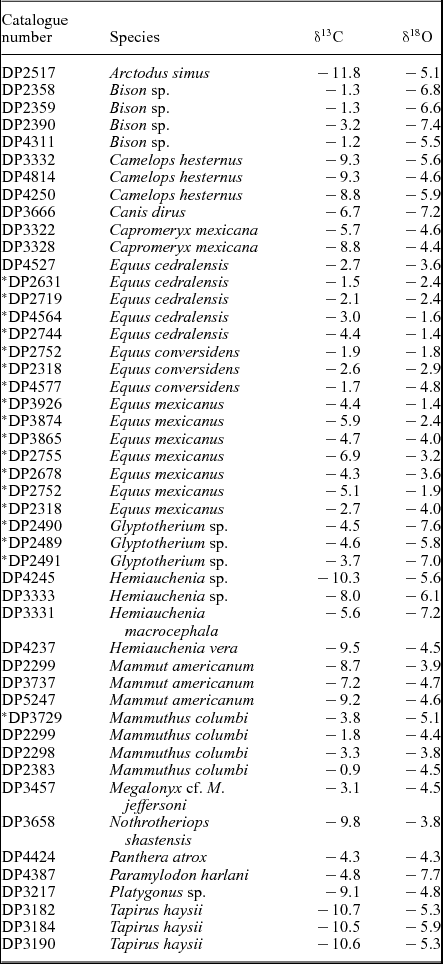
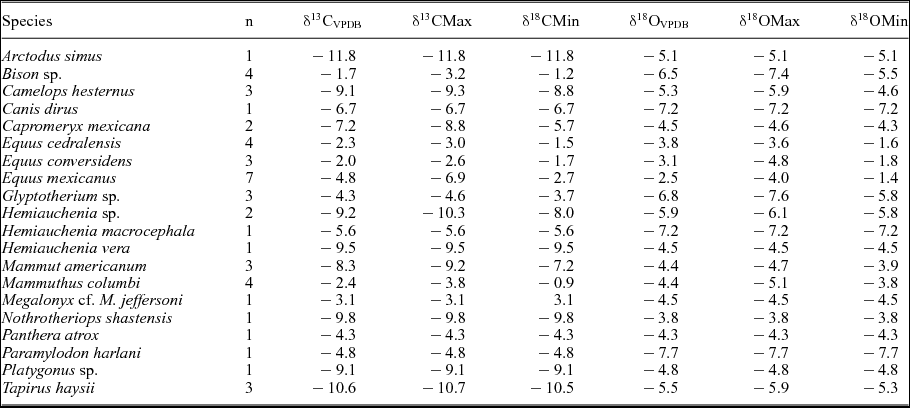
Table 1 contains carbon and oxygen isotopic values for each one of the studied specimens, and Table 2 has average values for each studied species. The most negative carbon isotopic value is for the short-faced bear (Arctodus simus), while bison (Bison sp.) has the most positive average isotopic values.
Carbon and oxygen isotopic values for carnivores and herbivores from Cedral

*Values taken from Pérez-Crespo et al. (Reference Pérez-Crespo, Sánchez-Chillón, Arroyo-Cabrales, Alberdi, Polaco, Santos-Moreno, Benammi, Morales-Puente and Cienfuegos-Alvarado2009, Reference Pérez-Crespo, Arroyo-Cabrales, Benammi, Johnson, Polaco, Santos-Moreno, Morales-Puente and Cienfuegos-Alvarado2012 b).
Means, maximum and minimum values of δ13C and δ18O

n – number of individuals; delta values expressed in ‰.
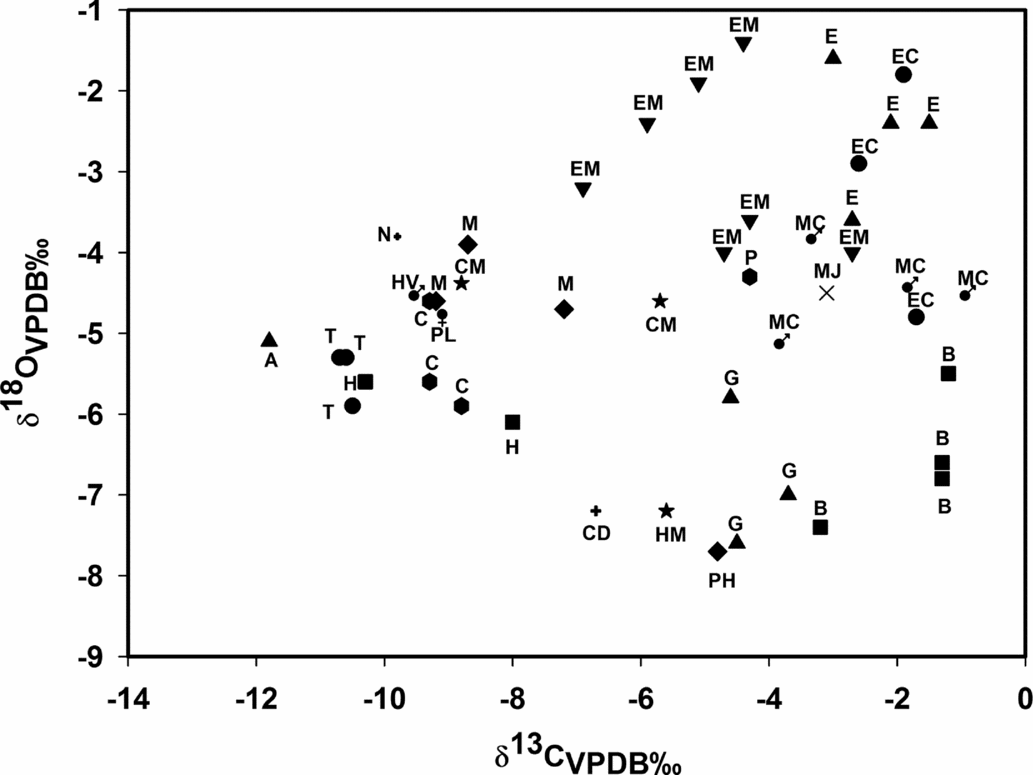
Both analysis of variance and Kruskall-Wallis tests assayed between δ13C and δ18O values show that significant differences exist among the analysed species (p < 0.00001; Degree of Freedom: 46; Fisher test: 17.61; p < 0.001685; Degree of Freedom: 46; H test: 42.1652); see online Supplementary Material Tables S1 and S2 available at http://journals.cambridge.org/geo for the results from the Tukey-Kramer tests for both isotopic relationships. In the graph (Fig. 3), most values for bison, some horses and mammoth are located to the right, which indicates these animals lived in areas of open vegetation. Values for short-faced bear, tapir (Tapirus sp.), some llamas (Hemiauchenia sp. and H. vera), camel (Camelops hesternus), mastodon (Mammut americanum), javelina (Platygonus sp.) and Shasta ground sloth (Nothrotheriops shastensis) are to the left, which suggests those animals preferred areas of closed vegetation. The American lion (Panthera atrox), dire wolf (Canis dirus), ground sloth (Paramylodon harlani), glyptodont (Glyptotherium sp.), some horses, llamas (H. macrocephala) and mammoth values are located between those two groups, indicating that those animals lived in areas with some degree of tree coverage.
Graph of the δ13C v. δ18O values for Cedral fauna. A – Arctodus simus; B – Bison sp.; C – Camelops hesternus; CD – Canis dirus; CM – Capromeryx mexicana; E – Equus cedralensis; EC – Equus conversidens; EM – Equus mexicanus; G – Glyptotherium sp.; H – Hemiauchenia sp.; HM – Hemiauchenia macrocephala; HV – Hemiauchenia vera; MM – Mammut americanum; MC – Mammuthus columbi; MJ – Megalonyx cf. M. jeffersoni; N – Nothrotheriops shastensis; P – Panthera atrox; PH – Paramylodon harlani; PL – Platygonus sp.; T – Tapirus haysii.

4. Discussion
4.a. Herbivore diets
The results show that most of the bison at Cedral were feeding on C4 plants. One, however, shows a mixed C3/C4 diet, but with an important C4 plant intake. Based on data δ13C secured for Bison species by Chisholm et al. (Reference Chisholm, Driver, Dube and Schwarcz1986), Connin, Betancourt & Quade (Reference Connin, Betancourt and Quade1998), Gadbury et al. (Reference Gadbury, Todd, Jahren and Amundson2000), Leyden & Oetelaar (Reference Leyden and Oetelaar2001), Koch, Diffenbaugh & Hoppe (Reference Koch, Diffenbaugh and Hoppe2004) and Feranec (Reference Feranec2007) in the USA and Canada, bison were feeding primarily on C4 plants, with a few individuals being C3/C4 mixed feeders. Furthermore, meso- and microwear studies have shown that Pleistocene bison were more flexible in their diet than previously considered (Rivals, Solounias & Mihlbachler, Reference Rivals, Solounias and Mihlbachler2007).
For the camels, assays showed that their diet was mainly based on C3 plants. Similarly, Pérez-Crespo et al. (Reference Pérez-Crespo, Arroyo-Cabrales, Alva-Valdivia, Morales-Puente and Cienfuegos-Alvarado2012 b) analysed the diet for this animal from Laguna de las Cruces, a locality near Cedral. They found that some individuals were C3/C4 mixed feeders with a large intake of C4 plants, while others exclusively fed upon C4 plants. Dompierre & Churcher (Reference Dompierre and Churcher1996) and Semprebon & Rivals (Reference Semprebon and Rivals2010) pointed out that camels were mainly mixed-diet feeders. Some individuals or even populations, however, showed either grazing or browsing diets, like the Cedral individuals. These results suggested that these animals were generalists rather than specialists in their diet.
Individuals of Capromerxy mexicana showed a C3/C4 mixed diet, similar to results based on mesowear by Barrón-Ortíz et al. (Reference Barrón-Ortíz, Pérez-Crespo, Arroyo-Cabrales, Theodor, Morales-Puente and Cienfuegos-Alvarado2014) for the same samples. This small pronghorn was characterized as a grassland browser and grazer based on morphological inferences (Johnson, Arroyo-Cabrales & Polaco, Reference Johnson, Arroyo-Cabrales, Polaco, Jiménez, González, Pompa y Padilla and Ortíz2006). Studies by Connin, Betancourt & Quade (Reference Connin, Betancourt and Quade1998), Coltrain et al. (Reference Coltrain, Harris, Cerling, Ehleringer, Dearing, Ward and Allen2004), Rivals & Semprebon (Reference Rivals and Semprebon2006) and Semprobon & Rivals (Reference Semprebon and Rivals2007) on different genera of Cenozoic antilocaprids showed that these animals had a wider feeding spectrum than previously proposed.
For the horses, on average the three known species at Cedral were C3/C4 mixed-diet feeders. Small differences, however, occurred in the amount of C3 or C4 plant consumption for each species. Equus cedralensis had a C3/C4 mixed diet, while one individual ate C4 plants exclusively. E. conversidens was a C3/C4 mixed feeder, but with some preferences for C4 plants. Finally, E. mexicanus had a mixed diet, but with a larger consumption of C3 plants than the other two species. One individual, however, had a mixed diet with a larger intake of C4 plants. Barrón-Ortíz, Theodor & Arroyo-Cabrales (Reference Barrón-Ortíz, Theodor and Arroyo-Cabrales2014) evaluated the same individuals using both meso- and microwear analyses and found a similar pattern. They proposed that the pattern may be due to microhabitats at the site as well as to size differences among the horse species.
The glyptodont δ13C values indicated a C3/C4 mixed diet with a large consumption of C4 plants. Gillete & Ray (Reference Gillete and Ray1981) proposed that this genus had a browsing feeding habit. Later, Fariña & Vizcaíno (Reference Fariña and Vizcaíno2001) questioned such a proposal, and indicated that glyptodont teeth were hypsodont and had ostedentine rings that mimicked enamel function, as well as skull morphofunctional adaptations (Vizcaíno, De Iuliis & Bargo, Reference Vizcaíno, De Iuliis and Bargo1998; Vizcaíno et al. Reference Vizcaíno, Fariña, Bargo and De Iuliis2004). These lines supported the suggestion that the genus mainly ate grasses. Johnson, Arroyo-Cabrales & Polaco (Reference Johnson, Arroyo-Cabrales, Polaco, Jiménez, González, Pompa y Padilla and Ortíz2006) characterized the glyptodont as a browser along waterways. Isotopic data, however, obtained during the present study supports the proposal by Vizcaíno (Reference Vizcaíno2000) and Fariña & Vizcaíno (Reference Fariña and Vizcaíno2001). The Cedral individuals primarily ate C4 grasses.
For the Cedral llamas, two individuals assigned to Hemiauchenia sp. and an individual of Hemiauchenia vera showed a diet mainly based on C3 plants, while H. macrocephala had a C3/C4 mixed diet, but with an important intake of C3 plants. The current isotopic analysis and meso- and microwear studies (Barrón-Ortíz, Theodor & Arroyo-Cabrales, Reference Barrón-Ortíz, Theodor and Arroyo-Cabrales2014) indicated that these animals were generalists in their diet. Individuals were eating either C3 or C4 plants only, or with C3/C4 mixed diets (Feranec, Reference Feranec2003; Semprebon & Rivals, Reference Semprebon and Rivals2010), as previously proposed by Honey et al. (Reference Honey, Harrison, Prothero, Stevens, Janis, Scott and Jacobs1998).
For Cedral mastodons, the study individuals only ate C3 plants. Isotopic studies by Koch, Hoppe & Webb (Reference Koch, Hoppe and Webb1998) and Metcalfe (Reference Metcalfe2011) with mastodon samples from Ontario (Canada) and New York and Florida (USA) indicated that this species was a browser (exclusively eating C3 plants). This interpretation was supported by dental microwear studies by Green & Hulbert (Reference Green and Hulbert2005), Green, Semprebon & Solounias (Reference Green, Semprebon and Solounias2005), Green (Reference Green2006) and Rivals, Semprebon & Lister (Reference Rivals, Semprebon and Lister2012) using specimens from South Carolina, Florida and Texas (USA). Coprolite analysis of samples from Aucilla River, Florida pertaining to this animal assayed by Leeper et al. (Reference Leeper, Frolking, Fisher, Goldstein and Sanger1991) and Newson & Mihlbachler (Reference Newsom, Mihlbachler and Weeb2006), however, found small quantities of herbs.
For the other proboscidean group at Cedral, three mammoths had a C3/C4 mixed diet, while one individual exclusively ate C4 plants. Another study with Mexican mammoth samples also showed that this animal had a C3/C4 mixed diet with an important consumption of C4 plants (Pérez-Crespo et al. Reference Pérez-Crespo, Arroyo-Cabrales, Alva-Valdivia, Morales-Puente and Cienfuegos-Alvarado2012 a), similar to the findings at Cedral.
The one javelina sample from Cedral showed a diet exclusively of C3 plants. Previously, this animal was thought to have eaten leaves and fruits, as well as succulent plants (Kurtén & Anderson, Reference Kurtén and Anderson1980). Isotopic analysis of specimens from California and Florida (USA) showed that these animals had a C3/C4 mixed diet, with some individuals exclusively eating C3 plants (Feranec, Reference Feranec2005; Trayler, Reference Trayler2012).
Ground sloths at Cedral had a wide variety of diets depending upon species. The mylodont had a C3/C4 mixed diet, with an important C3 plant intake. Kurtén & Anderson (Reference Kurtén and Anderson1980) mentioned that the species ate grasses, short shrubs and roots, while Johnson, Arroyo-Cabrales & Polaco (Reference Johnson, Arroyo-Cabrales, Polaco, Jiménez, González, Pompa y Padilla and Ortíz2006) characterized Paramylodon harlani as a grassland mixed browser. Morphometric analyses undertaken by McDonald (Reference McDonald2005), McDonald & Pelikan (Reference McDonald and Pelikan2006) and Bargo & Vizcaíno (Reference Bargo and Vizcaíno2008), however, suggested that this species ate mainly grasses and other herbs. Isotopic analysis of Texan specimens by Reuz (Reference Ruez2005) showed a mixed diet similar to the individual from Cedral.
On the other hand, the nothrotheriop sloth at Cedral exclusively ate C3 plants. Microwear studies showed that those animals fed upon leaves (Green, Reference Green2009), but isotopic analysis indicated that these animals mostly had a C3/C4 mixed diet (Bonde, Reference Bonde2013). Similarly, coprolite analysis from materials pertaining to this species indicated that these animals ate tree leaves, herbs and cacti (Thompson et al. Reference Thompson, Van Devender, Martin, Foppe and Long1980; Poinar et al. Reference Poinar, Hofreiter, Spaulding, Martin, Stankiewicz, Bland, Evershed, Possnert and Pääbo1998). In the case of Megalonyx cf. M. jeffersoni, this individual had a C3/C4 mixed diet, with an important intake of C4 plants. Such a finding was different from that based on the morphological inference (Kurtén & Anderson, Reference Kurtén and Anderson1980; McDonald, Reference McDonald2005; Johnson, Arroyo-Cabrales & Polaco, Reference Johnson, Arroyo-Cabrales, Polaco, Jiménez, González, Pompa y Padilla and Ortíz2006) that these animals ate fruit and tree leaves. Isotopic data from individuals elsewhere in North America (Kohn, McKay & Knight, Reference Kohn, McKay and Knight2005) showed that this animal ate C3 plants. Bonde (Reference Bonde2013), however, found individuals from California (USA) had a C3/C4 mixed diet. He proposed that the species had different feeding strategies, allowing it to eat a wide diversity of plants.
Finally, tapirs at Cedral had a diet based on C3 plants. Tapirs today are known to eat mainly leaves, stems, fruits, bark and flowers (Naranjo, Reference Naranjo2009; Talamoni & Assi, Reference Talamoni and Assis2009). Isotopic analyses of present and fossil (Florida) specimens (Koch, Hoppe & Webb, Reference Koch, Hoppe and Webb1998; DeSantis & MacFadden, Reference Desantis and MacFadden2007; DeSantis, Reference Desantis2011) indicate that these animals were specialized in consumption of C3 plants, similar to what was found for the Cedral specimens.
4.b. Carnivore diets
The carbon isotopic value for the Pleistocene lion Panthera atrox at Cedral shows that this felid fed upon mixed-diet herbivores or C4 grazers such as bison, horses, pronghorn and mammoth. Fox-Dobbs, Leonard & Koch (Reference Fox-Dobbs, Leonard and Koch2008) suggested that individuals of the Pleistocene lion from Beringia ate bison, horses, moose and young mammoth, species that fed on C3 herbs. Cedral herbivores, like those from Beringia, ate herbs with different photosynthetic pathways and their diets should not be considered much different. Furthermore, Trayler (Reference Trayler2012) found that some specimens from California ate C3 herbivores, like cervids and mastodon, as well as some horses. These data suggest, as with all other information, that the American lion had a wide variety of prey.
For the one dire wolf Canis dirus at Cedral, the δ13C value suggests that it fed upon horses, llamas, mastodon and camel. Kurtén & Anderson (Reference Kurtén and Anderson1980) and Binder & Van Valkenburgh (Reference Binder and Van Valkenburgh2010) characterized the dire wolf as a scavenger. On the other hand, Wang & Tedford (Reference Wang and Tedford2008), Anyonge & Baker (Reference Anyonge and Baker2005) and Meloro (Reference Meloro2012) suggested that the species was an active hunter that also ate carrion, similar to grey wolf behaviour today. Fox-Dobbs et al. (Reference Fox-Dobbs, Bump, Peterson, Fox and Koch2007) noted that dire wolf from Rancho La Brea scavenged mastodon and sloth carcasses, but actively hunted bison, camel and horses. Coltrain et al. (Reference Coltrain, Harris, Cerling, Ehleringer, Dearing, Ward and Allen2004) found that other Rancho La Brea dire wolf had isotopic values that suggested they ate C3 herbivores. Trayler's (Reference Trayler2012) results from two California locations had isotopic values pointing to them eating C4 herbivores. These data showed that dire wolf had a wide variety of prey upon which it could feed, providing enough resources to inhabit the same area with other large predators, like the Pleistocene lion or sabre-toothed cat. Because Pleistocene lions also were present at Cedral, the dire wolf being more of a generalist would help it to coexist with the felid. With only one sample for each species, this hypothesis could not be tested.
Kurtén & Anderson (Reference Kurtén and Anderson1980) and Christiansen (Reference Christiansen1999) classified the short-faced bear Arctodus simus as an active predator. Based on isotopic analysis, Matheus (Reference Matheus1995, unpub. Ph.D. thesis, Univ. Alaska Fairbanks, 1997) identified it as a scavenger. Figuerido et al. (Reference Figuerido, Pérez-Claros, Torregosa, Martín-Serra and Palmqvist2010) and Donohue et al. (Reference Donohue, Desantis, Schubert and Ungar2013) noted it as an omnivore. Owing to having only one sample from Cedral and the lack of nitrogen isotopic values, it is difficult at this point to infer whether the short-faced bear was an omnivore or solely fed upon meat. The δ13C value, however, showed that this individual fed upon C3 herbivores, different from those eaten by the American lion and the dire wolf. The value did not overlap with any of the known herbivores from the site, but was close to tapir and llama values. Those animals could have been included in their diet, along with other C3 herbivores like camel, javelina, Nothrotheriops and mastodon. For Alaska and California (Fairmed Landfill) specimens, Fox-Dobbs, Leonard & Koch (Reference Fox-Dobbs, Leonard and Koch2008) and Trayler (Reference Trayler2012) proposed that this animal ate mammoth, horse, bison and cervid. Trayler (Reference Trayler2012), however, noted for other California locations (McKittrick and Asphalt Seep) that short-faced bear had a diet based on deer and tapir, similar to the one inferred for the Cedral individual.
4.c. Habitat
In regard to the oxygen isotopic values, taxa differences may be due to the species’ particular physiology (Bryant & Froelich, Reference Bryant and Froelich1995; Fricke & O'Niel, Reference Fricke and O'Niel1996; Zanazzi & Kohn, Reference Zanazzi and Kohn2008), as well as to movements the animals may have undertaken. These animals would have a water isotopic composition from the areas where they previously fed (Hoppe, Reference Hoppe2004).
Cedral herbivores lived in diverse habitats. Bison, some horse species and some mammoth preferred inhabiting open areas, while tapir, nothrotherid sloths, javelina, llamas, camel and mastodon preferred closed areas. All other herbivores preferred areas with some tree coverage such as Pleistocene pronghorn, glyptodont, mylodont and megalonichid sloths, and some mastodon, horse and mammoth (Fig. 3).
For carnivores, the American lion at Cedral inhabited areas with sparse tree coverage. Christiansen & Harris (Reference Christiansen and Harris2009) indicated that Panthera atrox mainly lived in open areas, while Trayler (Reference Trayler2012) also included closed areas. The combined findings suggested that this species occupied a wide variety of habitats. Likewise, the dire wolf Canis dirus individual preferred open areas with some tree coverage. Johnson, Arroyo-Cabrales & Polaco (Reference Johnson, Arroyo-Cabrales, Polaco, Jiménez, González, Pompa y Padilla and Ortíz2006) mentioned that this animal was an inhabitant of grasslands or savannas. California specimens also showed that they inhabited tree covered areas (Trayler, Reference Trayler2012).
On the other hand, short-faced bear at Cedral inhabited closed areas. Kurtén & Anderson (Reference Kurtén and Anderson1980), P. E. Matheus (unpub. Ph.D. thesis, Univ. Alaska Fairbanks, 1997) and Johnson, Arroyo-Cabrales & Polaco (Reference Johnson, Arroyo-Cabrales, Polaco, Jiménez, González, Pompa y Padilla and Ortíz2006) considered that this animal lived in grasslands or savannas. Trayler (Reference Trayler2012) found bear individuals living in forested areas and others in areas with open vegetation. This variation suggested that this species was capable of living in a variety of habitats and fed upon animals living there. The lack of a larger sample, however, precluded testing that proposal.
Habitat differential preferences for Cedral carnivores and herbivores indicated that an open forest existed at this site. The fossil pollen record showed the presence of trees, herbs and cacti (Sánchez-Martínez & Alvarado, Reference Sánchez-Martínez, Alvarado and Mirambell2012). That record supported the proposal by Corona-M (Reference Corona-M. and Mirambell2012) and Olivera-Carrasco (Reference Olivera-Carrasco and Mirambell2012) that a wetland existed along with the spring, with a gallery forest near to grassland or scrub. This vegetation mosaic supported a diverse mammalian herbivore and carnivore fauna that inhabited Cedral during Late Pleistocene time. This pattern was similar to that found in northwestern Sonora and southwestern USA (Hall, Van Devender & Olson, Reference Hall, Van Devender and Olson1988; Metcalfe, Reference Metcalfe2006; Clark et al. Reference Clark, Dyke, Shakun, Carlson, Clark, Wohlfarth, Mitrovica, Hostetler and McCabe2012). A humid climate allowed the presence of this vegetation mosaic. The warming environment in Holocene time allowed the rise of the xerophilous scrub that is present today (Flores, Reference Flores and Mirambell2012).
5. Conclusions
For Cedral, north-central México, the herbivorous mammal fauna was constituted by three groups of animals. One group fed on C3 plants and lived in open areas, like camel and some llamas. Another group fed on C4 plants in open areas, like some bisons, horses and mammoths. The third group had a mixed diet, living in areas with some tree coverage, like pronghorn, glyptodont, mastodon, javelina, mylodont ground sloth, and other bison, horses, llamas and mammoth. On the other hand, American lion and dire wolf preyed on herbivores that lived in areas with some tree coverage, while short-faced bear ate herbivores living in closed areas. Based on these data and the pollen record, these animals lived in a forest with a nearby grassland. During Late Pleistocene time, environmental conditions were wetter than present, providing the best conditions for the settling of the first Mexican humans.
Acknowledgements
We thank the Consejo de Arqueología from INAH for granting the permit to obtain the enamel samples from the studied horses. Also, Consejo Nacional de Ciencia y Tecnologia and (#132620) and Programa de Apoyo a Proyectos de Investigación e Innovación Tecnológica-UNAM (#IN404714) provided supportive grants. Laboratorio de Isotópos Estables from the Instituto de Geologia, UNAM, as well as R. Puente M. analysed the samples. Also, Dr Eileen Johnson very kindly reviewed the English writing, but any mistakes are from the authors. Maria Teresa Alberdi and one anonymous review also contributed with useful comments.
Supplementary material
To view supplementary material for this article, please visit http://dx.doi.org/10.1017/S0016756816000935