INTRODUCTION
Fish is an important component of a healthy diet, providing a number of substantial nutrients that are essential for achieving balanced nutrition for children and adults. Marine fish are good sources of fats, proteins, vitamins and minerals. Fish protein is regarded as quality protein, being rich in essential amino acids with a high digestibility value. The amino acid composition is one of the most important nutritional qualities of protein, and the amino acid score is used to evaluate protein quality world-wide (FAO/WHO, 1990). Studies on fish amino acids are necessary as fish amino acids are important in healing processes, and their composition in fish is comparable to that in humans (Osibona et al., Reference Osibona, Kusemiju and Akande2009). Fish can also transport various minerals and vitamins necessary for human health. Fish oil is a rich source of vitamins, including vitamins A, D, E, K and C, which must be taken on a regular basis because of their key roles in human health and metabolism (Boran & Karaçam, Reference Boran and Karaçam2011). Fish can contribute appreciable amounts of dietary calcium, iron and zinc, nutrients that tend to be low in human diets.
Silver bellies (pony fish or slip mouths), especially, Leiognathus splendens (Cuvier, 1829) (Leiognathidae), are a significant group of fin fish widely distributed in Indo-Pacific waters (Kimura et al., Reference Kimura, Ito, Peristiwady, Iwatsuki, Yoshino and Dunlap2005). The southern coast is the most productive zone for silver belly in India, accounting for about 85% of the total landings (Nair, Reference Nair2005). Although, several studies have been conducted on the proximate composition, osteological studies, maturation, spawning, etc., in silver bellies along the Indian coast (Abraham et al., Reference Abraham, Murty and Joshi2011; Sebastian et al., Reference Sebastian, Inasu and Tharakan2011) no published studies are available on its nutritional composition, viz. amino acid, vitamin and mineral composition. The present study is designed to investigate the annual (2008–2011), spatial (south-west and south-east coasts of India), and seasonal (pre-monsoon, monsoon and post-monsoon) variations of protein, essential/non-essential amino acids, fat soluble vitamins and minerals of Leiognathus splendens collected from the south-west and south-east coasts of India by studying its living environment, viz. chlorophyll-a concentration derived from Sea Viewing Wide Field-of-view Sensor (SeaWiFS) data, keeping in mind the implication of such a variation for pharmaceutical products, food additives and dietary health supplements. The chlorophyll-a concentration at the oceanic surface is expected to give information about its relationship with the plankton abundance. The nutritional indicators were corroborated with the chlorophyll-a concentration to understand their effect on the nutritional signatures of L. splendens throughout the study period.
MATERIALS AND METHODS
Samples and study area
Fresh silver bellies were collected from the fishing harbours of Mangalore, Calicut, Cochin (situated at the south-west coast bordering the Arabian Sea) and Chennai, Mandapam, Tuticorin (situated at the south-east coast bordering the Bay of Bengal) during 2008–2011 on the fifteenth day of each month (200 g each). In order to obtain information on the seasonal variations, monthly data were grouped as pre-monsoon (February–May), monsoon (June–September) and post-monsoon (October–January). The results of the three centres on each coast were pooled and average values were used in the present study. Five pools of fish per collection site, each composed of thirty specimens of comparable body size were collected within each sample and washed in sterile water before being transported to the laboratory in an ice box (−18°C) for analysis. The entire amount of pooled edible portion (fish flesh) were then gutted and minced before being used for analysis. The time interval between capturing and the arrival of the fish at the landing sites was about 3–4 h. Although, age and sex differences in nutritional composition evidently could occur, we regarded the fish as a whole food source, which was representative of the market and thus totally used by the local population, without any age or sex differences.
Total protein and amino acids
The protein content of the silver bellies was estimated by the established method (Lowry et al., Reference Lowry, Roserrough, Farr and Randall1951). The protein content of the sample was calculated from the standard curve of bovine serum albumin, and expressed as g/100 g edible portion. The amino acid content was measured using the Pico–Tag method as described previously (Chakraborty et al., Reference Chakraborty, Joseph, Chakkalakal and Vijayan2013). Briefly, the sample was hydrolysed for 24 h at 110°C with 6 M HCl in sealed glass tubes filled with nitrogen. The hydrolysed samples were treated with redrying reagent (MeOH 95%: water:triethylamine, 2:2:1 v/v/v), and thereafter pre-column derivatization of the hydrolysable amino acids was performed with phenylisothiocyanate (PITC, or Edman's reagent) to form phenylthiocarbamyl (PTC) amino acids. The reagent was freshly prepared, and the composition of the derivatizing reagent was methanol 95%: triethylamine: phenylisothiocyanate (20 µl, 7:1:l v/v/v). The derivatized sample (PTC derivative, 20 µl) was diluted with the sample diluent (20 µl, 5 mM sodium phosphate NaHPO4 buffer, pH 7.4: acetonitrile 95:5 v/v) before being injected into the reversed-phase binary gradient high performance liquid chromatograph (HPLC) (Waters reversed-phase PICO.TAG amino acid analysis system), fitted with a packed column (dimethylocatadecylsilyl-bonded amorphous silica; Nova-Pak C18, 3.9 × 150 mm) maintained at 38 ± 1°C in a column oven, to be detected by their UV absorbance (λ max 254 nm; Waters 2487 dual absorbance detector). The mobile phase eluents used were eluents A and B, where eluent A comprises sodium acetate trihydrate (0.14 M, 940 ml, pH 6.4) containing triethylamine (0.05%), mixed with acetonitrile (60 ml), and eluent B used was acetonitrile:water (60:40, v/v). A gradient elution programme, with increasing eluent B was employed for this purpose. An additional step of 100% eluent B is used to wash the column prior to returning to initial conditions. The standard (PIERS amino acid standard H; Thermo Scientific) was run before each sample injection. Samples (PTC amino acid derivatives) were injected in triplicate, and the output was analysed using the BREEZE software (Waters). The quantification of amino acids was carried out by comparing the sample with the standard (PIERS amino acid standard H; Thermo Scientific), and the results were expressed in g/100 g edible portion.
Nutritional health indices and amino acid score
The total essential amino acids (TEAA), total non-essential amino acids (TNEAA), total amino acids (TAA), total aromatic amino acids (TArAA), total sulphur containing amino acids (TSAA) and the ratios of TEAA to TNEAA, TEAA to TAA, TNEAA to TAA and leucine/isoleucine (Leu/Ile) were calculated. The amino acid score (AS) for the essential amino acids was calculated using the formula: amount of amino acid per sample protein (mg g−1)/amount of amino acid per protein in reference protein (mg g−1) (FAO/WHO, 1991), with respect to the reference amino acid requirements for adults (FAO/WHO/UNU, 2007).
Fat soluble (A, D, E, K) and water soluble (C) vitamins
Estimation of the fat soluble vitamins (A, D3, E and K1) was carried out by a modified method of Salo-Vaananen et al. (Reference Salo-Vaananen, Mattila, Lehikoinen, Salmela-Molsa and Piironen2000). The stock solutions (1, 10, 25, 50 and 100 ppm) of vitamin standards (Sigma-Aldrich, St Louis, MO) were stored at −20°C except vitamin D3, where the stock solutions were stored at 4°C. The lipids (0.1 g) were extracted using the established method (Chakraborty et al., Reference Chakraborty, Joseph, Chakkalakal and Vijayan2013), before being hydrolysed (KOH/MeOH 0.5N, 2 ml) at 60°C for 30 min. The hydrolysed mixture (2 ml) was extracted with petroleum ether (fraction of 40–60°C, 15 ml) and washed with deionized water (2 × 10 ml) to make it alkali-free. The non-saponifiable portion was concentrated under vacuum and reconstituted in MeOH. The latter was filtered through a syringe filter (0.2 µm) before being injected (20 µl) in the HPLC (Shimadzu, Prominence). The HPLC system was equipped with a reverse phase column (Phenomenex, C18 250 mm length, 4.6 mm I.D., 5 µm) that was housed in a column oven (32°C) and connected to a photodiode array detector. The gradient programme was as follows: 20% methanol (HPLC grade) up to 3 min, which was increased to 100% in the next 5 min and held for 37 min with a complete run time of 45 min. The flow rate was 1 ml min−1. Vitamin C was determined based upon the quantitative discoloration of 2,6-dichlorophenol indophenol titrimetric method (AOAC International, 1995). In brief, ascorbic acid was extracted from the fish (W, 15–20 g) using an acetic acid and metaphosphoric acid solution (HPO3–CH3COOH, 10 ml × 2). The extracts were transferred with distilled water into a known volume (V, ml) and filtered rapidly. The known volume (Z, ml) of the above solution was pipetted out and titrated with the redox dye, 2,6 dichlorophenol indophenol solution until the faint pink colour persisted for 15 s. Ascorbic acid was calculated as:
 $$\lcub\lpar P-J\rpar \times F \times V \times 10 \rcub/\lpar W \times Z\rpar \comma \;$$
where P = average volume for test solution titration (ml), J = average volume for test blank titration (ml) and F = mg ascorbic acid equivalent to one ml indophenol standard solution. The vitamins A, D3, E, K1 and C were expressed as μg/100 g fresh sample.
Mineral composition
The estimation of minerals was carried out by atomic absorption spectrophotometer (CHEMITO AA 203) following the di-acid (HNO3/HClO4) digestion method with suitable modifications (Chakraborty et al., Reference Chakraborty, Joseph, Chakkalakal and Vijayan2013). Phosphorus content was analysed by an alkalimetric ammonium molybdophosphate method as described by AOAC (AOAC International, 2002).
Chlorophyll-a concentration
Chlorophyll-a concentration was derived from the global 9 km monthly mean SeaWiFS data for the period from January 2008 to December 2011 (Chakraborty et al., Reference Chakraborty, Joseph, Chakkalakal and Vijayan2013, Reference Chakraborty, Joseph and Chakkalakal2014) to indicate the distribution of the photosynthetic pigment chlorophyll-a, and expressed as mg m−3.
Statistical analysis
Statistical evaluation was carried out with the Statistical Program for Social Sciences 13.0 (SPSS Inc, Chicago, USA, v.13.0). Analyses were carried out in triplicate, and the means of all parameters were examined for significance by analysis of variance (ANOVA). The level of significance for all analyses was P < 0.05.
RESULTS
Inter-annual and seasonal variability in chlorophyll-a concentration along the south-west and south-east coasts of India
The variance in the spatial distribution of chlorophyll-a during 2008–2011, with respect to three seasons (pre-monsoon, monsoon and post-monsoon) have been computed in earlier studies (Chakraborty et al., Reference Chakraborty, Joseph, Chakkalakal and Vijayan2013, Reference Chakraborty, Joseph and Chakkalakal2014), which demonstrated relatively low values in pre-monsoon (four-year pre-monsoon average of 0.3 mg m−3), reaching monsoon maxima (1.2 mg m−3), and subsequently decreased throughout the post-monsoon season (0.5 mg m−3) on the south-west coast. On the south-east coast, chlorophyll-a recorded a maximum at 0.8 mg m−3 during the monsoon and post-monsoon seasons, and a minimum during pre-monsoon period (0.7 mg m−3).
Total protein content and amino acid composition
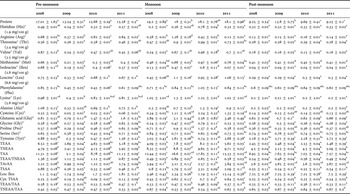
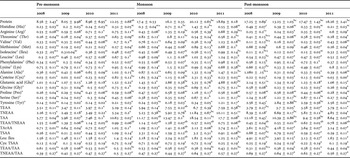
The protein content of L. splendens varied between 9.2 and 19.2% on the south-west coast and between 8 and 20.1% on the south-east coast (Table 1A, B, respectively). The four years mean protein content was observed at its maximum during the monsoon along the south-west (18.4 g/100 g) and south-east (18.1 g/100 g) coasts. The essential and non-essential amino acid compositions of L. splendens from the south-west and south-east coasts are recorded in Table 1A, B, respectively. On the south-west coast, EAAs dominated the protein content in the silver bellies during pre-monsoon (four year average of 4.8 g/100 g) with a greater content of valine (four year average of 0.51 g/100 g) and arginine (four year average 0.68 g/100 g). However, during the monsoon and post-monsoon seasons, the NEAAs were found to be greater (four year average of 9.1 and 4.8 g/100 g, respectively) with significantly greater content of glutamic acid (four year average of 3.0 g/100 g) and tyrosine (four year average of 2.5 g/100 g), respectively (P < 0.05). Similarly, the EAA showed pre-monsoon maximum (4.1 g/100 g) in the samples from the south-east coast, whereas those from the monsoon and post-monsoon exhibited greater values of NEAA (8.3 and 6.4 g/100 g).
Protein (g/100 g edible muscle) and amino acid composition (g/100 g edible muscle) of Leiognathus splendens collected from south-west coast of India during 2008–2011 in three different seasons (pre-monsoon, monsoon and post-monsoon).

1, essential amino acids; 2, non-essential amino acids; TEAA, Total amino acids; TNEAA, total non-essential amino acids; TAA, total amino acids; TArAA, total aromatic amino acids (histidine + phenylalanine + tyrosine); TSAA, total sulphur containing amino acids (methionine + cysteine); data are expressed as mean ± standard deviation (N = 3); different superscripts (a–d) within a row denote significant differences (P < 0.05). FAO/WHO reference pattern (1990) for evaluating proteins (mg/100 g) are indicated in parentheses (FAO/WHO, 1990). Tryptophan was not determined.
Protein (g/100 g edible muscle) and amino acid composition (g/100 g edible muscle) of Leiognathus splendens collected from south-east coast of India during 2008–2011 in three different seasons (pre-monsoon, monsoon and post-monsoon).

Data are expressed as mean ± standard deviation (N = 3). Other notations are as indicated in Table 1A; *, represents a significant difference (P < 0.05) between the values of south-east coast with respect to the corresponding values of south-west coast.
Inter-annual and seasonal variability of nutritional indices and amino acid scores in L. splendens collected from the south-west and south-east coasts of India
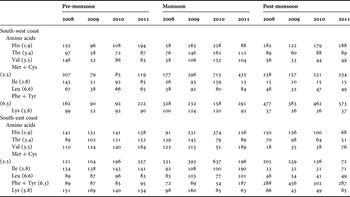
The nutritional indices with respect to different amino acid ratios of L. splendens collected from south-west and south-east coasts of India are shown in Table 1A, B, respectively. The TEAA/TNEAA ratio observed maximum during pre-monsoon on the south-west (four year average of 1.36) and south-east (four year average of 1.27) coasts of India. During the pre-monsoon period, the EAA/TAA ratios of silver bellies were found to be significantly greater (greater than 0.5) than those from the other seasons (P < 0.05). The seasonal average TArAA in silver belly showed post-monsoon maxima on both the coasts (3.6 g/100 g). The seasonal average TSAA showed greater values during the monsoon, and did not significantly differ between the sampling locations (2.0 g/100 g). The Cys:TSAA ratio also showed greater values in silver belly during the monsoon period (0.6). Correspondingly, the average leucine:isoleucine ratio showed greater values during post-monsoon (7.3) on the south-west and south-east coasts (3.4). The amino acid scores were found to be greater during the monsoon with respect to TSAA, valine, leucine and lysine along the south-west coast (Table 2). However, during post-monsoon, amino acid scores with respect to threonine, valine, isoleucine and lysine were recorded at their maxima in the samples collected from the south-east coast.
Essential amino acid scores (%) of Leiognathus splendens collected from the south-west and south-east coasts of India during 2008–2011 in three different seasons (pre-monsoon, monsoon and post-monsoon).

The reference values for adults standard FAO/WHO (1991) (g/100 g protein) are given in parentheses.
Vitamin composition
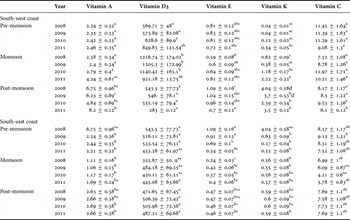
The vitamin contents of L. splendens collected from the south-west and south-east coasts of India are shown in Table 3. No significant differences (P > 0.05) in vitamins A, D, E and K contents were observed between the samples collected from the south-west and south-east coasts over four years (2008–2011). The average vitamin A content was significantly greater during the post-monsoon season with respect to the samples collected from the south-west coast (6.5 µg/100 g) and during pre-monsoon in the samples from the south-east coast (3.5 µg/100 g). The vitamin D3 content in samples collected from the south-west coast was significantly greater in monsoon (~121 µg/100 g), whereas the silver bellies collected from the south-east coast demonstrated no significant seasonal differences (428–507 µg/100 g). A post-monsoon maxima of vitamin E content on the south-west coast (0.95 µg/100 g) and pre-monsoon maxima on the south-east coast (0.8 µg/100 g) were noted. However, vitamin K content observed post-monsoon maxima (3.4 µg/100 g) in the silver bellies collected from the south-west coast and pre-monsoon maximum (1.4 µg/100 g) on the south-east coast. The vitamin C content was found to be greater in the silver bellies collected during pre-monsoon from the south-west and south-east coasts (10.8 and 8.3 µg/100 g, respectively).
Vitamin compositions (μg/100 g) of Leiognathus splendens collected from the south-west and south-east coasts of India during 2008–2011 in three different seasons (pre-monsoon, monsoon and post-monsoon).

Vitamins A, D3, E, K and C are represented in μg/100 g. Data are expressed as mean ± standard deviation (N = 3); different superscripts (a–c) within a column denote significant differences (P < 0.05); *, represents a significant difference (P < 0.05) between the values of south-east coast with respect to the corresponding values of south-west coast.
Macro and micro mineral composition
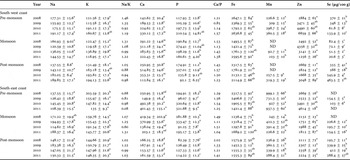
The macro (Na, K, Ca and P) and micro (Fe, Mn, Zn, Se) mineral concentrations in silver bellies collected during the three seasons over four years from the south-west and south-east coasts of India are shown in Table 4. No remarkable variations in mineral compositions were observed between the samples collected from the south-west and south-east coasts over four years (2008–2011) and different seasons. No significant differences were observed in the mean seasonal Na/K ratio along the sampling locations (P > 0.05). The Na content recorded a maximum during pre-monsoon in the silver bellies collected from the south-west coast, whereas Ca and K maxima were observed post-monsoon. Fe (260–10,000 µg/100 g), Mn (20–170 µg/100 g) and Zn (1990–6130 µg/100 g) were found to be greater in the samples collected from the south-west coasts than the south-east coast. The Se concentration ranged from 10 to 20 µg/100 g in the silver bellies from the south-west coast and from 10 to 30 µg/100 g from the south-east coast. The Se content recorded a maximum in the silver bellies collected during the post-monsoon and was found to be independent of the sampling locations.
Macro and micro mineral composition of Leiognathus splendens collected from the south-west and south-east coasts of India during 2008–2011 in three different seasons (pre-monsoon, monsoon and post-monsoon).

Data are expressed as mean ± standard deviation (N = 3); Different superscripts (a–d) within a column denote significant differences (P < 0.05). Macro minerals (mg/100 g wet sample) are Na, K, Ca and P; Micro minerals (μg/100 g wet sample) are Fe, Mn, and Zn.
DISCUSSION
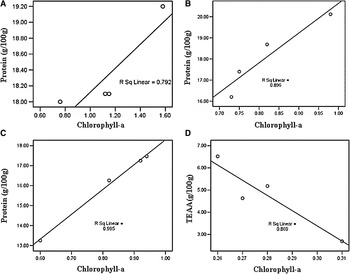
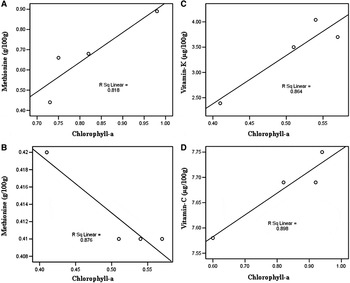
Proteins are an essential nutritional component of L. splendens, and are essentially required by human beings for growth and survival. The amino acid profile of silver bellies from two different coasts (south-west and south-east) of the Indian subcontinent demonstrated that the essential amino acids were significantly greater in concentrations, when compared to the reference pattern (FAO/WHO, 1990), which implied that the proteins present had a higher biological value. A good correlation was observed between protein and chlorophyll-a content off the south-west coast during the monsoon season (r 2 = 0.792) (Figure 1A). Similarly, the chlorophyll-a concentration during and post-monsoon showed high correlation with the protein content (r 2 = 0.896 and 0.995, respectively) on the south-east coast (Figure 1B, C). It is interesting to note that a significant negative correlation between total essential amino acids (TEAA) and chlorophyll-a content off the south-west coast (r 2 = 0.869) during the post-monsoon season was apparent (Figure 1D). The increase of TEAAs rather than NEAAs pre-monsoon along the sampling locations was mainly due to the significant increase of arginine and lysine. Arginine is involved in many metabolic processes and important in the treatment of heart diseases and high blood pressure, whereas lysine is involved in the growth and maintenance of positive nitrogen balance, and also used in protein cross-linking, especially collagen (Furuya et al., Reference Furuya, Graciano, Vida, Xavier, Gongora, Righetti and Furuya2012). The lysine content noted in the silver bellies was comparable with the reference egg protein (0.63 mg/100 g). It is significant to note that a reduced supply of lysine in the diet may lead to mental and physical handicaps because it is an important precursor for the de novo synthesis of glutamate, the most significant neurotransmitter in the mammalian central nervous system. The TEAA/TAA ratio in the samples was greater than 50%, mainly during the pre-monsoon and monsoon seasons, well above the adequate limits of 39% for ideal protein food for infants, 26% for children, and 11% for adults (FAO/WHO/UNU, 1985; FAO/WHO, 1990). The EAA/NEAA ratio, which showed more than 1.0 in the samples harvested during the pre-monsoon seasons off south-west and south-east coast, indicated that silver bellies in these seasons could provide high quality proteins or well-balanced protein deposition. The EAA/NEAA ratio greater than 1.0 is considered to be optimum for balanced amino acid nutrition. Therefore, it can be concluded that silver bellies from both coasts, especially during the pre-monsoon season are sources of well-balanced proteins and a high-quality protein source in respect of EAA/NEAA ratio. The significant correlation between the sulfur containing essential amino acid methionine of the edible muscle of silver belly along with chlorophyll-a concentration off the south-east coast during the monsoon season (r 2 = 0.818) (Figure 2A) revealed that it is possible to correlate the important nutritional qualities of this marine species with chlorophyll-a concentration. The average EAA/NEAA ratio of many fish species, as explained by Iwasaki & Harada (Reference Iwasaki and Harada1985), was considerably less than the present study. In the present investigation, the total aromatic amino acids (TArAA), which are the precursors of adrenaline and thyroxin hormones, were found to be high during the post-monsoon in the south-west and south-east coasts. The sulphur-containing amino acid, methionine cannot be synthesized de novo in humans. A strong correlation was observed between the methionine content (g/100 g) and chlorophyll-a content (mg m−3) (r 2 = 0.876) (Figure 2B) among the silver bellies collected from the south-east coast of India during monsoon. Likewise, cysteine can be made from homocysteine, but cannot be synthesized on its own. In the present study, greater TSAA contents were recorded in the silver bellies collected during the post-monsoon season off both the coasts. The leucine/isoleucine ratios of the samples collected from the different sampling locations were typical of the ideal ratio suggested by FAO/WHO (FAO/WHO, 1990). The amino acid score is indicative of the maximum percentage of protein that may be retained for growth; these results coincide with the hypothesis proposed by an earlier study (García & Valverde, Reference García and Valverde2006).
The correlation between chlorophyll-a (mg m−3) and (A) protein content (g/100 g edible muscle) of silver bellies collected from the south-west coast of India during monsoon, (B) protein content (g/100 g edible muscle) of silver bellies collected from the south-east coast of India during monsoon, (C) protein content (g/100 g edible muscle) of silver bellies collected from the south-east coast of India during post-monsoon, and (D) TEAA (g/100 g) during pre-monsoon along south-west coast of India bounding the Arabian Sea.

The correlation between chlorophyll-a (mg m−3) and (A) methionine content (g/100 g) of silver bellies collected from the south-east coast of India during monsoon, (B) methionine content (g/100 g) of silver bellies collected from the south-west coast of India during post-monsoon, (C) vitamin-K (μg/100 g) of silver bellies collected from the south-west coast of India during post-monsoon, and (D) vitamin-C (μg/100 g) of silver bellies collected from the south-east coast of India during post-monsoon along south-east coast of India bounding the Bay of Bengal.

The lipid of L. splendens was found to be a good source of fat soluble vitamins, including vitamins A, D3, E and K1, which must be taken on a regular basis because of their key roles in human health and metabolism. The spatio-seasonal disparity observed in these vitamin levels could be the interactive results of the season, life stage or availability of nutrition in the ocean. The vitamin A content in L. splendens was recorded to be significantly lower (2–6.5 µg/100 g in south-west and 1.2–3.5 µg/100 g in south-east) as compared to an earlier study of Harlioğlu (Reference Harlioğlu2012) on rainbow trout (Oncorhynchus mykiss). Generally, the flesh of lean fish contains 7.5–15 µg/100 g vitamin A, whereas in the fatty species the vitamin content ranges from 30 to 1350 µg /100 g (Sikorski et al., Reference Sikorski, Kolakowska, Pan and Sikorski1989). Hence, L. splendens can be considered as fish with low content of vitamin A, like European catfish Silurus glanis (6.30 µg/100 g) (Özyurt et al., Reference Özyurt, Polat and Loker2009). Vitamin A has a major role in the process of photoreception, and regulates gene expression, cell division, reproduction, etc. Vitamin D3 plays a crucial role in the regulation of calcium–phosphate balance, stimulating calcium absorption by the small intestine and thus regulating bone metabolism. Vitamin D3 promotes and enhances the absorption and metabolism of calcium and phosphorus in the body (Trivedi et al., Reference Trivedi, Doll and Khaw2003). The lesser level of vitamin E in the silver bellies harvested from the south-east coast can be attributed to the low fat content in their tissues. Vitamin E acts as an antioxidant against peroxidation of fatty acid contained in the cellular and sub-cellular membrane phospholipids, leading to the formation of phenoxy free radicals. Apart from the above fat soluble vitamins, a considerable amount of vitamin K, which play an important role in blood clotting and bone metabolism pertaining to the prevention of osteoporosis and carotid artery elasticity, was also present in L. splendens (Cranenburg et al., Reference Cranenburg, Schurgers and Vermeer2007). Vitamin C is an essential antioxidative nutrient for humans, but an additional external dietary source is required because it is not synthesized by human metabolism (Jeevitha et al., Reference Jeevitha, Athiperumalsami and Kumar2013). Significant correlation between the vitamin K and C contents of the edible muscle of silver belly, along with chlorophyll-a concentration off the south-west and south-east coasts during the post-monsoon season (r 2 = 0.864 and 0.898, respectively) (Figure 2C, D), revealed that it is possible to correlate the fat soluble vitamin contents of silver belly with chlorophyll-a concentration.
The greater quantities of the macro minerals in the silver bellies from the south-east coast suggest that the samples from this area could be used as good sources for these minerals. The variations recorded in the concentration of the different mineral components in the fish could have been as a result of the rate at which these components are available in the water body, and the ability of the fish to absorb and convert the essential minerals from the diet or the water bodies where they live. Na and K are required to maintain osmotic balance of body fluid and the pH of the body, which, in turn regulate muscle and nerve irritability, control glucose absorption and enhance normal retention of protein during growth. Erkan & Ozden (Reference Erkan and Ozden2007) also reported significantly greater values of K content compared to the current findings (116–193 and 135–204 mg/100 g on the south-west and south-east coasts, respectively), at the mean average of 459.7 mg/100 g in sea bass (Dicentrarchus labrax) and 393.8 mg/100 g in sea bream (Sparus aurata). The greater Na/K ratio in the samples during pre-monsoon and monsoon seasons on the south-west coast and monsoon/post-monsoon on the south-east coast seems to be important because physiological and epidemiological data suggest that a high Na/K ratio intake can be associated with an increased risk of developing high blood pressure and cardiovascular disease. The high content of Ca and P were observed in the silver belly due to the presence of the bones present in them. In general, a food is considered ‘good’ if the Ca/P ratio ≥1.0 and ‘poor’ if the ratio ≤0.5 (Erkan & Ozden, Reference Erkan and Ozden2007). The richness in P level in L. splendens can also be attributed to the fact that the element is a component of protein.
Most of the micro minerals were found in greater concentrations in L. splendens and varied significantly inter-annually and seasonally. These discrepancies might be explained in part by seasonal changes in their concentrations and differences in the annual reproductive cycle of the specimens. In addition, differences in the concentrations of the mineral of the surrounding seawater could also influence their levels in the fish tissues. The trace mineral Mn is an essential co-factor in a number of enzymes important in energy production and antioxidant defences. Fe plays an active part in oxidation/reduction reactions and electron transport associated with cellular respiration. The iron content observed in the present study was found to be greater compared to some selected marine fish examined by Nurnadia et al. (Reference Nurnadia, Azrina, Amin, Mohd Yunus and Mohd Izuan Effendi2013), with the exceptions noted in cockles and oysters. The Zn level observed was significantly lower than the limit set by the FAO/WHO (1984) (15,000 µg/100 g) (P < 0.05). Earlier studies reported that Zn levels in three marine species (Sparus aurata, Scorpaena porcus and Mullus barbatus) from the Black Sea and Aegean Sea were found to be greater than the legal Turkish limit of 5 mg/100 g (Özyurt et al., Reference Özyurt, Polat and Loker2009). Leiognathus splendens collected from different sampling locations showed <5 mg/100 g Zn content in its edible portion. The Mn content in all samples, except the samples from the pre-monsoon season along the south-east coast (four year average 899 µg/100 g), was found to be lower than the permissible limit set by FAO/WHO (FAO/WHO, 1984), 5.4 ppm or 540 µg/100 g food. The abundance of Fe, Mn and Zn among the samples collected from the south-west coast was likely due to the greater bioavailability of these elements arising in the fish by a high metal absorption from the food chain as a consequence of high feeding activity. The Se content in L. splendens was significantly greater than cereals, fruits and vegetables (Levander & Burk, Reference Levander, Burk, Ziegler and Filer1994).
CONCLUSION
The long-term study of nutritional parameters of silver belly, including amino acids, minerals, vitamins and amino acid-based nutritional indices established this candidate species as an ideal healthy food for human consumption and as a desirable food item from the consumer health perspective. This study described how changes in the chlorophyll-a concentration influence the various nutritional parameters of the fish. The significant correlation between the essential amino acids of the edible muscle of silver belly along with chlorophyll-a concentration revealed that it is possible to correlate the important nutritional qualities of this marine species with chlorophyll-a concentration. No significant variations in the amino acid, vitamin and mineral composition were observed between the samples collected from the different sampling locations encompassing the Bay of Bengal and Arabian Sea covering the south-west and south-east coasts of India, respectively. This commercially important fish species is available throughout the year, and is predominant over other related species of tuna on the Arabian Sea and Bay of Bengal coasts of the Indian subcontinent. This study provides valuable information on the inter-annual, spatial and seasonal variations in the protein, amino acid, mineral and vitamin composition of L. splendens in order to use this marine fish species in processing from a manufacturer's point of view, and to distinguish their nutritional value from a consumer's point of view.
ACKNOWLEDGEMENTS
The authors are thankful to the Indian Council of Agricultural Research, New Delhi for providing necessary facilities and encouragements to carry out the work under ICAR Outreach Activity-3 on ‘Nutrient profiling of fish as a food for health and dietary component’. The authors thank the Director, Central Marine Fisheries Research Institute for his guidance and support. Thanks are due to the Head, Marine Biotechnology Division, Central Marine Fisheries Research Institute for facilitating the research activity.