Introduction
Vitamin D deficiency is a result of inadequate exposure to ultraviolet (UV) B radiation from sun light or low intakes of dietary vitamin D. While being best known for its role in calcium metabolism and bone health vitamin D status in pregnancy has been inversely associated with adverse outcomes such as preeclampsiaReference Bodnar, Simhan and Catov 1 and gestational diabetes mellitus (GDM).Reference Yap, Cheung and Gunton 2 , Reference Arnold, Enquobahrie and Qiu 3 Numerous studies globally report prevalent vitamin D deficiency in pregnant women, particularly in clasically ‘high risk’ groups such as veiled or dark skinned women,Reference Al Kabani, Elshafie and Rawahi 4 – Reference Hamilton, McNeil and Hollis 6 potentially putting these populations at risk of adverse pregnancy outcomes. Even in Australia, a country with abundant sun shine, publications over the past decade indicate that vitamin D deficiency may be commonplace in pregnant women.Reference Bowyer, Catling-Paull and Diamond 7 – Reference Thomas, Fudge, Whiting and Coates 9 This includes previous data from Perth, Western Australia (WA), where 36% of a predominently white Caucasian population recorded 25-hydroxyvitamin D [25(OH)D] levels <50 nmol/l at 18 weeks gestation.Reference Hart, Lucas and Walsh 10 This latter report, however, was based on a cohort recruited during the period 1989–1991, with no contempory data available to confrim the relevance of these results in the present day.
In the Australian food supply only edible oil spreads and margarines are mandatorily fortified, 11 the other main dietary contributor being oily fish.Reference Kimlin, Lucas and Harrison 12 Dietary vitamin D intakes of Australian adults are typically below the recommended dietary intake of 200 IU,Reference Diamond, Eisman and Mason 13 , 14 with exposure to UV radiation being the greatest contributor to 25(OH)D status.Reference Kimlin, Lucas and Harrison 12 While dietary vitamin D intakes remain limited there is evidence of a significant increase in vitamin D supplementation in Australia, with sales nearly tripling between 2000 and 2010.Reference Bilinski and Talbot 15 In addition, several commonly used antenatal vitamin supplements now contain vitamin D. The present study, therefore, aims to describe the 25(OH)D status of a contemporary, cross-sectional cohort of pregnant women in Perth, Western Australia, with analysis of the association between 25(OH)D levels, ambient UV radiation and supplemental vitamin D intakes. Secondary analyses will also explore the association between 25(OH)D levels and gestational diabetes during pregnancy.
Methods
Subjects
Participants in this study were pregnant women undergoing screening for involvement in an allergy prevention trial investigating infant vitamin D supplementation (ACTRN12606000281594). Participants were recruited from maternity hospitals in Perth, WA, between 31 August 2012 and 30 August 2015, and the study appointment was conducted between 36 and 40 weeks of gestation. Families with a history of allergic disease (asthma, eczema or hayfever in the mother, father or sibling of the infant) were included in the study. Exclusion criteria matched those required for the infant vitamin D supplementation and allergy prevention trial. These were maternal cigarette smoking during pregnancy, maternal autoimmune disease, or a current multiple pregnancies. All participants provided written, informed consent.
Blood collection and 25(OH)D analysis
Blood was collected from the cubital vein into a serum clot activator tube (Vacuette, Z Serum Clot activator; Greiner Bio-One GmbH, Kremsmünster, Austria). Serum samples were analysed for total 25(OH)D by a competitive chemiluminescent immunoassay, automated on the Abbott Architect i2000 (Abbott Laboratories, Abbott Park, IL, USA), operated by PathWest Laboratory Medicine, WA, a pathology laboratory accredited by the National Association of Testing Authorities, Australia. Internal quality control data indicates the imprecision of the assay (coefficient of variation) as follows: 11.4% at 22nmol/l; 5.2% at 48 nmol/l; 4.5% at 68nmol/l; and 4.0% at 90nmol/l. Participants were classified as vitamin D deficient (<50nmol/l), insufficient (50 to <75nmol/l) or sufficient (⩾75nmol/l), following published guidelines.Reference Holick, Binkley and Bischoff-Ferrari 16
Intrinsic factors
Skin type was determined based on participant responses to a six category Fitzpatrick Skin Type questionnaire.Reference Fitzpatrick 17 Skin types I through VI are described as follows: I – Fair skinned Caucasians, burn very easily, never tan; II – Fair skinned Caucasians, burn easily, tan slowly and with difficulty; III – Medium skinned Caucasians, burn rarely, tan relatively easily; IV – Darker skinned Caucasians, virtually never burn, tan readily, for example Mediterranean ancestry; V – Asian or Indian skin; and VI – Afro-Caribbean or Black skin. In addition to skin type participants were asked what ethnicity they identified as. Body weight and height were measured on the day of the appointment by research staff, and pre-pregnancy weight self-reported by participants.
Exogenous vitamin D intake
Vitamin D intake was ascertained through questions on the brand, dose and frequency of ingestion of multivitamin and specific vitamin D supplements in the third trimester of pregnancy. Supplemental vitamin D intake is reported in international units (IU), where 1 IU is equivalent to 0.025 µg. In a previous study in pregnant women we found that dietary vitamin D intakes were low and, unlike vitamin supplements, were not significantly correlated with cord blood 25(OH)D levels.Reference Jones, Palmer, Zhang and Prescott 18 For this reason dietary intake data was not collected in the current study.
Ultraviolet radiation and sun exposure behaviours
Recordings of the UV Index (UVI), 19 a linear scale of UV radiation in which one point on the scale is equivalent to 25 mW/m2 of UV radiation, were obtained from the Australian Radiation Protection and Nuclear Safety Agency (ARPANSA) 20 in order to analyse the association between ambient UV radiation and 25(OH)D levels. ARPANSA continuously log solar UV radiation levels in Perth, and from this data the daily peak UVI was obtained. Due to the limited geographical distribution of study participants (within 1° latitude) a single UV data collection site was considered adequate. The average peak UVI for various periods of time preceding blood draw were calculated and correlated with 25(OH)D levels.
Participants gave information on their sun protection habits and duration of sun exposure via a questionnaire adapted from a previously published example.Reference Chan, Jaceldo-Siegl and Fraser 21 Questions were asked on the use of sunscreen and hats when outdoors, and the estimated amount of time (minutes) they spent in the sun on an average weekday and weekend day, in the preceding 2 months. Body surface area exposed was reported as: face and hands; face, hands and arms; or face, hands, arms and legs.
GDM
GDM was recorded as a self-reported diagnosis of GDM in the current pregnancy. Australian guidelines recommend that all pregnant women be screened for GDM by means of a 75 g oral glucose tolerance test (OGTT) at 24–28 weeks’ gestation. 22
Statistical analysis
All statistical analyses were conducted using SPSS v20 (IBM Corporation, Chicago, IL, USA). A P value <0.05 was considered significant. Figures were generated in GraphPad Prism v 6.05 (GraphPad Software, La Jolla, CA, USA). Season-adjusted 25(OH)D level was calculated following the example of Jenab et al.Reference Jenab, Bueno-de-Mesquita and Ferrari 23 First, to account for differing numbers of observations per month an overall mean was calculated with weighting for the number of samples collected per month. Second, an unstandardized residual was calculated using a linear regression model with serum 25(OH)D as the dependent variable and month of collection as a categorical independent variable. Lastly, the unstandardized residual was added to the overall weighted mean serum 25(OH)D value to create the standardized value.
Data was tested for normality using the Kolmogorov–Smirnov test. Correlative associations were analysed by linear regression, with unstandardized coefficients (B) and 95% confidence intervals (95% CI) reported, or Spearman’s rank correlation coefficient (ρ) where data was non-parametric. Pre-pregnancy body mass index (BMI) (kg/m2) was calculated based on pre-pregnancy weight, and height as measured at the time of the appointment. Independent sample’s t-tests were used for the comparison of means between two groups, and one-way ANOVA where there were three or more groups. Where the data was non-parametric Mann–Whitney U tests and Kruskal–Wallis one-way ANOVA were employed. Odds ratios (95% CI) for binary outcomes were calculated using binary logistic regression analysis. Categorical variables were analysed using Pearson’s χ2 test. Seasons were categorized using the following definitions: Summer – December through February; autumn – March through May; winter – June through August; and spring – September through November.
Results
Study population
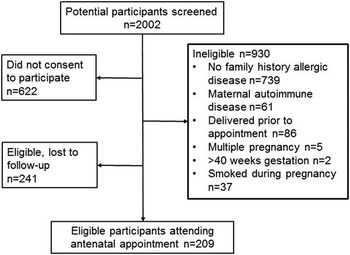
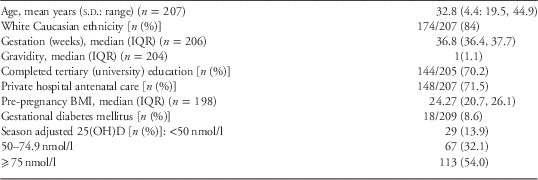
Two thousand and two potential participants were screened to obtain a final sample size of 209 for the current analyses (Fig. 1). Key demographic characteristics are presented in Table 1. The majority of participants (200/207, 96.6%) resided in the Perth metropolitan area, the remainder residing within 1° latitude of Perth.
Flow diagram of participant screening.

Characteristics of study population

25(OH)D status of the study population
25(OH)D levels ranged from 19 to 185 nmol/l. After adjusting for season the mean (s.d.) 25(OH)D level was 77.7 (24.6) nmol/l. The proportion of participants with deficient and insufficient 25(OH)D levels is reported in Table 1.
Intrinsic factors
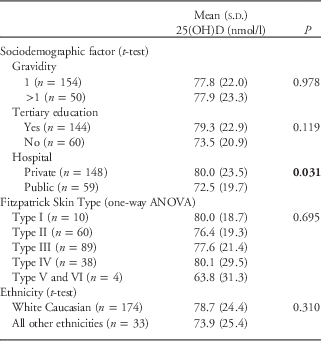
Sociodemographic factors, Fitzpatrick Skin Type and ethnicity were not associated with season-adjusted 25(OH)D levels, with the exception of private v. public hospital care (Table 2). Neither pre-pregnancy body weight, BMI, nor current body weight were associated with season-adjusted 25(OH)D (P>0.10 for all).
Season-adjusted 25(OH)D level by maternal socio-demographic factors, Fitzpatrick Skin Type and ethnicity

Bold values are significant at P<0.05 level.
Exogenous intake
Multivitamin supplements were taken by 176/205 (84.2%) of participants. Vitamin D was an ingredient in 168/176 (80.4%) of the multivitamin formulations used. There was a non-significant trend for the use of multivitamin supplements in women attending private, v. public, maternity hospitals; a possible indicator of socioeconomic status (130/147 [88.4%] and 46/58 [79.3%], P=0.091). Hospital type was significantly associated with the type of multivitamin used, with a greater proportion of women attending private hospitals using a vitamin D-containing multivitamin product (128/131 [97.7%] v. 40/45 [88.9%] of women attending public hospitals, P=0.014).
Specific vitamin D supplements were taken by 56/205 (26.8%) women; 46/56 of whom simultaneously took a vitamin D-containing multivitamin. The use of specific vitamin D supplements did not vary significantly between private or public hospital care (42/147 [28.5%] and 14/44 [31.8%], respectively, P=0.521). Median (IQR) vitamin D intakes varied significantly depending on whether the participant took a vitamin D-containing multivitamin (500 [250, 500] IU/day, n=122), a specific vitamin D supplement (1000 [800, 1000] IU/day, n=10) or both (1500 [1250, 1850] IU/day, n=46) (P<0.001). Participants attending a private hospital had a greater median vitamin D intake than those in the public system (500 [250, 1000] IU/day v. 400 [10, 1000] IU/day, P=0.006), which may have contributed to the higher serum 25(OH)D levels in this group.
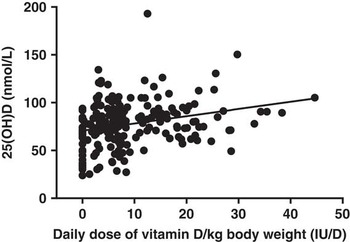
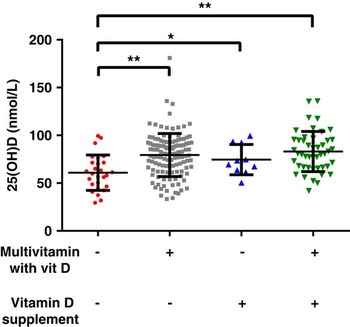
Vitamin D intake from supplements positively correlated with season-adjusted 25(OH)D level (B=0.008; 95% CI 0.004, 0.012, P<0.001). This correlation was strengthened by adjusting for body weight (IU/kg) (B=0.744; 95% CI 0.395, 1.092, P<0.001) (Fig. 2). Participants who took supplemental vitamin D in any form had significantly higher season-adjusted 25(OH)D levels than unsupplemented women (Fig. 3). Subsequently, the odds for vitamin D deficiency in unsupplemented women were more than 4.5 times that of supplemented women, controlling for maternal age, ethnicity, BMI, hospital type (private/public) and education (OR 4.52; 95% CI 1.36, 15.00, P=0.014).
Correlation between supplemental daily dose of vitamin D/kg body weight (IU/D) and season-adjusted 25(OH)D level. Line represents linear regression line.

Mean (s.d.) season-adjusted 25(OH)D levels of participants by use of antenatal vitamin supplements. Participants who did not take supplemental vitamin D (n=27) had significantly lower 25(OH)D levels than those who took a vitamin D-containing multivitamin (n=122), a specific vitamin D supplement (n=10) or both (n=46). *P=0.049, **P<0.001.

Seasonal variation in 25(OH)D and association with ambient ultraviolet radiation
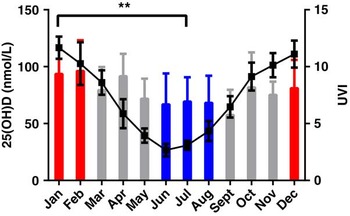
UVI varied significantly by season, the highest levels being in summer, followed by spring, autumn and winter (one-way ANOVA P<0.001) (Fig. 4). Similarly, there was significant seasonal variation in unadjusted 25(OH)D, with levels being significantly greater in summer than in winter (P<0.001) (Fig. 4). Despite having the second lowest average UVI, autumn had the second highest average 25(OH)D levels, suggestive of a lag between changes from the peak UVI levels in summer and changes in circulating 25(OH)D.
Monthly mean (s.d.) 25(OH)D levels (columns) and UVI (black line). Summer months (red columns) witness the greatest average UVI and 25(OH)D levels, and are significantly different to those observed in winter (blue columns). **P<0.001.

Unadjusted serum 25(OH)D levels were analysed in relation to UVI preceding blood draw. Ambient UV radiation was a superior predictor of 25(OH)D status than oral vitamin D intake, with the average UVI of the preceding 90 days providing the strongest correlation (B=2.82; 95% CI 1.77, 3.86, P<0.001).
Sun exposure behaviours and 25(OH)D levels
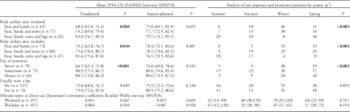
A number of sun exposure behaviours were significantly associated with unadjusted 25(OH)D levels; specifically, body surface area exposed on weekends and weekdays (a function of clothing choices), and the use of sunscreen (Table 3). While the association between body surface area exposed and 25(OH)D level followed an intuitive pattern – 25(OH)D levels being lower in participants who reported exposing only their face and hands – the use of sunscreen was unexpectedly associated with higher 25(OH)D levels. Further analyses, however, found that these behaviours varied significantly with season, and were not associated with season-adjusted 25(OH)D levels. Thus it appears that clothing choices and the use of sunscreen are largely determined by season, and are not strong independent predictors of 25(OH)D level.
Variation in 25(OH)D level by sun exposure and protection factors, and in practices by season

Bold values are significant at P<0.05 level.
Relationship between 25(OH)D level and GDM
In contrast to previous findings (2, 3) season-adjusted 25(OH)D was positively associated with a self-reported diagnosis of GDM (OR 1.35; 95% CI 1.12, 1.58, P=0.003 per 10 nmol/l increase in 25(OH)D, controlling for maternal age, ethnicity, BMI, hospital type and education). However, it should be noted that 25(OH)D levels were measured ~11 weeks after a diagnosis of GDM would typically be made (24–28 weeks); a sufficient period of time for seasonal variation in UVI to affect 25(OH)D levels and potentially altering findings.
Discussion
This is the first study to examine the 25(OH)D status of pregnant women in Perth, WA in the past 25 years, and the first to collect data on the use of antenatal vitamin products in relation to serum 25(OH)D levels. The study finds that 13.9% of participants had 25(OH)D levels <50 nmol/l in late gestation, and in total 46% had levels <75 nmol/l; a range considered insufficient by the Endocrine Society.Reference Holick, Binkley and Bischoff-Ferrari 16 In addition, we find that although ambient UV radiation is the strongest predictor of 25(OH)D level, supplemental vitamin D intakes are significantly associated with serum 25(OH)D, and the use of vitamin D-containing supplement products is associated with a significantly decreased risk of vitamin D deficiency. It is, perhaps, the high prevalence of vitamin D supplementation, in the form of antenatal multivitamins or specific vitamin D supplements, which accounts for the lower proportion of vitamin D deficient pregnant women in the current study, in comparison to samples collected in 1989–1991 for the Raine Study when supplementation was reportedly uncommon.Reference Hart, Lucas and Walsh 10
Our finding that supplemental vitamin D intakes and serum 25(OH)D levels were higher in women attending private hospitals is noteworthy. It is conceivable that this is an effect of socioeconomic status, whereby participants with greater household incomes are better able to afford private hospital cover and high-end multivitamin supplements. As the majority of our participants were private hospital patients it is not possible to conclude that the data collected here is reflective of all socioeconomic groups in Perth, WA.
Of interest is that sun exposure behaviours such as clothing and the use of sunscreen were not associated with seasonally adjusted 25(OH)D levels. These behaviours were highly seasonal and likely reflect the change in weather conditions that coincide with changes in UVI. The results presented here are in agreement with those of an RCT determining that although the amount of body surface area exposed to UV radiation is a determinant of vitamin D synthesis, the change in 25(OH)D is mainly dependent on UV dose.Reference Bogh, Schmedes, Philipsen, Thieden and Wulf 24
An unexpected finding in the current study is that 25(OH)D levels in late gestation were positively associated with the odds of GDM, in conflict with the reports of others.Reference Yap, Cheung and Gunton 2 , Reference Arnold, Enquobahrie and Qiu 3 The differing results between the current study and those cited may be related to the stage of pregnancy at which 25(OH)D was measured. In the current study 25(OH)D was measured at 36–40 weeks’ gestation, several months after the typical onset of GDM. By contrast, those studies reporting an inverse associations between 25(OH)D and GDM or impaired glucose tolerance measured 25(OH)D earlier in pregnancy (~16 weeks).Reference Yap, Cheung and Gunton 2 , Reference Arnold, Enquobahrie and Qiu 3
While this study provides a much needed update on the vitamin D status of pregnant women in Perth, WA, it comes with several recognized limitations. The study population is relatively homogeneous, comprising predominantly white Caucasian women, the majority of whom are university educated. While this population compares well to that of the Raine Study,Reference Hart, Lucas and Walsh 10 and thus serves as an interesting comparison for a given demographic in a given location, the results may not be generalizable to other populations. For example, these findings do not necessarily extrapolate to populations residing at different latitudes, or who have significantly different sun exposure and vitamin supplementation behaviours. Such factors may account for the higher prevalence of vitamin D deficiency reported in pregnant women who routinely wear veils, or who live in lower UV environments.Reference Al Kabani, Elshafie and Rawahi 4 , Reference Thomas, Fudge, Whiting and Coates 9 Second, issues around the performance of chemiluminescent assays for the measurement of 25(OH)D have been raised, with these assays often considered to be less accurate than the ‘gold standard’ liquid chromatography tandem mass spectrometry methods.Reference Farrell, Martin and McWhinney 25 However, we will point out that as the assay used in the current study is operated by one of the largest pathology laboratories in Perth, WA, it is representative of the testing conducted on a clinical basis in this population. Lastly, the study relies on self-reported diagnosis of GDM, where access to medical records would have been preferable.
The information provided by this study has direct implications for antenatal supplementation practices and expenditure on 25(OH)D testing in pregnant women in Perth, WA and similar locales. The data presented here suggests that the regular use of a vitamin D-containing antenatal supplement or specific vitamin D supplement is associated with a reduced risk of deficiency (<50nmol/l), although we acknowledge that higher doses may be required in environments with lower ambient UV radiation, or in individuals with limited sun exposure. The results also suggest that routine 25(OH)D testing in women of this demographic who are already taking supplemental vitamin D is not warranted, particularly during summer months. Recognition by clinicians of the major contributing factors to vitamin D status in pregnant women in their population will assist in the provision of appropriate advice around supplementation and aid in preventing vitamin D deficiency.
Acknowledgements
The authors would like to sincerely thank the participating women and acknowledge the nurses and research assistants involved with this study.
Financial Support
This research was supported by funding from the Asthma Foundation of Western Australia (2013–2014) and the Telethon-New Children’s Hospital Research Fund (2013–2015).
Conflicts of Interest
None.
Ethical Standards
The authors assert that all procedures contributing to this work comply with the ethical standards of the relevant national guidelines on human experimentation (Australian National Health and Medical Research Council) and with the Helsinki Declaration of 1975, as revised in 2008, and has been approved by the institutional committees (the Princess Margaret Hospital for Children Ethics Committee and Research Governance Office (1959/EP), Joondalup Health Campus Human Research Ethics Committee (1224), Sir Charles Gairdner Hospital Human Research Ethics Committee (2012-070), St John of God Health Care Ethics Committee (561), and the South Metropolitan Area Health Service Human Research Ethics Committee).