Introduction
Bipolar disorder (BD) is widely recognized as a highly heritable illness and there is increasing evidence that it is characterized neurostructurally by abnormalities in cerebral white matter (WM) (Mahon et al. Reference Mahon, Burdick and Szeszko2010; Vederine et al. Reference Vederine, Wessa, Leboyer and Houenou2011). Conventional magnetic resonance imaging (MRI)-based neuroimaging and more advanced analytical techniques such as voxel-based analysis (VBA) and diffusion tensor imaging (DTI) have revealed both global and regional differences in WM volume (Emsell & McDonald, Reference Emsell and McDonald2009), increased rates of hyperintense lesions (so-called white matter hyperintensities, or WMH) (Kempton et al. Reference Kempton, Geddes, Ettinger, Williams and Grasby2008) and alterations in quantitative diffusion indices such as fractional anisotropy (FA), mean diffusivity (MD) and radial diffusivity (RD), when comparing BD to control subjects (Macritchie et al. Reference Macritchie, Lloyd, Bastin, Vasudev, Gallagher, Eyre, Marshall, Wardlaw, Ferrier, Moore and Young2010; Benedetti et al. Reference Benedetti, Absinta, Rocca, Radaelli, Poletti, Bernasconi, Dallaspezia, Pagani, Falini, Copetti, Colombo, Comi, Smeraldi and Filippi2011a ; Emsell et al. Reference Emsell, Langan, Van Hecke, Barker, Leemans, Sunaert, McCarthy, Nolan, Cannon and McDonald2013a ; Skudlarski et al. Reference Skudlarski, Schretlen, Thaker, Stevens, Keshavan, Sweeney, Tamminga, Clementz, O'Neil and Pearlson2013). Given the heritability of the illness, recent work demonstrating the heritability of WM organization (Chiang et al. Reference Chiang, Barysheva, McMahon, de Zubicaray, Johnson, Montgomery, Martin, Toga, Wright, Shapshak and Thompson2012) and the presence of WM microstructural alterations in unaffected relatives (UR) of BD patients (Chaddock et al. Reference Chaddock, Barker, Marshall, Schulze, Hall, Fern, Walshe, Bramon, Chitnis, Murray and McDonald2009; Sprooten et al. Reference Sprooten, Sussmann, Clugston, Peel, McKirdy, Moorhead, Anderson, Shand, Giles, Bastin, Hall, Johnstone, Lawrie and McIntosh2011; Tighe et al. Reference Tighe, Reading, Rivkin, Caffo, Schweizer, Pearlson, Potash, Depaulo and Bassett2012; Mahon et al. Reference Mahon, Burdick, Ikuta, Braga, Gruner, Malhotra and Szeszko2013), it is possible that such changes could represent potential endophenotypes of the illness (Borgwardt & Fusar-Poli, Reference Borgwardt and Fusar-Poli2012).
The current study is an extension of previously published work on a sample of families multiply affected with BD type I that used a whole-brain VBA of DTI-derived FA differences between patients, their UR and healthy controls (Chaddock et al. Reference Chaddock, Barker, Marshall, Schulze, Hall, Fern, Walshe, Bramon, Chitnis, Murray and McDonald2009). In this previous work, reductions in FA were identified in anterior portions of the fronto-occipital (FOF) and superior longitudinal fasciculus (SLF), the genu of the corpus callosum, the left anterior limb of the internal capsule (ALIC), the right inferior longitudinal fasciculus (ILF) and corona radiata in patients compared to controls. Although there were no significant FA differences when relatives and controls were compared directly, mean FA in UR extracted from the case–control analysis was intermediate between patients and controls. Post-hoc analysis incorporating an estimate of genetic liability based upon the density of illness within families (McDonald et al. Reference McDonald, Bullmore, Sham, Chitnis, Wickham, Bramon and Murray2004) revealed greater reductions in FA with increasing genetic liability, suggesting that distributed FA reductions represented a potential intermediate phenotype for BD.
Tractography is a post-processing technique for diffusion MRI data that uses the principal direction of water diffusion as determined by a specific model, typically the diffusion tensor, to virtually dissect major WM fibre pathways (Basser et al. Reference Basser, Pajevic, Pierpaoli, Duda and Aldroubi2000). Unlike exploratory whole-brain voxel-wise techniques, tractography is anatomically driven and allows for the assessment of WM microstructure in specific regions of interest (ROIs), chosen a priori, and therefore may be more sensitive to detect differences in these regions. VBA and tractography are thus complementary techniques that, in combination, can yield additional information about the nature and location of WM microstructural differences.
The current study aimed to reproduce and extend previous exploratory work on the same sample reported in Chaddock et al. (Reference Chaddock, Barker, Marshall, Schulze, Hall, Fern, Walshe, Bramon, Chitnis, Murray and McDonald2009), by using hypothesis-driven high angular resolution diffusion tensor tractography to specifically investigate changes in both FA and RD in key WM fibre bundles implicated in BD. The tracts selected for investigation were the cingulum bundle, the uncinate fasciculus (UF), the arcuate portion of the SLF, the genu and splenium of the corpus callosum, the ILF and the ALIC. The cingulum bundle and UF were chosen as they are key limbic system tracts that connect brain regions involved in emotional regulation, and have been implicated previously in BD. The remaining tracts were chosen because regional changes were detected in these bundles in the VBA on this sample, and have emerged in other DTI studies of BD. Reproducing an FA decrease in these tracts would strengthen earlier findings, which are typically highly heterogeneous and difficult to replicate in BD. Additionally, we investigated the effect of increasing genetic load liability on these diffusion metrics to explore candidate WM-based endophenotypic biomarkers of BD.
Method
Participants
Diffusion-weighted imaging data were acquired from 58 participants, comprising 19 out-patients meeting DSM-IV criteria for type I BD, 21 of their unaffected first-degree relatives (four parents, 10 siblings, seven children) and 18 healthy volunteers. All patients were clinically in remission at the time of scanning but had experienced psychotic symptoms (delusions or hallucinations) during previous episodes of illness exacerbation. Patients were recruited from a group of 21 families where there was at least one additional first- and/or second-degree relative with a psychotic disorder (family history of BD: n = 13 families; schizophrenia or schizo-affective disorder: n = 6; psychosis not otherwise specified: n = 2). Further clinical details are described in Chaddock et al. (Reference Chaddock, Barker, Marshall, Schulze, Hall, Fern, Walshe, Bramon, Chitnis, Murray and McDonald2009).
All participants were assessed using formal structured interviews and clinical rating scales. DSM-IV diagnoses were derived from using the Schedule for Affective Disorders and Schizophrenia – Lifetime Version (Endicott & Spitzer, Reference Endicott and Spitzer1978). Present mood state and psychological well-being were assessed using the Beck Depression Inventory (BDI; Craven et al. Reference Craven, Rodin and Littlefield1988) and the Altman Self-Rating Mania Scale (ASRM; Altman et al. Reference Altman, Hedeker, Peterson and Davis1997). Information regarding family history of psychiatric illness was obtained from the most reliable informants using the Family Interview for Genetic Studies (Maxwell, Reference Maxwell1992) and from medical notes when available. Full-scale IQ was estimated using the Wechsler Abbreviated Scale of Intelligence (Whalley et al. Reference Whalley, Sprooten, Hackett, Hall, Blackwood, Glahn, Bastin, Hall, Lawrie, Sussmann and McIntosh2013).
Exclusion criteria included organic brain disease, previous head trauma resulting in loss of consciousness for more than 5 min, and substance or alcohol dependence in the 12 months prior to assessment. Additionally, no UR or controls had ever experienced a psychotic illness. The local research ethics committee (the London – Camberwell St Giles National Research Ethics Service Committee, formerly the Joint South London and Maudsley and the Institute of Psychiatry Research Ethics Committee) approved the study and written informed consent was obtained from all participants.
DTI acquisition
Diffusion-weighted MRI data were acquired using a GE Signa 1.5-T LX MRI system (General Electric, USA), using an echo planar imaging acquisition, peripherally gated to the cardiac cycle. At each of the 60 slice locations, seven non-diffusion-weighted images were acquired (b = 0), along with 64 images with diffusion gradients (b = 1300 s/mm2) applied in 64 optimized directions uniformly distributed in space (Jones et al. Reference Jones, Williams, Gasston, Horsfield, Simmons and Howard2002). Echo time (TE) = 107 ms; effective repetition time (TR) = 15 RR intervals; duration of the diffusion encoding gradients = 17.3 ms; acquired voxel size = 2.5 mm × 2.5 mm × 2.5 mm, zero-filled during reconstruction to 1.875 mm × 1.875 mm × 2.5 mm.
DTI post-processing
Quality assurance and motion and distortion correction were performed using ExploreDTI (Leemans et al. Reference Leemans, Jeurissen, Sijbers and Jones2009). All DTI datasets underwent a combined rigid-motion and eddy current correction post-processing step. Additionally, during this step, the b matrix was rotated to preserve orientational information in the data (Leemans & Jones, Reference Leemans and Jones2009) and the signal intensity was modulated using the Jacobian determinant, to account for volumetric changes arising during the affine mapping to the non-diffusion weighted images (Jones, Reference Jones2010).
Construction of population atlas
A group-wise population-specific DTI atlas was constructed from healthy subjects, unaffected relatives (UR) and patients as described in Van Hecke et al. (Reference Van Hecke, Sijbers, D'Agostino, Maes, De Backer, Vandervliet, Parizel and Leemans2008), which has been shown to improve the quality of VBA (Van Hecke et al. Reference Van Hecke, Leemans, Sage, Emsell, Veraart, Sijbers, Sunaert and Parizel2011). In the population-specific atlas approach, non-rigid deformation fields were calculated between all data sets of the subject group, each data set was then transformed with the mean deformation field to all other data sets, and these transformed images were averaged to create the population-specific atlas (Van Hecke et al. Reference Van Hecke, Leemans, D'Agostino, De Backer, Vandervliet, Parizel and Sijbers2007).
Tractography
Fibre tracts in the population atlas were generated in ExploreDTI for the whole brain by propagating multiple fibre trajectories using the first eigenvector of the diffusion tensor as an estimate of local tract orientation in a deterministic manner (Basser et al. Reference Basser, Pajevic, Pierpaoli, Duda and Aldroubi2000). To constrain tracking and reduce spurious results, the following typical parameter thresholds were chosen: FA seed threshold = 0.15, fibre length range = 50–500 mm, angle = 30°, step size = 1 mm.
Tractography in atlas space
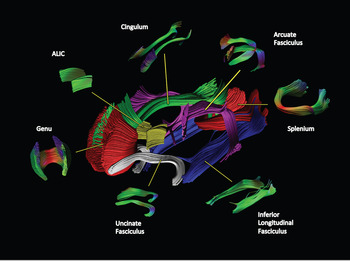
Fibre bundles were extracted blindly for each participant by a single rater (L.E.) using two-dimensional (2D) tract selection ROIs. As in normal logical operations, an ‘AND’ ROI selects all (and only) tracts that pass through it whereas a ‘NOT’ gate removes tracts that pass through it. This approach provides a more robust means to ensure that all the relevant fibres are captured without the bias of initial seed-point placement. To optimize tract definition, a tailor-made approach was taken to ROI placement based on an accepted method that uses information derived from the colour FA and MD maps (Emsell et al. Reference Emsell, Leemans, Langan, Van Hecke, Barker, McCarthy, Jeurissen, Sijbers, Sunaert, Cannon and McDonald2013b ). The colour FA contrast provided fibre orientation information and the MD contrast enabled sulcal boundaries to be more readily visualized. Tract delineation was based on previously published DTI and anatomical studies (Schmahmann & Pandya, Reference Schmahmann and Pandya2006; Catani & Thiebaut de Schotten, Reference Catani and Thiebaut de Schotten2008). As the ROIs were defined only once in atlas space, intra-rater reliability measurements for individual tracts were not required. The ROI placement for each tract is outlined in Supplementary Table S1 (online), and visualizations of the selected tracts in atlas space are illustrated in Fig. 1.
Tractography masks for the fibre bundles of interest extracted from the population atlas. ALIC, Anterior limb of the internal capsule.

Genetic liability scale (GLS)
The variation in the level of genetic risk among subjects was modelled using a continuous quantitative measure of genetic liability based on each individual's affection status and the number, affection status and genetic relatedness of all adult members of each family as far as second degree from the index patient. This approach has been described in detail previously and applied to the present sample (McDonald et al. Reference McDonald, Bullmore, Sham, Chitnis, Wickham, Bramon and Murray2004; Chaddock et al. Reference Chaddock, Barker, Marshall, Schulze, Hall, Fern, Walshe, Bramon, Chitnis, Murray and McDonald2009). To summarize, a polygenic multifactorial liability threshold model of illness was used in which liability was assumed to be a continuous Gaussian distribution in the population. To calculate the scales, patients were initially assumed to have an expected liability above the population prevalence rate of 0.5% for BD. Given this assumption, the initial imputed liability was 2.89. Relatives who were without a psychotic disorder were considered unaffected and were initially imputed a mean liability below the threshold. These scores were then adjusted for each individual to account for family size and affection distribution for all individuals older than 16 years and as far as second degree from the index patient. In reality, the data were found to have a bimodal distribution. Therefore, to remove the possibility of correlations between the GLS and FA and RD being driven by group differences in the GLS, rather than variation within the patient and relative groups, the GLS values from each group were standardized separately to their respective subgroup means. This standardization gave z-score values for relatives (−1.48 < z < 2.13) and patients (−1.44 < z < 1.95), resulting in a normally distributed continuous variable for genetic liability (Kolmogorov–Smirnov test, p = 0.141).
Statistical analysis
Two main effects analyses were performed using Stata version 8 (Stata Corporation, USA): one to investigate group effects on FA and RD and the other to investigate the effect of genetic liability on the diffusion parameters. Exploratory partial correlations (corrected for age) were also conducted to examine associations between DTI measures and (a) age of symptom onset, (b) illness duration and (c) number of hospitalizations. In all analyses, statistical significance was set to p < 0.05.
In the first study, regression analysis was used to determine if FA or RD could predict participant group, that is BD patient, UR or healthy control (xi:regress command). We accounted for the inclusion of related individuals by using Stata's ‘cluster’ command within the regression analyses, which maintains correct type 1 error rates when data are observed in clusters (in this case, families). Age and gender were included as covariates. Post-hoc pairwise comparisons of groups were carried out in a similar fashion where an overall effect was seen. In the second set of analyses, a similar regression analysis was performed to determine if GLS could predict FA or RD (regress command), again accounting for familial links with the ‘cluster’ command, and covarying for age and gender.
We did not explicitly correct significance thresholds for multiple comparisons given the substantial inter-relatedness of the investigated measures and because we were investigating tracts based on a priori hypotheses of diffusion changes in the present sample. However, to limit the number of comparisons made, we restricted our analyses to six tracts (with bilateral components), to two relevant diffusion parameters (FA and RD), and only tested for post-hoc pairwise group differences (e.g. patient versus UR, etc.) when the overall analysis was significant.
Results
Demographics
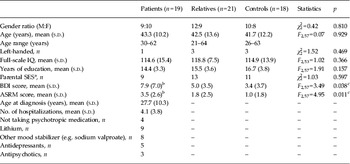
Participants' clinical and sociodemographic information is outlined in Table 1 and has been described in detail previously (Chaddock et al. Reference Chaddock, Barker, Marshall, Schulze, Hall, Fern, Walshe, Bramon, Chitnis, Murray and McDonald2009). There were no significant differences between the three groups in age, gender, handedness, full-scale IQ, years of education or parental social class. Although the patients were clinically in remission at the time of scanning, they continued to experience some subsyndromal mood symptoms leading to marginally higher (but statistically significantly different) values on the BDI and ASRM compared to controls.
Participant sociodemographic and clinical summary

M, Male; F, female; SES, socio-economic status; BDI, Beck Depression Inventory; ASRM, Altman Self-Rating Mania Scale; s.d., standard deviation.
a Class I or II (professional, managerial and technical occupations). Based on details of parental occupation at the time of the individual's birth.
b Mean difference between patients and controls is significant at p < 0.05 in post-hoc (Bonferroni) analyses.
c Group comparisons significant at p < 0.05; two-tailed continuous data were assessed with a one-way ANOVA and categorical data were assessed using a χ 2 test.
At the time of scanning, 15 patients were taking at least one psychotropic medication whereas four patients were not receiving any medication. No relatives or controls were taking psychotropic medication at the time of scanning. The mean duration of BD, as measured from the time of diagnosis, was 15.6 years, and patients had experienced on average four hospitalizations (range 0–13) during the course of their illness. Lifetime co-morbidity was detected in two patients, one with anxiety disorder and one with alcohol dependence syndrome (both recovered).
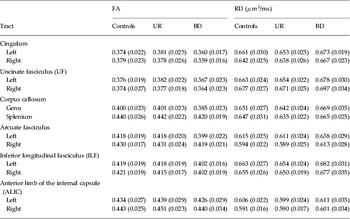
The FA and RD measures in each tract and group are provided in Table 2.
Raw mean fractional anisotropy (FA) and radial diffusivity (RD) across tracts of interest for patients with bipolar disorder (BD), their unaffected relatives (UR) and healthy controls

Values given as mean (standard deviation).
FA
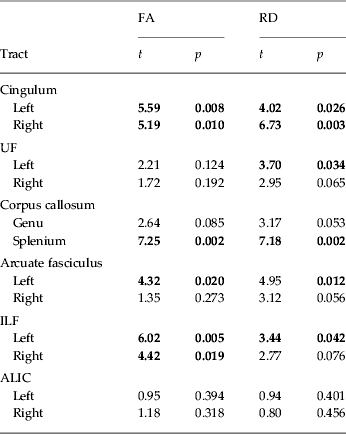
FA was associated with group membership in the cingulum and ILF bilaterally, and in the left SLF and the splenium of the corpus callosum (Table 3). Post-hoc pairwise comparisons revealed that this effect was driven by significant reductions in FA in patients compared to UR in the left cingulum (t = − 3.12, p = 0.003), right cingulum (t = − 2.60, p = 0.013), left ILF (t = − 3.06, p = 0.004), left SLF (t = − 2.79, p = 0.008) and callosal splenium (t = − 3.52, p = 0.001); and compared to controls in the left cingulum (t = –2.13, p = 0.040), right cingulum (t = − 2.72, p = 0.010), left ILF (t = − 3.09, p = 0.004), right ILF (t = − 2.97, p = 0.005), left SLF (t = − 2.42, p = 0.020) and callosal splenium (t = − 2.65, p = 0.012). There were no significant group effects detected between relatives and controls. There were also no significant associations between FA and age of symptom onset, illness duration or number of hospitalizations.
Statistically significant effect of group on fractional anisotropy (FA) and radial diffusivity (RD)
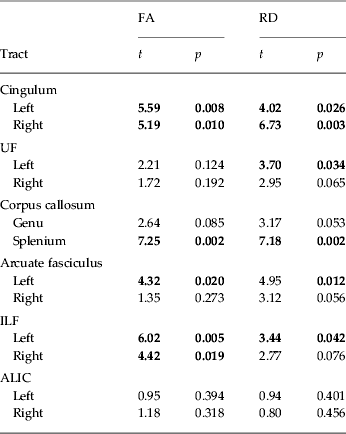
UF, Uncinate fasciculus; ILF, inferior longitudinal fasciculus; ALIC, anterior limb of the internal capsule; p, statistical significance of overall model.
Results of the regression analysis examining if the diffusion parameters FA and RD could predict group membership (patient, relative or healthy control). In this model, family membership was accounted for by specifying that the observations were independent across families but not within families; and age and gender were included as covariates of no interest.
Significant results, p < 0.05, are highlighted in bold.
RD
RD was associated with group membership in the cingulum bilaterally, the left ILF and UF, and the splenium of the corpus callosum (Table 3). Post-hoc pairwise comparisons revealed that this effect was driven by significant increases in RD in patients compared to UR in the left cingulum (t = 2.80, p = 0.008), right cingulum (t = 3.34, p = 0.002), left UF (t = 2.69, p = 0.010), left SLF (t = 3.10, p = 0.004), left ILF (t = 2.58, p = 0.014) and callosal splenium (t = 3.78, p = 0.001); and compared to controls in the right cingulum (t = 2.94, p = 0.006) and left SLF (t = 2.30, p = 0.027). There were no significant effects detected between relatives and controls. There were also no significant associations between RD and age of symptom onset, illness duration or number of hospitalizations.
FA and RD changes with the GLS
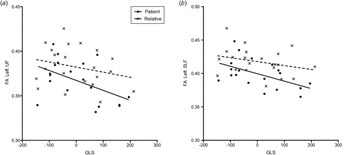
Increasing genetic liability was associated with decreased FA in the right UF (t = − 2.24, p = 0.036), left SLF (t = − 2.10, p = 0.049) and right SLF (t = − 2.61, p = 0.017). Further investigation of this finding using partial correlations (corrected for age) in UR and patients separately revealed statistically significant associations with increasing genetic load and decreasing FA in patients only (Fig. 2), in the right SLF (t = − 2.84, p = 0.01), left SLF (t = − 2.73, p = 0.02) and in the left UF (t = − 3.67, p = 0.002). There were no GLS effects associated with RD in the combined analysis; however, increasing genetic load was associated with increased RD in the left UF in patients when analysed separately (t = 2.34, p = 0.03).
Correlations between the genetic liability scale (GLS) and fractional anisotropy (FA), in patients with bipolar disorder (BD) and unaffected relatives (UR), in the uncinate fasciculus (UF) and left superior longitudinal fasciculus (SLF). Scatterplots illustrating the association between the score on the GLS and raw mean values of FA, in BD patients and UR groups, in (a) the left UF (patients: t = − 3.67, p = 0.002, relatives: t = − 0.43, p = 0.67) and (b) the left SLF (patients: t = − 2.73, p = 0.02, relatives: t = − 0.72, p = 0.48).

Discussion
We report evidence of tract-specific FA reduction and increased RD associated with a diagnosis of BD, in the cingulum, UF, SLF, callosal splenium and ILF. We did not find any effect of diagnosis in the ALIC. Contrary to our hypothesis, and previous VBA, relatives did not exhibit intermediary effects in these tracts. Nevertheless, evidence for a contribution of genetic liability for BD to decreased FA in the SLF and UF was detected through the analysis of tract metrics with the GLS. We did not detect evidence of raised FA or reduced RD associated with BD or genetic liability for BD in any tract.
WM change as a trait feature of BD
WM abnormalities emerge consistently in studies of BD, with volumetric reduction and FA reduction being reported most frequently (Chaddock et al. Reference Chaddock, Barker, Marshall, Schulze, Hall, Fern, Walshe, Bramon, Chitnis, Murray and McDonald2009; Macritchie et al. Reference Macritchie, Lloyd, Bastin, Vasudev, Gallagher, Eyre, Marshall, Wardlaw, Ferrier, Moore and Young2010; Benedetti et al. Reference Benedetti, Yeh, Bellani, Radaelli, Nicoletti, Poletti, Falini, Dallaspezia, Colombo, Scotti, Smeraldi, Soares and Brambilla2011b ; Vederine et al. Reference Vederine, Wessa, Leboyer and Houenou2011; Emsell et al. Reference Emsell, Langan, Van Hecke, Barker, Leemans, Sunaert, McCarthy, Nolan, Cannon and McDonald2013a ). A meta-analysis of 11 DTI studies described two frequently reported clusters of FA change in BD. One region was in the right parahippocampal gyrus, traversed by the ILF, inferior fronto-occipital fasciculus (IFOF) and SLF, and the other was located subgenually and traversed by the uncinate, forceps minor and anterior portion of the IFOF (Vederine et al. Reference Vederine, Wessa, Leboyer and Houenou2011). Tracts traversing these regions also emerge in our study of patients in clinical remission. Other studies of euthymic patients have also found FA decreases in the corpus callosum (Macritchie et al. Reference Macritchie, Lloyd, Bastin, Vasudev, Gallagher, Eyre, Marshall, Wardlaw, Ferrier, Moore and Young2010; Versace et al. Reference Versace, Andreazza, Young, Fournier, Almeida, Stiffler, Lockovich, Aslam, Pollock, Park, Nimgaonkar, Kupfer and Phillips2013), SLF and cingulum (Versace et al. Reference Versace, Andreazza, Young, Fournier, Almeida, Stiffler, Lockovich, Aslam, Pollock, Park, Nimgaonkar, Kupfer and Phillips2013) and ILF (Ambrosi et al. Reference Ambrosi, Rossi-Espagnet, Kotzalidis, Comparelli, Del Casale, Carducci, Romano, Manfredi, Tatarelli, Bozzao and Girardi2013). A recent larger study by our group investigating an unrelated sample of euthymic BD type I patients and controls, using similar tractographic methodology, also reported comparable regional FA reduction and RD increase in the cingulum and callosal splenium (Emsell et al. Reference Emsell, Leemans, Langan, Van Hecke, Barker, McCarthy, Jeurissen, Sijbers, Sunaert, Cannon and McDonald2013b ). Notably, this study only found differences in anterior subdivisions of the cingulum, and not when the whole tract was examined. It is possible that the lack of significant findings in other tracts in the present study, and discrepancies with the seemingly more widespread results from VBA, could be due to averaging the results across the whole tract.
WM matter change as a BD endophenotype
Strong indirect evidence derived from structural MRI techniques, such as automated segmentation of global tissue volumes and computational morphometry, suggests that both global and regional WM volumes are largely under genetic control and that the degree of heritability is heterogeneous across different brain regions and varies with age and gender (Thompson et al. Reference Thompson, Cannon, Narr, van Erp, Poutanen, Huttunen, Lonnqvist, Standertskjold-Nordenstam, Kaprio, Khaledy, Dail, Zoumalan and Toga2001; Kieseppa et al. Reference Kieseppa, van Erp, Haukka, Partonen, Cannon, Poutanen, Kaprio and Lonnqvist2003; Hulshoff Pol et al. Reference Hulshoff Pol, Schnack, Posthuma, Mandl, Baare, van Oel, van Haren, Collins, Evans, Amunts, Buergel, Zilles, de Geus, Boomsma and Kahn2006). Evidence from population and twin studies assessing the heritability of DTI measures has identified a significant genetic influence, particularly on FA (van der Schot et al. Reference van der Schot, Vonk, Brans, van Haren, Koolschijn, Nuboer, Schnack, van Baal, Boomsma, Nolen, Hulshoff Pol and Kahn2009; Kochunov et al. Reference Kochunov, Glahn, Nichols, Winkler, Hong, Holcomb, Stein, Thompson, Curran, Carless, Olvera, Johnson, Cole, Kochunov, Kent and Blangero2011; Blokland et al. Reference Blokland, de Zubicaray, McMahon and Wright2012; Chiang et al. Reference Chiang, Barysheva, McMahon, de Zubicaray, Johnson, Montgomery, Martin, Toga, Wright, Shapshak and Thompson2012; Hulshoff Pol et al. Reference Hulshoff Pol, van Baal, Schnack, Brans, van der Schot, Brouwer, van Haren, Lepage, Collins, Evans, Boomsma, Nolen and Kahn2012; Jahanshad et al. Reference Jahanshad, Kochunov, Sprooten, Mandl, Nichols, Almassy, Blangero, Brouwer, Curran, de Zubicaray, Duggirala, Fox, Hong, Landman, Martin, McMahon, Medland, Mitchell, Olvera, Peterson, Starr, Sussmann, Toga, Wardlaw, Wright, Hulshoff Pol, Bastin, McIntosh, Deary, Thompson and Glahn2013).
Other family studies including affected and unaffected relatives have reported FA reductions in patients. In a cohort of size comparable to ours, Mahon et al. (Reference Mahon, Burdick, Ikuta, Braga, Gruner, Malhotra and Szeszko2013) identified FA decrease in three clusters within the IFOF using tract-based spatial statistics (TBSS). This tract partially overlaps with the anatomically adjacent ILF, and it is possible that our findings in this tract and in our previous VBA mirror the temporal lobe deficits identified in this TBSS study. Notably, Mahon et al. (Reference Mahon, Burdick, Ikuta, Braga, Gruner, Malhotra and Szeszko2013) also detected intermediate effects for UR. In a larger TBSS study including only patients (n = 79) and UR (n = 117), Sprooten and colleagues identified widespread WM reduction in UR (Sprooten et al. Reference Sprooten, Sussmann, Clugston, Peel, McKirdy, Moorhead, Anderson, Shand, Giles, Bastin, Hall, Johnstone, Lawrie and McIntosh2011) and an association between FA and genes broadly related to cell adhesion, axon guidance and neuronal plasticity (Sprooten et al. Reference Sprooten, Fleming, Thomson, Bastin, Whalley, Hall, Sussmann, McKirdy, Blackwood, Lawrie and McIntosh2013). However, Whalley et al. (Reference Whalley, Sprooten, Hackett, Hall, Blackwood, Glahn, Bastin, Hall, Lawrie, Sussmann and McIntosh2013) failed to find an association between polygenic risk and FA in BD in subjects from the same family cohort.
In the current study we failed to reproduce the widespread GLS effects detected previously using VBA, and also did not detect intermediate diffusion values in UR. Although these findings alone do not support lower FA values as an endophenotypic trait, we did detect significant associations between lower FA and increased genetic liability in the UF and SLF in the patient group, and a corresponding increased RD in the left UF in patients, indicating that those individuals most likely to be carrying susceptibility genes for the illness demonstrate subtle WM abnormalities in these regions. Support for an endophenotypic contribution to FA reduction in BD comes from a recent large study by Skudlarski et al. (Reference Skudlarski, Schretlen, Thaker, Stevens, Keshavan, Sweeney, Tamminga, Clementz, O'Neil and Pearlson2013) investigating overlapping schizophrenia and BD endophenotypes. The authors detected significant FA differences in BD probands and their UR that were more subtle than those found in schizophrenia and confined to younger bipolar relatives (Skudlarski et al. Reference Skudlarski, Schretlen, Thaker, Stevens, Keshavan, Sweeney, Tamminga, Clementz, O'Neil and Pearlson2013).
Methodological considerations
VBA and tractography as complementary methods
One of the challenges of interpreting DTI metric changes arises when different methods, such as VBA and tractography, yield different results from the same or similar DTI data. For example, in this study there are discrepant GLS findings and a negative finding in the ALIC. In VBA, images are typically smoothed, sometimes masked, and one or more statistical thresholds are applied to generate a statistical probability map highlighting regions that are deemed representative of genuine differences in voxel-wise mean values between groups. The act of smoothing alters the DTI metric value, increasing it or decreasing it as a function of its location, and in relation to the size of the smoothing kernel used. Statistics are still applied on a voxel level, therefore comparing DTI metrics at a local level. In tractography, DTI metric values are averaged along a 3D ROI (i.e. the reconstructed tract). As information from the whole WM bundle of interest is evaluated, some local information about differences in specific regions of the tract is lost. Methodological issues such as these therefore prevent direct comparison of results between VBA and tractography approaches. When concordant DTI metric changes are found (i.e. a decrease in FA in the callosal splenium in both types of analysis), the finding may represent a larger regional or magnitude change in the parameter between groups than if the finding only arises in one type of analysis. It is likely that, by increasing statistical power, discrepant findings arising from noise or high variance could be disentangled from findings that represent genuine subtle or focal changes in WM microstructure; although increased power will not overcome the inherent differences between methodologies due to their differential sampling of local and more long-range effects.
Methodological strengths
The study population as a whole consisted of well-matched groups with respect to age, gender, IQ, education and social class. The patient group was well-characterized clinically, and represented a homogeneous subsample of the spectrum of BD, namely familial euthymic BD type I patients who had previously experienced at least one psychotic episode. As individual native space fibre-tracking results may vary considerably, it is difficult to compare diffusion metrics across them equitably. We attempted to control for this by registering all the subjects' data to a common space, a population atlas wherein each voxel in the atlas was approximately equivalent to the corresponding voxel in each individual dataset.
A particular strength of the present study is that it also includes an analysis of RD. Reports of increases in RD are a recurrent finding in BD studies, notably in euthymic or younger adolescent and adult patient cohorts (Benedetti et al. Reference Benedetti, Yeh, Bellani, Radaelli, Nicoletti, Poletti, Falini, Dallaspezia, Colombo, Scotti, Smeraldi, Soares and Brambilla2011b ; Ambrosi et al. Reference Ambrosi, Rossi-Espagnet, Kotzalidis, Comparelli, Del Casale, Carducci, Romano, Manfredi, Tatarelli, Bozzao and Girardi2013; Emsell et al. Reference Emsell, Leemans, Langan, Van Hecke, Barker, McCarthy, Jeurissen, Sijbers, Sunaert, Cannon and McDonald2013b ; Lagopoulos et al. Reference Lagopoulos, Hermens, Hatton, Tobias-Webb, Griffiths, Naismith, Scott and Hickie2013; Paillere Martinot et al. Reference Paillere Martinot, Lemaitre, Artiges, Miranda, Goodman, Penttila, Struve, Fadai, Kappel, Poustka, Conrod, Banaschewski, Barbot, Barker, Buchel, Flor, Gallinat, Garavan, Heinz, Ittermann, Lawrence, Loth, Mann, Paus, Pausova, Rietschel, Robbins, Smolka, Schumann and Martinot2013; Versace et al. Reference Versace, Andreazza, Young, Fournier, Almeida, Stiffler, Lockovich, Aslam, Pollock, Park, Nimgaonkar, Kupfer and Phillips2013). As diffusion parameters are modulated by numerous factors, both biological (e.g. cellular density, membrane porosity, water content) and arising from the DTI method (e.g. partial volume, averaging, crossing-fibres), it is impossible to deduce the precise biological mechanism that is driving changes in FA and RD (Beaulieu, Reference Beaulieu2002; Vos et al. Reference Vos, Jones, Viergever and Leemans2011). Complementary work focusing on molecular biological substrates of BD has found alterations in the expression of WM genes that control myelination and oligodendrocyte function (Uranova et al. Reference Uranova, Vostrikov, Orlovskaya and Rachmanova2004; Kim & Webster, Reference Kim and Webster2010; Cannon et al. Reference Cannon, Walshe, Dempster, Collier, Marshall, Bramon, Murray and McDonald2012). Although speculative, such converging evidence provides support for interpreting FA decreases and RD increase in terms of altered myelination.
Limitations
The small number of subjects in each group and the relatively large number of measures, uncorrected for multiple comparisons, mean that the results are vulnerable to both type I and type II errors. The approach to multiple comparison correction is a common issue in studies of this type. In the strictest sense, the most statistically correct approach would be to apply one of several multiple comparison correction strategies, such as Bonferroni. However, these approaches do not take into account the broader context of the analysis in terms of its multivariate nature, the inter-relatedness of imaging features and quantitative parameters or previous findings. It is therefore possible that such a correction would be too stringent and may obscure true results. However, we are afforded some confidence in the legitimacy of our findings because they were all in the hypothesized direction (i.e. FA decrease and RD increase) and in tracts that have emerged in other BD studies.
The use of self-report questionnaires to assess mood may be a limitation of this study. However, the patients were out-patients in clinical remission when recruited, with little variation in these validated symptom measures, and it is unlikely that observer-rated scales would have significantly affected the results of the study.
All the patients had experienced a psychotic episode and the differences we detected also emerge in studies of patients with schizophrenia. Furthermore, there is compelling evidence of trans-disorder, overlapping genetic susceptibility effects in BD and schizophrenia from genome-wide association studies (Williams et al. Reference Williams, Craddock, Russo, Hamshere, Moskvina, Dwyer, Smith, Green, Grozeva, Holmans, Owen and O'Donovan2011; Smoller et al. Reference Smoller, Craddock, Kendler, Lee, Neale, Nurnberger, Ripke, Santangelo and Sullivan2013), twin studies (Hulshoff Pol et al. Reference Hulshoff Pol, van Baal, Schnack, Brans, van der Schot, Brouwer, van Haren, Lepage, Collins, Evans, Boomsma, Nolen and Kahn2012) and other family studies (McDonald et al. Reference McDonald, Bullmore, Sham, Chitnis, Suckling, MacCabe, Walshe and Murray2005; Skudlarski et al. Reference Skudlarski, Schretlen, Thaker, Stevens, Keshavan, Sweeney, Tamminga, Clementz, O'Neil and Pearlson2013). It is therefore possible that our findings reflect a neurostructural and genetic vulnerability to psychosis, which may not be generalizable to less severe forms of BD.
As with the majority of other studies of this type, we cannot rule out the effect of medication or previous alcohol and substance abuse on our findings in the patient group. However, such effects were minimal in our previous VBA study, and because of possible pharmacological neurotrophic and compensatory mechanisms, measurable effects may be limited in neuroimaging studies including medicated BD populations (Hafeman et al. Reference Hafeman, Chang, Garrett, Sanders and Phillips2012).
As with any DTI analysis, misregistration errors must be considered. All types of tractography are subject to model limitations, and the tensor is demonstrably worse than high angular resolution techniques at modelling crossing fibres (Jeurissen et al. Reference Jeurissen, Leemans, Tournier, Jones and Sijbers2012). However, DTI provides a reliable, reproducible construction of the major inter- and intra-hemispheric WM pathways investigated in this study.
Conclusions
In this tractography study, WM microstructural abnormalities in limbic, temporal and callosal pathways were detected in BD type I. Furthermore, increasing genetic liability was associated with diffusion changes in the UF and SLF in patients, indicating a potential contribution of susceptibility genes to these findings, although no evidence was found for endophenotypic effects throughout other limbic or callosal tracts. Complementary DTI methodologies could serve to further elucidate the nature of pathophysiological changes in WM in BD and whether endophenotypic effects in other tracts or segments of such tracts characterize genetic liability for the illness.
Supplementary material
For supplementary material accompanying this paper, please visit http://dx.doi.org/10.1017/S0033291713002845.
Acknowledgements
This study was supported by a National Alliance for Research on Schizophrenia and Depression (NARSAD) Independent Investigator Grant and a Medical Research Council (MRC) Pathfinder Award (C.McD.). Additional individual funding included an international mobility postdoctoral bursary from KU Leuven (L.E.), an MRC studentship (C.C.) and a postdoctoral award from the Department of Health (E.B.).
We are grateful to the Manic Depression Fellowship for help with participant recruitment and offer special thanks to all the families who took part in this research.
Declaration of Interest
G.J.B. received honoraria for teaching from General Electric during the course of this study.