Introduction
Late medieval sources reveal an annual handover of a meerzwijn between the council of the city of Blankenberge and the aldermen of Bruges. A meerzwijn is a porpoise, a marine mammal that grows to a length of 180 centimetres and up to 150 kilogrammes in weight in adulthood. The presentation of the animal required some organization. A few sturdy men first hauled the porpoise from the beach over the dune tops to the city centre. From there, a sergeant transported the porpoise 12 kilometres south to Scheepsdale, a junction of land and waterways on the northern edge of Bruges. The animal was then carried into the city centre and transferred into the capable hands of a local fishmonger. The porpoise was cut into smaller portions and distributed among the Bruges aldermen, officials and their servants by breykins. Footnote 1 A few moments later, the porpoise slices were taken into the kitchens, where they were prepared for subsequent consumption. This presentation and consumption of the meerzwijn consistently occurred on a spring day, and the practice was repeated on an annual basis for more than three centuries.Footnote 2
The annual pattern, the consistent timing and the longevity of this custom seem to indicate a close, perhaps special, bond between the two cities. However, the nature of this relationship is not immediately clear. As is generally known, the much older city of Bruges, which is located on an interface between the higher sandy soils of inner Flanders and the lower wetlands of the coastal plain, had developed from a political and military stronghold into a centre of international trade by the tenth century. By the second half of the twelfth century, the city secured access to the sea via a canal to the Zwin estuary located five kilometres to the north. This long and initially spacious arm of the sea and the outports on its shores became an important logistical hub and a maritime transport corridor between the centre of Bruges, the open sea and the major rivers to the north.
Blankenberge did not develop into a city until the twelfth century, and it was a relative newcomer to this landscape. The community did not take root on the edge of the transport corridor facing Bruges but rather an de zeecant (on the seashores) to the north-west of that city (Figure 1). At first glance, the community did not participate in the commercial processes that characterized the Zwin area. The residents lived sheltered from the elements behind the dunes. Much of the population of the coastal city was mainly engaged in fishing, and the harbour was nothing more than a stretch of the shore where the fishermen could beach their boats.
Blankenberge and the Flemish coast, c. 1300.

The reason for the handover of the porpoise is not disclosed by the sources. The city accounts – the oldest one dates from 1400 – use conventional and fossilized formulations such as ‘also van houden tiden langhe ghecostumiert heeft ghesiin’ (as has been the custom for a long time) or ‘ghepresenteert naer coustume’ (presented according to custom). It is an indication that the residents of Blankenberge at the time seemed to have taken the transfer of the porpoise for granted.
In the historiography of fishing and coastal communities, the porpoise presented by Blankenberge to Bruges usually only plays a role in quantitative analyses of the past. It is generally added to the long list of documented appearances of this animal in a vast corpus of late medieval texts. This abundance of references is believed to indicate the economic significance of the porpoise and to demonstrate its role as a commodity, an object of trade. The exchange of porpoises is considered to be part of the crucial supply of sea fish on which the growing urban population depended for food.Footnote 3
However, the reason the animals are so frequently mentioned in medieval texts is their use as a gift. The porpoise is only one of the many marine and freshwater species that were presented in various sizes and states of preservation. Hence, medievalists who study this gift behaviour in an urban context often explain the porpoise as an instrument that the aldermen and civil servants employed to promote their interests and uphold their reputations. Gifts such as the meerzwijn were mainly presented to influential people, including the members of the ducal court, ambassadors and members of the nobility.
The issue here is that the porpoise presented by Blankenberge lacks the typical characteristics of common medieval urban gifts. The latter were mainly offered to individuals and not exchanged between communities, as was the case with Blankenberge and Bruges. It should therefore come as no surprise that the Flemish positivist historian and archivist Louis Gilliodts-Van Severen offered a very different interpretation. In his edited legal sources of Blankenberge, which were published in 1890, Gilliodts-Van Severen argued that the porpoise should not be understood as a gift but rather as a punishment, a fine imposed by Bruges.
Commodity, gift or punishment – these are three different interpretations of the same transfer taking place between two urban communities. The absence of consensus as to the meaning of the presentation of the porpoise is partly due to the limited attention that has been paid to this custom. The history of the city of Blankenberge has not often been explored in relation to Bruges. The latter is commonly researched as a trading hub, frequently in relation to the north-eastern outports, but scholars have less frequently linked the role and position of the Bruges market to the rural hinterland and the coastal communities, which only had a limited port and commercial infrastructure.Footnote 4 A tendency to overemphasize infrastructure and to overlook relationships of co-operation and competition can also be noted in research on coastal communities in other regions, which, until recently, have been predominantly explored as independent, self-contained units with wills and personalities of their own.Footnote 5 Perhaps the limited attention that has been paid to the relationships between the Flemish coastal communities and major inland centres is due to Wim Blockmans’ argument that these communities mainly maintained relationships with each other and promoted their interests as a group, which resulted in difficulties in terms of fitting these communities into the agendas of the large cities.Footnote 6 The fact that Blankenberge seems to have maintained a unique relationship with Bruges, however, has been relatively unexplored.
In what follows, I attempt to explain the role that the presentation and consumption of the porpoise played in the relationship between Blankenberge and Bruges. In the first section, I outline the development of Blankenberge and search for the roots of the relationships that this community established as it entered a highly competitive maritime landscape. I subsequently examine certain characteristics of the porpoise and some plausible interpretations of the handover. In the final section, I provide an explanation that clarifies the relationship between Bruges and Blankenberge, its context and the way in which the presentation of the porpoise supported it.
Blankenberge and the maritime landscape
The economic and technological mastery of water was an essential condition for successful growth in the context of the Flemish medieval coastal landscape. Control over water allowed communities to exploit newly reclaimed land while ensuring access from and to the sea.Footnote 7 Historians have referred to this coastal landscape as a ‘civilization de l'eau’. As this landscape was shaped by the ubiquity of water and the eternal human struggle against the effects of the ocean, seignorial power had fewer opportunities to take root, thus increasing the legal and economic freedom of both urban and rural communities.Footnote 8 Archaeologists frequently consider this particular amphibious civilization as a ‘maritime cultural landscape’, a concept that allows them to describe maritime communities as complex, flexible and resilient systems that continuously adapt and evolve around environmental, economic and social relations.Footnote 9 Starting from a landscape perspective, the research not only focuses on the physical remains of maritime cultures but also on cognitive systems and cultural practices. People do not exert a monodirectional influence on the landscape, as the landscape also influences them.Footnote 10
Blankenberge was established on a reclaimed salt marsh at the edge of the sea, presumably in the second half of the twelfth century. This place, initially called Scarphout, was the western border of the rural parish of Uitkerke,Footnote 11 a territory for which the local lord had acquired seigniorial prerogatives such as the right to receive a share of the fines imposed by judicial officers. When the coastal community received urban privileges in the thirteenth century, the rights of this lord were harmed. The charter between the countess and the lord settling this loss dates from 1270 and suggests that Blankenberge only acquired the privileges around that date.Footnote 12 Bailiff accounts of the early fourteenth centuryFootnote 13 and the very first Transport van Vlaanderen, a tax distribution list determining which part of the contribution had to be paid by each city and rural community to the count,Footnote 14 suggest that the number of inhabitants in Blankenberge was considerably higher than in other communities along the northern coast of Flanders. The fact that the bailiff of Bruges, who was responsible for the Liberty of Bruges, the rural administrative district around Bruges, established a prison within the city also demonstrates Blankenberge's central function.Footnote 15
Written sources provide insights into the individuals and factors that contributed to the rise of this community. An embankment called the Genteledijk separated the two largest water drainage systems in the region, each of which was administered by its own water board. The main sluice of one of these systems was the western border of the jurisdiction of Blankenberge. The inhabitants made use of two distinct waterway systems, one saltwater and the other freshwater. These were two transport zones, each with its own types of vessels and port activities. The systems were segregated by the dunes, the management and maintenance of which were a recurring cost borne by the urban community. The planting of straw and the enriching of the sand dunes with manure and ash were monitored by the sluice masters of the water boards and the so-called opperduunherder, a high official who managed this part of the counts’ domain on their behalf.Footnote 16
On the freshwater, inland side of the dunes, there was a network of waterways, gutters and canals called the stede waterloop (city watercourse), which was largely dug and maintained by the inhabitants of Blankenberge themselves. It linked the city to Scheepsdale and the northern city gates of Bruges via two canals called Grote Eede and Ieperleet (see Figure 1). Atop this canal system, the citizens of Blankenberge had arranged a simple grid of streets perpendicular to the main street that ran from the sea to the church and further inland. Most streets had to be provided with bridges because of the many waterways.Footnote 17 In these streets between the canals, the inhabitants worked and lived in their fish houses, horse stables and constructions called draaihuusen (rope houses) and werchuusen (workshops).Footnote 18
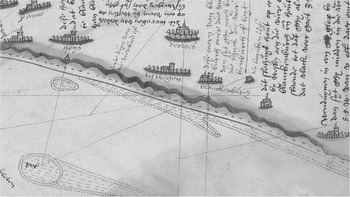
The infrastructure on the saltwater side of the dunes was rather limited. A vierboete, a lighthouse, was built from wood and iron on top of the dunes; it was maintained at the expense of Blankenberge.Footnote 19 In combination with the buildings located further inland, this lighthouse served as an important positioning tool at sea (see Figure 2). Towards the end of the fifteenth century, this part of the dunes was called the quay and was regularly repaired and protected against the forces of the sea, an indication of its importance. Additionally, the only port infrastructure on the shore consisted of wooden posts driven into the sand to mark the area where fishing boats were allowed to run aground.
The lighthouse of Blankenberge as a leading mark on a sixteenth-century map (Antwerp, Erfgoedbibliotheek Hendrik Conscience, Collectie Stad Antwerpen, MS B.29166, fol. 13r, c. 1570).

On the salty side of the dunes, the men of Blankenberge were engaged as skippers in the service of merchants, as inshore fishermen or as fishermen on the high seas who would follow the migration path of herring and offer their catches on the markets and ports of eastern England.Footnote 20 In the fifteenth century, the added value of these men as nautical experts was undeniable. The Blankenberge aldermen, usually in the company of the most seasoned skippers, often had to attend the councils of the city of Bruges and other cities, as they would regularly require expert maritime advice.Footnote 21
Neither the salt side nor the freshwater side of the port was used for the transhipment of merchandise. Although the stede waterloop gave access to Bruges via the above-mentioned inland waterways, these routes were seldom used for international trade. This terminal of an inland shipping network was used by scutelieden (barge skippers) to supply, for example, wood and salt from Bruges.Footnote 22 The city and port were mainly a logistics centre serving inshore and high sea fish production. Along the canals, the fishermen used a hysere, a crane with which the herring barrels were handled.Footnote 23 The share of both sides of the port in the international transport network was undeniably modest. The previously mentioned bailiff accounts indicate that the number of foreigners in Blankenberge was insignificant at the beginning of the fourteenth century. The Zwin was subject to rigorous staple restrictions stipulating that all goods imported had to be sold on the Bruges market.Footnote 24 The burgesses of Blankenberge were never exempt from the series of tolls, which applied to all ships, carriages and goods destined for the Zwin staple.Footnote 25
Nevertheless, this insignificant port infrastructure did not prevent the inhabitants of Blankenberge from playing a notable maritime role. They performed well as pilots and advisers in the many nautical projects that supported international maritime transport, usually on the request of Bruges. As fishermen, they contributed to the food supply of the entire highly urbanized region. For fishing, Blankenberge largely co-operated with other producers, such as Walraversijde, Ostend, Nieuwpoort and Dunkirk, but Bruges and the other cities closely monitored production. Bruges controlled the major supply routes for herring and other fish (Zwin estuary,Footnote 26 ScheepsdaleFootnote 27), where the catch was measured, displayed and sold, and the city also had a voice in deciding when seamen would sail.Footnote 28
Blankenberge's sea-facing position on the border of the Flemish territory also implied that the community played an essential role in mitigating the risks associated with that position. This risk management consisted of activities that in contemporary sources are usually referred to as ‘de bewaernesse vanden lande ende vander zee’ (the safekeeping of the land and the sea)Footnote 29 and roughly consisted of guarding, dissuasion and reprisal.
As vigilantes, the men of Blankenberge primarily gathered information about possible impending threats. They stood guard, checked with neighbours and passed on messages to the communities to their west and east. Special attention was paid to foes approaching the Zwin estuary. Inshore fishermen were warned of impending danger with a sailcloth hoisted from a pole and by the sound of the bell in the city hall. Approaching enemies were greeted with projectiles from a ribaud (a piece of artillery) placed in the dunes and from men equipped with arquebuses.Footnote 30 At sea, vreitscepen (so-called ‘peace ships’) protected the fishermen.Footnote 31 Encounters with seamen considered to be hostile often resulted in the seizing of vessels and the mistreatment of crews. Active and offensive violent actions were mainly organized by the count, who would employ his bailiffs, captains and admirals for this purpose,Footnote 32 but the boundaries between vigilance, reprisal and assault were usually unclear.
The costs associated with these risk management activities fell mainly on Blankenberge. However, the other actors in the maritime landscape shared the consequences. The city of Bruges, dependent as it was on maritime transport, was usually not a supporter of the violence conducted at sea during reprisals or the offensive actions led by the count.Footnote 33 Nonetheless, the city encouraged the inhabitants of Blankenberge to remain vigilant and draw up long-term plans that took into account seasonal differences in conditions.Footnote 34
While its port infrastructure was insignificant, the city's interaction with the maritime landscape turned the men and women of Blankenberge into important players in fishing, maritime transport and the mitigation of maritime risks. Their role obviously transcended the local level. In addition to Bruges, Blankenberge had to maintain relations with the count and his officials, the lord of Uitkerke, the so-called ‘small cities of the seaside’ (Ostend, Nieuwpoort and Dunkirk) and Sluis. The city also had ties with the water boards, the opperduunherder and the Liberty of Bruges. Consequently, all these players on the political and socio-economic fields were important for Blankenberge in one way or another. Nevertheless, only Bruges was offered a porpoise every year. To understand why Blankenberge made this annual offering, we need to closely examine the porpoise itself.
An exclusive animal
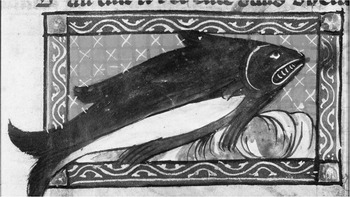
In many of the extant sources, the porpoise is usually referred to as a meerzwijn or merswyn, marsouin, porc de mer or Schweinswall. In modern taxonomy, the porpoise is classified as Phocoena phocoena in the infraorder of the Cetacea.Footnote 35 Cetacea are aquatic mammals such as the dolphin, the killer whale and the sperm whale. However, it cannot be stated with certainty whether the meerzwijn mentioned in the sources was always a porpoise. Concepts from modern taxonomy were not used in the Middle Ages, and we only have limited knowledge concerning how animals were named and categorized.Footnote 36 It is striking that in the thirteenth-century encyclopaedia Der naturen bloeme by Jacob van Maerlant – an author born and raised in the Flemish coastal areaFootnote 37 – the porcus marinus is depicted as a gherebbet (ribbed) and ghespecket (spotted) pig equipped with poisonous thorns (Figure 3). We do not know whether the authors of the medieval texts and their contemporaries were familiar with the animal and could always recognize the animal as a porpoise. It is undoubtedly possible that the meerzwijn reported in the sources was not always a porpoise but perhaps another member of the order of the Cetacea.Footnote 38
Porcus marinus, in Der naturen bloeme of Jacob van Maerlant, c. 1340–1350 (image from ‘Liber de natura rerum’ of Thomas van Cantimpré, Den Haag, Koninklijke Bibliotheek, KA 16, fol. 119r).

The acquisition and consumption of marine mammals do not seem to have been particularly exceptional on the coasts of western Europe. The animals are believed to have been actively hunted, and they accidentally found themselves in fishing nets or washed up on beaches. In the Middle Ages, the meat of whales, porpoises and seals was occasionally served on the table, and oil was produced from the skin, fat layers and parts of the skeleton to be used as fuel.Footnote 39 The afore-mentioned written sources are generally administrative in nature. They are accounts or toll tariff rolls in which the porpoise is listed because it was the subject of a transfer that incurred costs. Early examples are the tariff rolls of the Saint-Vaast abbey of Arras (1024)Footnote 40 and the city of Damme (1252).Footnote 41 As noted previously, the list of treasurers, tax collectors and bailiffs who mentioned a porpoise in their documents is too long to be presented in its entirety here.
However, it is uncertain whether the porpoise had a common place in medieval society, whether it was part of the daily diet and whether it was frequently traded. The fact that the transfer incurred costs in no way means that the porpoise was always an object of transaction in the economic sense of the word. The recorded payment was often nothing more than a godspenning (God's penny) received by the courier to transport the animal to its destination. Archaeological research conducted on medieval contexts over the past 30 years also casts doubt on the role of the porpoise as a commodity,Footnote 42 as the porpoise is not abundant in archaeological deposits.Footnote 43 There are hardly any indications of the direct hunting of the porpoise in medieval Flanders. An exception is Wenduine, a coastal community only four kilometres away from Blankenberge, where fishermen are believed to have hunted the animals with harpoons. However, the sources supporting this claim – the fourteenth- and fifteenth-century account books of the local fishermenFootnote 44 – have largely been lost, and what remains is too fragmented to convincingly prove that porpoise fishing was a widespread activity in coastal Flanders.
Fishermen likely found porpoises as drowned bycatch in their nets or washed up on the sandy beach. These porpoise strandings also occur in the twenty-first century. As far as the Flemish coast is concerned, these strandings seem to mainly occur east of Ostend, in Wenduine, Blankenberge or Heist. Biologists today assume that the porpoises follow their prey southward along the straight coastline of the east of England.Footnote 45 After a long hunt, exhausted animals – especially old and young ones – throw themselves on the Flemish shore.Footnote 46 It is not unlikely that the porpoise displayed analogous behaviour in the Middle Ages. It is perhaps no coincidence that the animal appears relatively more frequently in the historical texts produced by the communities of Wenduine and Blankenberge than those produced west of Ostend.
However, the fishermen along the coast could not simply appropriate the porpoises. In the Middle Ages, the porpoise was generally regarded as a special and exclusive animal that could be acquired only by a few privileged people.Footnote 47 The archaeologist Mark Gardiner notes the special role that ancient seignorial rights played with regard to the status of these animals, particularly the royal claims to wrecks, cetaceans or other objects deposited on beaches by the sea.Footnote 48 In Flanders, these washed-up objects, including animals, were reserved for the count. The coastal bailiffs in Flanders generally confiscated stranded porpoises in his name and then sold them to the highest bidder.
In some places along that coastline, exclusive access was granted to a local lord, who sometimes delegated that access to certain groups within his jurisdiction, often fishermen. This case was evident in Wenduine, where the community presented a porpoise as a tribute to each newly elected dean of the Sint-Donaas chapter in Bruges, who was the lord of the ecclesiastical seigniory of which Wenduine was a part.Footnote 49 This offering of a porpoise to the lord could also be observed on the coasts of Picardy, along the banks of the Seine and in Normandy, where fishermen presented a porpoise to bishops or abbots on occasion.Footnote 50 Gardiner demonstrates that challenging exclusive access to certain animals may have been used as a strategy to test relationships. He analysed the wreck rolls of Leiston Abbey, the court records of the abbey whose jurisdiction bordered a seven-mile stretch of the English east coast.Footnote 51 Although the English king claimed all washed-up goods, he could no longer enforce that right by the thirteenth century. All the wreckage and so-called ‘royal fish’ found on the small stretch of coastline were progressively appropriated by the abbot, to the detriment of the English king, who eventually only received the tails and the heads of the animals.Footnote 52 The abbot's claim on washed-up porpoises was obviously motivated by factors beyond their monetary value alone, as ownership and control over these animals seemed to emphasize the abbey's social status. According to Gardiner, exercising the right to claim stranded animals was a manoeuvre intended to strengthen the abbey's place in the social hierarchy and to challenge and test the social order.Footnote 53 The symbolic value of the animals was thus greater than the material.
Porpoise as a penalty
Gilliodts-Van Severen noted that the aldermen of Bruges did not pay for the Blankenberge porpoise. He believed the meerzwijn was ‘une penalité’, a fine imposed by the people of Bruges because the burgesses of Blankenberge had once refused to recognize the city of Bruges as the city's legal superior (wettelijk hoofd, chef de sens).Footnote 54 By wettelijk hoofd, Gilliodts-Van Severen refers to the most extraordinary institution of Flemish law. In Flanders, jurisdiction was in the hands of the count, who delegated the application and execution of the law to municipal aldermen or lower lords. Comital law was mainly customary law, which was based on precedents.Footnote 55 Inexperienced aldermen of newly founded jurisdictions often could not rely on previous decisions and therefore sought advice from seasoned aldermen. The latter could be found in older cities or castellanies whose charters had often served as a model for the privileges that the count had granted the new communities. The more experienced bench of aldermen was the wettelijk hoofd, and requesting advice was called hoofdvaart (journey to the superior).Footnote 56 The filiation from older privileges and the advisory relationships between the legal institutions created a type of judicial community between the territories of jurisdiction. Although the seasoned aldermen did not relinquish the subaltern bench's decision-making power,Footnote 57 the advice of the legal superior gradually became binding.Footnote 58 This hoofdvaart was an important driver in the formation and expansion of the territorial spheres of influence of the cities of Ghent, Bruges and Ypres.
It should come as no surprise that Gilliodts-Van Severen used legal arguments to explain his view that the offering of the porpoise was inflicted as a punishment. During his entire professional life, this nineteenth-century lawyer, historian and archivist sought to identify the roots of Flemish law, an enterprise that resulted in an impressive oeuvre of source editions.Footnote 59 However, he surprisingly linked the argument that the porpoise served as a sign of legal submission to a motif from the spiritual sphere. According to him, an appropriate time to settle accounts was Lent, the period in which sacrifices are made following the confession of sins.Footnote 60
Fasting originally took different forms. The main fasting period started on Ash Wednesday and lasted until Easter. In this long period of abstention, the quantity and the quality of the food the population could consume were subject to special rules.Footnote 61 The consumption of meat was to be avoided. Although fish was a common feature of the medieval daily menu, it appeared increasingly frequently during Lent. Even though the porpoise is a mammal and not a fish, it was considered an acceptable fasting food because its usual habitat was aquatic.Footnote 62 Being presented with a porpoise during Lent was therefore not inconvenient for the aldermen of Bruges, as the consumption of this animal was compatible with the obligations imposed by Lent. At the same time, it was a sacrifice on the part of the people of Blankenberge that served to purify them of any sins they may have committed.
The connection of a spiritual motif to a worldly one makes Gilliodts-Van Severen's argument fairly persuasive, which is probably the main reason why his thesis has hardly been contested. However, a number of elements arguably place this reading of the porpoise as a penalty in a different light. These elements relate to both the cause of the outstanding account to be settled and the interpretation of the day on which the porpoise was presented.
In essence, hoofdvaart was a legal remedy intended to secure a higher-quality judgement, somewhere between advice and appeal.Footnote 63 In general, hoofdvaart should not be regarded as an attempt of a larger city to usurp the privileges of a smaller one, as Gilliodts-Van Severen suggests in his interpretation of the offering of the porpoise.Footnote 64 At the beginning of the fourteenth century, 27 cities were legally connected to Bruges via hoofdvaart.Footnote 65 With the exception of one city, there is no evidence that Bruges usurped the jurisdiction of smaller cities prior to 1300. That exception is Damme, where this attempt resulted in a conflict that was settled in 1289 by mediation of the count.Footnote 66 It was not until the fourteenth century that Bruges used hoofdvaart as a tool for gaining a firm grip on the cities on which its prosperity depended,Footnote 67 a process that largely ran parallel with that of the Zwin staple, which evolved from a voluntary institution into an obligation.Footnote 68
In late medieval Flanders, the imposition of a fine by one community on another was exceptional. Fines payable by the cities usually had comital origins, often in response to cities rebelling against the count's authority. Such fines generally went hand in hand with the deprivation of privileges, the confiscation of goods, the destruction of urban public buildings and space and the banishment of leaders of uprisings.Footnote 69 It should come as no surprise that the imposition of a fine by one community on another was not common. The privileges that communities enjoyed were granted by the count, and it goes without saying that conflicts could not be resolved without involving him or his supervising institutions, such as the Council of Flanders. Punishment of disobedience and criminality was certainly possible,Footnote 70 but this would occur within individual communities, be they urban or rural.Footnote 71
The reasoning behind the time of the transfer can also be questioned. That time – Lent – prompted Gilliodts-Van Severen to establish a surprising link between the legal and spiritual motives of the presentation of the porpoise. Here, Gilliodts-Van Severen pursued a path that scholars have since followed more frequently. To understand non-functional, irrational behaviour, people are even today inclined to find an explanation in the spiritual or religious domain. Especially with regard to irrational behaviour involving animals, for want of a better explanation, one finds a solution in ‘sacrifice’.Footnote 72 In half of the recorded cases, the specific day on which the porpoise was brought to Bruges was reported in the Blankenberge city accounts. In all these cases, that day was identified as Groten Vastenavond, which is the first Sunday of Lent.Footnote 73 As Sundays were not fasting days, and abstinence was not required on those days, it is difficult to believe that the porpoise presented on that day was a sacrifice. On the contrary, the animal seems to have played a role in a banquet celebrating the transition from winter to spring. Consequently, the presentation of the porpoise marked not a moment of reflection and penance but rather of hope for a new start.Footnote 74
In addition, it is not inconceivable that the occasion of presenting the porpoise in spring had completely different, more pragmatic origins. For example, an unmistakable correlation exists between the renewing of the bench of aldermen in Blankenberge and the day the sergeant went to Bruges to present the porpoise (see Figure 4). Blankenberge was not entirely in control of the timing of the renewal of the bench, as this process was influenced by the travel behaviour of the council commissioners, who followed relatively fixed routes during their annual voyages.Footnote 75 The porpoise seems more likely to have been a tool in the strategy of new aldermen attempting to introduce themselves to a crucial partner or a new master to begin their collaboration under optimal conditions. Rather than a fine, the porpoise thus seems to gain the characteristics of a tribute or a gift.
Time of renewal of the bench of aldermen in Blankenberge (1400–84) and first Sunday of Lent (rectangle) (ARA/CdC, Registers 32148–217).

Porpoise as a gift
The body of anthropological and historical research focusing on the gift is extensive.Footnote 76 An influential scholar in this debate is Marcel Mauss,Footnote 77 who at the beginning of the twentieth century treated the gift as a prestation totale, a total social phenomenon incorporating market, contract and religion. According to Mauss, the gift had numerous explicit and implicit meanings. The gift was ‘total’ because it has a meaning for society as a whole.Footnote 78 As mentioned in the introduction, historians have in the past similarly made significant efforts to understand this behaviour. In their research, medievalists usually make a distinction between the ecclesiastical, noble and urban contexts in which gift behaviour took place. In the ecclesiastical context, an often-studied phenomenon is the so-called ‘dona, beneficia and patrimonia’,Footnote 79 the transfer of goods to ecclesiastical institutions, in addition to the ‘pro anima’ gift, seen as a form of insurance for the salvation of the soul after death.Footnote 80 In the noble or chivalric context, the display of social relations was central, along with the strengthening of cohesion between equals. Largesse was an important and widely recognized aspect of lordship in the Middle Ages,Footnote 81 one that was primarily indebted to the feudal ties between feudal lord and vassal.
In the cities of the Low Countries, gifts mainly took the form of the presentation of jugs of wine or smaller amounts of money. These so-called pots-de-vin and hoofsheden were primarily instruments in strategies intended to uphold a city's honour and to influence decisions yet to be made.Footnote 82 According to Derville, at the extremes of this spectrum of urban gift behaviour were spontaneity and extortion, while in the middle of that spectrum was patronage.Footnote 83 Support, internal cohesion and the way that gifts have influenced the growth of the modern state are given an important place in in urban historical research.Footnote 84
As previously indicated, the Blankenberge porpoise does not fit into these traditional explanations well. Nonetheless, the extensive body of gift research does provide us with a number of typical properties of this behaviour that are relevant to our case. One essential characteristic is the fact that on the one hand, gifts are generally not coerced; on the other hand, they do not come completely unexpected.Footnote 85 After giving, the expectation that one will obtain something in return arises. The latter should preferably not happen immediately, but rather only after an appropriate length of time. This reciprocity, this principle of do ut des, moderates social intercourse and integration, or as Mauss viewed it, the total society.
In addition, gifts are useful in rites of passage, social events where the exchange of objects contributes to the ceremonial passage from one status to another.Footnote 86 Gifts create an ideal climate for nurturing relationships among friends, neighbours, family, colleagues or commercial partners at all social levels.Footnote 87 In medieval society, which was characterized by an eye for tradition and custom, the predictability of a gift was also strongly stimulated by precedents, which allowed certain acts of gift-giving to evolve into customary obligations and acquired rights.Footnote 88 As gifts are often part of rites of passage, they gain the appeal of a ritual. A gift then juxtaposes certain actions, producing a distinction between the extraordinary and quotidian.Footnote 89 Such a ritual can subsequently turn into a cultural signal that can only be understood by considering it in its context and in relation to the given object.Footnote 90
The power and meaning of a gift are therefore also determined by the given object itself. An object can be used as a gift only under specific circumstances; this is particularly the case with food. Feeding satisfies a basic need, but, as it is mainly done within a group, it can also play a role in strengthening cohesion.Footnote 91 However, the food used for such a purpose should not be ordinary, such as cereals or beer, and it should be adapted to the status of the recipient and to the context of the giver, who had to be able to supply the particular food. According to the city accounts, examples of commonly exchanged foods in medieval coastal cities are fish or shellfish,Footnote 92 carps and eels, lampreys, sturgeons, pikes and, of course, porpoises.Footnote 93
Returning to our case-study, we can presume that the annual presentation of the porpoise was an element in a rite of passage. As noted previously, this ‘passage’ was probably the announcement of spring and the renewal of the bench of aldermen, who would be sworn in by the commissioners. A sergeant subsequently went to Bruges to present a porpoise to the wet van Brugge (Bruges magistrate). This gift was not the result of coercion, yet it was highly predictable and expected.Footnote 94 Building on precedents, the porpoise eventually became a tradition, one that was close to a customary obligation van ouden tiden (of old times).Footnote 95 However, the basis of this ultimately fossilized behaviour was the deliberate and free transfer of a sought-after object. This object was a foodstuff of the exclusive kind. Similar to the practice performed by the fishermen of neighbouring Wenduine, the presentation of an exclusive and special animal highlighted the distinction and the social identity of the presenting community.Footnote 96 The porpoise represented both mutual dependence and appreciation.
We must remember that, at first glance, it seems that Bruges never presented anything tangible to the inhabitants of Blankenberge in exchange for the porpoise. Thus, the most important questions that remain unanswered are how and why did this alliance come about?
The meaning of the porpoise
During its development, the community of Blankenberge had to compete and co-operate with many players in the landscape. Although all the representatives of these institutions were treated appropriately and presented the usual pitchers of wine, with regard to the annual presentation of the porpoise, only the city of Bruges managed to secure VIP treatment. Bruges’ city accounts attest that this was already the case as of 1288.Footnote 97
The last quarter of the thirteenth century was an extremely tumultuous period for Bruges. The demographic and economic boom that occurred in maritime Flanders came with an acceleration in development and an increase in the number of new institutions, actors and rivalries. The position of the Flemish merchant-entrepreneurs, who had long organized themselves into so-called hanze Footnote 98 and were predominantly active in the wool trade with England and Scotland, declined. Instead, the Zwin harbour welcomed an increasing number of foreign merchants, signalling the unfolding transition from active to passive trade in coastal Flanders.Footnote 99 The commercial elite largely abandoned overseas trade and instead focused on the establishment of a material, commercial and financial infrastructure in support of the foreign merchants in the city.Footnote 100 Bruges transformed from an industrial city into a more differentiated trading centre. The port functions and the transhipment of goods were outsourced.Footnote 101 This process was not without consequences for the structures in and around Bruges. In Bruges itself, the members of the bench of aldermen were still recruited from the old patriciate, supported by the count. However, tensions increased and polarization sharpened, as the citizens were fuelled by a desire to return to the old urban commune ideal. Mounting city debts and the tax burden on consumption eventually triggered uprisings, resulting in a democratic turn and a tense relationship with the count's dynasty.Footnote 102
In the last quarter of the thirteenth century, Scarphout transformed from a rural community into a city and independent jurisdiction. As we have seen, this outcome most likely occurred around 1270, when the frictions and competition outlined above were intensifying. There are no texts or other indications unambiguously demonstrating that the new privileges enjoyed by Blankenberge contributed to the custom of presenting the porpoise. However, the arguments presented in the previous sections provide a number of elements that provide support for this thesis. These elements are presented below.
(1) In the late Middle Ages, Bruges became more dependent on the maritime craftsmanship of the seaside communities. Along the banks of the Zwin, this craftsmanship mainly translated into port infrastructure and logistics functions. The coastal communities predominantly provided expertise in fishing, seamanship and mitigation of maritime risks. In the thirteenth century, Blankenberge was a prosperous community due to its location near two water drainage systems close to a sluice, involved in inland water management. Furthermore, the city's position on sea and coastal routes made it easy to identify approaching danger. Blankenberge produced fish for the growing urban population, who were supplied by a fish market controlled by Bruges. The latter partly depended on Blankenberge's maritime expertise and key position in the landscape.
(2) Both cities entered into a relationship characterized by co-operation and solidarity of their own free will. This relationship could only thrive within a framework of common values and standards.Footnote 103 The values shared by the two cities may have sprung from the mutually beneficial interaction with the landscape, but they may have become more material and formal through the filiation of urban privileges and the transmission of legal knowhow. This development produced a form of judicial community, a bond of trust and the guarantee that the obligations associated with the trust would be fulfilled.Footnote 104 This community of values could hardly have been created had Blankenberge continued to be part of Uitkerke, within the Liberty of Bruges and partly controlled by the local lord. The urban privileges of Blankenberge were therefore an essential condition for the conception of the alliance.
(3) The annual gift presented in spring was an instrument asserting the co-operation and solidarity between the two cities. The gift alone was insufficient to forge a lasting relationship.Footnote 105 It was essential that the gift was transferred from one bench of aldermen to another, as these individuals served as representatives of two jurisdictions and two communities. The direction of giving seems to indicate an unequal relationship. The animal was presented, however, in return for the filiation of values, advice and legal knowhow. The porpoise closed the circle of reciprocity.
(4) The porpoise was a suitable object to give as a present. This exclusive animal highlighted both the maritime nature of the inhabitants of Blankenberge and the special status of the receiver. The porpoise was also an effective method of challenging the social order; after all, it tested the authority of the count. By appropriating the prerogatives of the count, the cities armed themselves against the ambitions of the other actors in the landscape during a time in which competition was fierce.
Conclusion
This article contributes to the recent body of research on medieval port cities and coastal communities that has been produced from a holistic and comparative perspective, integrating knowledge from different scientific disciplines. In Flanders, such research has been published on the fishing community WalraversijdeFootnote 106 and the port cities MonnikeredeFootnote 107 and Hoeke;Footnote 108 studies have approached these communities as complex, flexible and resilient systems which relied on resources from the sea and the rural hinterland and which continuously adapted and evolved in response to changing environmental, economic and social relations, in the context of which they developed ties of solidarity. This article introduces a cultural perspective by drawing on anthropological frameworks and concepts from archaeology for understanding gift giving and contextualizing its role in a comprehensive way. Historians working on coastal communities, both in the Low Countries and other geographical regions, could benefit from this approach by considering this alternative perspective while reanalysing the scarce written sources and integrating knowledge from other disciplines.Footnote 109
In coastal Flanders, the presentation of the porpoise demonstrates how communities not only maintained ties of solidarity with each other but also relied on relations with the larger inland cities. Similarly to the outports in the Zwin estuary, the newcomer Blankenberge was integrated into Bruges’ sphere of influence. While the outports became part of a port and staple network, Blankenberge entered a system that had to provide Bruges with food, nautical expertise and protection against the risks associated with the maritime landscape. This system was essentially based on trust. Both cities partially depended on the support of the other to maintain and improve their respective places in the landscape.
Perhaps the presentation of the porpoise was a custom that had existed for a long time, possibly between the Scarphout community and another partner. The practice corresponds well with what took place between the fishermen of Wenduine and the dean of Sint-Donaas. Perhaps Bruges and Blankenberge began their relationship of trust and co-operation earlier than 1270. In any case, the privileges that Blankenberge received as an independent jurisdiction around that year paved the way for strengthening the ties between the two cities. As the Bruges city accounts already mentioned the porpoise in 1288, we can assume that the annual presentation started between 1270 and 1288.
It is difficult to determine whether the Blankenberge porpoise always had the meaning described in the previous section. Through semiotic anthropology, we know that signs are read differently from generation to generation.Footnote 110 According to Arjun Appadurai, the meaning of an object passed on from one owner to another depends on the value regimes and cultural repertoires prevailing in that specific space and period.Footnote 111 These regimes and repertoires alter over time, and they are partly determined by the landscape in which they thrive.
In the sixteenth century, the relationship with that landscape had changed significantly for both Blankenberge and Bruges. In the coastal communities, curing and barrelling herring at sea had increased the scale of fishing enterprises, leading to a demand for improved port infrastructure.Footnote 112 At the same time, along with the declining significance of the staple and market of Bruges, the importance of the Zwin harbour and the outports had diminished. From 1568, this maritime landscape went through a period of crisis for decades due to the Eighty Years’ War. This long conflict had consequences for the relations between the cities of Blankenberge and Bruges. In 1564, the treasurer of Blankenberge recorded a payment for the presentation of the porpoise for the last time. Until 1621, the accounts continue to show the same fossilized record, without any payment being made, indicating that the presentation of the animal was still perceived as something that should be done and perhaps a belief that the old ways would return. After 1621, however, the animal disappears from the Blankenberge sources, never to return.