Introduction
The fight against marginality and social exclusion is at the forefront of social justice and social welfare (Byrne, Reference Byrne1999; Ottomann, Reference Ottomann2011; Pierson, Reference Pierson2009). For decades, increasing attention has been given to the exclusion of marginalized groups from the mainstream economy (Cnaan et al., Reference Cnaan, Moodithaya and Handy2011; Hills et al., Reference Hills, Le Grand and Piachaud2002; Littlewood et al., Reference Littlewood, Glorieux, Herkommer and Jonsson1999). In many ways, technological advancements help bridge social and economic gaps. However, technology can also widen the divide, which is the case in rural India through its effect on financial inclusion. In this paper, we focused on the impact that the advent digital banking and cashless society may have on the socially excluded members of society with special reference to rural people in India.
In its basic form, financial inclusion implies that all people should have access to bank accounts, loans, and saving opportunities. People who are not allowed into mainstream economic institutions are left without financial opportunities for prosperity and often rely on informal (gray market) predatory lenders (Conning and Udry, Reference Conning, Udry, Evenson, Pingali and Schultz2007). Localized attempts to provide access to credit, such as self-help groups, mitigate exclusion from mainstream credit markets, but have their own limitations.
Socially marginalized people are regularly barred from participating in the financial industry. Their access to banking is restricted, or if available, is often limited to basic services only. These people are often poor, minimally educated, members of ethnic minority groups, reside in rural areas or undesired neighborhoods, and/or suffer from a disability. As such, they are financially excluded in addition to being socially excluded. The economic plight of marginalized populations may worsen in the emerging age of digital banking and the digital economy. To meaningfully participate in the emerging digital banking, an information (IT) infrastructure, computer literacy, and financial literacy are needed. The larger question for our study is: do socially excluded people have access to the opportunities afforded by digital banking or are they further excluded? Put differently, do advances in digital banking and the push for cashless society discriminate against those who are at the margins of society?
The Indian government aims to move towards a cashless economy by ridding the country of physical money and conducting all financial transactions digitally. In this article, we specifically focus on rural villagers in India that attempt to align with the movement towards cashless society by increasing the use of digital banking technologies. With that background, we used a natural experiment design comparing 14 villages across seven Indian states – two villages in each state, with one that has endeavored to become financially digital (experiment villages) and one that has not (comparison villages).
In the following section, we discuss the pending transition from cash to digital banking. This section is followed by a discussion of financial exclusion/inclusion. We then discuss issues of digital literacy and financial literacy, followed by a discussion of digital banking in India and the Indian government’s push for a cashless society. Before the methods, results, and findings discussion, we summarized this review of the literature with a set of hypotheses related to the adaptation to digital banking. The article concludes with a set of policy recommendations regarding the too-swift transition to digital banking when a large segment of the population is unprepared and financially excluded.
Literature review
We organized the literature review section to follow the themes that are pertinent to our key research question about the impact of digital banking on socially excluded members of society in rural India. We start by explaining the trend away from a cash economy towards a digital one, including India’s quest to become a cashless and financial digital society. We then elaborate on two necessary skills that according to the literature are needed for participating in the digital economy: financial and technological literacies. We then explain how the infrastructure as well as the two forms of literacy required for a transition to a cashless and financial digital society may adversely affect those already socially excluded in Indian society.
Transition from cash to digital economy
Transitioning from cash to digital financial transactions has been a focus of technological advancements within the banking industry for the last several decades. In fact, the Information Technology (IT) and Artificial Intelligence (AI) advancements in the field of banking suggest that new electronic currencies may ultimately displace existing (cash) money (Adrian and Mancini-Griffoli, Reference Adrian and Mancini-Griffoli2019). In this article, we use e-money, mobile money and digital currency interchangeably to denote electronic-based money systems that replace the cash economy. The concept goes beyond only using credit and debit cards and thus includes performing all (or most) financial transactions electronically and often outside of traditional banks (Lotz and Vasselin, Reference Lotz and Vasselin2019). While in most countries cash and e-money economies co-exist, the trend is to reduce cash usage and increase reliance on electronic financial transactions (Adrian and Mancini-Griffoli, Reference Adrian and Mancini-Griffoli2019). The push towards digital banking was further intensified during the COVID-19 pandemic when people feared using paper currency and specie because of the increased risk of transmission (Alber and Dabour, Reference Alber and Dabour2020; Kumar et al., Reference Kumar2020).
The advantages of transitioning from cash money to e-money include a greater access to fundamental financial services to all members of society, including the poor and marginalized (CGAP, 2010; Rogoff, Reference Rogoff2016; Adrian and Mancini-Griffoli, Reference Adrian and Mancini-Griffoli2019). Other advantages include reducing the scope of cheating, stealing, and burglarizing, especially among vulnerable populations (e.g. older adults, those with low educational achievement). Digital money can also help the environment and save the government by ending the process of printing and minting money. Additional incentives lie with governments’ ability to enhance equitable taxation. Finally, it is expected to reduce the need for a Black-Market economy and unscrupulous money lenders (CGAP, 2010; Rogoff, Reference Rogoff2016; Adrian and Mancini-Griffoli, Reference Adrian and Mancini-Griffoli2019). While some small-scale experiments were carried out, there is no evidence of what global outcomes look like if or when cash money is discontinued.
It is a reality in most developed societies that the use of cash is declining as more financial transactions are digitalized and bypass cash money. Ingves (Reference Ingves2018) reported:
Not only many restaurants and cafés, but also many shops, no longer accept cash. You cannot use cash to pay for parking your car, to pay your taxes or to buy a bus ticket. Several large department stores are testing cash-free stores (p. 42).
Further reporting notes that the value of outstanding cash as a percentage of GDP is just over 1 percent in Sweden (Ingves, Reference Ingves2018). In fact, the Swedish government called for abolishing the cash krona and aspires to replace it with an e-krona by 2023. It may take longer to achieve this goal, but Sweden is setting the trend, and many countries are likely to follow it.
In developing countries, where about 2.6 billion people live without access to formal financial institutions, about a billion of them own cell phones (CGAP, 2010; Dermish et al., Reference Dermish, Kneiding, Leishman and Mas2011). This may explain why mobile money, in some of these countries, has become ubiquitous. For example, Safaricom, a Kenyan mobile network company, formalized cellphone money transfer in 2007 through a platform known as M-PESA. This platform allows the transfer of money from one’s individual bank account to deposit, send, and withdraw funds using a cellphone. M-PESA was so successful that, by 2009, 65 percent of Kenyan households were using the system to transfer money. In other developing countries, different companies use cell technologies to transfer money from one person to another outside of formal banking (Suri, Reference Suri2017). Surprisingly, these systems of mobile money are far way more common in developing countries than in developed countries (Lotz and Vasselin, Reference Lotz and Vasselin2019).
Many upper-middle class residents of developing countries are ready for the transition to e-money. Formal access to financial inclusion, however, is stalled for the poor and marginalized due to a lack of relevant information and customer service infrastructure. The situation in this respect is worse for those who live far away from financial centers and those lacking financial literacy, basic computer skills, or online access such as many millions of rural Indians. To be able to use digital banking one needs both the access to the technology as well as financial literacy and digital literacy. As such, we discuss these two literacy concepts in the contexts of digital banking.
Financial literacy
Financial literacy has been a baseline measure for economic and social well-being that impacts individuals and their families and communities. For a person to be financially literate, they must have awareness of “financial products, institutions, and concepts; financial skills, such as the ability to calculate compound interest payments; and financial capability more generally, in terms of money management and financial planning” (Xu and Zia, Reference Xu and Zia2012, p.2). Financial literacy research highlights that people who are appropriately informed have increased financial capacity and access to opportunities that lead to fiscal stability (e.g. home ownership, adequate savings, and retirement) (Klapper et al., Reference Klapper, Lusardi and Panos2012; Sherraden and Ansong, Reference Sherraden, Ansong, Aprea, Wuttke, Breuer, Koh, Davies, Greimel-Fuhrmann and Lopus2016). Financial literacy is also linked to an increased view of inclusion in the larger financial world (e.g. banking) and ability to be financially stable across the lifespan (e.g. working years through retirement) (Agarwal, Reference Agarwal2016; Grohman et al., Reference Grohman, Klühs and Menkhoff2018; Kezar and Yang, Reference Kezar and Yang2010; Lusardi and Mitchell, Reference Lusardi and Mitchell2014).
Financial literacy is a level of financial knowledge that correlates with increased economic benefits across communities by reducing poverty, increasing savings, and encouraging fiscally responsible behaviors (Huston, Reference Huston2010; Kochar, Reference Kochar2018). Some argue, however, that financial literacy education does not have a direct correlation to behavioral changes (Fernandes et al., Reference Fernandes, Lynch and Netemeyer2014; Ogden, Reference Ogden2019). In the age of digital technology, financial literacy is increasingly associated with digital literacy (OECD, 2017). Measuring financial literacy can be challenging because of cultural, linguistic, and educational differences. Most of the research on financial literacy has been conducted in the United States and other developed countries, as in the scale developed by Lusardi and Mitchell (Reference Lusardi and Mitchell2006). The scales used by Lusardi and Mitchell (Reference Lusardi and Mitchell2006) were adjusted and tested by Cole, Sampson, and Zia (Reference Cole, Sampson and Zia2011) to measure financial literacy in developing countries, specifically India and Indonesia. We used the financial literacy questions developed by Cole et al. (Reference Cole, Sampson and Zia2011) which tested the participants comprehension of: 1) compound interest, 2) the future value of money, 3) the diversifying crops, and 4) the ability to calculate interest (see Appendix A).
Digital literacy
The term “digital literacy” is an umbrella term for the ability to effectively utilize various digital technologies (e.g. cellular devices, computers, tablets). An evolving and multi-faceted concept, digital literacy is becoming a prerequisite for inclusion within a globalizing and technology-led society. Digital literacy is required to better function in modern society (e.g. paying bills, ordering food, monitoring assets, and planning retirement) (Alvermann and Sanders, Reference Alvermann and Sanders2019; Tsai et al., Reference Tsai, Shillair and Cotten2017). Digital literacy is required for the increased automation of jobs, digital banking platforms, and technologized format of various parts of life (McKinsey Global Institute, 2019).
As society becomes more dependent on technology, the increase of digital literacy across formats is required. While the use of cellular phones and computer ownership are widespread across the globe, there are still varying degrees of use, access, knowledge, and inclusion (Correa et al., Reference Correa, Pavez and Contreras2020; Van Deursen and van Dijk, Reference Van Deursen and van Dijk2019). For instance, a family can own a computer and printer for their children to complete tasks or for parents to maintain a monthly budget. However, access to and stability of the internet varies across countries, states, cities, and villages. Therefore, more aggregate assessments of individual locations within the same countries and states should be assessed to ensure inclusion within the local and larger society.
India’s cashless society
Like many countries, India has been interested in joining the global movement of digital banking and reducing cash in both urban and rural parts of the country. According to (Gaonkar, Reference Gaonkar2017), less than 5% of all monetary transactions are electronic within India. For several decades, there have been plans and programs targeted toward banking access and inclusion supported by the Indian federal government (Cnaan et al., Reference Cnaan, Moodithaya and Handy2011; Kochar, Reference Kochar2018). As mentioned in the previous sections on financial and digital literacy, these literacies are required in order to utilize the digital resources provided by banking.
In an effort to align with the Indian federal government, many state and local governments, or Panchayats, have announced efforts to reduce the dependency on cash and increase the use of digital banking within their own villages. Localized efforts are not uniform and are often innovative and entrepreneurial. One objective is to partner with regional and national banks to send local agents into rural areas, where brick and mortar banks were absent. These local agents, called “business correspondents,” gave people in rural parts of India the opportunity to make financial transactions, increase their household savings, and reduce the financial and opportunity costs brought on by a lack of access to resources (Kochar, Reference Kochar2018). Other efforts focus on improving the local infrastructure for internet and wireless access, but these efforts are costly, take time, and require support from the local tax base. Other strategies included local policy changes such as collecting utility bills and selling bus tickets through phone pay systems. For local governments to declare their village as a “digital village” signaled a progressive policy stance toward digital banking, aligned with support of federal policies for reducing cash transactions. These villages are providing more digital technology infrastructure or contracting with financial institutions to increase digital access in their village, self-declaring themselves as digital villages. The efficacy of these digital villages in including poor villagers in the new digital banking has not yet been evaluated.
As such, it is not clear that the self-proclaimed digital villages have made any progress towards being cashless and enabling digital banking for all. Furthermore, it is not known to what extent the residents in these villages are able to perform banking transactions digitally. It is possible that the technology is only used by a few residents, such as those with greater means and literacy. It is likely that those who are at the top of the social ladder in the village may be able to benefit from the advanced technology and the rest would lag behind. All these issues are related to our major research question about the impact of digital banking on those socially excluded. In the next section, we present the relevant study hypotheses.
Hypotheses
Based on our literature review, we formulated a set of hypotheses:
-
1. Residents in villages that declared themselves to be digital villages (experiment) will report higher rates of digital financial activities when compared with residents of non-digitalized villages.
-
2. Rural Indians with higher socioeconomic status (SES) (education, English proficiency, income, ownership of property) will be more likely to report the use of digital financial activities when compared with people with lower SES.
-
3. Rural Indians with higher financial literacy will be more likely to report the use of digital financial activities when compared with people with lower financial literacy.
-
4. Rural Indians with higher digital access will be more likely to report the use of digital financial activities when compared with people with lower digital literacy.
-
5. Rural Indians who participate in self-help groups will be more likely to report the use of digital financial activities when compared with those who do not.
Methods
This study was approved by the Institutional Review Board of the university of the first author. It was a collaborative effort between schools from the United States and India. Below are the methods centered on the sampling approach, survey management (e.g. trainings, language, interviews), data management, and the variables derived from the surveys.
Sampling
We used a combined sampling approach based on a convenience-purposive sampling paired with the local census. The surveys were collected face-to-face in rural Indian villages across seven states – Gujarat, Karnataka, Kerala, Maharashtra, Sikkim, Utter Pradesh, and West Bengal. The data collection took place in three separate segments – January 2019 (Karnataka and Kerala), March 2019 (Sikkim, Utter Pradesh, and West Bengal), and June 2019 (Gujarat and Maharashtra). The states were selected to offer a national coverage and based on collaborating local universities. In each state, two rural villages were selected – one designated as a digital banking community while the other had made no discernible efforts to become digital (comparison).
The seven states, with one exception, are far apart. Each of them has a different dominant official language and the cultures are also different. Each state has its own cuisine and unique educational system. They exemplify how different the states are; we discuss the two adjunct states where the villages are only 100km apart. These states were Kerala and Karnataka. These neighboring states are very different. In some, the common language was Malayalam (Kerala) and in other Kannada and Telugu (Karnataka). Politically, the two states are far apart. While Karnataka is more centrist/nationalistic and governed by the Bhartiya Janata Party, Kerala is way more centrist and left winged ruled intermittingly or jointly by the Indian national Congress Party and the Communist Party of India. The BJP that swept the Union elections at the National level couldn’t even open its account in Kerala. Kerala also has a much higher rate of literacy. While we cannot claim to represent all states, our sample of seven states is most diverse.
We applied a natural experiment design by conducting an empirical investigation comparing groups that are exposed to the experimental and comparison conditions that are determined by other factors outside the control of the researchers (Craig et al., Reference Craig, Katikireddi, Leyland and Popham2017; Dunning, Reference Dunning2012). In our case, in each studied state, we found a village that on its own undertook to be cashless and financially digital. We then selected a nearby village of similar size that did not aim to become cashless and did not implement any mechanism of digital banking to be the comparison village. As such, like all natural-experiment studies, we could not control all possible biases of validity but were able to compare villages of the same size in the same social environments.
In the digital banking villages, a bank, government unit, or local entrepreneur installed a Wi-Fi system that could be reached throughout the village or in central locations and residents could access digital services. Willing residents were assisted with conducting financial transactions from saving to paying bills to purchasing services such as health insurance and life insurance. The comparison village was of similar size and proximity to an urban center within the same region as the digital village. The selection of villages was completed by the India members of our research team in collaboration with a local university within the given state. The project aimed to collect survey data from at least 200 households in each village or as many as possible (See Appendix B). In the villages where 200 surveys were not collected, more than 70% of the village’s households were surveyed (over 140 households). In some cases, people were not at home, but among the residents who were at home, the overwhelming majority agreed to participate in the study. Rate of refusal was below one percent.
Instrumentation
The 202-question survey was divided into 18 different sections. There were 19 demographic questions asked of both the interviewee and their household make up (e.g. gender, income, religion, caste identification, social engagement). The remaining questions centered on household technology access (9 questions), bank access (6 questions), digital financial transactions used (22 questions), financial services (15 questions), knowledge of digital transaction methods (10 questions), digital transaction opinions (21 questions), computer literacy (13 questions), financial literacy (5 questions), global connection (8 questions), life-satisfaction (5 questions), digital banking (6 questions), income (8 questions), assets (18 questions), savings (7 questions), giving (4 questions), donation (10 questions), volunteering (5 questions), government schemes (6 questions), and expectations of government (5 questions). On average, the survey took 25-30 minutes to complete.
Language
The survey was compiled in English by both the India and U.S.-based scholars, then translated into the local languages (e.g. Bengali, Guajarati, Hindi, Kannada, Malayalam, Nepali) of each village. The original translation from English to a local language was conducted by the India-based scholars. Each survey was translated from English to the local language and back to English by several bi-lingual scholars to ensure that the translations were correct.
Administering the surveys
The local universities assisted with data collection by selecting capable university-level students to be hired as research assistants for data collection and village navigation alongside a willing employee of the university. The 20-30 research assistants spoke English as well as the given village’s local language. One full day was devoted to train the research assistants on how to administer the survey by reviewing all 202 survey questions, in both English and the local language, before going to the villages. The research assistants worked in pairs. One person asked the survey questions in the local language, while the other assistant recorded the answer on the English version of the survey. Members of both the U.S. and India research team who were at the village accompanied the students and made sure that the data collection followed the protocol. At the end of each day, surveys were returned to the researchers and reviewed to ensure that all data were entered accurately, and fidelity was kept throughout.
Data analysis
Our dependent variable was the use of digital transactions based on six modes – business correspondent, cell phone, debit card, Aadhaar card, computer with internet, or mobile app (each measured as a Yes/No variable). The question for using a cell phone to do digital transactions was not specific about any kind of application, while the question for mobile applications included a list of 6-7 different financial mobile apps (e.g. Airtel Money, FreeCharge, MobiKwik, GooglePay, and Paytm) depending on what was most popular in that region. We asked both cell phone and mobile apps separately because it is possible for people to use a mobile app from a device that is not a cell phone but does connect to Wi-Fi. Because of a low response to using digital transactions, we collapsed all six modes into one dichotomous outcome variable measuring the use of any form of digital transactions versus using none.
Based on the five hypotheses for this study, the independent variables for this paper are as follows. Using the logic of natural experiments, residing in a village that was designated as digital villages, a dichotomous variable (yes/no). Socioeconomic status (SES) comprises education, English proficiency, income, and home ownership. The six education categories were 1=illiterate, 2=semi-literate (<5th Standard, or not completing primary school), 3=literate (>5th Standard, completing primary school), 4=Secondary school leaving certificate (SSLC) and above =4, 5= Graduate (from tertiary school) =5, 6=Post-Graduate). Education was measured for both the respondent and their spouse (if extant); in the analyses, we used the highest level of education reported for the household. English proficiency was measured in four levels – Not known, Somehow manage, Conversant, and Fluent. Annual income was calculated by summing eight survey items of various sources of income. We used quartiles to analyze income groups. The first quartile ranged from 0 – 12,000 INR, the median annual income was 60,000 INR, or about $780 USD, and the fourth quartile ranged from 160,000 – 5,992,000 INR. Home ownership was measured as a dichotomous yes/no response. Financial literacy was based on the Cole, Sampson, and Zia (Reference Cole, Sampson and Zia2011) scale. We calculated as the sum of correctly answered financial literacy questions (range of 0-4, with 0=no correct answers; 4=all answers were correct). Digital access was the sum of positive answers on seven items related to access including owning a cell phone, owning a computer, having access to the fast, reliable internet, and so forth. Self-help group participation was measured as dichotomous (yes/no). The study also includes several demographic measures used as control variables, including age, sex, religion, social group, number of adults and children in household.
Results
Demographics
The descriptive statistics for this study (Table 1) report a mean age of about 40 years old with a majority (67%) of the primary respondents identified as male. For religion, most respondents identified as Hindu (77%), while the remaining were Muslim (10%), Buddhist (7%), and Christian (6%). Social groups across the respondents were majority from the “Other Backward Communities” (47%), while the “Other social groups” comprised of 34% of the respondents with the remaining 20% divided between the scheduled tribes (11%) and scheduled caste (9%). The households were largely comprised of more adults (3.85 per household) than children (1.75 per household). Only 18% of the respondents participated in self-help groups. The mean education level was 3.35, highlighting that most respondents were between having completed elementary and secondary studies. Average English proficiency was reported at 1.74, which falls between “Not known” and “Somehow manage”. Almost half (48.3%) reported not knowing English, and more than one third (34.9%) reported “somehow manage.” The mean annual income was 156,248 rupees (INR), or about $2,031 USD. Compared to the national median household income of India of 244,000 INR, or $3,168 USD (World Population Review, 2020), about 80% of our sample was under the median national household income. Almost the entire sample (93.2%) owned their home – a result of government housing programs. On average, respondents scored very low in financial literacy (1.64), meaning most villagers could not answer 2 out of 4 financial questions correctly.
Descriptive Statistics with Village Comparison

Note: Statistical significances of differences between villages were calculated using t-test for differences of means; n.s. = no significant differences; * = significant at the .05 level; ** = significant at the .01 level. *** = significant at the .001 level.
For digital access, almost all respondents used cell phones (95%), while only 23% utilized a computer, and less than 0.5% reported having no form of digital access. Composite digital access scores averaged 3.8 on a scale of 0-7. A substantial minority (17.5%) of respondents did participate in self-help groups.
Less than one-third of all households (32.5%) reported using any mode of digital transaction. This is a first major indicator of the how challenging it is to bring digital banking to rural India. To look more closely at this key outcome variable, we report the various modes of possible digital transactions. We see that the most common modes of digital transactions were cell phones (20%), debit cards (22%), and mobile apps (22%), while the less common forms – business correspondents, Aadhaar cards, and computers – all had less than 8% of households using them. Clearly, there is some overlap by those who use multiple forms, but we reemphasize how small a portion of rural Indian households use any form of digital transactions.
Comparison of villages
Before testing our hypotheses, we compared the digital villages to the comparison villages using demographics and independent variables of interest (see Table 1). In six variables, there were no significant differences. When there were statistically significant differences, most were substantially quite small. For example, in both types of villages, men were more likely to be the respondents (69% in digital villages and 65% in non-digital villages). While the difference is statistically significant, it is more of a result of large sample sizes that detects even small differences as significant than meaningful differences. The same applies for education levels, English proficiency, number of children in the household, home ownership, financial literacy, and digital access. The more substantial differences were between some religious groups, some social groups, and the percentage of households with membership in self-help groups. These differences will be controlled in the analyses for hypothesis testing. Similarly, we found some statistically significant differences in demographic and independent variables among the seven states; therefore, we will include fixed effects for each state in our analyses.
State-by-state comparisons
India is composed of 28 states and nine union territories. They are markedly different from each other. Some of these states are more prosperous than others, and different political parties rule different states. As would be expected, a one-way ANOVA confirmed there is considerable variation across states on our dependent variable. On average, 32.5% of the participating households use any form of digital banking. Gujarat and Uttar Pradesh reported the highest levels (43.6% and 48.3% respectively). Sikkim and West Bengal reported the lowest levels of using digital banking (17.5% and 16.4% respectively). The other three states – Kerala, Karnataka, and Maharashtra – were at the range of the study average. Therefore, we controlled for nested fixed effects by state in our analysis.
Testing the hypotheses
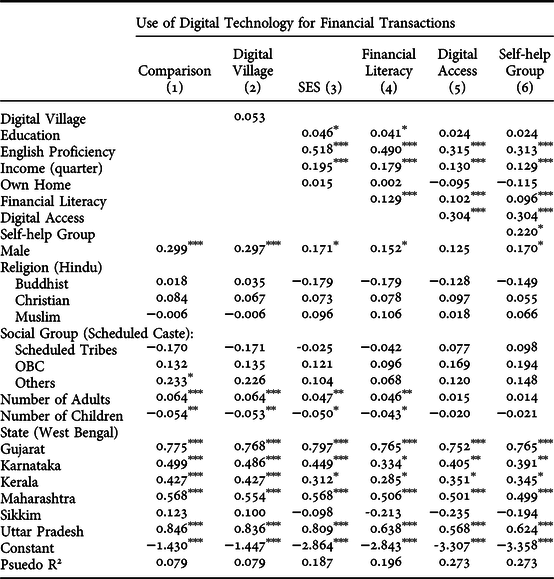
To test the five hypotheses, we ran six nested Probit regression models with the use of digital transactions as the dependent variable (see Table 2). In the first model, we only entered the control variables, including gender, religion, social group, number of adults and children, and dummy variables for each state. Males were more likely to use digital transactions in five out of six models. The gender gap disappeared in model (5) when financial literacy was entered into the regression, but reappeared when self-help group was analyzed. We can infer from these results that financial literacy closes gender gaps in using digital transaction, but that self-help groups (which are known to consist predominantly of women) partially account for the financial literacy of digital savvy women. We found religion and social groups to not be significant predictors of using digital transactions and neither were the number of adults and children significant factors after controlling for digital access. It appears that having more adults and less children correlated with higher digital access, which became the significant predictor. All states, except for Sikkim, were significantly different from West Bengal to varying degrees.
Probit Regression of the Use of Digital Transactions

Note: * p<0.05 ** p<0.01 *** p<0.001, Standard deviations are omitted.
Our first hypothesis, that villages that underwent a process to become digital and self-indicated digital villages would report increased use of digital transactions, was not supported by our analysis. In Model 2 of Table 2, including the marker for digital villages had no significant predictive power, after controlling for our covariate. This is not surprising, given that we did not find a significant difference in means between villages in our t-tests (Table 1). The rest of the hypotheses, however, were mostly supported by the data.
Two out of four indicators for socioeconomic status, English proficiency and income, were significant predictors of digital transaction use in all remaining models. Education level faded from significance as other explanatory factors were added. Owning a home or rent was not a significant factor at all. Understanding that 93.3% of our sample owned their home, the skewed distribution may have made this variable a poor predictor. English proficiency and income appeared to be the most dominant SES markers that help to explain the use of digital transactions. Closely related to these two factors, financial literacy also significantly contributed to explain the use of digital transaction in Models 4-6, evidencing support for the third hypothesis. Digital access also added explanatory power to the regression models, substantiating the fourth hypothesis. Note the increase of the Pseudo R2 values between Models 4 and 5 (from .196 to .273). This value did not increase when the self-help group factor was included in the last model, but the regression coefficient was statistically significant. This result provides some (weak) evidence for the role of SHGs in fostering digital banking.
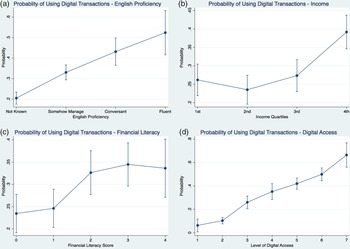
After running the Probit regressions, we calculated predicted probabilities (using the “margins” command in Stata 14) to interpret the coefficients of the significant predictor variables. Keeping all other factors at their means, increasing English proficiency increases the probability of using digital transactions from 20.5% (English Not Known) to 52% (Fluent) (see Figure 1a). Interestingly, only the highest income quartile resulted in a significantly higher probability of using digital transactions (39% compared to about 25% for the other quartiles) (see Figure 1b). When keeping all other variables at their means, the marginal increases from financial literacy were only significantly different by jumping from a score of 0 to 3, resulting in predicted probabilities of 23.4 and 33.6% respectively (see Figure 1c). Increases in digital access resulted in the most pronounced increases in the probability of using digital transactions (See Figure 1d). Going from the lowest level of digital access to the highest resulted in predicted probabilities that climbed from 6.2% to 66.4% - the largest marginal increase among all of our predictors. While still a statistically significant independent variable, self-help group participation did not yield a significantly increased predicted probability when keeping other variables at their means. This post-estimation analysis underscores the importance of several explanatory factors such as English, income and financial literacy, but emphasizes the importance of digital access in predicting whether rural villagers in India will use digital means to complete financial transactions.
Predicted Probabilities of Using Digital Transactions

Discussion
In this paper, we set out to test the success of transforming rural poor Indian villages to become examples of cashless communities. First, we found that villages which were officially declared “digital villages,” some of which the Indian prime-minister and other politicians hailed their success, were not different from their neighboring villages. All villages demonstrated a very low level of digital banking utilization. Recall that our definition of using digital banking was most rudimentary. Put differently, in our sample, most rural Indians were not ready for the pending transition from cash to digital financial transactions. In the villages we visited, local vendors told us that they do not accept digital payment for a variety of reasons that ranged from too few transactions, high-banking costs, no regular electricity, the unreliable village Wi-Fi system, and no training in digital transactions. The villagers who toil the land – a majority of this highly populated country – are likely not ready to become members of the cashless society. Their infrastructure is ill equipped to help them move into the desired cashless society and the era of digital banking.
When we look at the demographic variables for which we controlled in this study, three stayed as significant predictors of using digital banking. If the head of the household was a man, the likelihood of using digital banking was higher. However, participation in a self-help group also significantly correlated with the use of digital banking. Most often, such participation is open to women and much less so for men. It may be that women who attend self-help groups learn to use digital technology and are encouraged to use digital banking. What also strongly emerges is that households with a high income and high English proficiency are significantly more likely to use digital banking. These two variables are clear signs of SES. In India, the upper-middle class speak English at home and send their children to English-medium schools. As such, these two variables suggest that even at the village level, those who are already of a higher SES are making better use of digital banking and perpetuating the social order in the village.
There were significant state-related differences in using digital banking. We wondered if these differences are reflective of the states or the result of our sampling procedures. Comparing the states in our sample to the state per-capita net domestic product (NDP) shows that our sample may raise questions about our findings. For example, Sikkim, which was ranked along with West Bengal as very low in digital utilization, is the third highest per-capita NDP state in India while West Bengal is ranked 23rd. Similarly, Uttar Pradesh was ranked highly in this study but is ranked the second lowest state regarding its per-capita NDP. We focused on villages that were officially declared digital villages and aimed to find a nearby comparison village, and as such, we could not assume that these two villages are best representative of the state. In addition, per-capita NDP includes more affluent towns and cities while we focused on rural poor villages. Yet, the results from 14 villages in seven states across India unequivocally allow us to offer the story of low use of digital banking by rural residents and advantage to those who are already ahead in the game; the rich get richer and the poor keep working hard and staying poor.
Limitations
Like many cross-sectional studies, this study has some serious limitations. First, regardless of covering seven states, many states are not included in our sample. It is possible that in other states the differences between the experiment and comparison villages are not as profound as in our sample. Second, in each state, we covered only one designated digital village in each state and one nearby comparison village. We have no way to know how well these two villages represent the entire state. There are possibly more digital villages in each state. It is also possible that our comparison villages are not perfect matches to the digital villages for which they are compared. These sampling limitations pose doubt about causality. Regardless of the sample size and the large number of villages, this is not a true experiment. We should note however, that similar inferences are now common in India news media (James, Reference James2020; Komberg, Reference Komberg2017; Srivastava, Reference Srivastava2018). Third, in each state, we used local experts to translate and transliterate the questionnaires to local languages. Still, the interviews were conducted in different languages, and it is possible that some level of nuance was lost in the process. Fourth, after the first round of interviews, in the state of Karnataka, we realized that some changes were needed in the questionnaire. As a result, ages of the interviewees were not collected and the financial literacy measurement was less stringent. For instance, the research assistants helped respondents who could not answer fast enough as they did not want to embarrass them. As such, we added a category of “Did not answer” which accounted for the “wrong answer”/”no answer” and was treated as no correct answer. Fifth, in Maharashtra, a monsoon storm ended our survey collection early and the full village was not covered. While only 60 respondents short of our desired 200 households, the continued storm deterred further data collection. In two villages, we reached a high coverage of interviews (180 households) because there were not enough households to reach 200. Nonetheless, a large sample from all over India was covered that allows us to draw conclusions about the near future of digital banking and financial exclusion.
Conclusions
The rapid advancement of digitalization, mega-analytics, and machine-based decision making are supposed to help authorities provide adequate services to needy populations. However, more and more critics argue the contrary (Benjamin, Reference Benjamin2019; Dixon-Roman, Reference Dixon-Roman2016; O’Neil, Reference O’Neil2017). For example, Eubanks (Reference Eubanks2018) argued that public authorities use data to impose new modes of surveillance, profiling, punishment, containment, and exclusion. She refers to these advancements as a “digital poorhouse.” According to Eubanks, other social scholars of analytics, and AI, these technologies amplify rather than diminish inequality. In this article, we assert that digital currency and digital banking have a strong potential to deprive and harm marginalized groups in India and likely worldwide.
We started our study with the larger question of whether socially excluded people have access to the opportunities afforded by digital banking or if they will be further excluded by it. By the end of the study, we offer a warning against rushing toward digital banking and the formation of cashless societies. Desmond and Western (Reference Desmond and Western2018) called on scholars to more deeply explore the relational character of poverty and disadvantage. The relational perspective offers a comprehensive view of poverty. Poverty is not viewed as the outcome of a person’s unique attributes or even historical structure, but rather addresses the outcome of unequal relationships between the financially secure and insecure. Through financial and structural exchanges, “the rich take advantage of the poor and profit from their vulnerability” (Desmond and Western, Reference Desmond and Western2018, p. 311). In the same vein, rural poor people in India are expected to adopt and exclusively use digital banking services and adapt to the ideal of a cashless society. In cities and financial hubs, people are gradually adapting to digital financial transactions, but that is not the case with regards to poor rural villagers and other marginalized groups. That is, poor rural villagers are now taken advantage of by the traditional local lenders who charge astronomical interest rates, by the financial institutions that claim to provide access to digital banking, as well as the government that pushes for cashless economy without the provision of the required infrastructure. The residents of these villages are unable to finance a reliable infrastructure needed for reliable digital banking accessibility. In many of the digital villages we visited, local entrepreneurs or banks monopolized the digital financial access and charged local residents for digital transactions. Poor local people were lured in with the promise that they will get access to state-sponsored benefits, and in the process, paid transactional commissions. If cash is outlawed or essentially phased out, these poor rural villagers will likely have no access to financial products and will be further dependent on local entrepreneurs and greedy banks. People who are now at the bottom of the pyramid will perpetually be taken advantage of if access and financial education are not to be provided nationally. The more technological banking procedures advance, poor and marginalized populations will pay higher prices for services and will not benefit from easy cash flow, reasonable loans, and the ability to invest. Banks and local lenders will profit, and the villagers will keep living in poverty while working hard. They would be excluded further from economic prosperity.
In the foreseeable future, cash-based economy will continue to be essential to the life of poor and rural people around the world and especially in India. Transactions on the local level and between farmers and buyers are carried out with minimal profits. Adding digital-related costs will negatively impact millions of poor and rural people. People who are financially literate can easily access fiscal opportunities and benefit from the advent digital banking (Agarwal, Reference Agarwal2016; Grohman et al., Reference Grohman, Klühs and Menkhoff2018; Kezar and Yang, Reference Kezar and Yang2010; Klapper et al., Reference Klapper, Lusardi and Panos2012; Sherraden and Ansong, Reference Sherraden, Ansong, Aprea, Wuttke, Breuer, Koh, Davies, Greimel-Fuhrmann and Lopus2016). Without proper financial literacy the cash-based economy works well for the villagers and they do not see a reason to embrace digital banking. Understanding the logic of investments and compounded interests is not straightforward and requires serous learning. Such education is another divide between the privileged and the disenfranchised. Poor and rural people are subjected to educational system that rarely prepare them for the challenges of modern life or to become financially literate.
Digital banking and the quest for a cashless society cannot take place without the needed infrastructure and technological literacy (Correa et al., Reference Correa, Pavez and Contreras2020; Van Deursen and van Dijk, Reference Van Deursen and van Dijk2019). Our findings suggest that most of the interviewees demonstrated very low level of digital literacy and most were barely capable of using PCs. Moreover, our participants had limited access to the necessary infrastructures, such as reliable Wi-Fi networks. Both deficiencies are too pervasive and cannot be remedied by local initiatives. Poor and rural people need much assistance to become digitally savvy and able to access the digital world.
National top-down policies that aim to transform the way people manage their daily activities are often doomed to fail, and especially in India (James, Reference James2020). While the train to cashless economy left the station, its speed needs to be controlled. Policies of building local infrastructure that will ensure wide access to the net are required preliminary steps. In large cities where the economy is vibrant, local residents can sustain such infrastructure. In the country where rural poor people are the majority and they spread around the provision of technological infrastructure is the responsibility of the state and national governments. Furthermore, as our findings suggest, financial literacy and command of English are prerequisites of digital financial inclusion in India. As such, the educational system in villages and where poor people reside should be reconfigured to offer local youth basic command of financial literacy and English proficiency. These are not easy tasks, but they are essential to assuring full financial inclusion in the age of cashless societies.
Acknowledgements
The study was financially supported by the University of Pennsylvania Global Engagement Fund and by Nitte University. None of the authors have any conflict of interest.
Appendix A. Financial Literacy Questions used by Cole et al. (Reference Cole, Sampson and Zia2011, p. 1938)
Question 1. Suppose you borrow Rp. 100,000 from a money lender at an interest rate of 2% per month, with no repayment for 3 months. After 3 months, do you owe less than Rp. 102,000, exactly Rp. 102,000, or more than Rp. 102,000?
Question 2. If you have Rp. 100,000 in a savings account earning 1% interest per annum, and prices for goods and services rise 2% over a 1-year period, can you buy more than, less than, or the same amount of goods in 1 year as you could today, with the money in the account?
Question 3. Is it riskier to plant multiple crops or one crop?
Question 4. Suppose you need to borrow Rp. 500,000. Two people offer you a loan. One loan requires you to pay back Rp. 600,000 in 1 month. The second loan requires you to pay back in 1-month Rp. 500,000 plus 15% interest. Which loan represents a better deal for you?
Appendix B. Table of States and Village where digital surveys were conducted.