I. INTRODUCTION
Bis (1-amidino-2-ethylisourea) copper(II) nitrate belongs to complexes which may be suggested to be part of pyrotechnics compositions for inflating automobile safety systems, namely airbags and seatbelt pretensioners (Zigmund et al., Reference Zigmund, Matyáš, Jalový and Šelešovský2012) and (Jalový et al., Reference Jalový, Matyáš, Zigmund and Lorenc2011). The main reason to use these complexes is to replace sodium azide and double-base propellants (based on nitrocellulose) in gas-generating mixtures. The use of sodium azide causes problems from many aspects: it is itself highly toxic, in neutral or acidic solutions it releases the very poisonous and volatile hydrazoic acid, it is a broad-spectrum biocide with an as yet unknown environmental fate and thus it has been criticized from many points of view (Betterton, Reference Betterton2003), (Hambrook and Fink, Reference Hambrook and Fink2006) and (Chang and Lamm, Reference Chang and Lamm2003). Also, sodium azide, as a major part of safety pyrotechnics devices, causes problems during recycling of vehicles and the handling of highly toxic waste. As for double-base propellants, based on nitrocellulose, they are excellent propellants (Blomquist, Reference Blomquist2002) and (Gottwald, Reference Gottwald2009), but long-term stability and toxic gaseous products (containing nitrogen oxides and carbon monoxide) have limited its application in recent years.
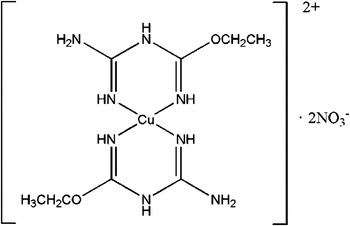
The presented complex shown in Figure 1 is formed by ion pairs of doubly chelated copper metal center by two neutral ligands and two nitrate anions out of the primary coordination sphere of the metal atom.
Structural formula C8H20CuN10O8-ethanol

We have inspected CSD database (Allen, Reference Allen2002) for the compound summary formula and found the crystal structure data for this organic substance C8H20CuN10O8 (Meenongwa et al., Reference Meenongwa, Chaveeracha and Pakawatchaib2009). The compound is monoclinical [a = 5.2547(6) Å, b = 14.0087(15) Å, c = 12.1511 (13) Å, β = 96.982 (2)°, unit-cell volume V = 887.83 (17) Å3, Z = 2, space group P21/n, and T = 293 K]. The calculated powder pattern of this compound is in very good agreement with the measured powder pattern presented in this article.
II. EXPERIMENTAL
A. Synthesis
The title compound was prepared by dissolving of bis (cyanoguanidine) copper(II) nitrate in ethanol and heating of the solution under reflux for two hours. The starting bis(cyanoguanidine) copper(II) nitrate was prepared by heating under reflux of stoichiometric amounts of cyanoguanidine and copper nitrate trihydrate for two hours in ethyl acetate (Jalový et al., Reference Jalový, Padělková, Jirásko, Matyáš, Holčapek, Němec, Novotná and Mišková2012).
B. Specimen preparation
The sample was prepared by careful grinding in an agate mortar and front-loaded into the specimen holder.
C. Diffraction data collection and reduction
The diffraction pattern for the title compound was collected at room temperature with an X'Pert PRO θ-θ powder diffractometer with parafocusing Bragg-Brentano geometry using CuKα 1 radiation (λ = 1.5406 Å, Ni filter, generator setting: 40 kV, 30 mA). An ultrafast X'Celerator detector was employed to collect XRD data over the angular range from 4 to 70°2θ with a step size of 0.017°2θ and a counting time of 81.28 s step−1.
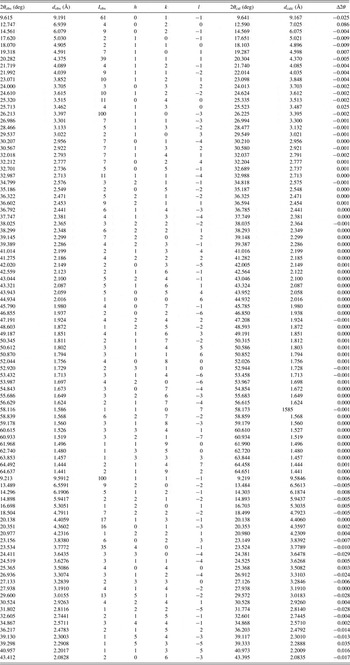
The software package HighScore Plus V 3.0e (PANalytical, Almelo, Netherlands) was used to smooth the data, to fit the background, to eliminate the Kα 2 component, and the top of the smoothed peak method was used to determine the peak positions and intensities of the diffraction peaks (Table I).
Indexed X-ray powder diffraction data for C8H20CuN10O8. Only the peaks with Irel of 1 or greater are presented [a = 5.262 (2) Å, b = 14.051 (3) Å, c = 12.183 (3) Å, β = 96.912 (5)°, unit-cell volume V = 894.3 Å3, Z = 2, space group P21/n]. All lines were indexed and are consistent with the P21/n space group. The d-values were calculated using CuKα1 radiation (λ = 1.5406 Å).

III. RESULTS AND DISCUSSION
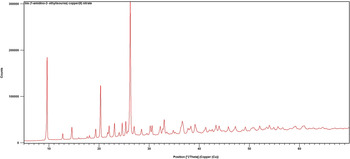
The experimental powder diffraction pattern is depicted in Figure 2. Automatic indexing of results obtained using DICVOL04 (Boultif and Louër, Reference Boultif and Louër2004) show that title compound C8H20CuN10O8 is monoclinical with space group P21/n and unit-cell parameters: a = 5.262 (2) Å, b = 14.051 (3) Å, c = 12.183 (3) Å, β = 96.912 (5)°, unit-cell volume V = 894.3 Å3, and Z = 2. The figures of merits are F 20 = 20.1(0.012381) (Smith and Snyder, Reference Smith and Snyder1979) and M 20 = 13.0 (de Wolff, Reference de Wolff1968). All measured lines were indexed and are consistent with the P21/n space group.
X-ray powder diffraction pattern of C8H20CuN10O8-ethanol

Unit cell parameters from single crystal data at 293 K (Meenongwa et al., Reference Meenongwa, Chaveeracha and Pakawatchaib2009) display a slight shortening with respect to unit cell parameters derived from powder data at the same temperature at 293 K (this article).
SUPPLEMENTARY MATERIALS AND METHODS
Supplementary material accompanies this paper on the journals website (http://journals.cambridge.org/pdj).
ACKNOWLEDGEMENTS
This work was supported by grant No. P106/12/1276 from the Grant Agency of the Czech Republic and by grant TAČR TA02010781 of the Technological Agency of the Czech Republic.