Over the last 2 decades, the social identity approach (Tajfel & Turner, Reference Tajfel and Turner1986) has inspired numerous studies investigating the psychological relationship between employees and their organization (e.g., Ashforth & Mael, Reference Ashforth and Mael1989; van Dick, Reference van Dick2001). This relationship has been conceptualized in terms of organizational identification that is defined as ‘the perception of oneness with or belongingness to the organization’ (Ashforth & Mael, Reference Ashforth and Mael1989: 34). Although research on identification in the workplace has mainly focused on identification with the organization as a whole, recent studies have shown that employees distinguish between multiple entities in the organization and identify with multiple organizational constituencies (e.g., van Dick & Wagner, Reference van Dick and Wagner2002; Johnson, Morgeson, Ilgen, Meyer, & Lloyd, Reference Johnson, Morgeson, Ilgen, Meyer and Lloyd2006). Moreover, some scholars have demonstrated that identification with more proximal targets such as the workgroup, the department, or the occupation is positively associated with identification with the global organization (e.g., Bartels, Pruyn, De Jong, & Joustra, Reference Bartels, Pruyn, De Jong and Joustra2007; Marique & Stinglhamber, Reference Marique and Stinglhamber2011).
Over the years, numerous authors have stressed the importance to examine the relationships between targets of identification (e.g., Reichers, Reference Reichers1986; Grice, Paulsen, & Jones, Reference Grice, Paulsen and Jones2002). More precisely, some authors (e.g., Meyer, Becker, & van Dick, Reference Meyer, Becker and van Dick2006) have argued that these multiple targets of identification can have reinforcing or diluting effects on each other. Indeed, when values, goals, and norms between these targets are incompatible, employee's identification with one target could undermine identification with the other (Meyer, Becker, & van Dick, Reference Meyer, Becker and van Dick2006). In line with this view, perceived similarities between the workgroup and the organization should explain, at least partially, the potential variation in the strength of the relationship between workgroup identification and organizational identification. Although the first studies on the relationship between workgroup identification and organizational identification suggest that such a variation exists (Bartels et al., Reference Bartels, Pruyn, De Jong and Joustra2007; Marique & Stinglhamber, Reference Marique and Stinglhamber2011), few studies have investigated the role of compatibility or conflicts between targets in the relationship between workgroup identification and organizational identification.
Our purpose in the present research was therefore to investigate the role played by employees’ perceptions of similarities between their workgroup and their organization in the relationship between workgroup identification (i.e., a proximal target) and organizational identification (i.e., a more distal target). More precisely, we hypothesized that the relationship between workgroup identification and organizational identification will be stronger for employees who perceive high similarities between their workgroup and their organization. Additionally, based on previous research which has shown that the relationship between workgroup identification and affective organizational commitment is mediated by organizational identification (Marique & Stinglhamber, Reference Marique and Stinglhamber2011), we hypothesized that the interaction between workgroup identification and perceived similarities between the workgroup and the organization on organizational identification will carry over to affective organizational commitment. By doing so, the present research fills two important gaps in the literature. First, we empirically investigate the role of perceived similarities between targets, answering some authors’ call to carefully examine the relationships between multifoci identification. Second, we extend the scarce literature having examined the relationships between identification with a proximal target and affective organizational commitment through organizational identification by identifying a boundary condition of these relationships, that is perceived similarities between the proximal target and the organization.
Figure 1 provides with an overview of our conceptual model. The theoretical framework and specific assumptions examined in our research are developed below. First, we will present the literature dealing with the relationship between multifoci identification. Second, we will investigate the literature suggesting a potential moderating role of perceived similarities between targets. Finally, we will review the literature on the relationship between multifoci identification and affective organizational commitment. We will then present the empirical investigation of our assumptions. Two studies have been conducted in order to examine the hypotheses that are proposed in the present research.
Conceptual model

Multifoci identification
Social identity approach (Turner, Reference Turner1985; Tajfel & Turner, Reference Tajfel and Turner1986) holds that individuals classify themselves and other individuals into different social categories in order to define and locate themselves in a given context. Based on this assumption, several scholars have argued that the organization is one of the most important targets of identification for the individual (e.g., Bergami & Bagozzi, Reference Bergami and Bagozzi2000; Hogg & Terry, Reference Hogg and Terry2000). Organizational identification is thus perceived as a specific form of social identification (Hogg & Terry, Reference Hogg and Terry2000). However, although social identification is considered as a multidimensional construct which includes affective, evaluative, and cognitive dimensions, organizational identification is commonly conceptualized as a cognitive concept referring to the self-definitional aspect of identification (Ashforth & Mael, Reference Ashforth and Mael1989). Organizational identification was found to be positively related to a broad range of employees’ attitudes and behaviors at work, including job satisfaction (e.g., van Dick et al., Reference van Dick, Christ, Stellmacher, Wagner, Ahlswede, Grubba, Hauptmeier, Höhfeld, Moltzen and Tissington2004), in-role and extra-role performance, and negatively related to turnover intentions (e.g., Riketta, Reference Riketta2005).
More recently, research has demonstrated that, just as employees may be identified with their organization, they can also develop identification with other organizational entities or constituencies such as their workgroup, their department, or their occupation (e.g., Johnson et al., Reference Johnson, Morgeson, Ilgen, Meyer and Lloyd2006). Several research perspectives have emerged in the literature on multifoci identification. First, some scholars have found that identification with proximal targets such as the workgroup is stronger than organizational identification (e.g., van Knippenberg & van Schie, Reference van Knippenberg and van Schie2000). These results are in agreement with Brewer's (Reference Brewer1991) optimal distinctiveness theory which holds that employees are more likely to be strongly identified with their workgroup because the workgroup is smaller than the organization and consequently do not threaten, or threaten in a lesser extent, their individual distinctiveness, as compared with their organizational membership. Because higher order groups tend to be more heterogeneous than lower order group, the workgroup is also more salient, leading employees to perceive themselves in terms of workgroup membership and consequently to strongly identify with it. Finally, because employees spend most of their organizational life with their workgroup, the workgroup is more likely to be considered as familiar and attractive than the organization as a whole.
Second, some scholars have found that identification with proximal targets, such as the workgroup or the occupation, is more strongly related to some work-related attitudes and behaviors than organizational identification. For instance, van Knippenberg and van Schie (Reference van Knippenberg and van Schie2000) found that workgroup identification is more strongly related to job satisfaction, job involvement, and job motivation than organizational identification. They also showed that workgroup identification predicts job satisfaction, turnover intentions, job involvement and job motivation, over and above organizational identification.
Finally, several authors have proposed that identification with proximal targets contributes to identification with more distal targets (e.g., Russo, Reference Russo1998; Ashforth & Johnson, Reference Aiken and West2001; Marique & Stinglhamber, Reference Marique and Stinglhamber2011). They argued that organizations may be considered as the ‘home’ for the development of more local identities. Therefore, to the extent that proximal targets are generally nested in the organization, identification with these targets should generalize to the organization. Marique and Stinglhamber (Reference Marique and Stinglhamber2011) also argued that activating identification with a proximal target such as the workgroup should make the organization more salient and cognitively accessible as a target of identification. These propositions have been supported in several studies. For instance, Bartels et al. (Reference Bartels, Pruyn, De Jong and Joustra2007) have shown that workgroup identification is positively related to department identification, business unit identification, and organizational identification. Similarly, Bamber and Iyer (Reference Bamber and Iyer2002) have found that occupational identification is positively related to organizational identification. Finally, Marique and Stinglhamber (Reference Marique and Stinglhamber2011) have found that workgroup identification and occupational identification are positively associated with organizational identification.
The moderating role of perceived similarities
Despite the empirical evidence for a positive relationship between identification with proximal targets and organizational identification, Meyer, Becker, and van Dick (Reference Meyer, Becker and van Dick2006) have argued that these multiple targets of identification (i.e., proximal and distal targets) can have reinforcing or diluting effects on each other. According to these authors, identification with one target could undermine identification with the other when their goals, values, or norms are perceived as incompatible. In contrast, they suggested that identification with one target may reinforce identification with the other when their goals, values, or norms are perceived as compatible. This view is in line with previous literature on multifoci identification. Indeed, over the years, numerous authors have stressed the importance to examine the relationships between targets of identification (e.g., Reichers, Reference Reichers1986; Grice, Paulsen, & Jones, Reference Grice, Paulsen and Jones2002). For instance, Grice, Paulsen, and Jones (Reference Grice, Paulsen and Jones2002) stated that ‘two targets of identification are likely to be compatible when the core values associated with each are similar, and when categorization of the self in terms of one group does not preclude categorization of the self in terms of the other group’ (p. 24). Furthermore, they argued that compatibility between targets of identification is likely to impact employees’ attitudes and behaviors. More precisely, they suggested that incompatibility may create tension in the workplace, leading to decreased levels of satisfaction or increased levels of emotional exhaustion. In a similar vein, Bamber and Iyer (Reference Bamber and Iyer2002) argued that conflicts between targets of identification are likely to occur when there is an incompatibility between the values of the different targets. Based on this previous literature, it thus seems reasonable to assume that the perception of similarities between targets of identification will moderate the extent to which identification with a proximal target generalizes to identification with a more distal target (i.e., the organization). In line with previous work (e.g., Kristof, Reference Kristof1996; Meyer, Becker, & van Dick, Reference Meyer, Becker and van Dick2006), we defined perceived similarities as the perception of shared characteristics, values, norms, goals, or culture between the individual and an organizational entity or between two organizational entities.
Several studies have addressed the importance of perceived similarities in the relationships between attitudes toward different foci. For instance, using two samples of employees orginating from a US social service agency (Study 1) and multiple Portuguese organizations (Study 2), Eisenberger et al. (Reference Eisenberger, Karagonlar, Stinglhamber, Neves, Becker, Gonzalez-Morales and Steiger-Mueller2010) have shown that employees form a perception concerning the extent to which their supervisor shares their organization's characteristics. They defined this overlap between the supervisor's identity and the organization's identity in terms of supervisor organizational embodiment and showed that supervisor organizational embodiment moderates the relationship between leader-member exchange and affective organizational commitment. Similarly, De Cremer, van Dijke, and Mayer (Reference De Cremer, van Dijke and Mayer2010) found that leader prototypicality of the group moderates the relationship between procedural fairness emanating from the supervisor and cooperation on behalf of the group across an experimental study conducted with students and three cross-sectional field studies conducted with employees from various organizations. However, to the best of our knowledge, few studies have investigated the role of perceived similarities in the relationship between identification with multiple foci. Only one study of Riketta and Nienaber (Reference Riketta and Nienaber2007) has investigated the role of perceived compatibility in the relationship between identification with nested units in the context of cooperative network of pharmaceutical stores. They defined perceived compatibility as ‘the extent to which employees perceived the network as beneficial to or in harmony with the store’ (p. 65). More precisely, they assessed the perceived compatibility along four dimensions (i.e., ensuring future, preserving tradition, preserving distinctiveness, maintaining autonomy) and found that perceived compatibility between the store and the network fosters the transfer of identification from the store to the network. Therefore, in line with these studies and following Meyer, Becker, and van Dick (Reference Meyer, Becker and van Dick2006) assumption, we posited that the relationship between workgroup identification and organizational identification is stronger when employees perceive high similarities between their workgroup and their organization.
Hypothesis 1: Perceived similarities moderate the relationship between workgroup identification and organizational identification, such that as perceived similarities increase, the relationship between workgroup identification and organizational identification increases.
Relationship between identification and commitment
Independently of the literature on identification, the relationship between the employee and his or her organization has also been conceptualized in terms of organizational commitment in the literature on organizational psychology. Organizational commitment is defined as ‘a force that binds an individual to a course of action of relevance to one or more targets’ (Meyer & Herscovitch, Reference Meyer and Herscovitch2001: 301). Meyer and Allen (Reference Meyer and Allen1991) distinguished three components of commitment. Affective commitment refers to an ‘emotional attachment to, identification with, and involvement in the organization’ (Meyer & Allen, Reference Meyer and Allen1991: 67). Normative commitment is viewed as ‘a feeling of obligation to continue employment’ whereas continuance commitment is defined as an ‘awareness of the costs associated with leaving the organization’ (Meyer & Allen, Reference Meyer and Allen1991: 67). Research has shown that committed employees display more positive attitudes and behaviors at work (e.g., satisfaction, performance) than non-committed employees (e.g., Meyer, Allen, & Smith, Reference Meyer, Allen and Smith1993; Meyer, Stanley, Herscovitch, & Topolnytsky, Reference Meyer, Stanley, Herscovitch and Topolnytsky2002). More precisely, the affective dimension of commitment (i.e., affective organizational commitment) was found to have the strongest relationships with several employee-relevant and organization-relevant outcomes such as satisfaction, stress, voluntary turnover, performance, and absenteeism (e.g., Meyer et al., Reference Meyer, Stanley, Herscovitch and Topolnytsky2002). Given its consequences for both employees and organizations, a better understanding of the determinants of affective organizational commitment is of utmost importance.
Some scholars have recently investigated the distinction and the relationship between organizational identification and affective commitment. Results of exploratory and confirmatory factor analyses revealed that employees make a clear distinction between identification and affective commitment to the organization (e.g., van Knippenberg & Sleebos, Reference van Knippenberg and Sleebos2006). However, organizational identification and affective organizational commitment were found to be closely related to each other (e.g., Gautam, van Dick, & Wagner, Reference Gautam, van Dick and Wagner2004; van Knippenberg & Sleebos, Reference van Knippenberg and Sleebos2006). Based on the assumption that individual's self-categorization as a member of the organization would represent a necessary first step toward the development of an affective attachment to this organization, several scholars have proposed that organizational identification is a determinant of affective organizational commitment (e.g., Meyer, Becker, & van Dick, Reference Meyer, Becker and van Dick2006). This proposition has been supported empirically. Indeed, Ellemers, Spears, and Doosje (Reference Ellemers, Spears and Doosje1997) found in two experimental studies conducted with Dutch students that group commitment was predicted by in-group identification. Several scholars (Bergami & Bagozzi, Reference Bergami and Bagozzi2000; Marique & Stinglhamber, Reference Marique and Stinglhamber2011) also found, relying on cross-sectional data, that organizational identification predicted affective organizational commitment whereas the reverse was not true. Finally, using a sample of employees working for four organizations in the electronics and media industries in Israel, Carmeli, Gillat, and Weisberg (Reference Carmeli, Gilat and Weisberg2006) showed that organizational identification mediates the relationship between organizational prestige and affective organizational commitment. Although the antecedence of organizational identification on affective organizational commitment has not been strictly demonstrated in organizational settings (i.e., using longitudinal designs with repeated measures of organizational identification and affective organizational commitment), it seems reasonable to consider that organizational identification is an antecedent of affective organizational commitment.
In line with this previous research, several scholars have addressed the relationship between identification and commitment in a multifoci perspective. Russo (Reference Russo1998) has proposed that occupational identification should reinforce commitment toward the organization because ‘organizations provide the means necessary to work as professional and share a professional identity’ (p. 79). Accordingly, Loi, Hang-yue, and Foley (Reference Loi, Hang-yue and Foley2004) found that lawyer's occupational identification was positively related to their affective commitment toward the organization. Extending this research, Marique and Stinglhamber (Reference Marique and Stinglhamber2011) hypothesized that affective organizational commitment should not only be strengthened by occupational identification but also by workgroup identification to the extent that the organization gives employees the opportunity to work with their colleagues and to share of common workgroup identity. Using three sets of cross-sectional data originating from two hospitals and one engineering company, they found that the relationship between occupational and workgroup identification and affective organizational commitment is mediated by organizational identification.
These findings indicate that organizational identification mediates the relationship between workgroup identification and affective organizational commitment. Yet, we argued that perceived similarities between the workgroup and the organization would moderate the relationship between workgroup identification and organizational identification. Therefore, in interaction with perceived similarities between the workgroup and the organization, workgroup identification should be positively related to organizational identification and subsequently to affective organizational commitment. We thus posited that the interaction between workgroup identification and perceived similarities on affective organizational commitment will be mediated by organizational identification.
Hypothesis 2: Organizational identification will mediate the relationship between the workgroup identification-by-perceived similarities interaction and affective organizational commitment.
Two studies have been designed in order to investigate these two hypotheses. The first study has been conducted in an association composed of students working by group on diverse projects and investigated the role of perceived similarities with a global measure of the concept. The second study has been conducted with employees from the healthcare sector and conceptualized perceived similarities in terms of value congruence (i.e., the match between the values hold by the workgroup and those of the employing organization).
Study 1
Study 1 was designed to examine the moderating role of perceived similarities between the workgroup and the organization in the relationship between workgroup identification and organizational identification (Hypothesis 1), and the mediating role of organizational identification in the relationship between the workgroup identification-by-perceived similarities interaction and affective organizational commitment (Hypothesis 2). Our hypotheses were tested using a global measure of perceived similarities between the workgroup and the organization.
Method
Sample and procedure
We surveyed 600 members from a Belgian association (i.e., the organization) composed of students living together and working by groups on long-term projects with social, cultural, or humanitarian dimensions during an academic year (i.e., the workgroups). This association may be considered as a full-fledged organization with hierarchy, rules, norms, and values. The students were sent the link to an electronic survey through an email explaining the purpose of our survey and stressing the confidentiality of the responses. A total of 109 students completed the questionnaire (response rate = 18.17%). Of this final sample, 67% were male and average age was 21.21 years (SD = 1.52). Students were members of this association on average for 1.71 years (SD = 0.99) and members of their workgroup on average for 1.38 years (SD = 0.6).
Measures
Because the study was conducted in a French-speaking context, all measures were translated from English into French using the standard translation-back-translation procedure recommended by Brislin (Reference Brislin1980). A 5-point Likert scale was used in order to measure respondents’ level of agreement with each item (1 = “strongly disagree”; 5 = “strongly agree”).
Identification
The 6-item scale of Mael and Ashforth (Reference Mael and Ashforth1992) was used to assess organizational identification. A sample item is ‘When I talk about my organization I usually say “we” rather than “‘they”.’ To assess workgroup identification, we adapted the six items of Mael and Ashforth (Reference Mael and Ashforth1992) by replacing the word organization with the term workgroup. A sample item is ‘My workgroup successes are my successes.’
Affective commitment
We used the revised 6-item scale of Meyer, Allen, and Smith (Reference Meyer, Allen and Smith1993) to measure affective organizational commitment. A sample item is ‘I do not feel “emotionally attached” to this organization’ (R).
Perceived similarities
We assessed perceived similarities between the workgroup and organization with the 3-item scale of intergroup distinctiveness developed by Jetten, Summerville, Hornsey, and Mewse (Reference Jetten, Summerville, Hornsey and Mewse2005). A sample item is ‘My workgroup is similar to my organization.’
Control variables
Following Becker's (Reference Becker2005) recommendations, we carefully examined the relationships between potential control variables and the dependent variables of our model (i.e., the mediator or the outcome variable). We found that none of the sociodemographic variables was correlated with organizational identification and affective organizational commitment. We therefore decided not to include sociodemographic variables as control variables in our analyses.
Results
Confirmatory factor analyses
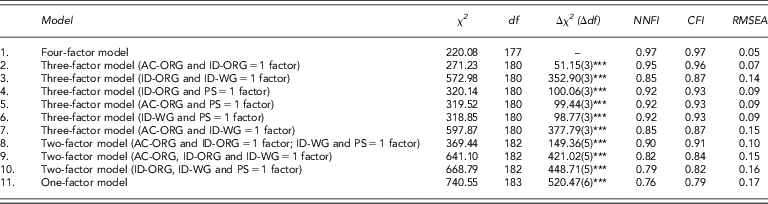
Using the LISREL package (Jöreskog & Sörbom, Reference Jöreskog and Sörbom1993), we conducted a series of confirmatory analyses in order to test the discriminant validity of the variables included in our study (i.e., organizational identification, workgroup identification, affective organizational commitment and perceived similarities between the workgroup and the organization). Following the nested models comparison procedure (Bentler & Bonett, Reference Bentler and Bonett1980), a sequence of 11 nested models, ranging from the hypothesized measurement model to a one-factor model, was tested. Model adequacy was assessed using the χ2 statistic, the root mean square error of approximation, the non-normed fit index and the comparative fit index.The χ2 difference test was used to compare the fit indices of the hypothesized measurement model and the more constrained models. As indicated in Table 1, the four-factor model fitted the data well and was significantly superior to all more constrained models, confirming the distinctiveness of the variables included in our study.
Study 1. Confirmatory factor analyses fit indices for measurement models
Note. n = 109.
AC-ORG = affective organizational commitment; CFI = comparative fit index; ID-ORG = organizational identification; ID-WG = workgroup identification; NNFI = non-normed fit index; PS = perceived similarities between the workgroup and the organization; RMSEA = root mean square error of approximation.
***p < .001.
Relationships among variables
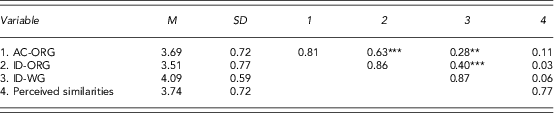
Means, standard deviations, reliability coefficients and intercorrelations among variables are displayed in Table 2.
Study 1. Descriptive statistics and intercorrelations among variables
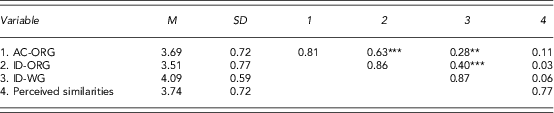
Note. n = 109. α coefficients are reported on the diagonal.
AC-ORG = affective organizational commitment; ID-ORG = organizational identification; ID-WG = workgroup identification.
**p < .01, ***p < .001.
SEM analyses
We tested a structural equation model in which workgroup identification, perceived similarities and their interaction were related to organizational identification, which in turn led to affective organizational commitment. Since we were dealing with latent constructs, we used indicators for the main effects as well as for the interaction term. Following Marsh, Wen, and Hau's (Reference Marsh, Wen and Hau2004) recommendations, we first centered each indicator used to create the interaction term (i.e., the indicators of workgroup identification and perceived similarities) in order to lessen multicollinearity. Second, based on a preliminary confirmatory factor analysis, we reduced to three the number of indicators for workgroup identification using the partial disaggregation method described by Bagozzi and Edwards (Reference Bagozzi and Edwards1998) and we constructed indicators of the latent interaction term by multiplying the highest-loading indicator of workgroup identification with the highest-loading indicator of perceived similarities. This procedure was followed for each subsequent pair of indicators. Fit indices for the hypothesized structural model and a series of alternative models in which additional paths that were theoretically plausible were added are reported in Table 3. As indicated in Table 3, none of the alternative models showed a significant improvement over the hypothesized model. The hypothesized model was thus retained as the best depiction of the data.
Study 1. Fit indices for structural models

Note. n = 109.
AC-ORG = affective organizational commitment; CFI = comparative fit index; ID-ORG = organizational identification; ID-WG = workgroup identification; NNFI = non-normed fit index; PS = perceived similarities between the workgroup and the organization; RMSEA = root mean square error of approximation.
Standardized parameter estimates of the hypothesized model are shown in Figure 2. Results indicated that perceived similarities were not significantly related to organizational identification (γ = 0.03, n.s.) whereas workgroup identification was (γ = 0.55, p < .001). Organizational identification was found to be positively related to affective organizational commitment (β = 0.78, p < .001) and to mediate the relationship between workgroup identification and affective organizational commitment (indirect effect = 0.62, z′ = 3.55, p < .001). Consistent with Hypothesis 1, the interactive influence of workgroup identification and perceived similarities on organizational identification was significant (γ = 0.26, p < .05). Figure 3 illustrates the moderating influence of perceived similarities on the relationship between workgroup identification and organizational identification. The simple slopes tests (Aiken & West, 1991) revealed that the relationship between workgroup identification and organizational identification was statistically significant at one standard deviation above (B = 1.27, t(104) = 6.87, p < .001) and one standard deviation below (B = 0.55, t(104) = 3.84, p < .001) the mean perceived similarities score. The simple slopes tests (Aiken & West, 1991) also showed that the slopes were significantly different from each other (t(104) = 3.16, p < .01) which indicated that the relationship between workgroup identification and organizational identification is stronger when employees perceived high similarities than when they perceived low similaritiesFootnote 1. In line with Hypothesis 2, we found that the interactive influence of workgroup identification and perceived similarities on organizational identification carried over to affective organizational commitment (indirect effect = 0.35, z′ = 2.03, p < .05). We then conducted bootstrapping analyses using the PROCESS macro (Hayes, Reference Hayes2013) to further explore the interactive effect of workgroup identification and perceived similarities on affective organizational commitment through organizational identification. Consistently with SEM results, we found that organizational identification mediates the interactive effect of workgroup identification and perceived similarities on affective organizational commitment. More precisely, the test of conditional indirect effects showed that the indirect effect of workgroup identification on affective organizational commitment via organizational identification was significant when perceived similarities were high (indirect effect = 0.49; BCa 95% CI = [0.26; 0.77]) while the indirect effect of workgroup identification on affective organizational commitment via organizational identification was non-significant when perceived similarities were low (indirect effect = 0.19; BCa 95% CI = [−0.01; 0.50]). These findings suggest that organizational identification mediates the interactive effect of workgroup identification and perceived similarities on affective organizational commitment only when employees perceive high similarities between their workgroup and their organization.
Completely standardized path coefficients for hypothesized model in Study 1. For the sake of clarity, only structural relationships are shown. AC-ORG = affective organizational commitment; ID-ORG = organizational identification; ID-WG = workgroup identification; PS = perceived similarities between the workgroup and the organization. *p < .05. ***p < .001
Relationship between workgroup identification and organizational identification as a function of the perceived similarities between the workgroup and the organization (Study 1). High and low perceived similarities are, respectively, 1 SD above and 1 SD below the mean
Although Study 1 provides strong support for our hypotheses, the sample used in Study 1 was composed of students working as volunteers, raising the question of the generalizability of our results. This limitation was therefore addressed in Study 2 by examining our hypotheses using a sample composed of real workers.
Study 2
Numerous scholars have addressed the importance of organizational values in the prediction of work-related attitudes and behaviors. Edwards and Cable (Reference Edwards and Cable2009) have argued that organizational value systems guide the decisions and actions of organizational members by providing norms that specify how they should behave and how organizational resources should be allocated. However, research has shown that employees differed on the extent to which they shared organizational values (Stinglhamber, Bentein, & Vandenberghe, Reference Stinglhamber, Bentein and Vandenberghe2004). The congruence between individual and organizational values was found to be related to desired outcomes such as job satisfaction, organizational identification, organizational commitment or intent to stay (e.g., Kristof, Reference Kristof1996; Stinglhamber, Bentein, & Vandenberghe, Reference Stinglhamber, Bentein and Vandenberghe2004; Kristof-Brown, Zimmerman, & Johnson, Reference Kristof-Brown, Zimmerman and Johnson2005). In the same vein, several studies have also addressed the importance of congruence between individual and workgroup values (e.g., Klimoski & Jones, Reference Klimoski and Jones1995). In line with this empirical evidence, we could make the assumption that perceived similarities in terms of values (i.e., value congruence) play a crucial role in organizational settings. However, Kristof (Reference Kristof1996) argued that the degree of fit between the employees and their workgroup may differ from the fit between the employees and their organization since the workgroups may hold different values than the organization in which they are included. Therefore, to the extent that values held by a group guide the decisions and actions of its members, the workgroup's values could play a potential conflicting role in the relationships between the workgroup and the organization when they are incompatible with organizational values. Accordingly, in Study 2, perceived similarities between the workgroup and the organization were operationalized in terms of congruence between the workgroup's values and the organization's values.
Method
Sample and procedure
This sample consisted of 147 employees from a large public and regional Belgian hospital (response rate = 18.38%). Among these participants, 74.8% were female and average age was 38.38 years (SD = 9.94). Participants were employed by the hospital on average for 13.63 years (SD = 10.69) and worked with their workgroup on average for 8.99 years (SD = 9.06). Of this final sample, 1.4% were blue-collars, 10.9% had an administrative profession, 8.8% were nurses’ aides, 50.3% were nurses, 16.3% were paramedics and 12.2% did not respond to the question. Printed questionnaires were distributed to the participants who were asked to return the completed questionnaire to the human resources office using a sealed envelope. A cover letter assuring the confidentiality of the responses accompanied the questionnaire.
Measures
Because the study was conducted in a French-speaking context, all measures were translated using the standard translation-back-translation procedure (Brislin, Reference Brislin1980).
Identification
We used the same 6-item scales as in Study 1 to assess organizational identification and workgroup identification. For this and the remaining measures, participants give their agreement with each item using a 5-point Likert scale (1 = “strongly disagree”; 5 = “strongly agree”).
Affective commitment
As in Study 1, affective organizational commitment was measured with the 6-item scale of Meyer, Allen, and Smith (Reference Meyer, Allen and Smith1993).
Value congruence
We adapted the 3-item scale of person-organization fit developed by Cable and DeRue (Reference Cable and DeRue2002), replacing the terms my personal values with the words my workgroup values. A sample item is ‘My workgroup's values match my organization's values and culture.’
Control variables
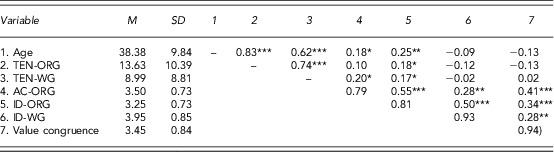
Following Becker's (Reference Becker2005) recommendations and consistently with Study 1, we examined the correlations between potential control variables and the dependent variables of our model (i.e., the mediator and the outcome variable). We found that age, organizational tenure and workgroup tenure display a significant correlation with organizational identification (r = 0.25, p < .01, r = 0.18, p < .05, and r = 0.17, p < .05, respectively). Given the potential redundancy and the high correlations between age and organizational tenure (r = 0.83, p < .001), age and workgroup tenure (r = 0.62, p < .001), and organizational tenure and workgroup tenure (r = 0.74, p < .001), a preliminary analysis was conducted before the test of the hypotheses in order to avoid the inclusion of impotent control variables (Becker, Reference Becker2005). Organizational identification was regressed on age, organizational tenure, and workgroup tenure. The results indicated that organizational tenure and workgroup tenure were no longer significantly related to organizational identification when controlling for age. We therefore decided to include age as the only control variable for organizational identification in the subsequent analyses. The same procedure was followed for affective organizational commitment. Both age and workgroup tenure were found to be significantly correlated with affective organizational commitment (r = 0.18, p < .05 and r = 0.20, p < .05, respectively). Affective organizational commitment was regressed on age and workgroup tenure, and the results indicated that age was no longer a significant predictor of affective organizational commitment when controlling for workgroup tenure. Only workgroup tenure was thus introduced as an additional exogenous variable predicting affective organizational commitment.
Results
Confirmatory factor analyses
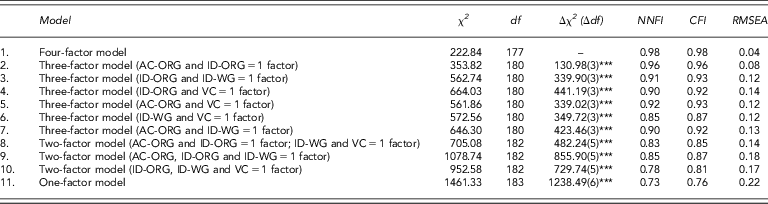
We examined the distinctiveness between organizational identification, workgroup identification, affective organizational commitment and value congruence via a sequence of 11 nested models. Fit indices for measurement models are displayed in Table 4. The results showed that the four-factor model fitted the data well and the more constrained models displayed significant decrements in fit as compared with the four-factor model, confirming the discriminant validity of the constructs included in our study.
Study 2. Confirmatory factor analyses fit indices for measurement models
Note. n = 147.
AC-ORG = affective organizational commitment; CFI = comparative fit index; ID-ORG = organizational identification; ID-WG = workgroup identification; NNFI = non-normed fit index; RMSEA = root mean square error of approximation; VC = value congruence between the workgroup and the organization.
***p < .001.
Relationships among variables
Descriptive statistics, reliability coefficients, and intercorrelations among variables are presented in Table 5.
Study 2. Descriptive statistics and intercorrelations among variables
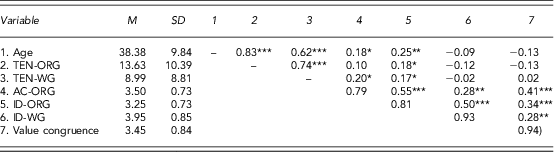
Note. n = 147.
α coefficients are reported on the diagonal.
AC-ORG = affective organizational commitment; ID-ORG = organizational identification; ID-WG = workgroup identification; TEN-ORG = organizational tenure; TEN-WG = workgroup tenure.
*p < .05, **p < .01, ***p < .001.
SEM analyses
Using LISREL package, we assessed our hypothesized structural model in which workgroup identification, value congruence, and their interaction were related to organizational identification, which in turn led to affective organizational commitment. We assessed the interaction between workgroup identification and value congruence in the same way as in Study 1. Fit indices for the hypothesized structural model and a series of alternative models are reported in Table 6. The results showed that the hypothesized structural model yielded a good fit to the data. However, as indicated by the χ2 difference test, the alternative model 1, which proposes an additional path between value congruence and affective organizational commitment, showed a significant improvement over the hypothesized model (Δχ2 = 15.53, p < .001). This suggests that value congruence is significantly and directly related to affective organizational commitment.
Study 2. Fit indices for structural models

Note. n = 147.
AC-ORG = affective organizational commitment; CFI = comparative fit index; ID-ORG = organizational identification; ID-WG = workgroup identification; NNFI = non-normed fit index; RMSEA = root mean square error of approximation; VC = value congruence.
***p < .001.
Standardized parameter estimates for this model are shown in Figure 4. For the sake of clarity, the effects of the control variables are described in the text. Age was positively and significantly related to organizational identification (γ = 0.35, p < .001) while workgroup tenure was not significantly related to affective organizational commitment (γ = 0.12, n.s.). Results indicated that, controlling for age and workgroup tenure, workgroup identification and value congruence were positively associated with organizational identification (γ = 0.52, p < .001 and γ = 0.27, p < .01, respectively) which, in turn, was significantly related to affective organizational commitment (β = 0.52, p < .001). The indirect effects of workgroup identification and value congruence on affective organizational commitment through organizational identification were significant (indirect effect = 0.20, z′ = 3.70, p < .001 and 0.11, z′ = 2.73, p < .01, respectively). The interactive influence of workgroup identification and value congruence on organizational identification was also significant (γ = 0.15, p < .05), supporting Hypothesis 1. In order to examine the interactive effect of workgroup identification and value congruence on organizational identification, lines representing the relationship between workgroup identification and organizational identification were plotted at high and low level of value congruence (±1 SD; cf. Figure 5). The results of simple slopes tests (Aiken & West, 1991) indicated that the relationship between workgroup identification and organizational identification was significant when value congruence was high (B = 0.55, t(142) = 7.71, p < .001) and when value congruence was low (B = 0.35, t(142) = 4.90, p < .001). The slopes were also significantly different from each other (t(142) = 2.19, p < .05), which indicated that the relationship between workgroup identification and organizational identification was stronger when employees perceived high value congruence between their workgroup and their organizationFootnote 2.
Completely standardized path coefficients for the alternative model 1 in Study 2. For the sake of clarity, only structural relationships are shown. AC-ORG = affective organizational commitment; ID-ORG = organizational identification; ID-WG = workgroup identification; VC = value congruence between the workgroup and the organization. *p < .05. **p < .01. ***p < .001
Relationship between workgroup identification and organizational identification as a function of the value congruence between the workgroup and the organization (Study 2). High and low value congruence are, respectively, 1 SD above and 1 SD below the mean.
We also examined whether the interactive effect of workgroup identification and value congruence would extent to affective organizational commitment. The results showed that the indirect effect of the workgroup identification × value congruence interactive term on affective organizational commitment through organizational identification was significant (indirect effect = 0.05, z′ = 1.80, p < .05; critical z-prime value for statistical significance = |0.97|; see MacKinnon, Lockwood, Hoffman, West, & Sheets, Reference MacKinnon, Lockwood, Hoffman, West and Sheets2002). As in Study 1, we conducted bootstrapping analyses via the PROCESS macro (Hayes, Reference Hayes2013) in order to further analyze the interactive influence of workgroup identification and value congruence on affective organizational commitment via organizational identification. Consistently with SEM results, we found that organizational identification mediated the interactive effect of workgroup identification and value congruence on affective organizational commitment. More precisely, the test of conditional indirect effects showed that the indirect effect of workgroup identification on affective organizational commitment via organizational identification was significant both when value congruence was high (indirect effect = 0.25; BCa 95% CI = [0.15; 0.38]) and when value congruence was low (indirect effect = 0.16; BCa 95% CI = [0.09; 0.26]). These findings suggest that organizational identification mediates the interactive effect of workgroup identification and value congruence on affective organizational commitment both at high and low level of value congruence.
Discussion
Consistent with Meyer, Becker, and van Dick (Reference Meyer, Becker and van Dick2006) assumption, we found in two different samples that the relationship between workgroup identification and organizational identification increases when employees perceived high similarities between their workgroup and their organization. The moderating role of perceived similarities in the relationship between workgroup identification and organizational identification was found with both a global measure of perceived similarities (Study 1) and a more narrow measure operationalizing perceived similarities in terms of value congruence (Study 2), confirming the generalizability of our results. These findings are consistent with previous research in which the compatibility between nested units was found to moderate the relationship between identification with these units (e.g., Riketta & Nienaber, Reference Riketta and Nienaber2007). However, the pattern of interaction slightly differs among our two studies. Indeed, in Study 1, high global perceived similarities were found to reinforce the relationship between workgroup identification and organizational identification when workgroup identification was high but they were also found to decrease organizational identification when workgroup identification was low. The results of Study 1 thus indicated that when workgroup identification was low, high global perceived similarities between the workgroup and the organization may have a detrimental effect on organizational identification. This is in line with Meyer, Becker, and van Dick (Reference Meyer, Becker and van Dick2006) who argued that identification with one target can have a reinforcing or (in this case) a diluting effect on identification with the other depending on the perceived compatibility of their goals, values, or norms. Moreover, our results are also in agreement with the theory of cognitive dissonance, which proposes that individuals are motivated to maintain a cognitive consistency in their attitudes and behaviors (Festinger, Reference Festinger1957).
However, the results of Study 2 indicated that value congruence moderated the relationship between workgroup identification and organizational identification so that the more the employees perceived value congruence between their workgroup and their organization, the more their workgroup identification generalized to their organizational identification. However, low workgroup identification had no detrimental effect on organizational identification when value congruence was high. The difference observed in the pattern of interaction between the two studies may be due to the fact that global perceived similarities reflect more than value congruence between targets which can thus be considered as a more specific dimension of global perceived similarities. Indeed, as underlined above, individuals may also perceive similarities in terms of norms, goals, vision of the future, or strategies. Also, we might assume that value congruence reflects a more affective dimension of the global concept of perceived similarities (Cable & DeRue, Reference Cable and DeRue2002). Given that value congruence had no detrimental effect on organizational identification when workgroup identification was low, that would suggest that the affective dimension of perceived similarities (i.e., value congruence) has only a reinforcing effect on the relationships between identification to different targets. In contrast, we could suspect that other elements included in the more global concept of perceived similarities such as strategies, vision of the future, norms or goals of the targets are more cognitive and consequently more likely to create conflicts between targets.
Additionally, we found that, contrary to the global measure of perceived similarities (cf. Study 1), value congruence (i.e., the affective dimension of perceived similarities) had a direct and positive relationship with affective organizational commitment (cf. Study 2). Previous research has shown that the congruence between individual and organizational values was positively related to affective organizational commitment (e.g., Stinglhamber, Bentein, & Vandenberghe, Reference Stinglhamber, Bentein and Vandenberghe2004). However, to the best of our knowledge, no study has investigated the role played by the congruence between workgroup's and organization's values on employees’ affective organizational commitment. Yet, to the extent that employees spend most of their time with their workgroup, we could make the assumption that employees might have internalized the workgroup values as their own values, leading to an increased in affective organizational commitment.
Finally, as hypothesized, our findings also showed that the moderating role of perceived similarities in the relationship between workgroup identification and organizational identification carried over to affective organizational commitment, indicating that the moderating role of perceived similarities may be extended to the affective dimension of the relationship between the employee and the employing organization. These results are consistent with previous research which showed that affective organizational commitment results from a cognitive process (i.e., identification) (e.g., Bergami & Bagozzi, Reference Bergami and Bagozzi2000; Marique & Stinglhamber, Reference Marique and Stinglhamber2011). The mediating role of organizational identification in the relationship between the workgroup identification × perceived similarities interactive term and affective organizational commitment is also in line with Marique and Stinglhamber (Reference Marique and Stinglhamber2011) who found that the impact of identification with more proximal targets on affective organizational commitment is mediated by organizational identification.
More generally, by showing that the relationship between workgroup identification and affective organizational commitment is moderated by the perceived similarities between the workgroup and the organization, our results also contribute to extend the literature dealing with relationships between attitudes toward different foci (e.g., De Cremer, van Dijke, & Mayer, Reference De Cremer, van Dijke and Mayer2010; Eisenberger et al., Reference Eisenberger, Karagonlar, Stinglhamber, Neves, Becker, Gonzalez-Morales and Steiger-Mueller2010). Indeed, the last decades have been witness to a growing body of research dealing with the relationships between attitudes and behaviors toward multiple foci, raising questions on the underlying mechanisms of such multifoci relationships.
Limitations and perspectives for future research
Several limitations must however be acknowledged when interpreting the findings of these two studies. On the methodological level, beside the limitation related to the causality due to the cross-sectional design of our studies, our results may have been exposed to the common method bias. Indeed, the use of self-reported measures might have inflated the relationships among variables. However, the main purpose of our research was to examine employees’ perceptions. The use of self-reported measures was therefore the most appropriate way to assess these variables. Moreover, the problem of common method variance was partially addressed since results of confirmatory factor analyses revealed that a single-factor model showed a poor fit to the data (i.e., Harman's single-factor test; Podsakoff, MacKenzie, Lee, & Podsakoff, Reference Podsakoff, MacKenzie, Lee and Podsakoff2003). Additionally, as showed by Siemsen, Roth, and Oliveira (Reference Siemsen, Roth and Oliveira2010), common method bias might lead to an attenuation of the interaction effect. Therefore, finding a significant interaction in our two studies provides strong evidence that an interaction exists.
An additional limitation refers to the non-independence of our data. Indeed, some respondents are likely to belong to the same workgroup. It is possible that our results have been influenced by the team context. It would therefore be interesting to replicate our research taking into account this additional level of analysis. Another limitation is related to the generalizability of our results. Indeed, the samples we used in this research both originate from Belgium. It would therefore be helpful to replicate these studies in other countries in order to avoid an underestimation of the impact of deeply rooted societal norms (Hofstede, Reference Hofstede2001). In a similar vein, it would also be interesting to replicate our results in other organizational contexts and with other occupational groups in order to investigate the generalizability of our findings, and more particularly the relevance of perceived similarities between targets in other organizational contexts. Finally, the low response rates (Baruch & Holtom, Reference Baruch and Holtom2008) may also represent a limitation for the generalizability of our results. However, an examination of the characteristics of the final samples indicates that participants are representative of the initial samples in terms of sociodemographic characteristics.
In the studies presented in this paper, we assessed perceived similarities through a global measure of perceived similarities (Study 1) and a value congruence measure (Study 2). Yet, perceived similarities embrace more than just the value congruence between targets. It might thus be of interest to replicate these studies by taking into account other elements of perceived similarities such as similarities in terms of strategies, vision of the future, norms, or goals. Furthermore, recent studies have shown that the fit between two entities may be conceptualized in terms of supplementary fit (i.e., value congruence) and complementary fit (i.e., psychological need fulfilment) (Cable & Edwards, Reference Cable and Edwards2004). According to these authors, the social identity perspective suggests that value congruence is more important than psychological need fulfillment in order to predict employees’ attitudes (Cable & Edwards, Reference Cable and Edwards2004). However, Kristof (Reference Kristof1996) argued that an optimum fit ‘may be achieved when each entity's needs are fulfilled by other (i.e. complementary fit) and they share similar fundamental characteristics (i.e., supplementary fit)’ (p. 6). It would therefore be interesting to investigate the role played by the complementary fit between the workgroup and the organization in the relationships between workgroup identification, organizational identification, and affective organizational commitment. Indeed, the extent to which organization fulfils workgroup needs may also play an important role in the relationship between workgroup identification and organizational identification.
Practical implications
The present studies have important practical implications. Indeed, our findings revealed that the more nested units are perceived as sharing some similarities, the more identification directed to one of these units may generalize to identification directed to the other unit. Managers should thus pay more attention to identification with proximal targets. Indeed, the workgroup tends to be more concrete and proximal for the employees than the organization (Ashforth & Johnson, Reference Aiken and West2001). Given that the workgroup is an important target of identification for employees, it should not be neglected by the manager. Several human resources practices oriented toward the workgroup such as ‘team building’ should be implemented in order to foster workgroup identification and consequently attitudes directed toward the organization (i.e., organizational identification and affective commitment). Of utmost importance, the results of Study 2 revealed that value congruence between the workgroup and the organization reinforces the relationship between workgroup identification and organizational identification when workgroup identification is high. Consequently, managers should identify the values hold by workgroups and create organizational campaigns that make salient those values that are common to both workgroups and organization. Finally, because global perceived similarities between the workgroup and the organization seem to have detrimental effects for organizational identification when workgroup identification is low, managers should be careful when reinforcing similarity between the workgroup and the organization if their employees are not highly identified with their workgroup. In sum, managers who want to foster their employees’ organizational identification and affective organizational commitment through workgroup identification should reinforce workgroup identification before making the similarities between the workgroup and the organization salient in order to avoid a detrimental effect of workgroup identification.
Acknowledgement
This work was supported by a grant from the Belgian National Fund for Scientific Research, awarded to the first author, Géraldine Marique. In addition, the authors would like to thank the Editor and the reviewers for their helpful comments and suggestions.