Introduction
Paleo-parasitological analysis can provide evidence of past diet, agricultural practices, animal domestication, migration routes, climate fluctuations, hygiene practices, cultural interactions, ethnomedicine, and the overall health status of past human societies (e.g., Reinhard, Reference Reinhard1990; Reinhard et al., Reference Reinhard, Slepchenko and Shin2018; Littleton et al., Reference Littleton, Karstens, Busse and Malone2022). Microscopic eggs of gastrointestinal parasites (helminths) can be readily extracted from soils, sediments, and coprolites using density separation or flotation techniques (David & Lindquist, Reference David and Lindquist1982; Anastasiou & Mitchell, Reference Anastasiou and Mitchell2013; Horrocks, Reference Horrocks2020).
Paleo-parasitological research in North America over the last several decades has revealed eggs of numerous helminth taxa from many pre- and post-European arrival archaeological sites across several regions. Reinhard (Reference Reinhard, Ferreira, Reinhard and Araújo2014) and Mitchell (Reference Mitchell2023) provided comprehensive reviews, which we summarize here.
In Fitz Hugh Sound, British Columbia, eggs of the fish cestode Adenocephalus pacificus and fish-eating mammal trematode Nanophyetus salmincola were discovered in middens and coprolites (Bathurst, Reference Bathurst2005). In the Aleutians of Alaska, a human burial on Adak Island revealed eggs of the nematode Ascaris lumbricoides (Bouchet et al., Reference Bouchet, West, Lefèvre and Corbett2001), while a midden on Buldir Island revealed those of Adenocephalus sp. (Bouchet et al., Reference Bouchet, Lefèvre, West and Corbett1999). The studies showed widespread fish helminth infection among the human hunter–gatherer communities as a result of the common custom of eating fish raw (Mitchell, Reference Mitchell2023). Also in the Aleutians, hydatid cyst evidence of Echinococcus sp. was found associated with a human skeleton (Ortner and Putschar, Reference Ortner and Putschar1983).
In the United States mainland, pre-Columbian coprolite studies have shown certain parasites concentrated in specific regions (Reinhard, Reference Reinhard, Ferreira, Reinhard and Araújo2014). An example is the restriction of the cestode Dibothriocephalus (= Diphyllobothrium) sp. more to the north, while infection of acanthocephalans is limited to the Great Basin. Both infections appear common in hunter–gatherers and differ from hookworm infections and the presence of the nematode Strongyloides stercoralis found in agricultural societies in the southern part of North America, which has more favourable conditions for transmission. Infection by the nematode Enterobius vermicularis is considered ancient among hunter–gatherer groups and ubiquitous among the Ancestral Puebloans of the Southwest and in other regions (Fry & Hall, Reference Fry and Hall1969). Other intestinal helminths, such as the nematodes A. lumbricoides and Trichuris trichiura, commonly found in humans at present, were rarer in pre-Columbian America. Other pre-Columbian studies include Taeniidae cestodes identified at the Schultz site in the Saginaw Valley of Michigan (McClary, Reference McClary and Fitting1972), eggs of the tapeworm Taenia sp. found in coprolites from Oregon (McDonough, Reference McDonough2019), and hydatid cyst evidence of Echinococcus sp. in human burials from North Dakota (Williams, Reference Williams1985).
Studies of colonial sites have included a latrine from Newfoundland (Horne & Tuck, Reference Horne and Tuck1996), barrel latrines from an early Swedish colony in Philadelphia (Reinhard, Reference Reinhard, Ferreira, Reinhard and Araújo2014), surface sediments from the Dutch Colony of Albany, New York (Reinhard, Reference Reinhard, Ferreira, Reinhard and Araújo2014), and latrines from Williamsburg (Reinhard, Reference Reinhard1990). Unlike pre-Columbian sites, A. lumbricoides and T. trichiura were present at all sites. Eggs of T. trichiura were also found in privies and household refuse disposal areas at the company town of Fayette, Michigan (Faulkner et al., Reference Faulkner, Cowie, Martin, Martin, Mayes and Patton2000).
Notable in this array of North American studies from numerous different geographic regions and encompassing both pre- and post-Columbian times is the absence of Toxocara canis, the common canid parasite. This helminth has been found at archaeological sites in South America and frequently throughout the Pacific region (e.g., Aschero, Reference Aschero1981; Civalero & Aschero, Reference Civalero, Aschero, Miotti, Salemme and Flegheimer2003; Horrocks et al., Reference Horrocks, Summerhayes and Presswell2023, Reference Horrocks, Bedford, Flexner, Valentin, Cochrane, Allen, Burley, Kirch and Presswell2024a, Reference Horrocks, Gumbley, Bickler, Jones and Presswellb, Reference Horrocks, Denham and Presswell2025; Richardson et al., Reference Richardson, Guillén, Beckett, Kyle, Conlogue and Harper-Beckett2012).
A recent archaeological excavation at the Cloudman site on Drummond Island in the northern Lake Huron Basin, Upper Great Lakes (Geiger, Reference Geiger2023) provided us with the opportunity for further North American parasitological analysis. The goal is to build on the currently limited parasitological research in the region, shedding light on local human–animal associations and human and domesticated animal health.
The study area and site
The Upper Great Lakes region was home to some of the most northerly Woodland Period populations in North America (Boyd et al., Reference Boyd, Surette, Lints and Hamilton2014). The people were of the Anishinaabe, a large, culturally related group of Indigenous peoples in the Great Lakes region of Canada and the United States, including the Ojibwe, Odawa, and Potawatomi (e.g., Warren, Reference Warren2009). The Anishinaabe languages belong to the Algonquian language family. At the Cloudman site, the Late Woodland Period (c. AD 600–1600) has been characterized by a hunter–gatherer/marginal horticulturalist culture with a shift towards wild rice from maize over time (Kooiman et al., Reference Kooiman, Dunham and Stevenson2019). Paleoparasitological research carried out so far in the region comprises the discovery of Taeniidae cestodes at the Schultz site in the Saginaw Valley of Michigan (McClary, Reference McClary and Fitting1972).
The Cloudman site (20CH6) is located on Drummond Island, east of Michigan’s Upper Peninsula in Lake Huron. There was a large indigenous village on the island with 1600 years of periodic occupation (Branstner, Reference Branstner1995; Kooiman, Reference Kooiman2018; Kooiman & Walder, Reference Kooiman and Walder2019; Kooiman et al., Reference Kooiman, Albert and Malainey2022). The site spans multiple time periods, from the first millennium AD to the 20th century. The first major period includes a Middle Woodland component (200 BC-AD 500/600). French explorers arrived in the Great Lakes region in the early 1600s, establishing trade relationships and facilitating the fur trade. French missionaries also arrived in the early century.
The site chronology was refined through both retyping pottery vessels as well as direct dating charred material on some of the sherds (Branstner, Reference Branstner1995; Kooiman, Reference Kooiman2018, Reference Kooiman2021; Kooiman et al., Reference Kooiman, Dunham and Stevenson2019; Kooiman & Walder, Reference Kooiman and Walder2019). Of the samples dated from carbonized residue, the chronology and occupation periods were organized as Middle Woodland Period, followed by three Late Woodland subdivisions: Early Late Woodland, Middle Late Woodland, and Late Late Woodland subperiods. Later, the 17th-century occupation of the site was established through chronometric dating. Elemental analysis of European-made beads from the site placed the 17th-century component circa AD 1670–1700 (Kooiman & Walder, Reference Kooiman and Walder2019).
A subsequent archaeological study of the site was conducted in 2019 with the goal of exploring the roles of indigenous human–environmental interactions on the St. Mary’s River (Geiger, Reference Geiger2023). In the present study, we show results of parasite analysis that date from c. AD 700 to AD 1700. Details of all the various analyses and results of the complete archaeological study are given in the work of Geiger (Reference Geiger2023).
Materials and methods
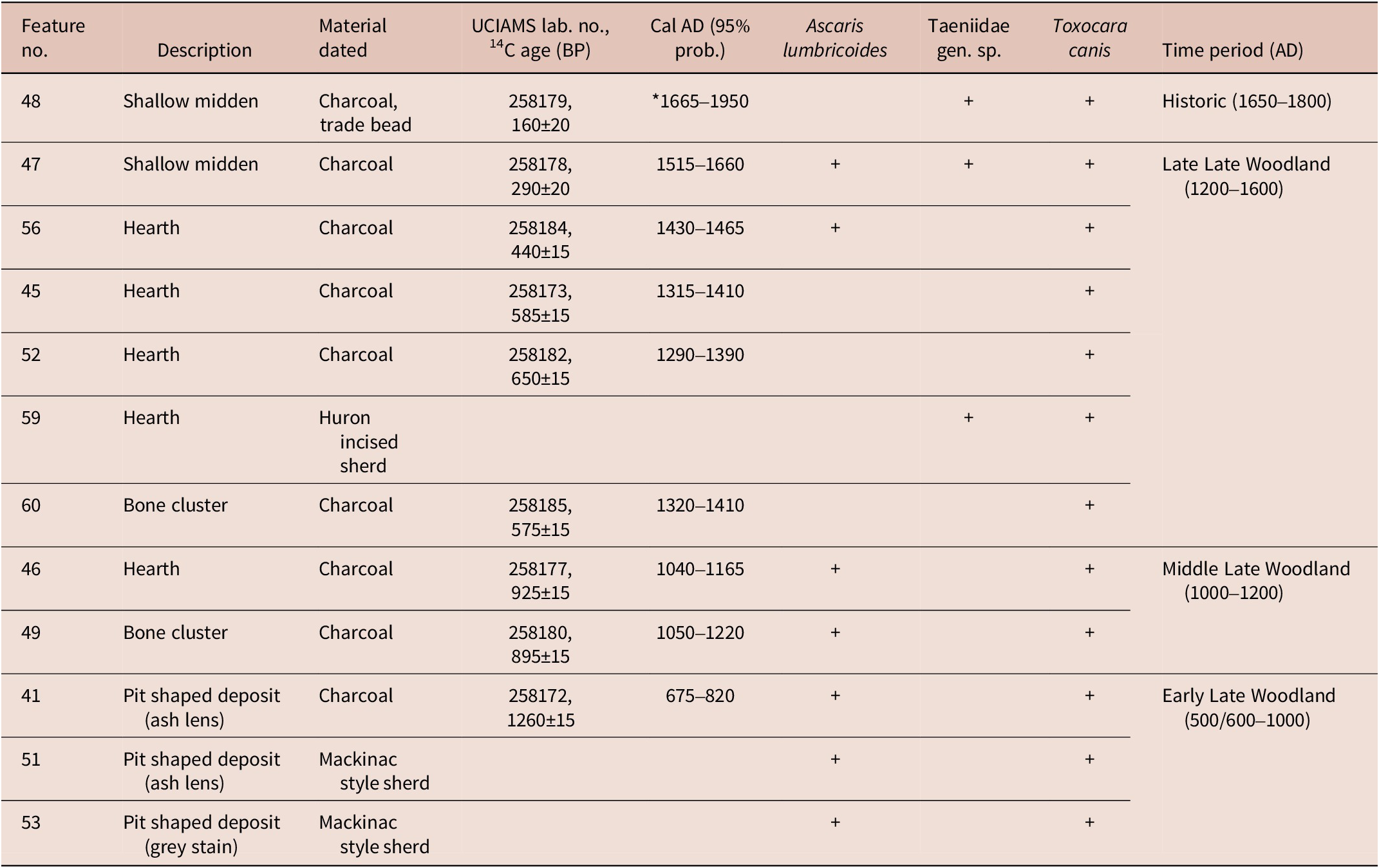
A sample from each of 12 archaeological features was analysed for helminth parasite eggs. Sample labels and feature types are given in Table 1. The time periods encompassed by the analysis (Early Late Woodland to the 17th century) were determined based on calibrated 14C analysis and relative dating of trade goods (Table 1). Sampling locations are given in the work of Geiger (Reference Geiger2023:46).
Provenance, age, and frequency of helminth eggs from the Cloudman site, using associated artifact dating and radiocarbon dating (Kooiman et al., Reference Kooiman, Albert and Malainey2022; Geiger, Reference Geiger2023). Calibration performed using the IntCal20 calibration curve (Reimer et al., Reference Reimer, Austin, Bard, Bayliss, Blackwell, Bronk Ramsey, Butzin, Cheng, Edwards and Friedrichet2020) and the OxCal program v.4.4.4 (Bronk Ramsey, Reference Bronk Ramsey2021). *Date range refined using associated artifacts. (Geiger, Reference Geiger2023:128)

Samples were prepared for analysis of helminth eggs by density separation (1.8 specific gravity) with sodium polytungstate (David & Lindquist, Reference David and Lindquist1982; Horrocks, Reference Horrocks2020). Helminth eggs have a specific gravity of approximately 1.130–1.238 (David & Lindquist, Reference David and Lindquist1982). The separations were mounted on slides with glycerol jelly. Presence/absence of relevant specimens was noted.
Photomicrographs of helminth eggs were taken with a Canon EOS 600D camera mounted on a Nikon 400E microscope. Measurements were made using a calibration slide.
Results
Dating
Dates for nine of the 12 soil samples analyzed for this study were derived from charcoal samples collected during the 2019 Cloudman field season and submitted to the W. M. Keck Carbon Cycle Mass Spectrometry Laboratory at the University of California, Irvine (Table 1). Three samples were dated based on associated artifacts using the recent direct dating of Kooiman et al. (Reference Kooiman, Albert and Malainey2022). Additionally, the Historic period sample was AMS dated, with the date range narrowed to 1650–1700 AD based on the presence of diagnostic trade beads. Each soil sample was associated with Cloudman archaeological features and not general fill.
Helminth Eggs
Three types of helminth eggs were identified in this study: T. canis, A. lumbricoides, and a cestode of family Taeniidae.
Toxocara canis
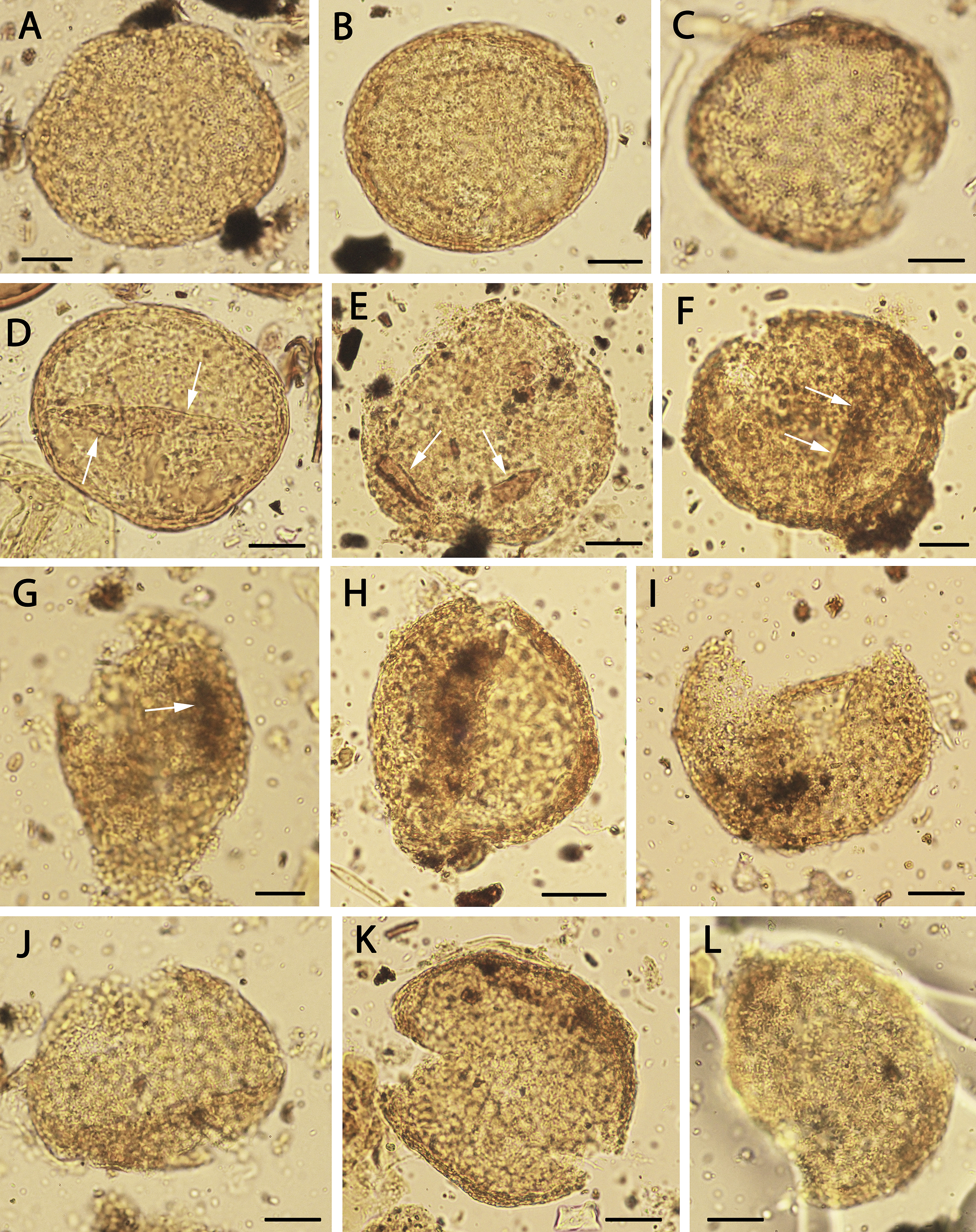
Nematode of family Ascarididae: Found in all 12 samples (Table 1). These eggs are sub-spherical, with the mostly intact specimens measuring 72–101 μm in (longest) diameter and exhibiting a pitted surface and thick shell (Figure 1). The eggs showed variable preservation, ranging from intact (Figure 1A-D) to degraded and/or damaged (Figure 1E-L) (Horrocks et al. Reference Horrocks, Bedford, Flexner, Valentin, Cochrane, Allen, Burley, Kirch and Presswell2024a). Larva remains were visible in some eggs (Figure 1D-G). The T. canis eggs were by far the most abundant egg type in this study, with ratios of T. canis to the other egg types at least around 10:1 per slide. Particularly high T. canis concentrations were observed in the samples from Features 47 and 60, with the ratios around 50:1 per slide.
Nematode Toxocara canis eggs from the Cloudman site, showing characteristic pitted surface and thick shell. 600x; scale bars = 20 μm; feature numbers (in brackets) shown in Table 1. A (60), B (47), C (60), D (41) Relatively well-preserved eggs. E (60), F (52), G (51), H (41), I (45), J (59), K (60), L (46) Degraded and/or damaged eggs. D-G Larva remains visible (arrows). H Egg partially folded vertically with possible larva remains visible (darker area). J, K Eggs with folding at base and top, respectively (dark lines). L Egg squashed between air bubbles.

Ascaris lumbricoides
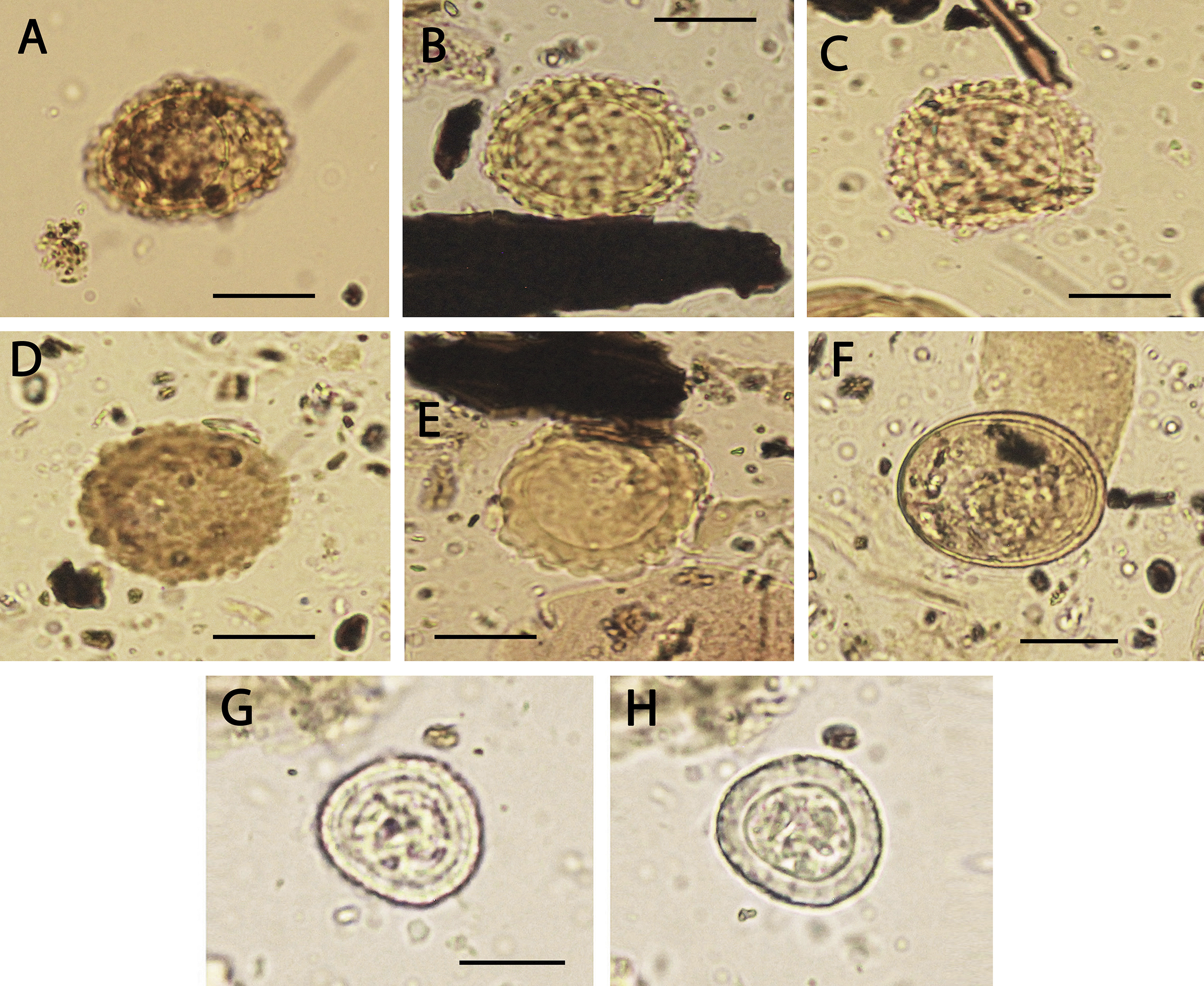
Nematode of family Ascarididae: Found in seven of the 12 samples (Table 1). These ovoid eggs are 41-49 μm in length and have a thick shell and external mammillated layer (Figure 2A-E). Some corticated specimens were also observed (Figure 2F) (e.g., Barbera et al. Reference Barbera, Hertzel and Reinhard2020).
Nematode Ascaris lumbricoides and cestode Taeniidae eggs from the Cloudman site. 600x; scale bars = 20 μm; feature numbers (in brackets) shown in Table 1. A (53), B (56), C (49), D, E (53) Eggs of A. lumbricoides showing characteristic mammillated layer. F (53) Corticated A. lumbricoides egg. G, H (59) Taeniidae egg at different sections showing characteristic thick, radially striated shell (striation faint in this specimen).

Discussion
Toxocara canis
The nematode T. canis inhabits the small intestine of canids and is usually asymptomatic, except with pup infection, which may be fatal. Eggs are deposited in dog faeces, where they become infectious in soil and are then ingested by dogs to repeat the cycle. Toxocariasis is a zoonotic disease, acquired by ingesting eggs from soil (Harris-Linton, Reference Harris-Linton2001). In humans, larval worms do not mature, but migrate through the tissues, with hepatitis and retinitis the most common symptoms. Toxocara canis can only complete its life cycle by passing through the intestine of a canid. Therefore, as the eggs are not deposited by humans, the presence of eggs of this helminth in archaeological contexts is confirmation of the presence of dogs.
At the time of writing, we can find no previous reports of eggs of Toxocara sp. in pre-Columbian contexts in North America. This nematode egg type could potentially be from native wild, or domesticated, host canids (T. canis) and native wild felids (T. cati). Native canids comprise wolves, coyotes, and foxes, and there are several native felid species. Toxocara canis has on average larger eggs than T. cati (Uga et al., Reference Uga, Matsuo, Kimura, Rai, Koshino and Igarashi2000; Panova & Khrustalev, Reference Panova and Khrustalev2017). Among the samples in this study, most of the eggs are within the larger range, lending more weight to a canid origin.
The domesticated dog (Canis familiaris) was the only pre-Columbian domesticated animal in the Americas and arrived with humans via Beringia. People are thought to have first arrived in North America c. 16,000 years ago and the earliest dog evidence so far is between c. 9,500 and 10,000 years ago from southern Illinois (Perri et al., Reference Perri, Widga, Lawler, Martin, Loebel, Farnsworth, Kohn and Buenger2019). However, there is little research or evidence in the Great Lakes region to correspond with increasing evidence of the importance and roles of dogs in other parts of the pre-Columbian Midwest (Witt et al., Reference Witt, Yarlagadda, Allen, Bader, Simon, Kuehn, Swanson, Cross, Hedman, Ambrose and Malhi2021). Dogs were deeply integrated into North America’s Indigenous cultures, often ceremonially ritualized, and further used as hunting aids, protectors, draft animals, companions, and sources of food (often primary) and warmth (e.g., Callahan, Reference Callahan1997; Oberholtzer, Reference Oberholtzer2002; Reisman, Reference Reisman2015).
We consider that the eggs in this study are likely from the domesticated dog, for the following reasons: (1) the larger egg size, (2) the high egg frequency at the site, (3) a ritual dog burial at the site (Cooper, Reference Cooper1996), (4) the dog had a wide variety of uses, and (5) the dog had a domesticated Eurasian, not North American, wolf ancestor and was introduced with the first humans (Leonard, et al., Reference Leonard, Wayne, Wheeler, Valadez, Guillén and Vilà2002; Leathlobhair et al., Reference Leathlobhair, Perri, Irving-Pease, Witt, Linderholm and Haile2018). Leathlobhair et al. (Reference Leathlobhair, Perri, Irving-Pease, Witt, Linderholm and Haile2018) sequenced the mitochondrial and nuclear genomes of the ancient dogs and concluded that the lineages dated back to a common ancestor coinciding with the first human arrivals. The lineage appears to have been mostly replaced by European-introduced dogs, with the primary extant lineage remaining as a canine transmissible venereal tumour. This interbreeding would presumably have started around the Cloudman site sometime after French arrival in the region in the early 1600s, therefore some of the eggs could be from this interaction. Toxocara sp. eggs have been identified at pre-Columbian sites in South America, in southern Patagonia (Aschero, Reference Aschero1981; Civalero & Aschero Reference Civalero, Aschero, Miotti, Salemme and Flegheimer2003) and Peru (definitive T. canis: Richardson et al. (Reference Richardson, Guillén, Beckett, Kyle, Conlogue and Harper-Beckett2012)).
Previous faunal remains from the Cloudman site comprise bones from two features, associated with the Late Woodland period or later (Cooper, Reference Cooper1996). The features contained bones of woodchuck, beaver, muskrat, black bear, caribou, common loon, spring and early summer-spawning fish, and autumn-spawning fish. One of the features also contained bones of a snapping turtle and, consistent with our data, the aforementioned dog burial.
Luxenberg (Reference Luxenberg and Fitting1972) had previously carried out a faunal analysis at the Schultz site in the Saginaw Valley of Michigan. Among several mammal bone taxa, dog bones were also identified. Given that the latter had butchering marks and were in the refuse along with all other bones, Luxenberg (Reference Luxenberg and Fitting1972) considered that the dog was probably used for food.
Ascaris lumbricoides
The nematode A. lumbricoides is a soil-transmitted helminth, having a single host and a direct life cycle. Fertilized eggs become infective in the soil, and when ingested, the larva hatches and then penetrates the intestine wall, entering the bloodstream from where it is carried to the lungs. The larvae are coughed up and swallowed, thereby reaching the intestine where they develop into sexually reproducing adults. Eggs are voided with the faeces, thus reaching the soil to start the cycle again (Dold & Holland, Reference Dold and Holland2011). Ascariasis is usually asymptomatic but may cause an acute inflammatory reaction during the migration process. Heavy infections can block the intestines and may slow growth or even be fatal in children (Dold & Holland, Reference Dold and Holland2011).
A second species of Ascaris, A. suum, has very similar eggs that are easily confused with those of A. lumbricoides. However, A. suum is a parasite of pigs, which are not native to North America. Our identification of A. lumbricoides is therefore based on cultural context rather than egg morphology. Ascaris lumbricoides eggs have previously been identified at pre-and post-Columbian archaeological sites in North America, although not in the Great Lakes region (Reinhard, Reference Reinhard, Ferreira, Reinhard and Araújo2014).
Taeniidae
Eggs of taeniid cestodes (Taenia spp. and Echinococcus spp.) have previously been found at pre-and post-Columbian archaeological sites in North America (Reinhard, Reference Reinhard, Ferreira, Reinhard and Araújo2014). The exact species of this cestode type represented by these previous finds is currently unknown. The eggs of this family cannot be definitively differentiated in microscopy, and there are many potential North American host species, including canids and felids. Humans may be accidental intermediate hosts to taeniid cestodes which have the potential to cause serious disease or death. For example, hydatid cyst disease is caused by the species of Echinococcus. The primary hosts are canids, with numerous intermediate species, including humans, where cysts can develop. The North American hydatid cyst findings of Williams (Reference Williams1985) and Ortner and Putschar (Reference Ortner and Putschar1983) led them to suggest that dogs were associated with the pre-Columbian populations (although without ruling out the possibility of wild canids).
Conclusions
The discovery of helminth eggs of A. lumbricoides, Taeniidae, and T. canis (the latter a first for North America) reveals parasites that could have affected the health of people and their domesticated dogs from the Late Woodland Period to the early Historic period. The eggs suggest that the presence of dogs at the site remained relatively stable over the c. 1000-year span of this period. The results offer a new line of evidence for possible dog presence and domestication in North America.
The microfossil data build on previous botanical work at the Cloudman site showing plant utilization (Kooiman et al., Reference Kooiman2018; Geiger, Reference Geiger2023), providing evidence for animal utilization. In addition, our microscopic examination extends the analysed material from ceramic residues to soils/sediments.
Acknowledgements
Geiger was funded by the University of Michigan Museum of Anthropological Archaeology’s Linda Britton and John R. Halsey Great Lakes Research Fund and James B. Griffin Endowment. We are grateful to the Repatriation & Historic Preservation Department at the Sault Ste. Marie Tribe of Chippewa Indians for their feedback on this research. We give special thanks to the landowners, Gary and Barbara Cloudman, for their permission.
Competing interests
The authors declare none.