In individuals with inapparent falciparum malaria (Plasmodium falciparum), a traumatic event can cause parasite recrudescence or symptomatic infection in previously asymptomatic individuals.Reference Heger, Sundet, Heng and Husum 1 – Reference Takongmo, Gaggini, Malonga, Leundji and Same 3 Cambodia is a country that remains highly contaminated by landmines as a result of past violent conflict, and severe trauma from landmines has been found to precipitate symptomatic falciparum malaria in more than 30% of those who arrive at a hospital.Reference Heger, Sundet, Heng and Husum 1 , Reference Husum, Heger and Sundet 2 , Reference Sundet, Heger and Husum 4 , Reference Heger, Han, Heng, Sundet, Larson and Husum 5 It was hypothesized, therefore, that a link may exist between the geolocation of landmine amputations and cases of P falciparum malaria. This hypothesized link is explored, and the importance of considering malaria recrudescence after highly stressful events such as in complex emergencies is described in this report.
Cambodia is one of the most heavily landmine-contaminated countries in the world as a result of nearly 3 decades of armed conflict. Most of the contamination is in rural areas and concentrated in 21 districts in 6 provinces along Cambodia’s western and northern borders with Thailand. 6 The full extent of this contamination has not been determined, but the densest contamination, which is reportedly up to 2400 landmines per linear kilometer, is known to be along the western border. 7 The Cambodian Mine Victim Injury Survey (CMVIS) has reported 63 815 landmine and explosive remnants of war casualties since 1979.
Although the incidence of malaria, including P falciparum, has declined in Cambodia since the early 2000s, it remains one of the high-incidence countries in the Greater Mekong Subregion.Reference Cui, Yan and Sattabongkot 8 The incidence of malaria is the highest in rural areas, including along the Vietnamese border. It is also elevated along the Thai-Cambodian border, largely due to high-risk groups such as mobile workers undertaking economic activities (eg, lumber cutting, gem mining) in forested areas.Reference Cui, Yan and Sattabongkot 8 These border areas describe an epicenter of multidrug-resistant P falciparum,Reference Cui, Yan and Sattabongkot 8 specifically strains resistant to artemisinin-based combination therapies (ACTs),Reference Dondrop, Nosten and Yi 9 the frontline defense against falciparum malaria since chloroquine resistance became widespread in the late 1990s.Reference Lin, Juliano and Wongsrichanalai 10 In malaria-endemic areas where people are repeatedly infected, asymptomatic infections, characterized by low-grade parasitemia without overt symptoms such as fever, are common as a result of acquired immunity.Reference Heger, Han, Heng, Sundet, Larson and Husum 5 , Reference White 11 Further, in the absence of effective chemotherapy, recrudescence of these previously subpatent P falciparum infections can occur, causing acute illness.
A study in Battambang, the referral trauma center for the highly landmine-contaminated north and western provinces of Cambodia, found that one third of 342 people who experienced landmine casualties developed postoperative symptomatic malaria.Reference Husum, Heger and Sundet 2 Of these, 90% were positive for P falciparum malaria, and the infections were observed to occur in less than the normal incubation period, thus excluding the possibility of new infections. This finding suggested that recrudescence of existing malaria is occurring rather than newly acquired infections.
In another Cambodian study of landmine injuries, 43% of the patients (n=227) developed malaria within 10 days of injury with little opportunity for post-injury infection exposure, also suggesting recrudescence. As in the previous study, 90% of these patients were positive for P falciparum infections.Reference Sundet, Heger and Husum 4 An increase of 36.1% in wound infections was observed, as compared with 10.0% in patients without symptomatic malaria (95% CI for difference: 15.2%–36.9%). This finding was thought to be due to immunosuppression related to suppressed malaria. 6
In a qualitative study consisting of interviews with surgeons in Battambang, Heger and colleaguesReference Heger, Sundet, Heng and Husum 1 found that the surgeons (n=18) estimated the prevalence of falciparum malaria in post-landmine injury to range from 10% to 80%. Thus, while the pathophysiological link appears well established, the practitioners in this study appeared to have widely disparate opinions on the significance of the condition. This gap could have been due to differences in clinical practice and lack of access to diagnostic technology such as skilled microscopists. The other studies were hospital based and were unlikely to have captured all the landmine-related traumatic injuries, as not all casualties reach a hospital-based facility. In the present study, we assessed whether a link existed between the geolocation of landmine amputations and cases of P falciparum malaria using population-based data.
Methods
Landmine amputation data from the CMVIS for the years 2005 to 2008 were compared with those of malaria endemicity in 2010, which were assembled by the Malaria Atlas Project (MAP). The years 2005 to 2008 were selected for the landmine data because from 2005 onward the CMVIS recorded more detailed (subprovincial level) information on the location of the injury. These data were collected through a community-based surveillance system with data entered into CMVIS by the Cambodian Action Centre.
The MAP endemicity surface was drawn from a model-based geostatistical prediction using all available data from P falciparum parasite rate (PfPR) surveys in 85 countries identified as endemic for P falciparum in 2010.Reference Gething, Patil and Smith 12 Both versions of the map include prevalence data from 1985. The older data are used to inform more contemporary measures of prevalence, but the prediction model was designed to down-weight older surveys such that they have less influence in the final endemicity predictions. The 2010 map was used instead of the 2007 iteration because predictions in the 2010 version were based on a larger number of parasite rate surveys. In addition, the spatial modeling techniques used provide more refined estimates than earlier maps, which were deemed necessary for this regional analysis.
Analysis
The locations of the amputation data were identified using Google Maps and Google Earth. Where possible, the point location of the village or commune was identified. If only the district or province of an amputation even could be located, the coordinates of the center of that location were used.
The latitude and longitude values recorded for injuries that had resulted in amputation were plotted over a surface of P falciparum parasite rates using ArcGIS 10.0 (ESRI 2010). The parasite rate surface is a raster grid made of 1×1-km pixels, each of which contains a value of malaria prevalence. Amputation records were also mapped relative to areas mined and under residual threat that were obtained from the Cambodia National Survey Project.
Population surfaces for 2010 extrapolated from the year 2000 estimates from the Global Rural Urban Mapping ProjectReference Balk, Deichmann, Yetman, Pozzi, Hay and Nelson 13 were used to approximate the number of individuals in each province and district. Using the number of amputations from each administrative level, the amputation rate per thousand people was calculated at the provincial and district levels.
The outcome measure was the PfPR at both the provincial and district levels, and the amputation rate was the predictor variable. The variables of interest showed serious departures from normality at both the provincial and district levels, as seen by standardized skewness and kurtosis coefficients. Accordingly, a nonparametric procedure, the Spearman rank-order correlation coefficient (ie, Spearman rho), was performed to address the research question.
Ethics
Permission to use the CMVIS data was provided by the Cambodian Action Centre. Permission to use the malaria data was provided by the MAP. All data were de-identified, routine in nature, and collected with the intent of eventually becoming publicly available, thus individual consent was not required.
Results
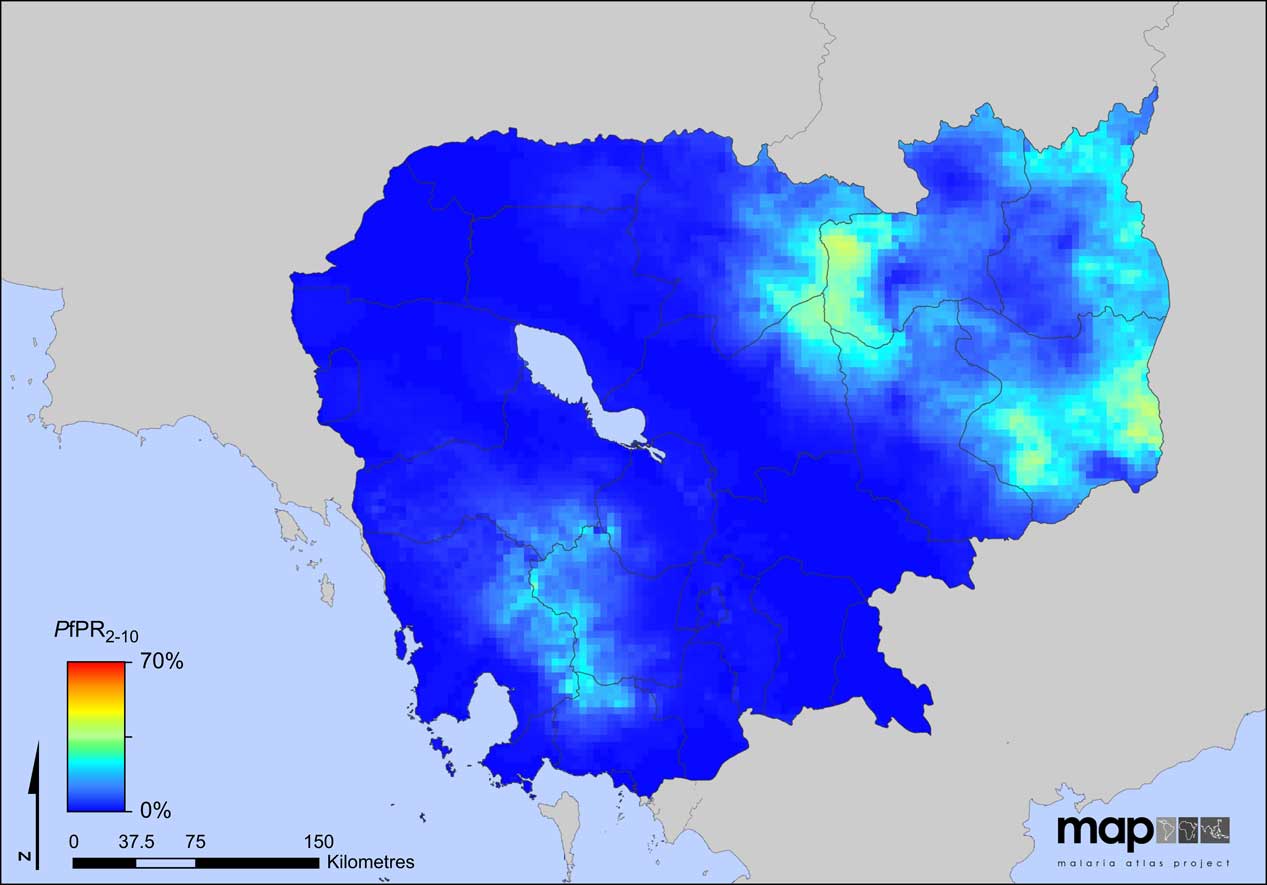
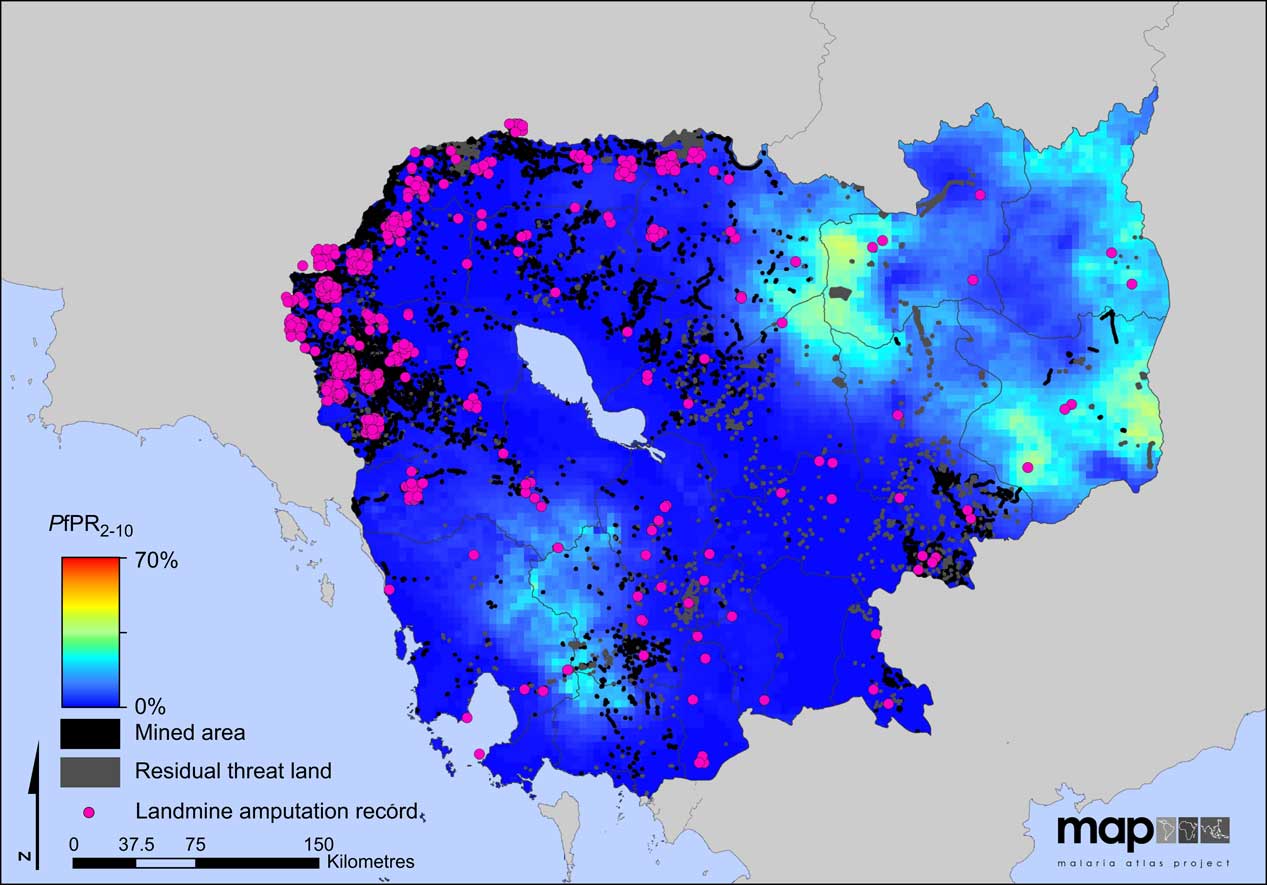
A total of 507 records of amputations from landmines were recorded in Cambodia between 2005 and 2008. Of these, 4 were georeferenced to the province level, 405 to the district level, 89 to the commune level, and 9 to the village level. P falciparum endemicity in Cambodia is shown in Figure 1. Correlation statistical analysis based on the Spearman rho revealed a non-statistically significant relationship between the amputation rate and the provincial-level P falciparum parasite rates (P=.24) and the district-level P falciparum parasite rates (P=.14). Figure 2 shows a combination of areas with evidence of landmines and residual threat, the geopositioned records of landmine amputations, and P falciparum endemicity. In addition to the results of the statistical analysis, simple visual inspection of the map indicated no association between location of landmine injury and P falciparum parasite rates.
Plasmodium falciparum Endemicity in Cambodia. Model-based geostatistical point estimates of P falciparum parasite rate age standardized to the 2- to 10-year age range (PfPR2-10) within the stable limits of P falciparum in Cambodia as a continuum from blue to red and from 0 to 70%.

Amputation Records and Mined Land Areas Plotted Over a Surface of Plasmodium falciparum Endemicity. Malaria endemicity (PfPR2-10) is shown as a continuum from blue to red and from 0 to 70%. Pink dots indicate amputation records; black areas indicate landmine-contaminated areas; and gray areas indicate areas of residual threat.

Discussion
Asymptomatic P falciparum patients may develop symptomatic malaria infection following injury or surgery, which also increases the risk for postoperative wound infection.Reference Heger, Sundet, Heng and Husum 1 , Reference Husum, Heger and Sundet 2 , Reference Heger, Han, Heng, Sundet, Larson and Husum 5 It was expected that in the present study a geographical correlation would be observed between P falciparum parasite rate and the landmine injury amputation rate. However, no statistically significant correlation was found. This finding may have been due to high population mobility and migration in Cambodia and the surrounding border areas.
In addition, the P falciparum endemicity surface was drawn from a model-based geostatistical prediction based on all available data from P falciparum parasite rate (PfPR) surveys and not a survey of blood smear specimens from cases of amputation. The prevalence surveys used by the MAP to generate PfPR predictions are community-wide surveys meant to be representative of whole populations; therefore, they exclude hospital or injured populations. This difference may have explained why in the present research we failed to detect an association between the geolocation of landmine amputations and cases of malaria.
Further, the malaria data in this study are for all P falciparum cases and do not distinguish cases of recrudescence from primary infections. Consequently, any association with only recrudescent infections may have been lost. It also implies that in previous studies in Cambodia in which symptomatic falciparum malaria has been observed in patients with traumatic landmine injuries, the cases are most likely reactivated falciparum infections and not new ones.
Cases of malaria after injury are described in military medicine but rarely discussed in textbooksReference Heger, Sundet, Heng and Husum 1 or the literature on post-conflict landmine injury. Yet, P falciparum can be fatal alone or as a secondary infection in a severely injured person. Malaria may present in nonspecific or misleading ways. Common symptoms such as fever and malaise can be confused with other causes of postoperative illness and may be fatal if undiagnosed. It is essential, therefore, that in complex emergencies occurring in malaria endemic areas with high levels of severe trauma, health professionals are aware of the possibility of post-injury or postoperative P falciparum malaria recrudescence.Reference Heger, Sundet, Heng and Husum 1
In such contexts, diagnosis of malaria by blood smear examination should be considered for any patient with postoperative fever. If treated, postoperative malaria is normally not fatal, but its presence can still increase the risk of wound infection and considerably delay the recovery process.Reference Heger, Sundet, Heng and Husum 1 Trauma patients from malaria endemic areas could have blood smears examined for malaria parasites before surgery, although it is likely that low-density parasitemias will remain undetected.Reference Takongmo, Gaggini, Malonga, Leundji and Same 3 Anyone with a positive result on a malaria smear should be treated with antimalarial drugs, especially in the case of postoperative fever.Reference Takongmo, Gaggini, Malonga, Leundji and Same 3
Given increasing drug resistance, any treatment regimen must be based on an awareness of the local pattern of resistance among P falciparum strains. In Cambodia, preoperative antimalarial treatment given to landmine trauma patients was found to be ineffective in preventing symptomatic malaria, likely due to the frequency of multidrug-resistant malaria in this region.Reference Heger, Han, Heng, Sundet, Larson and Husum 5
Many of the regions vulnerable to armed conflict and natural disasters are also malaria endemic areas with largely rural populations.Reference Heger, Han, Heng, Sundet, Larson and Husum 5 Understanding the link between P falciparum and trauma is also of global importance in responding to complex emergencies when large numbers of displaced people move into and from malaria endemic areas into previously malaria-free or malaria elimination settings. Great physical stress without direct trauma may have a similar effect on malaria, as that seen with landmine injuries.
For example, malaria was the leading cause of early mortality of the Khmer people surviving the arduous conditions and physical stress experienced during the trek through the jungle from Phnom Penh to the SaKeo refugee camp on the Thai border in the late 1970s.Reference Glass, Cates and Nieburg 14 To minimize the threat of an outbreak during complex emergencies where Anopheles mosquitoes are transmitting malaria, it is important that protocols are in place to guide treatment regimens, especially for medical staff unfamiliar with tropical diseases.Reference White 11
Limitations
As with many investigations, this study has limitations. One concerns the CMVIS data, which only record whether the casualty required an amputation or not. Other cases of severe trauma common with landmine injuries, such as blindness, may have been excluded in our study. Also, evacuation procedures and transport are rudimentary, and it is unknown what proportion of total landmine casualties survive to arrive at urban tertiary level hospitals that can manage traumatic injuries.Reference Sundet, Heger and Husum 4
In addition, factors related to P falciparum rates, such as income and health care as proxies for adequacy of treatment were not available and could not be included in a multivariable model. Moreover, P falciparum prevalence data were not available for the same years as the CMVIS data. However, the 2010 PfPR data would still reflect which areas had proportionally higher levels of falciparum malaria. Finally, the CMVIS data did not allow direct matching of amputation patients and malaria. Nevertheless, the link between recrudescence of symptomatic P falciparum malaria and stressful events including severe trauma is well-established.Reference Heger, Han, Heng, Sundet, Larson and Husum 5 It is possible that recrudescent infections were missed within this sample of all malaria infections.
Conclusions
Further research is needed to understand the relationship between P falciparum and trauma in landmine-contaminated environments and the best way to prevent postoperative malaria. To allow for a better understanding of the link between P falciparum and trauma, future studies should aim to distinguish P falciparum recrudescence from new cases. For this purpose, a prospective registry is likely to be the best method. In the meantime, it is important to raise awareness of the potential for trauma-related P falciparum recrudescence, especially with increasing multidrug resistance in regions that are vulnerable to complex emergencies and humanitarian disasters.
Acknowledgment
The Cambodian Mine Action Authority supplied the landmine injury data.