Since the 1980s there has been an upsurge in historical research on women and the family in Middle Eastern societies, and in Ottoman society in particular.Footnote 1 Within the new literature that has emerged, studies based on Ottoman shariʿa court rulings—primarily from sijjil records—suggest that women were present and active in court as plaintiffs and defendants, and made both direct and indirect attempts to extend their roles and rights in society. The shariʿa courts thus often dealt with women seeking to address matters related to, for example, property and inheritance, waqfs, slavery, as well as divorce and custody.Footnote 2 Moreover, the courts exhibited considerable flexibility in their willingness to temper many of the strictly delineated gender roles of the time.
Although by no means did women make up the majority of the litigants who approached the shariʿa courts, in their patriarchal society the courts were by far their best means of pursuing justice in a way that did not violate social norms. The shariʿa courts thus offered women a degree of agency and a path to protect their interests. This posture vis-à-vis women is an example of Ottoman “institutional flexibility, especially in the judicial system that interpreted and applied the shariʿa but also in other agencies of the state, that reflected an underlying concern about ensuring the rights of the vulnerable and providing some basic standard of justice.”Footnote 3
In contrast to the extensive research that has been done on women in the shariʿa courts, scant analysis is available on other discourses and negotiation practices potentially open to women in the Ottoman Empire. This is particularly true of women's petitions to state authorities in the imperial capital of Istanbul.Footnote 4 To the extent that petitions kept in the Ottoman archives are a sufficient indication, women submitted relatively few petitions directly to the imperial center. The age-old institution of petitioning remained dominated by men from different strata of society until the collapse of the empire in 1918.
If women so often used the shariʿa courts, why did they so infrequently petition Istanbul? This question is particularly puzzling when considered in the light of dozens of paintings that exist from the mid-19th-century that depict women approaching arzuhalcis, professional letter and petition writers, on the street. In a painting dated to 1844, for instance, an image of which was published in The Gallery of Engravings, two women and a child approach an arzuhalci who is seated in his makeshift stand on a street corner offering his services to the public.Footnote 5 As will be discussed below, women apparently approached Istanbul only as a last resort in times of great distress. Yet similar to other historians who have examined women's petitions, we find the very existence of such documents, scarce as they are, fascinating and significant.Footnote 6 We argue that whereas women's contacting the local shariʿa court was widely perceived as consistent with the religious and patriarchal order, (individual) petitions sent by Ottoman women to the imperial center in Istanbul constituted a break with it and with social convention.
As Suraiya Faroqhi has argued, every act of petitioning is, by its nature, a political act.Footnote 7 Nevertheless, in the Ottoman Empire, petitions—including women's petitions—went through a gradual process of “politicization,” meaning that over time they became more strident in tone. Thus, although petitions were long a locus for traditional interactions between rulers and submissive subjects, towards the end of the Ottoman Empire the nature of that interaction fundamentally changed. This study examines the transformation of women's petitions during the late Ottoman era, specifically between 1865 and the period immediately following the empire's collapse in late 1918, when the King–Crane Commission toured the former Ottoman territories in search of a political solution for the region. The article first presents a general overview of women's petitions in the Ottoman Empire, including the topics they raised, their style, and the identity of petitioners. It then turns to Greater Syria to explore several case studies of women's petitions from the last decades of the Ottoman period. As will be demonstrated, during these decades considerable changes occurred in the patterns of petitioning the Ottoman imperial center, including among women.
The second and main part of this article examines women's double-voiced petitions. We borrow the term “double-voiced” from Elaine Showalter, who used it to characterize how women's writing challenges hegemonic (male) discourse. Showalter argued that women do not usually write from either inside or outside the male tradition; rather, they often write in a double-voiced way that includes both the dominant discourse as well as a muted one. This unique mechanism enables women to be noticed and simultaneously to challenge, on both individual and collective levels, their patriarchal society.Footnote 8 We extend Showalter's methodology from the genre of literary fiction to petitions, despite their known limitations as historical sources.Footnote 9 This helps us to further reveal women's voices and to offer new insights into women's efforts to participate in public discourse.
Ottoman women's double-voiced petitions first emerged after World War I, and particularly in the context of the King–Crane Commission. With the emergence of national struggles in the territories previously under Ottoman rule and women's recruitment to those struggles, some women petitioners merged the dominant national voice with their own muted voice, a significant shift in the history of Ottoman petitions. By comparing the style and content of these double-voiced petitions with those of previous Ottoman petitions, we trace changes in women's petition writing, which are reflective of changes in social and political discourse and in the gender order.
To help illustrate the nature of petitioning, the first part of this article discusses several dozen examples collected for a recent project on petitions that were sent from parts of Greater Syria to Istanbul between 1865 and the last decade of the empire.Footnote 10 These petitions are dispersed among various different collections in the Başbakanlık Osmanlı Arşivi (Ottoman State Archive). To set the historical context of these petitions and for the sake of comparison, we draw on existing secondary literature on women's petitioning in the empire during previous periods. In most cases, we do not possess the actual petitions sent by women, but rather the correspondence between Ottoman bureaus about the petitions, a gap that makes it difficult to analyze women's voices.Footnote 11 Our task is further complicated by the fact that during the 19th century petitions were no longer concentrated in one section of the bureaucracy. Establishing accurate statistics is therefore a challenge. By contrast, researchers working on Ottoman petitioning during the 17th and 18th centuries have at their disposal sources such as the șikayet defterleri (registrars of complaints) in which responses to petitions, including women's petitions, were recorded, allowing them to make fairly accurate counts.Footnote 12
The second part of this article deals with a selection of the approximately 3,000 petitions received by the American King–Crane Commission during its six-week tour of the Levant in the summer of 1919. We focus on the handful of petitions written by women from Greater Syria, either individually or in groups. These petitions, we show, are strikingly different from women's petitions to the Ottoman sultan, above all in their use of double-voiced discourse.
OBSERVATIONS ON WOMEN'S PETITIONS PRIOR TO THE 19TH CENTURY
Women's petitions have not attracted much interest from historians.Footnote 13 In the Ottoman case the topic has attracted particularly scant attention, in part due to the limited number of sources available. Petitions to the Otloman sultan were sent either by an individual or collectively (arz-i mahzar), for the most part by men.Footnote 14 Women seem to have petitioned the imperial center as individuals, though petitions by several women from the same family are exceptions to this rule.Footnote 15
Unlike in Britain, where one finds collective political petitions by women from as early as the 15th century, in the Ottoman case individual petitions stretch back only to the mid-16th century. Fariba Zarinebaf-Shahr's analysis of the şikayet defterleri suggests that this development was linked to the weakness of the imperial center, which, given its political situation, sought legitimacy and direct connection with its mass of subjects (reaya).Footnote 16 The door was opened to women to appeal to the state. Zarinebaf-Shahr shows that most Ottoman women's petitions were written by urbanites rather than rural people,Footnote 17 with the aim of appealing decisions made by a mahkeme on the basis of the shariʿa.Footnote 18
Most individual petitions by women had to do with inheritance and property, loans, divorce, and bride price.Footnote 19 They were submitted to the imperial center either by the petitioners themselves in person, by a male representative, or with the aid of the local kadı.Footnote 20 Not surprisingly, most of the women's petitions cited by Zarinebaf-Shahr were submitted by Istanbuli women, who, unlike women in other remote regions such as the Arab provinces, had relatively easy access to the imperial center. The petitioners largely belonged to “middle-income households, whose livelihood after the loss of a husband, father, or a divorce in certain circumstances depended greatly on inherited shares and the bride price.”Footnote 21
CHANGES IN WOMEN'S STATUS AND WOMEN'S PETITIONS IN 19TH-CENTURY GREATER SYRIA
The 19th century ushered in vast societal transformations that provided a host of new opportunities to women. Changes in the empire's Arab provinces brought about by the nahḍa and changes in Istanbul itself gradually impacted the status of middle-class and elite urban women. The spread of missionary schools and the 1869 Law of Education allowed more women to learn to read and write, though the number of literate women remained relatively low. Moreover, the nascent notion of Ottoman citizenship allowed Ottoman subjects—both women and men—to forge new identities. Print media, introduced to the empire on a wide scale only in the 19th century, provided a limited public arena for Ottoman intellectuals to discuss these identities. As a result of these processes, the role of women and their status in modern society came to the forefront of public debate, with one of the main questions being whether women should have a role in the public sphere.
This question was even more acute in the second half of the 19th century. During this period, middle-class women began to express themselves in Turkish and Arabic newspapers, often in the framework of what became known as the “woman question.” The debate over women's role in the public sphere led some male intellectuals to stress women's important role in the construction of modern civil society, families, and households, which required them to be trained in reading and writing. Such discussions were particularly pervasive in Istanbul, Cairo, Beirut, and other parts of Greater Syria. For example, as early as 1849, the leading Beiruti intellectual Butrus al-Bustani (1819–83) delivered a lecture entitled “On Women's Education,” which echoed the growing call to allow women to learn to read and write in order to become less dependent on men and play a constructive role in building modern society. Lamenting women's reliance on public scribes, al-Bustani said: “When a woman wishes to write a letter, she must go closely veiled to the street and hire a professional scribe to write for her a letter which she cannot read, and which may utterly misrepresent her!”Footnote 22 Criticizing men's attitudes toward women, al-Bustani added that:
It is surprising to see that many members of this generation, even in civilized places, have neglected this sex [jins, i.e., women], and are unwilling to elevate it from its uncivilized [mutawaḥḥish] state to one appropriate to an individual who has the same mental capacities and can help them [male members of society] remedy the conditions of the people [jumhūr] and the region [bilād]. How can we convince him that teaching her is akin to placing an antidote in the mouth of a patient whose health is deteriorating or pouring oil and wine on a serious mortal wound?Footnote 23
Yet even as he criticized men's attitudes toward women, al-Bustani cautioned women about their ambition, advising them not to go too far in their demands:
I say to the civilized woman [al-marʾa al-mutamaddina] that being a very useful and important member of the group should not lead her to narcissism and arrogance or compel her to talk down to her husband even if she is more knowledgeable because minor issues should not annul the essentials. A woman's place in comparison to a man's is known and she should not cross or exceed it under any circumstances.Footnote 24
Al-Bustani thus supported women's education but did not want to change the patriarchal order of society. In fact, the women's education he advocated was to be restricted to only certain topics. Nevertheless, al-Bustani's position doubtless made some male intellectuals and middle-class men uneasy. Some men published editorials in the press arguing that women's learning to write would endow them with undesirable skills such as the ability to compose letters to their lovers. Such men may have feared that these changes would pave the way for a breakdown of the patriarchal social order in the Ottoman Empire, including its Arab provinces. As such, the growing debate on domesticity, though it empowered women within the family, made it difficult for them to join the public sphere. Most men felt that women's active participation in society, whether through politics or work outside the home, contradicted their traditional role in the home, and was a modern phenomenon reflecting the influence of the West.
Thus, during the 19th century women had greater opportunity than before to write petitions and submit them to the imperial center in Istanbul. But until the end of the Ottoman era they largely refrained from doing so. The modernization of the Ottoman legal system in the second half of the 19th century and the establishment of the Nizamiye courts could have given women new opportunities to pursue justice. Yet paying expensive court fees and for the services of petition writers and professional attorneys—all prerequisites for applying to the Nizamiye courts—prevented many women from engaging them.Footnote 25 For this reason, women are only rarely found in the Nizamiye court records as either plaintiffs or defendants. Modernization, then, did not make women more visible in the Nizamiye courts than before. And yet women who did chose to approach the Nizamiye courts and were able to pay the required fees demonstrated that they had agency. Avi Rubin cites, for example, the case of Kali, a Greek Orthodox woman from the Island of İmroz (today the Turkish island of Gökçeada), who filed a civil lawsuit at the Nizamiye court against a person named Astarati, who had gotten her pregnant and then refused to marry her or acknowledge their child. The court ordered Astrarati to pay indemnities as well as child support. In addition to the civil lawsuit, criminal charges were filed against him.Footnote 26
Women who decided to petition Istanbul rather than approach the Nizamiye or shariʿa courts in this period did so for reasons as varied as gaining a husband's release from prison, finding a missing husband, bringing the perpetrators of murder to justice, halting eviction from a property, abrogating a husband's conscription, dealing with debts left by a dead husband, and even bringing allegations of sexual abuse against state officials. Similar to other petitions in this period, the voice and style of these traditional petitions were submissive and humble. Their content, however, unlike that of men's petitions, suggests that they were women's last resort after they had exhausted all options on the local level.Footnote 27
To cite a typical example of a women's petition from this period, in the spring of 1874 the widow of Hanna Hanun from Jaffa sent a petition to Istanbul claiming that her appeals to the local authorities in Jerusalem to resolve a property dispute had been ignored. Her late husband, she argued, had sold his share in their house to a person named Mikhaʾil in return for an amount of money paid partially in cash and partially through a loan. The transaction was nullified when the buyer did not meet his financial obligations. Hanna's son-in-law was appointed to oversee the reimbursement of the money already paid and the restoration of shariʿa ownership rights. The son-in-law, however, put up the house as a guarantee in order to obtain a loan from a French merchant, an action the widow claimed was illegal. When the son-in-law's debt went unpaid, the French merchant asked the widow and her children to leave the house. With no other options, the widow appealed Istanbul to prevent her and her family's eviction, arguing that her son-in-law had acted illegally by putting up the house as a guarantee.Footnote 28
Changes in the nature of women's petitions (but not in their numbers, which remained very low) only took place after the Young Turk Revolution of 1908, and were part of the general transformation of the institution of petitioning in the decade before the empire's collapse. This transformation was linked to the shift from justice by sultanic ad hoc prerogative to constitutional and civil law. Petitions from this period often invoke constitutional rights, a new era in the empire, an end to the forms of oppression and tyranny prevalent during Abdülhamid II's reign, and the beginning of a new period of just rule—all ideas that were percolating in the urban milieux of the empire, in the press, and elsewhere.Footnote 29 In general, they depict the previous era in terms of darkness and tyranny, and the new postrevolution era in terms of “sunshine.”Footnote 20 As pointed out by Michelle Campos in her analysis of the changing political discourse among the empire's subjects in the period after the revolution, “Ottoman citizens studied and cited the constitution and other revolutionary ‘sacred texts’ that endowed them with political power, and they utilized a variety of tools to exercise and preserve that power.”Footnote 31
These changes are also reflected in women's petitions. For example, in November 1909, in the aftermath of the Young Turk Revolution and the return of constitutional rule, several sisters from Jaffa who argued they were mütevvelis of waqf land wrote to the Interior Ministry that the waqf authorities in their town had confiscated some of their land illegally and claimed jurisdiction to manage it.Footnote 32 In response to the ministry's inquiry into this claim, the office of the governor of the District of Jerusalem informed it that the issue was still pending in the shariʿa courts and until a decision was handed down it had to act according to the original endowment of the land. It is clear from Jerusalem's response that the situation was much more complicated than the sisters had described. The land belonged to the waqf of Shakir al-Nabulsi and the sisters had in fact taken it over illegally, a situation that gave rise to a trial.Footnote 33
The sisters' petition, which was sent to the Interior Ministry in Istanbul by telegraph, was written in a straightforward, technical manner without the customary polite phraseology (“To the Interior Ministry in Istanbul”). Its high Ottoman language suggests that the sisters may have enlisted the help of a professional (male) petition writer.Footnote 34 The petition reflects the zeitgeist of the new constitutional era in the empire. Unlike previous petitions to the sultan, this one features not begging for mercy but rather demands for what the sisters perceived as their constitutional and civil rights. Interestingly, although the sisters—who likely came from educated urban circles—signed their own names, they still followed the patriarchal code by including in their signatures that they were the daughters of Ismaʿil al-Shakir.
Another case from the postrevolutionary period suggests that even after the revolution women approached Istanbul only as a last resort in times of personal distress. In early 1914 a woman from Jenin named ʿAfifa appealed several times by telegraph to the Interior Ministry for the release of her husband, Fayad-bin Yusuf al-Ahmad, from jail. Local Ottoman authorities had suspected him of kidnaping ʿAfifa and forcing her to convert from Christianity to Islam, and placed him under arrest. In ʿAfifa's telling, she had converted and married her husband out of her own free will. The petition is written in very simple language that combines Ottoman and Arabic and contains many grammatical mistakes.Footnote 35 It is possible that ʿAfifa dictated this petition to one of the officials at the post and telegraph office rather than employing a professional petition writer. She signed the petition as “ʿAfifa bint Nasir al-ʿAwad from the town of Jenin in the District of Nablus whose father is a Christian from Sirin.” A similar petition—this one written in Ottoman—was submitted by ʿAfifa two days later.Footnote 36 In it she added that she was three months pregnant and, in appealing for her husband's release, invoked the notion of justice and the constitution.
It is difficult to determine what motivated this petition, but extraordinary circumstances were clearly involved. These circumstances likely compelled ʿAfifa to apply to Istanbul as a last resort, perhaps under pressure by her husband or his family. The latter interpretation seems to be borne out by the response of the governor of the District of Beirut to Istanbul's inquiries about the affair. The governor claimed that the specifics of the affair were far different from what ʿAfifa had suggested in her petition,Footnote 37 and that her original religion must therefore be upheld until the legal investigation reached its conclusion. He also wrote that local church authorities had complained about her kidnapping and that Islamic legal experts who were consulted feared she had been forced to convert and had become pregnant against her will.
DOUBLE-VOICED WOMEN'S PETITIONS
As mentioned previously, collective public petitions by Ottoman women only began to appear after the collapse of the empire in 1918. This situation can be contrasted with women's petitions in Britain, for example, which were submitted collectively as early as the 15th century to achieve collective political and national goals.Footnote 38 It can also be compared with collective petitions by Ottoman men. By the second half of the 19th century, such petitions had largely become a tool in the hands of urban elites to negotiate with Istanbul and conduct local urban politics.Footnote 39
During the last decades of the Ottoman period, an increasing number of elite and middle-class women gradually became more vocal and active in the press, in philanthropic societies, and in social organizations. This tendency intensified after the Young Turk Revolution and during World War I. Women's attempts to gain greater presence in the public sphere was aided on the legal front by the very liberal Ottoman Family Law of 1917, which was in part a response to difficulties faced by Ottoman women during the war. Following years of fighting stretching back to the wars in Libya and the Balkans in 1911–13, many women had deceased, missing, or wounded husbands and needed to support their families singlehandedly. The new law made it easier for them to inherit property, work outside the home, appear in public, and support their families, which also helped maintain the war effort and alleviate its terrible consequences.Footnote 40
The distress and misery experienced by women during the war led to an increase in the number of petitions. In the words of Yiğit Akın, “frustrated by deteriorating local conditions and increasingly harsh state policies, Ottoman women from all parts of the empire sent petitions and letters to various ministries as well as to local authorities during the war years.”Footnote 41 Some of these petitions were extremely courageous compared to past petitions, suggesting “a new mode of interaction between women and state authorities based on a perceived understanding of mutual obligations and expectations.”Footnote 42 Nonetheless, these women still identified themselves in relation to male members of the family who went to war (i.e., a son, husband, or brother) rather than independently.Footnote 43 In the years immediately following the war, in the new Republic of Turkey, women's duress and their search for still missing sons, husbands, and brothers prompted them to publish appeals for information in Turkish newspapers and to petition the governing party for help.Footnote 44
Women in Greater Syria also took part in the war effort. Obliged to work to support their families in the absence of male relatives, women acquired a taste of autonomy. Many abandoned their seclusion to engage the public sphere; some voiced their opinions in newspapers.Footnote 45 After the war, women participated in national movements within the new states carved out of the Ottoman Empire in attempt to reshape their societies within a new national framework, thus becoming even more active and visible in the public sphere.Footnote 46 The latter development was accompanied by a rise in women's literacy (although by all accounts women's literacy rates were still relatively low) and participation in cultural activities, cultural societies, and salons.Footnote 47 As early as 1917 a club (nādī) for Muslim girls was founded in Beirut. Active for three years, this club held social and cultural activities and set up a school.Footnote 48 Among its members were some of the best known future activists in the Lebanese and Syrian nationalist and feminist movements, including Ibtihaj Kedoura (1893–1967), ʿAdila Bayhum (1900–1975),Footnote 49 Nazik Khatim al-ʿAbid Bayhum (1887–1960),Footnote 50 and ʿAnbara Salam al-Khalidi (1897–1986). The case of the latter, a leading Lebanese writer, translator, and feminist known for having combated the hijab and advocated women's independence, clearly shows that some women in Greater Syria were active in promoting women's rights even before the war.
Women's participation in the public sphere gained even more momentum during Amir Faysal's short rule in Damascus from 1918 to 1920. While arguments advocating the need for women's education and the benefits of women's employment had existed before the war, the years of hardship and trauma caused by the war appear to have made such positions more acceptable.Footnote 51 In addition, after 1920, when Greater Syria (excluding Palestine) fell under the French Mandate, women of all classes took part in the opposition and participated in its struggles by, for example, taking an active role in street demonstrations and smuggling weapons, food, and medicine.Footnote 52 For these reasons, women's postwar petitions to various Western and colonial bodies began to raise subjects beyond the restricted personal ones presented in earlier petitions. Their style also underwent change. Similar to men, some women, especially those recruited to the national effort, broke with the acceptable patterns of traditional petitioning. Yet distinct from men, women began to compose double-voiced petitions in which they expressed a covert narrative.
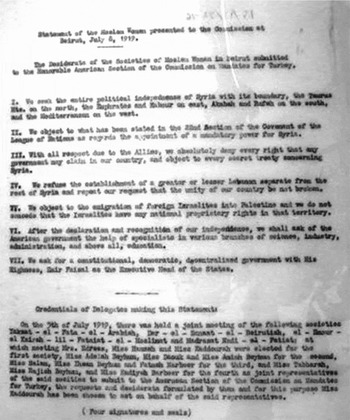
An English translation of a petition in Arabic that was submitted to the American King–Crane Commission, which toured the Levant in search of a political solution for former Ottoman regions, serves as an excellent example. The petition includes details of a joint meeting of four Arab women's societies that took place on 5 July 1919 in Beirut and that led to its submission to the authorities (Figure 1).Footnote 53 In the meeting, each of these societies, which were probably established during World War I, chose three representatives.Footnote 54 The translation of the petition is preserved in the collections of Oberlin College though it is in poor condition. The original Arabic version, which we do not possess today, ended with the stamps and signatures representing these four women's societies, which chose Ibtihaj Kedoura to act on their behalf. Their petition was submitted to the King–Crane Commission on 8 July 1919, a few days after the meeting, and was translated into English by the King–Crane auxiliary personnel. The content of the petition is similar to many other King–Crane petitions submitted en masse by men, which the petitioners copied word for word. In a rather demanding tone that differs greatly from the humble and submissive tone characteristic of earlier petitions to the sultan, the women asked that the Powers recognize the independence of Syria and emphasized their objection to Article 22 of the Covenant of the League of Nations and the separation of Lebanon from Syria. In addition, they appealed for aid from the American nation in establishing a democratic constitution and in designating Amir Faysal as head of the country.
Letter by the Muslim Women's Associations in Beirut, King-Crane Commission Digital Collection, Oberlin College Archives, accessed 7 July 2015, http://dcollections.oberlin.edu/cdm/singleitem/collection/kingcrane/id/1863.

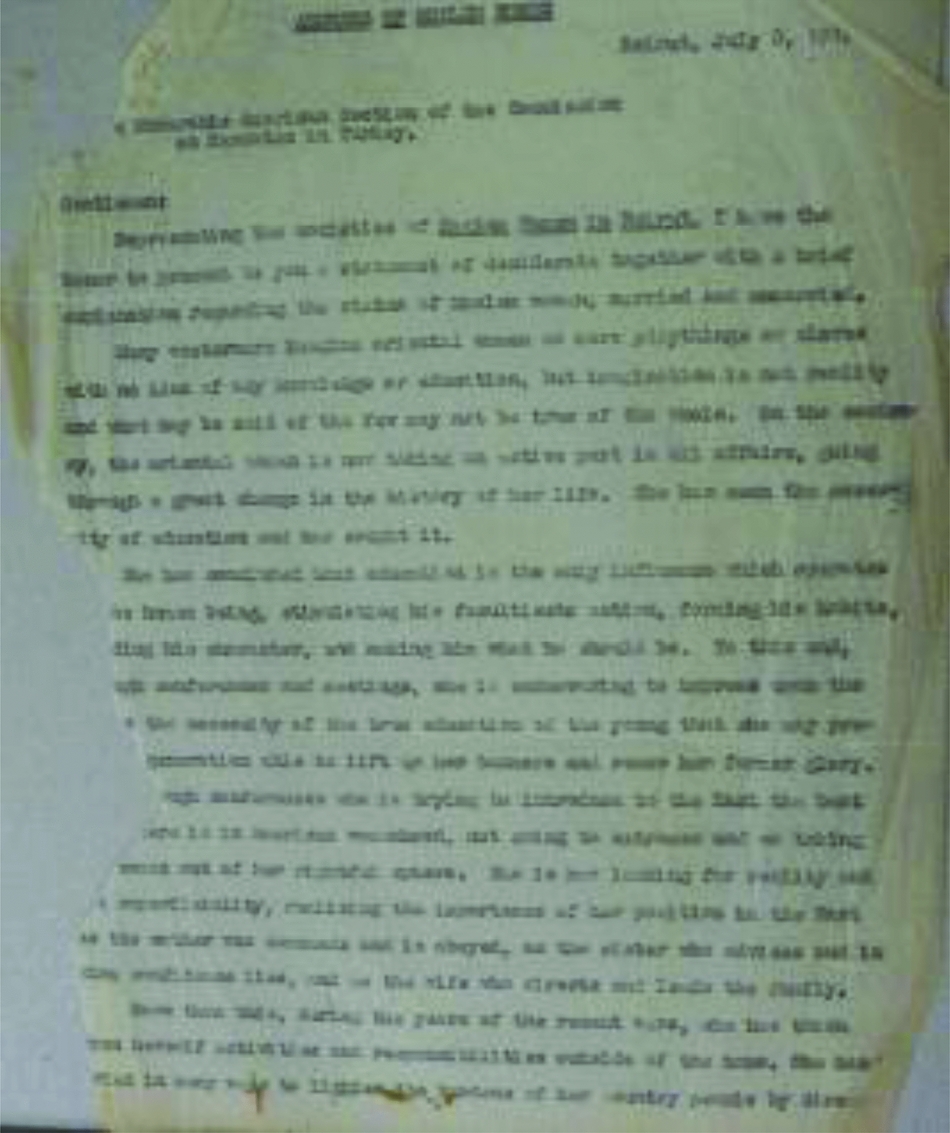
Interestingly, however, following a decision by the societies present at the meeting, Ibtihaj Kedoura also wrote on their behalf a personal petition (but signed at bottom only by her) with political overtones to the commission (Figure 2).Footnote 55 This petition was apparently written in Arabic and later translated into English. As an educated woman, Ibtihaj Kedoura likely wrote it alone, expressing her own opinion openly and loudly. Her petition is one of the few sent to the King–Crane Commission that were signed by an individual rather than by a group of people. It broke with the pattern of other petitions submitted to the committee in its style, content, wording, and argumentation as well. Moreover, the petition clearly encapsulates two voices: the muted voice of Syrian women fighting for their place in a new national society; and the dominant voice of the general public in Greater Syria, which was fighting for Syrian national independence. In fact, only through this dominant voice—advocating the right for Syrian independence—was Kedoura able to interweave her own personal voice and the general voice of women. In other words, and as is clear from the beginning of the petition, she spoke in subrhetorical style, not only in her own name but also “in the name of the societies of Muslim women in Beirut, both married and unmarried,” while using the national discourse to elevate her own agenda and that of women in general.
The first page of Ibtihaj Kedoura's letter, King-Crane Commission Digital Collection, Oberlin College Archives, accessed 7 July 2015, http://dcollections.oberlin.edu/cdm/compoundobject/collection/kingcrane/id/1459.
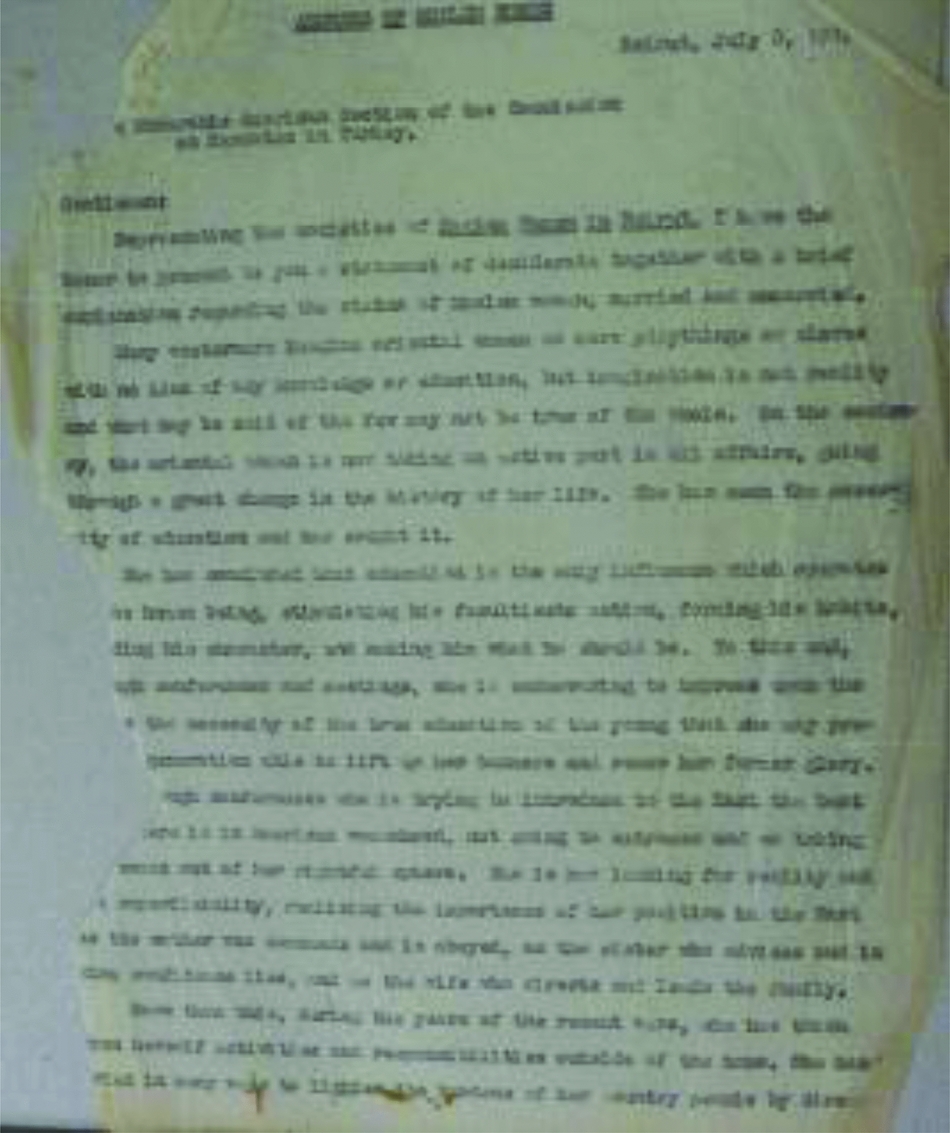
Kedoura also used her petition to draw attention to the way Eastern women were perceived in the West. She complained that Westerners tend to see Eastern women as “mere playthings or slaves with no idea of any knowledge or education.” This view, she added, is merely a figment of the “imagination [which] is not reality, and what may be said of the few may not be true of the whole.” Kedoura emphasized that Eastern women played a major role in changing their own history, and that education was critical to their success. These comments were directed not only to the commission, but also to Kedoura's own society, which she intended to influence. By showcasing Syrian women's efforts in support of the Syrian nation, she delivered a call for the education of women in Syrian society. Kedoura's letter also incorporated several other feminist aims and discourses related to the “woman question” during her time. Describing the women who had begun to engage in activities and responsibilities outside of the home, she wrote that,
we feel strongly the critical nature of the present moment with its power to send us either backward or forward…for the first time [we have] disregarded the custom which bars the oriental woman from participating in political affairs in the hope of achieving that liberty and independence upon which hearts are set.
In parallel, she stressed the woman's place at home as a “sister who advises” and as a “wife who directs the family.”
Kedoura's personal petition illustrates the difference between Ottoman and post-Ottoman women's petitions. In place of the traditional, pleading, and passive tone of petitions to the sultan in Istanbul common until the end of the 19th century, Kedoura deployed an active and demanding style—a shift part and parcel of women's incorporation into the public discourse, and hence the national discourse.Footnote 56 Kedoura signed the petition not with reference to male relatives, but in her own name, even though she claimed to speak on behalf of a large group of women. Finally, rather than making first-person demands so typical of women's petitions during the Ottoman era, Kedoura wrote in ideological and national terms and attempted to educate both a Western and a Syrian audience on the state of Eastern women, expressing criticisms of both. Kedoura's voice is one example of a woman's voice in Greater Syria at the time that challenged the interpretations of the dominant national discourse while constituting a dialogue between local women and Western representatives.
Another petition submitted to the King-Crane Commission in the name of a large group of women was signed by the “patriotic and intellectual Turkish women.”Footnote 57 It also dealt with political and national agendas and reflected the changes taking place in the post-Ottoman period. Submitted on 1 August 1919 in Ottoman Turkish, the petition—the original of which we possess with its English translation—stressed to the commission that the women sought peace and prosperity for both Muslims and non-Muslims. Most of the petition's eight points deal with humanistic global issues such as hunger, children's suffering, and bloodshed. It also demands that Constantinople be made part of Turkey and vehemently opposes an Armenian state within Turkey. The women use the expression “We, Turkish women, demand …” and “We, Turkish women, protest …” repeatedly.Footnote 58 The language of the petition echoes the language of women's writing in the press at the time, which is not surprising given the new public venues to express oneself in the press in the post-Ottoman period. In fact, Syrian women were not the only women in the former Ottoman territories at this time to submit political petitions that reflected women's opinions.Footnote 59
In the early 1920s Syrian and Lebanese women believed that their contribution to the national cause would eventually furnish them full citizenship rights. Some grounded their claims on ideas of the Islamic modernists and the legacy of pre-Islamic and early Islamic Arab heroines, arguing that women's exclusion from civic affairs violated the true spirit of Islam. Nonetheless, in the years that followed, under the French Mandate and later with Lebanese and Syrian independence in the 1940s, women were deprived of their rights—especially political rights—as priority was given to national goals.Footnote 60 In fact, women's advocates faced strong opposition, especially from Muslim conservatives and populist circles. When the Lebanese and Syrian constitutions were drafted in 1926 and 1930, respectively, they included no provision for female suffrage. And yet, as Beth Baron has argued:
[I]n spite of the obstacles, women devised their own forms and forums for shaping the national polity. In looking at women's political culture, a dynamic picture emerges as women alternated between and among partisan, feminist, Islamist, social and other politics in the name of nation-building.Footnote 61
Women's petitions, even when submitted in small numbers, were one facet of this political culture.
CONCLUSION
Compared to men, women do not seem to have submitted many petitions to Istanbul during the Ottoman era. Not surprisingly, petitioning largely remained a male domain. The limited number of women's petitions found in the archives are nonetheless significant, for they indicate a general tendency by women to avoid using the mechanism of petitioning the imperial center. Those women who did petition the imperial center did so as a last resort, when all other avenues for obtaing concessions or compromises had failed. At times petitioning could lead to the review of a legal issue based on principles less dogmatic and strict than those based on shariʿa limitations. Most women's petitions had to do with issues such as inheritance, property, marriage, and divorce. Changes in women's petitions occurred only gradually, though they were particularly noticeable after the 1908 revolution and the breakup of the Ottoman Empire.
The impact of World War I, the national struggles, and changing political and social circumstances is visible in the patterns of petitioning, as well as in the structure and content of petitions. The general shift from traditional to political petitions also created a short-lived window of opportunity for women to submit double-voiced petitions. Taking advantage of new opportunities afforded them by the new political reality, women used petitioning, in addition to other mechanisms, to advance their status and their own agendas within the frame of the national cause. Double-voiced petitions, such as that by Kedoura discussed above, allowed women to submit petitions as part of the dominant national discourse while expressing their muted voice—the voice of women fighting for their own place in the nationalist movement and the emerging national society.
The rare petitions that women submitted helped them challenge religious law in grey areas, make protests, become visible, and let their voices be heard. Women's petitions should thus be included in the canon of sources for epistolary research on women's or gender history, despite all of the methodological difficulties associated with them. As Christa Hämmerle has noted, women's petitions are located “at the interface between the normative regime and social practice, politics and the individual, the public and the private.”Footnote 62 Women's petitions shed light on how women managed to act privately in the public sphere, and how their techniques were drawn from their changing societies and realities.
Finally, historical research on petitions is generally based on evidence from state archives, but “at times [this research] may have a tendency to produce isolated micro histories detached from the larger social and historical context.”Footnote 63 In other words, petitions can be an important source for studying the discourses of marginalized groups in society, such as women. Women's petitions can provide invaluable insights into women's place in the family and society, gender relations, and women's role in the process of nation-building.