INTRODUCTION
Host-parasite checklists are fundamental tools in wildlife parasitology. Typically, such a checklist consists of the inventory of all parasite species found in each species of host belonging to a higher taxon, such as fish or birds, in a given geographical region; usually, this is accompanied by the reciprocal inventory, for each parasite species, of host species known to harbour them. Checklists are compiled from all existing surveys or other observational reports of parasites in wild hosts available from the literature at the time of compilation. For example, Moravec (Reference Moravec2001) produced a checklist of parasites of freshwater fishes from the Czech and Slovak Republics, and Paredes-León et al. (Reference Paredes-León, Garcia-Prieto, Guzmán-Cornejo, León-Règagnon and Pérez2008) assembled a checklist of the parasites of amphibians and reptiles from Mexico. Host-parasite checklists are major contributions to parasitology for at least two reasons. First, they are the go-to resource for anyone contemplating a study of parasitism in a wild host population, as a guide to the kinds of parasites one might expect to find, or for anyone that comes across parasites as part of other types of studies, to provide clues regarding parasite identification. Second, they are often used as sources of data in comparative studies of the variation in parasite species richness across host species (e.g. Price and Clancy, Reference Price and Clancy1983; Gregory et al. Reference Gregory, Keymer and Harvey1991; Sasal et al. Reference Sasal, Morand and Guégan1997; Hughes and Page, Reference Hughes and Page2007; Quiroz-Martinez and Salgado-Maldonado, Reference Quiroz-Martinez and Salgado-Maldonado2013), or variation in host specificity among parasite species (e.g. Poulin, Reference Poulin1992; Edwards and Vidrine, Reference Edwards and Vidrine2006; Palm and Caira, Reference Palm and Caira2008).
However, the usefulness of checklists depends on their completeness, that is, on how reliably they capture the full spectrum of host–parasite associations occurring in a particular region. All existing checklists are no doubt far from complete, but some are probably much further from completion than others. We can think of a host-parasite checklist as a bipartite interaction network, in which a set of P parasite species interact with a set of H host species (Poulin, Reference Poulin2010). Each possible link between a parasite species and a host species represents a potential host–parasite association. For each network, we have a number of known links, L, representing the total number of host–parasite associations that have been observed, with the maximum number of possible links equal to P × H. The true number of existing links lies somewhere between L and P × H, and it is its distance from L that determines how incomplete a particular checklist is.
There are at least three ways of determining whether the host-parasite checklist of a particular region is near completion. First, across well-sampled local networks, the proportion of possible links that are actually realized, that is the connectance of the network or L/(P × H), decreases exponentially with increasing numbers of host or parasite species per network (Poulin, Reference Poulin2007; Mouillot et al. Reference Mouillot, Krasnov, Shenbrot and Poulin2008). This pattern seems to apply universally to all kinds of ecological networks (Martinez, Reference Martinez1993; Stouffer et al. Reference Stouffer, Camacho, Guimerà, Ng and Amaral2005). A large fraction of possible links is usually realized in species-poor networks, whereas this fraction becomes very small in species-rich networks. By applying the connectance vs species richness relationship to a large set of host-parasite checklists, it should be possible to identify checklists with greater connectance than expected for their species richness, and those with lower connectance. The former should represent relatively more complete checklists than the latter, as they include more host–parasite associations than one would expect for a typical network consisting of that number of species.
Second, the host-parasite networks that are presented as checklists are assembled piece by piece over time. After the first host–parasite association is reported in the literature for a given region, the number of known associations will grow over time until, in theory, the total number of existing host–parasite associations have been found. The rise in the cumulative number of known host–parasite associations as a function of time should follow a sigmoidal function and reach an asymptote, with the rate at which new ones are discovered decreasing as we are left with increasingly difficult ones to find (i.e. highly host-specific parasites occurring at very low prevalences). This is exactly the same situation as seen in species discovery: finding and reporting new host-parasite links follows the same temporal dynamics as finding and reporting new species. Thus, the methods long used to extrapolate species diversity within a large taxon or an area from species accumulation curves (Soberón and Llorente, Reference Soberón and Llorente1993; Dolphin and Quicke, Reference Dolphin and Quicke2001; Cabrero-Sañudo and Lobo, Reference Cabrero-Sañudo and Lobo2003; Bebber et al. Reference Bebber, Marriott, Gaston, Harris and Scotland2007) can be applied to host-parasite networks, to extrapolate the asymptote in the rising number of known host–parasite associations. Extrapolation is only possible, however, if the accumulation curve has passed its inflexion point, that is, if the rate at which new host-parasite links are reported has passed its maximum and started to slow down (Bebber et al. Reference Bebber, Marriott, Gaston, Harris and Scotland2007). Checklists for which this is the case are not only closer to completion than those for which it is not, but we may also estimate the total number of existing (known and unknown) host-parasite links in those checklists.
Third, after a particular host–parasite association has been reported in the literature for the first time, it is likely to be observed and reported again in subsequent years. Assuming that observing and reporting host–parasite associations are frequency-dependent processes, determined mostly by the respective abundances of hosts and prevalences of parasites in a region, a positive relationship should develop between how often a given association has been reported and the time since its original discovery. The most common host–parasite associations should usually be among the first ones to be found, and should also be reported frequently thereafter. Checklists in which this inevitable relationship is either weak or non-existent are most likely based on very incomplete data, whereas those where this relationship emerges clearly are likely based on data from a region where the target host taxa have been well and repeatedly sampled for parasites.
Here, we use the above three approaches to test the completeness of multiple host-parasite checklists, involving metazoan parasites and vertebrate hosts. We show that most checklists perform poorly in all three tests of completeness; very few pass two of the three tests, and none pass all three tests. Our analysis provides solid grounds to discard most host-parasite checklists as potential sources of comparative data, because they are far from presenting a true and complete picture of natural host–parasite interactions.
MATERIALS AND METHODS
Data extraction from checklists
An internet search, using the keywords ‘host parasite checklist’ and the search engine Google, was conducted to find relevant checklists. Additional searches were conducted by replacing ‘host’ with ‘fish’, ‘amphibian’, ‘reptile’, ‘bird’, or ‘mammal’, and by replacing ‘parasite’ with ‘helminth’. Of all relevant checklists found by the searches, only those that could be downloaded as PDF files or those that were available through the University of Otago library were used in the present study. We focused only on checklists covering broad host groups, such as fish or mammals, and not those restricted to host families. Although the final set of checklists does not include all published ones, it is nevertheless a large and representative sample of available ones, ranging from short (probably far from completion) to very long (possibly much closer to completion) lists of host–parasite associations.
When a checklist was updated by a new one published later on the same host higher taxon from the same region, the two were combined into a single network, with care taken to account for synonymies and changes in species nomenclature, as well as what only appeared as distinct species due to obvious spelling mistakes. If a checklist combined data for different higher taxa of hosts (e.g. amphibians and reptiles), or in the case of fish hosts combined those from freshwater and marine (including brackish waters) habitats, then these subsets were separated into different networks as they represent different host-parasite faunas. We only considered metazoan parasites, though some checklists focused on helminth parasites only; protozoan parasites were covered by some checklists but are not included in our analyses. We excluded all host-parasite combinations (i) observed only through experimental infection, or (ii) in which one of the two participants was not identified by a full Latin binomial name, as species identified only to genus or family level were possibly the same as those fully identified in an association with the same antagonist. We included the host–parasite associations for which the compilers of some checklists commented that misidentification of the parasite by the original authors was a possibility, since these amounted to only a small fraction of the total number of associations reported. When the authors of a checklist treated host subspecies or hybrids between host species as distinct hosts, so did we. Finally, in the case of helminths with complex life cycles, we treated different life stages of the same species, in the very rare cases in which they interacted with the same host species, as different parasite species if transition from one stage to the other required a transmission event (i.e. metacercaria and adult trematodes linked by trophic transmission) but not if that transition only required within-host growth (L3, L4 and adult stages in nematodes).
For each network, we recorded the number of parasite species, P, the number of host species, H, the number of observed host–parasite associations or links, L, and the connectance or L/(P × H). For each host–parasite association in each network, we recorded the year in which it was first recorded, and the number of published reports of that association.
Data analysis
First, we tested whether connectance, L/(P × H), decreases exponentially with increasing numbers of host and parasite species (P + H) per network. A better fit was achieved in log-log space, where the relationship becomes linear and negative. We therefore regressed log [L/(P × H)] against log (P + H) and used the residuals of this regression to identify networks with greater (positive residuals) or lower (negative residuals) connectance than expected for their species richness. Initially, we performed separate regressions for networks with four different host types: freshwater fish, marine fish, herptiles (reptiles or amphibians) and endotherms (birds or mammals). However, as the slopes of the different regressions all fell within each other's 95% confidence intervals, in the end a single regression across all networks was used.
Second, to estimate the total number of host-parasite links in each network, we adopted the approach of Bebber et al. (Reference Bebber, Marriott, Gaston, Harris and Scotland2007), who use a generalized linear model with quasipoisson error to fit the model E(L t ) = k(L tot − L t−1), where E(L t ) is the expected number of links discovered in year t, L tot is the total number of existing links, L t−1 is the cumulative number of links described by year t−1, and k is a parameter to be estimated. We also considered a non-linear form for k, where k = b + c L t−1 (see Bebber et al. Reference Bebber, Marriott, Gaston, Harris and Scotland2007). The total number of existing host-parasite links or the bounds of its 95% confidence interval could not be estimated reliably in cases where the cumulative increase in the known number of records was erratic over time. In addition, we considered an estimated total invalid when its confidence interval was nonsensical, i.e. when its lower bound was lower than the currently known number of links and/or its upper bound was infinity.
Third, in each network, the relationship between the number of published reports mentioning a host–parasite association and the time elapsed, in years, between the year in which it was first recorded and the year of publication of the checklist, was tested across all host–parasite associations using Spearman rank correlations. A nonparametric test was necessary because data on the number of reports per host–parasite association are highly skewed and cannot be normalized by any type of transformation. The magnitude of the correlation coefficient, r s, provided a measure of the strength of the relationship.
RESULTS
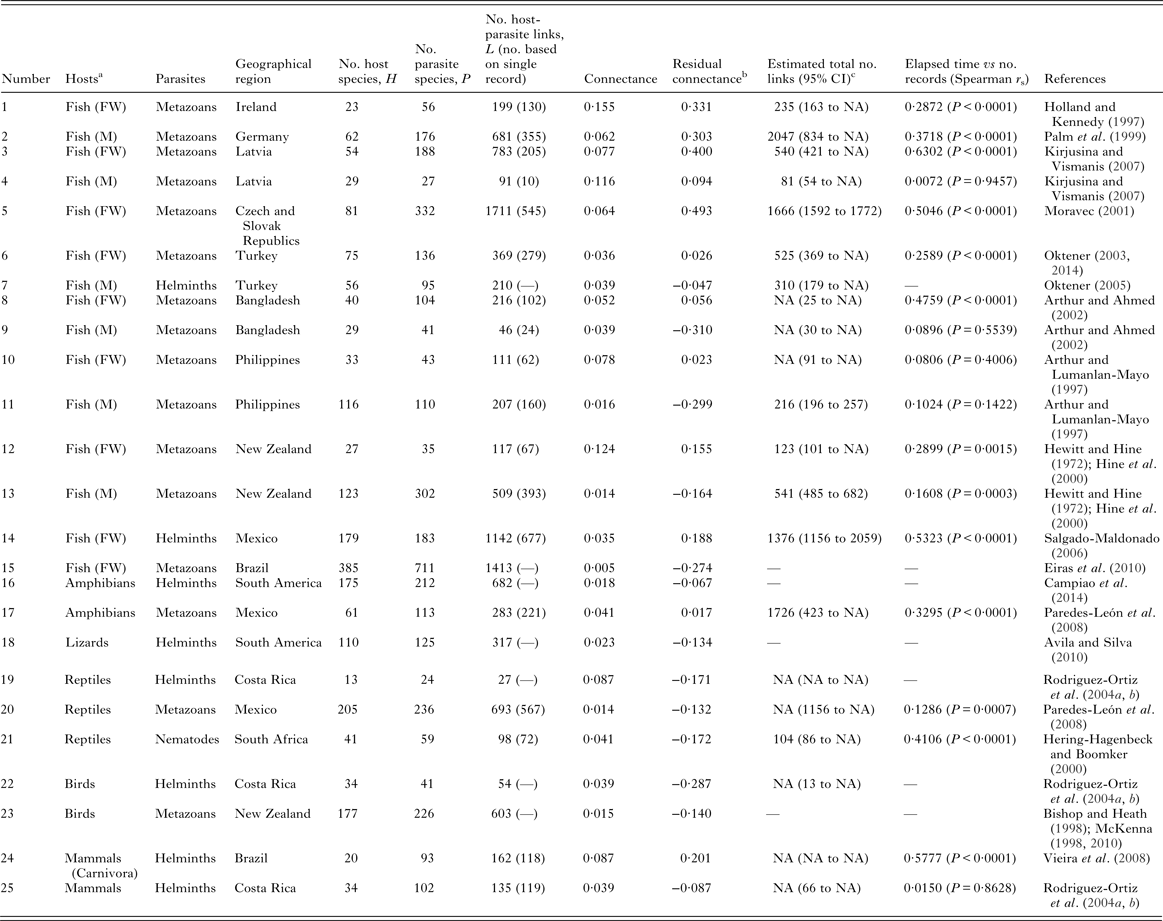
We obtained information from 18 (some with updates published after the original) host-parasite checklists from all over the world, published between 1972 and 2014, from which we derived 25 separate host-parasite networks (Table 1). These involved mostly fish hosts, and consisted of between 13 and 385 host species, 24 and 711 parasite species, and 27 and 1711 host-parasite links (Table 1). Across the networks, the number of host species correlated strongly with the number of parasite species per network (both log-transformed: R 2 = 0·728, N = 25, P < 0·001). Data on the year in which host–parasite associations were first recorded and/or the number of published reports of each association were unavailable, unclear, or not given in a way that was clearly linked to individual records, for 7 of these networks.
Summary data on the 25 host-parasite networks, derived from published checklists, included in the present analysis

a FW = freshwater, M = marine.
b From the linear regression of log connectance against log total number of host and parasite species per network.
c NA = calculation of the estimate or the bounds of its CI was not possible.
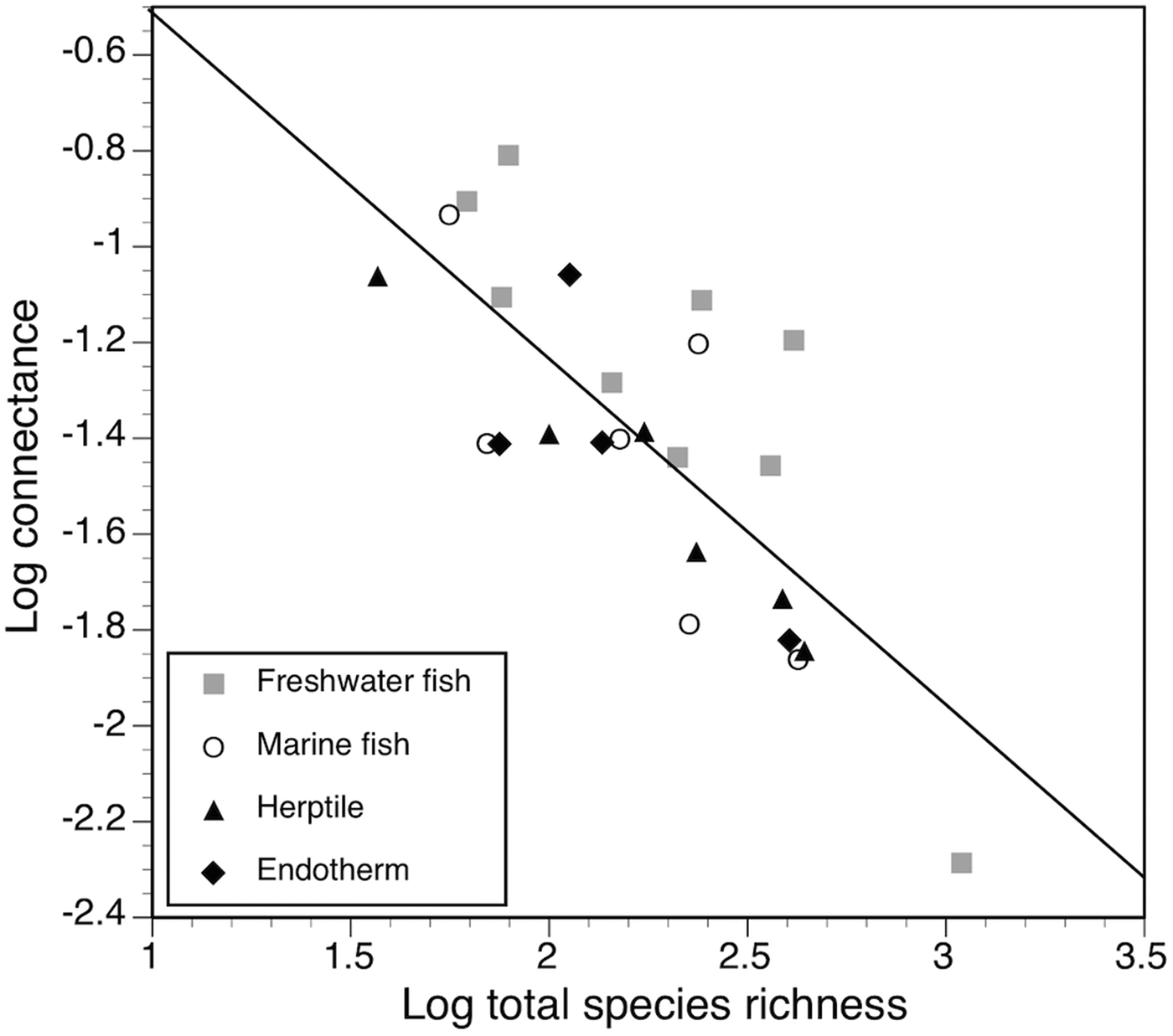
Across networks, connectance clearly decreased with increasing numbers of host and parasite species per network (R 2 = 0·594, N = 25, P < 0·001). The more host plus parasite species in a network, the smaller the proportion of possible host-parasite links that have been recorded (Fig. 1). The 4 networks with the clearly largest residual values of connectance, i.e. with the most observed links relative to what is expected from their species richness, were those for the freshwater fishes of the Czech and Slovak Republics, Latvia and Ireland, and the marine fishes of Germany (Table 1).
Relationship between connectance and the total number of host and parasite species per network, in log-log space, among the 25 host-parasite networks. Different symbols represent networks with different host types: freshwater fish, marine fish, herptiles (reptiles or amphibians) and endotherms (birds or mammals). The line represents the following regression equation: log connectance = −0·762 (log total richness) + 0·304.

The cumulative increase over time in the known number of host–parasite associations showed little signs of slowing down in most cases. Also, it was often erratic, with significant monographs often causing a sharp spike in the year they were published, followed by few or no new findings for several years (see Fig. 2 for examples). As a consequence, the asymptote of the curve, corresponding to the total number of existing associations, could only be calculated with credible 95% confidence intervals for a single network out of the 21 for which data allowed this to be attempted (Table 1). This network was the one involving associations between helminths and freshwater fishes of Mexico, in which 1142 host–parasite associations are currently known and the total is estimated at 1376 (95% CI = 1156 to 2059).
Cumulative number of known host–parasite associations as a function of time, for metazoan parasites of Irish freshwater fish (period 1844–1997), and helminth parasites of Mexican freshwater fish (period 1936–2006).

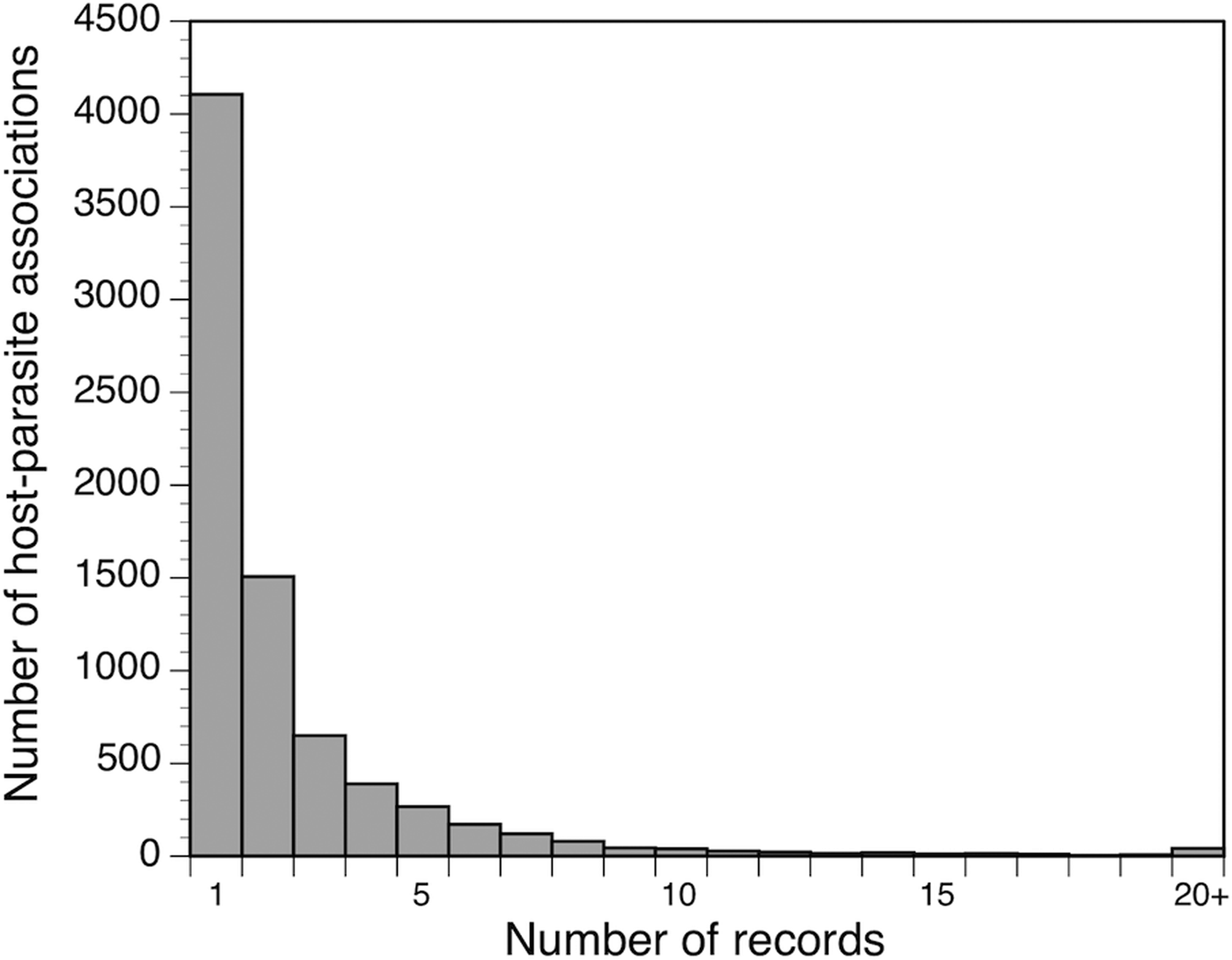
In the majority of networks, more than half of host–parasite associations have only ever been recorded once (Table 1). Across all networks pooled, about 55% of host–-parasite associations have been recorded a single time, and most of the others fewer than 5 times (Fig. 3). The relationship between the number of published reports mentioning a host–parasite association and the time elapsed between the year of its first record and the year of publication of the checklist was positive and significant in 13 of the 18 networks in which it could be tested (Table 1). In all cases, there were associations first observed long ago that were never reported again, though most single records tended to be recent ones (see Fig. 4 for examples). However, the relationship between elapsed time and the number of published records was only strong (r s > 0·5) in 4 networks. These were the networks for the freshwater fishes of the Czech and Slovak Republics, Latvia and Mexico and the mammals of Brazil (Table 1).
Frequency distribution of the number of published records per host–parasite association, across all 7553 associations pooled from 18 host-parasite networks (see Table 1 for list of networks).

Number of published records mentioning a host–parasite association as a function of the time elapsed between its first report and the year of publication of the checklist, across all known host–parasite associations for freshwater fish of Latvia and mammals of Brazil. The diameter of each point is proportional to the number of associations with those values (see scales).

DISCUSSION
Host-parasite checklists are essential resources that provide some expectations of the parasites one may find in a particular host species during a parasitological investigation. Checklists have also been used frequently as sources of data in comparative studies of either the variation in parasite species richness across host species, or variation in host specificity among parasite species (e.g. Price and Clancy, Reference Price and Clancy1983; Gregory et al. Reference Gregory, Keymer and Harvey1991; Poulin, Reference Poulin1992; Sasal et al. Reference Sasal, Morand and Guégan1997; Edwards and Vidrine, Reference Edwards and Vidrine2006; Hughes and Page, Reference Hughes and Page2007; Palm and Caira, Reference Palm and Caira2008; Quiroz-Martinez and Salgado-Maldonado, Reference Quiroz-Martinez and Salgado-Maldonado2013). At the time of their publication, they typically provide an exhaustive list of all host–parasite associations known to date from a given region. However, that does not mean a complete list of all existing host–parasite associations in that region. Here, we used three approaches to estimate how close to complete were the 25 checklists for which we had data. None of the 25 networks passed all three tests; however, those involving the parasites of freshwater fishes in the Czech and Slovak Republics, Latvia and Mexico passed two of the tests.
The first approach consisted in treating host-parasite checklists as interaction networks, and determining whether the proportion of possible links that are actually realized, i.e. the connectance of the network, decreased with increasing total species richness. Local communities of hosts and their associated parasites are increasingly depicted and analysed as bipartite networks of interacting species to provide new insights about their structure (e.g. Vázquez et al. Reference Vázquez, Poulin, Krasnov and Shenbrot2005; Lima et al. Reference Lima, Giacomini, Takemoto, Agostinho and Bini2012; Bellay et al. Reference Bellay, de Oliveira, Almeida-Neto, Mello, Takemoto and Luque2015). We found that host-parasite checklists, although covering larger spatial scales and combining species that may not occur in actual sympatry, display some of the same properties as local interaction networks. For instance, there was a strong positive correlation between the number of host species and the number of parasite species per network, a pattern commonly observed among local host and parasite communities (Kamiya et al. Reference Kamiya, O'Dwyer, Nakagawa and Poulin2014). Network connectance also decreased with increasing total host and parasite species richness, another pattern found across networks based on local communities (Poulin, Reference Poulin2007; Mouillot et al. Reference Mouillot, Krasnov, Shenbrot and Poulin2008). In this relationship, observed connectance values that are higher than predicted ones indicate networks in which a greater proportion of host-parasite links has been observed than in a typical network consisting of that many host and parasite species. These are therefore more likely to approach a complete inventory of existing host–parasite associations. The networks for the freshwater fishes of the Czech and Slovak Republics, Latvia and Ireland and the marine fishes of Germany had distinctly higher positive residuals in the connectance-vs-richness regression than other networks. Although this suggests that a large proportion of existing host-parasite links have been discovered in those networks, it may also be that they consist of parasite species with low host specificity or host species compatible with many parasites, leading to unusually well connected networks for their size. Nevertheless, high positive residuals in the connectance-vs-richness regression are unlikely to indicate poorly-known networks.
The second approach we used assumed that the discovery of host–parasite associations in a region follows the same temporal pattern as that of species, with the rising cumulative known number eventually slowing down toward an asymptote as the total is approached. This should apply to the temporal discovery of any finite set of entities with varying probabilities of being observed, assuming a roughly constant research effort with occasional spikes (i.e. publication of major monographs). Using a method to extrapolate this asymptote based on the cumulative rise in known associations over time (Bebber et al. Reference Bebber, Marriott, Gaston, Harris and Scotland2007), a credible estimate of the total number of existing host–parasite associations, with a proper confidence interval, could only be obtained for the network involving helminths of Mexican freshwater fishes. This may be because the discovery of parasite species in Mexican freshwater fish is itself at a very advanced stage (Pérez-Ponce de León and Choudhury, Reference Pérez-Ponce de León and Choudhury2010). The analysis suggests that well over half, possibly more than 90%, of host–parasite associations have already been documented in this network, providing compelling evidence that this checklist is the only one considered here that comes close to presenting a relatively complete picture of host–parasite interactions in nature. Of course, this applies only to the host species covered by the checklist, and not to other fish species in the Mexican fauna that have not yet been investigated for parasites; their associations with parasites remain unknown. Also, it applies only to the drainage basins that have been sampled to date. The relative completeness of the network of associations among the currently known species does not mean that there are no more parasite species to be discovered within the Mexican freshwater fish fauna. Indeed, new parasite species continue to be found (see updates in Salgado-Maldonado and Quiroz-Martinez, Reference Salgado-Maldonado and Quiroz-Martinez2013). However, among sampled hosts and parasite species known to date, the web of existing associations is well-known.
The final method we used made the plausible assumption that the most common host–parasite associations, i.e. those involving abundant host species and prevalent parasites, should tend to be among the first ones to be found, and should thereafter also be reported frequently. From this, we expected to find positive correlations between the time elapsed since an association was first observed and the total number of records of that association published since. We indeed found positive correlations in most networks, though these were only strong in four networks: those for the freshwater fishes of the Czech and Slovak Republics, Latvia and Mexico and the mammals of Brazil. These are the networks conforming most closely to the frequency-dependent pattern of temporal reporting expected a priori from situations where a regional group of hosts have been well-studied. Interestingly, our analysis also revealed that more than half of known host–parasite associations across all networks studied here have only been reported once; this fraction is even higher in several networks, surpassing two-thirds in those involving non-fish hosts. Thus, most host–parasite associations are reported once, and never again documented in the literature.
The last two methods we used to test for completeness could not be applied to several host-parasite checklists because these did not clearly identify all published reports documenting the occurrence of each host–parasite association. This made it impossible to obtain the year in which an association was first reported, or the total number of times it was reported. We urge future compilers of checklists to include this information clearly; it is not only valuable in its own right, but can also be used to ascertain how far from completion the current inventory is. The other piece of information lacking from almost all checklists is the sampling effort involved in the discovery of host–parasite associations. The original records almost invariably specify the number of host individuals examined for parasites; adding this information to each entry during the compilation of a checklist would allow other ways of assessing its completeness.
Admittedly, our set of checklists was biased toward those involving fish hosts (15 out of 25 networks considered here). It is possible that some of our findings would have been slightly different had we obtained more checklists of parasites from birds or mammals. Also, our analysis focused on checklists compiled for large areas (country or continent) and for broad taxonomic groups, such as vertebrate classes or all metazoans or helminths. It is very likely that checklists restricted to smaller spatial or taxonomic scales attain greater levels of completeness (e.g. Martinez-Aquino et al. Reference Martinez-Aquino, Mendoza-Palmero, Aguilar-Aguilar and Pérez-Ponce de León2014). Nevertheless, completeness should be tested, and not assumed.
There is one obvious reason why no current checklist can be complete: the recent application of molecular genetics to species identification is revealing a substantial cryptic diversity of parasites (Pérez-Ponce de León and Nadler, Reference Pérez-Ponce de León and Nadler2010; Poulin, Reference Poulin2011). Cryptic parasite species are morphologically indistinguishable from each other, and can only be separated using molecular markers. Most of the older records on which checklists are based have relied exclusively on morphology for species identification. Nevertheless, if we accept parasite morphospecies as true ‘species’, it is clear that most existing checklists do not present a summary of host–parasite interactions that is remotely close to what really exists in nature. In our analysis, no checklist out of 25 passed all three of our tests for completeness, and only three (those for the parasites of freshwater fishes in the Czech and Slovak Republics, Latvia and Mexico) passed two of the tests. By virtue of synthesizing information from multiple available records into a single list all host-parasite checklists are extremely useful. However, their usefulness has limits: they should not be used as reliable sources of data on parasite species richness per host species, or data on host specificity of different parasite species, unless it can be shown that the information they capture is relatively close to a full representation of natural host-parasite communities. Based on the present analysis, we suspect most existing checklists cannot be used as data sources for such analyses.
ACKNOWLEDGEMENTS
We thank Gerardo Pérez-Ponce de León for comments on an earlier version of the manuscript. Some of the ideas in the present study have benefitted from useful discussion within the Macroecology of Infectious Disease Research Coordination Network (funded by NSF/NIH/USDA DEB 131223), and the Otago Ecological Parasitology Group.
FINANCIAL SUPPORT
This study was funded by an internal grant from Otago University's Department of Zoology to R. P.