





Perinatal mental health problems affect around 1 in 5 women, yet it is estimated that only 30–50% of women with such problems are identified in high-income countries, Reference Gavin, Meltzer-Brody, Glover, Gaynes, AW and Milgrom1 and only 7% referred to specialist care. 2 In the United Kingdom (UK), prevalence rates for anxiety disorders vary from 25.5% in early pregnancy to 19% at 6 weeks postpartum, with obsessive–compulsive disorder (OCD) and generalised anxiety disorder being the most common. Reference Ayers, Sinesi, Meades, Cheyne, Maxwell and Best3 Some women also experience pregnancy-specific anxiety, involving worry about the birth itself or health of the child. Reference Huizink, Mulder, Robles de Medina, Visser and Buitelaar4 Anxiety during pregnancy has been linked to adverse outcomes including preterm birth, low birth weight, poor maternal–infant bonding and poor child emotional and behavioural adjustment. Reference Ding, Wu, Xu, Zhu, Jia and Zhang5
Most women with perinatal mental health problems do not access care, particularly those with mild to moderate problems Reference Bina6,Reference Khan7 or with less recognised conditions such as anxiety, OCD or post-traumatic stress disorder. Reference Challacombe and Wroe8,Reference Ayers, Wright and Thornton9 Health service use for perinatal mental health problems may be influenced by various factors, such as whether anxiety is identified, the availability and accessibility of services and their acceptability to women. In non-perinatal populations, anxiety is generally linked to higher health service use although some studies report inconsistent or lower use. Reference Horenstein and Heimberg10 Similarly, research in perinatal populations shows mixed results. Studies from the USA, Canada and Australia have found no link between perinatal anxiety and primary healthcare use for infants. Reference Farr, Dietz, Rizzo, Vesco, Callaghan and Bruce11–Reference Ward and Pratt13 Conversely, large UK and US data-set studies indicate that parents with common mental illnesses are more likely to use primary and secondary care services for their children. Reference Hope, Osam, Kontopantelis, Hughes, Munford and Ashcroft14,Reference Sills, Shetterly, Xu, Magid and Kempe15
To improve access to care in the UK, the National Health Service (NHS) has invested significantly in specialist services. UK policy advocates for integrated physical and mental health services, 16 with recently developed psychiatric mental health (PMH) care pathways outlining referral services based on PMH problem severity. 17 However, differences among the UK devolved nations in models of PMH care have developed in response to local priorities. At the community level in Scotland, for example, different models of service provision have been configured in relation to population density to accommodate rural and low-birth rate populations, whereas in England at community level, emphasis has been placed on expansion of services up to 2 years postpartum. Reference Cantwell18 Despite these efforts, there is little information on the actual use of these services, especially among women with anxiety. Most literature on PMH care in the UK focuses on service development and implementation or women’s experiences, predominantly regarding depression. Reference Morrell, Sutcliffe, Booth, Stevens, Scope and Stevenson19 A qualitative study of 17 women with perinatal anxiety highlighted service-level barriers and health professionals’ emphasis on depression as factors negatively impacting help-seeking for anxiety. Reference Oh, Chew-Graham, Silverwood, Shaheen, Walsh-House and Sumathipala20 Many women may hesitate to report anxiety due to stigma Reference Jankovic, Parsons, Jovanović, Berrisford, Copello and Fazil21 and fear of repercussions, Reference Schmied, Langdon, Matthey, Kemp, Austin and Johnson22 and this may be more pronounced in socially disadvantaged and ethnically diverse communities. Reference Fernandez Turienzo, Newburn, Agyepong, Buabeng, Dignam and Abe23 One meta-review identified numerous barriers and facilitators to PMH care access, spanning individual, health professional, interpersonal, organisational, political and societal levels, as well as across care pathways, Reference Webb, Uddin, Ford, Easter, Shakespeare and Roberts24 although again the evidence in this and other literature predominantly focused on depression. Reference Webb, Uddin, Ford, Easter, Shakespeare and Roberts24–Reference Ford, Shakespeare, Elias and Ayers26
Research is therefore needed to understand how women with anxiety use health services and their experiences, including any inequalities in access and use. Such data can inform clinical policies and strategies aimed at enhancing access to PMH services. 27–30 These can also help health service providers design and transform PMH services, understand the impact of care pathways on women and develop optimal care for those with perinatal anxiety. This study therefore aimed to (a) determine health service use and healthcare experiences of women with perinatal anxiety; (b) examine health inequalities in health service use and healthcare experiences of women with perinatal anxiety; and (c) examine regional differences in health service use and healthcare experiences of women with perinatal anxiety.
Method
Design
Methods of Assessing Perinatal Anxiety (MAP) 31 was a prospective longitudinal study of a cohort of women recruited in early pregnancy and followed up to 6 weeks postpartum. MAP Alliance then recruited participants from the MAP cohort who consented to take part in additional follow-ups. Assessments were completed 6 months, 1 year and 2 years postpartum to examine perinatal anxiety and health service use. The MAP Alliance study was preregistered Reference Ayers32 and the protocol is available online. 33 This paper reports perinatal anxiety 6 weeks postpartum and health service use 6 months postpartum.
Sample
The MAP cohort study involved 2243 pregnant women recruited from 12 NHS Trusts in England and 5 NHS Health Boards in Scotland between November 2020 and November 2021. Eligible participants were women aged 16 years or older, less than 15 weeks pregnant at recruitment, able to provide written informed consent and sufficiently proficient in English to complete questionnaires. The cohort completed measures of anxiety, depression and general psychological distress throughout pregnancy and at 6 weeks postpartum. The ethnic composition of the cohort was representative of the population in Scotland, 34 and was more ethnically diverse in England. 35
MAP Alliance followed these participants from 6 to 24 months postpartum, including those who consented only to further research, did not experience pregnancy loss or stillbirth, were 6+ months postpartum and had not withdrawn from the study. Of 1964 eligible participants, 794 (40%) consented. Of those 794 participants in the MAP Alliance study, 239 (30.1%) were from the West Midlands, 172 (21.7%) from the Northeast and North Cumbria region, 200 (25.2%)e from the North Thames region, 130 (16.4%) from Scotland and the region for 53 was unknown. Following consent, 15 withdrew and 3 moved out of the UK, resulting in a final sample of 776, of whom 722 completed the 6-month questionnaire. Because gender identity was not assessed, for clarity and readability the term ‘woman’ is used, while recognising that not all those who experience pregnancy and childbirth identify as women.
Measures
Measures completed by participants included self-reported anxiety, depression, psychological distress, health service use, quality of life and sociodemographic and obstetric information. 31–33 The measures analysed in this paper are outlined below.
Service use
Participants reported their use of services based on an adapted version of the Client Service Receipt Inventory questionnaire. 36 Participants self-reported service use for two different types of services in the first 6 months postpartum: (a) general health service use and (b) use of support services relevant to postpartum mental health. General health service use (which could be for physical and/or mental health) was broken down by service provider type: midwife, health visitor (i.e. family nurse), GP or hospital-based services; hospital services were broken down by in- versus out-patient treatment. For general health service use the outcome was the amount of service use as measured by the number of attendances per participant under each category of provider. General health service use for the mother and infant were reported separately.
For the support services relevant to postpartum mental health, these included both those provided by statutory and third sector providers. The services were broken down into those specifically tailored to mental health, e.g. psychiatry versus those more general other supports that may be used by people with mental health conditions – for example, children’s centres (see supplementary materials). Participants were asked to report use of other support services for themselves and their baby combined, because many of the general supports include both parents and infants, e.g. groups for new parents, parent–infant relationship therapy, family hubs, etc. Participants were also asked about referrals by healthcare professionals and their attendance (online or in-person) at these supports. Binary variables were created to indicate referrals and attendance at any mental health or any other support services. For each support we also looked at whether a participant was referred but did not attend: for example, a participant might report being referred to a psychologist but not having attended. This may have been because they were still on a waiting list or because they had an appointment but did not attend. We created a variable that reflected whether a participant had any services to which they were referred but did not attend.
Experience of health services
Participants were instructed thus: ‘Please answer the following questions thinking about your overall experience of healthcare for you in the period between 0 and 6 months after birth.’ Thirteen questions (Table 4) assessed participants’ general experience of health services, with response options of either ‘always’, ‘never’, ‘occasionally’, ‘sometimes’ or ‘often’. Consistently satisfactory healthcare experiences were defined as a response of ‘always’.
Perinatal anxiety
Anxiety was measured at 6 weeks postpartum using the Stirling Antenatal Anxiety Scale (SAAS), Reference Sinesi, Cheyne, Maxwell and OCarroll37 a ten-item scale assessing general and perinatal-specific anxiety symptoms over the past 2 weeks. Scores range from 0 to 40, with high scores indicating greater anxiety and a cut-off of 9 indicating clinically significant anxiety. SAAS was developed specifically to include general anxiety and perinatal-specific anxiety, and has excellent validity in perinatal populations. It can be used in both pregnancy and postpartum, with strong psychometric properties and diagnostic accuracy for anxiety disorders in the perinatal population (sensitivity 83.5%, specificity 72.7%) and good internal reliability (α = 0.91 Reference Ayers, Coates, Sinesi, Cheyne, Maxwell and Best38 ).
Depression
Potential depression was assessed using the Whooley questions Reference Whooley, Avins, Miranda and Browner39 – two questions used in clinical settings to screen for potential depression, with a response scale of ‘yes’ (score 1) or ‘no’ (score 0). Potential depression is noted if a participant responds ‘yes’ to both questions (i.e. a score of 2).
Sociodemographic variables
Self-reported sociodemographic characteristics were collected in early pregnancy (mean 11.4 weeks gestation, s.d. 2.0), including age, ethnic group, relationship status, education level, previous mental health issues and region of residence. Categorical variables were recoded for analysis: ethnic background (White versus other), education (degree level or higher versus other) and residence (England versus Scotland).
Birth complications
At 6 weeks postpartum, participants were asked ‘Did you have any complications during or after birth?’, to which they could respond either ‘yes’ or ‘no’.
Procedure
Eligible MAP participants consenting to further follow-up were sent information about the MAP Alliance study, a consent form and the 6-month questionnaire between 6 and 10 months postpartum. Participants completed the questionnaires by post or online, with reminders sent if questionnaires were not returned. Those not completing the full questionnaire could complete a short version by phone. Safeguarding procedures were in place for participants scoring high on mental health questionnaires or expressing suicidal intent.
Ethical standards
The authors assert that all procedures contributing to this work comply with the ethical standards of the relevant national and institutional committees on human experimentation, and with the Helsinki Declaration of 1975 as revised in 2013. All procedures involving human subjects/patients were approved by NHS West of Scotland REC 3 (reference no. 22/WS/0029). Written informed consent was provided by all participants.
Analysis
Data for participants in MAP (assessments in early pregnancy to 6 weeks postpartum) and MAP Alliance (assessments 6 months to 2 years postpartum) were cleaned and linked.
The outcomes for general health service use were reported using means and standard deviations of visit/appointment numbers for each type of provider: midwife, health visitor, GP and hospital services. Poisson regression examined the relationship between anxiety symptoms (SAAS score) at 6 weeks postpartum and health service use outcomes reported 6 months postpartum, with negative binomial regression used for over-dispersed counts. Incident rate ratios and 95% confidence intervals are reported.
The effects of inequalities and region on health service use were examined by testing whether the relationship between anxiety symptoms and health service use was moderated by sociodemographic factors (ethnic group, education, country of residence) through interaction effects with anxiety scores. Marginal effects and 95% confidence intervals were plotted for interaction effects that reached the threshold for statistical significance.
Frequencies for referrals and attendance at any mental health or any other support services (as a binary outcome) are presented. The relationship between anxiety at 6 weeks postpartum and the odds of referrals and attendance was analysed using logistic regression, with anxiety (SAAS score) as a continuous predictor.
The number and percentage of participants reporting satisfactory healthcare experiences were defined as answering ‘always’ to statements such as ‘How often did healthcare professionals treat you with courtesy and respect?’ (see full list in Table 4), and were tabulated. Logistic regression assessed the relationship between anxiety and the probability of consistently satisfactory healthcare experiences.
The regression analyses for general health service use and experience of care were rerun, adjusting for the effect of birth complications to determine the role of this aspect of physical health in explaining the relationship between anxiety and general health service use, and between anxiety and experience of care.
Cost of illness analysis of health service use is reported elsewhere, together with frequencies of health service use in those scoring above and below the threshold for clinically significant anxiety. Reference Pisavadia, Doungsong, Ezeofor, Haf Spencer, Tuersley and Best40
Results
Sample characteristics
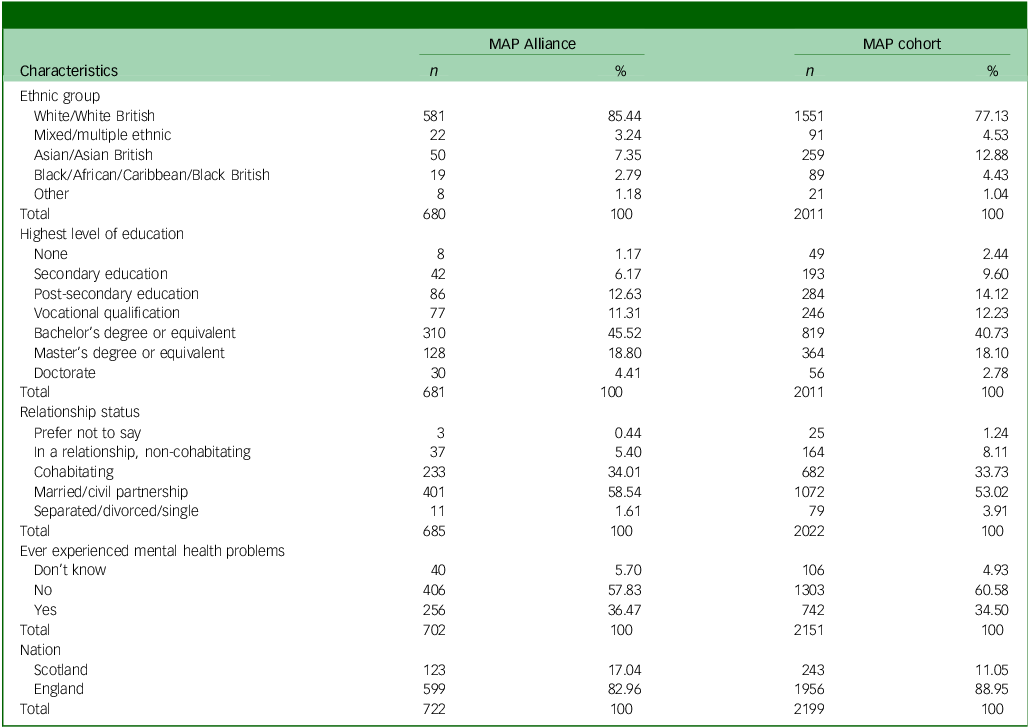
Participants’ mean age was 31.96 years (s.d. 4.77), with 14.6% being from Black and minority ethnic groups. Most participants were highly educated, with 68.7% having a university degree or higher. Table 1 gives sample characteristics for the MAP and MAP Alliance samples, and shows that attrition in the cohort between MAP and MAP Alliance assessments did not greatly affect sample composition. However, more participants in MAP screened positive for possible anxiety or depression (assessed in early pregnancy: 50.79% anxiety, 24.35% depression) compared with MAP Alliance (assessed 6 weeks postpartum: 37.45% anxiety, 15.01% depression).
Sample characteristics

Table 1 Long description
The table compares characteristics of participants in the MAP Alliance and MAP cohort across various categories. It has 4 sections: Ethnic group, Highest level of education, Relationship status, Ever experienced mental health problems, and Nation. Each section lists the number and percentage of participants for each characteristic. Ethnic group: White/White British (MAP Alliance: 581, 85.44%; MAP cohort: 1551, 77.13%), Mixed/multiple ethnic (MAP Alliance: 22, 3.24%; MAP cohort: 91, 4.53%), Asian/Asian British (MAP Alliance: 50, 7.35%; MAP cohort: 259, 12.88%), Black/African/Caribbean/Black British (MAP Alliance: 19, 2.79%; MAP cohort: 89, 4.43%), Other (MAP Alliance: 8, 1.18%; MAP cohort: 21, 1.04%). Highest level of education: None (MAP Alliance: 8, 1.17%; MAP cohort: 49, 2.44%), Secondary education (MAP Alliance: 42, 6.17%; MAP cohort: 193, 9.60%), Post-secondary education (MAP Alliance: 86, 12.63%; MAP cohort: 284, 14.12%), Vocational qualification (MAP Alliance: 77, 11.31%; MAP cohort: 246, 12.23%), Bachelor’s degree or equivalent (MAP Alliance: 310, 45.52%; MAP cohort: 819, 40.73%), Master’s degree or equivalent (MAP Alliance: 128, 18.80%; MAP cohort: 364, 18.10%), Doctorate (MAP Alliance: 30, 4.41%; MAP cohort: 56, 2.78%). Relationship status: Prefer not to say (MAP Alliance: 3, 0.44%; MAP cohort: 25, 1.24%), In a relationship, non-cohabiting (MAP Alliance: 37, 5.40%; MAP cohort: 164, 8.11%), Cohabiting (MAP Alliance: 233, 34.01%; MAP cohort: 682, 33.73%), Married/civil partnership (MAP Alliance: 401, 58.54%; MAP cohort: 1072, 53.02%), Separated/divorced/single (MAP Alliance: 11, 1.61%; MAP cohort: 79, 3.91%). Ever experienced mental health problems: Don’t know (MAP Alliance: 40, 5.70%; MAP cohort: 106, 4.93%), No (MAP Alliance: 406, 57.83%; MAP cohort: 1303, 60.58%), Yes (MAP Alliance: 256, 36.47%; MAP cohort: 742, 34.50%). Nation: Scotland (MAP Alliance: 123, 17.04%; MAP cohort: 243, 11.05%), England (MAP Alliance: 599, 82.96%; MAP cohort: 1956, 88.95%).
MAP, Methods of Assessing Perinatal Anxiety.
Use of health services in postpartum care
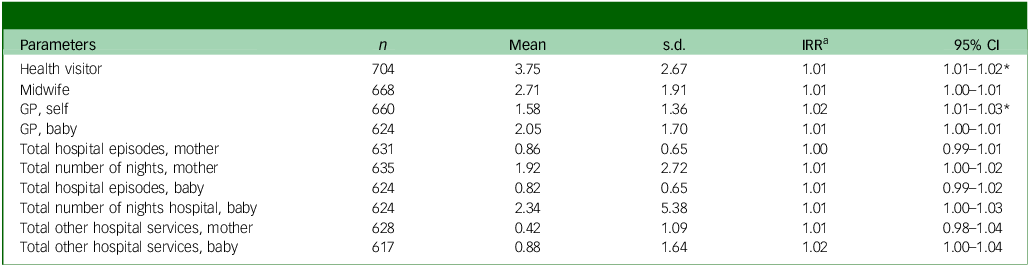
Table 2 details the average number of health service visits postpartum and the impact of increased anxiety on these visits. Women with higher anxiety 6 weeks postpartum had more health visitor and GP visits for themselves, but not for their infants. Average numbers of visits were 3.75 for health visitors, 2.71 for midwives, 1.58 for GPs (mother) and 2.05 for GPs (baby). The addition of birth complications to the models did not affect the estimates for anxiety. For example, in regard to GP visits for the mothers, the adjusted incidence risk ratio (IRR) for anxiety in the model including birth complications remained at 1.02 (1.01–1.03), and IRR for birth complications was 1.25 (1.09–1.45), indicating a large effect for birth complications: that is, mothers reporting birth complications had a 25% higher expected mean number of GP visits. However, the effects of birth complications and anxiety were largely independent in their effect on GP visits. In other words, adjusting for birth complications did not eliminate or change the effect of anxiety on GP visits.
National Health Service use and impact of increased anxiety

Table 2 Long description
A table with 10 rows and 6 columns detailing the average number of health service visits postpartum and the impact of increased anxiety. The columns are labeled Parameters, n, Mean, s.d., IRRa, and 95% CI. The rows list different health service parameters such as Health visitor, Midwife, GP, self, GP, baby, Total hospital episodes, mother, Total number of nights, mother, Total hospital episodes, baby, Total number of nights hospital, baby, Total other hospital services, mother, and Total other hospital services, baby. Each row provides specific values for n, Mean, s.d., IRRa, and 95% CI. Notable trends include higher average visits for health visitors and midwives, with specific incidence risk ratios and confidence intervals provided for each parameter.
GP, general practitioner.
a. Incident rate ratio associated with a one-unit increase in anxiety score on Stirling Antenatal Anxiety Scale.
*p < 0.005.
Inequalities and regional effects
Figure 1 illustrates inequalities in GP use (Fig. 1(a)) and health visitor service use (Fig. 1(b)). There was a significant interaction between ethnic group and anxiety for GP visits (IRR 1.03, 95% CI 1.00–1.06), where White women had more GP appointments for themselves as anxiety increased, but this was not observed in other ethnic groups. Education level also influenced health visitor visits, with degree-holders having more visits as anxiety increased (IRR 1.02, 95% CI 1.01–1.03). No significant regional differences were observed, except for fewer health visitor contacts in England compared with Scotland (Fig. 1(c)).
Inequalities and regional variation in health service use. (a) GP visits, by ethnic group and anxiety score. (b) Health visitor visits, by educational level and anxiety score. (c) Health visitor visits, by nation of residence and anxiety score. GP, general practitioner.

Use of mental health and other services
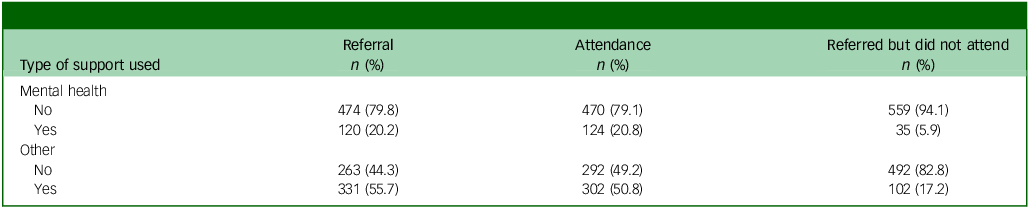
Table 3 shows that 20.2% of all participants were referred to mental health services and 20.8% of all participants attended a mental health service. Some services, such as private counselling or relationship therapy, were open to self-referral so not all attendances were the result of a referral from a health professional; thus total attendance reflects attendance from all possible pathways. More than half of participants (50.8%) used other support services. The majority of participants (78.2%) found mental health services helpful. However, 29.2% (35 of 120) of those referred to mental health services and 30.8% (102 of 331) referred to other support services did not attend.
Mental health and support services used

Table 3 Long description
The table has four rows and three columns. The columns are labeled Referral, Attendance, and Referred but did not attend. The rows are labeled Mental health and Other. Each column contains the number and percentage of participants in each category. For mental health services, 474 participants (79.8 percent) were not referred, 120 participants (20.2 percent) were referred, and 559 participants (94.1 percent) did not attend. For other support services, 263 participants (44.3 percent) were not referred, 331 participants (55.7 percent) were referred, and 492 participants (82.8 percent) did not attend.
Participants’ general experience of health services

Table 4 Long description
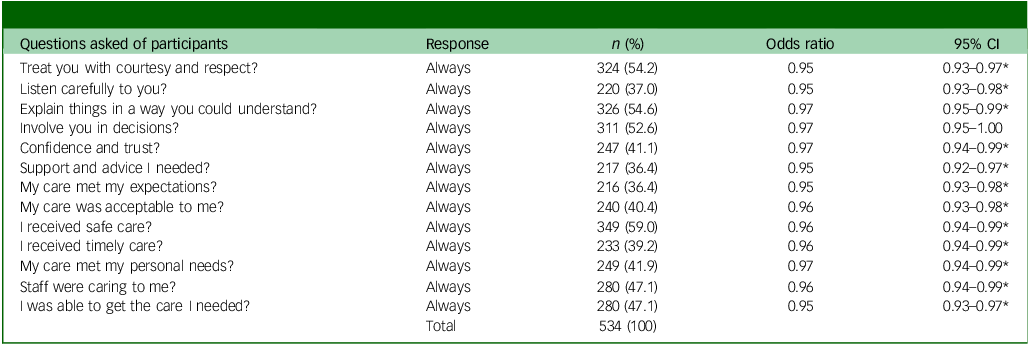
A table showing participants’ general experience of health services. The table has 13 rows and 4 columns. The columns are labeled ‘Questions asked of participants’, ‘n (%)’, ‘Odds ratio’, and ‘95% CI’. Each row lists a question asked of participants, the percentage of participants who responded ‘Always’, the odds ratio, and the 95% confidence interval. The questions cover various aspects of healthcare experience, such as courtesy, listening, explanation, involvement in decisions, confidence and trust, support and advice, meeting expectations, acceptability of care, safety, timeliness, personal needs, care when caring, and ability to get the care needed.
Possible response options were ‘always’, ‘never’, ‘occasionally’, ‘sometimes’ or ‘often’.
*p < 0.005.
Anxiety at 6 weeks postpartum was associated with increased referrals to mental health services (odds ratio 1.11, 95% CI 1.08–1.14) and other services (odds ratio 1.05, 95% CI 1.02–1.07). Across the whole sample. higher anxiety was also associated with increased odds of attending mental health (odds ratio 1.09, 95% CI 1.06–1.12) and other support services (odds ratio 1.04, 95% CI 1.01–1.06). Among those with clinically significant anxiety (SAAS score ≥9, n = 185), 16.6% attended counselling and 22% used specialist perinatal mental health services, compared with 2.4 and 0.8%, respectively, among those with lower anxiety (SAAS score <9, n = 346).
Experiences of healthcare
Table 4 shows that between a third and half of participants consistently had positive healthcare experiences. They reported ‘always’ receiving safe care (59%), clear explanations (54.6%) and courteous and respectful treatment (54.2%), involvement in decisions (52.6%), receiving needed care (47.1%) and caring staff (47.1%).
Higher anxiety was associated with lower satisfaction with health visitor care (odds ratio 0.97, 95% CI 0.94–0.99) and GP care for babies (odds ratio 0.97, 95% CI 0.94–0.99). No significant relationship was found between anxiety and satisfaction with midwife or GP care for mothers. Participants with greater anxiety 6 weeks postpartum were also less satisfied with their overall healthcare experience than participants with lower anxiety. For instance, a one-unit increase in anxiety reduced the odds of reporting always being treated with courtesy and respect by 5% (odds ratio 0.95, 95% CI 0.93–0.97).
The addition of birth complications to the models had little effect on effect estimates for the impact of anxiety on the experience of care. For example, for the outcome of being treated with courtesy and respect, the adjusted effect for anxiety was adjusted odds ratio (aOR) 0.95 (0.93–0.98), which is very similar to the unadjusted estimate. The aOR for birth complications was 0.60 (0.41–0.88) in the same model, indicating that people who experience birth complication are much less likely to report being treated with courtesy and respect but that this effect was independent of anxiety.
Educational level moderated the relationship between anxiety and healthcare experience. Participants with higher education had a greater decrease in satisfaction as anxiety increased, particularly regarding receiving needed care, caring staff, timely care, acceptable care and needed support and advice. No significant interactions were found between anxiety scores and ethnic group or nation of residence.
Discussion
This study aimed to assess health service use and healthcare experiences associated with perinatal anxiety while considering health inequalities and regional differences. Results showed that anxiety was associated with more primary care (GP and health visitor) visits for the mother but not for the infant. Adjusting for the impact of birth complications did not alter the estimated association with anxiety score. The effects of anxiety on numbers of GP and health visitor visits were moderated by ethnicity and level of education. Anxiety was linked to lower satisfaction with care from health visitors and GPs and poorer overall healthcare experiences. Women with anxiety were more likely to be referred to mental health and other support services, but over one in four women who were referred did not attend these services.
These findings align with previous research. The proportion of women referred to mental health services is consistent with the 20% prevalence of anxiety disorders. Reference Ayers, Sinesi, Meades, Cheyne, Maxwell and Best3 Increased health service use among anxious women is consistent with studies in both perinatal and general populations. Reference Farr, Dietz, Rizzo, Vesco, Callaghan and Bruce11–Reference Sills, Shetterly, Xu, Magid and Kempe15 Notably, perinatal anxiety did not increase health service use for babies, which is also consistent with earlier research. Reference Farr, Dietz, Rizzo, Vesco, Callaghan and Bruce11–Reference Ward and Pratt13 This suggests that the increase in service use is driven by maternal health needs or anxiety rather than by the baby’s health.
These findings can be interpreted using established models of the cognitive biases that accompany anxiety. Anxiety is associated with heightened threat perception and symptom vigilance, Reference Craske and Pontillo41 which may increase help-seeking from primary care services. For example, there is evidence that maternal anxiety may lead to greater interpretations of threat in situations that refer to the mother or child, as well as to women generating more catastrophic potential outcomes. Reference Lester, Field and Cartwright-Hatton42 Concerns about being judged as an unfit parent or social services involvement may further exacerbate anxiety and reduce trust in healthcare providers. These mechanisms may help explain why women with perinatal anxiety both use services more frequently and report poorer experiences of care.
The current study revealed inequalities in service use based on ethnicity and education. Women from White ethnic groups and those with higher education levels had more GP or health visitor visits as their anxiety increased. This is in line with research showing that minority ethnic groups have less access to community mental health services. Reference Jankovic, Parsons, Jovanović, Berrisford, Copello and Fazil21 Women from ethnic minority groups may also be more apprehensive about scrutiny from health professionals. Additionally, more highly educated women reported poorer healthcare experiences as anxiety increased, a trend not observed in women from Black and minority ethnic backgrounds or with less education.
These inequalities may reflect broader structural and systemic factors. Structural racism, implicit bias and lack of cultural safety within healthcare systems can limit engagement among women from minority ethnic backgrounds. Intersectionality theory suggests that overlapping identities, such as ethnicity, socioeconomic position and educational attainment, interact to shape women’s access to and perceptions of care. Reference Heard, Fitzgerald, Wigginton and Mutch43 Policy frameworks such as the NHS Long Term Plan, 27 the Perinatal Mental Health Care Pathway 17 and the CORE20PLUS5 44 approach provide opportunities to address these inequities through culturally competent care, improved continuity and targeted resource allocation.
No significant regional differences were found except that women in Scotland had more health visitor contacts than those in England. This may be due to differences in health service funding and provision. Within-region variations in service provision and access were not examined but warrant further research. About a third to a half of participants reported consistently positive healthcare experiences in the first 6 months postpartum, which reflects well on health services. However, this also means that a significant proportion did not always have positive experiences, indicating need for improvement. Understanding what drives positive experiences can inform service improvements. Relational continuity of care, empathic communication and consistent follow-up have been shown to improve satisfaction and engagement, Reference Kornhaber, Walsh, Duff and Walker45 particularly among those with mental health difficulties. Reference Engström, Hansson, Ali, Berg, Ekstedt and Engström46 Exploring the characteristics of services and providers associated with positive experiences could inform best practice models in perinatal care.
Strengths and limitations
The MAP Alliance study is the largest UK study on perinatal anxiety and health service use to date, but has some limitations. The sample was highly educated compared with the general population. Although broadly representative in terms of ethnicity, the sample size for different ethnic minority populations was insufficient, necessitating the combination of all Black and minority ethnic backgrounds into one group, possibly masking important differences. Additionally, disadvantaged groups were less likely to complete the survey despite efforts to recruit and retain women from these groups. Another limitation is that the study did not assess reasons for non-attendance, so cannot explain why participants who were referred to mental health support services did not attend.
The analyses reported here focus on the impact of anxiety on health service use. However, depression is highly comorbid with anxiety and may also contribute to increased health service use. Although this study assessed depression, the measure used (the Whooley questions) comprised only two items, which made it difficult to meaningfully compare the relative contribution of depression and anxiety to health service use. Further research is therefore needed to examine the relative contributions of anxiety and depression to health service use postpartum. Effect sizes in this study were small, so the clinical importance of these effects is not clear.
Implications for practice
These results have important implications for policy, practice and research. The association between anxiety and negative healthcare experiences suggests that anxious women might struggle to get the clinical care or recognition they want or need. Anxiety might also cause more negative perceptions of health services, especially if healthcare-related issues contribute to their anxiety.
The finding that over one in four women did not attend referred mental health or support services is concerning. This study did not clarify whether non-attendance was due to missed appointments or waiting lists. However, the retrospective nature of assessment means that it is reasonable to assume that many appointments had already passed so were missed. Non-attendance could be due to economic and practical barriers, stigma, spontaneous recovery or that women do not want the referred treatment. Reference Webb, Uddin, Ford, Easter, Shakespeare and Roberts24,Reference Webb, Uddin, Constantinou, Ford, Easter and Shakespeare47 Organisational factors such as long waiting lists, resource shortages and fragmented services might also play a role. Reference Webb, Uddin, Constantinou, Ford, Easter and Shakespeare47 Further research is needed to identify key factors behind non-attendance. It would be helpful to ask women directly what their reasons are for not participating in treatments to which they are referred. Differentiating between women who never initiate treatment and those who disengage part-way through treatment could further inform tailored engagement strategies.
Identified inequalities suggest that health services may not fully address the needs of women from minority ethnic groups or those with less education. These findings align with the EMBRRACE report on maternal mortality and morbidity, which found that women from Asian or Black backgrounds were more likely to die in childbirth than White women. Reference Knight, Bunch, Felker, Patel, Kotnis and Kenyon48 This study confirms that potential inequalities also exist in PMH care and initiatives are needed to address these. Existing action frameworks for reducing health inequalities through primary care could be helpful. Reference Gkiouleka, Wong, Sowden, Bambra, Siersbaek and Manji49 Practical measures to address these gaps include embedding routine perinatal anxiety screening within antenatal and postnatal pathways, improving continuity of care and providing training for healthcare professionals in perinatal mental health and cultural competence. Integration of low-intensity or digital psychological interventions could also enhance accessibility, particularly for women facing logistical or stigma-related barriers.
In conclusion, this study found that women with perinatal anxiety used primary care services more frequently and were more likely to be referred to mental health and other support services, although over one in four did not attend following referral. Service use inequalities existed for women with less education and from ethnic minority groups; health services need to be more responsive to these groups’ needs. Women with perinatal anxiety also reported lower satisfaction with care, indicating a need to address the reasons behind this. Future service planning should therefore prioritise equitable access and person-centred care. Nonetheless, the fact that many women had positive care experiences is encouraging, and identifying factors contributing to these positive experiences could help improve services for anxious and disadvantaged women. By addressing the psychological, structural and organisational factors that shape women’s experiences, perinatal services can better meet the needs of all mothers, particularly those experiencing anxiety and from marginalised backgrounds.
Supplementary material
The supplementary material is available online at https://doi.org/10.1192/bjo.2026.12100
Data availability
The data are not publicly available because this may risk people and organisations being identified. However, anonymised data subsets are available from the corresponding author on reasonable request.
Acknowledgements
We thank the women who agreed to take part in MAP Alliance and generously gave up their time to contribute to the study. We also thank NHS West of Scotland REC 3 and National Institute for Health Research (NIHR) for their support. The MAP Alliance Study Team includes the authors and Fiona Alderdice, Amy Delicate, Kathryn Hollins, Jennifer Holly, Rafiyah Khan, Rachel Leonard and Debra Salmon.
Author contributions
S.A., R.M., P.M.M., H.C., A.S., C.B. and R.T.E. conceptualised the research and acquired funding for the MAP Alliance study. R.M. and S.A. were responsible for project administration. P.M.M., U.H. and L.S. conducted the investigation and data collection. C.B. was responsible for data curation and formal analysis. S.A. and R.M. wrote the original draft of the manuscript. All authors contributed to methodology and reviewing and editing the final manuscript.
Funding
This project is funded by the NIHR Health Services Delivery and Research programme (project reference no. NIHR133727). The views expressed are those of the author(s) and not necessarily those of the NIHR or the Department of Health and Social Care.
Declaration of interest
None.



 Open access


eLetters
No eLetters have been published for this article.