Introduction
Paediatric patients with end-stage heart failure are commonly supported with ventricular assist devices as a bridge to transplant or decision or as destination therapy. Ventricular assist device support is associated with well-known adverse events including pump thrombosis, major bleeding, stroke, and infection, in particular among the single ventricle ventricular assist device population. Reference Zafar, Conway and Bleiweis1,Reference Joong, Maeda and Peng2,Reference Rabinowitz, Mehegan and Joong3 These events can occur acutely and require rapid, intensive management to prevent mortality and minimise morbidity. Thus, some programmes elect to maintain ventricular assist device patients in an intensive care unit (ICU) for the duration of their ventricular assist device support.
With status 1A heart transplant candidate median waitlist times of over 100 days (depending on patient characteristics), many patients remain inpatient on ventricular assist device support for months with some exceeding one year of inpatient ventricular assist device care. Reference Williams, Lu and Sleeper4 Given the long duration of ventricular assist device support for most patients, there is recognition that prolonged exposure to ICU morbidities (e.g., poor sleep, limitations in activities, delirium, decreased mobility, and social isolation) may negatively impact patients. Reference Cousino, May and Smyth5 Prolonged ICU stays for these patients incur substantially higher cost and heavily impact resource allocation. With infants and young children being supported on paracorporeal devices, there is no option for discharge to home. Thus, there is growing interest in building and maintaining infrastructure to support the care of ventricular assist device patients in a non-ICU hospital environment. Reference Harahsheh, Kipps and Hart6
In the Pediatric Acute Care Cardiology Collaborative (PAC3), 73% of centres report caring for patients supported with a ventricular assist device on the floor. Despite interest in transferring ventricular assist device patients outside of the ICU, there is a paucity of granular data around the demographics of eligible patients and the contemporary safety outcomes including ICU readmission rates and adverse events. In one single centre study exploring ICU readmission after floor transfer in this population, 60% of patients required ICU readmission. This occurred a median of 18 days after transfer and was most often due to pump thrombosis (30.4%) or neurologic dysfunction (23.9%). Reference Chacko, Pidborochynski and Buchholz7 To optimise safety and support current practice, we need a better understanding of the feasibility and implications of transfer out of an ICU environment for complex patients on ventricular assist device support, particularly for single ventricle patients in all stages of palliation who are prone to higher complication rates.
Since 2018, our institution, a large volume paediatric ventricular assist device centre, has supported transfer of eligible paediatric ventricular assist device recipients, including those with single ventricle physiology, from the ICU to the floor. This practice change resulted from increased provider experience and comfort with ventricular assist device management, training and consistent inpatient staffing of ventricular assist device primers (registered nurses with expertise in ventricular assist device management and troubleshooting), and development of protocols (e.g., anticoagulation) and clear communication pathways (e.g., ventricular assist device emergency phone, ventricular assist device stroke response protocol) to guide care and respond promptly to emergencies. Given inadequate data regarding appropriate candidacy for floor transfer and outcomes for paediatric ventricular assist device patients while on the floor, the aim of this study was to describe the characteristics and clinical course of a cohort of paediatric ventricular assist device patients at our centre after leaving the ICU, with an emphasis on ICU readmission and adverse events.
Materials and methods
The University of Utah and Primary Children’s Hospital Institutional Review Boards reviewed and approved this research. This single centre retrospective cohort study included paediatric patients (<18 years old) who were transferred from the ICU to the floor after placement of a ventricular assist device between January 2018 and November 2022. Patients supported on paracorporeal, continuous flow devices (e.g., CentriMag) are not eligible for transfer to the floor; patients on all other ventricular assist device types (continuous flow intracorporeal, pulsatile paracorporeal) are eligible for transfer. Eligibility for floor transfer is determined by the inpatient teams and is predicated on stable haemodynamics without vasoactives (with the exception of milrinone) and respiratory support (maximum support of low flow nasal cannula, intermittent non-invasive positive pressure with sleep for obstructive sleep apnoea). General stability of haemodynamics and anticoagulation are required before floor transfer, though adjustments of ventricular assist device support and anticoagulation are continued on the floor. Demographics and clinical data were abstracted retrospectively from the electronic medical record. Demographics included age, sex, weight, diagnosis, INTERMACS profile, specific ventricular assist device used, support type (left, right, single ventricle, biventricular), length of stay, and adverse events. Adverse events were defined by the Advanced Cardiac Therapies Improving Outcomes Network (ACTION). Reference Zafar, Conway and Bleiweis1 INTERMACS profile was defined in congruence with the INTERMACS Registry. Reference Stevenson, Pagani and Young8 Outcomes of interest included duration of ventricular assist device support, mode of ventricular assist device discontinuation (transplant, explant for recovery, death), time from ventricular assist device implant to floor transfer (days), total floor days on ventricular assist device support, hospital length of stay, ICU readmissions (including duration and reason), code blue/rapid response activations, and adverse events. Of note, not all adverse event incidents required ICU readmission. Descriptive statistics including means with standard deviations and medians with ranges were employed. To investigate the course and outcomes of those with single ventricle heart disease, a subanalysis was performed on this cohort. Statistical comparisons were deferred given the small size of the cohort.
Results
Baseline characteristics
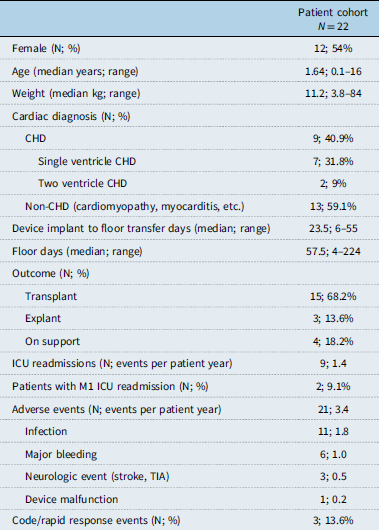
A total of 22 patients were included in the cohort (Table 1). The median age among the cohort was 1.65 years (range 0.1–16 years); the median weight was 11.15 kg (range 3.76–84 kg). The cohort was 54.5% (n = 12) female. Most patients were INTERMACS-2 (13, 59.1%); the remainder (9, 40.9%) were INTERMACS-3. The underlying diagnosis was non-CHD (dilated cardiomyopathy, myocarditis, and tachycardia-induced cardiomyopathy) in 13 patients (59.1%), and CHD in the remaining 9 patients (40.9%). Among those with CHD, 7 (77.8%) had single ventricle physiology; 3 patients had shunt-dependent pulmonary circulation (modified Blalock–Taussig–Thomas shunt), 3 patients had a bidirectional Glenn, and 1 patient had a Fontan. Left ventricular support was employed for 12 patients (54.5%, 2 with CHD), biventricular support for 4 patients (18.2%, 1 with CHD), and single ventricle support for 6 patients (27.3%, all with CHD). One patient (5%) was placed on VAD support as a bridge to recovery; the remainder were bridge to transplant. Device types included the Heartware HVAD Reference Medtronic9 (4, 18.2%), Heartmate 3 Reference Plymouth10 (1, 4.5%), and Berlin EXCOR 11 (17, 77.3%). Only one patient was transferred to the floor on a vasoactive medication (milrinone); this was due to right heart failure after left ventricular assist devise implant. Nine patients (40.9%) were on room air at the time of transfer, 13 (59.1%) required low flow nasal cannula oxygen, and 1 (4.5%) required nocturnal continuous positive airway pressure (CPAP).
Demographic characteristics, support times, and events (ICU readmission and adverse events) for the patient cohort (N = 22)

TIA = transient ischaemic attack.
Support time and lengths of stay
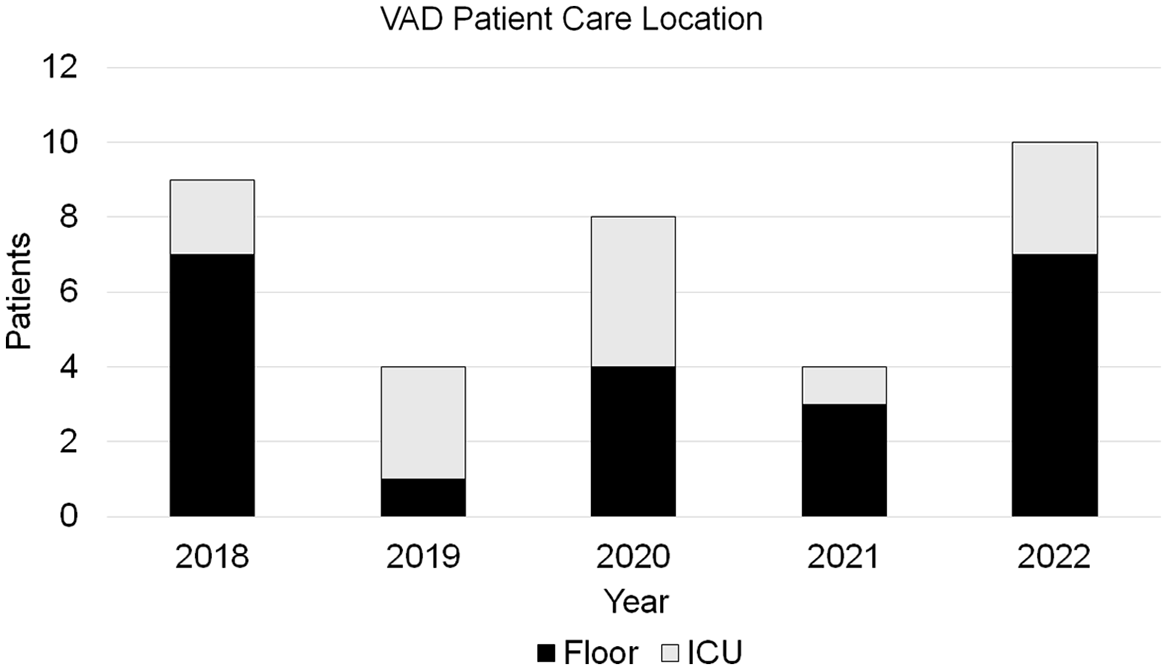
The patients in this cohort accrued a total of 2275 inpatient device support days. This included 571 support days (25%) in the ICU and 1704 support days (75%) on the floor. Of the 5 patients with outpatient-eligible ventricular assist devices (Heartware HVAD, Heartmate 3), 2 were discharged home. The median duration of ventricular assist device support was 97 days (range 24–239 days). At conclusion of the study period, 15 patients (68.2%) had received a heart transplant, 3 (13.6%) were explanted with recovery of cardiac function, and 4 (18.2%) remained on ventricular assist device support. Two patients (9.1%) were discharged to home on ventricular assist device support (1 subsequently explanted, 1 subsequently transplanted). Among this cohort, the median time from ventricular assist device implant to transfer out of the ICU was 23.5 days (range 6 days–52 days). The median total time on the floor was 58 days (range 4–224 days). The proportion of ventricular assist device patients transferred to the floor annually is reflected in Figure 1.
Proportion of ventricular assist device patients who transferred to the floor by year. There is no notable trend in patient care location over time.

ICU readmissions
Readmission to the ICU was required 9 times by 7 patients (32%); 2 patients had 2 readmissions, no patients had >2 readmissions. Of note, neither patient who was discharged home required ICU readmission. All patients who were readmitted to the ICU were subsequently transferred back to the floor. The median length of ICU stay for these patients was 2 days (range 1–9). Reasons for readmission included recovery following an elective procedure requiring general anaesthesia (2 patients; diagnostic catheterisation and airway procedure), device exchange (2), stroke (2), transient ischaemic attack (1), arrhythmia (1), and hypoxia (1).
Adverse events
Patients experienced a total of 21 adverse events with at least one adverse event experienced by 9 patients (41%, 3.4 per patient year) (Fig 2). Eleven infections were diagnosed in 6 patients (27.2%, 1.8 per patient year). Major bleeding events occurred 6 times in 4 patients (18.1%, 1.0 per patient year). There were 3 neurologic events in 2 patients (9%, 0.5 per patient year)—1 patient with stroke, 1 patient with a stroke and a transient ischaemic attack. There was 1 device malfunction (membrane delamination; 4.5%, 0.2 per patient year) requiring device exchange. In total, 17 of the 21 adverse events (81%) occurred on the floor totalling 3.6 adverse events on the floor per floor patient year versus 2.6 adverse events in the ICU per ICU patient year. ICU readmission was required for 5 (24%) of the adverse events. There were 3 codes called on 2 patients (2 for stroke, 1 for supraventricular tachycardia).
Adverse events per patient year for all patients and comparing single ventricle versus two ventricle ventricular assist device patients. The overall adverse event rate was 3.4 events per patient year. Infection was the most common adverse event with 1.8 events per patient year. Compared with the two ventricle population, single ventricle VAD patients experienced higher rates of infection, major bleeding, and neurologic events. Adverse event rates were comparable to those reported in the literature.

Single ventricle subgroup analysis
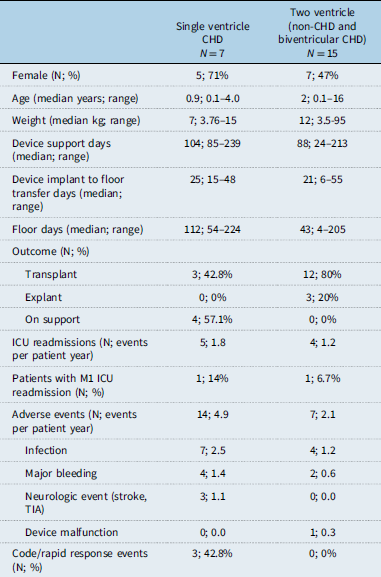
In comparison with the remainder of the cohort, the single ventricle subgroup experienced longer ICU length of stay (single ventricle: 25 days versus remaining cohort: 21 days), had a higher proportion requiring ICU readmission (single ventricle: 5/7, 71.4% vs remaining cohort: 4/15, 26.7%), had more adverse events (single ventricle: 14, 4.9 per patient year vs remaining cohort: 7, 2.1 per patient year) (Fig 2), and had a higher number ofcode/rapid response events (single ventricle: 3 events vs remaining cohort: 0 events ) (Table 2). Statistical comparisons between groups were deferred due to the small sample size. Also of note, 4 out of the 7 of the single ventricle patients remained on support at the end of this study.
Demographic characteristics, support times, and events (ICU readmission and adverse events) for single ventricle patients (N = 7) compared to non single ventricle patients (non-CHD, two ventricle CHD) patients (N = 15)

TIA = transient ischaemic attack.
Discussion
In this study, we describe the contemporary outcomes of paediatric patients with ventricular assist devices, including patients with all stages of single ventricle palliation, who were transferred from the ICU to the floor, with particular attention to ICU readmissions and adverse events. While prior literature reported ICU readmission rates after floor transfer in this population, Reference Chacko, Pidborochynski and Buchholz7 our study is the first to report adverse event rates for paediatric patients supported on ventricular assist device after floor transfer. Furthermore, it is the first to analyse these outcomes in the single ventricle population specifically.
We found a low proportion of patients required ICU readmission, ICU readmission lengths of stay were generally short, and adverse events occurred at low rates. A Pedimacs publication quantified adverse event rates for over 950 paediatric patients of mixed primary diagnoses supported on ventricular assist device. In that cohort, the incidence of infection was 2.5 events per patient year; major bleeding was 2.9 events per patient year; and stroke was 0.8 events per patient year. Reference Rossano, VanderPluym and Peng12 While receiving care on the floor, our cohort had comparable or better adverse event rates (1.8 events per patient year for infection; 1.0 for major bleeding; 0.5 for stroke). Of note, our ICU readmission rates were lower than prior reports, Reference Chacko, Pidborochynski and Buchholz7 perhaps demonstrating improved experience with management of patients on ventricular assist device support in this recent era. This may also reflect differences in threshold or criteria for transfer to the floor and/or ICU readmission.
Our study found adverse event rates were higher in patients with single ventricle heart disease compared to two ventricle patients, though were comparable to published expectations for this tenuous population. Rates of ICU readmission were also higher in the single ventricle group. In the Advanced Cardiac Therapies Improving Outcomes Network (ACTION), Stage I palliated single ventricle patients major bleeding events took place in 17% of patients, infection in 43%, stroke in 20%, and device malfunction in 3%. Reference Joong, Maeda and Peng2 Stage II palliated single ventricle patients had major bleeding occuring in 26% of patients, infection in 47%, stroke or transient ischaemic attack in 29%, and device malfunction in 20%. Reference Rabinowitz, Mehegan and Joong3 In our non-ICU cohort of Stage I and Stage II patients, our incidence of adverse events was similar to or lower than those reported in the literature. Our data suggest it is safe and feasible to care for paediatric ventricular assist device patients, including those with a complex single ventricle heart disease, outside of the ICU.
Safe, optimal care of ventricular assist device patients outside of the ICU is supported by robust infrastructure and staff education. For instance, we have a floor wing dedicated to paediatric cardiac patients with nursing staff who have specific training in the care of ventricular assist device patients. Our institution also provides 24/7 in-house physician coverage for these patients with a paediatric heart failure-transplant inpatient service during the day and paediatric cardiology fellows and paediatric cardiac ICU attendings (available for emergencies) overnight. Furthermore, we have 24/7 in house extracorporeal membrane oxygenation (ECMO)/ventricular assist device primer nurses with training and expertise in mechanical circulatory support to provide bedside troubleshooting of dressing, device, or driver concerns. Finally, we recently implemented a “ventricular assist device squad”, a team of cardiac floor nurses who assist each ventricular assist device patient’s bedside nurse with tasks such as dressing changes, transports, and device assessments during the day. For safe care of ventricular assist device patients on the floor, we recommend at a minimum structured ventricular assist device education for bedside staff (including nurses, advanced practice providers, and physician trainees), clear pathways to communicate concerns and respond to emergencies, and protocols to address common management items (e.g., anticoagulation) and adverse events (e.g., stroke). Of note, after conclusion of the data collection period, one floor patient (single ventricle Fontan on bi-circulation ventricular assist device support) died of complications related to a cannula rupture. Upon discovery of the cannula disruption, the patient was safely transferred to the ICU but prior to device exchange, had complete rupture of the cannula with air entrainment and air embolism ultimately resulting in mortality. This rare event highlights the potentially acute nature of ventricular assist device-related complications and further emphasises the importance of robust training and staffing as well as prompt emergency response.
The safe care of these patients outside of the ICU is beneficial in several regards, both tangible and intangible. It decreases the cost of care and resource utilisation of this patient population by dramatically decreasing their ICU length of stay. Furthermore, patients benefit from improved sleep hygiene, mobility, and focus on developmentally appropriate tasks (e.g., school, play, socialising) on the floor, all of which are critical to patients who experience prolonged hospital admission. In our hospital, rooms on the floor include enhanced accommodations for family (e.g., private bathroom, pull-out bed for parents), and the floor has less restrictive visitor policies which, based on anecdotal evidence, dramatically improves the experience of patients and families in the midst of a prolonged hospital admission.
This study was limited by several factors. First, this is a single centre study, and our population is cared for in a large volume, tertiary referral centre. Our results may not be generalisable across centres given institutional variability in infrastructure and staffing. Furthermore, though it is the largest of its kind and the only study reporting outcomes for single ventricle ventricular assist device patients after floor transfer, this is a small study with a limited number of patients.
In conclusion, this study demonstrates that it is safe and feasible to care for paediatric patients, including single ventricle patients, on ventricular assist device support outside of the ICU with low rates of ICU back-transfer and adverse events. Future directions include larger scale and multi-centre data analysis to assess adverse event rates across care environments within a cohort of ventricular assist device centres.
Acknowledgements
None
Financial support
This research received no specific grant from any funding agency, commercial, or not-for-profit sectors.
Competing interests
The authors declare none.