Clayton Christensen passed away on January 23, 2020. During his academic career he observed how new entrants could displace incumbents in an industry as a result of market changes driven by shifts in innovation. His ideas were both impactful and controversial. At Harvard Business School (HBS), Christensen's MBA elective class (“Building and Sustaining a Successful Enterprise”), where these ideas were conveyed to generations of students, was vastly popular. Between 2001, when it was first taught, and 2018, 7,648 students took the course. Christensen's imprint on the education of business leaders was also pronounced. Andy Grove and Steve Jobs listened intently because what he had to say was important to the way they thought strategically about competitive threats from new entrants. Grove recommended that everyone who attended Intel's 1998 sales and marketing conference read Christensen's book.Footnote 1 Jobs took Christensen seriously because he realized “people who invent something are usually the last ones to see past it.”Footnote 2 The implications of Christensen's theories were profound in an age of incessant creative destruction through technological change. In 2014, the noted venture capitalist Marc Andreessen exclaimed, “If we want to make the world a better and more equal place—the more Christensen-style disruption, and the faster, the better!”Footnote 3
Though less often emphasized, Christensen had a central interest in the history of business and technology, and this shaped his views on disruptive innovation. His highly influential 1997 book, The Innovator's Dilemma, relied on a classic narrative of innovation, entry, and incumbency in the disk drive industry, and it was supported by a range of other case studies of disruptive innovation from history. Indeed, his fourth publication in an academic journal was in the Business History Review (BHR), where these ideas were formulated for a business history audience.Footnote 4 Christensen won the Newcomen Society's award for the best paper published in the BHR in 1993. The article presents a fascinating insight into his early-stage thinking and the broader intellectual arena in which he was writing.
At the time the BHR article was published, Christensen was an assistant professor at HBS, having received his doctorate in business administration (DBA) from the institution a year earlier. Prior to his doctoral work he had been a consultant for the Boston Consulting Group, had worked in the federal government under the prestigious White House Fellows scheme, and in 1984 had cofounded a start-up called Ceramics Process Systems Corporation with a group of MIT scientists. That company, which went public in 1987, had a technology focus, aiming to transform how ceramics were made, particularly in the microelectronics market.
At its core the innovators dilemma involves a sequence of propositions, which Christensen felt were often misunderstood.Footnote 5 An incumbent firm can be disrupted by a new entrant whose product is attractive initially only to a small segment of the incumbent firm's customers. Soon, however, the new product improves through iteration, so its performance features become attractive to the incumbent firm's mainstream customers. The gap between the incumbent and the entrant firm rapidly closes to the point where the entrant becomes a competitive threat. Crucially, Christensen argued, the new entrant almost always wins because the incumbent is committed to its existing business lines. And therein lies the dilemma: even if an incumbent could see the threat posed by changes to products and industry dynamics, there was not much managers could do about it.
Christensen was not alone in thinking about firm strategies in the face of market disruption, or the key role of entrants in developing initially inferior technologies. In 1986, McKinsey director Richard Foster had published Innovation: The Attacker's Advantage, arguing that entrants generate payoffs by exploring new innovations whereas incumbents concentrate on innovations that protect their existing cash flows. Eventually, Foster suggested, these technology paths intersect and, through that process of disruption from below, incumbents often lose control of the market.
More generally, this was a fertile field of inquiry among leading scholars in the organization theory, innovation, and strategy literatures.Footnote 6 Indeed, in his BHR article Christensen proposes that the ideas developed by Rebecca Henderson and Kim Clark in a heavily cited article—“Architectural Innovation: The Reconfiguration of Existing Product Technologies and the Failure of Established Firms,” published in Administrative Science Quarterly in 1990—could be applied to industries undergoing disruption. Henderson and Clark argued that the threat of displacement would depend on how much a new technology influenced a firm's competence in component technology, in architectural design (i.e., how the components work together), or both, with architectural changes being much harder to preemptively react to because firms typically organize around component innovation.Footnote 7
Henderson graduated from Harvard's Business Economics doctoral program in 1988, whereas Christensen graduated with a DBA four years later. A reading of their respective work reveals how they approached research from different disciplinary backgrounds, with Henderson emphasizing more the rigor of organization science and economics and Christensen more the applied mind-set. Clark bridged both worlds. He joined the faculty of the HBS in 1978 and was the school's dean from 1995 to 2005. Clark was doctoral advisor to both Henderson and Christensen and had been immersed for some time in the study of the competitive implications of innovation. Indeed, Clark's oft-cited article with William Abernathy, “Innovation: Mapping the Winds of Creative Destruction,” published in Research Policy in 1985, offers a framework for categorizing different types of innovation. One type, “niche creation,” involves markets being disrupted by vigorous competition through incremental changes to technology.Footnote 8 That was precisely the kind of innovation that Christensen's disk drive work focused on.Footnote 9
The significance of the 1993 BHR article is that it narrates a story that combines the theory of disruptive innovation within these broader system-level frames of thinking. Moreover, it spoke to many other theories of innovation, competitive change, and organizational structure being developed at the time. With respect to business history, Christensen's view of the world complemented Alfred D. Chandler's argument that managerial hierarchies enabled vertically integrated enterprises to prosper. In 1978 Chandler had won the Pulitzer Prize for The Visible Hand: The Managerial Revolution in American Business, which cemented his reputation and led to other influential Chandlerian narratives including Scale and Scope: The Dynamics of Industrial Capitalism (1990). Chandler explained the rise of these firms from the late nineteenth century onward, whereas Christensen was constructing a theory for their decline.
The BHR had championed the Chandlerian methodological approach to the study of American business history emphasizing comparative work and business research based on primary materials. It also published papers that were part of much larger research agendas. For example, in 1960 the journal published Edith Penrose's “The Growth of the Firm—A Case Study: The Hercules Powder Company” a year after the release of her seminal book The Theory of the Growth of the Firm.Footnote 10 Penrose had conducted fieldwork at the Hercules Powder Company in the summer of 1954. By publishing the Christensen piece, the BHR continued that tradition of focusing on the detailed history of firms. Chandler himself was on the journal's editorial board at the time.
In the remainder of this article I show that Christensen was an influential scholar and public intellectual who used history to inform his theory of disruptive innovation. I first deconstruct the BHR article, showing the importance of the relationship between Christensen's theory and Chandler's work on vertically integrated firms. Second, I outline how business historians found mixed empirical evidence for the theory of disruptive innovation when they tested it in other contexts. Third, I review the criticisms of Christensen's work. Fourth, I show how his approach of using history to build theory was widespread among scholars at the time, and I also illustrate his outsized impact among business executives. A final section concludes. Throughout, I argue that the BHR article is a useful illustration of how the history of firms can be used to build management theory. Some of Christensen's provocative later work, however, departed from that effort by extrapolating beyond what the historical evidence could show.
Deconstructing the 1993 BHR Article
Christensen begins his BHR article by documenting the evolution of the disk drive industry—his key point of reference throughout his career on the significance of disruptive innovation. He traces the industry's beginnings to the late 1940s and early 1950s, specifically to IBM's RAMAC (Random Access Method of Accounting and Control) disk file developed at its San Jose laboratories. Introduced in 1956, this first rotating disk storage device had a 5MB capacity and was integrated into the first generation of mainframe computer systems. Following this breakthrough, IBM's R&D lab became the epicenter for innovation in magnetic information storage.
Over time, IBM engaged in heavy R&D investment to improve the technology, culminating in the 1973 “Winchester” disk drive, labeled that way after the name of an R&D project under which it was developed. This innovation, considered to be the harbinger of modern disk technology, is described by Christensen as “IBM's crowning architectural achievement in magnetic storage.” The 14-inch Winchester disk was housed in a hermetically sealed environment and had a much larger storage capacity and better functionality. Christensen thinks of this technology as architectural in nature because it influenced, at a more system level, how the elements of a disk drive worked together. His point of reference was clearly the Henderson-Clark framework of architectural innovation, which he explicitly references in the article.
It is through this lens that Christensen arrives at a key understanding of the organizational structure of the industry. The architecture dominated, at least in the early years. Most production was concentrated in vertically integrated businesses where firms engaged in everything from R&D to manufacturing the heads, the disks, and the motors of the drives. Products were sold mainly into the mainframe market. The ability to coordinate production across these disparate areas provided strong competitive advantage. IBM stood out in terms of market share because it was a primary innovator and it could control these system-wide changes.
A vertically integrated structure was the optimal form of organization because only leading incumbents with expertise in management could marshal the resources to introduce scale and scope into product development. Even when manufacturers started to make IBM plug-compatible disk drives, Christensen notes, IBM “was the environment” so although this represented a shift away from architectural and toward a more modular type of innovation, IBM could effectively control that subsystem as well. However, the number of nonintegrated original equipment manufacturers (OEMs) proliferated during the early 1980s, especially through venture capital funding, with the newly emerging minicomputer producers like Wang and Hewlett-Packard as the target customers.Footnote 11 Because of that shift in market dynamics, the nature of innovation bifurcated. The vertically integrated firms concentrated on selling 14-inch disks with greater capacity to the mainframe market while the new entrants focused on smaller capacity, smaller-inch disks. That would be crucial to Christensen's theory of disruptive innovation and industry change.
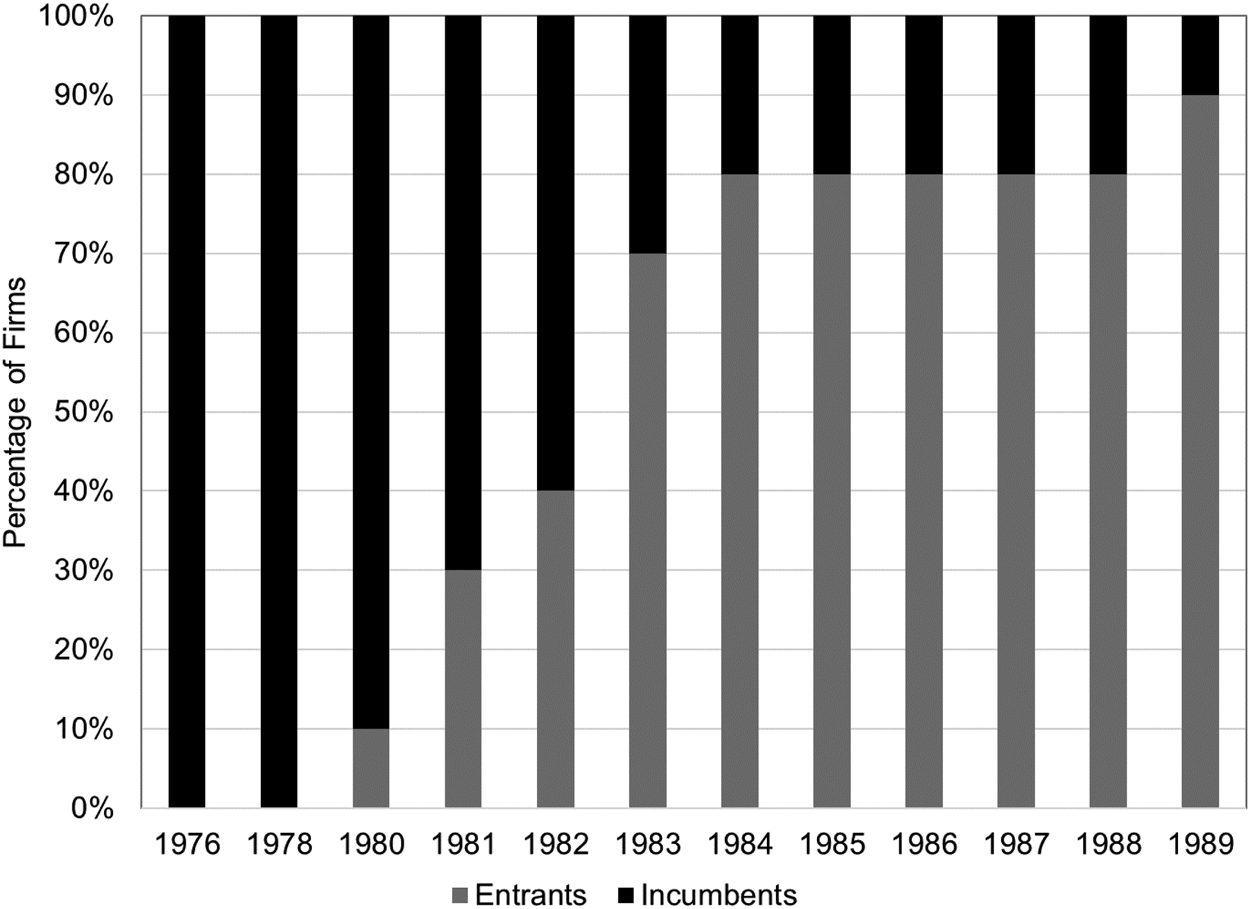
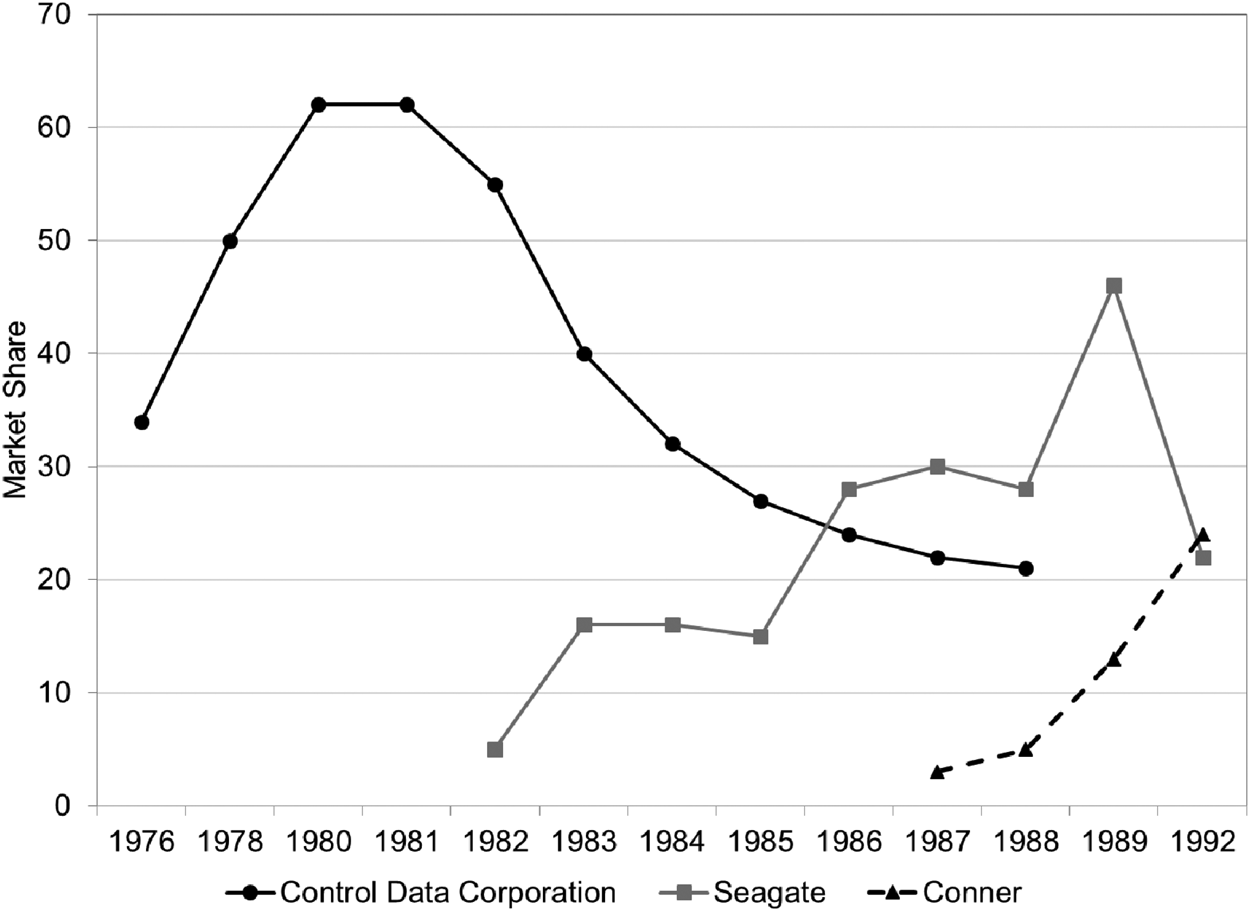
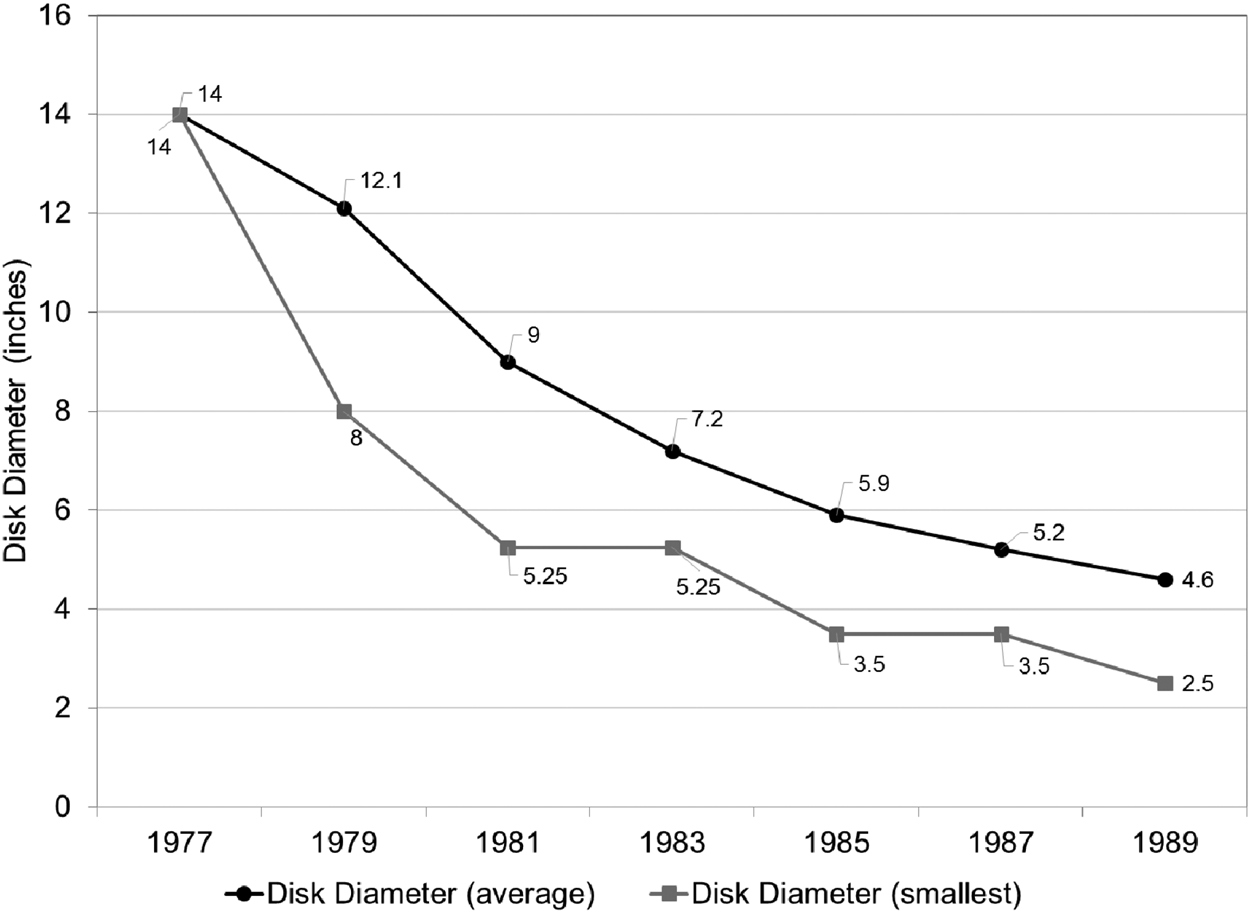
Christensen presents a wealth of data to support his argument in the BHR piece, all in the form of descriptive statistics. There is no quantitative model, nor is there much reference to economic theory. But the descriptive evidence is quite powerful, as illustrated by three figures based on Christensen's data. Figure 1 shows that the market structure of the ten largest disk drive manufacturers in the OEM market underwent significant changes during the 1980s. Incumbents like Control Data Corporation (CDC), the Minneapolis-based integrated manufacturer that initially held significant market share, were progressively replaced by new entrants like Seagate Technology, founded in 1979 by Alan Shugart (who had left Shugart Associates after it was acquired by Xerox in 1977), which became the industry's leading maker of 5.25-inch drives. Figure 2 shows how dramatic that change was over time, with the market share of CDC tapering significantly after Seagate Technology's entry. In fact, in 1988 CDC was acquired by Seagate. Figure 3 illustrates changes in the diameters of disks, upon which Christensen placed great emphasis in his theory of disruptive innovation. Sequential innovations led to smaller disk sizes, and decreasing costs, with 8 inches and 5.25 inches as the most critical disk-diameter thresholds.
Share of leading firms in the U.S. disk drive manufacturing industry that Christensen categorized as new entrants or incumbents, 1976–1989. (Source: data from Clayton M. Christensen, “The Rigid Disk Drive Industry: A History of Commercial and Technological Turbulence,” Business History Review 67, no. 4 [1993], table 3.)

The market share of three key firms in the U.S. disk drive manufacturing industry, 1976–1992. According to Christensen, Seagate disrupted Control Data Corporation, which focused originally on 14-inch drives. Seagate was then disrupted by Conner Peripherals in the shift to 3.5-inch drives. (Source: data from Clayton M. Christensen, “The Rigid Disk Drive Industry: A History of Commercial and Technological Turbulence,” Business History Review 67, no. 4 [1993], table 3.)

Changes in the disk drive diameter for all models in the market each year, 1977–1989. (Source: data from Clayton M. Christensen, “The Rigid Disk Drive Industry: A History of Commercial and Technological Turbulence,” Business History Review 67, no. 4 [1993], table 5.)

Key to this evolution was that the mainframe manufacturers demanded more storage, not disks of smaller diameter; hence the integrated manufacturers concentrated on supplying those needs, whereas the new entrants began to innovate in an area that would come to define their industry-wide advantage. Christensen defines Seagate Technology's impetus to smaller-sized drives as being pivotal. As performance improved, there was a crossover point where the smaller-diameter disks drove market demand in a different direction. Manufacturers of 14-inch drives started to fail, as captured in the shifting market shares illustrated in Figure 1.
Interestingly, Seagate as the initial disrupter itself became subject to disruption as it failed to foresee the significance of the competitive transition to the 3.5-inch drive. Although its engineers were fully aware of the technical functionality of the new, smaller drive, its existing customer base demanded larger capacity and larger-sized drives for their desktop computer systems. The transition to the 3.5-inch drive was embraced by a new entrant, Conner Peripherals, which had been founded by Finis Conner, one of the original founders of Seagate. Christensen documents that in 1992 Conner had displaced Seagate in terms of disk drive market share. Although there were firms that did manage the transition, either through strong managerial leadership or by using spinoff strategies, Christensen focused his theory around the firms that failed to keep pace.
The significance of these innovations, when taken together, is that they defined Christensen's approach to a taxonomy of technological change. The 14-inch Winchester drive, for example, could be considered as a sustaining innovation in his view because it “sustained the trajectory of product performance improvement” that the customers of incumbent firms demanded, whereas the 8-, 5.25-, and 3.5-inch architectures were a form of disruptive innovation because they “disrupted the trajectory of performance improvement in established markets.”Footnote 12 Everything hinged on the reaction of strategy to existing customer market segments, which determined the way that the new technologies were initially overlooked by the established firms. Disruptive innovations were initially less sophisticated and cheaper than sustaining innovations, but they were good enough from a functionality perspective that they would soon compete.
That shift in customer demand occurred because of two fundamental changes in the structure of the industry: first, minicomputers, and second, the personal computer, or PC. Minicomputers, which were first developed during the 1960s, fell between mainframes and PCs in term of capacity. Crucially, expansion of the minicomputer market coincided with the rise of OEM manufacturers, and that is where a wave of new entry took place. Managers of the incumbent firms listened to what their customers needed and prioritized development in those same areas. Managerial logic dictated that they did as much. The entrants, however, focused on different market niches leading to new technology trajectories that ultimately culminated in the displacement of the vertically integrated incumbent firms.
This was, as Christensen notes, a “un-Chandlerian” form of industry change, as the vertically integrated firms with their advantages in cost structures and supply chains should have maintained their lead. Many entrants in the disk drive industry were spinoffs from incumbent firms and a process of horizontal disintegration occurred as these firms focused on different market segments.Footnote 13 Christensen notes that vertical disintegration occurred too. The new entrants were more likely to be specialized in the manufacture of disk drives because a growing network of independent firms supplied them with components. Furthermore, because incumbents focused on existing customers, their most innovative engineers became disgruntled by a state of technological backwardness. These employees, in turn, left the integrated firms to found spinoffs, creating impetus for disruption through changes to product and industry architecture. Christensen states that “integration progressively seems to have become a disadvantage as the industry matured.”Footnote 14
The PC revolution of the 1980s was part of that push to industrial maturity. The performance of the PC soon began to surpass that of minicomputers, and indeed mainframes, for certain types of applications. Though Christensen eschewed much discussion of floppy drives, Apple's second model, the Apple II, had an optional 5.25-inch floppy drive; so did the Apple III, which was introduced in May 1980, a few months prior to the company's initial public offering. IBM started to sell a rival personal computer in August 1981, also with a 5.25-inch drive (as an optional single or dual drive add-on). In 1981 Sony introduced the first 3.5-inch floppy drive, which Hewlett-Packard adopted in 1982. By the late 1980s the 3.5-inch device was the industry standard. In The Innovator's Dilemma, Christensen sees the PC as a disruptive technology as firms like Apple offered products that were initially much simpler but the technology trajectory would soon intersect with minicomputers and mainframes. In the hard disk drive industry, Seagate introduced the 5.25-inch version to focus on the PC as opposed to the minicomputer market.
These changes had profound implications. As Christensen notes, “the average 5.25-inch drive, which initially could satisfy only the performance demanded in desktop personal computers, by 1986 packed the capacity demanded by the typical minicomputer user. By 1989 the 5.25-inch architecture was invading the lower end of the mainframe market.”Footnote 15 Therefore, the process of disruption continued iteratively through the impact of the PC market as well. As the industry matured, Christensen observes, “managers in vertically integrated firms found it difficult to protect or retain valuable component and architectural technologies that their customers did not want.”Footnote 16 They had been disrupted by a set of innovations in a remote market that rapidly coalesced to threaten the very existence of the integrated incumbent manufacturers. Disruptive innovation reshaped the industry, leading to shifts in market structure and the rise of specialized entities.
While the BHR article is important because it outlines the theory of disruptive innovation in the context of the history of the disk drive industry, it is also revealing about Christensen's intellectual development because of what it omits. Though he does not cite HBS professor Joseph Bower in his BHR article, Christensen was clearly influenced by Bower's 1970 book, Managing the Resource Allocation Process, which he refers to several times in The Innovator's Dilemma. Bower had done fieldwork at a large multiproduct company, focusing on the decisions it made during a two-year period. Christensen notes how his views about the role of customers in determining the types of innovative activity being pursued were shaped by Bower's finding that perceptions of customer demand could heavily sway resource allocation decisions.Footnote 17
Christensen predicted that vertically integrated firms would lose their competitive edge. In a later work written with Bower, he wrote about potential workarounds.Footnote 18 He maintained that the only way for an incumbent to avoid displacement was to establish a spinoff firm with more freedom to deviate from focal resource allocation constraints. In other words, disruptive innovation could only be addressed outside the incumbent's traditional boundaries.
That idea mattered in the context of incumbent dynamic competencies. In 1990, Philip Anderson and Michael Tushman formulated their central ideas about evolutionary technological change in an article published in the Administrative Science Quarterly titled “Technological Discontinuities and Dominant Designs: A Cyclical Model of Technological Change.”Footnote 19 The article looks at the long-run history of technology discontinuities in the cement, glass, and minicomputer industries. A key insight is that of changing industry standards and dominant designs over time and the need for incumbents to develop competencies to shift their emphasis from product to process innovation over the life cycle of the discontinuity. Christensen references this piece in his BHR piece. Later work by Charles O'Reilly and Michael Tushman shows that vertically integrated incumbents can maintain their lead under competition from new entrants. Through measures such as structural separation, target integration, and top team integration, incumbents can explore new innovations that disrupt markets while also exploiting existing technologies. Christensen did not consider this dynamic performance possibility in the BHR article because he focused his analysis exclusively on the entrant's advantage and the incumbent's disadvantage.
Christensen's framework also differed from other leading research produced, for example, by Stanford's James March, who modeled a firm's capacity to concurrently explore and exploit innovation. Through organizational learning, firms might adapt to potential blind spots.Footnote 20 That idea, in turn, was deeply rooted in the organization, management, and theory, strategy, and innovation literatures, which were heavily influenced by scholars with historical interests in firms and technology such as Paul David, Thomas Hughes, Wiebe Bijker, and Richard Rosenbloom. In fact, Christensen coauthored an article with Rosenbloom “Explaining the Attacker's Advantage: Technological Paradigms, Organizational Dynamics, and the Value Network,” that was published in Research Policy in 1995. The main argument is in line with Christensen's work on the disk drive industry because the authors assert that in circumstances where entrants introduce new technologies to new classes of buyers they invariably displace incumbents who are blindsided by their existing buyers.Footnote 21
It is also notable that Christensen's BHR article does not discuss the literature on dominant designs. He uses the term “dominant architectural design” but does not cite work by James Utterback and William Abernathy, who originated the concept (a dominant design emerges over the life cycle of an industry and involves common design features of a technology that have the most appeal to the mass market).Footnote 22 Three years after the BHR article came out, Christensen published a piece in Management Science with Utterback as one of the coauthors. The article draws on Christensen's BHR piece to describe a dominant design emerging in the disk drive industry over a decade of advances, from the Winchester disk architecture to the use of embedded intelligent controllers to enhance processing capabilities. In that article, Christensen, Utterback, and Fernando F. Suárez found that prior to the dominant design being established, later entrants had lower exit rates because they could compete with incumbents without being constrained by investments in older technologies that the dominant design would soon make obsolete. After the dominant design had been established, the most capable firms survived. That led to a crucial refinement in Christensen's stance on disruptive innovation. The Management Science article states: “Christensen's earlier work has stressed that leaders of one generation of disk drives tended not to remain as leaders for the next generation . . . [but] in a post-dominant design period it may be possible for a few dominant firms to stay as leaders for several generations.”Footnote 23 In other words, dynamics over the industry life cycle mattered. That realization brought Christensen's research into conflict with other work in this area that rejected the idea of a dominant design as a determinant of industry evolution.Footnote 24
Searching for Disruptive Innovation in Business History
Christensen's arguments should have been particularly central to the study of business history, which attempts to explain the performance of industries and countries through the lens of firms, their professional managers, and other stakeholders. Perhaps surprisingly, they were relatively neglected, which may reflect parochialism on the part of business historians who tend to be reluctant to embrace research ideas that come from different disciplinary backgrounds, or concerns that his research did not have applicability in the wider history of industries.
At the time Christensen's BHR piece was published, the Chandlerian emphasis on the large-scale modern corporation as a focal force in economic development was still a dominant narrative in U.S. business history. Chandler had argued that by investing in mass production, mass distribution, and professional management, U.S. firms first created advantages over their European counterparts. They could scale, grab market power, and operate far more efficiently than through transactions conducted in the market. The visible hand of management, Chandler argued, was such a fundamental improvement over the invisible hand of the market that it paved the way for sustained economic growth. Indeed, in many industries the triumph of the large vertically integrated corporation, in Chandler's frame of thinking, was central to the history of capitalism. As argued by Naomi Lamoreaux, Daniel Raff, and Peter Temin, the problem for this thesis was that during the 1980s and 1990s vertically integrated enterprises were losing their edge.Footnote 25 The rise of specialized, vertically disintegrated counterparts was the type of structural change in industry formation that Christensen's analysis of the disk drive industry highlighted.
While Chandler did not dwell much on why market leaders lose their position, Christensen's contribution should have been more significant to business history research because he was essentially offering a view of when these corporations and their professional managers failed. Rather than being a permanent state of the world, large vertically integrated enterprises could be displaced. Analogous to Joseph Schumpeter's writings, they would be prone to competition that “strikes not at the margins of the profits and the outputs of the existing firms but at their foundations and their very lives.” Tracing the largest one hundred firms in the United States between 1912 and 1995, Leslie Hannah documents that “the typical firm declined,” with 48 percent of them actually disappearing altogether.Footnote 26 In a rare mention of Christensen, a review article in the BHR by Louis Galambos points to disruptive innovation as one of the possible explanations.Footnote 27
Moreover, according to Christensen, the process of disruption, which would have affected some of these leading firms, was not the result of managerial failure; rather, managers in incumbent firms were making sensible decisions by focusing innovation on their traditional customer segments even though this increased the likelihood of disruption. In that sense they could be exonerated from any blame because they just had natural blind spots. By contrast, much of the business history literature focuses on the role of managerial agency in determining these kinds of outcomes.
Though use of Christensen's framework was limited by business historians who tended to focus more on the Chandlerian business performance perspective, the BHR published some interesting papers in relation to his findings, both in support and against. In one, Mila Davids and Geert Verbong examine the problems the Dutch company Philips faced when it tried to maintain a leadership position in semiconductors in the European market during the 1950s and 1960s. Despite its strong technical and organizational capabilities, Phillips faced difficulties in transitioning from selling semiconductors for consumer electronics to industrial products. This was not disruption in the classic sense that Christensen had envisaged, but it did speak to the argument that the nature of customer markets could determine an ability to react to strategic changes. Davids and Verbong state, “We agree with Christensen's view that entry into a new market and the creation of a customer network requires more than the acquisition of new technological capabilities.”Footnote 28
Christopher McDonald's analysis of Western Union, on the other hand, rejects Christensen's arguments as an explanation for the demise of the once dominant company at the heart of the communications system in the United States.Footnote 29 Rather than ignoring new niche-level technological innovations, Western Union actually embraced them as it attempted to transition to a strategy focused on computer-based data transmission and information services. Yet, smaller, specialized firms gained a foothold in this sector during the 1960s and 1970s, because Western Union remained rooted to principles that had made it a telegraph powerhouse. That reluctance to embrace change at the managerial level reflected not a commitment to existing customer segments but a more fundamental level of managerial ineptitude that constrained adaptability to change. Donald Sull makes similar arguments when considering the failure of the Firestone Tire & Rubber company to effectively respond to the introduction by French manufacturer Michelin of the radial tire into the U.S. market during the late 1960s.Footnote 30 He references Christensen when thinking about the dynamics of changing relationships with established customers but suggests the failure was more related to a deep-seated managerial mind-set that militated against change.
In a particularly pertinent contribution to the business history literature in light of Christensen's emphasis on the role of IBM in establishing the rigid disk drive industry, James Cortada's comprehensive history of IBM addresses the contribution of Christensen's research. Notably, Cortada finds that during the late 1990s The Innovator's Dilemma “enjoyed considerable popularity within managerial circles at IBM,” as executives would reference Christensen in presentations about corporate strategy. IBM was going through a process of change from selling computers to selling services and software. However, by the early 2000s, Cortada finds, the book was “less consulted.”Footnote 31 Cortada does see particular relevance in the concept of disruptive innovation, because IBM was so beholden to the demands of its large corporate customers it could miss paradigm changes emerging in niche markets. Yet, he outlines a much broader context in which IBM faced challenges when attempting to respond to disruptive transitions, including the role of managerial failure, strategic ineptitude, and that crucial but nebulous factor, company culture.Footnote 32
Overall, case studies of industry evolution and growth in the business history literature neither overwhelmingly support nor refute the hypothesis of disruptive innovation that Christensen identified in the disk drive industry. The relative infrequency of references to Christensen's BHR article is indicative both of how little researchers from management and business history fields used to interact and of major disciplinary differences. Business historians tend to embrace complexity in the history of firms and industries as a way of understanding the past. They are less likely to subscribe to catch-all explanations like Christensen's attempt to construct a generalizable theory of disruptions through technology and market changes. There is also the possibility that Christensen's theory was simply wrong.
The Critique and Alternative Explanations
Most scholars who produce impactful research eventually come in for some hard knocks. Christensen joined those ranks most publicly in 2014 when Jill Lepore, a prolific professor in Harvard's history department, wrote a scathing criticism of his work in the New Yorker. Some of Lepore's denunciations have to do with mistakes of historical fact. For example, Seagate was still a leading manufacturer in the disk drive industry in 1997 when The Innovator's Dilemma was published and so had not really been disrupted, as Christensen claims, in the transition to 3.5-inch disks. Lepore's general criticism amounts to a refutation of disruptive innovation as a predictive theory of industry change that business leaders frequently used to frame their decision making on just about everything. Lepore states that “many of the successes that have been labelled disruptive innovation look like something else, and many of the failures that are often seen to have resulted from failing to embrace disruptive innovation look like bad management.”Footnote 33 Christensen lamented the criticism of his work, what he considered to be a misrepresentation of his theory, and that Lepore had published the piece without the courtesy of advance notice.Footnote 34 Academic quibbles aside, Lepore's article is carefully researched and comprehensive.
A number of other scholars have also taken issue with Christensen's research. For example, Andrew King and Baljir Baatartogtokh found little evidence for the theory when they dissected case studies of disruptive innovation that Christensen had written about, though they did conclude that the theory “provides a generally useful warning about managerial myopia.”Footnote 35 In their empirical analysis of technology disruptions, Ashish Sood and Gerard Tellis wrote that “the theory of disruptive innovations lacks precise definitions, suffers from tautologies, lacks adequate empirical testing, and has no predictive model,” but they also found that “the theory is right in one aspect: the hazard of disruption by low-priced new technologies is higher.”Footnote 36 Erwin Danneels also quibbled with ambiguity of definitional stance.Footnote 37 Andrew King and Christopher Tucci revisited the disk drive industry with an empirical framework to test the theory of incumbent firm failure.Footnote 38 They found that managerial experience in production or sales or prior experience of transitioning to new markets had a positive effect on the probability of success in new market niches. Capabilities in one market may have created a stock of knowledge that led to advantages in another market. That finding is important because it goes against the Christensen hypothesis that experience in an existing market with dominant customers could be a cause of inertia. King and Tucci are careful to point out, however, that their research design captures an average effect across firms whereas Christensen's effect derived from a focus on top-level firms. This implies variation across the firm-size distribution, placing an emphasis on theory frameworks and research designs that can account for these heterogeneities.Footnote 39 In a related vein, Constantinos Markides argues that different types of innovations will have fundamentally different market impacts, alluding to the type of heterogenous effects that Christensen's theory cannot explain.Footnote 40
Yet, it is not unusual for theories to be refuted, and this is how research ideas ultimately progress. In a balanced exposition and critique of Christensen's theory of disruptive innovation, Joshua Gans attempts to move the research program forward. In The Disruption Dilemma, published in 2016 (Christensen provided a glowing blurb for the front cover), Gans argues that theories should present upfront predictions prior to being tested and that there must be potential for falsification. Furthermore, he argues, individual case studies, like Christensen used as a platform for his research, are unlikely to be sufficient to guide theory. Instead, the researcher would need long-run data on firms to observe success and failure and the mechanisms driving these outcomes.Footnote 41
Gans also proposes a more nuanced taxonomy of how disruptive innovation manifests itself. Whereas Christensen had offered what Gans calls a “demand-side theory” as incumbent firms took signals about technology trajectories from their existing customers, Gans adds a “supply-side theory” where new technologies challenge the architecture of a product rather than just its componentry. That channel of disruption, Gans emphasizes, relates to the Henderson-Clark argument that firms could not respond to “architectural innovation” because they were organizationally calibrated to deal with more incremental component-based changes. The more nuanced taxonomy allows Gans to study the practical implications of disruption for firms: how they could identify and react to it, from entrant acquisitions or separate divisions, to insure against demand-side disruption, to R&D programs that would protect against supply-side changes of a more architectural nature.
The setting of the disk drive industry that Christensen did much to popularize also led to further research on firm behavior, pushing the research program into new areas of understanding, though with results that conflicted with some of Christensen's basic premises. In an empirical analysis grounded in economic theory, Josh Lerner used the same data that Christensen had used, augmented with his own data collection including firm financials.Footnote 42 Lerner's analysis shows that entrants in the various disk-size categories were able to overtake incumbent firms because they invested more heavily in innovation and the introduction of new products at an early stage. He interprets this evidence through the lens of Jennifer Reinganum's influential model of a technology race, where a monopolist has less incentive to introduce a new product in the case of a radical innovation than an entrant because the monopolist only captures the payoffs in excess of those it already enjoys from its existing technology.Footnote 43 As Kenneth Arrow had put it earlier, “The pre-invention monopoly power acts as a strong disincentive to further innovation,” which Jean Tirole termed the “replacement effect.”Footnote 44 The entrant, by contrast, has no payoffs to cannibalize, so its incentives to innovate are greater. As such, Lerner notes, the displacement of leaders might be seen as “an appropriate response to the competitive environment” rather than a reflection of any type of agency costs or other forms of managerial failure.Footnote 45 In both the Lerner and Christensen accounts, the incumbent was avoiding preemptively innovating because of natural market forces, though the respective mechanisms emphasized by the two authors are quite different.
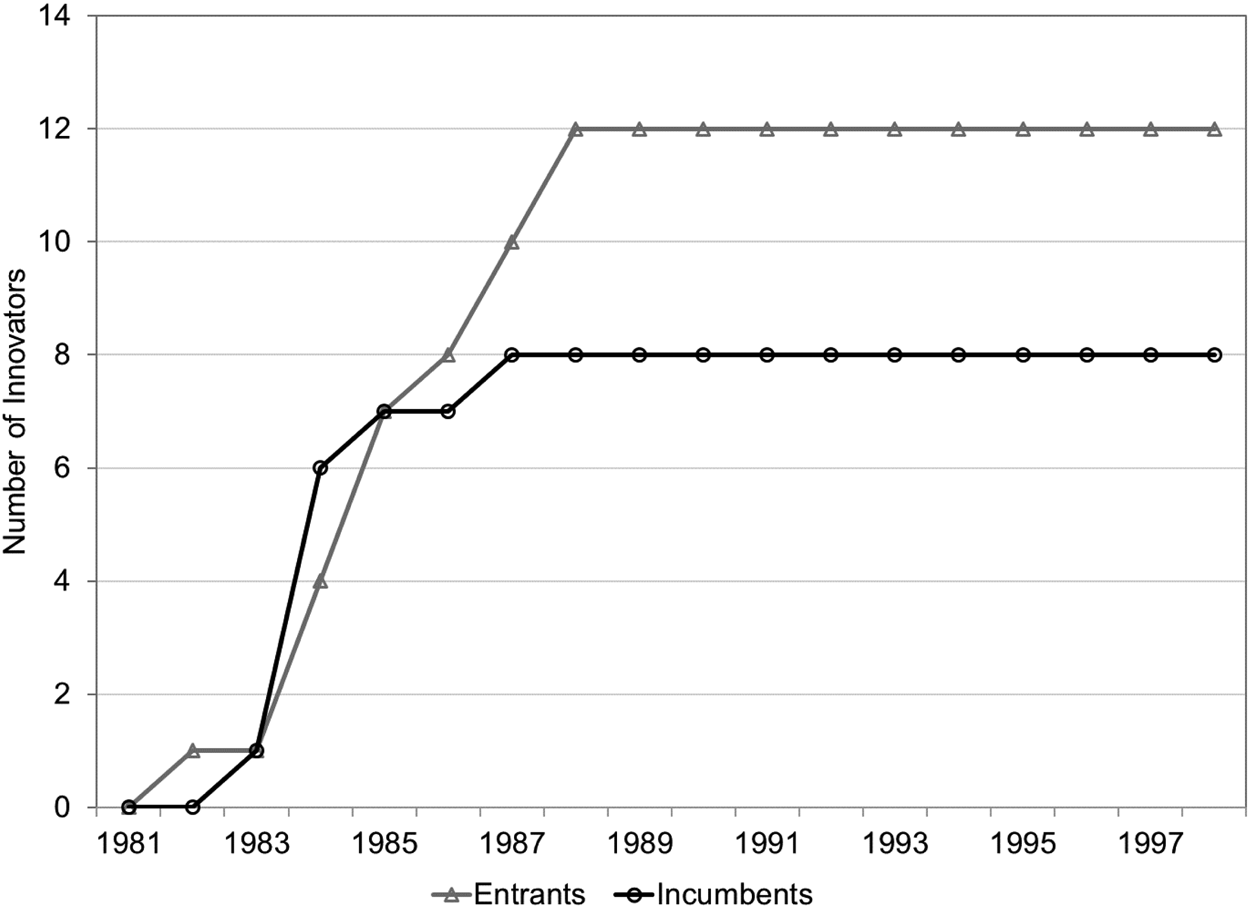
Mitsuru Igami revisits the innovator's dilemma in the disk drive industry, again using the same data that Christensen used, as well as adding new data of his own and, crucially, a structural model of interfirm behavior. The attractiveness of this analysis is that Igami's model, by estimating counterfactual scenarios, can be used to discriminate between several hypotheses for the decline of industry leaders, including the effect of cannibalization and differential costs, for example. His primary focus is on the shift from 5.25-inch to 3.5-inch disks, one of the key transitions that Christensen identified. Igami attempts to explain the gap between the cumulative number of innovators in the transition from 5.25-inch to 3.5-inch drives (Figure 4). He shows that the most important effect is cannibalization. In the absence of this effect, his model shows, the innovation gap between incumbents and entrants, shown in Figure 4, would have been reduced by 57 percent. He backs this finding up qualitatively. Finis Conner, Igami notes, stated that Seagate was reluctant to invest in the 3.5-inch technology “because it encroached on their 5.25-inch business.”Footnote 46 By contrast, Christensen had thought of, but ruled out, cannibalization as a cause of Seagate's reluctance to innovate because the disruptive innovation posed no initial threat. According to his BHR article, the disrupted firms were ignorant of “the potential benefits and possibilities of the new architectures.”Footnote 47
The innovation gap between entrants and incumbents. The figure shows the cumulative number of firms producing 3.5-inch drives as the industry switched from 5.25 to 3.5-inch drives. “Incumbents” are defined as firms already active in the 5.25-inch disk drive area that introduced 3.5-inch drives and “entrants” are defined as new producers of 3.5-inch drives. (Source: data from Mitsuru Igami, “Estimating the Innovator's Dilemma: Structural Analysis of Creative Destruction in the Hard Disk Drive Industry, 1981–1998,” Journal of Political Economy 125, no. 3 [2017]: 798–847.)

In contrast to Christensen, Igami also emphasizes the power of incumbent firms to overcome the threat posed by entrants because of their sizable cost advantages. This finding, in turn, relates to the organization and management theory literatures where incumbents with dynamic capabilities can respond to competitive threats.Footnote 48 The “ambidextrous organization” that Charles O'Reilly and Michael Tushman describe could innovate in the present and adapt and cope with the type of disruption that Christensen had in mind.Footnote 49 In another example, Mary Tripsas's work on the typesetter industry shows how incumbency can be persistent.Footnote 50 Tripsas exploited the history of the typesetter industry from 1886 to 1990 to examine the performance of incumbents versus new entrants across four generations of technology. When incumbents’ specialized complementary assets retained their value across generations, control of those assets insulated incumbent firms from competition, enabling them to dominate over technologically superior new entrants.
Overall, what we can see here is how this research program progressed. The authors discussed above, and many others, were fundamentally interested in the reasons why established firms sometimes fail, but they approached this question from different methodological perspectives. Christensen's view of the world revolved around an inductive, theory-building approach. He engaged in fieldwork with managers and collected data to construct a qualitative theory that reflected those managerial beliefs and data observations. Other approaches relied more on a deductive theory-testing approach using quantitative models and empirics. Although Christensen's hypothesis was often falsified, it is through the process of refuting a theory that one ultimately ends up knowing more. Indeed, Christensen was self-reflective in light of the various criticisms of his research. In a 2018 article, two years prior to his death, he noted that “our understanding of the phenomenon of disruption has changed as the theory has developed.”Footnote 51
Building Theory from the History of Firms
Notwithstanding the various criticisms of Christensen's theory discussed above, it is worth emphasizing how in the BHR article Christensen was attempting to build theory by analyzing the history of firms and industries. While some of his theorizing became problematic when applied to other industries, or even to the disk drive industry itself, the approach in this article yielded significant insights more generally. Penrose had built an influential theory of the firm though her detailed understanding of how the Hercules Powder Company functioned. She redefined the firm by what would later be described as its organizational competencies. By the same token, Henderson and Clark's highly impactful article on architectural innovation uses as its motivation the problems Xerox faced when transitioning from larger to smaller copiers in the mid-1970s, as well as RCA's failure to embrace the small transistorized radio during the 1950s, which Sony exploited to its own competitive advantage in the U.S. market. As these important examples illustrate, history can be used to construct and frame managerial theories.
Indeed, much of the literature I have discussed in this article was conducted by scholars using insights from the history of firms. Abernathy and Utterback's 1975 paper on dominant designs, for example, relied on a data set of 567 commercially successful twentieth-century innovations from five industries and 120 firms.Footnote 52 Work by Anderson and Tushman on technological discontinuities used data from the start of the minicomputer, cement, and airline industries. David Teece remarked that his research on why firms exist, their organizational structures and capabilities, and the management of innovation was developed “by combining an understanding of economic theory, organization theory, business history, and the economics of innovation.”Footnote 53 Although March's well-known paper “Exploration and Exploitation in Organizational Learning,” published in Organization Science in 1991, is ahistorical, he values the lessons that historical perspectives could bring.Footnote 54 When asked in 2013 what business leaders should learn, March replied, “you should learn some fundamental economics; you should learn some fundamental philosophy; you should learn some fundamental history.”Footnote 55
There are other important examples too. When Michael Porter published his seminal book, Competitive Strategy: Techniques for Analyzing Industries and Competitors, in 1980, he exposed readers to the idea that strategies were historically contingent and that understanding long-run data was crucial to developing a method for analyzing an industry. As Porter noted, “one of the often-powerful indicators of a competitor's goals and assumptions with respect to a business is its history in the business.”Footnote 56 Porter was engaged in the application of industrial organization theories to general management issues, whereas Steven Klepper, a leading industrial organization scholar at the time, combined the tools of economics with long-run data sets and detailed historical analysis. Like Christensen, Klepper was interested in entry and exit and what factors cause changes in market structure, especially during an industry “shakeout” associated with the evolution of market concentration. He also realized the key was to establish a unified theory. His pathbreaking 1996 article, “Entry, Exit, Growth, and Innovation over the Product Life Cycle,” in the American Economic Review, constructs a model in which earlier entrants into an industry have an advantage over their later-entering counterparts because it is costly to grow the size of a firm, and increasing returns to innovation become harder to capture over time. Because of this dynamic relationship, entry finally ceases because it is unprofitable to do so, less-capable later-entering firms are shaken out, and the industry consolidates around the most capable earlier-entering firms.Footnote 57
Klepper also built models to explain the success of spinoffs such as Seagate Technology, a spinoff from Shugart Associates, and Conner Peripherals, a spinoff from Seagate and Miniscribe, which were key firms that Christensen studied in the disk drive industry. In work cowritten with Sally Sleeper, Klepper theorized that spinoffs would be more successful than other entrants because they inherited the capabilities of their parent firms.Footnote 58 This theory receives support in an empirical analysis of spinoffs in the disk drive industry where firms with inherited capabilities were more likely to survive.Footnote 59 As discussed earlier, Christensen (with Bower) also considered that spinoffs should play an important role in industry change. In a Harvard Business Review article, they wrote that a spinoff from a parent organization is the only way to manage a disruptive innovation that initially had lower margins and addressed a different customer niche to the core business of the parent.Footnote 60 More specifically, while Christensen had focused on customer relationships as the most important determinant of entry-incumbent outcomes over an industry life cycle, Klepper viewed industry change as an evolving process conditioned by a multifaceted relationship between shifts in market structure and innovation. Both derived theories from different methodological mind-sets, but they were similarly guided by the history of firms and industries.
There are several reasons why the history of firms can be instrumental to the development of research programs on management theory and industry evolution. According to William Lazonick, “the types of strategy, finance, and organization that support innovation process change over time can vary markedly across industrial activities and institutional environments. The innovative firm must, therefore, be analyzed in a comparative–historical perspective.”Footnote 61 Although Christensen's work was mostly U.S.-centric, and he sometimes undervalued differences across industries, institutions, and cultures, he took a global perspective on the disk drive industry in his BHR article, and The Innovator's Dilemma is replete with examples from the United States, Europe, and Japan. In keeping with the value of comparative insights from business history, Richard Rosenbloom and Michael Cusumano came to an understanding of “technological pioneering” through the history of the VCR industry, emphasizing the key role of strategic experimentation and disciplined learning that Japanese firms displayed relative to their global counterparts.Footnote 62
Because industry dynamics change over the long run, engagement with history naturally allows for pattern recognition. To inform and evaluate theories of shakeouts, Klepper and Kenneth Simons summarize painstaking data collection efforts on patterns of industry evolution for automobiles, tires, televisions, and penicillin.Footnote 63 Examination of the history of firms, industries, and technologies also gives rise to a process through which a theory can be refined or rejected, leading to advances in our understanding of the mechanisms associated with causation. Klepper and Sleeper came to their theory of spinoffs because they studied long-run data on the laser industry and noticed that it had not experienced a shakeout, as Klepper's earlier work might have predicted.Footnote 64
Christensen too followed the principle of studying firms, industries, and technologies historically, but his approach also rested on a belief that large data sets tend to “gloss over or ignore anomalies” and that “it's only by exploring anomalies that we can develop a deeper understanding of causation.”Footnote 65 While that premise is contentious, because large data sets are conducive to theory construction since they can be used to identify both average and anomalous effects, Christensen was certainly correct that outliers can lead to useful new theory developments. Indeed, Klepper and Sleeper had shown as much by investigating the anomalous case of the laser industry.
In another example of anomaly identification, Marco Iansiti and Tarun Khanna studied the history of the mainframe computer industry, finding that it was “not well characterized by existing models” of innovation because of the complex structure of product componentry. Technical change at the subsystem level, they argued, could render a firm's capabilities obsolete even though customer needs and the dominant design of a mainframe computer remained stable in aggregate. From that observation they developed their “critical path model” of technological change, wherein a firm optimizes based on a combination of competencies at the subsystem level.Footnote 66 An implication of the model is that managing dynamic capabilities is the key to firm survival. In the mainframe industry, IBM retained market leadership through to the early 1980s by successfully managing a sequence of new product iterations. When customer preferences did change in aggregate, with personal computers and workstations, IBM lost market share. That observation accords with Christensen's view that market discontinuities create opportunities for new entrants to win.
Finally, history acts as a point of persuasion when ideas are ultimately presented to practicing managers and executives, and Christensen's impact in this arena was unmatched. Notably, in 1998 Intel introduced the Celeron processor, which was technically less sophisticated and cheaper than its high-end Pentium processor, because Andy Grove was a follower of Christensen's theory. The Celeron processor targeted the low-cost PC market and represented an effort by Intel to avoid disruption. Equally, as Christensen emphasized, perpetual disruption can make even the very best inventions obsolete. In that regard, Intel's longstanding competitor, AMD, has recently gained a competitive edge because of its low-cost processors and superior architectural innovation in gaming and graphics. Intel has also lost out to the simpler ARM architecture in mobile devices.
Jeff Bezos and executives at Amazon closely followed Christensen's writings. Amazon's low-end e-commerce platform disrupted traditional bookstores, and aspects of Amazon's evolution and product development over time are illustrative of how the theory of disruptive innovation was used. In 2004 Bezos instructed Steve Kessel, who at the time was running business development for physical books, “Your job is to kill your own business.” Kessel subsequently set up a subsidiary in Silicon Valley and hired engineers who experimented with new products, leading to the introduction of the Kindle e-reading device.Footnote 67 This was not low-end disruption, because reading on a Kindle represented a technological advance over reading a physical book. But Amazon, as an incumbent, was focusing on preemptively reacting to the threat posed by a smaller company developing an e-reader. Moreover, it attempted to manage that threat, as per Christensen's work with Bower, using a spinoff that would be unshackled by the parent organization.
Part of this appeal to business leaders reflected Christensen's charisma as a conveyor of ideas, but they also believed what he said because he had a tangible and historically guided theory of innovation and incumbent disadvantage to tell them. Grove argued that the Christensen framework of thinking could be juxtaposed onto Intel's business and Bezos clearly thought the same way.Footnote 68 They feared what would happen to their companies if they did not react. Analysis of large data sets undoubtedly provides better identification of causal effects and allows for more general explanations, but the lessons are often difficult to distill in meaningful ways. There is much to learn on either side about the benefits of detailed historical inquiry. On the one hand, an accurate reading of the past is key where case studies provide the basis of the evidence. On the other hand, where larger-scale empirical studies are concerned, historical examples can act as verification and falsification checks and be motivating devices in the search for wider managerial persuasion.
Conclusion
Christensen's research occupies a central place in the management literature because of his provocative views on the process of technology-induced market change. His insights were based on a detailed analysis of the history of the disk drive industry, as the BHR article exemplifies, and from there he developed his theory of disruptive innovation. That theory is often misunderstood, much to Christensen's annoyance, but put simply it means that incumbents miss market transitions because they are being too attentive to their established customers in following trajectory-sustaining technology architectures. By contrast, entrants that develop new innovations in remote markets with initially weaker performance attributes along disruptive trajectories can ultimately displace incumbents in traditional markets as these trajectories begin to intersect.
It was an influential account of how shifts in markets and customer preferences could have disruptive effects on leading firms and industries. However, in reality we know that disruptions tend to be more multifaceted. Christensen's theory does not allow for managerial discretion or for the fact that incumbents might not follow product development strategies that meet the needs of their most demanding customers. Sometimes disruption comes from above, not below. The iPhone, for example, displaced the iPod while being technically superior and more expensive. The theory of disruptive innovation cannot explain the decline and rebirth of Apple. As Christensen would later acknowledge, in a 2015 Harvard Business Review article, “Disruption theory does not, and never will, explain everything about innovation specifically or business success generally.”Footnote 69
In that sense, the virtue of his BHR article is that it provides an appropriate insight into the significance of history in that it explains why change happened in a particular industry over time and attempts to build a theory from that set of observations. The Innovator's Dilemma, in contrast, tended to generalize beyond what the “lessons of history” could actually show. Although Christensen allowed some scope for disagreements, he maintained a staunch yet often unassuming belief that he was right. His research ideas were unmistakably impactful in management practice and he taught us much about conveying those ideas to business executives. A critical appraisal of his work illustrates the significant benefit of using history to construct theories of industry change, while also highlighting where the boundaries associated with that endeavor should be drawn.