Introduction
A converging body of evidence indicates that a sizeable minority of children and adolescents in clinic and research settings satisfy DSM-IV diagnostic criteria for bipolar disorder (Mick et al. Reference Mick, Biederman, Faraone, Murray and Wozniak2003; Perlis et al. Reference Perlis, Miyahara, Marangell, Wisniewski, Ostacher, DelBello, Bowden, Sachs and Nierenberg2004). This literature also documents that pediatric bipolar disorder is extremely morbid and commonly associated with significant functional impairment in multiple domains including increased risks for psychiatric hospitalization, antisocial behaviors, addictions and suicidal ideation (Wozniak et al. Reference Wozniak, Biederman, Kiely, Ablon, Faraone, Mundy and Mennin1995a; Geller et al. Reference Geller, Bolhofner, Craney, Williams, DelBello and Gundersen2000a; Biederman et al. Reference Biederman, Mick, Faraone, van Patten, Burback and Wozniak2004; Birmaher et al. Reference Birmaher, Axelson, Strober, Gill, Valeri, Chiappetta, Ryan, Leonard, Hunt, Iyengar and Keller2006). In parallel to pediatric studies, an emerging literature in adults documents that as many as 65% of adults with bipolar disorder have an onset of their disorder in childhood and adolescence, indicating that onset in childhood and adolescence is a common feature of this disorder (Perlis et al. Reference Perlis, Miyahara, Marangell, Wisniewski, Ostacher, DelBello, Bowden, Sachs and Nierenberg2004). Despite these compelling findings, questions remain as to the validity of pediatric bipolar disorder.
A cornerstone of establishing the validity of a psychiatric disorder is demonstrating that relatives of diagnosed individuals (i.e. the proband) are at an increased risk for the same disorder (Robins & Guze, Reference Robins and Guze1970). That bipolar disorder in adults is highly familial has been known since the middle of the twentieth century (Tsuang & Faraone, Reference Tsuang and Faraone1990; Faraone et al. Reference Faraone, Glatt and Tsuang2003). In a recent review, Craddock & Forty (Reference Craddock and Forty2006) estimated the risk for bipolar disorder in the siblings of adult probands to be 5–10% and that the heritability of the disorder ranges from 0.80 to 0.90. In contrast to a rich literature on family studies of adult bipolar disorder, a much more limited literature exists on the familiality of pediatric bipolar disorder. In an uncontrolled study, Dwyer & Delong (Reference Dwyer and Delong1985) showed an excess of bipolar disorder in the relatives of 20 out-patient children with DSM-III diagnosed bipolar disorder. The excess risk for bipolar disorder in first-degree relatives was replicated in subsequent family studies of child probands with DSM-III (Strober et al. Reference Strober, Morrell, Burroughs, Lampert, Danforth and Freeman1988; Kutcher & Marton, Reference Kutcher and Marton1991; Neuman et al. Reference Neuman, Geller, Rice and Todd1997), DSM-IIIR (Wozniak et al. Reference Wozniak, Biederman, Mundy, Mennin and Faraone1995b) and DSM-IV bipolar disorder (Findling et al. Reference Findling, Gracious, McNamara, Youngstrom, Demeter, Branicky and Calabrese2001; Geller et al. Reference Geller, Tillman, Bolhofner, Zimerman, Strauss and Kaufmann2006; Brotman et al. Reference Brotman, Kassem, Reising, Guyer, Dickstein, Rich, Towbin, Pine, McMahon and Leibenluft2007; Wilens et al. Reference Wilens, Biederman, Adamson, Monuteaux, Henin, Sgambati, Santry and Faraone2007), which reported ranges of bipolar disorder in relatives of pediatric bipolar disorder probands ranging from 12 to 35% with the risk of unipolar depression ranging from 15 to 42%.
However, despite their clear contributions, the existing family studies of pediatric bipolar disorder suffer from several methodological limitations. Three studies relied on family history methods rather than directly interviewing relatives and half of the available studies examined only parents or adult relatives (Strober et al. Reference Strober, Morrell, Burroughs, Lampert, Danforth and Freeman1988; Kutcher & Marton, Reference Kutcher and Marton1991; Neuman et al. Reference Neuman, Geller, Rice and Todd1997; Findling et al. Reference Findling, Gracious, McNamara, Youngstrom, Demeter, Branicky and Calabrese2001; Brotman et al. Reference Brotman, Kassem, Reising, Guyer, Dickstein, Rich, Towbin, Pine, McMahon and Leibenluft2007; Wilens et al. Reference Wilens, Biederman, Adamson, Monuteaux, Henin, Sgambati, Santry and Faraone2007). Of the four studies utilizing DSM-IV criteria, two (Geller et al. Reference Geller, Tillman, Bolhofner, Zimerman, Strauss and Kaufmann2006; Brotman et al. Reference Brotman, Kassem, Reising, Guyer, Dickstein, Rich, Towbin, Pine, McMahon and Leibenluft2007) restricted recruitment of probands to children meeting a ‘narrow’ phenotype (Leibenluft et al. Reference Leibenluft, Charney, Towbin, Bhangoo and Pine2003) excluding other children who may have otherwise fully met DSM-IV bipolar-I (BP-I) disorder.
Furthermore, despite the fact that high rates of psychiatric co-morbidity have been consistently reported in youth with bipolar disorder, the extant literature on family studies of pediatric bipolar disorder probands has seldom systematically assessed other psychiatric disorders beyond mood disorders and those studies that did assess other psychiatric disorders did not account for a potential impact of psychiatric co-morbidity in probands on the risk of psychiatric morbidity in relatives.
The main aim of the present study was to re-evaluate the familiality of pediatric BP-I disorder attending to the limitations of the extant literature using a large family study sample. To this end, we conducted a familial risk analysis comparing structured diagnostic interview derived data from all first-degree relatives of pediatric probands with DSM-IV BP-I disorder attending to psychiatric co-morbidity in probands and relatives. Comparisons were made with findings in first-degree relatives of probands with attention deficit hyperactivity disorder (ADHD) and control probands without BP-I or ADHD. We hypothesized that first-degree relatives of probands with pediatric BP-I would be at increased risk for BP-I compared with relatives of ADHD probands and non-bipolar, non-ADHD control probands. Additionally, based upon patterns of psychiatric co-morbidity in children with BP-I (Wozniak et al. Reference Wozniak, Biederman, Mundy, Mennin and Faraone1995b; Geller et al. Reference Geller, Zimerman, Williams, Bolhofner, Craney, Delbello and Soutullo2000b; Findling et al. Reference Findling, Gracious, McNamara, Youngstrom, Demeter, Branicky and Calabrese2001; Mick et al. Reference Mick, Biederman, Faraone, Murray and Wozniak2003; Brotman et al. Reference Brotman, Kassem, Reising, Guyer, Dickstein, Rich, Towbin, Pine, McMahon and Leibenluft2007), we also hypothesized that relatives of pediatric BP-I probands would be at increased risk for disruptive behavior disorders, anxiety disorders, addictive disorders and psychosis. To the best of our knowledge this study represents one of the largest and most comprehensive family studies of pediatric bipolar disorder.
Method
Subjects
Families were recruited and assessed at the Clinical and Research Program in Pediatric Psychopharmacology and Adult ADHD at Massachusetts General Hospital. Probands were recruited for studies of bipolar probands 6–17 years of age of both genders (Wozniak, Reference Wozniak2005) and ADHD or non-ADHD control probands 6–17 years of age of both genders (Biederman et al. Reference Biederman, Faraone, Keenan, Benjamin, Krifcher, Moore, Sprich-Buckminster, Ugaglia, Jellinek, Steingard, Spencer, Norman, Kolodny, Kraus, Perrin, Keller and Tsuang1992, Reference Biederman, Faraone, Mick, Williamson, Wilens, Spencer, Weber, Jetton, Kraus, Pert and Zallen1999, Reference Biederman, Monuteaux, Mick, Spencer, Wilens, Klein, Price and Faraone2006a, Reference Biederman, Monuteaux, Mick, Spencer, Wilens, Silva, Snyder and Faraoneb). All studies were sampled from the same source population and used the same assessment methodology regardless of the disorder used to classify subjects as cases. All study procedures were reviewed and approved by the subcommittee for human subjects of our institution. All subjects' parents or guardians signed written informed consent forms and children older than 7 years of age signed written assent forms.
We recruited 157 BP-I probands and their 487 first-degree relatives for the family study of pediatric bipolar disorder. From 522 families participating in our case–control ADHD family studies we randomly selected 162 non-bipolar ADHD (511 first-degree relatives) and 136 non-bipolar non-ADHD control probands (411 first-degree relatives) so that the age and gender distribution was similar to that of the BP-I probands. ADHD probands with co-morbid bipolar disorder were not included in the present analyses.
Ascertainment method
Potential BP-I probands were ascertained from our clinical service, referrals from local clinicians or self-referral in response to advertisements. To avoid biasing our sample toward familial cases of bipolar disorder, all probands were ascertained blind to the diagnostic status of their relatives. Subjects were administered a phone screen, reviewing symptoms of DSM-IV BP-I and, if criteria were met, were scheduled for a face-to-face structured diagnostic interview (described below). In addition to the structured diagnostic interview it is the routine for the PI (J.W.) to perform a clinical interview that includes both the proband and his or her parents in order to confirm the diagnosis of bipolar disorder using the Schedule for Affective Disorders and Schizophrenia for School-Age Children (KSADS) mania module and we make every effort to ensure that this interview occurs with every proband. We have published data on the convergence of these clinical interviews with our structured interview diagnosis on the first 69 cases. We report 97% agreement between the structured interview and clinical diagnosis in this analysis of 69 children (Wozniak et al. Reference Wozniak, Monuteaux, Richards, Lail, Faraone and Biederman2003).
As previously reported (Biederman et al. Reference Biederman, Faraone, Keenan, Benjamin, Krifcher, Moore, Sprich-Buckminster, Ugaglia, Jellinek, Steingard, Spencer, Norman, Kolodny, Kraus, Perrin, Keller and Tsuang1992, Reference Biederman, Faraone, Mick, Williamson, Wilens, Spencer, Weber, Jetton, Kraus, Pert and Zallen1999; Wozniak et al. Reference Wozniak, Biederman, Kwon, Mick, Faraone, Orlovsky, Schnare, Cargol and Van Grondelle2005) ADHD cases were identified from either a major academic medical center, where we selected ADHD subjects from referrals to a pediatric psychopharmacology program, or from a major Health Maintenance Organization, in which ADHD subjects were selected from pediatric clinic out-patients. Controls were ascertained from out-patients referred for routine physical examinations to pediatric medical clinics at each setting, identified from their computerized records as not having ADHD. Screening procedures were similar to those described for the recruitment of the bipolar probands with the exception that we queried about ADHD (and not bipolar disorder) in the initial telephone screening and each proband was not assessed clinically.
Diagnostic procedures
Psychiatric assessments of subjects younger than 18 years were made with the KSADS-E (epidemiologic version; Orvaschel, Reference Orvaschel1994) and assessments of adult family members were made with the Structured Clinical Interview for DSM-IV (SCID; First et al. Reference First, Spitzer, Gibbon and Williams1997) supplemented with modules from the KSADS-E to cover childhood disorders. Diagnoses were based on independent interviews with mothers and direct interviews with children older than 12 years of age. Data were combined such that endorsement of a diagnosis by either reporter resulted in a positive diagnosis.
Interviews with both the KSADS and the SCID were conducted by extensively trained and supervised psychometricians with undergraduate degrees in psychology. This training involved several weeks of classroom instruction of interview mechanics, diagnostic criteria and coding algorithms. They also observed interviews by experienced raters and clinicians and were observed while conducting interviews during the final training period. In addition, all diagnoses were reviewed by a sign-off committee of experienced board-certified child and adolescent psychiatrists or clinical psychologists. The committee members were blind to the subjects' ascertainment group, ascertainment site and data collected from other family members. We computed κ coefficients of agreement by having experienced clinicians diagnose subjects from audiotaped interviews made by the assessment staff. Based on 500 interviews, the median κ coefficient between raters and clinicians was 0.99 and for individual diagnoses was ADHD (0.88), conduct disorder (CD) (1.0), major depression (1.0), mania (0.95), separation anxiety (1.0), agoraphobia (1.0), panic (0.95), substance use disorder (1.0) and tics/Tourette's (0.89). The median agreement between individual clinicians and the clinical review committee chaired by the PI was 0.87 and for individual diagnoses was ADHD (1.0), CD (1.0), major depression (1.0), bipolar (0.78), separation anxiety (0.89), agoraphobia (0.80), panic (0.77), substance use disorder (1.0) and tics/Tourette's (0.68).
Children were diagnosed with BP-I disorder according to DSM-IV criteria. The DSM-IV requires subjects to meet criterion A for a distinct period of extreme and persistently elevated, expansive or irritable mood lasting at least 1 week, plus criterion B, manifested by three (four if the mood is irritable only) of seven symptoms during the period of mood disturbance. To ensure that the B criterion symptoms were concurrent with A criterion mood disturbance, subjects were directed to focus on the worst or most impairing episode of mood disturbance while being assessed for the presence of the confirmatory B criterion symptoms. That is, the subject was asked to consider the time during which the screen was at its worst for the purposes of determining whether the remaining symptoms were also evident at the same time as the screening item. Also recorded was the onset of first episode, the number of episodes, offset of last episode and total duration of illness. Any subject meeting criteria for BP-II or BP-NOS was not included in this study. To gauge a distinct episode our interviewers asked for ‘a distinct period (of at least 1 week) of extreme and persistently elevated, expansive or irritable mood’ and further required that the irritability endorsed in this module is ‘super’ and ‘extreme’.
Statistical analysis
We analyzed censored time-to-failure data (i.e. onset of disorder if the disorder is present or age at interview if the disorder was not present) with survival analysis methods to weight the contribution of each family member by their age at assessment. This is necessary because we assessed both child and adult relatives and the simple prevalence of disorder in relatives may underestimate the true risk since children have not yet progressed through the entire window of risk. Thus, we report estimates of morbid risk (MR) calculated from Kaplan–Meier cumulative failure function.
Hazards ratios (HRs) and their 95% confidence intervals were estimated from Cox proportional hazard models to test for differences between groups of relatives. To estimate the independent risk of additional psychiatric morbidity in relatives, congruent proband co-morbidity was included in family risk models. For example, in estimating the relative increase in familial risk of anxiety, we modeled the risk of anxiety in relatives as a function of group status (BP-I, ADHD and control), co-morbid anxiety in proband and any other confounders of interest.
To account for non-independence within families, we adjusted variance estimates of these Cox models with Huber's (Reference Huber1967) formula as implemented in Stata (Rogers, Reference Rogers1993) to produce p values that are robust to distributional assumptions. Other demographic data (e.g. age, gender, etc) were analyzed with one-way analysis of variance or Pearson's χ2 test. All statistical tests were two-tailed and any p values <0.05 were considered statistically significant.
Results
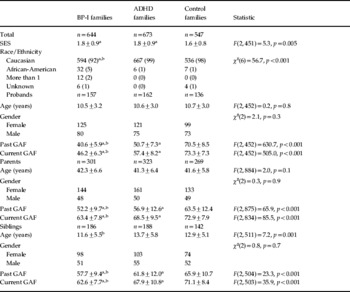
Demographic and clinical characteristics of the sample are presented in Table 1. In total, 80% of the BP-I probands were male. There were small but statistically significant differences in the ethnic and socio-economic backgrounds of the families. The control had higher socio-economic status (SES) and the BP-I families had more ethnic diversity. Accordingly, all subsequent tests were adjusted for SES and race. There were no differences in the age or gender of the BP-I, ADHD and control probands (by design, see Ascertainment method). The BP-I probands were more impaired than both ADHD and control children according to past and current global assessment of functioning (GAF) score (Table 1). There were no meaningful demographic characteristics differences between the parents or siblings of the BP-I, ADHD and control probands, but relatives of BP-I probands were more impaired according to both lifetime and current GAF scores than the relatives of both the ADHD and control probands.
Clinical and demographic characteristics

BP-I, Bipolar-I, ADHD, attention deficit hyperactivity disorder; SES, socio-economic status; GAF, global assessment of function.
a p<0.05 v. control; b p<0.05 v. ADHD.
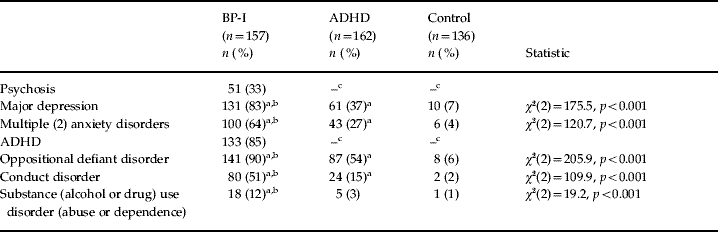
The clinical presentation of BP-I disorder in probands was characterized by early onset (5.8±3.4 years), rapid cycling (22.4±61.6 episodes) and a chronic course (3.6±3.3 years in duration). As shown in Table 2, BP-I in probands was predominantly mixed with co-occurring depression (n=131, 83%) and probands with BP-I were at increased risk of multiple (⩾2) anxiety disorders, disruptive behavior disorders and substance use disorder relative to both the ADHD and control probands. Although statistical comparisons could not be made between these groups for ADHD or psychosis due to the inclusion/exclusion criteria of the ADHD family studies, both of these disorders were over-represented in BP-I probands.
Psychiatric co-morbidity in proband children

BP-I, Bipolar-I.
a p<0.05 v. controls; b p<0.05 v. attention deficit hyperactivity disorder (ADHD).
c Potential probands with psychosis were excluded during ascertainment of ADHD and control families.
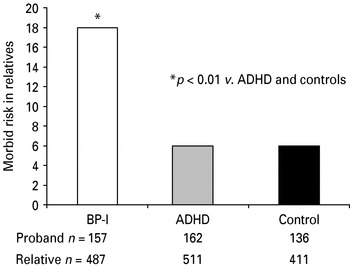
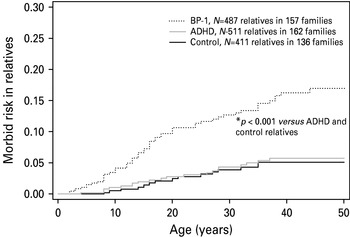
The age-dependent cumulative MR of BP-I disorder in relatives is illustrated in Figs 1 and 2. The risk of BP-I disorder in relatives of BP-I probands was statistically significantly higher compared with the relatives of both the ADHD (HR=3.1 (1.8–5.5); p<0.0001) and the healthy control probands (HR=3.3; (1.9–5.5); p<0.0001). In contrast, the relatives of ADHD probands were not at increased risk of BP-I compared with relatives of control probands (HR=1.0; (0.5–1.9); p=0.9). In this context, the HR indexes the relative risk for a disorder in the relative given the proband diagnoses. For example, the HR for BP-I in relatives of BP-I versus relatives of ADHD probands was 3.6, which means that there was an age-corrected 3.6-fold increase of BP-I among the relatives of BP-I probands compared with relatives of ADHD probands. Controlling for psychiatric co-morbidity in probands [oppositional defiant disorder (ODD), CD, major depression, multiple anxiety disorders and substance use disorder] did not impact the statistical significance or magnitude of the HRs comparing the relatives of BP-I probands with relatives of ADHD (corrected HR=3.8 (1.9–7.6, p<0.0001) or control (corrected HR=4.0 (1.6–10.1, p<0.0001) probands.
Familial risk of bipolar-I (BP-I) disorder in first-degree relatives. ADHD, attention deficit hyperactivity disorder.

Bipolar-I (BP-I) disorder in first-degree relatives.

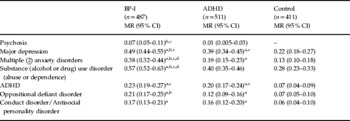
The MR of additional psychiatric disorders in the first-degree relatives of BP-I, ADHD and control probands are presented in Table 3. Relatives of BP-I probands were at increased risk of psychosis, major depression, multiple anxiety disorders, substance use disorders, ADHD, ODD and antisocial CD or antisocial personality disorder (ASPD) compared with relatives of control probands. In addition, in comparison with relatives of ADHD probands, relatives of BP-I probands were also at increased risk of major depression, multiple anxiety disorders, substance use disorders and ODD (Table 3). However, in models adjusting for the same psychiatric co-morbidity in probands, the relatives of BP-I probands were no longer at increased risk for ODD nor for CD/ASPD compared with relatives of control probands, nor for ODD and CD/ASPD compared with relatives of ADHD probands (all p's>0.05). Thus, BP-I in probands was independently associated with major depression, multiple anxiety disorders substance use disorders and ADHD in comparison with controls. Relatives of BP-I probands were at statistically significant increased risk of psychosis, multiple anxiety disorders and substance use disorder compared with relatives of ADHD probands independently of the psychiatric co-morbidity with these disorders in probands.
Psychiatric morbidity in first-degree relatives of pediatric bipolar disorder, attention deficit hyperactivity disorder (ADHD) and control probands

MR, Morbid risk; CI, confidence interval; HR, hazard ratio.
All results corrected for family socio-economic status and race.
a p<0.05 v. controls relatives;
b p<0.05 v. ADHD relatives;
c p<0.05 v. controls relatives after correcting for concordant psychiatric co-morbidity in the proband (e.g. the analysis of ADHD in the relatives was corrected for the presence of ADHD in the proband);
d p<0.05 v. ADHD relatives after correcting for concordant psychiatric co-morbidity in the proband.
To determine if our findings of familial transmission were moderated by age, we augmented our statistical models by adding the interaction of age (⩽12 years v. >12 years) by proband group. We found no statistically significant interaction, which indicates that the magnitude of familial transmission was not moderated by age group.
Discussion
Particular strengths of this study include its large sample size, the comprehensive scope of psychopathology examined in both probands and relatives and the use of both psychopathological (ADHD) and healthy control comparison groups. By assessing a wide range of psychiatric conditions in these data, we could adjust for psychiatric co-morbidity in probands when estimating the familiality of BP-I in their first-degree relatives and estimate the familial risk of additional psychiatric disorders in relatives of BP-I child probands, while also adjusting for psychiatric co-morbidity in the probands. The diagnosis of pediatric bipolar disorder continues to confound clinicians and researchers, with questions remaining as to its validity. Following the logic of Robins & Guze (Reference Robins and Guze1970), family studies provide data external to the clinical picture, which can support the validity of a diagnosis. The present study is unique in several ways: (1) it is the largest family study of this disorder; (2) it includes a psychopathological control group; (3) it ascertains subjects based on unmodified DSM criteria; (4) it is the first to focus on the familiality of additional psychopathological conditions in relatives.
In our sample, 80% of the BP-I probands are male. This is consistent with previous reports of male preponderance by Geller et al. (Reference Geller, Tillman, Bolhofner and Zimerman2008) 67%, Findling et al. (Reference Findling, Gracious, McNamara, Youngstrom, Demeter, Branicky and Calabrese2001) 71.1% and Luckenbaugh et al. (Reference Luckenbaugh, Findling, Leverich, Pizzarello and Post2009) 70%. Only Birmaher et al. (Reference Birmaher, Axelson, Goldstein, Strober, Gill, Hunt, Houck, Ha, Iyengar, Kim, Yen, Hower, Esposito-Smythers, Goldstein, Ryan and Keller2009) found a nearly equal gender representation for BP-I subjects of 53.5%.
The significantly elevated MR of BP-I in relatives was not appreciably changed after controlling for psychiatric co-morbidity in probands. This was so despite the high rates of co-morbid ADHD, ODD, major depression and anxiety disorders in children with BP-I disorder, as has been previously documented by several research groups (Wozniak & Biederman, Reference Wozniak and Biederman1995; Wozniak et al. Reference Wozniak, Biederman, Kiely, Ablon, Faraone, Mundy and Mennin1995a; Geller et al. Reference Geller, Zimerman, Williams, Bolhofner, Craney, Delbello and Soutullo2000b; Findling et al. Reference Findling, Gracious, McNamara, Youngstrom, Demeter, Branicky and Calabrese2001; Mick et al. Reference Mick, Biederman, Faraone, Murray and Wozniak2003; Brotman et al. Reference Brotman, Kassem, Reising, Guyer, Dickstein, Rich, Towbin, Pine, McMahon and Leibenluft2007). Moreover, the similar magnitude and statistical significance of the corrected and uncorrected HRs suggests that co-morbidity in probands had little impact on the familiality of BP-I disorder. This finding cannot be explained by any theory that posits BP-I disorder in children to be an epiphenomenon of another disorder.
Although relatives of BP-I probands were at increased risk for major depression compared with relatives of controls, the risk for major depression was not distinguishable between relatives of BP-I and relatives of ADHD probands. These results are consistent with previous studies (Kutcher & Marton, Reference Kutcher and Marton1991; Wozniak et al. Reference Wozniak, Biederman, Kiely, Ablon, Faraone, Mundy and Mennin1995a, Reference Wozniak, Biederman, Mundy, Mennin and Faraoneb; Geller et al. Reference Geller, Tillman, Bolhofner, Zimerman, Strauss and Kaufmann2006; Brotman et al. Reference Brotman, Kassem, Reising, Guyer, Dickstein, Rich, Towbin, Pine, McMahon and Leibenluft2007). Based on our previous work examining the nature of the association between ADHD and major depression, similarities in the risk for major depression between ADHD and BP-I families could be explained by research suggesting that ADHD and major depression may share familial risk factors (Faraone & Biederman, Reference Faraone and Biederman1997; Biederman et al. Reference Biederman, Mick and Faraone1998, Reference Biederman, Ball, Monuteaux, Mick, Spencer, McCreary, Cote and Faraone2008).
Our findings that the elevated rates of antisocial disorders in relatives of BP-I probands was accounted for by these disorders in the proband are consistent with findings reported by Wozniak et al. (Reference Wozniak, Biederman, Faraone, Blier and Monuteaux2001). These investigators also found that the relatives of BP-I in probands were not at increased risk for antisocial disorders after accounting for this co-morbidity in probands.
The association between BP-I and ADHD in families has been the subject of prior investigation. Rende et al. (Reference Rende, Birmaher, Axelson, Strober, Gill, Valeri, Chiappetta, Ryan, Leonard, Hunt, Iyengar and Keller2007) reported that 33% of children with BP-I disorder had a family history of ADHD and, although the MR of ADHD was not specifically estimated, Geller et al. (Reference Geller, Tillman, Bolhofner, Zimerman, Strauss and Kaufmann2006) found that relatives with ADHD, of child bipolar probands, were at increased risk for bipolar disorder. The familial relationship between ADHD and BP-I observed in these studies of BP-I probands (Geller et al. Reference Geller, Tillman, Bolhofner, Zimerman, Strauss and Kaufmann2006; Rende et al. Reference Rende, Birmaher, Axelson, Strober, Gill, Valeri, Chiappetta, Ryan, Leonard, Hunt, Iyengar and Keller2007) is consistent with our previous family studies of ADHD and BP-I (Wozniak et al. Reference Wozniak, Biederman, Mundy, Mennin and Faraone1995b; Faraone et al. Reference Faraone, Biederman, Mennin, Wozniak and Spencer1997, Reference Faraone, Biederman and Monuteaux2001). That these disorders may also share familial risk factors could explain the association of the dopamine transporter gene with both bipolar disorder (Greenwood et al. Reference Greenwood, Schork, Eskin and Kelsoe2006; Mick et al. Reference Mick, Kim, Biederman, Wozniak, Wilens, Smoller, Spencer, McGrath, Sklar and Faraone2007) and ADHD (Brookes et al. Reference Brookes, Xu, Chen, Zhou, Neale, Lowe, Aneey, Franke, Gill, Ebstein, Buitelaar, Sham, Campbell, Knight, Andreou, Altink, Arnold, Boer, Buschgens, Butler, Christiansen, Feldman, Fleischman, Fliers, Howe-Forbes, Goldfarb, Heise, Gabriels, Korn-Lubetzki, Marco, Medad, Minderaa, Mulas, Muller, Mulligan, Rabin, Rommelse, Sethna, Sorohan, Uebel, Psychogiou, Weeks, Barrett, Craig, Banaschewski, Sonuga-Barke, Eisenberg, Kuntsi, Manor, McGuffin, Miranda, Oades, Plomin, Roeyers, Rothenberger, Sergeant, Steinhausen, Taylor, Thompson, Faraone, Asherson and Johansson2006a, b; Asherson et al. Reference Asherson, Brookes, Franke, Chen, Gill, Ebstein, Buitelaar, Banaschewski, Sonuga-Barke, Eisenberg, Manor, Miranda, Oades, Roeyers, Rothenberger, Sergeant, Steinhausen and Faraone2007). More work is needed with larger samples of non-ADHD BP-I probands and their relatives to fully parse the familiality of ADHD and pediatric BP-I.
Our finding of increased familial risks for substance use disorders and anxiety disorders in relatives of pediatric BP-I probands is consistent with the literature (Dwyer & Delong, Reference Dwyer and Delong1985; Strober et al. Reference Strober, Morrell, Burroughs, Lampert, Danforth and Freeman1988; Brotman et al. Reference Brotman, Kassem, Reising, Guyer, Dickstein, Rich, Towbin, Pine, McMahon and Leibenluft2007). Wozniak et al. (Reference Wozniak, Biederman, Monuteaux, Richards and Faraone2002) also found an excess of anxiety disorders in relatives of pediatric bipolar probands but only among those of probands who also suffered from anxiety disorders. Similarly, prior work has shown an excess of substance use disorders in child BP-I probands and their relatives (Biederman et al. Reference Biederman, Faraone, Monuteaux and Feighner2000a, b). The consistency of the familial risk for psychopathology in the current study with that of the extant literature is particularly noteworthy considering the variability in study methodology (i.e. ascertainment criteria, sample size, study design) and suggests that the familiality of pediatric BP-I disorder may be as highly reproducible as it is for adult BP-I disorder (Tsuang & Faraone, Reference Tsuang and Faraone1990).
Our findings should be considered in the context of methodological limitations. Despite the large sample size, full stratification by psychiatric co-morbidity would have resulted in cells with small sample size (e.g. 24 non-ADHD BP-I probands). For our structured interviews, both the KSADS and the SCID, we used extensively trained interviewers with undergraduate degrees in psychology, rather than clinician raters. Although we did not administer structured diagnostic interviews directly to children younger than 12 years of age, a clinical diagnosis of BP-I in probands was corroborated by clinical assessment by an expert clinician prior to study inclusion (Wozniak et al. Reference Wozniak, Monuteaux, Richards, Lail, Faraone and Biederman2003). Also, we did not concurrently enroll comparison families but relied instead upon existing samples of ADHD and non-ADHD families. However, because all subjects were recruited from the same catchment area using the same ascertainment schema and research assessments, it is unlikely that the sample definition accounts for the findings presented here. Finally, because this sample was clinically referred and primarily Caucasian, these results may not generalize to non-referred children or to families of other ethnicities.
With these considerations in mind, we report that relatives of pediatric probands with DSM-IV defined BP-I disorder were at significantly increased risk for BP-I disorder compared with relatives of both ADHD and control probands. In addition, we found that pediatric BP-I disorder was associated with an increased familial risk of syndrome-congruent psychiatric co-morbidity such as of major depression, substance use disorder, anxiety disorders and psychosis. High rates of antisocial disorders were noted among the relatives of BP-I probands who also suffered from these co-morbidities. These results are consistent with the literature documenting the familiality of pediatric bipolar disorder and suggest that DSM-IV BP-I disorder diagnostic criteria applied to children is a valid clinical entity worthy of further clinical and scientific attention. While the familial component of the Robins & Guze (Reference Robins and Guze1970) criteria for a valid psychiatric condition may have been met, prospective follow-up studies, genetic association studies and neuroimaging studies are needed to further characterize the prognostic course and neurobiological underpinnings and causes of DSM-IV defined pediatric bipolar disorder.
Acknowledgements
This work was supported by National Institutes of Health (NIH) grants K08MH001503 and R01MH066237 to Dr Wozniak, R01MH050657 and R01HD036317 to Dr Biederman and K01MH065523 to Dr Mick. This work was also supported by a grant from the Susan G. Berk Endowed Fund for Juvenile Bipolar Disorder. The Heinz C. Prechter Bipolar Research Fund and the support of members of the MGH Pediatric Psychopharmacology Council. All sponsors of this research supported only the collection of the data and played no other role in the design, analysis or interpretation of these findings. Dr Eric Mick had full access to all of the data in the study and takes responsibility for the integrity of the data and the accuracy of the data analysis.
Declaration of Interest
Dr Eric Mick receives research support from the following sources and is on an advisory board for the following sources: McNeil Pediatrics, Ortho-McNeil Janssen Scientific Affairs, Pfizer, Shire Pharmaceuticals and the National Institute of Mental Health (NIMH) and has had an advisory or consulting relationship with Pfizer and Shire Pharmaceutical. Dr Joseph Biederman is currently receiving research support from the following sources: Alza, AstraZeneca, Bristol Myers Squibb, Eli Lilly and Co., Janssen Pharmaceuticals Inc., McNeil, Merck, Organon, Otsuka, Shire, NIMH and NICHD. Dr Biederman is currently a consultant/advisory board member for the following pharmaceutical companies: Janssen, McNeil, Novartis and Shire. He is currently a speaker for the following speaker's bureaux: Janssen, McNeil, Novartis, Shire and UCB Pharma, Inc. In previous years, Dr. Biederman has received research support, consultation fees or speaker's fees for/from the following additional sources: Abbott, AstraZeneca, Celltech, Cephalon, Eli Lilly and Co., Esai, Forest, Glaxo, Gliatech, NARSAD, NIDA, New River, Novartis, Noven, Neurosearch, Pfizer, Pharmacia, The Prechter Foundation, The Stanley Foundation and Wyeth. Dr Michael Monuteaux was a speaker in a symposia sponsored by Shire, Inc. Dr Faraone receives research support from and consults to Shire Pharmaceutical Development. He receives grant support from Eli Lilly and the NIH. Dr Wozniak has been a speaker for McNeil, Primedia/MGH Psychiatry Academy, on the Advisory Board for Pfizer and Shire and received research support from NIMH, McNeil, Shire and Lilly. Her spouse, John Winkelman MD, PhD, has been on the Speakers Bureau for Boehringer-Ingelheim, Cephalon, GlaxoSmithKline, King, Sanofi-Aventis, Sepracor, Takeda, on the Advisory Board for Axon Labs, Boehringer-Ingelheim, GlaxoSmithKline, Jazz Pharmaceuticals, Novartis, Neurogen, Novadel Pharma, Pfizer, UCB (Schwarz) Pharma, Sepracor, Takeda and received research support from Boehringer-Ingelheim, GlaxoSmithKline, UCB (Schwarz) Pharma, Sepracor.