Introduction
Preschool children (0 to 5 years of age) constitute a particularly high-risk group for sustaining traumatic brain injury (TBI), with a yearly rate of 1.85 per 100 in children under 5 years of age (compared to rates of <1.17 in other pediatric age groups; Faul, Xu, Wald, & Coronado, Reference Faul, Xu, Wald and Coronado2010; McKinlay et al., Reference McKinlay, Grace, Horwood, Fergusson, Ridder and MacFarlane2008). As with older individuals, preschoolers are most at-risk for sustaining mild TBI (mTBI), constituting 90% of all injuries (Crowe, Babl, Anderson, & Catroppa, Reference Crowe, Babl, Anderson and Catroppa2009; McKinlay et al., Reference McKinlay, Grace, Horwood, Fergusson, Ridder and MacFarlane2008). Cognitive deficits, delayed school readiness, behavioral and emotional disturbances, and somatic complaints have been documented following early brain injury across the severity spectrum, with evidence of long term persistence of these sequelae (e.g., Garcia, Hungerford, & Bagner, Reference Garcia, Hungerford and Bagner2015; Li & Liu, Reference Li and Liu2013; Shay et al., Reference Shay, Yeates, Walz, Stancin, Taylor, Beebe and Wade2014). Although the changes observed following mTBI tend to be more subtle and less pervasive than those associated with severe injuries, the ensuing difficulties can nonetheless interfere with development, notably in terms of school performance and socio-emotional maturation (Kaldoja & Kolk, Reference Kaldoja and Kolk2012; Wrightson, McGinn, & Gronwall, Reference Wrightson, McGinn and Gronwall1995).
Poor prognosis after early childhood TBI is likely to be attributed to the fact that cognitive functions coming online during the first 5 years of life are critically dependent on the integrity of particular brain structures at key developmental stages (Anderson, Catroppa, Morse, Haritou, & Rosenfeld, Reference Anderson, Catroppa, Morse, Haritou and Rosenfeld2005; Anderson et al., Reference Anderson, Spencer-Smith, Leventer, Coleman, Anderson, Williams and Jacobs2009; Ryan et al., Reference Ryan, Anderson, Godfrey, Beauchamp, Coleman, Eren and Catroppa2014). These formative years also constitute a rich period of social development with the emergence of rudimentary social skills and relationships setting the stage for more complex social interactions (Johnson, Ironsmith, Snow, & Poteat, Reference Johnson, Ironsmith, Snow and Poteat2000). Appropriate social functioning has repercussions beyond the social sphere as it is associated with school readiness and success, as well as emotional well-being (Blair, Reference Blair2002; Ladd, Reference Ladd1999; Parker & Asher, Reference Parker and Asher1987). Despite the pivotal role of social abilities during the early years and the high prevalence of TBI during this period, little is known of the consequences of preschool TBI on the precursors to adequate social functioning, such as the ability to take the perspective of others (theory of mind).
Global socio-behavioral (e.g., conduct disorders, disruptive behavior), socio-affective, and social participation impairments have been documented after childhood TBI (Anderson et al., Reference Anderson, Beauchamp, Yeates, Crossley, Hearps and Catroppa2013; Rosema, Crowe, & Anderson, Reference Rosema, Crowe and Anderson2012; Yeates et al., Reference Yeates, Swift, Taylor, Wade, Drotar, Stancin and Minich2004). These problems translate into difficulties maintaining peer relationships, reduced social competence, isolation, loneliness, and increased aggression (Andrews, Rose, & Johnson, Reference Andrews, Rose and Johnson1998; Baguley, Cooper, & Felmingham, Reference Baguley, Cooper and Felmingham2006; Max et al., Reference Max, Lindgren, Knutson, Pearson, Ihrig and Welborn1998). Although poor social outcome is especially evident after moderate and severe TBI, recent findings indicate that even milder brain injuries can result in social interaction impairments (Kaldoja & Kolk, Reference Kaldoja and Kolk2012). Rather than abating, these difficulties may exacerbate as preschoolers transition to later childhood and adolescence, due to the increased pressure and demands of social and academic responsibilities, such as attending school and developing social connections beyond the family (Muscara, Catroppa, Eren, & Anderson, Reference Muscara, Catroppa, Eren and Anderson2009; Taylor et al., Reference Taylor, Yeates, Wade, Drotar, Stancin and Minich2002). As such, it has been suggested that social impairments may be the most enduring and debilitating sequelae of childhood TBI (e.g., Beauchamp & Anderson, Reference Beauchamp and Anderson2013).
These findings highlight the need to better understand the nature of social dysfunction following early childhood TBI by going beyond the assessment of global social functioning to examine underlying social cognition (i.e., abilities that allow individuals to understand social cues and interact adequately). Theory of Mind (ToM) is a set of basic socio-cognitive skills that emerge in the preschool years and enable individuals to understand another person’s perspective and infer mental states, including desires, emotions, beliefs, and intentions in order to predict behavior (Wellman, Fang, & Peterson, Reference Wellman, Fang and Peterson2011). Extensive research shows that ToM is important for the development and maintenance of social behavior and skills including communication, conflict resolution, empathy, as well as general social competence (Astington, Reference Astington2003). More precisely, as children evolve from an egocentric point of view to a more considerate perspective of the role of internal states on behavior, they are increasingly able to predict and explain the associations between mental states and behavior, and hence become more competent social partners (Razza & Blair, Reference Razza and Blair2009).
Although there are individual differences regarding the specific ages at which key ToM concepts emerge and are fully acquired, a general developmental sequence prevails (Miller, Reference Miller2012). Studies have shown that precursors of ToM develop during infancy, notably joint attention and social referencing (i.e., social understanding guided by others’ emotional cues; e.g., Feinman, Reference Feinman1992; Moore & Dunham, Reference Moore and Dunham1995). During the preschool years, children develop a “desire theory” according to which behavior is explained in terms of desires, without any understanding or consideration of the influence of beliefs (Wellman & Woolley, Reference Wellman and Woolley1990). As such, by 3 years of age, children understand that people’s behavior is guided by their desires. They also appreciate the emotional impact of fulfilled or unfulfilled desires. By the time they reach the age of four, children have typically progressed toward “belief-desire psychology” whereby they realize that both desires and beliefs guide behavior and that people can act on beliefs that are untrue (Wellman, Reference Wellman1990; Wellman & Woolley, Reference Wellman and Woolley1990). A developmental breakthrough thus occurs during the preschool years, namely that of “false-belief understanding” (FBU). The concept of FBU has long been considered a milestone in the development of ToM because it is one of the first indications that children distinguish between the mind and the physical world, and demonstrate an understanding that these can sometimes be at odds with one another. It is partly for this reason that the earliest form of FBU, first order ToM, is the most widely studied. This concept is defined by Miller (Reference Miller2012) as “[…] children’s ability to think about mental states in themselves and others – thus to think about somebody thinking something, or feeling something, or wanting something, or whatever the relevant mental state may be ” (p. 44; “A thinks that…”). Considered a preschool achievement, first order FBU is usually mastered by the time children reach the age of five. From this foundational layer, more advanced FBU progressively develops. Second order FBU is generally understood by most 7- and 8-year-olds; it involves someone else’s belief about something in the world (“A thinks that B thinks that…”). The most complex form of FBU, third order FBU, is subsequently attained and involves the following recursive reasoning: “A thinks that B thinks that C thinks that…”.
Few studies examining ToM after childhood TBI have been conducted to date and they focused primarily on school-aged children. Five studies of individuals between the ages of 6 and 22 years tested between 1 and 12 years post-injury, found that youth with TBI (especially those with moderate to severe injuries) performed significantly worse than controls on ToM tasks (Dennis, Agostino, Roncadin, & Levin, Reference Dennis, Agostino, Roncadin and Levin2009; Dennis et al., Reference Dennis, Simic, Bigler, Abildskov, Agostino, Taylor and Yeates2013, Reference Dennis, Simic, Taylor, Bigler, Rubin, Vannatta and Yeates2012; Snodgrass & Knott, Reference Snodgrass and Knott2006; Turkstra, Dixon, & Baker, Reference Turkstra, Dixon and Baker2004). In these studies, impairments were found on more complex forms of ToM, but not on first-order tasks. In contrast, when children 6 to 8 years of age were tested approximately 1 year post-injury, first- and second-order ToM deficits were documented in those with severe TBI (Walz, Yeates, Taylor, Stancin, & Wade, Reference Walz, Yeates, Taylor, Stancin and Wade2010), constituting the first evidence that these fundamental skills may be affected in school-aged children. Only one study to date has examined ToM after preschool TBI, showing that children with severe TBI are impaired on FBU compared to those with moderate TBI and orthopedic controls (Walz, Yeates, Taylor, Stancin, & Wade, Reference Walz, Yeates, Taylor, Stancin and Wade2009). Given (a) the evidenced negative socio-cognitive consequences of head injuries in children and (b) the high prevalence of TBI, especially mTBI, in children under 5 years of age, the goal of the present study was to examine first-order ToM skills in preschool children (18 to 60 months) with mTBI. It was expected that children with mTBI would perform significantly worse on ToM tasks compared to typically developing children.
Method
Participants
Recruitment
This study was approved by the institutional review board of Ste-Justine Hospital and conducted in accordance with the Helsinki declaration. Informed written parental consent and child assent were obtained before participation. Participants were recruited as part of a prospective longitudinal cohort for a project aiming to study cognitive and social outcomes of early TBI. Data are presented pertaining to the 6-month post-injury timepoint. Children with mTBI, excluding mild complicated TBI, were recruited via the Emergency Room between 2011 and 2014, using the definition proposed by Osmond and colleagues (Reference Osmond, Klassen, Wells, Correll, Jarvis, Joubert and Stiell2010). Inclusion criteria were (a) age at injury between 18 and 60 months of age, (b) closed head injury with a Glasgow Coma Scale (GCS) between 13 and 15 (Teasdale & Jennett, Reference Teasdale and Jennett1974), (c) at least one of the following symptoms: loss of consciousness, excessive irritability, persistent vomiting (more than two times), confusion, headaches that worsen over time, drowsiness, dizziness, motor difficulties or balance problems, blurred vision, hypersensitivity to light, and/or the presence of seizures; d) child and at least one parent fluent in French or English. Exclusion criteria were: (a) non-accidental head injuries; (b) diagnosed congenital, neurological, developmental, psychiatric, or metabolic condition; (c) less than 36 weeks of gestation; (d) prior TBI; and e) evidence of intracranial lesion on clinical CT or MRI (i.e., mild complicated TBI).
Typically developing children (TDC) were recruited via advertisements posted in daycare centers. To ensure that children in the TDC group would be age-matched to the mTBI group at 6-months post-injury, inclusion criteria for the control group were: (a) aged between 24 and 66 months, (b) child and at least one parent fluent in French or English. The same exclusion criteria applied.
Final sample
Of the 63 children who sustained mTBI and the 51 TDC initially recruited, 6 participants (all mTBI) dropped-out before completing T1. Additionally, seven participants (six mTBI, one TDC) were excluded at T1 because they had TBI-like symptoms that were better explained by another medical condition (one), lacked mastery of French or English undetected at screening (three), or were identified as having a developmental disorder (three). Data from 51 children with mTBI and 50 TDC were therefore used in the analyses.
Procedure
mTBI
At enrolment (time point 0, T0), parents were asked to complete a pre-injury questionnaire booklet including sociodemographic information, developmental milestones, behavioral and adaptive functioning, and family characteristics. They were asked to report on their child’s behavior and adaptive skills as well as their familial situation in the weeks preceding the injury to provide an estimate of baseline characteristics. Six months post-injury (Time point 1, T1), children completed a socio-cognitive assessment battery administered by neuropsychology doctoral candidates and trained research assistants and parents completed the same questionnaire booklet (without the sociodemographic and developmental milestone questions) along with the Postconcussive Symptom Interview (PCS-I; Mittenberg, Wittner, & Miller, Reference Mittenberg, Wittner and Miller1997; Yeates et al., Reference Yeates, Taylor, Rusin, Bangert, Dietrich, Nuss and Wright2012) in an interview format. At this time point, parents were instructed to assess their child’s behavior and their family characteristics in the last 4 weeks before the testing session.
TDC
Given the absence of injury, typically developing children were tested as soon as possible after recruitment using the same socio-cognitive battery, and parents completed the same questionnaires and PCS-I as the one filled out by mTBI parents at T1, along with the sociodemographic and developmental milestone questionnaire.
Measures
Questionnaires
Case report form
General medical information was obtained from medical files including: cause of mTBI, lowest GCS, and neurological symptoms: headaches, irritability, persistent vomiting (more than two times), hematoma (forehead or scalp), drowsiness, dizziness, seizures, visual symptoms (blurred vision, hypersensitivity to light), and balance/motor problems. Loss of consciousness (LOC) was measured according to the following categories: none, <1 min, <5 min, <1 hrs, 1 to 24 hrs, >24 hrs, suspected, unknown. Where possible, alteration of consciousness (AOC, i.e., confusion) was also assessed as follows: none, <1 hrs, 1 to 24 hrs, >24 hrs, suspected, unknown. Results of clinical neuroimaging were obtained when available to verify exclusion criteria “e” (mild complicated TBI).
Postconcussive Symptom Interview
The PCS-I (Mittenberg et al., Reference Mittenberg, Wittner and Miller1997; Sady, Vaughan, & Gioia, Reference Sady, Vaughan and Gioia2014; Yeates et al., Reference Yeates, Taylor, Rusin, Bangert, Dietrich, Nuss and Wright2012) is a parental report questionnaire that consists of 15 symptoms from the following domains: Physical, Cognitive, Affective and Sleep; parents must say if the symptoms were present (score of 1) or absent (score of 0) at any time during the week before testing and within the last 6-months. The form was slightly reworded to be age-appropriate and to reflect a third-person perspective. A score out of 15 was calculated both for symptoms observed in the last week and in the 6 months post-injury.
ABCs Laboratory Sociodemographic Questionnaire
Parents completed an in-house developmental and demographic questionnaire. The following developmental information was recorded: highest APGAR score, age of first words, and age of first steps. Familial socioeconomic status was calculated using the Blishen Socioeconomic Index (Blishen, Carroll, & Moore, Reference Blishen, Carroll and Moore1987), which attributes a socioeconomic score according to caregiver occupation. For double-earner families, the highest socioeconomic score was used. Parental education was also tabulated according to eight levels (1=Doctoral level studies to 8=less than 7 years of education). Mother and father’s highest educational attainment were averaged.
Adaptive Behavior Assessment System
The Adaptive Behavior Assessment System (ABAS; 0 to 5 years old version; Harrison & Oakland, Reference Harrison and Oakland2003) is a 241-item assessment of everyday adaptive skills. Parents are asked to rate their child on a 4-point scale according to the frequency at which he or she correctly demonstrates a behavior, without help, when such behavior is necessary. The Global Adaptive Composite (GAC) as well as the Social Composite are reported (standard score, M=100; SD=10). The Social Composite evaluates children’s ability to interact socially, engage in play, initiate and maintain friendships, and express and recognize emotions.
Child Behavior Checklist
The Child Behavior Checklist (CBCL; 18 months to 5 years old version; Achenbach & Rescorla, Reference Achenbach and Rescorla2000), a 100-item questionnaire, asks parents to rate various aspects of their child’s behavior on a 3-point scale according to the degree to which the statement describes their child. Two global scores are obtained by grouping the subscales: Internalizing Behavior (Emotionally reactive, Anxious/depressed, Somatic complaints, and Withdrawn subscales) and Externalizing Behavior (Attention problems and Aggressive behavior subscales).
Family Assessment Device – General family functioning subscale
The Family Assessment Device – General family functioning subscale (FAD; Epstein, Baldwin, & Bishop, Reference Epstein, Baldwin and Bishop1983) requires the primary caregiver to rate the degree to which each of the 12 statements describes their general family functioning using a 4-point scale (e.g., “We can express feelings to each other”; “Planning family activities is difficult because we misunderstand each other”). Higher scores indicate poorer levels of family functioning.
Parental Stress Index
The Parental Stress Index (PSI-brief; Abidin, Reference Abidin1995) is a 24-item questionnaire filled out by the primary caregiver that aims to identify dysfunctional parent-child systems (e.g., “When I do things for my child, I get the feeling my efforts are not appreciated very much”). Two subscales were used: parental distress and parent-child dysfunctional interactions, in which a higher score indicates increased distress or dysfunction.
Dyadic Adjustment Scale
The Dyadic Adjustment Scale (DAS-4; Spanier, Reference Spanier1976) is a 4-item self-report measure filled out by the primary caregiver, and it assesses the degree of satisfaction couples are experiencing (e.g., “In general, how often do you think that things between you and your partner are going well?”).
Intellectual Functioning
Intellectual functioning and verbal ability were measured for descriptive purposes. Children between the ages of 24 and 30 months completed the Bayley Scales of Infant Development Cognitive and Language subscales (Bayley-III; Bayley, Reference Bayley2005). Children 31 months and older completed the Wechsler Preschool and Primary Scale of Intelligence (WPPSI-III; Wechsler, Reference Wechsler2002) and scores were calculated for the Verbal, Performance and Global Indices. The Cognitive Composite of the Bayley-III and the Global Index of the WPPSI-III were used as measures of intellectual functioning, whereas the Bayley Language Composite and the WPPSI-III Verbal Index were used as approximations of verbal ability. Percentile ranks were used to allow direct comparisons between assessment tools.
Theory of Mind
ToM tasks were selected to assess two aspects of ToM that develop during the preschool period: emotion and desires reasoning, and FBU. For emotion and desires reasoning, participants were administered age-appropriate variations of such tasks. All children completed the same FBU task.
Discrepant desires task
The discrepant desires task (24 to 35 months of age; Repacholi & Gopnik, Reference Repacholi and Gopnik1997) is a task of emotion and desires reasoning that involves giving the child the choice between two foods, one typically liked by children (e.g., cookies) and one that is generally less preferred (e.g., broccoli).The experimenter expresses a preference for the children’s non-preferred food and then asks them to give her another food item because she is still hungry. The goal of the task is to assess whether children will answer egocentrically or will consider the experimenter’s preferred food. A total of four food combinations are presented, for a maximum of four points; Z-scores are used.
Desires task
The desires task (36 months of age and older; Pears & Moses, Reference Pears and Moses2003) is a more advanced task assessing children’s understanding of how fulfilled and unfulfilled desires might affect a character’s feelings. The stories describe a character’s search for a desired object in a particular location with three possible endings to the story, each presented twice: (1) the character finds the desired object, (2) he finds nothing, or (3) he finds a different object, not initially sought after. The child is asked to speculate on the character’s feelings (happy or sad) in these three situations. A score out of a possible six points is calculated and Z-scores are used.
False belief task
For the false belief task (Hughes, Ensor, & Marks, Reference Hughes, Ensor and Marks2011), children are presented with a peep-through picture book which incorporates a deceptive element and are then asked to recall their own initial belief about what they saw, as well as predict another’s belief via two forced-choice questions. For example, children are made to believe that they see an eye through the peep-through hole, but they find out at the end of the story that it is a spot on a snake. They are then asked: “Before we turned the page, what did you think it was, an eye or a snake?” and (Turn back to initial page, before the child saw it was a spot and not an eye) “This is Leo, he has never read this book, what does he think it is, an eye or a snake?” A control question is also included “What is it really, an eye or a snake?”. For both scenarios, children receive credit (one point) only if they are able to answer the corresponding control question, for a maximum of two points.
Statistical Analyses
All data were analyzed using SPSS statistical software (version 21.0; SPSS, Inc., Chicago, IL) and screened for violations of normality. The degrees of freedom associated with equal variance not assumed are reported for t tests when Levene’s test for Equality of Variances was significant. An alpha level of p<.05 was considered significant and effect sizes were calculated using Cohen’s d (small effect d=0.2, medium effect d=0.5, large effect d=0.8; Cohen, Reference Cohen1988).
Group comparisons (mTBI vs. TDC) were conducted via independent samples t tests for the following variables: age at testing; intellectual functioning (Bayley-III Cognitive Composite or WPPSI-III Global Index); verbal abilities (Bayley-III Language Composite or WPPSI-III Verbal Index); socioeconomic status; parental education; pre- and post-injury global and social behavior (CBCL, ABAS) and family characteristics (FAD, PSI-brief, DAS-4); and postconcussive symptoms (PCS-I; 1 week and 6 months before T1 assessment). A chi-square analysis was conducted to determine whether there was a sex difference between the two groups (mTBI vs. TDC).
Percentages and frequencies are reported for the following TBI injury characteristics: lowest GCS, cause of the accident, presence of loss of consciousness (LOC) and alteration of consciousness (i.e., confusion; AOC). The mean and standard deviation is reported for the number of neurological symptoms reported in the case report form.
Group analyses (mTBI vs. TDC) were first conducted using independent samples t tests. The false belief task total raw score and the emotion and desires tasks combined Z-scores were used as outcome variables. An analysis of covariance (ANCOVA) was also performed to control for pre-existing group differences (externalizing behavior as measured by the CBCL; see below).
Correlations were computed between performance on the ToM tasks and the following TBI injury characteristics: lowest GCS, number of neurological symptoms reported in the case report form, and number of postconcussive symptoms (PCS-I).
Results
Sample Descriptives
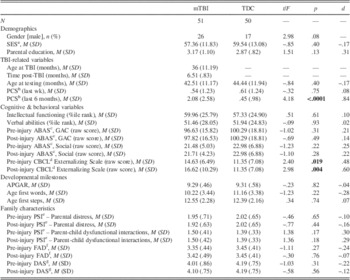
The two groups did not differ in terms of baseline intellectual, behavioral, developmental and family characteristics (see Table 1), except for pre- and post-injury externalizing behavior, as measured by the CBCL. Accordingly, pre-injury externalizing behavior was used as a covariate in the main analyses. There was no significant sex difference between the mTBI and TDC groups, χ2 (1, N=101)=2.98, p=.08. At T1, the two groups differed on the number of postconcussive symptoms reported within the last 6 months, as would be expected.
Sample descriptives

Note: aSES=Socioeconomic status, Blishen Socioeconomic Index, 1981; bPCS=Postconcussive symptoms; cABAS=Adaptive Behavior Assessment System; dCBCL=Child Behavior Checklist; eParental Stress Index; fFamily Assessment Device; gDyadic Adjustment Scale.
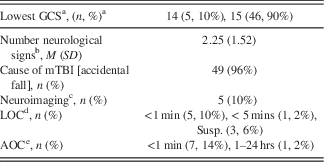
mTBI Injury Characteristics
The majority of children (90%) had a GCS score of 15. The most frequently documented neurological symptoms in the case report form were headaches (35%), persistent vomiting (49%), hematoma (49%), drowsiness (46%), and dizziness (18%). Seizures were reported in only one participant. The majority (96%) of mTBIs were caused by an accidental fall. Other injuries included bumping head on furniture (1) and knee hit on head (1). Nine children reportedly lost consciousness. The LOC lasted either for less than one minute (5), for less than 5 min (1) or it was suspected (3). Eight other participants experienced an alteration in consciousness (AOC). The AOC lasted either less than 1 min (7) or between one and 24 hr (1). See Table 2.
mTBI injury characteristics

Note: aGCS=Glasgow Coma Scale; bNeurological signs include the presence of the following symptoms: Headaches, irritability, persistant vomiting (more than two times), hematoma, drowsiness, dizziness, convulsions, visual symptoms (e.g., blurred vision), balance or motor problems (e.g. crooked walking); cNeuroimaging: All were found to be negative. dLOC=Loss of consciousness (Susp.=suspected); eAOC=Alteration of consciousness.
Theory of Mind Performances
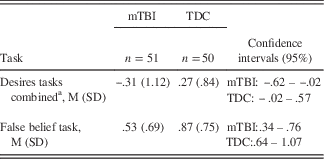
The mTBI group performed significantly worse than the TDC group on both the emotion and desires tasks (t(93)=−2.81; p=.006; d=−.58) and the false belief task (t(93)=−2.40; p=.02; d=−.49). The ANCOVAs revealed that when pre-injury externalizing behavior was entered as a covariate, the main effect of externalizing behavior was not significant in either case (F(1,89)=.67; p=.41; F(1,89)=.05; p=.83), while the main effect of group remained significant for both tasks (Desires task: F(1,89)=4.61; p=.03; d=−.53; False belief task: F(1,89)=2.47; p=.03; d=−.49). See Table 3.
Performance on theory of mind tasks according to group

Note: aStandardized scores of the discrepant desires task and the desires task; tabulated as Z-scores.
Correlations between mTBI Injury Characteristics and Theory of Mind Performances
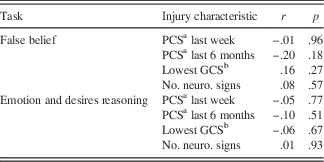
Analyses were conducted to verify if the lowest GCS, the number of neurological signs (as recorded in the case report form), and the number of postconcussive symptoms within the last week and within the last 6 months were associated with ToM. No correlations were found to be significant. See Table 4.
Correlations between ToM performance and mTBI injury characteristics.

Note: aPCS=Postconcussive symptoms; bGCS=Glasgow Coma Scale.
Discussion
The primary goal of this study was to examine the 6-month post-injury effects of mTBI on first-order ToM abilities in 2- to 5-year-old children. First-order ToM deficits of moderate magnitude were observed in children who sustained mTBI compared to their uninjured peers, and were characterized by poorer performance on tasks assessing emotions and desires reasoning as well as false belief understanding, even after controlling for pre-existing differences between the two groups (i.e., externalizing behavior). To our knowledge, this is the first time that poorer ToM is detected following mTBI in the preschool population. Only one other study has examined post-TBI ToM in an overlapping age group (3- to 5-year-olds). Walz and colleagues (Reference Walz, Yeates, Taylor, Stancin and Wade2009) found that children with severe TBI had difficulties in understanding false beliefs; however, reasoning about emotions and desires was not assessed, nor was mTBI.
Inconsistent effects of brain injury on cognitive and behavioral outcomes are reported following mTBI (Kirkwood et al., Reference Kirkwood, Yeates, Taylor, Randolph, McCrea and Anderson2008). Some studies document specific neuropsychological weaknesses (e.g., poorer performance on some aspects of attention, memory, language, visuoperception; Anderson, Catroppa, Morse, Haritou, & Rosenfeld, Reference Anderson, Catroppa, Morse, Haritou and Rosenfeld2001; Wrightson et al., Reference Wrightson, McGinn and Gronwall1995), whereas others suggest that mTBI is associated with minimal or no adverse consequences, especially in the long term (Babikian & Asarnow, Reference Babikian and Asarnow2009; Babikian et al., Reference Babikian, Satz, Zaucha, Light, Lewis and Asarnow2011; Kirkwood et al., Reference Kirkwood, Yeates, Taylor, Randolph, McCrea and Anderson2008; Maillard-Wermelinger et al., Reference Maillard-Wermelinger, Yeates, Taylor, Rusin, Bangert, Dietrich and Wright2009; Petersen, Scherwath, Fink, & Koch, Reference Petersen, Scherwath, Fink and Koch2008). Importantly, Hessen, Nestvold, and Anderson (Reference Hessen, Nestvold and Anderson2007) and Hessen, Nestvold, and Sundet (Reference Hessen, Nestvold and Sundet2006) suggest that even children with mTBI are at increased risk for chronicity of neuropsychological impairment and that outcomes may vary depending on the severity of symptoms (Satz et al., Reference Satz, Zaucha, McCleary, Light, Asarnow and Becker1997). However, most mTBI studies have focused on general aspects of cognition, and little is known about the impact of mTBI on the social domain. It is increasingly clear that moderate to severe TBI in older children is associated with global social repercussions such as social isolation, reduced participation in daily activities, psychosocial difficulties, and affective disorders (Anderson et al., Reference Anderson, Beauchamp, Yeates, Crossley, Hearps and Catroppa2013; Rosema et al., Reference Rosema, Crowe and Anderson2012; Yeates et al., Reference Yeates, Swift, Taylor, Wade, Drotar, Stancin and Minich2004), and one study in preschool children provides evidence that socio-emotional difficulties can occur following mild injuries (Kaldoja & Kolk, Reference Kaldoja and Kolk2012). Our findings specifically suggest that mTBI in very young children may have negative consequences on at least one aspect of social cognition, namely ToM.
In keeping with this, vulnerability theory posits that sustaining a brain injury at a young age can disturb functions that are coming online at the moment of injury, whereas well-consolidated skills are more resilient to damage (Anderson et al., Reference Anderson, Catroppa, Morse, Haritou and Rosenfeld2005, Reference Anderson, Spencer-Smith, Leventer, Coleman, Anderson, Williams and Jacobs2009; Hessen et al., Reference Hessen, Nestvold and Anderson2007; Ryan et al., Reference Ryan, Anderson, Godfrey, Beauchamp, Coleman, Eren and Catroppa2014). For example, data from school-aged children indicate that first- and second-order ToM deficits are present following severe TBI (Walz et al., Reference Walz, Yeates, Taylor, Stancin and Wade2010). In older children and adolescents, second-order ToM deficits have been found following moderate to severe TBI, in the absence of first-order ToM impairments (Dennis et al., Reference Dennis, Agostino, Roncadin and Levin2009, Reference Dennis, Simic, Bigler, Abildskov, Agostino, Taylor and Yeates2013, Reference Dennis, Simic, Taylor, Bigler, Rubin, Vannatta and Yeates2012; Snodgrass & Knott, Reference Snodgrass and Knott2006; Turkstra et al., Reference Turkstra, Dixon and Baker2004). These studies thus suggest that functions developing at the moment of the injury are most at risk of disruption. Given that preschool children are in the process of acquiring the most fundamental concepts and abilities, their developing socio-cognitive skills, such as ToM, may be more fragile and less resistant to disruption. This increased vulnerability is worrisome given the potentially cumulative effects of early injury and the possibility that difficulties may be magnified in the long term with increasingly demanding and complex social environments. Our results lend support to the idea that early brain injuries may disrupt important socio-cognitive processes that are emerging and developing. However, a longitudinal follow-up is necessary to track the post-TBI progression of theory of mind (FBU and emotion and desires reasoning) in the longer term and to examine whether more widespread, cumulative ToM deficits reveal themselves or if the difficulties resorb over time.
TBI Injury Characteristics and Theory of Mind Performance
No correlations were found between the TBI injury characteristics and theory of mind performance. Given that children with mild complicated TBI were excluded from this study, skull fractures or brain lesions (visible on CT or MRI scans) cannot be held responsible for poorer ToM. However, it is also possible that the clinical measures typically collected after mTBI are not sensitive enough to detect subtle variations in injury severity that may influence outcome. In addition, it is difficult to obtain reliable information on the presence and duration of LOC and AOC, and amnesia is impossible to evaluate in such young children due to their inability to clearly verbalize what they are experiencing. With respect to neuroimaging, there is evidence that CT and conventional MRI are relatively insensitive to small hemorrhagic lesions and that only more advanced techniques, such as susceptibility weighted imaging, are able to detect subtle brain changes that may influence outcome (Beauchamp and Anderson, Reference Beauchamp and Anderson2013; Beauchamp et al., Reference Beauchamp, Catroppa, Godfrey, Morse, Rosenfeld and Anderson2011). Mild brain injuries may also result in functional brain disturbances (e.g., abnormal metabolism, decreased blood flow, impaired neural transmission; Ewing-Cobbs et al., Reference Ewing-Cobbs, Prasad, Kramer, Louis, Baumgartner, Fletcher and Alpert2000; MacKenzie et al., Reference MacKenzie, Siddiqi, Babb, Bagley, Mannon, Sinson and Grossman2002; Umile, Sandel, Alavi, Terry, & Plotkin, Reference Umile, Sandel, Alavi, Terry and Plotkin2002; Wozniak et al., Reference Wozniak, Krach, Ward, Mueller, Muetzel, Schnoebelen and Lim2007), better assessed through advanced neuroimaging techniques and biomarkers (Papa, Lewis, Falk, et al., Reference Papa, Lewis, Falk, Zhang, Silvestri, Giordano and Wang2012; Papa, Lewis, Silvestri, et al., Reference Papa, Lewis, Silvestri, Falk, Giordano, Brophy and Wang2012).
Other studies indicate that environmental factors are more predictive of social outcomes post-TBI than clinical factors, (Anderson et al., Reference Anderson, Beauchamp, Yeates, Crossley, Hearps and Catroppa2013; Crowe, Catroppa, Babl, & Anderson, Reference Crowe, Catroppa, Babl and Anderson2012; Rosema et al., Reference Rosema, Crowe and Anderson2012). Research shows that positive parental behavior, adequate family functioning, and higher quality of home environment are linked to better recovery (Crowe et al., Reference Crowe, Catroppa, Babl and Anderson2012; Wade et al., Reference Wade, Cassedy, Walz, Taylor, Stancin and Yeates2011; Yeates et al., Reference Yeates, Swift, Taylor, Wade, Drotar, Stancin and Minich2004; Yeates, Taylor, Walz, Stancin, & Wade, Reference Yeates, Taylor, Walz, Stancin and Wade2010). The family characteristics assessed in the current study, namely general family functioning, parental stress, and parental marital satisfaction do not provide evidence for this hypothesis in our sample. However, a more exhaustive assessment of environmental and family characteristics may be necessary to capture all aspects of family dynamics and other environmental variables which may play a role in the link between mTBI and ToM.
Everyday Social Implications of Theory of Mind Difficulties
Disruptions to ToM skills can have a variety of negative socio-emotional consequences, such as difficulty taking another’s perspective, less sensitivity toward others’ feeling and misfortunes (i.e., empathy), or mistaken intent attribution and decoding of socio-emotional cues, which can all result in reduced social competence and is likely to elicit unfavorable reactions from peers. This is of concern given the well-documented importance of peer relationships for children’s subsequent emotional, social, and academic adjustment. For instance, studies show that young children who have more or better-quality friendships are likely to present better socio-emotional adjustment (Ladd & Troop-Gordon, Reference Ladd and Troop-Gordon2003) and school adjustment (Ladd, Reference Ladd2003; Ladd, Kochenderfer, & Coleman, Reference Ladd, Kochenderfer and Coleman1996), and are less likely to drop out of school in subsequent years (Srebnik & Elias, Reference Srebnik and Elias1993). Thus, early social deficits emanating from poor ToM could have lasting consequences for children’s developmental pathways.
Limitations
In the TBI literature, the issue of the appropriate control group (typically developing children vs. orthopedic injured peers) remains controversial (Babikian et al., Reference Babikian, Satz, Zaucha, Light, Lewis and Asarnow2011; Mathias, Dennington, Bowden, & Bigler, Reference Mathias, Dennington, Bowden and Bigler2013). Children with orthopedic injuries are thought to provide a better control for child characteristics that could put individuals at-risk for TBI (e.g., attention and behavior problems; Babikian et al., Reference Babikian, Satz, Zaucha, Light, Lewis and Asarnow2011), although a recent study, albeit in adults, suggests that orthopedic injury control groups do not have any clear advantages over community control groups (Mathias et al., Reference Mathias, Dennington, Bowden and Bigler2013). A typically developing (community) control group was used here to compare children with mTBI to the peers they are likely to interact with and be compared to in everyday life. While we cannot entirely rule out the possibility that group differences are inherent to the TBI population, it is notable that the two groups in this study had comparable (TBI pre-injury) socioeconomic status, developmental milestones, intellectual functioning, verbal skills, adaptive functioning, parental stress, parental marital satisfaction, and family functioning. They differed only on the increased presence of pre-injury externalizing behavior problems in the mTBI group, which is consistent with other studies (e.g., Garcia et al., Reference Garcia, Hungerford and Bagner2015; Li & Liu, Reference Li and Liu2013). When this difference was controlled for in the analyses, the results remained robust with medium effect sizes, suggesting that differences in ToM may be more attributable to TBI than to pre-existing behavioral differences. Another limitation in this study related to age effects. Given that ToM develops rapidly during the preschool years, future work with larger samples should seek to investigate ToM performance in smaller age bands to capture more subtle changes and differences in social cognition.
Conclusions
As the first evidence that mTBI is associated with ToM difficulties in very young children, the findings have substantial implications for clinical management. However, to devise appropriate interventions, we must first establish if the difficulties observed in the current study are associated with more extensive social impairments in the longer term, or whether they will resorb as a result of ongoing neurocognitive development, as some studies have shown for other cognitive functions (e.g., Anderson, Catroppa, Godfrey, & Rosenfeld, Reference Anderson, Catroppa, Godfrey and Rosenfeld2012; Anderson, Godfrey, Rosenfeld, & Catroppa, Reference Anderson, Godfrey, Rosenfeld and Catroppa2012; Beauchamp et al., Reference Beauchamp, Catroppa, Godfrey, Morse, Rosenfeld and Anderson2011). Additionally, given the complex and multidimensional nature of ToM, it will be important to establish, especially in the preschool population, if ToM skills are uniformly affected or if some components are more resilient to injury. Future studies should assess a wider range of ToM (e.g., intent attribution) and associated socio-cognitive skills (e.g., empathy) using longitudinal designs to obtain a clearer profile. Lastly, the link between mTBI and ToM skills may be the result of a complex orchestration of various cognitive functions not limited to ToM (e.g., attention, executive skills) and the relation may be modulated by other variables (e.g., fatigue, motivation) not considered in this study. Nonetheless, considering the impact that social difficulties may have on daily functioning, the current findings point to the necessity of assessing and monitoring social cognition after early TBI, even when injuries are mild. Elucidation of the putative causes and consequences of ToM impairments in this population will be helpful in guiding health practitioners in their management and follow-up of young children with mTBI who exhibit persistent socio-cognitive difficulties.
Acknowledgment
This work was supported by the Fonds de Recherche du Québec en Santé (J.B.) and the Canadian Institutes of Health Research (MOP11036 to M.H.B.). The authors declare no competing financial interests.