The most significant health initiatives in the thirty years after the end of the Second World War were the campaigns to eradicate malaria and smallpox. US doctor Robert Hingson; Brother's Brother Foundation; and the US government were central to these efforts.Footnote 1 In 1958, Hingson organized a multiple-month, around-the-world mission to assess medical needs internationally and contribute where possible. This undertaking facilitated later medical interventions abroad and the creation of an organization, Brother's Brother Foundation, to send American medical professionals on short-term missions. Explicitly Christian in nature, Hingson and his organization represented a new type of medical missionary. They did not live among their patients for years, as had earlier missionaries. Instead, aided by technological innovation and logistical support from the US government, their missions aimed for rapid medical intervention rather than deep, sustained contact.Footnote 2 They benefited in particular from the development of the jet injector – an affordable and efficient means to achieve mass immunization. Their methods, termed vertical interventions by global health scholars, were particularly well suited to smallpox eradication, which they pursued in Liberia in advance of and later elsewhere alongside the World Health Organization (WHO)'s international campaign. In contrast to narratives focused on the geopolitical motivations for smallpox elimination efforts, examining Hingson, Brother's Brother Foundation, and their 1962 medical mission to Liberia reveal the religious motivations for smallpox eradication as well as the early contributions of the US government.
Brother's Brother Foundation built upon a long history of religious inspiration underlying humanitarianism, although eighteenth-century missionaries intended ‘to save souls, not to lessen earthly distress’.Footnote 3 Similarly, Brother's Brother Foundation was part of a lengthy tradition of ‘medical men’ active in humanitarianism as historian Amanda Moniz has shown.Footnote 4 Among Hingson's motivations were a professed desire to follow the commandment to love one's neighbour as oneself, and one observer characterized the missions as bringing together ‘Christian Brotherhood’ and ‘modern medical science’. Hingson remarked, ‘I must apply my medical knowledge as far as I can reach.’Footnote 5 Hingson and his interdenominational colleagues served as medical missionaries in new ways.Footnote 6 His work represented a shift away from formal proselytism, and Brother's Brother Foundation fitted with the turn toward short-term missions that has accelerated into the twenty-first century.Footnote 7 Beyond missionaries, religious liberals became more secular, and they began to work with allies in other denominations.Footnote 8 Historian Andrew Preston describes a process of interdenominational collaboration among liberal Protestants on social justice, human rights, foreign assistance, and disarmament in the early years of the Cold War.Footnote 9
Hingson and his colleagues represented these broader changes taking place within American Protestantism in the early Cold War with missionaries increasingly turning to ‘ecumenical’ activities in which one would serve as a ‘specialist who adds technical skills to his basic desire to serve’.Footnote 10 In describing his 1962 Liberia mission to a medical colleague, Hingson wrote, ‘We do not forget that we represent the broader segment of the United States population dedicated to the principles of Christianity and its practical translation through improving health, education and living conditions among those who are ill fed, ill housed and ill clothed.’Footnote 11 Like other liberal Protestants at the time, Hingson had a broad conception of who as his ‘neighbour’ deserved his love and assistance. This international vision, which is similarly reflected in the attitudes of Americans engaged in human rights activism and other humanitarian activity in these years, helped save the lives of Liberians as well as enhance American soft power.Footnote 12
US government support for Hingson's private initiatives reveal the ways in which humanitarian and development efforts tied to international health evolved in the 1960s in connection with trends in American denominations and US foreign relations. In its global health efforts, however, Brother's Brother Foundation was not simply an independent non-governmental organization (NGO). Instead, the US government offered key logistical support to Hingson's efforts.Footnote 13 Brother's Brother Foundation initiatives inevitably achieved a degree of ‘soft power’ for the United States at a time when the United States sought allies in the Cold War and subscribed to development as one approach to prevent the spread of communism.Footnote 14 Hingson has given his own motivations as religious and moral, but his missions reveal complementary and competing religious, humanitarian, and development interests at work.
In its early decades, Hingson's organization responded to widespread health challenges. He and Brother's Brother Foundation revolutionized medical missionary work. Due to changes in transportation, medical technology, and the support of the US government, they were able to undertake mass immunization campaigns in varied places.Footnote 15 Brother's Brother Foundation's approach, however, was distinct from the ‘new humanitarianism’ of Médecins Sans Frontières (MSF) that challenged the sovereignty of states.Footnote 16 In contrast, Hingson worked alongside the Liberian and other governments. Hingson's efforts also differed from those of MSF in that the Operation Brother's Brother doctors did not engage in witnessing or speaking out about atrocities. Instead, they were struck by the quieter but deadly toll of disease, malnourishment, and insufficient medical care.Footnote 17 Using the language of historian Lasse Heerten, for Hingson and his colleagues ‘distant suffering’ became ‘a close concern’.Footnote 18
There is considerable scholarship outlining the context for Hingson's initiatives; historians have analysed a long history of US and Americans’ engagement with international health dating back to the beginning of the nineteenth century.Footnote 19 What scientist and medical doctor Peter J. Hoetz calls ‘American vaccine diplomacy’ began in the aftermath of the Second World War as the United States sought to rebuild Europe through the Marshall Plan, and his work is one contribution to what we might characterize as the competition narrative in understanding the US role in global health during the Cold War.Footnote 20 Other studies that have analysed US involvement in global health in a Cold War context have largely emphasized the country's participation in international collaboration to eradicate malaria and smallpox.Footnote 21 More recently, historian Erez Manela has argued that both strains could be simultaneously present in that the global smallpox campaign ‘transcend[ed]’ the Cold War and had a Cold War dimension for ‘hard-line anti-communists’. It enabled the US government to demonstrate its medical capabilities and prevent the spread of communism.Footnote 22
Hingson's correspondence does not reveal Cold War motivations for his efforts, but nonetheless the image of the United States benefited from Hingson's campaigns. Hingson's approach was distinct from many of the dominant ways that Americans engaged with international health in the twentieth century. To the extent that his vaccination campaigns advanced US empire, it was informal not formal; rhetoric about protecting Americans through disease control abroad was absent; and the countries in which Hingson operated were on the outer periphery of American attention in the Cold War. Rather, Hingson's world vision illustrates Manela's argument that in the twentieth century interested observers came to see disease as a global rather than local or national problem or, put another way, came to feel that even geographically distant disease should be treated as a ‘close concern’.Footnote 23
Although there is a wide literature on Americans involved in global health, Robert Hingson and Brother's Brother Foundation have not received any meaningful attention from scholars. The availability of archives presents some challenges; for example, Hingson's personal papers at the Wood Library-Museum of Anesthesiology in Schaumburg, Illinois, chronicle his medical research rather than the motivations for his humanitarian activities. Unfortunately, Brother's Brother Foundation does not have accessible archives. Yet, a patchwork of government and private records demonstrate the ways in which Hingson's medical contributions advanced health internationally and US foreign policy indirectly. Examining Hingson's vaccination campaigns in Liberia and elsewhere demonstrates the humanitarian organization's shift from relief to development, US government partnerships with non-state actors, and the deep degree of military/private partnerships. This article also reveals Hingson's development and early usage of technology critical to smallpox's eradication.
I
Robert Hingson grew up in Alabama and studied at the University of Alabama and then Emory University for his MD, graduating in 1938. His professional model was William Gorgas, the Alabama native and US army physician who rid Cuba of yellow fever by eradicating the Aedes aegypti mosquito that transmitted it.Footnote 24 A chance medical consultation for Treasury Secretary Henry Morgenthau in the North Atlantic facilitated a fellowship in anaesthesiology at the Mayo Clinic. He served in the United States Public Health Service during the war and worked in medical schools in Colombia, Venezuela, and the United States in the years that followed.Footnote 25 Beyond his medical research and innovations, Hingson was also deeply committed to his faith. During his university years, he articulated a wish to devote himself to a life of service in the model of his religious belief.Footnote 26
As an anaesthesiologist, he was focused on minimizing patients’ suffering in diverse ways. One observer theorized that Hingson was moved to experiment with ways to reduce the pain of childbirth by his mother's own difficult experience.Footnote 27 Hingson also initiated some of the first clinical trials with the jet injector, which changed immunization campaigns in subsequent decades. As part of Hingson's efforts to develop the jet injector, he practised on cadavers and gave himself 2,000 shots.Footnote 28 Early vaccination drives involving the jet injector were noted even in the halls of Congress with Representative Frances P. Bolton, a Republican from Ohio, discussing the innovation in the Congressional Record. Footnote 29
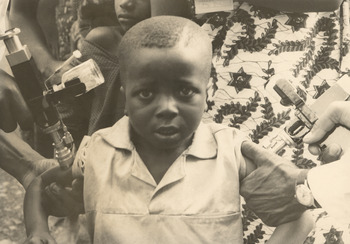
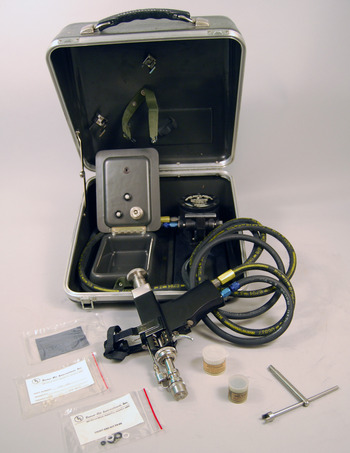
The multiple-dose jet injector (Figure 1) enabled the vaccination of 1,000 people per hour, a dramatic increase over earlier delivery methods and essential to mass immunization campaigns in communities with limited health infrastructure.Footnote 30 In addition to permitting increased numbers of patients reached, the innovation of the jet injector, or hypospray, offered other advantages over using a needle and a syringe. Most notably, the jet injector was less painful; half of patients reported a ‘complete absence of pain’. In addition, the jet injector did not require sterilization before use.Footnote 31 Its nickname, ‘peace gun’, came from two Burmese children – one of whom told her brother in 1958 when experiencing it while being inoculated for typhoid, ‘But it's not a bad gun; it's a peace gun.’Footnote 32 It is significant not only that the jet injector was a weapon of peace amidst the violence of the Cold War but also that it was wielded by civilians in non-governmental capacities.
A young boy in Cameroon receives smallpox and measles vaccinations via jet injector in 1968. Courtesy of the Public Health Image Library, Center for Disease Control and Prevention. Photo by J. Donald Millar, MD, DTPH.

In 1958, Hingson led the first American interracial, interdenominational, and interdisciplinary team of medical professionals to undertake a mission internationally. They embarked on an around-the-world trip to assess medical needs, travelling ‘45,000 miles by plane, ship, train, jeep, land rower [sic], bus, donkey, camel and on foot’.Footnote 33 Along the way, they stopped in Japan, the Philippines, Burma, South Korea, India, Hong Kong, Egypt, Kenya, Iran, Tanganyika, Southern Rhodesia, the Belgian Congo, French Equatorial Africa, Nigeria, and Liberia. Each stop revealed the particular medical challenges faced by that community – in Korea the ill rested in unsanitary conditions, in the Philippines many suffered from intestinal parasites, and in India the hospitals were severely under-equipped with patients sleeping ‘on the floor under beds’.Footnote 34 The travellers donated months of their time to visit hospitals, perform operations, administer vaccines, and deliver medical supplies, among other activities.Footnote 35 The team visited 100 hospitals and undertook 120 operations.Footnote 36 According to one measure, the group gave 90,000 people inoculations during its travels.Footnote 37 In Burma, the group administered typhoid vaccines to several hundred children.Footnote 38 They also met with national health officials and often were received by high-level government officials.Footnote 39 In addition to providing medical treatment and assessing country's healthcare needs, the doctors would also ‘give their own Christian testimony’ to the communities they visited by delivering sermons, among other activities.Footnote 40 In an interview, Hingson shared his ‘feeling of personal responsibility as a Christian doctor’.Footnote 41 Hingson described ‘Christian concern and conscience’ as well as terrible need – he cited the stark health and medical disparities between the United States and other countries in the world.Footnote 42
Hingson and Brother's Brother Foundation repeatedly demonstrated a commitment to religious and racial inclusion in the composition of their missions.Footnote 43 According to Hingson, the mission members represented the Lutheran, Methodist, Episcopalian, and Baptist denominations.Footnote 44 They hailed from across the country, including Louisiana, Oregon, Alabama, Ohio, and Kentucky. And the group was integrated racially. Dr Eugene H. Dibble, director of the John A. Andrew Memorial Hospital at the Tuskegee Institute in Tuskegee, Alabama, was black. Hingson's commitment to a diverse medical team may have been informed by his personal and professional experiences. Based on one account, Hingson was raised by a former slave who encouraged him to study medicine and made him attentive to the disproportionately poor health care that African Americans received.Footnote 45 In his medical research, Hingson had examined and sought to address the greater mortality among African American women giving birth under anaesthesia.Footnote 46
The mission was funded and publicized by the Baptist World Alliance. In addition to offering financial support, Robert Denny, an official with the Baptist World Alliance, co-ordinated the logistics of the mission.Footnote 47 A check for $20,000 also came from the foundation of Maxey Jarman, a prominent Baptist.Footnote 48 Hingson demonstrated his deep personal commitment to the mission by mortgaging his home to fund the travel.Footnote 49 The US government supported the group by transporting three tons of medical supplies from Hawaii to the Philippines.Footnote 50 As a signal of public interest in the trip, the Cleveland Plain Dealer dispatched a staff writer, Josephine Robertson, to cover the nission. Members of the trip also catalogued it on film and in a motion picture.Footnote 51
After their trip, participants shared their experiences via speeches to educational, civic, and religious groups; they also screened sections of the film footage taken on the journey.Footnote 52 One doctor, Gabe Payne, framed the mission as ‘Operation: Human Need’. In the first year, members of the mission shared their work with over 180,000 Americans.Footnote 53
In the months that followed the mission's end, foreign communities in which the tour had stopped articulated considerable medical needs, and the doctors involved created a committee to address those they catalogued on their journey.Footnote 54 Supported by the Baptist World Alliance, Hingson established Brother's Brother Foundation in Pittsburgh, Pennsylvania. He outlined the organization's goals as ‘inter-racial cooperation in the United States’; ‘international friendship’; organizing ‘cooperative projects’ in the developing world; aiding missionaries; and publicizing ‘the solution of human problems’.Footnote 55 The foundation's objective was to utilize US medical resources in global health challenges. As part of this effort, Hingson assembled a team of medical professionals (doctors, technicians, and nurses) who were ready to deploy on seventy-two hours’ notice to offer medical assistance overseas. Their principal planned activity was mass inoculation via jet injector.Footnote 56 In his formal proposal to create this foundation, Hingson identified each ‘suggested trustee’ by faith and race, revealing his consciousness about ensuring racial and religious diversity in the organization.Footnote 57 The inspiration for its name was a Nigerian medical student who told Hingson, ‘We don't need a keeper; we need a brother.’Footnote 58
II
Brother's Brother Foundation's first and most significant mission was a campaign to vaccinate Liberians against smallpox in 1962. It was a precursor to and in some ways served as a pilot study for the global smallpox eradication programme that followed. Although the Brother's Brother Foundation mission to Liberia has been overlooked in the literature, it marks an early American effort at smallpox eradication several years before the 1965 starting point given for US involvement in the eradication programme.Footnote 59
The reasons for undertaking a mission to Liberia are not transparent in the available records.Footnote 60 Yet, the two countries were entwined historically, economically, and diplomatically. Americans had long been present in Liberia as colonists, missionaries, and industrialists. Indeed, 14,000 African Americans moved to Liberia in the nineteenth century with some sailing across the Atlantic on a course similar to that which Hingson's team undertook.Footnote 61 Liberia had become dependent on the United States and eventually the Firestone Corporation in the early twentieth century, and it owed the United States millions of dollars on a loan to build a port in Monrovia during the Second World War.Footnote 62 At the same time, Liberian leaders faced entreaties from the Soviet Union.Footnote 63 Furthermore, the United States had security agreements with Liberia, including a Mutual Defense Assistance Agreement and the Military Mission Agreement. The US presence in Liberia in the 1960s was significant with hundreds of US officials and thousands of private citizens.Footnote 64 Finally, Hingson and Dibble had stopped in Liberia as part of the 1958 around-the-world tour, learning about the high rates of malaria infection there and lack of resources to treat Liberia's smallpox cases.Footnote 65 Based on his time there, Hingson shared that Liberia's ‘health needs were greater per capita than those observed in any other nation in our survey, exclusive of Korea’, which was still recovering from civil war.Footnote 66
Hingson devoted considerable time to organizing the Liberia operation, working with several partners to plan and fund the trip. He met with Liberia's surgeon general in March 1961 to discuss how a gift of Hingson's ‘peace guns’ could be used. Hingson communicated with President William V. S. Tubman and Vice President William R. Tolbert, Jr, for much of 1961 before a formal invitation came from Liberian leaders for Hingson to lead a delegation there.Footnote 67 Tolbert served as the Baptist World Alliance's vice president, which could have precipitated initial conversations about Hingson's involvement.Footnote 68 As he prepared the mission, Hingson consulted with State Department officials, the US surgeon general, and other US officials engaged in international health.Footnote 69
Hingson also discussed a potential mission to Liberia with American executives from Firestone, the principal employer in Liberia, and US-based Republic Steel, which owned the Liberian Mining Company. The executives offered free accommodation for those participating.Footnote 70 In writing about Liberia's health needs, Hingson pointed simultaneously to what the country offered the United States, including landing fields during the Second World War and considerable rubber and steel.Footnote 71 He made the connections between local industry and Liberia explicit in planning the medical mission: ‘In view of the fact that much of Cleveland's wealth through rubber and steel exports comes from the area of the world in greatest need, namely Liberia.’Footnote 72 Hingson echoed this theme in a letter to the Liberian president saying, ‘In your historic past your resources have contributed to America's greatness.’Footnote 73 Hingson's outreach reveals either a tactical effort to enlist the support of American corporations by emphasizing the potential financial gain to them of healthier Liberian workers or it represented a genuine belief that the security and economy of the United States would be enhanced by this campaign. Hingson was joined in the planning and execution by former Surgeon General Thomas Parran who noted that the Kennedy administration's conceptions of international assistance neglected health, asserting instead ‘that a disease-ridden population is an unproductive population’, linking again the group's humanitarian work to development goals.Footnote 74 Hingson's correspondence reveals a philosophy in which democracy and health are interconnected: ‘It is my prediction that the freedoms you have championed in Africa through the influence of Operation Brother's Brother II will now be extended into the realm of freedom from disease.’Footnote 75 In addition, alluding to the long, close history of American–Liberian relations, Hingson referred to Liberia as the United States's ‘little brother nation’. Tying his trip more explicitly to the Cold War, Hingson asked, ‘How can we criticize Russia or the Chinese when we permit such a condition to exist among our freed slaves?’ He also wrote vividly about the ‘misery’ he had encountered there and conveyed a conviction that the special Liberian–American relationship as well as the moral standing of the United States could be bolstered by smallpox eradication efforts.Footnote 76
In the months before Hingson and his team arrived in Liberia, the threat from smallpox had escalated. In April 1961, American mining interests reported a smallpox outbreak and requested State Department assistance in facilitating the shipment of vaccines to arrest the disease's spread.Footnote 77 Several months later, the US embassy in Monrovia cabled, ‘Smallpox epidemic Monrovia. Send 12 packages vaccine immediately.’Footnote 78 The next day, US officials reported that thirty people had died within the past six weeks.Footnote 79 Fortuitously Hingson's team arrived soon after the outbreak of the smallpox epidemic; the campaign's goal was to vaccinate one million Liberians.Footnote 80
Although State Department telegrams characterized the trip as ‘strictly private’, the two co-ordinated with the US Agency for International Development (USAID) in Monrovia.Footnote 81 US representatives in Liberia facilitated the mission, including by offering an orientation when the medical professionals arrived.Footnote 82 USAID also funded the 50,000 doses of smallpox vaccine shipped from Wyeth Laboratories.Footnote 83 USAID's involvement fits with the relatively high support funnelled to Liberia through the agency. Of all the countries in Africa, Liberia received one of the highest levels of AID funding from the United States – $21.2 million in 1963.Footnote 84 In addition to USAID personnel, Assistant Secretary of State Brooks Hays assisted the mission; US officials in Liberia regarded the county as ‘the State Department's jewel in all of Africa’.Footnote 85
The US navy also aided the mission; it characterized the work of transporting personnel and 200 tons of material to Liberia as part of former US President Dwight D. Eisenhower's People-to-People programme.Footnote 86 When Eisenhower announced the initiative, he declared that one of the principal ways for ‘people to get together and to leap governments’ was through ‘doctors helping in the conquering of disease’. For Eisenhower, the People-to-People initiative was ‘the truest path to peace’.Footnote 87 As a result, Hingson, his team, and extensive medical supplies travelled to Liberia aboard the USS Diamond Head, which normally sailed along the US coast to Guantanamo Bay, Cuba.Footnote 88 Writing later to Secretary of State Dean Rusk, Hingson noted the personal sacrifice the US sailors had made in foregoing eight days of shore leave to transport them.Footnote 89 The sailors also served as guinea pigs during the journey as Hingson and his colleagues experimented to determine the maximum acceptable dilution of the smallpox vaccine as Hingson had discovered after departure that he had only 10,000 doses rather than the one million promised.Footnote 90
The navy's official history asserts that Hingson's mission to Liberia was spurred by a request from the Liberian government to the US government for assistance. It claims that Hingson ‘was placed in charge of the project and the Chief of Naval Operations, Admiral Arleigh BURKE, placed DIAMOND HEAD at his disposal’.Footnote 91 In Burke's private correspondence to Hingson, he offered Hingson ‘the first available ship’ sailing for the West Coast of Africa and praised Hingson's work as revealing ‘the true image of our country’ and demonstrating Americans’ ‘love and concern…for their friends throughout the world’.Footnote 92 There are no other records that suggest the US government tapped Hingson for this role (rather than that he initiated the mission). Unfortunately, messages between ships and naval commands are considered temporary records, therefore Burke's thinking in utilizing the Diamond Head for transportation to Liberia cannot be discerned. The ship was under the command of Captain James Monroe Hingson, Robert's brother, which might have weighed in its selection. Later coverage of the trip suggests the two Hingson brothers made a joint application under the navy's person-to-person programme.Footnote 93 Captain Hingson also shared a namesake, his ancestor James Monroe, with Liberia's capital, Monrovia, which may have heightened the personal significance of the mission for him.Footnote 94
The Diamond Head left Virginia on 1 February and arrived in Liberia on the 11th where it was greeted by Tolbert, the Liberian vice president.Footnote 95 The medical professionals who arrived in Liberia represented many faiths and denominations; given that Hingson mentioned this diversity in key communications, it was clearly significant for him.Footnote 96 Despite this professed commitment to diversity, those reporting on the mission perpetuated discriminatory racial attitudes. In a special journal issue on the mission, the editor described the trip as a ‘medical safari’ and referred to ‘Liberian natives’.Footnote 97 Such language could suggest the participants engaged in observing exotic people (rather than animals) and reveals the potential for colonial or hierarchical attitudes toward the patients.
For Hingson, the Brother's Brother mission to Liberia represented the best expression of ‘American medicine and Christian humanitarian dedication’, demonstrating that his work had a political and a religious agenda.Footnote 98 In addition to medical supplies, including twenty tons of penicillin donated by Eli Lilly, the Americans also brought 40,000 books to distribute throughout Liberia.Footnote 99 Hingson was keenly aware of the economic impact such efforts could have. He wrote to George Anderson the chief of naval operations that ‘a 200 million dollar operation of free enterprise’ was protected because the country avoided a quarantine.Footnote 100
Cyril E. Bryant, managing editor of The Baptist World, penned a sympathetic history of Brother's Brother Foundation and related observations that the effort was successful in part because Liberians came to attribute status to the bandages, donated by Johnson & Johnson, applied in the aftermath of a vaccination. According to the mission's participants, the Band-Aids, one million of which were supplied, became ‘badges of honor’ that Liberians sought out to signal their vaccination. In total, five teams spread out across Liberia, and some stayed up to six weeks in the country. One innovation by the group was to target athletic competitions where large crowds gathered. Facilitated by Liberia's army and health service, Brother's Brother Foundation estimated reaching 80 per cent of the country's population, which led to a sharp decline in smallpox cases there. Previously, only 20 per cent of Liberians living in rural areas were vaccinated.Footnote 101 In contrast to the two thousand cases in 1961, in 1963, only forty cases were reported.Footnote 102
Hingson informed President Kennedy that Operation Brother's Brother II had succeeded in inoculating over 300,000 Liberians against smallpox.Footnote 103 From the White House's perspective, Hingson's ‘inspiring work’ improved global health and fostered ‘Libero-American friendship’.Footnote 104 As with the Cleveland Plain Dealer's extensive coverage of the Baptist World Alliance's earlier trip, there was considerable domestic media attention for Hingson's and his colleagues’ work, most notably with a 29 April 1962 television programme entitled, ‘“Guns of Peace”, filmed highlights of a voyage of medical ship USS Diamond Head to Liberia’.Footnote 105
The Brother's Brother mission to Liberia also was profiled in Christian Herald, at one point ‘the most widely read religious newspaper in the world’.Footnote 106 It revealed the religious motivations for the mission, recounting that in a press conference in Monrovia Hingson explained the goal of the visit was to aid Liberians with ‘schools, sanitation, sprays, self-respect and salvation’. According to the Christian Herald, Hingson listed ‘salvation’ last because ‘it could be better understood and accepted after the other things had been taken care of’.Footnote 107 The Christian Herald journalist also reported how the medical mission bolstered foreign missionaries in Liberia ‘as a reward of their faith’.
In terms of objective measures, the vaccine injections did prove to be highly effective, although Hingson's colleagues acknowledged that his own judgement about the mission's success would undoubtedly be ‘somewhat biased’.Footnote 108 After meeting with Liberian officials in 1964, Hingson reported that four smallpox hospitals were ‘torn down since they have no patients’. In his view, ‘Unquestionably this disease is now controlled’ in Liberia.Footnote 109
Hingson proposed a return visit on the fifth anniversary of Operation Brother's Brother II to Tubman – to revaccinate Liberians in connection with the WHO's drive to eliminate smallpox. He also suggested addressing polio, tetanus, measles, and worms in Liberia and even raised the possibility of undertaking a mission to neighbouring Sierra Leone at the same time. He maintained his commitment to marrying health interventions with spiritual ones, suggesting ‘passing out of a small Bible or Testament or at least a copy of a Gospel’ during the return mission to Liberia.Footnote 110
Hingson's queries, however, did not receive positive responses from Monrovia, potentially due to voices questioning the earlier campaign's efficacy.Footnote 111 Initial efforts to replicate Hingson's purported results of 98 per cent effectiveness failed, prompting concerns about the success of the injector and his dilution of the vaccine. Subsequent tests executed by the US Public Health Service confirmed Hingson's earlier claims and served as evidence for the methods by which medical professionals pursued smallpox eradication.Footnote 112 Jet injectors, like those used in Liberia, and other advances made smallpox vaccination ‘far cheaper, easier, and more effective’.Footnote 113 Whereas smallpox killed two million people per year in 1967, by 1977 WHO's Smallpox Eradication Programme achieved zero cases.Footnote 114
III
Historians have shown that NGOs and non-state actors such as missionaries had long aided the US government in achieving its development and modernization goals, and missionaries, foundations, and other groups increased their modernization efforts in the early years of the Cold War.Footnote 115 Regarding this time period, other scholars have argued the United States often saw overseas assistance, including in health, as a ‘tool’ of its Cold War foreign policy.Footnote 116 In those years, health was increasingly regarded as a condition for development and was therefore a key component of US policies.Footnote 117
Hingson's and Brother's Brother Foundation's approach to development was distinct from many other projects in that their missions were compressed in time, relatively low tech, and only subtly focused on enhancing production. Instead, they devoted their time to enhancing medical care and disease prevention. This emphasis connects their work to a broader international, volunteer movement that sought to alleviate poverty, racial inequality, and other social ills between 1958 and 1965.Footnote 118
Hingson and Brother's Brother Foundation were characterized by the three aspects that political scientist Michael Barnett argues mark humanitarianism: offering assistance internationally, ‘transcendent’ motivation, and the proliferation of organizations and processes to facilitate this aid.Footnote 119 Traditionally, Brother's Brother Foundation engaged in ‘transformative’ relief – that which improves conditions broadly for the future. Yet in Liberia, where Hingson faced a potential smallpox epidemic, the focus was more on ‘restorative’ relief – that which saves lives.Footnote 120 Brother's Brother Foundation was notably distinct from the radical and frustrated impulse that produced Médecins Sans Frontières in the wake of the war and famine in Biafra at the end of the 1960s.Footnote 121 Hingson and his colleagues were instead aligned with liberal approaches to Protestantism, humanitarianism, and development, as many other humanitarian organizations were in the 1960s.Footnote 122 In Liberia, Hingson's efforts went beyond relief and not only improved the health of others but also facilitated US business and furthered US foreign policy. In these cases, we can read disease in the words of American Studies scholar Christina Klein as ‘a metaphor for underdevelopment’, which could enable the spread of communism.Footnote 123
The role of Brother's Brother Foundation in Liberia's immunization campaign fits into growing transnational connections forged by US-based NGOs in the 1960s.Footnote 124 According to historians Francis J. Gavin and Mark Atwood Lawrence, ‘The 1960s gave rise to increasingly large and ambitious international organizations and networks of activists, many of which were dedicated to addressing problems such as poverty, hunger, population growth, disease, human rights and environmental pollution.’Footnote 125 Similarly, the historian Akira Iriye emphasizes the ‘unprecedented degree of interactions across borders’ in the years after the Second World War.Footnote 126 Iriye suggests that these activities created a ‘global community’, which in the case of Brother's Brother Foundation, its peers, and its supporters, focused on global health.Footnote 127 The work Brother's Brother Foundation was doing facilitated these imaginations of an international community.Footnote 128 By 1970, eighty-two organizations in the United States worked overseas on health issues.Footnote 129
Aided by the innovative jet injector, between 1958 and 1980, Brother's Brother Foundation immunized more than ten million people.Footnote 130 Between its founding and 1996, when Hingson died, the organization distributed $560 million of medical and humanitarian supplies, serving forty million people.Footnote 131 For his efforts, United States representative to the United Nations Commission on Human Rights Morris Abram, among others, wrote to the Johnson White House, suggesting it name Hingson surgeon general.Footnote 132 In further evidence of the public–private nature of his work, US President Ronald Reagan honoured Hingson with a Volunteer Action Award, characterizing the awardees as ‘part of an American tradition of neighbor helping neighbor’.Footnote 133 A jet injector is now in the collection of the Smithsonian's National Museum of American History (see Figure 2).Footnote 134
A jet injector in the collection of the Smithsonian. Courtesy of Division of Medicine and Science, National Museum of American History, Smithsonian Institution.

Hingson and Brother's Brother Foundation took advantage of changes in transportation costs as well as shifts within Protestantism to become roving doctors, travelling by air and across seas to address pressing health crises.Footnote 135 Their humanitarian work contributed to shifting medical missionary approaches in the mid-twentieth century and capitalized on US government programmes that facilitated such work for development and public diplomacy ends. Even more crucial to international health was the development and deployment of Hingson's ‘peace gun’ in the nascent campaign against smallpox and other diseases. Their Liberia mission ultimately had far-reaching significant as an unwitting pilot study for the subsequent campaign against smallpox when concern for one's brother and then one's neighbour expanded with ramifications on a global scale.
Acknowledgements
The author expresses her appreciation to Lauren Carruth, Daniel Fine, Julia Irwin, Jennifer Johnson, Amanda McVety, Amanda Moniz, and Andrew Preston for their feedback and suggestions; to Jaclyn Fox, Matthew Hartwell, Patrick Kendall, and Ingrid Korsgard for their research assistance; and to American University's School of International Service for research support.