Introduction
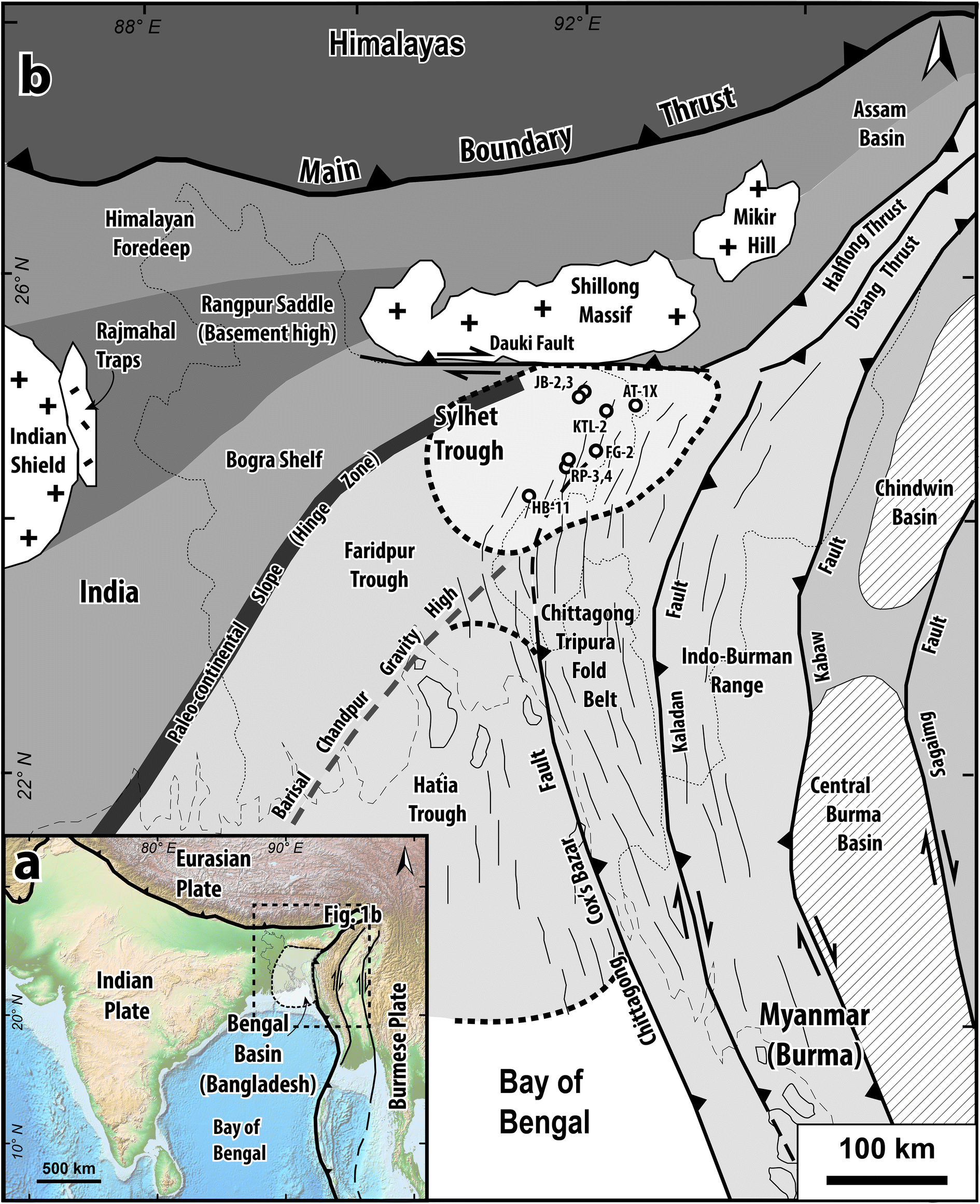
The Sylhet Trough, a sub-basin of the Bengal Basin (Fig. 1a) in the northeastern Indian Plate, was developed as a foreland basin in response to the uplift of the mountain belts of the Himalaya and Indo-Burman ranges since the Cenozoic (Abdullah et al., Reference Abdullah, Hossain, Aktar, Hossain and Khanam2021, Reference Abdullah, Aurthy, Khanam, Hossain and Sayem2022; Alam et al., Reference Alam, Alam, Curray, Chowdhury and Gani2003; Hiller & Elahi, Reference Hiller and Elahi1984). The Sylhet Trough (Fig. 1b) is one of the proven hydrocarbon provinces in the Bengal Basin, and considerable interest has been focused over the past few decades on petroleum exploration in Bangladesh as a result.
a Simplified map showing the location of the Sylhet Trough of the Bengal Basin in the context of Indian, Burmese, and Eurasian plates; b Tectonic map showing major structural elements of the Bengal Basin and its adjoining areas (modified after Alam et al., Reference Alam, Alam, Curray, Chowdhury and Gani2003) and sites for borehole locations (JB-2,3: Jalalabad 2 and 3; KTL-2: Kailastila 2; AT-1X: Atgram 1X; FG-2: Fenchuganj 2; RP-3,4: Rashidpur 3 and 4; HB-11: Hobiganj 11).

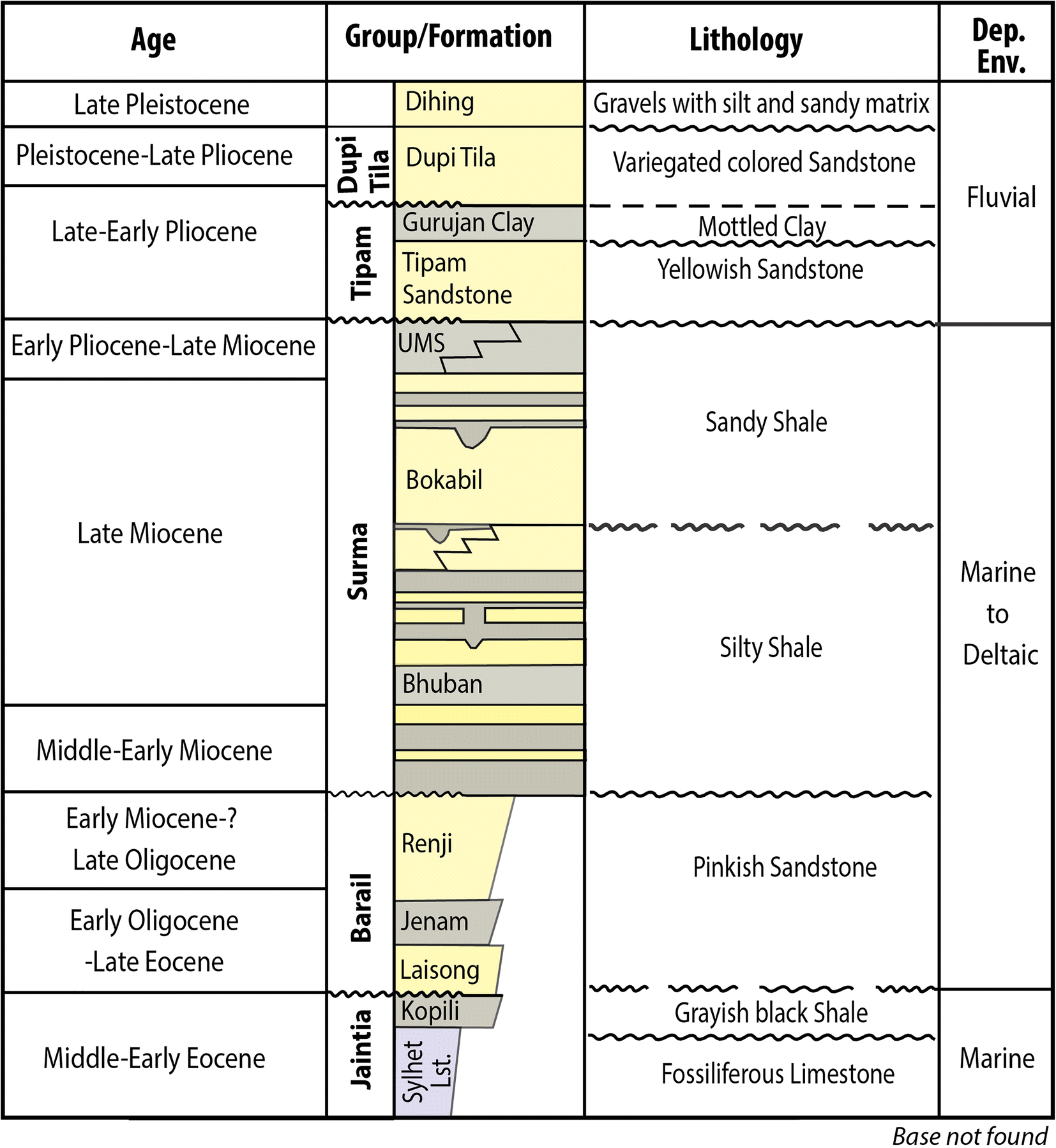
In the Sylhet Trough, the ~17 km-thick Eocene–Recent sedimentary succession (Fig. 2) had been deposited in response to the uplift and erosion of the Himalaya (Hiller & Elahi, Reference Hiller and Elahi1984). The deltaic-to-shallow marine Surma Group of Miocene age contains the sandstone reservoirs of the Bengal Basin (Rahman et al., Reference Rahman, McCann, Abdullah and Yeasmin2011). The sedimentary succession of this group consists mainly of alternating sandstones, shales, sandy shales, and siltstones. The Surma Group sandstones are predominantly fine- to medium-grained and moderately sorted (Rahman et al., Reference Rahman, McCann, Abdullah and Yeasmin2011). The core porosity and permeability of the reservoir sandstones in the Sylhet Trough range from 3 to 28% and from 0.15 to 1230 mD, respectively (Islam, Reference Islam2010). Multiple factors may control this relatively wide range of porosity. Among these factors, the clay minerals may exert significant controls on reservoir properties in terms of porosity and permeability. Many studies have been conducted on clay minerals there (e.g. Bjørlykke, Reference Bjørlykke2014; Bjørlykke & Jahren, Reference Bjørlykke and Jahren2012; Lai et al., Reference Lai, Wang, Chai, Xin, Wu, Zhang and Sun2017, Reference Lai, Wang, Wang, Cao, Li, Pang, Zhou, Fan, Dai, Yang, He and Qin2018; Morad et al., Reference Morad, Al-Ramadan, Ketzer and De Ros2010) but few have been conducted on sandstone burial diagenesis in the Bengal Basin (e.g. Imam & Shaw, Reference Imam and Shaw1987; Rahman & Worden, Reference Rahman and Worden2016). Detailed works have not been reported thus far on the associated clay mineralogy of shales interbedded with sandstones. Studies of clay minerals and their diagenesis in shales are important in view of sandstone diagenesis and the supply of chemical components from the adjacent shales (Shaw & Conybeare, Reference Shaw and Conybeare2003).
Summary of stratigraphy of the Sylhet Trough of the Bengal Basin (after Alam et al., Reference Alam, Alam, Curray, Chowdhury and Gani2003; Johnson & Alam, Reference Johnson and Alam1991; Najman et al., Reference Najman, Bickle, BouDagher-Fadel, Carter, Garzanti, Paul, Wijbrans, Willett, Oliver, Parrish and Akhter2008; Reimann, Reference Reimann1993; Shamsuddin & Abdullah, Reference Shamsuddin and Abdullah1997).

The relationship between sequence stratigraphy and the distribution of diagenetic alteration in sandstones is anticipated (Ketzer et al., Reference Ketzer, Holz, Morad and Al-Aasm2003; Morad et al., Reference Morad, Ketzer and De Ros2000) because changes in the detrital composition and pore-water chemistry occur commonly at sequence stratigraphic surfaces (e.g. MFS – marine flooding surface, TS – transgressive surface, TES – transgressive erosional surface, and RES – regressional erosional surface) and within systems tracts (HST – highstand systems tract, TST – transgressive systems tract, and LST – lowstand systems tract). Linking diagenesis with sequence stratigraphy allows the prediction of the spatial and temporal distribution of diagenetic alterations. Thus, such linking can help in predicting the post-depositional evolution of reservoir quality in sandstones (Ketzer et al., Reference Ketzer, Holz, Morad and Al-Aasm2003).
The aim of the present study was to demonstrate the distribution of clay minerals and their diagenetic alterations in interbedded sandstones and shales based on petrography, scanning electron microscopy, and X-ray diffraction analysis of core samples at depths of ~1375–4936 m in eight petroleum exploration wells (JB-2,3: Jalalabad 2 and 3; KTL-2: Kailastila 2; AT-1X: Atgram 1X; FG-2: Fenchuganj 2; RP-3,4: Rashidpur 3 and 4; HB-11: Hobiganj 11) within the Sylhet Trough (Figs 1 and 3). A further objective was to link the distribution of clay minerals and their diagenetic alterations with the established sequence stratigraphic frameworks of the Sylhet Trough.
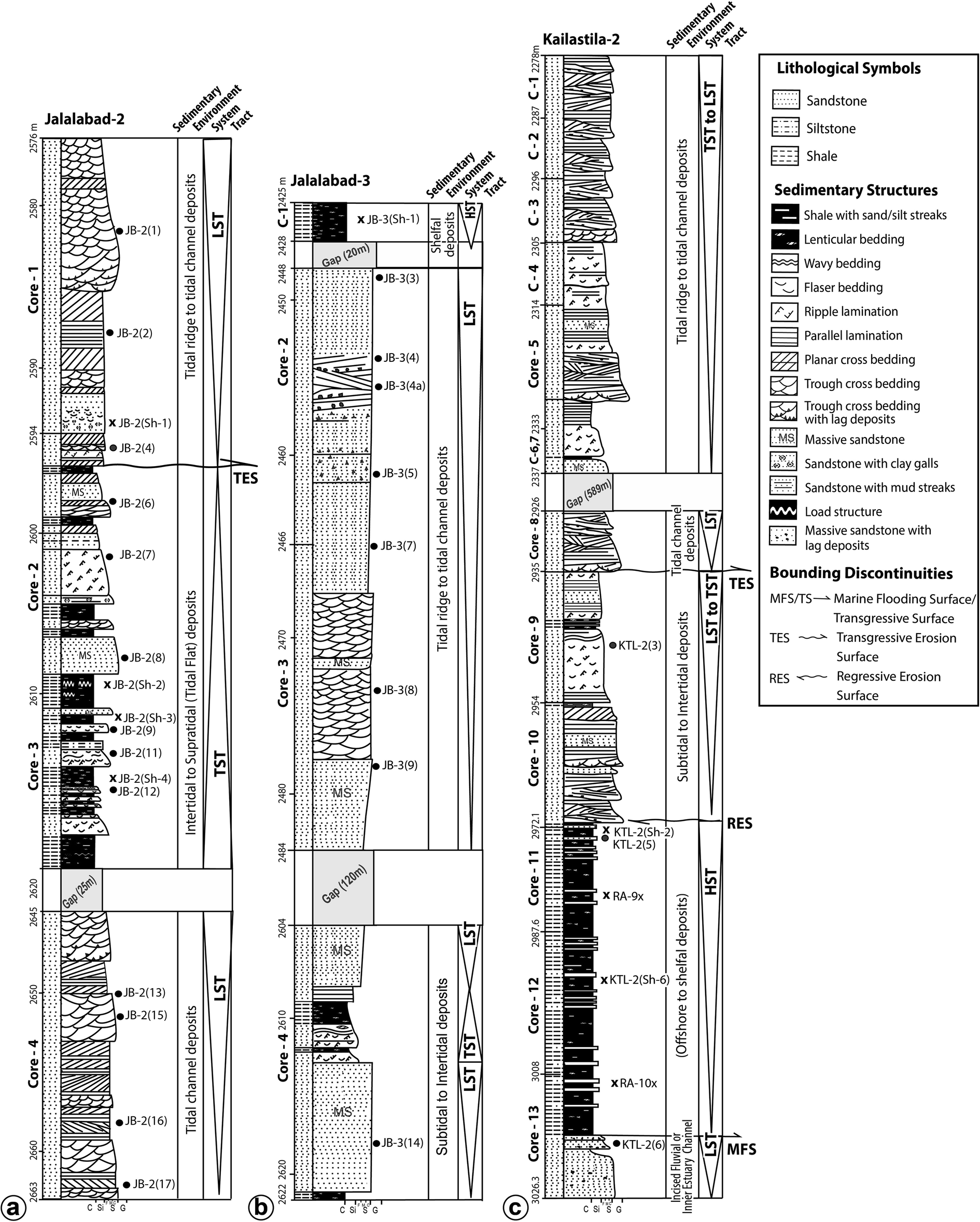
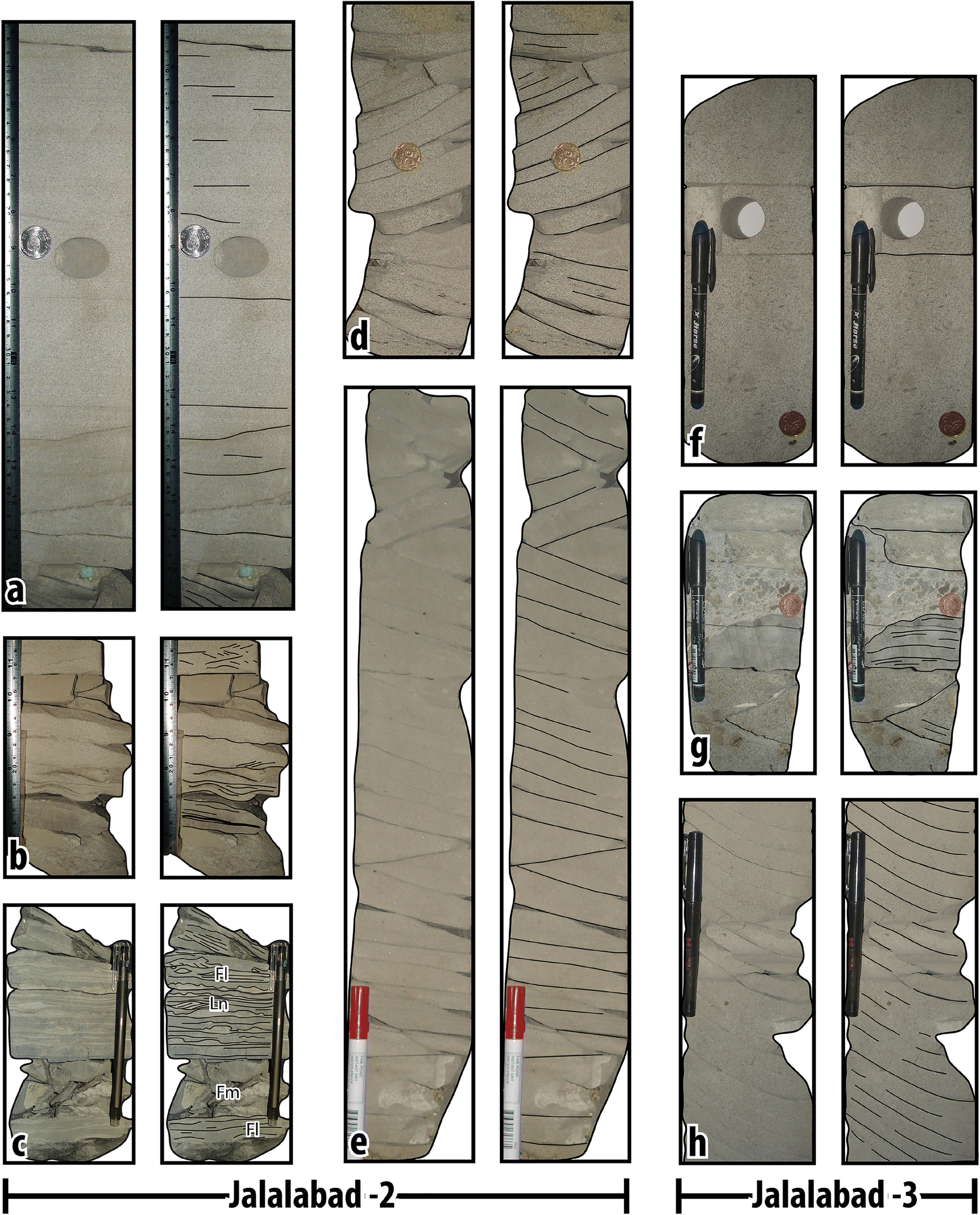
a-c Interpreted core lithofacies of the Surma Group sediments. Detailed information for the marked samples is given in the Tables.

Geological Settings
The Bengal Basin is well known for being a gas-prone province. Geographically, the basin occupies a key position at the junction of three interacting plates (i.e. the Indian, Eurasian, and Burmese plates) (Fig. 1a). To the north, the Dauki Fault marks the boundary between the Bengal Basin and the Precambrian Shillong Plateau (Fig. 1b). To the east and southeast, the basin is bordered by the Chittagong Tripura Fold Belt of the Indo-Burman Ranges and on the west by the Precambrian Indian Shield (Fig. 1b). To the south, it is open to the Bengal Fan of the Bay of Bengal (Fig. 1b).
Sedimentation and tectonic evolution of the Bengal Basin have dated to the Jurassic–early Cretaceous Gondwana break-up (Alam et al., Reference Alam, Alam, Curray, Chowdhury and Gani2003; Najman et al., Reference Najman, Bickle, BouDagher-Fadel, Carter, Garzanti, Paul, Wijbrans, Willett, Oliver, Parrish and Akhter2008; Shamsuddin & Abdullah, Reference Shamsuddin and Abdullah1997). During Oligocene-to-Miocene times, the Bengal Basin (including the Cenozoic Sylhet Trough; Fig. 1b) was transformed from a pre-Oligocene passive continental margin to a foreland basin in response to the collision between the Indian and Burmese plates (Johnson & Alam, Reference Johnson and Alam1991). Later (possibly during the Pliocene to Holocene), this foreland basin was more linked to the south directed over-thrusting of the Shillong Massif (Johnson & Alam, Reference Johnson and Alam1991). Alternatively, Rahman and Faupl (Reference Rahman and Faupl2003) suggested that the basin formed as a portion of the foreland basin of the Himalayan Orogen and the Indo-Burman Range.
The stratigraphy of the Sylhet Trough in the northeastern Bengal Basin is comprised mainly of Cenozoic clastic sediments with Eocene limestone in the lower part (Fig. 2). The sediments within the basin demonstrate evolution from shallow-marine, tide-dominated deltaic to a fluvial depositional setting (Alam et al., Reference Alam, Alam, Curray, Chowdhury and Gani2003; Johnson & Alam, Reference Johnson and Alam1991; Khanam et al., Reference Khanam, Rahman, Alam and Abdullah2017).
The oldest exposed stratigraphic unit of the Bengal Basin or the Sylhet Trough is the Jaintia Group (Fig. 2). In the northeastern Sylhet Trough, the Upper Jaintia Group includes the Eocene Sylhet Limestone and Kopili Shale formations of the Eocene age (Alam et al., Reference Alam, Alam, Curray, Chowdhury and Gani2003; Reimann, Reference Reimann1993). Overlying the Jaintia Group is the Oligocene Barail Group (Fig. 2), composed of massive medium-grained sandstone interbedded with siltstone. The Miocene Surma Group includes the Bhuban (Lower) and Bokabil (Upper) formations (Fig. 2). Both of the formations consist of dark gray shale, siltstone, fine- to coarse-grained sandstone, and occasional intraformational conglomerate. The Pliocene Tipam Group overlies the Surma Group. This Tipam Group includes the Tipam Sandstone and the Girujan Clay formations (Fig. 2). The youngest unit is the Dupi Tila Group (Fig. 2), which comprises mostly sandstone and overlies the Girujan Clay Formation.
Petroleum exploration within the Bengal Basin (i.e. the Sylhet Trough) has focused mainly on anticlinal traps, targeting sandstones from the Miocene Surma Group sediments. Sedimentological and facies analyses of the Surma Group sediments from both outcrops and cores indicate a possible deltaic depositional setting that includes tidal flat (sub-tidal to intertidal), tidal ridge, and tidal channel deposits (Khanam et al., Reference Khanam, Rahman, Alam and Abdullah2017, Reference Khanam, Rahman, Alam and Abdullah2021; Rahman et al., Reference Rahman, Faupl and Alam2009).
Materials and Methods
Representative sandstone and shale core plug samples of the Surma Group were collected from eight boreholes across the Sylhet Trough (Fig. 1b). Detailed core logging and lithofacies analysis were carried out based on sediment texture, primary sedimentary structures, and internal bedding architecture (Fig. 3) to decipher the depositional environment and stratigraphic framework of the Surma Group sediments.
Forty thin sections of sandstones from the core plugs at depths of 1485–4728 m (Tables 1 and 2) were prepared for optical microscopic study. Thin sections were impregnated with blue epoxy in order to recognize porosity. Detrital framework grains, authigenic minerals, and porosities were determined by the point count method using a petrographic microscope (MEIJI ML 9000). Modal analyses were performed based on the work of Dickinson and Suczek (Reference Dickinson and Suczek1979) and Dickinson (Reference Dickinson and Zuffa1985), with 600 points counted per sample. A PANalytical X'pert pro MPD X-ray diffractometer with CuKα X-ray source operating at 40 kV and 40 mA (University of Liverpool, UK) was used for clay-mineral analysis of sandstones.
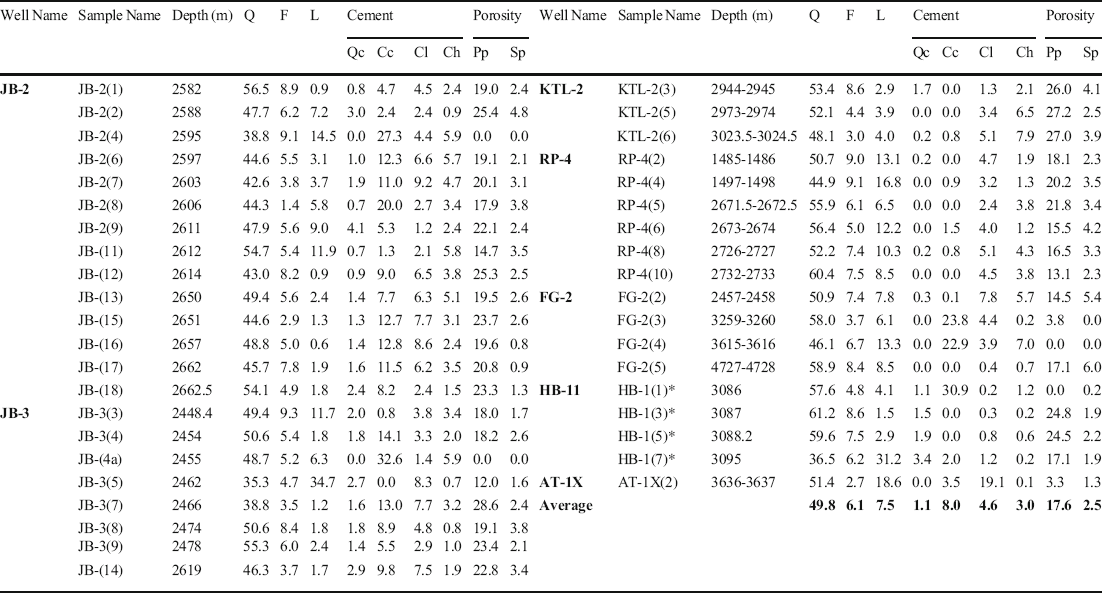
Petrographic composition of the framework grain and authigenic cement in the Surma Group sandstones (%) collected from the wells, Jalalabad (JB-2, JB-3), Kailastila (KTL-2), Rashidpur (RP-3, RP-4), Fenchuganj (FG-2), Hobiganj (HB-11), and Atgram (AT-1X) of the Sylhet Trough, Bangladesh.

[Abbreviations: Q – Quartz, F – Feldspar, L – Lithic grains, Qc – Quartz Cement, Cc – Calcite Cement, Cl – Clay Cement, Ch – Authigenic Chlorite Cement, Pp – Primary Porosity, Sp – Secondary Porosity]
[Note: * marked samples are from Rahman & McCann, Reference Rahman and McCann2012; for well locations and symbol definitions, see Fig. 1b]
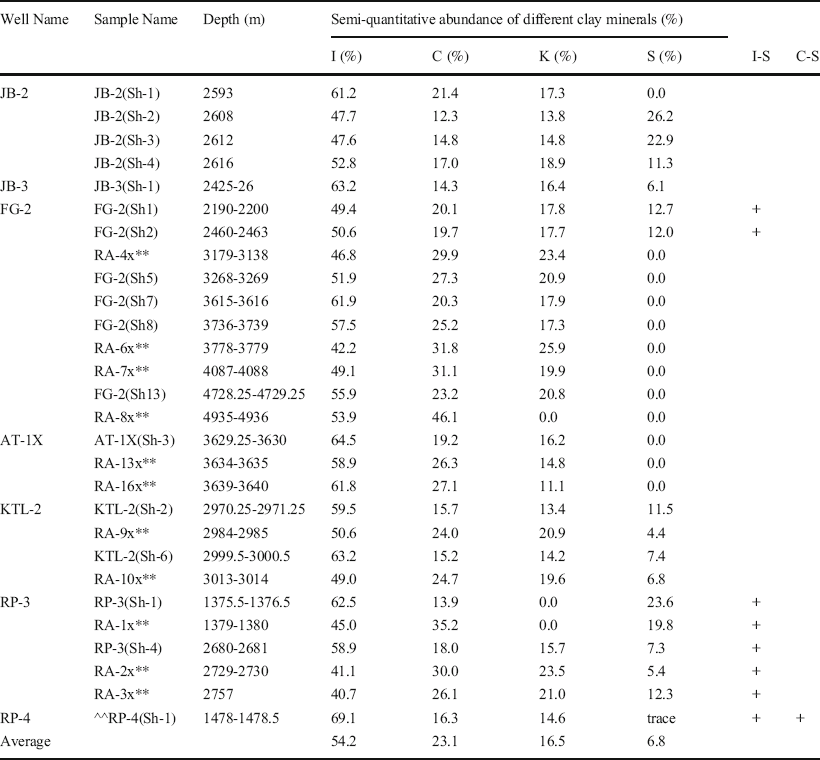
The semi-quantitative abundance of <2 μm clay minerals (%) of the Neogene shales in seven wells in the Sylhet Trough, JB-2, JB-3, FG-2, AT-1X, KTL-2, RP-3, and RP-4 wells.

[Note: Mixed-layer clay was traced in samples marked with + and ** marked samples from Rahman, Reference Rahman2000; for well locations and symbol definitions, see Fig. 1(b); Abbreviations: I- Illite; C- Chlorite; K- Kaolinite; S- Smectite; I-S-Illite-smectite; C-S-Chlorite-smectite]
Seventeen shale samples for X-ray diffraction (XRD) analysis were cut from the core samples. Samples were analyzed using a Rigaku ULTIMA-IV (Tokyo, Japan) (185 mm) Goniometer (αCuKα/ 40 kV / 40 mA) with a scanning speed of 2°2θ/min at the Bangladesh Petroleum Exploration and Production Company Limited (BAPEX) laboratory for clay-mineral identification. Clay-mineral fractions of <2 μm were obtained by the sedimentation method. This method was done using a settling tube (Atterberg), which is performed following Stokes’s Law. For clay minerals, an oriented mount was prepared for air-dry, glycol, and dimethyl sulfoxide (DMSO) treatments. For all three treatments, the samples were scanned at between 2 and 30°2θ. The semi-quantification of clay minerals was made by taking peak height above the background for diagnostic reflections multiplied by a correction factor, such as 1 for illite, 0.5 for kaolinite, 0.54 for chlorite, and 0.35 for smectite (Schultz, Reference Schultz1964). In the case of chlorite and kaolinite, the intensity at 7 Å was split by taking the intensity relation at 3.52 Å for chlorite and 3.57 Å for kaolinite.
For scanning electron microscopy (SEM), a Philips XL30 (Eindhoven, The Netherlands) tungsten filament SEM fitted with an Oxford Instruments INCA EDS system (United Kingdom) with a SiLi detector at the University of Liverpool, United Kingdom, was used in secondary electron (SEI) and backscattered electron (BSE) imaging modes. The SEM images were used to observe authigenic minerals, cement, and pore geometry in sandstone and shale. Broken rock chips and polished sections were examined using SEM. The chips were coated with a thin layer of gold (around 10nm) using sputter coating and examined at an acceleration voltage of 20 kV. Polished sections for backscattered scanning electron microscopy (BSEM) and energy dispersive spectra (EDS) analysis were coated using an Emitech K950X carbon coater.
Results
Lithologies of Reservoir Rocks and Interbedded Shales
Reservoir rocks of the Miocene Surma Group are characterized by fine- to medium-grained sandstones (Fig. 4). The texture and sedimentary structures of the reservoir rocks permit recognition of several major lithofacies, namely: ripple-laminated sandstone, partly with flaser-bedded, cross-laminated sandstone, wavy- to lenticular-bedded sandstone, parallel-laminated sandstone, trough, and planar cross-bedded sandstones with lags of mud clasts, massive sandstone facies with lags (Figs 3 and 4).
a Parallel-laminated sandstone with low-angle cross-bedding in the lower part (JB-2: 2606 m); b Rippled cross-laminated sandstone with mud flasers (JB-2: 2612 m); c Lenticular bedding with sand/silt streak and soft-sediment deformation (JB-2: 2615 m); d Stacked sandstone unit, internally trough cross-bedded, low-angle cross-bedded and parallel-laminated, some planar cross-bedding shows the opposite direction (JB-2: 2650 m); e Stacked sandstone unit shows planar cross-bedding and parallel-lamination; some planar cross-bedding shows opposite direction (JB-2: 2662 m); f Thick bedded, apparently parallel-laminated sandstone with a lag of mud clasts (JB-3: 2454 m); g Cross-bedded sandstone with lag deposit at the base (matrix-supported conglomerate) (JB-3: 2462 m); h Medium to coarse-grained trough cross-bedded sandstone (JB-3: 2474 m). [JB = Jalalabad].

Ripple-laminated sandstone, partly with flaser-bedded facies, is continuously rippled and often bi-directional (Fig. 4b). The small-scale cross-laminae show a strong tangential contact in the lower parts. Mud flasers are usually present in the ripple troughs, occasionally continuing the lower part of the ripple foreset laminae (Fig. 4b). The thickness of the flaser bedding ranges from 1 to 3 cm, whereas its width varies from a few millimeters to a few tens of centimeters.
In several cores (Figs 3 and 4b), sets of vertically adjacent ripples show small-scale herringbone cross-stratification, which is indicative of a bi-directional current system under which the sediments were deposited. Ripples are mainly asymmetrical in nature, having amplitudes of a few centimeters. Parallel-laminated sandstone shows nearly horizontal laminations and is distinguished by a gray color, moderate porosity, and medium to coarse grains (Fig. 4a). The lower bounding surfaces of the trough cross-bedded facies are curved, possibly representing an erosional surface (Fig. 3). In general, the cross-bed sets are marked by the presence of thin mud laminae (Fig. 4d). In addition, carbonaceous detritus is present occasionally along the foresets. Reactivation surfaces were observed in several units of the cross-bedded facies. Structureless sandstone facies are apparently massive and predominantly fine- to medium-grained, although some are coarse-grained. The sandstones are light gray to gray in color; in places, good orientation of mud clasts was visible on the surface (Fig. 4f). The mud clasts are commonly confined toward the base of the facies and represent an erosional contact with the underlying bed. Several representative sub-environments are noted in the reservoir interval studied, including distributary tidal channel, tidal flat (sub-tidal to intertidal), and tidal ridge (Figs 3 and 4).
The clay facies association (Figs 3 and 4c) includes mainly interbedded shale/claystone (Fm), sand/silt-streaked shale (Fl), and shale with sandy/silty lenticles or lenticular-bedded facies (Ln). Among these, the interbedded shale/claystone facies consists mainly of very thinly laminated shale and minor massive claystone with occasional siltstone (Fig. 4). Shale is gray to blackish gray in color, with bed thickness ranging from a few centimeters to a few tens of centimeters. On the other hand, claystone is dark gray to black in color and does not show any preferred sedimentary structures (Fig. 4).
The small-scale fining upward cycles (Figs 3 and 4) and characteristic sedimentary structures, such as evenly laminated sand/silt-streaked shales, flaser-, wavy- and lenticular bedding, the bipolarity of ripple cross-stratification, herringbone cross-stratification, reactivation surfaces within cross-bedded sandstone sets and mud-drapes on foreset laminae are diagnostic of tidal influence (Rahman et al., Reference Rahman, Faupl and Alam2009).
Sandstone Petrography
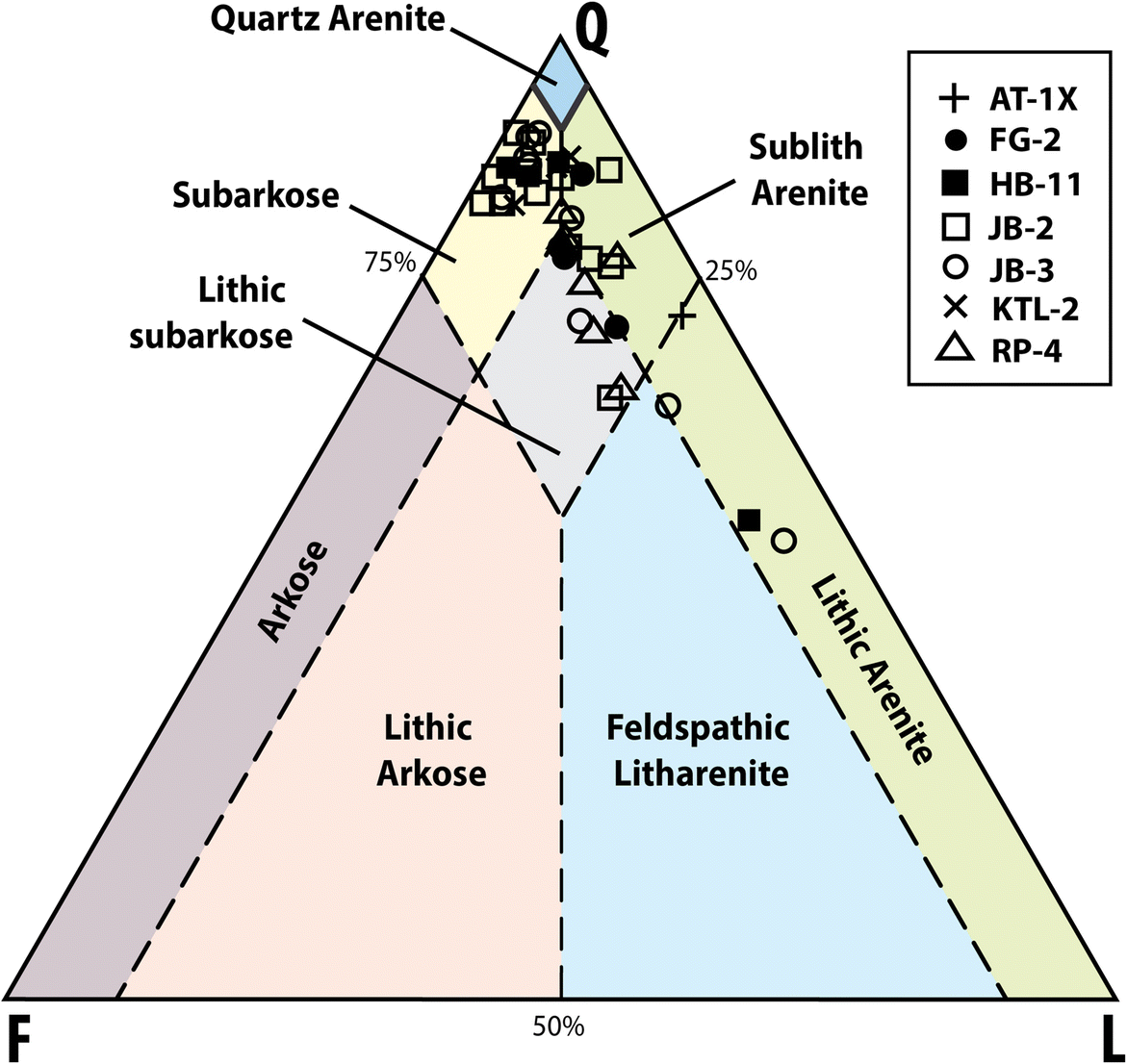
The sandstones of the Surma Group are mainly subarkoses to lithic subarkoses with some sublitharenites (Fig. 5, classification of McBride, Reference McBride1963) having quartz (average 49.8%), feldspar (average 6.1%), and rock fragments (average 7.5%). Muscovite (white mica), biotite, detrital chlorite, detrital carbonates, and some heavy minerals are the accessory framework minerals. Cements are mainly of calcite, clay minerals, and quartz (Table 1). The sandstones are characterized by a high quartz content with low feldspar and low-grade metamorphic and sedimentary lithic grains and a few volcanic lithic grains, indicating that the sediments were reworked and derived from a mainly recycled source terrain, such as a fold-thrust belt and a collision suture belt and deposited in a remnant ocean basin (Khanam et al., Reference Khanam, Rahman, Abdullah, Xiao and Alam2020).
QFL triangular diagram (Q = Quartz, F = Feldspar, L = Lithic grain) showing the modal composition and classification of the Surma Group sandstones in the Sylhet Trough (McBride, Reference McBride1963). For well location and symbol explanation, see Fig. 1b.

Authigenic Clay Minerals in Sandstone
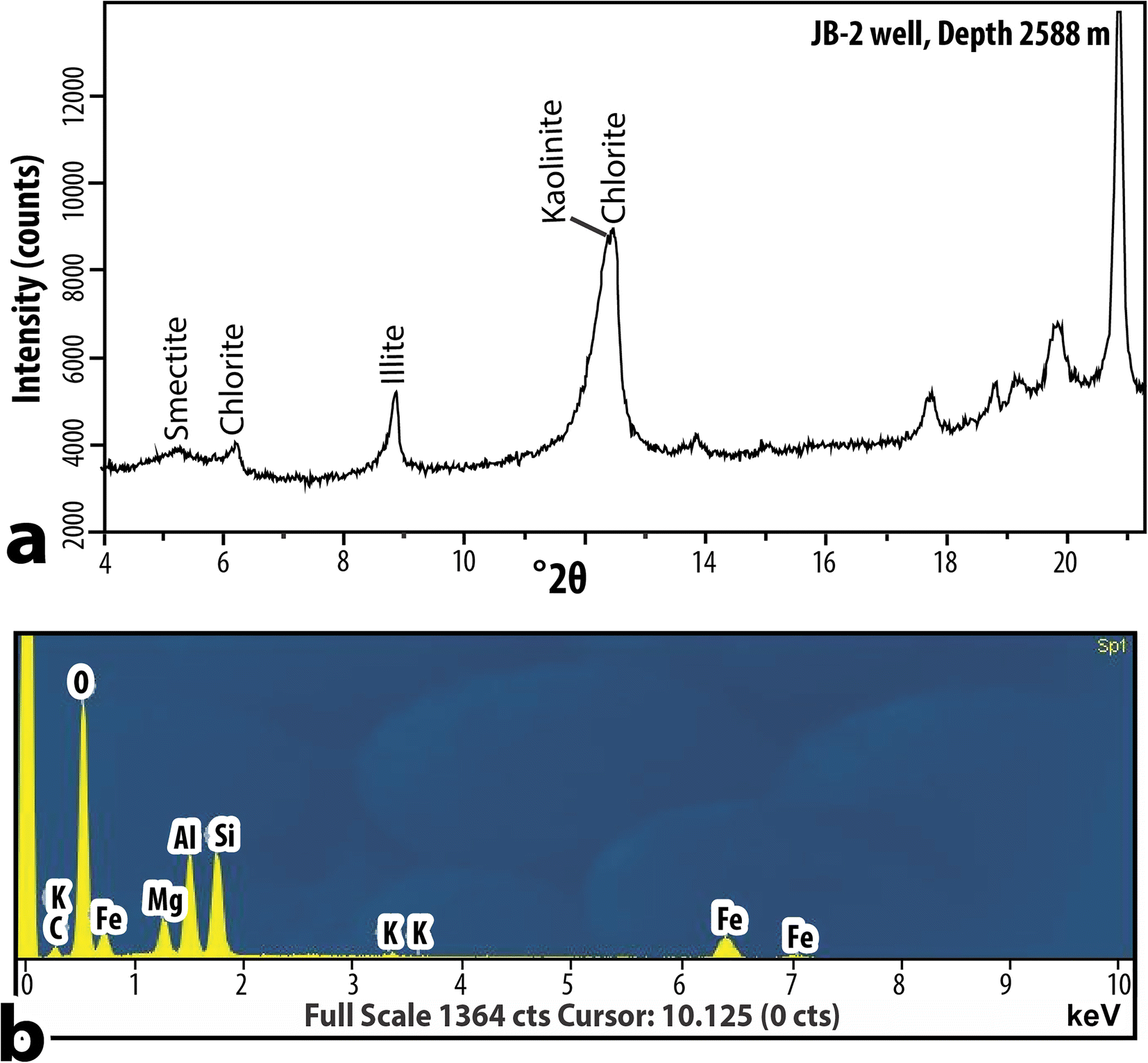
Authigenic clay minerals constitute an average of ~7.5% (Table 1) of the total framework constituents in the studied sandstones and include chlorite, illite/illite-smectite, kaolinite, and traces of mixed-layer chlorite-smectite as revealed by XRD (Fig. 6a) and SEM analysis (Figs 7, 8, 9 and 10). X-ray diffraction confirmed that the 2 μm clay separates of these sandstones comprise illite, chlorite, kaolinite, smectite, and mixed-layer clays (Rahman & Worden, Reference Rahman and Worden2016) (Fig. 6a). The XRD patterns indicated an overall relative chlorite content of up to 22%, a combined illite and smectite content up to 53%, and a kaolinite content of up to 25% in the clay fractions of the Neogene Surma Group sandstones (Rahman & Worden, Reference Rahman and Worden2016).
a XRD spectra (glycolated) of clay separates (<2 μm) of sandstone at a depth of 2588 m in JB-2 (Rahman & Worden, Reference Rahman and Worden2016); b Characteristic EDX spectra of chlorite (this chlorite is characterized as iron-rich). [JB = Jalalabad].

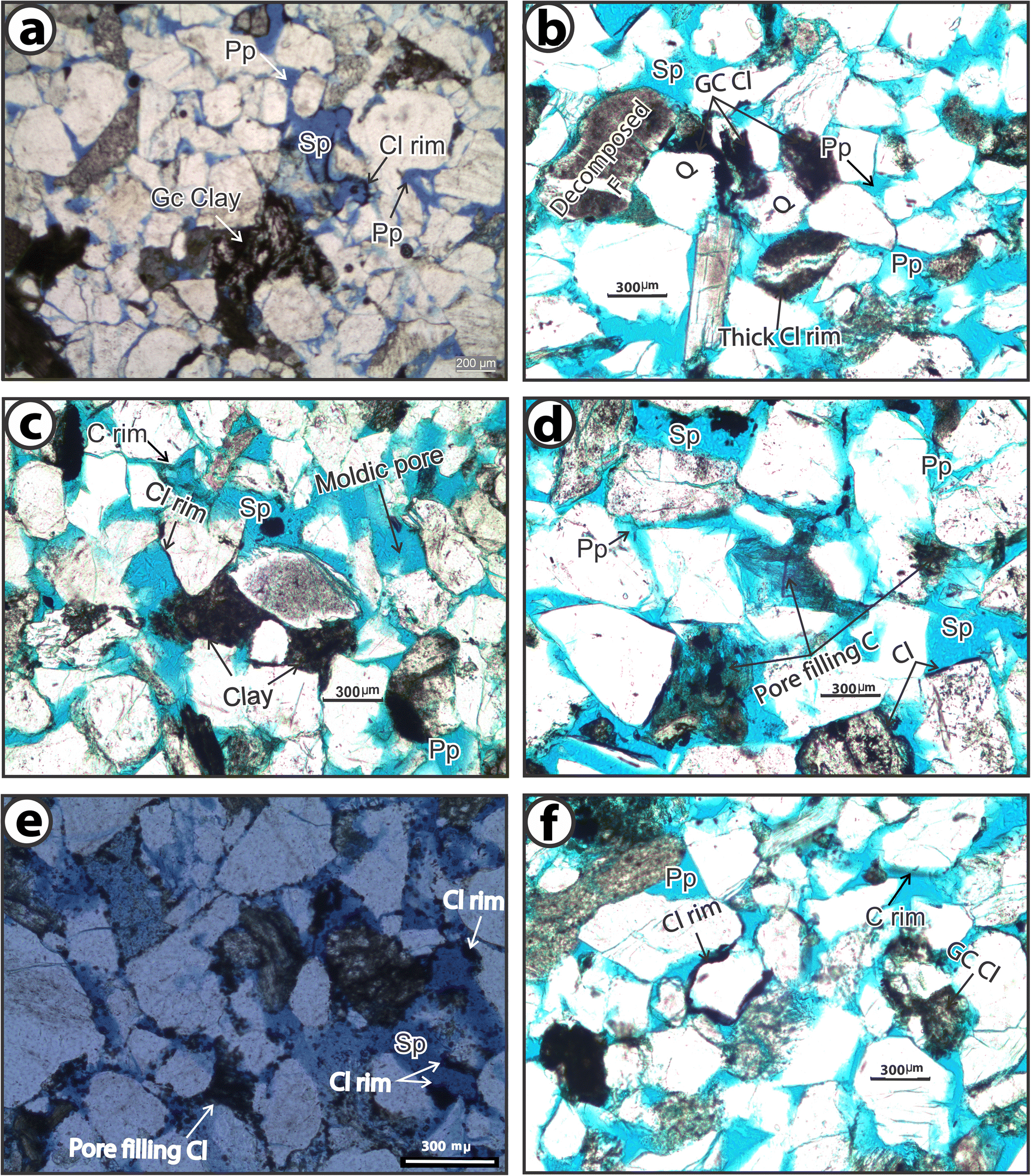
a Grain-coating clay and clay rim at a depth of 2457.6 m in KTL-2; b Grain-coating clay (GC Cl), thick clay rim, and decomposed feldspar (F) at a depth of 2615 m in JB-2. Quartz grains are partially replaced by authigenic clay here; c Pore-lining chlorite (Cl) rim, completely dissolved grain that resulted in moldic (secondary) porosity at a depth of 2650 m in JB-2; d Pore-filling chlorite cement (C), and clay cement (Cl) at a depth of 2588 m in JB-2; e Thin chlorite (C) rim (C), clay (Cl) rim, and pore-filling clay at a depth of 3619.5 m in FG-2; f Pore-lining chlorite (C) rim, clay (Cl) rim, and grain-coating clay (GC Cl) at a depth of 2615 m in JB-2. [Abbreviations for boreholes: FG - Fenchuganj; JB - Jalalabad; KTL - Kailastila]. In parts a–f, Pp = primary porosity, Sp = secondary porosity.

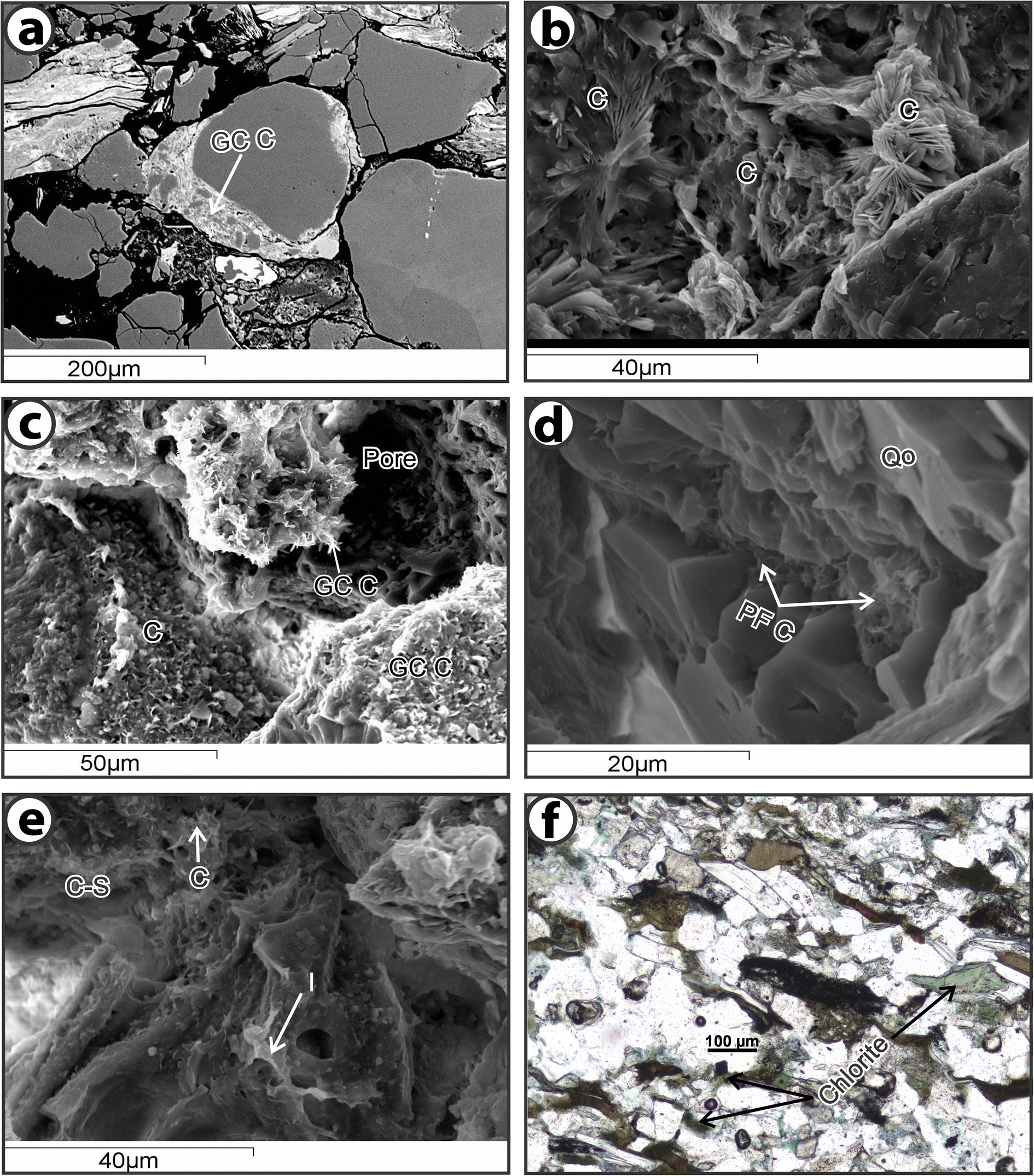
a Backscattered scanning electron (BSE) image showing; grain-coating chlorite (GCC) at a depth of 2597 m in JB-2; b Microporosity and authigenic chlorite (C) at a depth of 2608 m in JB-2; c Pore-lining, pore-filling, and grain-coating chlorite at a depth of 2603 m in JB-2; d Pore-filling chlorite (PFC) aggregates engulfed by quartz overgrowth (Qo) at a depth of 2608 m in JB-2; e Mixed-layer chlorite-smectite (C-S), illite (I), depth of 2597 m in JB-2 well; f biotite being altered to chlorite (chloritized biotite) at a depth of 2457–2458 m in FG-2 well. [Abbreviations for boreholes: JB - Jalalabad; FG - Fenchuganj].

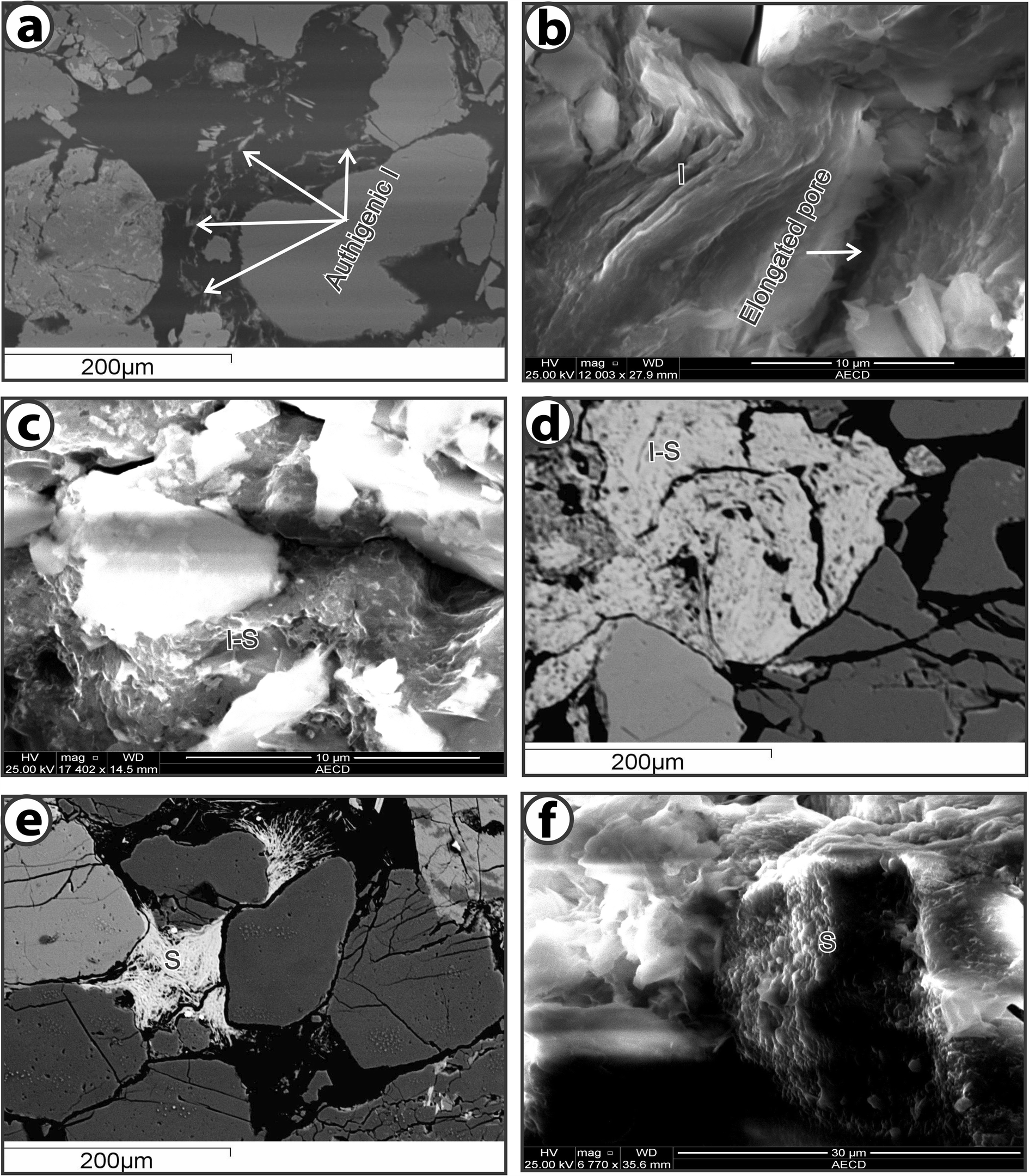
a Backscattered scanning electron (BSE) image showing authigenic illite (I) at a depth of 2473 m in JB-3; b Lath-shaped illite (I) and elongated pore at a depth of 3259 to 3269 m in FG-2; c Mixed-layer illite-smectite (I-S) at a depth of 3817 m, in well AT-1X; d Clay cements predominantly of mixed-layer I-S (BSE image) at a depth of 2473 m in JB-3; e BSE image showing pore-filling smectite (S) at depth of 2597 m in JB-2; f Honeycomb-like smectite (S) at a depth of 1497–1498 m in RP-4. [Abbreviations for boreholes: AT - Atgram; FG - Fenchuganj; JB - Jalalabad; RP - Rashidpur].

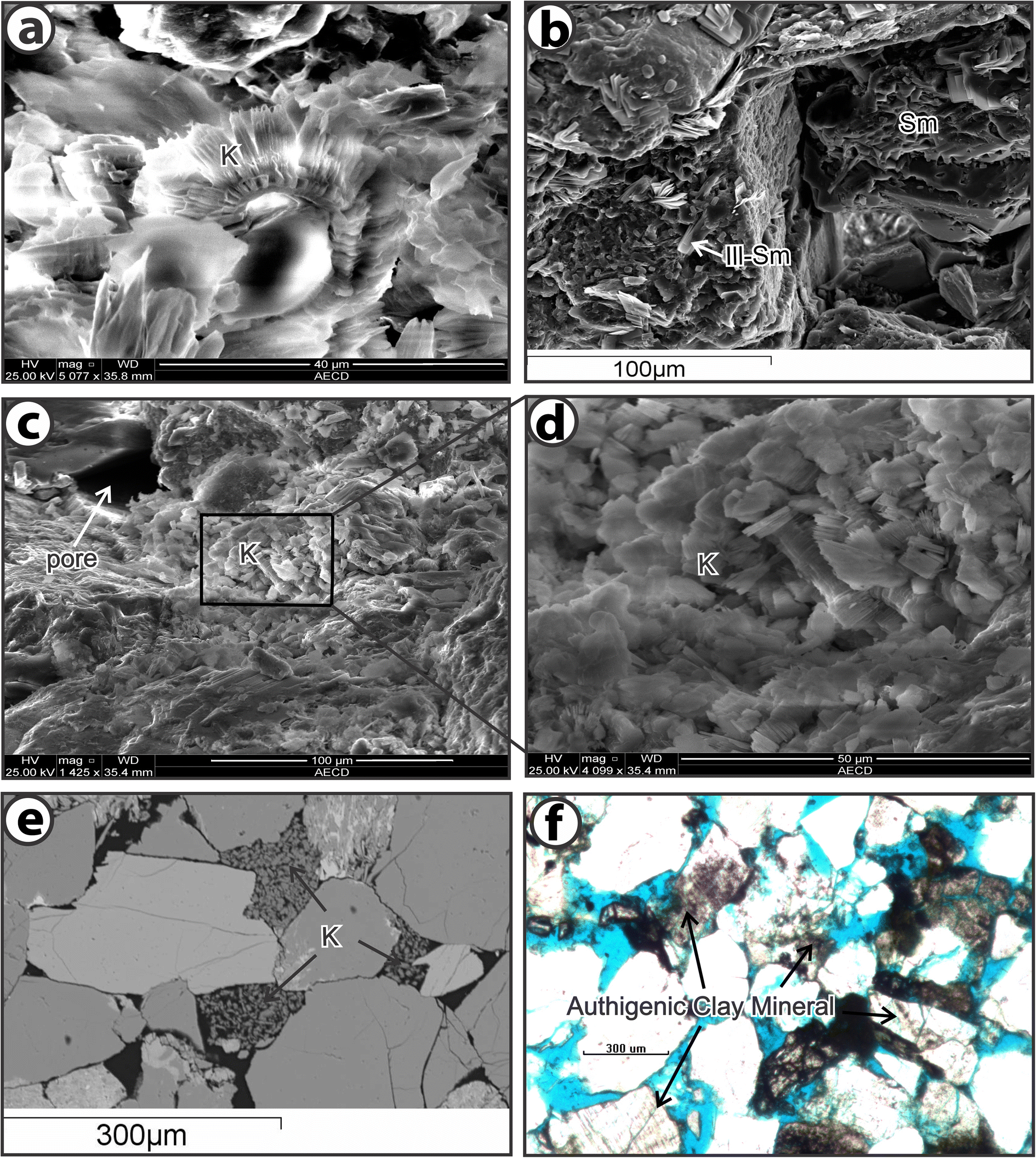
a Vermiform kaolinite (K) at a depth of 1497–1498 m in RP-4; b Pore-filling smectite at a depth of 2608 m in JB-2; c Pore-filling kaolinite (face-to-face stacks of pseudohexagonal plates) partly occluded the pore throats at a depth of 2732–2733 m in RP-4; d Enlarged view of pore-filling vermiform kaolinite (K); e vermicular kaolinite (K), Backscattered Electron (BSE) image at a depth of 2608 m in JB-2; f Authigenic clay mineral in feldspar at a depth of 2461 m in JB-2 [Abbreviations for boreholes: JB - Jalalabad; RP - Rashidpur].

These clay minerals formed pore-filling cements as well as very thin clay coating and clay rim cements (Figs 7, 8, 9 and 10). They also occurred in fractures within detrital grains, in cleavage and twinning planes of feldspars (Fig. 10f), and in microcrystalline boundaries within polycrystalline quartz and chert.
In thin section, the average authigenic chlorite content is ~2.8% and forms grain coating (Fig. 8a, c), pore-lining/chlorite rims (Fig. 7c, f), and pore-filling (Figs 7d and 8b–d) around the detrital grains. The chlorite rims (Fig. 7c, f) are generally thin and discontinuous, although thick and continuous rims occur also. The SEM results show that the chlorites occur as small irregular to pseudohexagonal platelets which are oriented perpendicular to the grain surfaces (Fig. 8d). Chlorite also fills pore spaces as clusters of bladed or platy crystals which frequently take the form of rosettes (Fig. 8b). They are occasionally enclosed by quartz overgrowths (Fig. 8d), smectite (Fig. 8e), and kaolinite. Traces of mixed-phase chlorite-smectite are observed by their bladed or platy crystals mixed with honeycomb-like texture (Fig. 8e). The EDX analysis revealed that the chlorite is iron-rich (Fig. 6b).
The illite is characterized by its filamentous or fibrous habit. In contrast, the illite-smectite is recognized by its lath-shaped, flame-like, crenulated and short honeycomb-like crystal morphology under SEM (Figs 8e and 9a–f) and is found as pore-lining (grain-coating), pore-filling, as well as pore-bridging, and thus could have acted as a permeability barrier for movement of fluids (especially hydrocarbons). At shallow depth, honeycomb-like true smectite was observed under SEM analysis (Fig. 9f).
Authigenic kaolin, predominantly in the form of kaolinite, is a late diagenetic phase within the Surma Group sandstones in the Sylhet Trough and occurred as isolated pore-filling cements (Fig. 10c) and in situ alteration products of pre-existing feldspars. It is likely that kaolinite cements originated from the diagenetic alteration of detrital feldspars. The BSE image and SEM analysis revealed that kaolinite is found in primary pore spaces as thin stacks of booklets, vermiform aggregates (Fig. 10a, e) adjacent to common detrital grains. It is also present as blocky euhedral, pseudohexagonal plates sitting in primary pores (Fig. 10c, e).
Clay Minerals in Shale
X-ray diffraction results show that the subsurface Neogene shales are composed mainly of quartz, plagioclase feldspar, illite, chlorite, kaolinite, and smectite, with less K-feldspar, dolomite, and minor amounts of carbonate minerals (Rahman, Reference Rahman2000). In general, the principal <2 μm clay mineral groups are in the following order of abundance: illite > chlorite > kaolinite > smectite (Table 2). In addition, mixed-layer clays (mainly illite-smectite and traces of chlorite-smectite) have also been revealed. The clay-mineral contents of the shales of the Surma Group are calculated semi-quantitatively (Table 2).
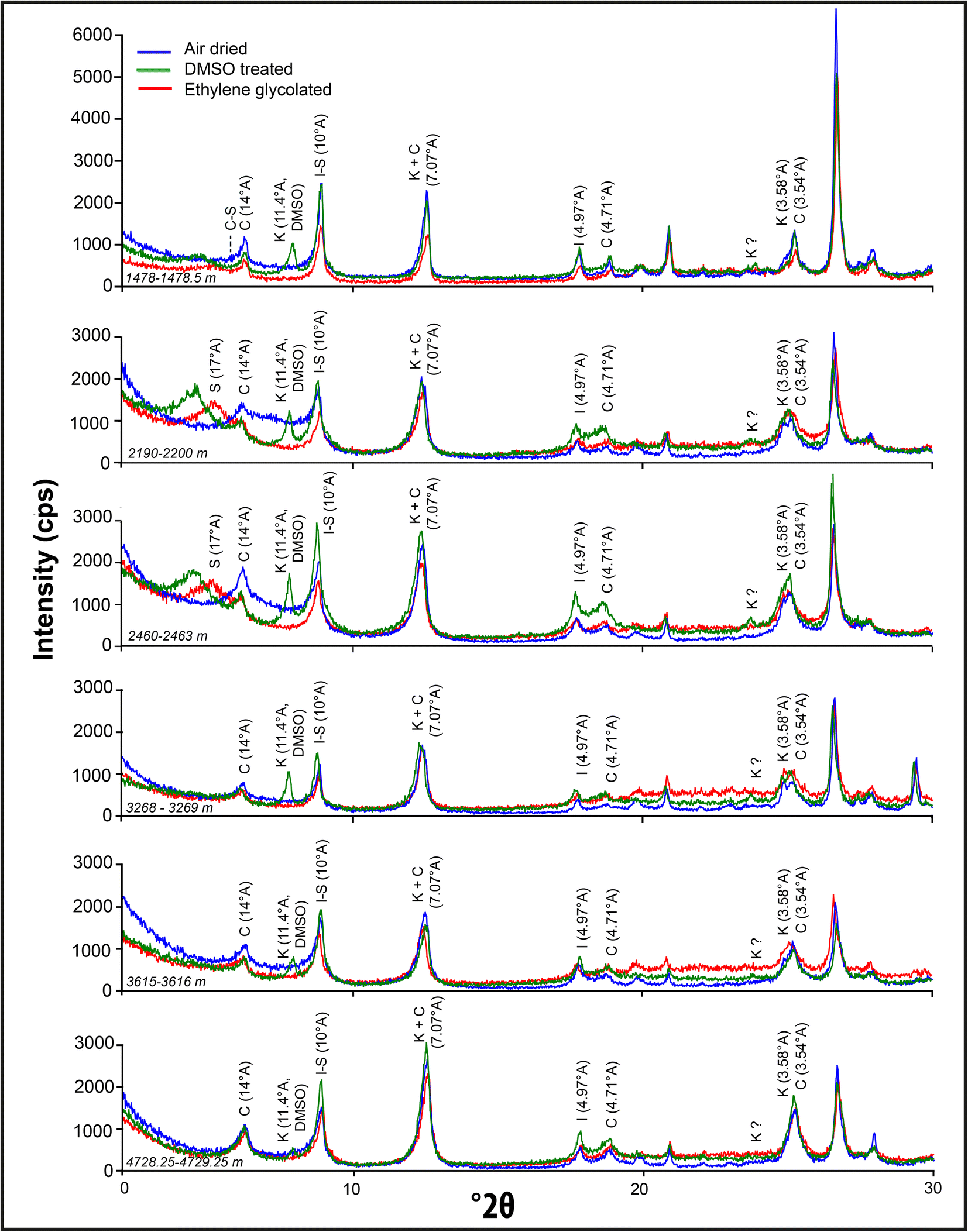
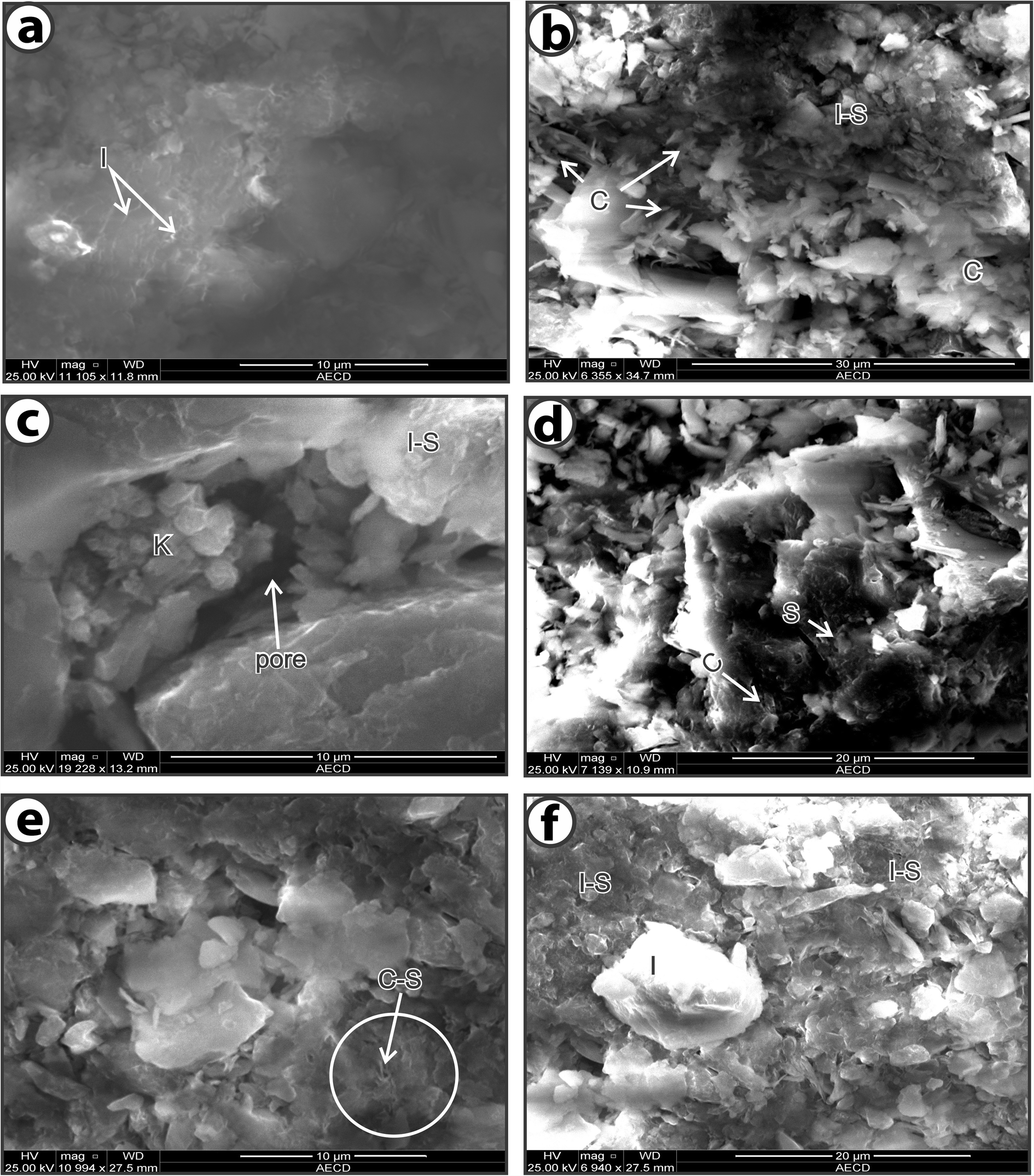
Illite is the most common type of clay mineral characterized by a 10 Å peak (8.8°2θ) basal (001) reflection and its 002 reflections at 4.96 Å (17.80°2θ). In all samples, illite shows larger values (Fig. 11). The average value is ~54.2% and ranges from 40.7 to 69.1% (Table 2). Under SEM analysis (Fig. 12a, f), illite-smectite showed a hair-like, crenulated, and cornflake-like structure.
XRD pattern of the clay fraction (<2 μm) of Neogene shales of the Surma Group showing the presence of major-clay mineral types (Abbreviation: S - Smectite, C - Chlorite, K - Kaolinite and I - Illite). In the studied wells, note a clear trend of gradually decreasing smectite with depth.

Scanning electron micrographs of shales showing: a Hair-like illite (I) at depths of 3615–3616 m in FG-2; b Pore-filling and grain-coating chlorite (C) and mixed-layer I-S at depths of 1375.5–1376.5 m in RP-3; c Pore-filling kaolinite (K) at depths of 2190 to 2200 m in FG-2; d Pore filled by clay matrix (mainly S and C) at depths of 3115–3116 m in KTL-4; (e, f) Mixed-layer C-S and grain-coating I, mixd-layer I-S at a depth of 1478–1478.5 m depth in RP-4. [Abbreviations for boreholes: FG - Fenchuganj; JB - Jalalabad; KTL - Kailastila; RP - Rashidpur].

The second dominant clay mineral group is chlorite. Chlorite is present in all the samples ranging from 12.3 to 46.1%, with an average content of 23.1% among the clay minerals. The SEM images (Fig. 12b, d) showed the chlorites as small irregular to pseudo-hexagonal platelets oriented perpendicular to the grain surfaces.
The kaolinite had 001 basal reflections at 7.07 Å (12.42°2θ) and 002 reflections at 3.58 Å (24.80°2θ) on the XRD traces of ethylene-glycolated samples (Fig. 11). Identifying kaolinite is difficult if associated with chlorite because both kaolinite and chlorite have reflections at 7.07 Å. For XRD traces of DMSO-treated samples, kaolinite showed the characteristic peak at 11.4 Å (7.7°2θ) which split from chlorite at 002 basal reflections (Fig. 11). Kaolinite occurred as thin stacks of pseudohexagonal crystals with booklet habit in SEM analysis (Fig. 12c). The kaolinite had an average content of ~16.5% and ranged from 0 to 25.9%.
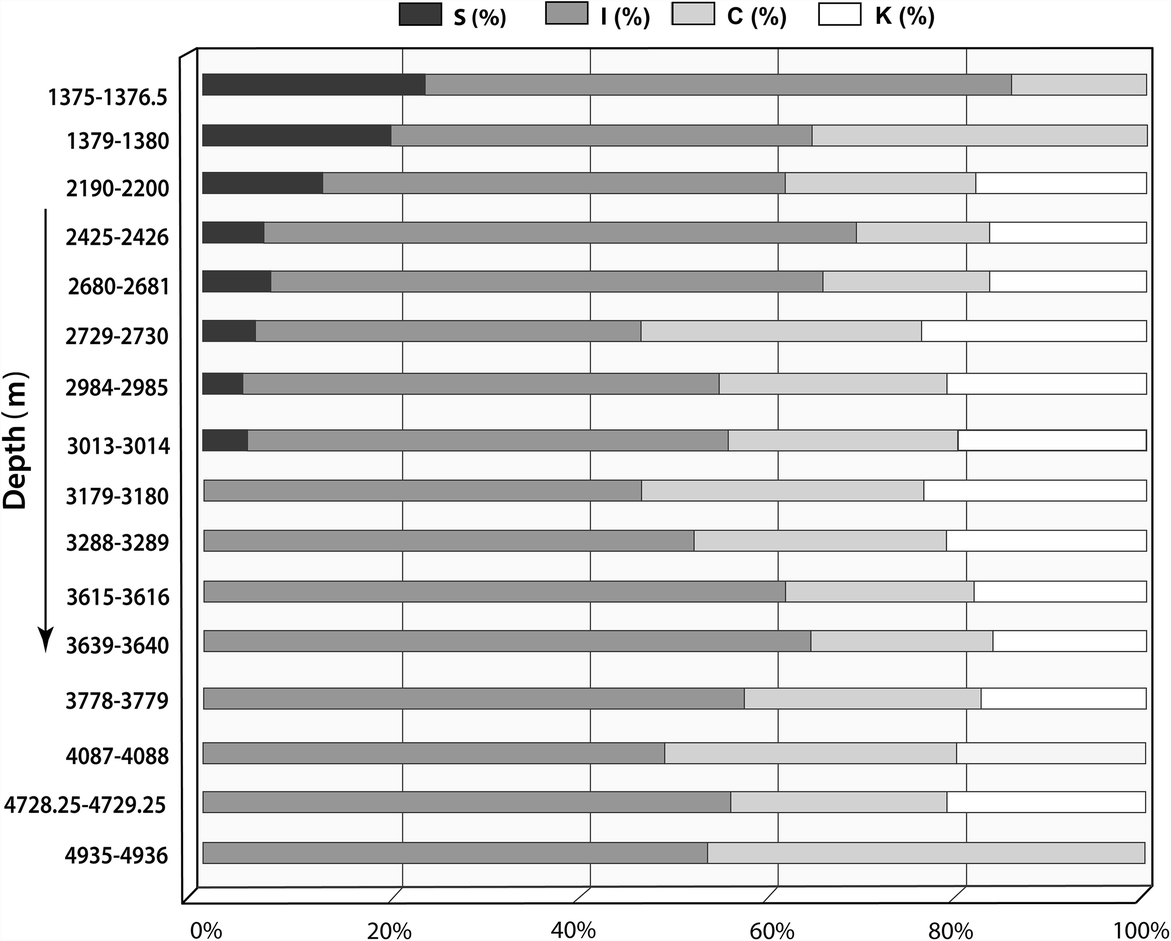
The 001 basal reflections characterize the minor group of clay minerals in the smectite group at 17 Å (5.30°2θ) on the XRD traces of ethylene glycol-treated samples. However, the DMSO-treated samples showed a clearer and wider peak at 3°2θ and 4.5–4.9°2θ (Fig. 10). The average amount of smectite was 6.8% and ranged from 0 to 26.2%. It occurs at shallow to medium depth (1375 to 3000 m) and is absent at deeper depths (≥3000 m).
The presence of mixed-layer clays is recognized from the asymmetrical shapes of the reflection pattern (Fig. 11). For example, the asymmetrical shape of 001 illite indicates the presence of mixed-layer illite-smectite. In addition, the asymmetrical shape of 001 chlorite indicates traces of mixed-phase chlorite-smectite. These mixed-layer clay minerals (illite-smectite and chlorite-smectite) were also noted in the <2 μm clay fractions from the Hatia Trough and Chittagong Tripura Fold Belt (Fig. 1) in the Bengal Basin (Najman et al., Reference Najman, Allen, Willett, Carter, Barfod, Garzanti, Wijbrans, Bickle, Vezzoli, Ando, Oliver and Uddin2012).
Porosity and Permeability
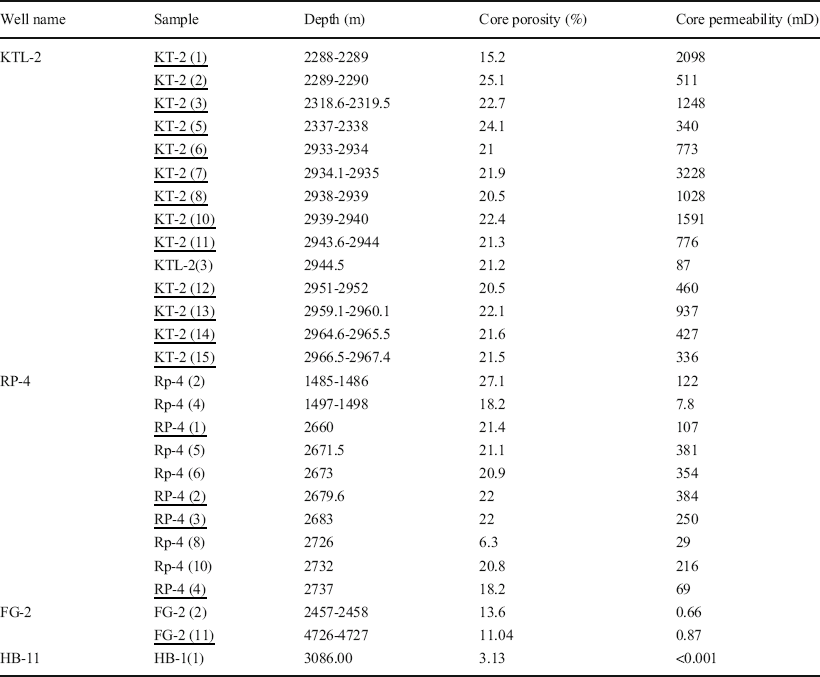
Petrographic microscopy and SEM analysis showed that the sandstones exhibit well connected intergranular macroporosity (primary porosity), secondary porosity (Fig. 7), and micro-porosity associated with clays, which are possibly secondary in origin (Figs 8c, e, 9d and 10b, d). Petrographically defined primary porosity had an average value of 18%, ranging from 0 to 27% and secondary porosity had an average of ~2.5%. The porosity, measured by Rahman and McCann (Reference Rahman and McCann2012), ranged from 0 to 34% (average 17.4%) of the Surma Group sandstones in the Sylhet Trough, which is in good agreement with the results of the current study. Core porosity ranged from 3 to 27%, with an average value of 20% and core permeability ranges from <0.001 to 3228 mD (Table 3) (BAPEX, 1996).
Core porosity and core permeability data (BAPEX, 1996).

[Note: Samples with names underlined are from Rahman & McCann (Reference Rahman and McCann2012); for well locations and symbol definitions, see Fig. 1b]
Discussion
The occurrence and origin of clay minerals in interbedded sandstone and shale lithologies and the role of clay/clay cements in sandstone reservoirs are discussed in the sections below .
Origin of Clay Minerals in Sandstones
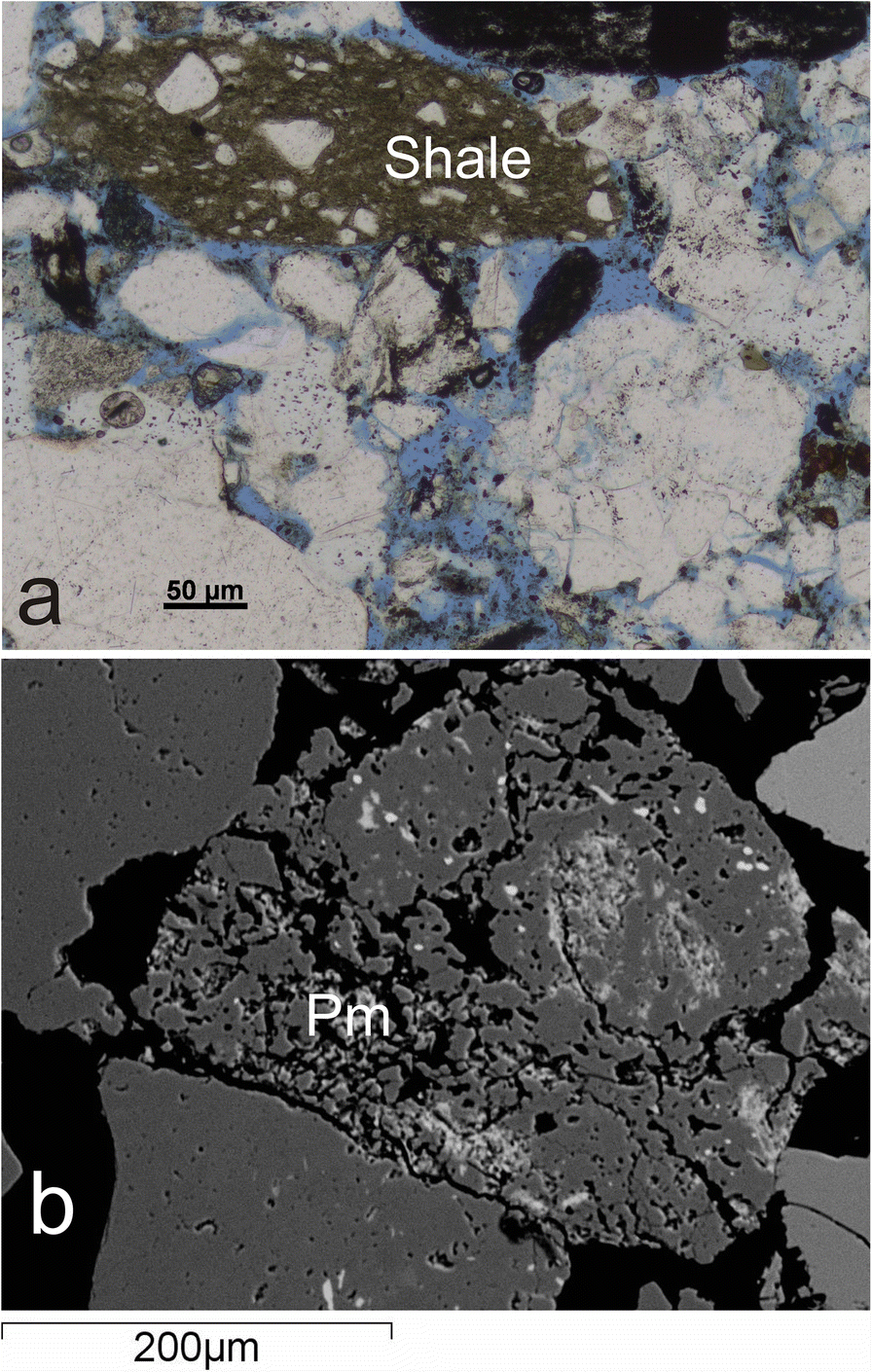
Detrital clay minerals may be mixed with sandstones by bioturbation and infiltration of muddy waters; diagenetically, clay minerals are formed by alteration of unstable detrital silicates and transformation of detrital and precursor diagenetic clay minerals (Worden & Burley, Reference Worden, Burley, Burley and Worden2003; Worden & Morad, Reference Worden and Morad2003). Sandstone rich in clay-rich lithic grains (Fig. 13) is susceptible to plastic deformation and clay diagenetic reactions (Worden & Burley, Reference Worden, Burley, Burley and Worden2003), forming authigenic clay minerals.
a Photomicrograph (plane-polarized light) showing mud/shale clasts at a depth of 2671.5–2672.5 m, Rashidpur 4 well (RP-4); b Backscattered Electron (BSE) image of pseudo-matrix (Pm), 2474 m depth, Jalalabad-3 well (JB-3).

In the Sylhet Trough, the presence of authigenic chlorite has been reported throughout the depth range from 1485 to 4728.25 m within the sandstones. Several explanations can be given for the origin of chlorite (Worden & Morad, Reference Worden, Morad, Worden and Morad2009). Among these, the widely accepted mechanisms of chlorite precipitation are either direct replacement from detrital biotite (Fig. 8f) or direct precipitation from pore water or precursor clay transformation (from smectite to chlorite) (Zhang et al., Reference Zhang, Lin, Cai, Qu and Chen2012).
Petrographic data revealed that authigenic chlorite is linked commonly with altered biotite (Fig. 8f). The greater abundances of authigenic chlorite can also be associated with biotite-rich sandstones, therefore (Fig. 8f). Authigenic chlorite may be grain-coating, pore-filling, or grain-replacing (Worden et al., Reference Worden, Griffiths, Wooldridge, Utley, Lawan, Muhammed, Simon and Armitage2020) and was derived from the replacement from detrital biotite at an intermediate to deep burial stage (Fig. 14). Biotite is transformed into chlorite through replacing K and Fe ions with Mg ions (Zhou et al., Reference Zhou, Lv, Li, Chen, Ma and Li2020 and references therein).
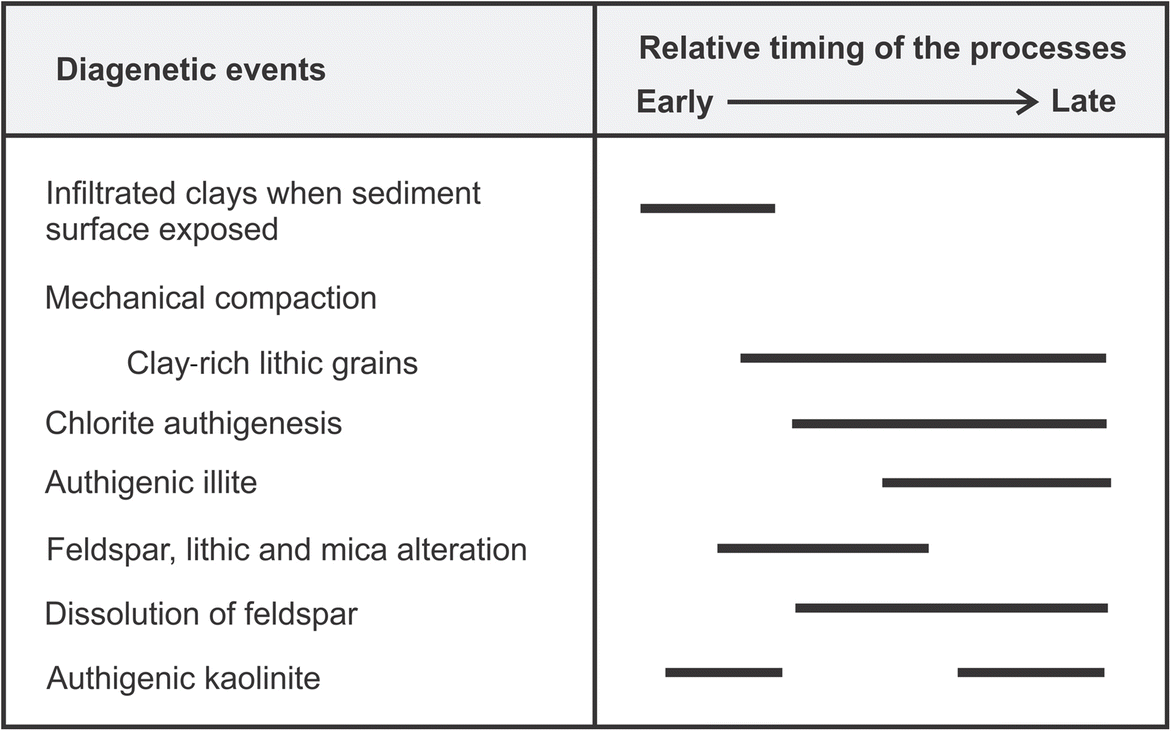
Paragenetic sequence of clay minerals in the Miocene Surma Group sandstones from the Sylhet Trough. The thick bar represents the relative period of diagenesis.

During progressive burial (mesodiagenetic) (Fig. 14), illite forms because of transformation of infiltrated clays (smectites via mixed-layer illite-smectite) under high temperatures (90–130°C) and high K+/H+ ratios in pore waters (Morad et al., Reference Morad, Ketzer and De Ros2000; Morad & De Ros, Reference Morad and De Ros1994). The formation of illite requires a source of Al and K which is generally provided by the alteration of K-feldspar (Brosse et al., Reference Brosse, Margueron, Cassou, Sanjuan, Canham, Girard, Lacharpagne and Sommer2009). The illitic clays (Fig. 9a, b) also occurred as pore-bridging clays and are associated with smectite, mixed-layer illite-smectite (Fig. 9c, d), and subordinate amounts of kaolinite. Diagenetic illite is identified by its hairy or fibrous and lath-shaped morphology (Rafiei et al., Reference Rafiei, Löhr, Baldermann, Webster and Kong2020). The kaolinites identified are mostly overlying the feldspar grains under SEM, indicating that these were possibly formed in response to the feldspar transformation. Kaolinite, especially the vermicular form (Fig. 10a, c), is a product of replacement and the first pore-filling phase and thus can be interpreted as an early diagenetic product (Fig. 14), formed by flushing shallow-buried sandstones by meteoric water (Burley & Macquaker, Reference Burley, Macquaker, Houseknecht and Pittman1992; De Ros, Reference De Ros1998). Kaolinite can form diagenetically during deep burial through transformation of feldspar, as well as via precipitation from pore fluids (Li et al., Reference Li, Schieber and Bish2020). The overall paragenetic sequence of clay minerals in sandstones was inferred with respect to time (Fig. 14) based on the mutual textural relationships observed in thin sections and by SEM.
Origin of Clay Minerals in Shales
Mineralogically, the Neogene shales of the Surma Group are composed predominantly of illite/illite-smectite, followed by chlorite, kaolinite, and minor smectite. Clay minerals in fine-grained sedimentary successions are most commonly considered to be of detrital origin (Li et al., Reference Li, Schieber and Bish2020). Possible sources for the mixed-layer illite-smectite in shales include erosion of older smectite-bearing mudstone successions and weathering of volcanic rocks or volcanic debris in the source area (Li et al., Reference Li, Schieber and Bish2020). According to Chamley (Reference Chamley1989), illite and chlorite are derived commonly from erosion and detrital supply of little-weathered metamorphic and plutonic source rocks. Detrital illite derived from physical weathering of mica has a 2M 1 polytype and contains large amounts of potassium compared to diagenetic illite and is characterized by coarse flakes (cf. Rafiei et al., Reference Rafiei, Löhr, Baldermann, Webster and Kong2020). Coarse chlorite flakes with distinct particle boundaries may be of detrital origin (Worden et al., Reference Worden, Utley, Butcher, Griffiths, Wooldridge and Lawan2018).
Recent studies on the provenance and depositional processes of fine-grained sediments indicate that clay minerals in mudstones can be of a variety of origins. The formation of authigenic clay minerals, especially the transformation of smectite to illite during deep burial, has been studied widely (cf. Li et al., Reference Li, Schieber and Bish2020).
In the Surma Group shales, diagenetic alteration of smectite to illite is clearly evidenced by the decrease in smectite and the corresponding increase in illite with depth (Table 2; Fig. 15). Smectite has not been observed below depths of 3000 m (Table 2; Fig. 15). In the studied wells, a distinct trend is found of gradually decreasing smectite with depth, disappearing ultimately at depths of ~3179 to 3180 m. The presence of discrete illite in the shales deeper than 3000 m agrees with the report of Chamley (Reference Chamley1989). This is also largely consistent with the previous observations from the northeastern Sylhet Trough (e.g. the Patharia anticline; Imam, Reference Imam1994), southern Bengal Basin (Shahbazpur structure, Hasan et al., Reference Hasan, Yeasmin, Rahman and Potter-McIntyre2020). No evidence has been found for pure smectite in the shales of the Patharia anticline (Imam, Reference Imam1994). In studies of shale diagenesis, alteration of smectite to illite (illitization) is recorded frequently (e.g. Hower et al., Reference Hower, Eslinger, Hower and Perry1976; Jahren & Aagaard, Reference Jahren and Aagaard1989). This illitization is also accompanied by a decrease in kaolinite content and an increase in chlorite content (Hower et al., Reference Hower, Eslinger, Hower and Perry1976; Jahren & Aagaard, Reference Jahren and Aagaard1989). Authigenic illite may be formed from mineralogical transformation, e.g. smectite to illite and kaolinite to illite. Kaolinite can form in fine-grained sediments by the weathering of feldsparshttps://www.sctopics/topics/earth-and-planetary-sciences/feldspar and also be sourced from clayey sedimentary parent materials (Li et al., Reference Li, Schieber and Bish2020). Only a small amount of chlorite and kaolinite is present as pore-filling cements (Fig. 12b–d) in a few shale samples. The precipitation of kaolinite and chlorite in shale was probably related to the availability of organic acids, iron, and magnesium in pore waters (Li et al., Reference Li, Schieber and Bish2020).
The trend in clay-mineral abundance of shales (Surma Group) at various depths in the studied wells in Sylhet Trough; illite is the most abundant clay mineral, and at greater depths smectite has not been observed (depth of >3000 m).

The dominant clay mineral assemblages (illite-chlorite-kaolinite) in shales are broadly similar to those of the sandstone, except the proportion of kaolinite seems to be greater in shales than in sandstones. These similar amounts of clays/clay cements may indicate derivation from uniform source areas and similar fluid–rock interactions/internally sourced components for the diagenetic reactions (e.g. dissolution of K-feldspar, mica, and organic acid to produce Al and K) in both lithotypes, with little influence of cross-lithology formation fluid (Shaw & Conybeare, Reference Shaw and Conybeare2003). CO2, Ca, SiO2, H2O, K, Al, Fe, Mg, and Na ions and organic acids released from kerogen maturation and illite-smectite reaction in adjacent shale could transfer to sandstone and form multiple generations of cement in sandstone reservoirs (Thyne, Reference Thyne2001 and references therein). The diagenetic transformation of smectite to illite in the mixed-clay illite-smectite mineral in the Surma shales in the Bengal Basin might release Si and Ca that could migrate with expelled water and form important sources of quartz overgrowth and late calcite cement, respectively, in the overlying sandstones (Imam, Reference Imam1987). In certain organic acids, this could be derived from the mudrocks and might be responsible for authigenic illite formation in sandstones. The components for the formation of authigenic illite in the mudrocks might all be derived internally (Shaw & Conybeare, Reference Shaw and Conybeare2003).
Linking Clay Diagenesis with Sequence Stratigraphic Framework
In the Sylhet Trough, the Miocene Surma Group sediments indicate a tide-dominated shallow-marine deltaic environment of deposition (e.g. tidal channel, tidal ridge, and tidal flat deposits) (Rahman & Suzuki, Reference Rahman and Suzuki2007; Khanam et al., Reference Khanam, Rahman, Alam and Abdullah2021). Based on the facies architecture, depositional environments, and interpreted bounding discontinuities such as MFS or TS, TES, and RES, the Surma Group has been divided into HST, TST, and LST (Khanam et al., Reference Khanam, Rahman, Alam and Abdullah2021). A similar sequence stratigraphic framework is also valid for the sub-surface Surma Group sediments, as shown in Fig. 3. LST was interpreted as an overall regressive stratigraphic unit bounded by a sequence boundary at the base of blocky or coarsening upward trend, and the top of this systems tract is marked by the TS and having prograding sand units. TS was interpreted as the surface between a coarsening upward trend and a fining upward trend, representing the first major flooding surface to follow the sequence boundary. MFS was identified based on the fining upward sequence, represented as shaliest section, whereas HST was recognized as a prograding unit bounded below a MFS.
The distribution of diagenetic alterations of clays in sandstones can be linked to the sequence stratigraphic framework of paralic and shallow marine deposits. Diagenetic clay minerals (such as chlorite, kaolinite, illite), calcite, and mechanical clay infiltration showed a systematic distribution in sandstones lying in the vicinity of sequence and parasequence boundaries, transgressive and maximum flooding surfaces, and in sandstones of the lowstand, transgressive, and highstand systems tracts. Mechanically infiltrated clays occurred mainly in sandstones that are deposited within the tidal flat sub-environment with TST and LST in an eodiagenesis stage. In sandstones, the preservation of mechanically infiltrated clays is low below sequence boundaries that correspond with wave-ravinement surfaces (i.e. transgressive surface) due to reworking of the underlying sands (Ketzer et al., Reference Ketzer, Holz, Morad and Al-Aasm2003). These sandstones also contain variable amounts of kaolinite that occur by the dissolution of detrital feldspar. In a LST, clay minerals within the sandstones commonly include mechanically infiltrated smectitic clays. These smectitic clays eventually evolved to grain-coating chlorite and/or illite during a mesodiagenesis stage.
Implications for Clays/Clay Cements in the Reservoir Quality of Sandstones
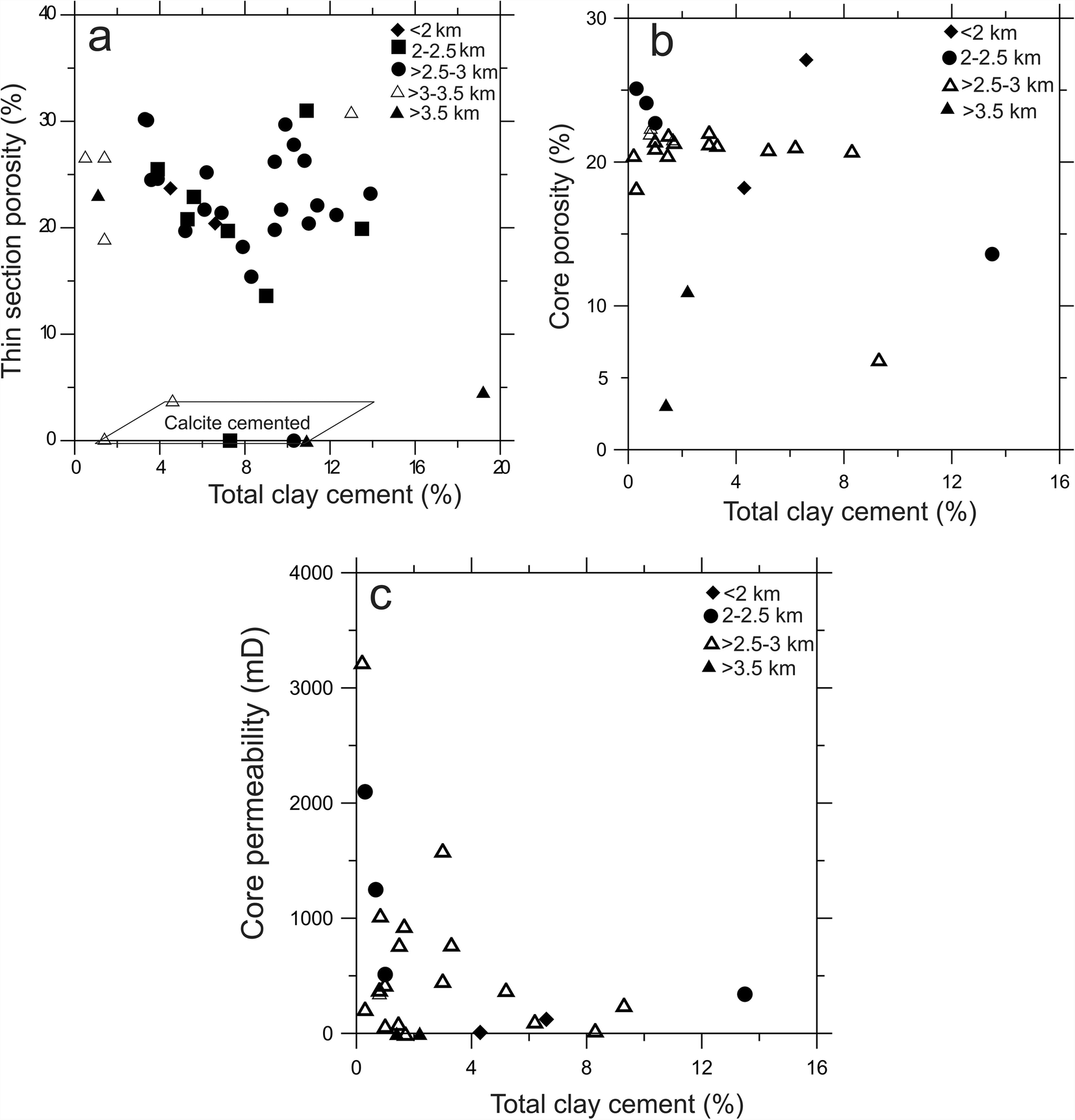
Sandstones have good porosities (~14–27%) and permeabilities (29 to 3228 mD) throughout the depth range 1485 to 3100 m (Fig. 16). Point-count thin-section porosities (0–27%) are in good overall agreement with those of the core plug porosities (3–27%), although thin-section porosity is, in most cases, less than the core porosity, which indicates the presence of microporosity associated with clays. Locally, poikilotopic calcite cement had reduced porosity of as little as 0% (Fig. 16a) and permeability of <1 mD (Fig. 16c).
Porosity-permeability controls: a Point-counted thin-section porosity versus clay-mineral cement; b Core porosity versus clay-mineral cement; c. Core permeability versus clay-mineral cement.

The sandstones studied in most cases contain interlayering of shales and mud clasts that may act as baffles against fluid flow and can affect petrophysical properties (porosity and permeability). The degree of shaliness in sandstones can cause wide variation in permeability values (29–3228 mD). Shale/mud clasts (Fig. 13a) in sandstone decreased pore-throat radius and permeability during burial due to mud clasts owing to their mechanical compaction and the formation of pseudo-matrix (Fig. 13b).
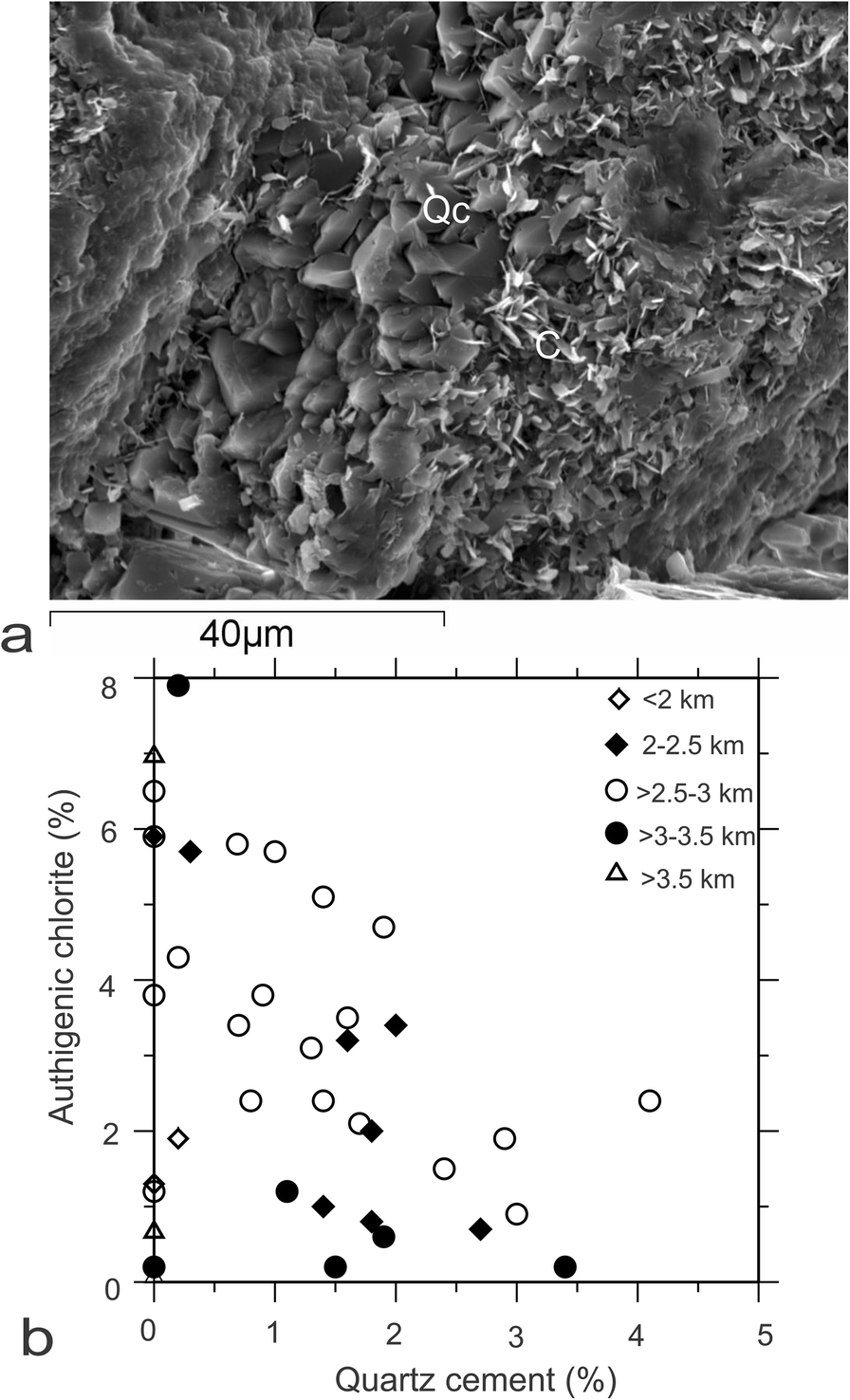
Clay cements played a role in reducing pore-throat radius, but they did not have a significant impact on the reservoir quality of the Neogene reservoir sandstones in the Sylhet Trough (Figs 7, 8, 9, 10 and 16). Clay cements in the Neogene Surma Group sandstones occurred mainly as grain-coating (pore-lining), grain-replacing, and few as pore-filling. In general, these mixed-layer clays decrease the porosity and permeability. Specifically, pore-filling illite-smectite reduced porosity slightly but had a more dramatic effect on permeability (Worden & Burley, Reference Worden, Burley, Burley and Worden2003; Worden & Morad, Reference Worden and Morad2003). The pore-filling kaolinite reduced the porosity of sandstone and had little effect on the permeability, whereas the pore-lining illite reduced the permeability considerably by blocking pore throats, but had little effect on porosity (Tucker, Reference Tucker2001). Chlorite coats are associated with the occurrence of high porosity and permeability in the sandstone reservoir. Chlorite coating on sand grains (Fig. 8c) can preserve reservoir quality by preventing quartz cementation (Bloch et al., Reference Bloch, Lander and Bonnell2002; Dowey et al., Reference Dowey, Hodgson and Worden2012). An inverse relationship exists between the amount of chlorite and the amount of authigenic quartz (Fig. 17). This phenomenon has been reported from many basins around the world (Dowey et al., Reference Dowey, Hodgson and Worden2012). Secondary porosity is not effective, as much of it is filled with clay cement and oversized secondary pores are outlined by clay-mineral rims (Fig. 7a, c, e). The clay minerals within the sandstones commonly include mechanically infiltrated clays in a LST that are eventually evolved to grain-coating chlorite and/or illite during mesodiagenesis. The clay minerals/cements had an insignificant effect on reservoir quality in sandstones. The poikilotopic calcite was distributed locally in the LST that destroyed porosity and permeability.
a SEM image of sandstone showing: chlorite cement (C) and quartz cement (Qc) at a depth of 2597 m, JB-2 well; b Relation between petrographically determined authigenic chlorite (C) versus quartz cement (Qc) with depth of burial.

Conclusions
A synthesis of results from the Miocene Surma Group sediments yielded the following findings:
1. In the Sylhet Trough, the Surma Group sandstones contain clay materials including chlorite, illite, kaolinite, and mixed-layer illite-smectite with lesser amounts of smectite, and traces of chlorite-smectite. In reservoir sandstones, these clay minerals usually occurred as both detrital matrix and authigenic cement.
2. Three main stages of authigenic clay minerals in the Surma Group sandstones are (a) an early diagenetic clay coating around detrital grains, (b) formation of vermiform kaolinite at shallow to intermediate burial depth, and kaolinite from the dissolution of feldspars at deeper burial stage, and (c) authigenic chlorite at an intermediate to deep burial stage and authigenic illite at the deepest burial stage.
3. In a lowstand systems tract (LST), clay minerals within the sandstones other than precipitation from pore fluids commonly include mechanically infiltrated clays and mud intraclasts forming a pseudomatrix due to mechanical compaction. These clays eventually evolved to grain-coating chlorite and/or illite during mesodiagenesis.
4. The Surma Group shales are enriched in illite with considerable amounts of chlorite and kaolinite throughout burial depth and seem to be dominantly detrital in origin at depths of ~3000 m. The gradual decrease in the smectite clays with depth and ultimate disappearance at greater depths (~3000 m) leads to diagenetic illite.
5. The Neogene sandstones offer a good-quality reservoir in most cases having porosity of ~14–27% and permeability of 29–3228 mD. The effect of clays/clay minerals on the reservoir quality of sandstones seems to be insignificant as clay minerals in these sandstones occurred mostly as grain-coating/pore-lining.
Acknowledgments
The authors express their gratitude to the Chairman of Petrobangla and the Managing Director of BAPEX for their kind approval for core analysis and to the Bangladesh Atomic Energy Commission (BAEC), the University of Bonn (Germany), and the University of Liverpool (United Kingdom) for laboratory support. The first author also acknowledges the 'Banggabandhu Fellowship Programme' of the Ministry of Science and Technology of the Government of the People's Republic of Bangladesh for providing the research funding. Special thanks to the Editor-in-Chief, Associate Editor, and anonymous reviewers for their constructive comments and suggestions.
Code availability
Not applicable
Author Contribution
Dr Farida Khanam: Sample collection, data analyses, manuscript writing
Professor M. Julleh Jalalur Rahman: Laboratory work, manuscript writing
Dr Rashed Abdullah: Data analyses, manuscript writing.
Funding
The first author acknowledges the 'Banggabandhu Fellowship Programme' of the Ministry of Science and Technology of the Government of the People's Republic of Bangladesh for providing the research funding during her PhD.
Data availability
All of the data collected are available in Tables 1 and 2. Core porosity and permeability data (Table 3) are reported from BAPEX, 1996). There are no deposited data.
Declarations
Ethics approval
Not applicable
Consents to participate
Not applicable
Consent for publications
Not applicable.
Conflicts of interest
The authors declare that there is no conflict of interest or competing interests.