I. INTRODUCTION
Silicon is probably one of the least expensive alloying additions commonly made to aluminum, which improves castability, increases strength to weight ratio, enhances corrosion resistance, decreases the coefficient of thermal expansion, and imparts wear resistance to aluminum. Reference Mondolfo1,2 Due to the increasing requirement to reduce vehicle weight and to improve fuel economy, aluminum–silicon (Al–Si) alloy castings have been found the most widespread use in automobile. Eutectic and near-eutectic Al–Si casting alloys attract more attention due to its excellent castability and lower cost of raw materials compared with A356 alloys. Reference Liao, Sun and Sun3–Reference Asensio-Lozano and Suárez-Peña5
Commercial eutectic and near-eutectic Al–Si alloys exhibit a hypereutectic microstructure normally consisting of α-Al dendrites, eutectic Si of an acicular and/or laminar morphology, primary silicon phase of a polygonal morphology. Reference Chang, Moon and Choi6 Large cuboid-shaped primary silicon and acicular eutectic silicon particles are known to deteriorate mechanical and friction performance of Al–Si alloys. Modification of Si phases in Al–Si alloys is carried out extensively in industry to improve mechanical properties. Traditionally, P, Na, Sr, and B are added as modifiers to Al–Si alloys, Reference Wu, Tu and Fukuda7–Reference Wu, Liu and Bian9 and the eutectic microstructure is converted from a coarse flake to a fine fibrous morphology and large cuboid-shaped primary silicon particles were refined simultaneously. Nogita et al. Reference Nogita, McDonald and Dahle10 investigated the eutectic silicon modification efficiency of fourteen kinds of rare earth elements in Al–10Si alloy. It suggested that the structural transition was limited to a refinement of the coarse plate-like silicon structure to a finer, but still plate-like, morphology, with exception of Eu. In recent studies, however, lots of references reported the effects of adding rare earth elements, including La, Reference Tsai, Chou, Lee, Lin, Lin and Lim11–Reference Mousavi, Emamy and Rassizadehghani13 Ce, Reference Zhang, Duan, Shao, Xu, Yin and Yan14 Er, Reference Xing, Gao, Zhuang, Liu and Tu15,Reference Na, Bian, Yin and Yao16 Nd, Reference Xu, Jiang, Yang, Wang and Wang17 Sc, Reference Prukkanon, Srisukhumbowornchai and Limmaneevichitr18 Y, Reference Li, Wang, Jie and Wei19 and Pr Reference Chen, Ma and Chen20,Reference Peng, Li, Huang and Du21 to modify silicon phases in Al–Si system. The modification resulted in considerable refinement in microstructure and improvement in mechanical properties. In addition, some researchers found that rare earth Pr would improve the ultimate tensile strength and fracture elongation of Al–Si metal matrix composites. Reference Peng, Li, Huang and Du21
According to the previous study, Reference Nogita, McDonald and Dahle10 Sm was added into hypoeutectic Al–Si alloy, could result in some changes in the appearance of eutectic silicon, but still unsatisfactory. Besides, there is a lack of analysis of mechanical properties when modified by Sm addition. No reports on the use of Sm in near-eutectic Al–Si alloy for casting have been found. The present work, therefore, is to investigate the effects of Sm on the microstructures and mechanical properties of Al–12Si alloy. Furthermore, thermal analysis is carried out to reveal the relationship between Sm concentration and eutectic temperature of the Al–12Si alloy.
II. EXPERIMENTAL PROCEDURES
A. Materials preparation
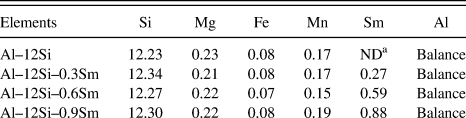
Commercial available Al–12Si (ZL102) was used as the base alloy. The as-received Al–12Si ingots used in this research were primarily prepared from the same batch to avoid any undesired variations and effect from minor element contamination. Pure Al (99.9%) and pure Sm (99.9%) were used to prepare Al–15Sm master alloys in a medium-frequency induction furnace under an inert argon atmosphere. The alloy for each test was melt in a graphite crucible by using an electric resistance furnace. The graphite crucible was preheated to 400 °C, and then the alloys were heated up to 740 °C and carefully skimmed to remove the dross and other impurities. Subsequently, the preheated Al–15Sm master alloys wrapped in aluminum-foil papers were added into the melts and the additions of Sm were 0, 0.3, 0.6, and 0.9 wt.%, respectively. The liquid melt was isothermally held for 20 min at 720 °C and stirred for 2–5 min to ensure that Sm was completely dissolved. Then the modified melt was degassed with high pure nitrogen gas for 5 min to ensure low hydrogen content. The surface of the melt was skimmed and then poured into a permanent mold at 710 °C. The permanent mold was preheated to 250 °C to evaporate water before casting. Table I presents the chemical composition and designation of alloys analyzed by inductively coupled plasma–atomic emission spectroscopy.
Chemical composition of alloys (wt.%).

a ND: Not detectable.
B. Analysis procedures
Samples for microstructure analysis were prepared by conventional mechanical means and were etched with an aqueous solution of 0.5% HF. The microstructures of different Sm content alloys were examined by optical microscopy (Nikon M300, Japan) and scanning electron microscope (SEM, NOVA NANOSEM 450, FEI, Inc., Hillsboro, OR) with an energy dispersive spectrometer (EDS, INCA 250X-Max 50, FEI, Inc., Hillsboro, OR). The volume fraction and grain size of primary silicon cuboids, mean area and aspect ratio of the eutectic silicon particles, were measured by Image-Pro Plus 6.0 image analyzer. These four parameters are calculated as follows:
 $${\rm{Grain}}\;{\rm{size}} = {1 \over m}{\mathop\sum\limits_{j = 1}^m {\left( {{1 \over n}\mathop\sum\limits_{i = 1}^n {\sqrt {{{4{A_{{\rm{p}}i}}} \over {\rm{\pi }}}} } } \right)} _j}\quad,$$
 $${\rm{Volume}}\;{\rm{fraction}} = {1 \over m}\mathop\sum\limits_{j = 1}^m {{{{{\left( {\mathop\sum\limits_{i = 1}^n {{A_{{\rm{p}}i}}} } \right)}_j}} \over {{A_j}}}} \quad,$$
 $${\rm{Mean}}\;{\rm{area}} = {1 \over m}{\mathop\sum\limits_{j = 1}^m {\left( {{1 \over n}\mathop\sum\limits_{i = 1}^n {{A_{{\rm{e}}i}}} } \right)} _j}\quad,$$
 $${\rm{Aspect}}\;{\rm{ratio}} = {1 \over m}{\mathop\sum\limits_{j = 1}^m {\left[ {{1 \over n}\mathop\sum\limits_{i = 1}^n {\left( {{{{L_{\rm{l}}}} \over {{L_{\rm{s}}}}}} \right)} } \right]} _j}\quad,$$
where A pi is the area of a single primary silicon particle, and A ei is the area of a single eutectic silicon particle, L l/L s is the ratio of the longest to shortest dimensions of a single silicon particle, n is the number of particles of a single field, m is the number of the fields, and A j is the area of a single field.
To evaluate mechanical properties, the ingots were machined to a diameter of 6 mm and a gage length of 30 mm (ASTM B557M specification) for being used as the tensile tested bars. Tensile tests were carried out at a crosshead speed of 1.0 mm/min. Six specimens were made for each material condition in the tensile test and the average reported as the final result.
Thermal analysis was carried out by using a differential thermal analyzer (DTA, DZ3320, Nanjing Dazhan Institute of Electromechanical Technology, China). Specimens were machined into rods of approximately 3 mm in diameter and weighing 20 mg. The temperature recorded during the remelting process was plotted against time thus creating a heating curve. The system was allowed to heat at a scanning rate of 10 °C/min over the range from room temperature (RT) to 630 °C.
III. RESULTS AND DISCUSSION
A. Thermal analysis
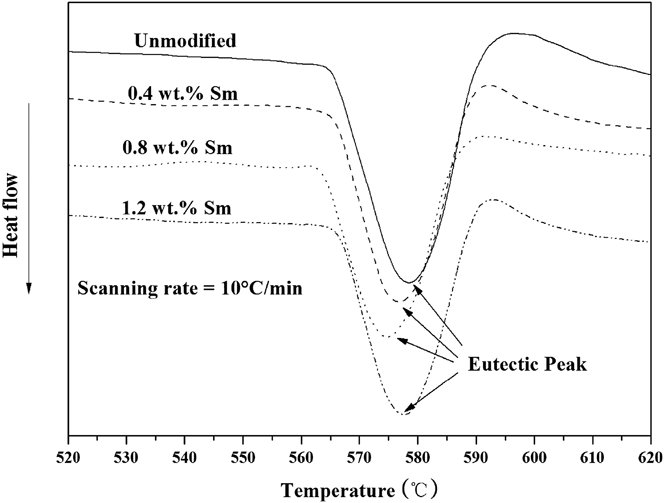
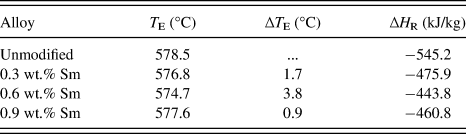
Figure 1 shows the DTA curves of as-cast Al–12Si alloy and modified with various Sm additions. In the DTA curve, the reaction peak reflects the specific phase change and the peak area is proportional to the heat of reaction (∆H R) associated with the phase transformation. Negative values of ∆H R are due to the endothermic reactions of liquid formation during heating, while positive values result from the latent heat released. As shown in Fig. 1, the eutectic peak represents the main binary eutectic reaction L ↔ (α) Al + Si. Table II tabulates the characteristics of the DTA curves in Fig. 1.
DTA curves of as-cast Al–12Si alloy and modified with varying Sm addition.

DTA remelting characteristics of Al–12Si alloys.

From the DTA curves and their characteristics, it can be seen that a small amount of Sm addition has a marked effect on the remelting behavior. Increasing Sm content decreases the binary eutectic temperature as observed in DTA curves, and thus the eutectic temperature depression ∆T E (∆T E = T EU − T EM, where the subscripts E, U, and M denote eutectic, unmodified, and modified, respectively) increases, which is in good agreement with the findings of Nogita et al. Reference Nogita, McDonald and Dahle10,Reference Dahle, Nogita, McDonald, Dinnis and Lu22 A low eutectic temperature is a feature of the well-modified microstructure. It can be seen that rare earth element Sm causes an increase in the eutectic latent heat ∆H R, and the magnitude of this latent heat increases steadily with increasing concentration of Sm. However, when the addition level increases above 0.6 wt.%, the effect of rare earth Sm addition on the remelting behavior was weakened. The magnitude of eutectic peak temperature depression ∆T E and latent heat ∆H R began to decrease, as shown in Table II. It can be concluded that addition of Sm results in a depression in eutectic peak temperature and an increase in latent heat ∆H R.
B. Influence of Sm additions on primary α-Al of the Al–12Si alloy
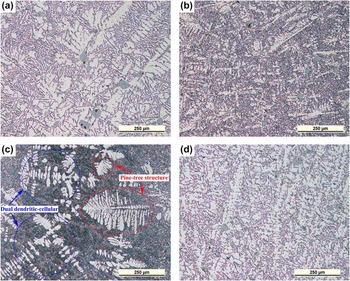
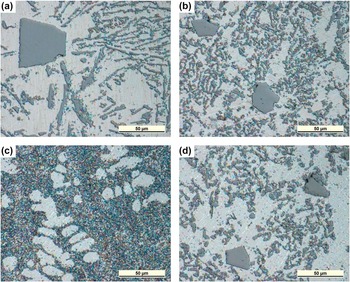
The microstructures of Al–12Si alloys with different Sm additions are shown in Fig. 2. As shown in Fig. 2(a), the unmodified Al–12Si commercial alloy shows the dendritic nature of the primary α-Al dendrites, sometimes the dendrites nucleate on pre-existing silicon cuboids (seen as angular gray particles). The eutectic displays a lamellar habit of alternating Si and α-Al platelets. After minor addition of 0.3 wt.% Sm, Fig. 2(b) shows that Sm is capable of breaking down the primary α-A1 phase, giving rise to an increment in the number of dendrites. When Sm addition increases up to 0.6 wt.%, the primary α-Al phase appears as a slightly dual dendritic-cellular nature and pine-tree structure, and the directions of oriented growth are obvious, as shown in Fig. 2(c). Nevertheless, further increase in the addition level of Sm to 0.9 wt.%, long coarse primary dendrites appear again, as shown in Fig. 2(d).
Microstructures of Al–12Si commercial alloy with different Sm additions. (a) Without Sm addition; (b) 0.3 wt.% Sm; (c) 0.6 wt.% Sm; (d) 0.9 wt.% Sm.

It can be concluded that Sm additions affect the morphology and distribution of α-Al dendrites. And this change is believed to be related to the eutectic temperature depression. Liao et al. Reference Liao, Sun and Sun3 and Juan et al. Reference Asensio-Lozano and Suárez-Peña5 reported that the eutectic temperature depression ∆T E was responsible for the increment in the amount of the α-Al phase and led to a shift of eutectic point toward a higher silicon level. According to the KJMA grain growth model Reference Aparicio, Barrera, Trapaga, Ramirez-Argaez and Gonzalez-Rivera23 proposed by Kolmogorov, Johnson, Mehl, and Avrami, it is assumed there are N spherical grains of radius R developing during the solidification of the sample, where N is the number of grains per unit volume, taking into account grain impingement in the last stages of solidification. The evolution of solid fraction f s at time t is given by
 $${f_{\rm{s}}}^t = 1 - {\rm{exp}}\left( { - {4 \over 3}\pi N{{\left( {{R^t}} \right)}^3}} \right)\quad,$$
where f s t and R t are the solid fraction and radius at time t, respectively. And the relationship between the number of crystal nucleus P(t) formed at time t, the nucleation rate n, and the grain growth rate v g can be derived from Eq. (5) and is shown as follows:
 $$P\left( t \right) = k{\left( {{n \over {{v_{\rm{g}}}}}} \right)^{3/4}}\quad,$$
where n and v g can be calculated as
 $$n \propto \exp ( - 1/\Delta {T^2})\quad,$$
 $${v_{\rm{g}}} \propto \Delta T\quad.$$
In Eq. (6), k is a constant determined by the morphology of nucleus. P(t) is determined by n and grain growth rate v g. When rare earth Sm was added to the melt, the eutectic temperature declined to a lower temperature which would increase the undercooling ∆T in the binary Al–Si system. That would increase the nucleation rate n and grain growth rate v g of primary α-A1 in the same material respectively, as shown in Eqs. (7) and (8). However, the increment in nucleation rate n was greater than that in v g. As a result, the number of crystal nucleus P(t) increased. And this conclusion might be used to explain the increment in the amount of dendritic α-A1 phase caused by the addition of Sm.
C. Influence of Sm additions on silicon morphology
The morphologies of silicon phases with different Sm concentration in Al–12Si alloys are shown in Fig. 3. The unmodified alloy has coarse block-like primary Si cuboids with sharp corners and long needlelike eutectic Si phases, as shown in Fig. 3(a). The introduction of 0.3 wt.% Sm causes refinement of primary silicon and eutectic silicon in Al–12Si alloy, as shown in Fig. 3(b). The primary silicon is broken down into smaller cuboids which still are characterized by sharp corners. In the mean time, the eutectic silicon is refined and most of them turn to be smooth, resulting in a round shape structure. Furthermore, Al–12Si alloy with 0.6 wt.% Sm addition shows a fully modified, fine fibrous eutectic structure, as shown in Fig. 3(c). It is worth noting that there is a smooth interface between α-Al and eutectic silicon, and no primary silicon cuboids can be found in Al–12Si modified with 0.6 wt.% Sm as well. However, when Sm addition increases up to 0.9 wt.%, block-like primary silicon and needlelike eutectic silicon appear again, as shown in Fig. 3(d).
The morphologies of eutectic Si phase with different Sm concentration in Al–12Si alloys at higher magnification: (a) unmodified; (b) 0.3 wt.% Sm; (c) 0.6 wt.% Sm; (d) 0.9 wt.% Sm.

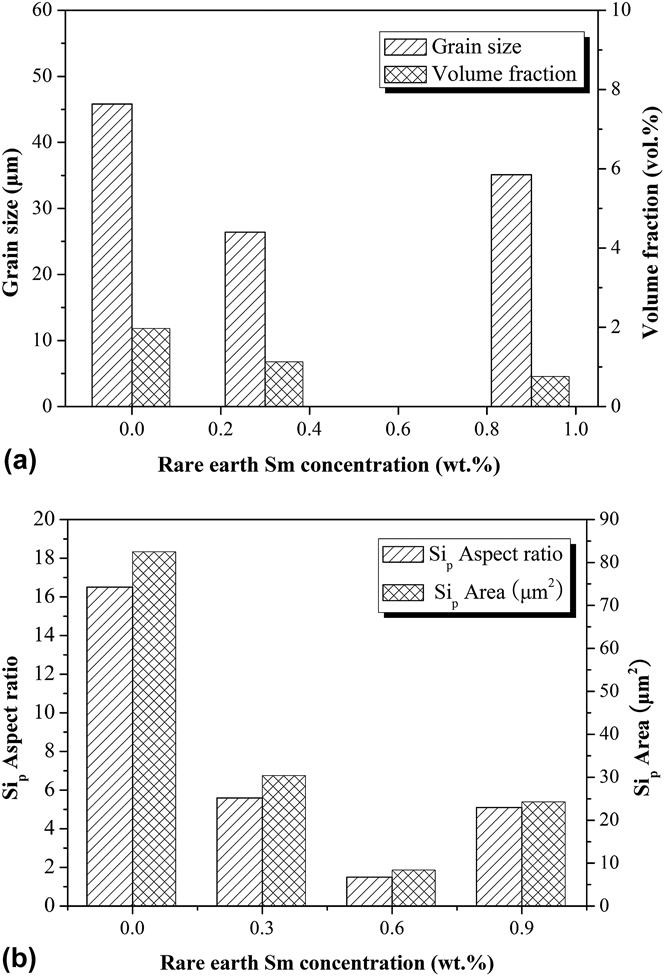
The quantitative metallographic results measured by an image analyzer are shown in Fig. 4. Grain size and volume fraction of primary silicon are found to be decreased with increasing Sm addition, as shown in Fig. 4(a). Nevertheless, as rare earth element Sm concentration surpasses 0.6 wt.%, they start to increase. Similar situations are observed for the mean area and aspect ratio of eutectic silicon, as shown in Fig. 4(b). It can be concluded that the eutectic silicon in alloys with 0.3, 0.6, 0.9 wt.% Sm additions is more spherical than that in the unmodified alloy. Modification with the addition of 0.6 wt.% Sm results in a fine granular, fully modified eutectic silicon structure. The efficiency of Sm modification reaches to its highest when rare earth Sm concentration is 0.6 wt.%.
Image analysis of Al–12Si alloys with different Sm additions: (a) primary Si; (b) eutectic Si.

Many studies have been carried out to find out the mechanism by which the morphology of eutectic silicon is modified in Al–Si alloy. Controversy still remains although most theories involve possible effects of modifying agent on the nucleation and/or growth of eutectic silicon during solidification. Reference Nogita, Yasuda, Yoshida, Uesugi, Takeuchi, Suzuki and Dahle24 It has been confirmed that the modified silicon fibers contain more twins than unmodified silicon and have a rough micro interface. Each defect on modified silicon surface is a potential site for branching under solidification condition. Therefore, the heavily twinned Si fibers are suggested to be crystallographic all very imperfect and able to bend, curve, and split to give a fine microstructure. According to the impurity induced twining theory which was proposed by Lu and Hellawell, Reference Lu and Hellawell25 a value of 1.646 is proposed as the ideal ratio of the atomic radius of the impurity-element compared to silicon (r ie:r Si) for an element to cause modification. The atomic ratio of Sm compared with silicon (r Sm:r Si) is 1.53 which is close to the idea value (1.65) and therefore Sm is predicted to result in modification.
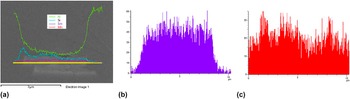
Silicon is a diamond cubic structure and contains four possible {111} twin planes, any two of which share a common {101}. In any one flake segment of unmodified eutectic silicon, only one twin plane operates, giving the configuration in which all twin planes are parallel. Reference Chang26 Transmission electron microscope (TEM) analysis was carried out for the observations of eutectic silicon in Al–12Si alloy fully modified with 0.6 wt.% Sm, as shown in Fig. 5. A new twin plane forms by branching from the original twin plane and it starts at an angle to the first in Zone 1. However, the two twins share a common direction in Zone 2. The linear SEM-EDS results of eutectic silicon in Al–12Si alloy with 0.6 wt.% Sm are shown in Fig. 6. As shown in Fig. 6(a), eutectic silicon shows polygonal morphology at high magnifications. The linear SEM-EDS image demonstrates the distribution of four main elements (Al, Si, Sm, Mn) in the Al–12Si alloy. Sm was mainly distributed in eutectic silicon area [Fig. 6(b)], while Al was relatively less [Fig. 6(a)]. As in the case of Mn element, there is no significant difference in or out of the range of the eutectic area [Fig. 6(c)]. It can be concluded that Sm is associated with silicon phase other than Al or Mn from the linear SEM-EDS images. Meanwhile, the existence of rare earth Sm within the eutectic silicon and twins might be strong evidences to support the impurity induced twinning theory proposed by Lu and Hellawell.
TEM micrograph of the Al–12Si alloy with 0.6 wt.% Sm showing twins in silicon.

Linear SEM-EDS image of eutectic silicon in Al–12Si alloy with 0.6 wt.% Sm: results of linear SEM-EDS (a), distribution features of Sm element (b) and Mn element (c).

The mechanics of primary silicon modification of Al–Si alloys has been explained based on the observations of temperature depression when trace rare earth elements were added. Reference Chang, Moon and Choi6 According to the critical growth temperature hypothesis, nucleation of silicon is suppressed to the temperature of globular growth by the addition of rare earth, thus modifying the structure. However, this hypothesis may not be applied to explain the elimination of primary silicon, because the matrices used in our experiments were near-eutectic Al–Si alloys rather than hypereutectic alloys. The near-eutectic phase diagram was extremely sensitive to trace element addition. Reference Liao, Sun and Sun3–Reference Asensio-Lozano and Suárez-Peña5 The fact that Sm additions to Al–Si alloy studied in this work caused a depression of eutectic arrest to lower temperature. This change would lead to a shift in the eutectic composition toward higher silicon contents. When 0.6 wt.% Sm was added into the melts, Al–12Si alloy probably showed a hypoeutectic structure which feathers for eutectic silicon and α-Al.
D. Analysis of mechanical properties
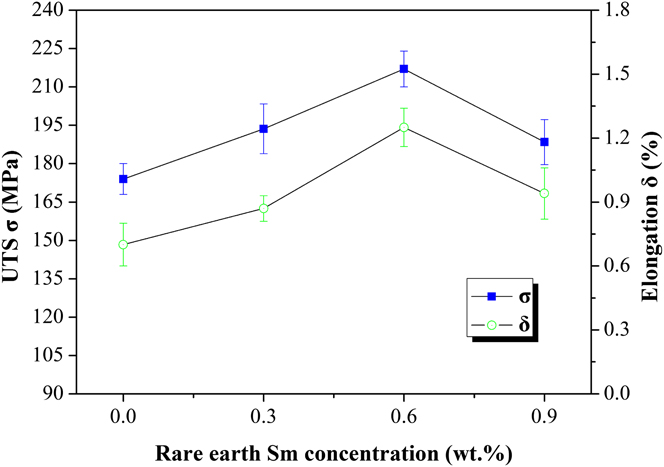
The tensile properties of Al–12Si alloys at RT are presented in Fig. 7. Comparing with the unmodified alloy, the tensile properties of Sm modified alloys are superior to that of the unmodified alloy. It is confirmed that mechanical properties of the Al–Si casting alloys are known to be largely dependent on the silicon characteristics (i.e., size, morphology, and distribution). Reference Suárez-Peña and Asensio-Lozano4,Reference Kobayashi27 Therefore, the addition of Sm has a great influence on the tensile properties of the as-cast alloys due to simultaneous refinement and modification of primary Si and eutectic Si [Figs. 3(b) and 3(c)]. Regarding alloy with 0.3 wt.% Sm, the grain size of primary Si is still large and the volume fraction only decreases slightly, but the aspect ratio and average area of eutectic silicon decrease significantly from 16.5, 82.5 to 5.6, 30.4, respectively, as shown in Fig. 7. It causes the elongation of the alloy to be almost equal to that of the unmodified alloy. But the tensile strength is increased by 11.4%. The alloy possesses the best ultimate tensile strength (217 MPa) and elongation (1.3%) with the addition of 0.6 wt.% Sm. A fine fibrous silicon structure and smooth interface of α-Al and eutectic mixture were formed [Fig. 3(c)]; meanwhile, the two parameters of eutectic silicon particles decrease significantly to the lowest [Fig. 4(b)]. The changes in morphology of eutectic silicon particles and the disappearance of detrimental primary silicon cuboids make the tensile strength and elongation of the Al–12Si alloy to increase respectively by 24.7 and 78.6% as compared with the unmodified alloy. When the content of Sm reached up to 0.9 wt.%, the tensile property and elongation declined slightly as compared with the 0.6 wt.% Sm addition alloy. This was partly resulted from the reappearance of detrimental primary silicon cuboids with sharp corners.
The tensile properties of Al–12Si alloys.

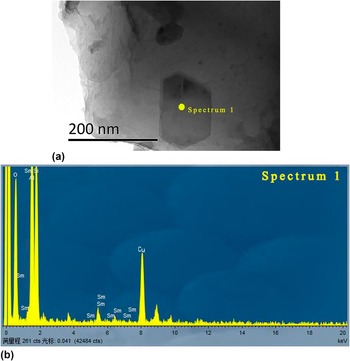
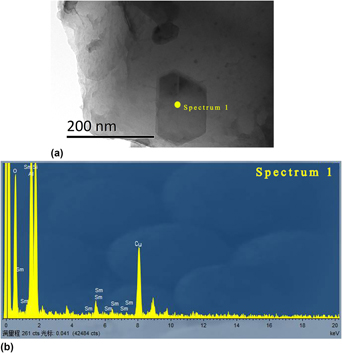
In addition, when rare earth (RE) element was added into melt, intermetallics of RE-rich which have higher melting point than the temperature of the liquid-phase line of the alloy compounds would form. Reference Tsai, Chou, Lee, Lin, Lin and Lim11,Reference Son, Lee, Kim, Yoshimi and Maruyama28 To investigate the morphology and chemical composition of the RE-rich intermetallics in Al–12Si alloys, TEM was used, and the results are shown in Fig. 8. Polygonal nanoparticles of 70–130 nm , as shown in Fig. 8(a), are clearly observed. EDS result [Fig. 8(b)] shows that the nanoparticles contain Al, O, Si, Cu, and Sm elements. The Cu peak is due to the use of Cu grid applied in TEM. The presence of polygonal nanosized intermetallic compounds might be another factor which results in the improvement of the tensile properties. Meanwhile, the reinforcing mechanism and the crystal structure of the nanosized intermetallic compounds in Al–12Si alloy are still unknown and need further research.
TEM-EDS analysis on the nano intermetallic compound of the 0.6 wt.% / ZL102 alloy: (a) TEM image of the nano intermetallic compound; (b) EDS image, in which the Cu peak is due to the use of Cu applied in transmission electron microscope.

IV. CONCLUSIONS
The modification of rare earth Sm which was added in Al–12Si alloy has been investigated in this study. The major observations are summarized in the following:
-
(1) The results of thermal analysis reveal that the addition of Sm in Al–12Si alloy causes a depression of eutectic temperature and an increase in latent heat.
-
(2) 0.3 wt.% Sm is capable of breaking down the primary α-A1 phase, giving rise to an increment in the number of dendrites. With proper addition of 0.6 wt.% Sm, the primary α-Al phases appear as a slightly dual dendritic-cellular nature and pine-tree structure.
-
(3) Simultaneous primary Si refinement and eutectic modification were achieved by Sm addition.
-
(4) The tensile properties of Al–12Si alloys have been strengthened by the addition of Sm due to the modification of silicon. And the ultimate tensile strength and elongation of the alloys modified with 0.6 wt.% Sm are increased respectively by 24.7 and 78.6% as compared with the matrix.
ACKNOWLEDGMENTS
This research is supported by National Natural Science Foundation of China (51364035, 51165032), Innovative Group of Science and Technology of College of Jiangxi Province (00008713), Jiangxi Province Education Commission Foundation (GJJ13203), Production and Teaching and Research Cooperation plan of Nanchang Non-party Experts and Doctor (2012-CYH-DW-XCL-002).