INTRODUCTION
Staging transmission events under controlled experimental conditions is an essential step towards understanding the ecology and epidemiology of parasites. Experimental infections have served to elucidate life cycles, to assess the suitability of various host species for particular parasite species, and to test the efficacy of drugs or vaccines against parasitic infection (see Fried and Graczyk, Reference Fried and Graczyk2000). They are also crucial to determine the developmental rate and lifespan of various parasite life stages. Although each experimental study is informative on its own, an analysis of their pooled results can provide new insights into both large-scale patterns in parasite biology, and the influence of experimental design decisions on the outcome of infection. For instance, a recent meta-analysis of 145 experiments on cercarial transmission in trematodes revealed that experimental procedures, such as the exposure method used and the time between infection and recovery of parasites, impacted significantly on infection success (Poulin, Reference Poulin2010). This analysis also found a significant dose-dependent effect on infection success: the higher the dose (number of infective stages, i.e. cercariae) used in an experiment, the smaller the proportion recovered from the host, though this effect was modulated by host body mass and taxonomic identity (Poulin, Reference Poulin2010). Interestingly, across all studies included in the meta-analysis, the cercarial dose chosen was strongly positively related with host body mass, so that the larger the target host, the more cercariae it was exposed to (Poulin, Reference Poulin2010). Clearly, decisions made by researchers in the design of infection experiments, though rarely justified in print, can affect the results of those experiments in ways that can bias their interpretations.
The present study is a sequel to that of Poulin (Reference Poulin2010), with the focus shifting to the next step in the trematode life cycle: transmission of metacercariae to definitive hosts. Trematodes all multiply asexually within their first intermediate host, usually a snail (Galaktionov and Dobrovolskij, Reference Galaktionov and Dobrovolskij2003); after that, the life cycle can follow different paths. In many trematode taxa, the cercarial stages produced in the snail leave to penetrate and encyst (as metacercariae) within a different second intermediate host. In taxa with abbreviated life cycles (Poulin and Cribb, Reference Poulin and Cribb2002), cercariae re-use the same snail as second intermediate host, and thus reach the metacercarial stage within the original snail host. Either way, in all these trematodes metacercariae accumulate within a second intermediate host until they are transmitted via predation to the vertebrate definitive host, in which they develop as adult worms. Alternatively, in other trematode taxa such as liver flukes (family Fasciolidae), the cercariae leave the snail to encyst as metacercariae on nearby vegetation, where they await accidental ingestion by grazing herbivores. Whether or not a second intermediate host is used, the metacercariae-to-definitive-host step in the life cycle of trematodes has been extensively studied in the laboratory. In nature, definitive hosts ingest metacercariae a few at a time over long periods (trickle infections), for instance acquiring them as small ‘packets’ each time they consume an infected intermediate host (Bush et al. Reference Bush, Heard and Overstreet1993). However, in experimental studies, a single large dose of metacercariae is the norm, presumably because it is logistically easier to implement than repeated small doses. The many studies using this simple design allow us to look for general effects of metacercarial dose and other experimental parameters on infection success.
First, we can ask what determines the choice of a metacercarial dose in an experiment. This is an important question, because in many host-parasite systems, the dose to which hosts are exposed can affect estimates of infection success, parasite virulence, or within-host interactions among parasites (Regoes et al. Reference Regoes, Hottinger, Sygnarski and Ebert2003; de Roode et al. Reference de Roode, Gold and Altizer2007; Ben-Ami et al. Reference Ben-Ami, Regoes and Ebert2008; Fellous and Koella, Reference Fellous and Koella2009). The dose, or range of doses, chosen should correspond to what a host can acquire during a single infection event in nature. For instance, in the case of trematodes using second intermediate hosts, the choice of experimental doses should be guided by the mean intensity of metacercarial infections in second intermediate hosts in the wild, since these represent the natural one-off doses that a definitive host can acquire in a single meal. In published studies, very little information is provided to justify the doses chosen. One possibility is that the magnitude of experimental doses covaries with the body size of the second intermediate host, since larger second intermediate hosts tend to harbour more metacercariae than small ones (Poulin, Reference Poulin2000). An alternative hypothesis is that the chosen metacercarial dose increases as a function of the body size of the definitive host, following arbitrary decisions made by researchers based on intuition. Larger animal species do indeed generally harbour a greater biomass of parasites (Poulin and George-Nascimento, Reference Poulin and George-Nascimento2007). Choosing a higher dose for a larger animal therefore seems logical, and this is certainly what people do with cercarial infections (Poulin, Reference Poulin2010). The shape of the interspecific relationship between metacercarial dose and definitive host body size can also be revealing. In practice, it should be described by a power function of the form D=aM b, where D is metacercarial dose, M is definitive host body mass, a is a normalization constant, and b is a scaling exponent. This power function can be converted into a straight line if we plot log-transformed D against log-transformed M, with the scaling exponent b becoming the slope of the linear equation (Harvey, Reference Harvey1982). If the slope b is equal to 1, then the metacercarial dose chosen scales in perfect proportion to host body mass. A quantitative examination of this relationship can therefore reveal the subconscious rules followed by researchers selecting experimental metacercarial doses.
Second, we can use analyses of the pooled results of experimental infections to identify what determines parasite success. On the one hand, infection success may depend on the number of metacercariae to which the definitive host is exposed, and on the characteristics of the host itself. Interactions between parasites after they reach the host gastrointestinal tract can result in dose-dependent reductions in infection success. These are often measurable within the range of doses used in a particular study (e.g. Kay et al. Reference Kay, Murrell, Hansen, Madsen, Trang, Hung and Dalsgaard2009), and can become clearer when a larger dataset is available. All else being equal, dose-dependence can be relaxed in larger definitive hosts, which offer more space and resources to incoming metacercariae, and it may also vary with the taxonomic identity of the host, since immune responses against parasites differ among animal taxa. On the other hand, some aspects of experimental design can also impact the estimated success of metacercariae. For instance, the time between infection and dissection of the definitive host to recover and count the successful parasites varies across studies. In studies where worms are recovered at different times post-infection, the proportion recovered is not constant over time, although it does not invariably decrease with time (Muñoz-Antoli et al. Reference Muñoz-Antoli, Sotillo, Monteagudo, Fried, Marcilla and Toledo2007; Kay et al. Reference Kay, Murrell, Hansen, Madsen, Trang, Hung and Dalsgaard2009; Platt, Reference Platt2009). Therefore, time between infection and worm recovery can have complex effects on estimates of infection success.
The goal of this study was to reveal general patterns in the infection success of trematode metacercariae derived from experimental studies. The specific objectives were (i) to determine whether the choice of infection doses in metacercarial experiments is directly related to either intensity of infections in second intermediate hosts, body size of second intermediate hosts, or body size of the definitive host; (ii) to evaluate the importance of dose-dependence in metacercarial transmission, by measuring the impact of the chosen infection dose and the body mass and taxonomic identity of the definitive host on metacercarial success; and (iii) to determine whether the time until dissection affects the estimates of metacercarial success. The results of the present analyses provide not only a basis for the design of future studies, but also insights into metacercarial epidemiology.
MATERIALS AND METHODS
Data collection
A search of the ISI Web of Science® in late July 2009 using the search terms ‘metacercar* and infect* and experiment*’ produced a list of 377 studies. All those available through the University of Otago's library system were examined. Data from these publications were included only if they involved experimental exposure of individual hosts to a single known dose of metacercariae under controlled conditions. In all cases, metacercariae were administered orally, either mixed with food, via gavage (i.e. through a stomach tube), or inside a gelatine capsule, although the exact method was not always specified. Studies in which either there was no replication (only 1 host individual per dose), the exact single metacercarial dose was not given, or individual hosts were exposed to repeated small doses (trickle infection), were all excluded. Some studies provided more than one entry in the data set, by either showing data for different combinations of host and parasite species, or by presenting data on the same host-parasite combination but from distinct experiments. When metacercariae of the same species were exposed to hosts of different species in the same experiment, and when one or more host species proved unsuitable for the parasite (because of unusually low infection success), data from those host species were excluded. Several studies measured infection success after hosts had been vaccinated or treated in some other way; in these cases, only data from control groups of untreated hosts were used. Finally, if experiments were repeated using different times for parasite recovery post-infection, only data from the time of highest recovery were used.
For each of the experiments included, the following information was recorded: (i) the species name and family of the trematode involved; (ii) the species name of the experimental definitive host and its taxonomic group, i.e. bird or mammal, or in one case, fish; (iii) the species name of the natural second intermediate host and its taxonomic group, i.e. snail, bivalve, platyhelminth, crustacean, insect, amphibian, fish or reptile, although for some families included here (Fasciolidae, Paramphistomidae, and Zygocotylidae) there is no second intermediate host; (iv) the average body mass of both the second intermediate and definitive hosts used, either given in the original study or obtained from other sources, taking into account any information provided on age or length of individuals used; (v) the metacercarial dose, i.e. number of metacercariae per individual host, or, when several doses were used in the same experiment, the intermediate or median dose between the minimum and maximum values used (see also below); (vi) the infection success, or the mean number of adult worms per individual host recovered at dissection and expressed as a percentage of the initial dose; and (vii) the time to dissection, measured as the number of days between infection and dissection (in the few studies where hosts were dissected at different times, the time of maximum infection success was used). Infection success, as defined above, represents not only the initial success of metacercariae at establishing inside the definitive host, but also their survivorship until dissection. Thus, this measure takes into account not only the proportion of metacercariae that fail to establish, but also the attrition over time among the initially successful ones.
In addition to the above variables, 2 additional variables were recorded. First, for the few studies that provided this information, the mean intensity of infection (number of parasites per infected host) in second intermediate hosts available in nature was noted. In almost all cases, these estimates came from a representative sample from one population of the main second intermediate host species, and thus they do not account for potential variability among localities or among the different animal species that can be used as second intermediate hosts by the same trematode species. This value is meant to represent the average one-off dose that a definitive host may acquire in nature, as part of one meal on an infected prey. In the case of the echinostome Echinoparyphium megacirrus, the second intermediate host is a small ectosymbiotic flatworm living on the carapace of freshwater crabs (Viozzi et al. Reference Viozzi, Flores and Rauque2005); since the avian definitive host does not eat these flatworms one by one, but instead eats an entire crab, the intensity of infection for this species was calculated as the mean number of metacercariae per flatworm multiplied by the average number of flatworms per crab, to represent the number of metacercariae actually ingested by a bird with a single meal.
Second, a specific measure of within-study dose-dependence was computed for the few studies where several doses were used in the same experiment. Data were recorded on the minimum and maximum metacercarial doses used (D min and D max, respectively), and on the mean number of parasites recovered at dissection from these initial doses (R min and R max, respectively). If infection success, or the proportion of parasites that establish, changes as a function of the dose, then the ratio D minR max/D maxR min (simply called dose-dependence below) should differ from 1. A ratio smaller than 1 would indicate that within-study infection success is smaller for higher doses, whereas a ratio greater than 1 would indicate that infection success increases at higher doses.
Prior to the analyses, it became apparent that 2 trematode families, Echinostomatidae and Fasciolidae, dominated the dataset. These 2 families differ in transmission mode: fasciolids have no second intermediate hosts, their cercariae encysting as metacercariae on vegetation, whereas echinostomes have the classical 3-host trematode life cycle. In addition, their numerical dominance can bias the analyses in many ways because of phylogenetic influences. Therefore, for all these reasons, the analyses that follow are performed separately for Echinostomatidae, Fasciolidae, and other trematodes.
Statistical analyses
Four continuous variables, i.e. intermediate host body mass, definitive host body mass, cercarial dose, and time to dissection, required logarithmic transformation to meet the assumptions of normality. For analyses, host taxonomic groups were also simplified. In the case of intermediate hosts, 3 categories were used: vertebrates (combining fish, amphibians and reptiles), molluscs, and ‘others’ (mostly arthropods). In the case of definitive hosts, the original groups using either birds or mammals were maintained, but the single trematode species (family Bucephalidae) using a fish definitive host was excluded from analyses in which host taxonomic group was used as an explanatory variable, because of insufficient data.
Generalized linear models (GLM) were used to analyse what factors determine the choice of the metacercarial dose used in an experiment, and what factors influenced both infection success and dose-dependence; all were carried out with the statistical software JMP 7.0. All models had a Poisson error structure and log link function, as these provided the best match to the data. After starting with a full model (see below), significance levels were based on the deviance explained by each factor, based on χ2 statistics, following backward stepwise elimination of non-significant (P>0·05) terms. Only the final models are presented in the results. All likely two-way interactions were initially included, but none were retained as significant.
In analyses of the choice of metacercarial dose, 4 explanatory variables were included in the initial GLMs: intermediate host body mass, intermediate host taxonomic group, definitive host body mass, and definitive host taxonomic group. For Fasciolidae, however, since there is no second intermediate host and all definitive hosts are mammals, the only explanatory variable that could be used was definitive host body mass. Following the GLMs, when a significant effect was found in 1 of the 3 datasets (Echinostomatidae, Fasciolidae, other trematodes), and in order to assess the scaling relationship between definitive host body mass and the chosen metacercarial dose in an experiment, the slope of the linear regression (ordinary least squares) between these 2 variables, both log-transformed, was also computed.
Additionally, the product-moment correlation coefficient between the mean intensity of infection in second intermediate hosts in nature and the metacercarial dose chosen for an experiment (both variables log-transformed), was computed across the few experiments for which these data were available. Mean intensity of infection could not be included as an explanatory variable in the above GLMs because it was only available for a handful of studies.
In analyses of the factors influencing either infection success or dose-dependence, 4 explanatory variables were included in the initial GLMs: definitive host body mass, definitive host taxonomic group, metacercarial dose, and time to dissection. For Fasciolidae, definitive host taxonomic group was not included (all definitive hosts of fasciolids are mammals) and there were only 3 explanatory variables in the initial GLM. In the case of dose dependence, since data were only available from a few experiments, the analysis was run across all trematodes and not separately for Echinostomatidae, Fasciolidae, and other trematodes.
RESULTS
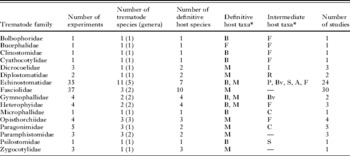
Data from a total of 106 metacercarial infection experiments were obtained from 83 studies; the full data set, including the list of original studies, is available as Supplementary Material (in online version only). These involved a total of 36 trematode species, representing 26 genera and 16 families (Table 1). Two families account for a disproportionate number of experiments: Echinostomatidae, with 35 experiments mostly on members of the genus Echinostoma, and Fasciolidae, with 37 experiments involving mainly the genus Fasciola (Table 1).
Summary of the taxonomic composition of the dataset on experimental metacercarial infections

* Host taxonomic groups: C, crustaceans; I, insects; P, platyhelminths; Bv, bivalves; S, snails; A, amphibians; F, fish; R, reptiles; B, birds; M, mammals (— denotes that there is no intermediate host).
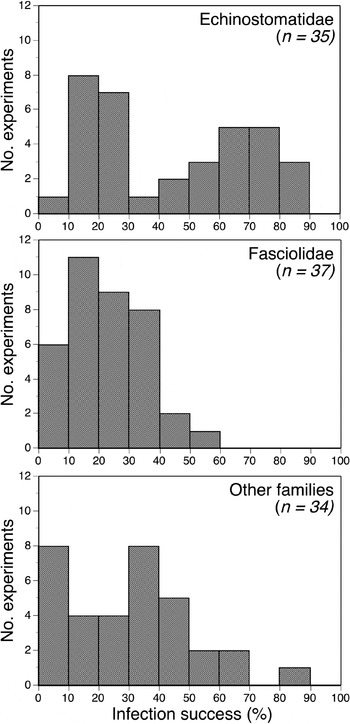
Values for infection success were highest for Echinostomatidae (mean±standard error, 43·1±4·5%) and lowest for Fasciolidae (22·4±2·0%), with other trematodes generally falling in between these extremes (30·7±3·5%). Values for members of Echinostomatidae fell into a cluster of high values and 1 of low values (Fig. 1), a pattern reflecting the type of definitive host used (see below). In addition to the biological differences between the 3 trematode groups highlighted in the Materials and Methods section, they also differed in several other respects in the experiments considered here. First, lower metacercarial doses were used in experiments with Echinostomatidae than with Fasciolidae or other trematodes (Table 2). Second, Echinostomatidae were used to infect much smaller definitive hosts than those fed with either Fasciolidae or other trematodes (Table 2); the former parasites were generally used to infect rodents or chicks, whereas fasciolids were used to infect mostly large mammals such as calves or sheep. Third, the natural second intermediate hosts of Echinostomatidae are generally smaller than those of other trematodes (Fasciolidae have no intermediate hosts). Finally, times from infection to host dissection were also longer for Fasciolidae than for Echinostomatidae or other trematodes (Table 2). These differences provide further justification for treating these 3 groups of trematodes separately.
Frequency distribution of infection success values in experiments involving metacercariae of Echinostomatidae, Fasciolidae, or other trematode families. Infection success is the mean number of worms per individual host recovered at dissection and expressed as a percentage of the initial dose.

Summary of the doses, host masses and times until dissection used in experimental metacercarial infections

Choice of metacercarial dose
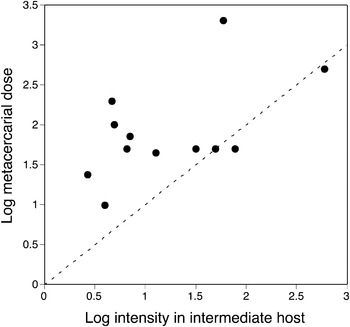
Across the few experiments for which data are available, there is a marginally positive correlation between the mean intensity of infection in second intermediate hosts in nature and the metacercarial dose chosen for an experiment (n=13, r=0·513, P=0·073). More importantly, most chosen doses clearly exceed the mean intensity of infection in intermediate hosts (Fig. 2). The average (±s.e.) ratio of chosen metacercarial dose to intensity of metacercariae in natural intermediate hosts is 10·3±3·8 (based on non-transformed values). In other words, the metacercarial dose typically given to an experimental definitive host represents approximately 10 times the number of metacercariae that an animal could acquire in a single meal, assuming that only 1 intermediate host is eaten at a time. This is a realistic assumption, since in almost all cases the intermediate hosts are either large crabs or fish, and a bird or mammal definitive host can only consume a relatively small number of such prey items per day. The exception is the trematode Dicrocoelium dendriticum (the highest point in Fig. 2, with the second highest dose-to-intensity ratio=33·4); its intermediate hosts are ants, and a grazing mammal could conceivably consume numerous infected ants in a short amount of time.
Relationship between the mean intensity of infection in second intermediate hosts in nature and the metacercarial dose chosen for an experiment, across 13 experiments involving 12 trematode species belonging to 7 families. The broken line indicates the line of equality, where the chosen dose matches exactly the intensity in the intermediate host.

In the GLMs, definitive host body mass influenced the metacercarial dose chosen in an experiment for Fasciolidae (χ2=6·33, d.f.=1, P=0·0119), with higher cercarial doses chosen for larger-bodied host species. However, none of the 4 explanatory variables considered (intermediate host body mass, intermediate host taxonomic group, definitive host body mass, and definitive host taxonomic group; all P>0·10) had an effect on the choice of metacercarial dose in experiments involving Echinostomatidae or other trematode families.
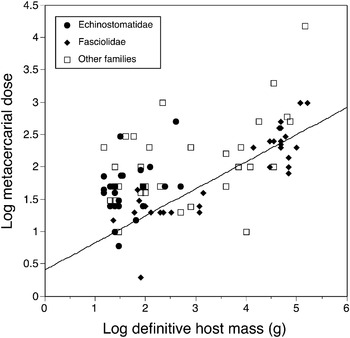
Regardless of the outcome of the GLMs, higher metacercarial doses are routinely chosen for larger definitive hosts, whatever the trematode family (Fig. 3). Across fasciolid species, the slope of the strong positive relationship (r 2=0·796; Fig. 3) between definitive host body mass and metacercarial dose chosen, based on ordinary least squares regression with log-transformed data, was 0·418 (95% confidence intervals=0·345 to 0·491). This relationship across fasciolids spanned 5 orders of magnitude in host body mass (Fig. 3). The observed slope value differs from the slope expected from direct proportionality with host body mass (slope=1), and is more suggestive of a simple general correlation with definitive host body mass.
Relationship between definitive host body mass and the metacercarial dose chosen for an experimental infection, for Echinostomatidae (n=35), Fasciolidae (n=37) and other trematodes (n=33); note that several points are stacked on top of each other for certain coordinates. The line represents the best-fit line from a linear regression for the Fasciolidae, the only group for which definitive host body mass proved significant in a GLM.

Infection success and dose dependence
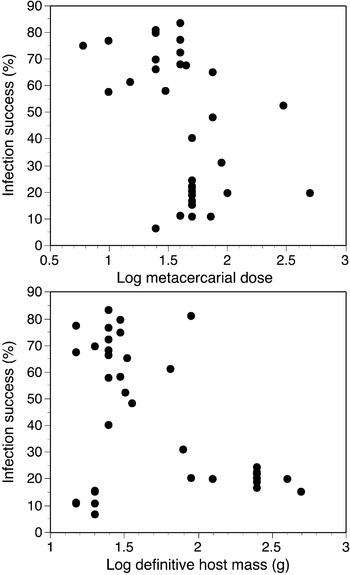
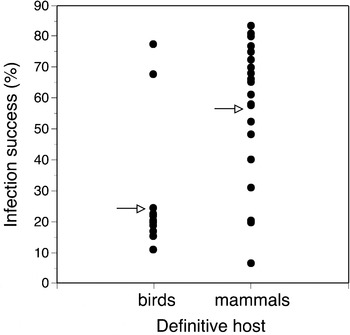
For both Echinostomatidae and Fasciolidae, time to dissection was not included in the final models explaining infection success. However, both initial metacercarial dose and definitive host body mass significantly affected infection success (Table 3). Overall, low values of infection success were more likely with increasing metacercarial doses, and/or when larger definitive hosts were used (see Fig. 4 for example with Echinostomatidae). In the case of Echinostomatidae, the taxonomic identity of the definitive host also significantly influenced infection success (Table 3). These trematodes achieved consistently higher infection success in mammals than in avian definitive hosts (Fig. 5). For trematode species belonging to families other than Echinostomatidae or Fasciolidae, none of the explanatory variables considered accounted for the variation in infection success observed.
Relationship between both (top) the metacercarial dose chosen for an experiment and (bottom) the body mass of the definitive host, and infection success, i.e. the mean percentage of worms recovered per individual host. Data include only species within the Echinostomatidae (n=35).

Infection success of Echinostomatidae when metacercariae are ingested by either avian (n=15) or mammalian (n=20) definitive hosts under experimental conditions. Arrows indicate the mean infection success for each host taxon.

Results of generalized linear models of the factors influencing infection success in experimental metacercarial infections
(Only the final models are shown, following backward elimination of non-significant factors. The χ2 tests assess the significance of the deviance explained by each factor.)

Estimates of within-study dose dependence were only available from 14 experiments, which limited the power of the analysis of factors influencing dose dependence in metacercarial infections. In the GLM across all 14 experiments, none of the explanatory variables included accounted for the variation in dose dependence observed. Therefore, since the ‘median’ dose did not influence within-study dose dependence, whether an experiment is performed using doses in the range 100–500 metacercariae per host as opposed to 10–50 does not mean that the effect of dose becomes less evident. Dose-dependence values (i.e. the ratio D minR max/D maxR min, see Materials and Methods section) varied widely, from 0·25 to 1·77, but they averaged (± standard error) 0·92±0·13; this is close to 1, suggesting that, within a study, infection success does not differ consistently between the lowest and highest doses used.
DISCUSSION
Experimental infections of animals with trematode metacercariae have provided vital information on previously unknown life cycles (Viozzi et al. Reference Viozzi, Flores and Rauque2005; de Nunez, Reference de Nunez2007), host-parasite biochemical and immune interactions (Toledo et al. Reference Toledo, Espert, Muñoz-Antoli, Marcilla, Fried and Esteban2005; Alcala-Canto et al. Reference Alcala-Canto, Ibarra-Velarde, Sumano-Lopez, Gracia-Mora and Alberti-Navarro2007; Raadsma et al. Reference Raadsma, Kingsford, Suharyanta, Spithill and Piedrafita2007), or the efficacy of vaccines and drugs against infection (Gonzalez-Lanza et al. Reference Gonzalez-Lanza, Manga-Gonzalez and Revilla-Nuin2006; Reyes et al. Reference Reyes, Ibarra, Vera, Canto, Hernandez, Hernandez, Castillo and Villa2008). However, the results of metacercarial infections are not independent of choices made by researchers during the design of the experiment. These include how many metacercariae to use, and how long to wait until dissection and recovery of the successful parasites. Here, I have focused both on the choices made by researchers and the general determinants of metacercarial infection success, and my analyses have yielded 4 general patterns from a compilation of available studies: (i) metacercarial doses given to experimental definitive hosts are typically much larger than what can be acquired from a single intermediate host in nature; (ii) larger experimental definitive hosts are usually given larger metacercarial doses; (iii) infection success by metacercariae is generally negatively related with the initial dose; and (iv) infection success is also higher in smaller-bodied definitive hosts, and, for Echinostomatidae, higher in mammal than in bird definitive hosts.
Intuitively, one would expect that a larger host can tolerate a higher dose or biomass of parasites (Poulin and George-Nascimento, Reference Poulin and George-Nascimento2007); however, if experimental infections are to provide useful insights into host-parasite interactions, the choice of dose should be based on what the animals actually experience in nature, and not on what they appear capable of enduring. This should mean repeated (trickle) infections with metacercarial doses corresponding to the mean intensity of infection observed in naturally infected second intermediate hosts. In reality, too few experiments using trickle infections are available for analysis; the vast majority of studies employ a single dose that, as demonstrated here, is typically about 10 times higher than the average intensity seen in intermediate hosts. Across all experiments included in the present analyses, fewer than 10% came with an attempt to justify the metacercarial dose chosen. Across all studies, the body mass of the definitive host appeared to match the chosen dose. In the Fasciolidae, where this relationship was significant, definitive host body mass explained about 80% of the variability in metacercarial dose, making it a very good predictor of what dose researchers are likely to choose. The exact same pattern emerged from an analysis of cercarial infections (Poulin, Reference Poulin2010), showing that dose selection is influenced by the size of the target host at all stages of the trematode life cycle. The scaling coefficient (0·418) between metacercarial dose and host body mass among fasciolids is much lower than what would be expected if the dose was chosen to be exactly proportional to definitive host mass. This lack of proportionality suggests that researchers just use higher doses for larger animals without following any explicit or rigorous quantitative rule. The influence of host body mass may also impact other aspects of the design of experiments involving metacercarial infection; indeed, across all available studies, definitive host body mass correlated significantly and positively with the time between infection and dissection (both log-transformed: r=0·601, n=106, P=0·0001). Subjective decisions roughly based on the size of the model animal can thus influence experimental design in many ways.
Whatever the rationale underlying its choice, the metacercarial dose is particularly crucial, since the other major finding of this study is that across all experiments, infection success is negatively dose dependent: proportionally fewer metacercariae are successful at infecting the definitive host as the dose is increased. This conclusion comes from the significant effect of metacercarial dose in the GLMs on infection success across studies on both Echinostomatidae and Fasciolidae. In the separate analysis of within-study dose dependence, however, for the few studies that used a range of infection doses across which infection success can sometimes vary (e.g., Kay et al. Reference Kay, Murrell, Hansen, Madsen, Trang, Hung and Dalsgaard2009), there was no consistent evidence of either positive or negative dose dependence. The discrepancy may be explained by the fact that within-study dose variation is much lower than that across studies, limiting its potential to reveal dose-dependent effects. These effects, clearly apparent in the GLMs across studies on Echinostomatidae and Fasciolidae, may result from interference competition among worms following excystment as they attempt to establish within the definitive host, or from post-infection mortality that could result from competition for resources such as space or nutrients. The latter was probably not a factor in the present analyses: although it can be important (Muñoz-Antoli et al. Reference Muñoz-Antoli, Sotillo, Monteagudo, Fried, Marcilla and Toledo2007; Kay et al. Reference Kay, Murrell, Hansen, Madsen, Trang, Hung and Dalsgaard2009; Platt, Reference Platt2009), here the time to dissection did not influence infection success in the GLMs, suggesting that the time-frame used in the experiments included here was generally too short to allow substantial mortality to occur post-infection. In trematodes other than Echinostomatidae and Fasciolidae, there was no detectable effect of metacercarial dose on infection success; one possibility is that the mixtures of trematode and host taxa involved masked any underlying pattern. Among Echinostomatidae and Fasciolidae, although it was statistically significant, the dose-dependent effect observed was not particularly strong (see scatter in Fig. 4); therefore, clearly other factors can influence metacercarial infection success.
Two of these factors appear to correspond to properties of the definitive host. First, metacercarial infection success generally decreased as definitive host body mass increased in both Echinostomatidae and Fasciolidae. This seems counter-intuitive, as larger hosts should provide more space and other resources to parasites, and thus alleviate any competitive effects. However, among the range of definitive host taxa included in the experiments compiled for the present analyses, body mass is not independent of other properties that may affect worm establishment and survival. For instance, in the experiments involving Fasciolidae, the definitive hosts used were either rodents (25–325 g), rabbits (1200–1400 g), or large herbivores such as goats, sheep and bovids (14 000–165 000 g). The diet of rodents kept in cages often consists of artificial pellets, whereas that of sheep or cattle kept in experimental paddocks consists of fresh vegetation. It is possible that the coarseness of the food ingested affects worm establishment success and survival, and that although the two are associated, it is in fact food type that matters, and not host body mass.
Second, in the case of Echinostomatidae, the taxonomic identity of the definitive host had a clear effect on infection success, with metacercariae generally achieving lower success in birds than in mammals. Both birds and mammals have efficient immune systems, and there is no obvious immunological explanation for this difference. Perhaps the reason for this difference is that many experiments with mammalian definitive hosts involved well-studied echinostome model species (i.e. Echinostoma caproni, E. friedi, E. trivolvis) for which experimental infection methods have been refined to a point where high success rates are guaranteed. Further research will be needed to confirm and explain the uneven performance of Echinostomatidae in different types of definitive hosts.
In addition to the biological factors discussed above, methodological issues could also impact estimated infection success. Metacercariae are typically force-fed to their definitive host using either a tube inserted through the mouth (gavage), a gelatine capsule, or mixed with food. Some studies do not specify the infection method; among those that do, a preliminary analysis indicated that there was no difference in metacercarial infection success between the 3 infection methods listed above.
In conclusion, the present meta-analysis of published studies of experimental trematode infections has highlighted some general patterns. First, metacercarial infection success shows weak but significant dose dependence, although both the taxonomic group of the definitive host (for Echinostomatidae) and its body mass can also modulate infection success. Second, the metacercarial doses used in most experiments are much larger than those to which definitive hosts are normally exposed in nature, based on intensity of infection in intermediate hosts, and appear to reflect the researchers' intuition regarding what the definitive host can tolerate. Third, the overall experimental design of published studies is generally poorly justified despite its potentially strong influence on the estimated success of metacercarial infection. These findings, like those of Poulin (Reference Poulin2010) for cercarial infections, emphasize the importance of carefully choosing parameter values for the experimental measurement of biological processes related to parasite transmission.
ACKNOWLEDGEMENTS
I am grateful to Dave Kelly, Tommy Leung, and David Thieltges for feedback on an earlier version.