In recent years, laparoscopic techniques have been introduced for various kinds of surgery, leading to increased surgical costs due to longer operating times and increased use of disposable instrument. However, clinical studies show evidence of reduced postoperative pain (1;8) and that recovery time tends to be shorter than for open surgery. Experience gained from procedures, such as cholecystectomy, hernia repair, and fundoplication show that, where laparoscopic techniques are used instead of open surgery, length of hospital stay (LHS) and/or sick leave is reduced (1;8;9;11).
Laparoscopic resection (LR) compared with open resection (OR) in colon cancer is currently being documented in several major clinical studies, of which one is COLOR (Colon Cancer Laparoscopic or Open Resection). The objective is to evaluate long-term clinical effects on recurrence and survival.
Results from a small study have shown an improved 3-year cancer-related survival in the LR group. With regard to the LHS, it was 2.7 days shorter (p=.005) in the LR group (10). Similarly, Weeks and colleagues (15) demonstrated a significantly shorter LHS, 0.8 days, in a study where the short-term quality-of-life after LR versus OR for colon cancer was compared. The quality of life was superior in the LR group, 2 weeks postoperatively but the difference had vanished 2 months after the operation.
A prospective health economic substudy to COLOR has been completed recently, referred to below to as HE-COLOR I (6). It was performed in the Swedish subset of patients, and the follow-up time was 12 weeks. Two hundred ten patients were included, whereas the number of patients in the international clinical trial was 1,108. No statistically significant difference in the societal cost between the laparoscopic colon resection (LR) group and the open colon resection (OR) group (€11,660 and €9,814, respectively, p=.104) were shown, whereas the costs to the health care system were significantly higher in the LR group (LR group, €9 479; OR group, €7 235; p=.018). Notably, the LHS was similar in both groups but the estimate for costs due to sick leave was lower in the LR group, although not significantly different. Results from the international clinical study showed results different from those in HE-COLOR I for important variables (14). Therefore, questions have arisen if the design of HE-COLOR I has influenced the result, and in particular, (i) if some variables could have been chosen and/or measured differently and (ii) if the number of observations was large enough.
In 2003, the COLOR II trial started, a multinational study with a similar design to COLOR but with a different indication. The patients are randomized to open or laparoscopic surgery in the treatment of rectal cancer and the primary end point is loco-regional recurrence rate, 3 years' postoperatively. The follow-up will continue for 7 years, and the overall survival and survival free of cancer recurrence are secondary end points. The number of Swedish patients in COLOR II is expected to be up to 300, and the number of patients in the entire COLOR II study 1,275.
As the study was to start, the question came up whether an economic evaluation should be performed based on the study. No funds were available for a separate and complete collection of data on resource consumption, but it was possible to add one or two questions into the clinical case record forms (CRFs). A preliminary review of the clinical trial protocol and the CRFs indicated that some of the information, collected for the purpose of the clinical study, could be used for an economic evaluation. By using the experiences gained in HE-COLOR I, we could improve the method for identifying and measuring resource use items and also use data from the global study population. However, this approach raised a new set of issues related to the aggregation of resource-use data from different countries. The objective of this study is to describe the principles for the design of the economic evaluation of COLOR II. The focus will be on the Swedish analysis, but an economic evaluation, in principle, can be performed from the perspective of any other country.
EVIDENCE FROM HE-COLOR I
HE-COLOR I was performed in the Swedish subset of patients in parallel to the clinical study (6). Detailed information on resource uses for LR and OR was collected prospectively, and unit costs from one of the centers in Sweden were applied.
The result showed significantly higher costs to the health care system for laparoscopic surgery than for open surgery. As expected, the cost of the initial operation was higher in the LR group. The hypothesis was that the higher operation costs for LR would be compensated for by a shorter recovery, leading to shorter hospital stay and less consumption postoperatively of other health care resources, but this was not demonstrated in the study. Surprisingly, the LHS was the same in both groups: 9.0 days (95% confidence interval [CI], 8.0–9.9) in the LR group and 9.1 days (95% CI, 8.2–10.0) in the OR group.
A contributing factor to the relatively high costs in the laparoscopic group, apart from the initial operation, was that there were numerically more complications and reoperations in the laparoscopic group. The variable LHS may have been confounded by several factors, such as the incentive of the ward personnel to discharge patients early/late or local conventions of care, thus not fully taking advantage of the potential benefits of a new treatment. In hindsight, the resource unit reflecting the need for hospital stay may not have been identified and measured optimally.
Patients in COLOR, the international clinical study, are still being followed up, but results from the day of operation until 12 weeks postoperatively are available (14). Some of the variables in the CRFs of the clinical study indicate actual or potential resource utilization, and these data can be used to validate the findings in HE-COLOR I. When the results from all patients in COLOR were considered, the mean LHS was 1.1 days shorter in the LR group (p<.0001). The mean difference in number of days until 1,000 ml of fluid was drunk and to the passage of the first stool was also in favor of LR, 0.9 and 1.0 days, respectively (p<.0001). These findings support the notion that there could be a potential for shortening the hospital stay for patients undergoing LR.
The international COLOR study also revealed that complications were much the same in both groups, although there was a tendency to more complications in the LR group among the Swedish patients. Consistent results, although without significant differences between the groups, were seen in the global patient group and in HE-COLOR I regarding the number of transfusions (lower in LR group) and the number of reoperations (higher in LR group).
A limited number of expensive resource items and a few clinical events had a substantial impact on the results in HE-COLOR I. A comparison of HE-COLOR I and the global COLOR shows that results differed for important variables, indicating that the Swedish subset of patients was too small to validly answer the research question.
Methodological Aspects on Resource-Use Data
Relevant resource items to include are those related to the interventions and, thus, likely to differ between treatment alternatives. This statement means that the use of other resources can be disregarded, as they should accrue similarly in both groups. In fact, if resource use is truly unrelated, differences between the study groups may only occur by chance: therefore, they may lead to increased variance and greater difficulties to detect differences (2;7). Resource items, likely to have a major influence on the result (below called key cost-driving events or key cost-driving variables) should be identified, as efforts should be directed toward an accurate and precise measure of those.
Resource consumption can be measured with various levels of precision. Micro-costing means that all separate resource items consumed are identified, measured, and translated to monetary units in great detail on a patient-specific basis. This method was applied in HE-COLOR I (6). Gross costing is when the consumption of single resources is aggregated to some meaningful resource units to which a unit cost is then attached. This method is appropriate for use when resource items involve predictable combinations and sequences of resource use. Thus, measurements of detailed resource consumption from each individual patient are not necessary.
Gross costing requires some prior understanding of the treatments and procedures associated with the interventions, so that the key cost-driving events/variables can be identified. Key cost-driving events are usually events that have a high unit cost or a small unit cost and high frequency (2;7).
There are various methods of performing an economic evaluation for a single country using data from a multinational clinical study (3;5;13). One option is a country-specific evaluation where the resource use, the unit costs, and the effectiveness all relate to a subset from a particular country (fully split with one-country costing). HE-COLOR I is an example of this approach, although only resource use and unit costs were taken into consideration and not effectiveness, as the study was a cost-minimization analysis based on an assumption of equal effectiveness after 12 weeks of follow-up. The advantage of “fully split with one-country costing” is that the patient-level relationship is retained for resource use as well as clinical outcome as both variables are measured on the same group of patients. Hence stochastic analytical techniques can be used to assess the uncertainty around point estimates. Moreover, the assignment of unit costs is simplified as the unit costs are derived from the same country as the resource utilization is measured. The drawback is the loss of statistical power due to the limited number of observations. In reality, this country-specific approach is in most cases only applied for resource use and unit costs because the raison d'etre for multinational clinical studies is that the sample sizes for individual countries are generally not sufficient to detect significant differences in the primary clinical variable between study arms.
An alternative approach is to apply the unit cost from one country to resource use of the patients from all countries in the study (“fully pooled with one-country costing”). The disadvantage is that relationships between resource use and unit cost cannot be captured. This means that, in countries where unit costs are lower than in the reference country, the costs will be overestimated, and the opposite applies to countries with relatively higher unit costs. The absolute cost difference may also vary depending on whether the reference country is a high-cost country (e.g., the United States) or a low-cost country (e.g., Portugal). Advantages with this method are that the patient-level relationship between costs and effects is maintained and that the statistical power is maximized as data from all patients are used for costs as well as effects.
In biomedical science, it is accepted that the effect in multinational studies can be pooled, as the biological effect of a drug should generally not differ between countries. On the contrary, the default assumption on economic data is that it cannot be pooled due to a complex interplay of epidemiological, biological, and sociological factors as well as preferences of decision makers (4;16). Some of these aspects also apply to the clinical part of a study, but the concern then relates to the representativeness of clinical effects across countries, whereas in the economic evaluation, it is the representativeness of the economic impact of the intervention that matters (12).
In designing an economic evaluation, it is important to assess whether each resource item, relevant for the research question (i) will/will not be subject to random variation at patient level, (ii) will/will not be suitable for being measured at a detailed patient level, (iii) may/may not be influenced by factors that may confound the result, (iv) will/will not be suitable as a resource variable in the study, (v) can/cannot be measured in the study and (vi) is/is not likely to be influenced by differences in practice patterns across centers/countries.
Designing the Collection of Data on Resource Use in HE-COLOR II
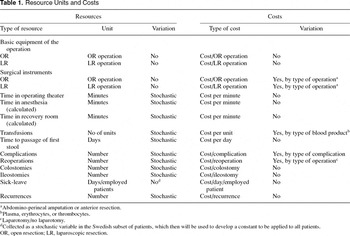
Surgical treatment for rectal cancer is a resource-consuming health care intervention. However, the primary surgical treatment aiming to cure is standardized; thus, several costly resources and events can be identified in advance. Experiences gained in HE-COLOR I demonstrated that basic costs for the operation were fixed, based on standard equipment and instrumentation used for the respective surgical techniques. These costs included capital costs and costs for sterilization of reusable instruments for laparoscopic and open procedures, respectively, as well as the capital costs of laparoscopic staples and the laparoscope. These costs, therefore, can be added as constants, one for each surgical technique (Table 1).

Similarly, HE-COLOR I also showed that variation in instrument use was mainly related to whether the surgeon systematically used disposable instruments in the laparoscopic procedures. Hence, the laborious collection of data on instrument use can be avoided, particularly as the use of instruments for rectal cancer surgery is even more standardized than for resections due to colon cancer. This variable, therefore, will be handled as an aggregate resource unit for which a standardized cost estimate is applied.
In HE-COLOR I, patients undergoing LR spent a longer time (33 minutes) in the operating theater. As the cost per minute was fairly high, this factor added €265 (14%) to the total mean difference in cost. The difference in time under anesthesia was somewhat larger (48 minutes), but as the cost per minute was only approximately half of that for the operating theater, it added only €148 (8%) to the total mean difference in costs. The OR group spent 121 minutes more in the recovery room, but the difference in costs was relatively low (€79) and had little impact on the result. The same pattern can be expected in HE-COLOR II. Time in the operating theater will be recorded in the clinical part of the study, but not time under anesthesia and time in recovery room. These variables, however, are expected to be correlated to the operation performed, and they will be estimated from the observed time in the operating theater in COLOR II and data from HE-COLOR I.
In HE-COLOR I, there was a tendency toward less need for transfusions in the LR group, but it had very little influence on the result. However, in HE-COLOR II, it is expected to be a somewhat more important cost.
Hospital stay is expected to be one of the key cost-driving resource units that may differ between the groups. However, the LHS may be influenced by factors other than the patients' recovery from the operation, as discussed above. The primary variable relating to the need of hospital stay, therefore, will be a surrogate end point, namely the number of days until passage of the first stool. The actual number of days spent in the hospital will be used in a secondary analysis.
Reoperations may occur after both surgical techniques, and they will be performed by an open technique. Once the patient undergoes a reoperation for a specific cause, the number and type of resources consumed principally will be the same, irrespective of whether the patient initially underwent an LR or OR. Hence, various types of reoperations will be treated as aggregated variables similar for both groups. The same principle will be followed for complications.
Some of the patients are likely to require an ileostomy or colostomy. The frequency may vary between the groups, and this aspect, therefore, will be followed at the patient level in the study. The detailed resource use, however, will be similar for both groups, as the management of the stomies will be the same, irrespective of initial operational technique. Ileostomies and colostomies will be treated as aggregate variables.
Resource use for the aggregate variables will be obtained from the Cost-per-patient system in one of the participating hospitals.
HE-COLOR I indicated that differences related to sick leave might be a key cost-driver. This possibility may also be the case when comparing LR versus OR in rectal surgery. Data on sick leave, therefore, will be retrieved for Swedish patients by means of the Swedish Social Insurance Office, and a mean sick-leave cost per employed patient value will be calculated for the LR and OR group, respectively. This cost will then be applied to all patients in the study. An advantage with this method is that it eliminates the problem with different employment levels in the respective group, which may occur because the study is not stratified for this variable.
Beyond the follow-up period of 12 months, any difference in resource use cannot be expected to be related to whether the patient was initially subject to LR or OR, apart from such resource use that is directly related to the clinical end points. Hence, only resource use based on recurrence will be taken into consideration, which is both a clinical end point and a key cost-driving event. The estimate will be based on gross costing.
The plan is to use information on clinical effectiveness and resource use from the global COLOR II patient population. The exceptions are basic equipment in the operating theater and instrument use that will be added as constants and time under anesthesia and time in recovery room, which will be assigned estimated values as discussed above. Furthermore, sick-leave will be handled as a stochastic variable when collecting data from the Swedish subset of patients, but it will be treated as a constant in the analysis of the study. Thus, this approach is a hybrid between fully pooled with one-country costing and fully split with one-country costing, which will still maintain the patient-level relationship between cost and effect. The strengths with this approach are that the variables for which random variation is likely to be large will be gathered from the largest possible number of patients (time in operating theater, transfusions, time to first stool, complications, reoperations, stomies, and recurrences), whereas instrument use that may be subject to management decisions is standardized and, thus, not left open to chance findings. The randomness for several of the random variables will be restricted to their frequency, and any difference in resource use once the demand for these resource variables has arisen will not be incorporated, that is, they will always cost the same. This finding applies to complications, reoperations, stomies, and recurrences; hence, it can be argued that their frequency can be expected to be influenced more by surgical technique than by country of origin; thus, a pooling of data from all countries can be justified. Time in the operating theater, transfusions, and time to first stool will be measured on a detailed level. The first variable is likely to be influenced by the experience and skill of the surgeon, which may differ between individual surgeons, centers, and countries. However, the variation between countries of this variable is difficult to foresee. The choice of a clinical manifestation (days to first stool) as a surrogate end point for number of days in hospital will reduce the impact of country and center-specific factors and generally improve the validity of the variable.
As some of the clinical events are at the same time key cost-driving resource items, a strong link between the clinical outcome and the costs can be claimed, thereby reducing the impact of differences in health care systems and, thus, facilitating the use of data from several countries.
CONCLUDING REMARKS
Surgery is in a transition period where new techniques are being introduced, many of which add extra costs to the health-care system. To use scarce health care resources wisely, the cost-effectiveness of new interventions should ideally be assessed routinely. However, economic evaluations of surgical interventions are still rare. There is a widespread mindset that economic evaluations may only be performed if extensive and prospective data collection is undertaken. This statement might be true in several situations, but we have identified a situation where the necessary data are derived from the CRFs in a clinical multi-country study and coupled with information gathered in a previous study.
In the operationalization of HE-COLOR II an attempt was made to reduce the uncertainty in the cost variables by considering (i) what aspects drive each variable, (ii) what resource use is related to the intervention and what is unrelated, and (iii) how data from different countries will affect the variable.
The overall objective of this process was to refine the data collection to only include data related to the interventions under study and to reduce the impact of the health care systems in different countries. The main features relating to the identification and measurement of resource-use data were as follows:
Instrument Use as a Constant Variable. One experience learned from HE-COLOR I was that the cost of instruments was related to whether disposable instruments for laparoscopy were used systematically or not. In HE-COLOR II, sensitivity analyses will be based on different routines for use of disposable/nondisposable instruments. The use of disposable or nondisposable instruments is a management decision; therefore, it is not suitable as a stochastic variable in the analysis.
Aggregate Key Cost-Driving Resource Items Were Developed that Corresponded to Clinical Events. The link to clinical events facilitates pooling of data from different countries.
The Same Unit Cost for Each Aggregated Key Cost-Driving Resource Item. The aggregated resource unit are such clinical events (reoperations, complications, stomies, and recurrences) that could give rise to high variation between patients, for example, those of greater age. In addition, the incidence of these events is low, and a combination of a low frequency and a high unit cost for a variable means risk of a skewed result. By restricting the data collection to the frequency, and thus disregarding detailed resource use, these variables are only allowed to vary in one dimension, that is, the incidence of these events. Subsequently, the problem with an unduly skewed result is attenuated.
Surrogate Variable Instead of the Obvious Variable. The variable LHS may potentially be diluted by several factors relating to, for example, incentives and administrative conventions. This dilution may be a particular threat when data are to be gathered in several countries and a surrogate variable, namely time to first stool, was chosen as a clinical manifestation related to the surgical technique and representing the potential for hospital discharge.
In conclusion, when designing the collection of resource-use data in HE-COLOR II, the characteristics and relative importance of each resource-use unit was carefully considered. Hence, some of the uncertainty foreseen at the design stage could be eliminated, and the impact of a few confounding factors could also be avoided; thus, the problem with insufficient power for the economic question could be attenuated.
CONTACT INFORMATION
Ingela Björholt, PhD (inb@nheresearch.se), Department of Surgery Göteborg, Sweden, Institute of Surgical Sciences, Sahlgrenska University Hospital, Bruna stråket 11, 413 45 Göteborg, Sweden
Martin Janson, MD (martin.janson@karolinska.se), PhD student, Department of Surgery, CLINTEC, Karolinska Institutet, K 53, Karolinska University Hospital Huddinge, 14186 Stockholm, Sweden
Bengt Jönsson, PhD (Hebj@hhs.se), Professor, Department of Economics, Stockholm School of Economics, Sveavägen 65, 113 83 Stockholm, Sweden
Eva Haglind, MD, PhD (eva.haglind@sahlgrenska.se), Professor, Department of Surgery Göteborg, Sweden, Institute of Surgical Sciences; Senior Medical Advisor, Sahlgrenska University Hospital, Bruna stråket 11, 413 45 Göteborg, Sweden
This work was supported by grants from the Swedish Cancer Foundation (grant 4287-B01-03XCC), Assar Gabrielsson's Foundation for Clinical Research, Jubileumskliniken Research Foundation, Sahlgrenska University Hospital, and the Swedish Society of Medicine.