Near midnight on Monday, July 28, on 43rd Street in Chicago's “Black Belt,” L. C. Washington stabbed Clarence Metz, mortally wounding him. Washington, a recently discharged lieutenant in the U.S. Army, two other veterans, and three women had gone out for the evening, even though the call by Chicago's black leaders for all blacks to stay off the streets received wide publicity that morning and afternoon. A streetcar operators' strike had forced the group to walk home when they were attacked by a crowd of white men including Metz, who shouted, “Let's get the niggers.” Telling phrases in the jury's findings situated Washington's testimony and actions firmly within a political discourse of respectability. Historians have long argued that African Americans who engaged in armed defense in the 1919 race riots were rejecting a well-established politics of respectability, which sought to undermine white supremacy by adherence to Victorian norms of restraint, self-denial, and sober morality. However, in discharging Washington from criminal responsibility, the coroner's jury closely investigated the event for markers of proper respectable manhood. They found it important to explain that the group of blacks' presence in the riot zone late at night was unintentional and that they had not provoked the attack. Washington and his male friends had prepared themselves for trouble that evening by bringing weapons on their excursion; but the jury determined that the act of armed self-defense was less important than the fact that, immediately before the incident, Washington and his friends “were acting in an orderly and inoffensive manner.”Footnote 2
After Reconstruction, African American political life was dominated by an accommodationist politics developed in response to segregation, disfranchisement, and lynching—the “nadir” of American race relations. Especially since Evelyn Brooks Higginbotham's 1993 book, Righteous Discontent: The Women's Movement in the Black Baptist Church, 1880–1920, scholars have argued that an African American “politics of respectability” profoundly shaped not only antiracist politics, but also black culture and society in the late nineteenth century and early twentieth century.Footnote 3 African American leaders employed a discourse of respectability to challenge social Darwinist racial ideology. In response to this and other racist outlooks that envisioned African Americans as lazy, licentious, and ignorant, black leaders argued all African Americans could and should counteract these stereotypes by embodying the virtues of hard work, good manners and hygiene, education, and circumscribed sexuality. Respectable black leaders presented themselves as exemplars of these virtues to whites, whom they assumed could be convinced to abandon their prejudice. They also directed their self-presentations to African Americans and criticized, often bitterly, blacks who failed to follow their prescriptions.Footnote 4
The masses of African Americans defending themselves from white assaults in the World War I era have been widely seen as a major challenge to this politics of respectability. Accounts of the Harlem Renaissance and New Negro movement typically identify black armed defense as a critical precursor to a new era of antiracist activism, or as embodying a potential for social change on which these movements failed to capitalize. The classic study of the 1919 riot, William M. Tuttle Jr.'s Race Riot: Chicago in the Red Summer of 1919, argued that a new spirit of militancy among African Americans shaped blacks' actions during the days-long violence and destruction.Footnote 5 Studies of black migration, as well as the emergence of the Harlem Renaissance and New Negro movement, typically cite the militance of the black response to antiblack violence as an important signal of this shift.Footnote 6 Kevin K. Gaines, for example, has argued that the intensity and scope of black armed self-defense signaled the end of the relevance of respectable politics.Footnote 7
In assessing the historical significance of African Americans' actions in the World War I-era riots, scholars have relied on theories of collective violence that posit direct connections between the form and meaning of violent events and the social tensions or strains that supposedly create the necessary conditions for riots. Tuttle's Race Riot challenged the argument, prevalent in 1919, that rioters were merely “hoodlums” taking advantage of the chaos of the riot to gratify their criminal impulses. Tuttle argued instead that the sources of riot violence were not to be found in the innate criminality of social deviants, or in “high-level policy,” but in the “gut level animosities between black and white people who were generally inarticulate.”Footnote 8 These animosities were the result of strains on existing systems of racial interaction in areas such as housing, work, public space, and policing, strains caused by the massive increase of the black population in a city that segregated black spaces and exploited black bodies. The view that race riots were caused by social strain permitted imputation of rational meaning to the violence of the riot. Historians and sociologists studying riots argued that collective violence provided a window into the consciousness and concerns of historical actors who had left few written records.Footnote 9
Sociologists and historians have persuasively questioned the adequacy of theories of social strain to explain collective violence. Not only have riots occurred where no social strain can be demonstrated; social strain as measured, for example, by indices of segregation, has proved unable to explain why, during periods of nationwide social change, some cities experience riots and some do not.Footnote 10 The notion that young men with weak attachments to existing social structures represented the demographic group least invested in normative conceptions of law and order and most likely to experience social strain has also been undermined by sociological research.Footnote 11 Moreover, sociologists and historians have criticized strain theory for failing to account for the disproportionate power and influence of economic and political elites in shaping the conditions that resulted in collective violence. Roberta Seneschal's Sociogenesis of a Race Riot, Gregory Mixon's The Atlanta Riot, and Charles Lumpkins's American Pogrom document the challenges that black economic and political gains posed to established, white elites in early twentieth-century Springfield and Atlanta and in World War I-era St. Louis. Riots in those cities were not the result of the natural emergence of “gut-level” animosities generated by social strain. Instead, the racial conflict prior to the 1919 riots that Tuttle and other scholars have documented were in part the result of concerned efforts by political and economic elites to heighten racial tensions.Footnote 12
Although riot violence is not merely the natural language of hoodlums set free from social controls, neither is it the unmediated voice of ordinary people's reactions to social or political changes. Acts of violence are complex events in which responses to underlying conditions are shaped by the circumstances of the riot themselves. African American and white elites began to debate the meaning of the riot almost immediately following the outbreak of violence. The 1919 Chicago race riot was susceptible to multiple interpretations, and these interpretations drew both from pre-existing ideologies and strategies and also from the heterogeneous nature of the violent acts themselves. Ordinary blacks, participants in riot violence, also attempted to shape narratives that connected individual acts and incidents to the riot as a whole and the riot overall to the city's underlying social, economic, and political conflicts. In the process of deriving meaning from this complex event, respectable politics were not rejected but embraced, debated, and changed. As the Chicago riot ended, Chicago's black leaders advanced an interpretation of the riot that claimed that armed defense of one's rights and property demonstrated both manhood and fitness for citizenship. This interpretation would in turn be contested by black radicals, who perceived the riot as a repudiation of both prevailing social and economic values and of any black leaders who proclaimed these values as the essence of an antiracist politics.
Riot and Response
The Chicago riot began with incidents of collective resistance by African Americans to antiblack violence. These incidents were in part responses to attempts by whites to impose and maintain antiblack structures and practices. Tuttle's Race Riot shows the riot began after white and African American bathers engaged in rock fights over the segregation of Lake Michigan beaches.Footnote 13 White attacks intensified after black bathers responded in kind, and this led indirectly to the first major confrontation of the riot on Sunday, July 27. George Stauber, twenty-five years old, had hit Eugene Williams, a seventeen-year-old boy, in the head with a rock while Williams swam with friends on a homemade raft just north of the contested beach at 29th street. Williams drowned. His friends led an unnamed African American policeman to the 29th Street beach and urged white patrolman Dan Callahan to arrest Stauber. Callahan not only refused to arrest Stauber, but also prevented the African American policeman from doing so. As the two policemen argued over Stauber, Tuttle writes, Williams's friends spread the word of the young man's death and Callahan's actions to African Americans at the 29th Street beach. A crowd gathered, and arrest of one of the members of the black crowd sparked a general melee, in which James Crawford, an African American who fired a revolver at police, was killed by a black policeman.Footnote 14 In response, a crowd of perhaps 1,000 blacks chased the policemen from the scene. Callahan ran into a bicycle shop to phone for police rescue. The same crowd then marched southwest from the beach, attacking whites along the way, including William Cheelin, a white resident of Chicago's Black Belt, who in the words of the Herald-Examiner was “unable to give a coherent version of the attack” and would not identify even the race of his assailants.Footnote 15
Although the incident that began the riot involved an African American crowd that violently resisted both whites intent on segregation and police who appeared to shield them, the riot quickly became a far larger and more complex event. Street violence had largely ended by Wednesday, July 30, when Mayor William H. Thompson agreed to request deployment of the state militia. The toll of the riot was staggering. Thirty-eight people had been killed, hundreds of people injured, and property damage was estimated in the millions. African Americans, who made up just over 100,000 of the city's 2.7 million residents in 1920, suffered two-thirds of the deaths and injuries and the overwhelming majority of the property damage. Murder victims included not just the twenty-three victims of mob violence, but also nine men killed by police, six killed in defensive violence, and several bystanders. Many African Americans and whites found themselves suffering the same fate as William Cheelin—struck down by riot violence with little awareness of what caused the attack.Footnote 16
Prior to the riot, black leaders had repeatedly called for African Americans to defend themselves from racist attacks. Tuttle documents how leaders of black Chicago again and again urged armed resistance to attacks during World War I. In the months before the riot, A. L. Jackson, director of the predominantly black Wabash Avenue YMCA; former assistant state's attorney Ferdinand Barnett; the editors of the city's most prominent black newspapers, the Chicago Defender and the Chicago Broad-Ax; and Reverend Archibald Carey, an African Methodist Episcopal Church pastor and political supporter of William H. Thompson, counted among those who paired denunciations of attacks on African Americans with warnings that these offenses should not go unanswered.Footnote 17
Chicago black leaders' initial public statements during the riot, however, repudiated violence and called for blacks to avoid further confrontations. Starting on July 28, renowned antilynching activist Ida B. Wells-Barnett joined her husband, Barnett, and other prominent black Chicagoans in daily meetings at the Olivet Baptist Church, which with 16,000 congregants was the largest black church in the city. This ad hoc group also included the church's pastor Lacey K. Williams, Reverend Carey, and Second Ward alderman Robert R. Jackson. In their first public statements on the riot, published in the afternoon edition of the Chicago Daily News, these notables condemned the violence and urged black Chicagoans to stay home and “avoid all action which might result in disorder.”Footnote 18 They also agreed to “take part in a speaking campaign” urging African Americans to stay indoors and avoid violence.Footnote 19 Even when Alderman Jackson and fellow Second Ward alderman Louis B. Anderson released a statement Tuesday, July 29, noting that African American violence was a response to “white men” who had “cleaned up the Negro men” in the Bridgeport neighborhood, they forcefully admonished unnamed “Negro agitators” in the second ward. “Agitators,” they said, were “for political purposes, making themselves out as leaders of the Negro race.” Any who counseled violence, they emphasized, were not leaders of “the Negro race . . . they are traitors to it.”Footnote 20
Initial Consensus: “Hoodlums Negro and Hoodlums White”
African American leaders' initial statements on the riot represented a retreat from their earlier exhortations to African Americans, and warnings to whites, that blacks should be willing to defend themselves. Black leaders framed their responses to the riot along the well-established lines of respectable politics. They made no effort to distinguish between aggressive and defensive violence. They refused to link the riot to the broader context of increasingly frequent attacks on African Americans, especially by politically connected “athletic clubs,” or the two-years-old campaign of bombings against blacks who attempted to leave the Black Belt. Rather than a response to white attacks, black leaders suggested the violence was the result of African Americans' refusal to follow the example of their leaders and their inability to control their emotions. In this, African American leaders suggested, black rioters were much like their antagonists and did not represent the black community as a whole. The group at Monday's meeting of African American leaders agreed that “the 40,000 non-church-going Negroes of the city” were responsible for violence being committed by blacks and that the trouble was indicative of a “young, irresponsible element” of both races. Lacey K. Williams specifically linked illicit sex, gambling, and alcohol to riot violence, telling Daily News reporter Carl Sandburg that the “open vice and gambling” resorts were “breeding spots for ‘bad negroes,’ and mob congestion and mob spirit have been notable at those places.”Footnote 21 Black leaders' analysis of the riot formed part of an initial consensus among much of the city's leadership, white and black.
African American leaders' claim that the riot was the work of a “young, irresponsible element” among both races was favorably received by the editors of Chicago's largest newspapers, as well as by prominent Republican politicians. The languages of class and gender that pervaded African Americans' initial response to the riot proved powerful and persuasive. In a similar fashion to Reverend Williams, prominent white Chicagoans blamed the riot on “hoodlums” whose inability to control their emotions marked them as insufficiently masculine and whose actions could only be opposed by sober, rational middle-class and elite men. Victor Lawson's Chicago Daily News editorials consistently blamed the riot on “lawless” elements of both races. Noting his lack of surprise at the outbreak of violence, Lawson wrote that “thoughtless or lawless representatives of both races have so conducted themselves as to arouse deadly antagonisms.” He contrasted these “representatives” with the group of black leaders meeting to end the riot, lauding the “conscientious and systematic efforts of the intelligent and patriotic citizens of that race.”Footnote 22 Lawson's News may have been unusual among Chicago's dailies for its empathetic attempts to educate its largely white and suburban readership about the African American community. When the riot began, the newspaper was in the middle of Carl Sandburg's lengthy series about black Chicagoans and the Black Belt.Footnote 23 Lawson's position on the riot itself echoed the initial public positions of Chicago's African American elite and indeed the early assessments of numerous civic and business leaders.
Even when commenters did not specifically reference the Olivet Baptist committee, their statements reproduced their analysis and language. Robert R. McCormick's Chicago Tribune condemned the violence as “the means of expression of the unthinking” and called for a “deliberative” process between the “intelligent” leaders of both communities. Like the News, the Tribune's editors described the riot as a conflict between the “savage” of both races, whose actions sprang from “the hate or alarm of the moment” rather than sober reflection.Footnote 24 Governor Frank O. Lowden similarly claimed, “Hoodlum elements of both races are to blame.” Lowden added that once “the ringleaders are captured I believe the rioting will subside, for the better elements of both races deplore the affair.”Footnote 25 William R. Hearst's Chicago Herald-Examiner, avidly competing for readers with the Tribune, made similar arguments. “Race rioting is asinine,” its July 29th editorial read. The violence was the expression of “hoodlums Negro and hoodlums white . . . who would rather engage in a brawl than witness the orderly operation of the law.”Footnote 26 Republican congressman Martin B. Madden, whose district included substantial portions of the Black Belt, told the Daily News, “Chicago has always been recognized as one of the cities in the nation where freedom of action within the law has never been denied to any man of any race” and called on the “better element” to end the violence.Footnote 27
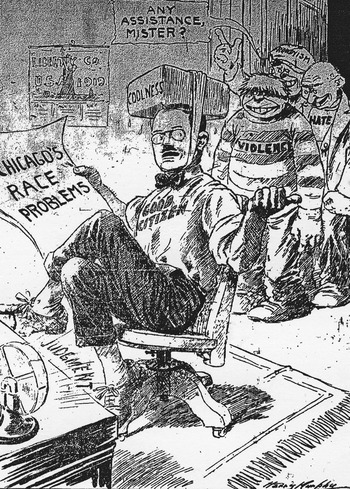
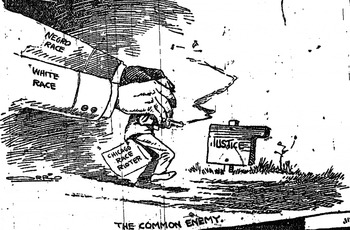
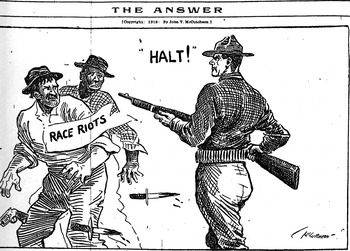
In all these analyses, respect for the law, a desire for order, and the restraint of the passions were identified as distinctively masculine characteristics. The working-class perpetrators of riot violence lacked sufficient control to be truly considered men, and their haste to overturn order had usurped the leadership of their bourgeois betters. The solution was clear. Order must be restored, by violence if necessary, and then the rightful leaders of Chicago could calmly sort out a lasting solution to the city's racial tensions. Cartoons in the city's newspapers, including the Chicago Defender, consistently depicted black and white “rioters” in shabby working-class clothes, with slouching posture. In contrast to the reality of interracial violence, in cartoons, white and black rioters collaborated in their violent acts. The Tribune's edition celebrating the deployment of the state militia paired the terse headline, “TROOPS ACT: HALT RIOTING,” with a cartoon contrasting an interracial pair of rioters with a proud militiaman, whose erect posture and one word command (“HALT!”) unnerved the “hoodlums” as much as his rifle.Footnote 28 By blaming “hoodlums of both races” for riot violence, the initial consensus rendered meaningless the specifics of the riot itself. Violence represented a detour from the serious business of solving the city's “race problem.” If both races were equally to blame, then it made little sense to parse the events that made up the riot.
Democratic Politicians Versus the Riot Consensus
By contrast to commercial civic leaders and Republican politicians and editors, Democratic politicians emphatically blamed the riot on the new black assertiveness and constructed specific narratives of riot violence to bolster their case. Some of the most vocal Chicago Democrats had sponsored the very organizations, the infamous “athletic clubs,” later deemed responsible for the most heinous attacks in the riot. However, all of the city's Democratic politicians who spoke publicly on the subject during the riot blamed African Americans alone. Third Ward Democratic alderman John Passmore began the July 28th City Council session by inquiring how the city might disarm African Americans. After asking one of the city's corporation counsels “for a ruling on the city's right to enter all homes in the strife-born district and search for arms,” Passmore introduced a resolution that would have allowed police to “search all suspicious individuals for weapons and disarm them.” Although Passmore did not single out African Americans in so many words, his explicit call to search homes in the Black Belt made his meaning plain.Footnote 29 Democratic state's attorney Maclay Hoyne repeatedly blamed the violence on Mayor Thompson's irresponsible administration and its alleged favoritism toward blacks. Hoyne told the Herald-Examiner, “The lawless crowd has been taught it needs neither fear nor respect the law and that politics and graft rule.”Footnote 30 Hoyne cited letters he received from “prominent negroes” suggesting that “negro hoodlums and a black agitator who is said to have urged negroes to kill whites” were responsible for the violence.Footnote 31
Chicago's restrained white middle-class depicted as the proper agent for solving “race problems.” “Beat H,” Chicago Herald-Examiner, August 1, 1919.

Blacks and whites acting together against a “race rioter” whose identity they obscure to achieve justice. “The Common Enemy,” Chicago Tribune, August 1, 1919.

Black and white “rioters” depicted as acting in concert, opposed by an orderly, commanding, white militiaman. “The Answer,” Chicago Tribune, July 31, 1919.

Another depiction of an alliance between black and white “riot ring leaders,” threatened by the startling shadow of the hangman's noose. “The Only Cure,” Chicago Defender, August 9, 1919.

State representative Thomas Doyle and Alderman Joseph McDonough, both sponsors of the Hamburg “athletic club,” produced the most sensational narratives that blamed the riot on the violent acts of African Americans. Following a tour of Bridgeport the evening of July 29, they insisted that African Americans were armed and a threat to whites. Doyle told the Daily News that he had personally witnessed a carload of black men shoot a white woman and her child: “The mayor is talking about opening up 35th and 47th streets to the colored people can get back to work. What will happen when they go home at night? . . . [blacks] are all armed and the white people are not. We must defend ourselves if the city authorities won't protect us.”Footnote 32 McDonough's statements were quoted to different effect in the white-owned dailies. The Daily News emphasized his sensational images of an African American threat: “I saw white men and women running through the streets dragging children by the hand and carrying babies in their arms. Frightened white men told me a police captain had just rushed through the district crying: ‘For God's sake, arm. They're coming and we can't hold them.’”Footnote 33 The Herald-Examiner, on the other hand, focused on McDonough's warning “his constituents to arm themselves.” According to the report, McDonough stated firmly “that he was armed and ‘did not care who knew it.’”Footnote 34 McDonough was also the source of a Daily News report on Wednesday, July 30, that “there was enough ammunition in the south side trouble region to carry on a guerilla warfare for a year.”Footnote 35 During the Chicago riot, the only local figures to emphasize black assertiveness were white Democrats, who had a political interest in demonizing Thompson and his black supporters and who were probably inclined toward such attitudes in any case. The Democrats' street gangs were, of course, responsible for much of the anti-black violence.
The initial range of public reactions left little room for images of militant New Negroes engaged in armed defense. African American leaders relied on old themes and images to disclaim and delegitimize violence, arguing that “bad negroes” who committed violent acts did not represent the community as a whole. White elites largely condemned the violence in similar terms. While the claims of Democratic politicians were met with skepticism from everyone but their own constituents (a huge segment, however, of white Chicago), such claims also illustrated the challenges that black Chicagoans confronted when considering the legitimacy of black armed defense. Any argument that black riot violence was the foundation of a new, militant, antiracist politics would be based on riot narratives that emphasized and justified acts of violence committed by blacks. Not only would Democrats seize on these claims as justifying their own views, but such narratives would repudiate the initial consensus on the riot between black leaders and Chicago's white elites.
Contested Views of Armed Self-Defense
Established African American leaders' narrative of the riot began to shift during the riot itself, as did their vision of “New Negro” antiracist politics. Black leaders not only abandoned their condemnation of riot violence, but they began provocatively to claim that African American assertiveness—rather than racist oppression and cruelty—was a root cause of the riot. Rather than a lamentable tragedy whose details should be ignored, some of Chicago's black leaders publicly recast the riot itself as a demand for equality. Had African Americans been willing to endure injustice, such spokespeople suggested, the riot would never have happened.
This shift emerged from three interrelated developments that occurred during the few days of the riot. First, press coverage of the riot, in contrast to public commentary on its significance, indicated that despite their apparent disagreements, influential whites shared a perception of an aggressive black population that threatened public order. Second, press coverage both justified and was informed by the response of the city's police to the riot. As the riot developed, police focused most of their efforts on preventing black armed defense. Third, the complexity of the riot itself resulted in an event that was impossible to encapsulate in a single, simple narrative. For every instance of heroic self-defense, there was an instance of seemingly random violence. Moreover, events evolved even as they occurred, complicating efforts to discern their meaning in simple terms.
Alderman McDonough's characterization of African American violence as guerilla warfare was but one expression of a theme in much newspaper coverage. Newspapers repeatedly described African Americans engaged in riot violence in terms evoking military organization, discipline, and firepower. The Herald-Examiner circulated reports of a supposed attempt by black rioters to break into the Eighth Regiment Armory on South Giles Street. On Wednesday, July 29, the newspaper reported that “several thousand men” took “hundreds of guns with ammunition” from the armory before police arrived. Although the unit's officers denied the incident occurred, the newspaper suggestively stated, “The possession by Negroes in civilian attire of Springfields with bayonets attached is a mystery.”Footnote 36 A black man accused of shooting three whites was “said to be armed with a machine gun.”Footnote 37 Another African American man accused of shooting a police officer was said to have taken “up an ambuscade . . . and opened fire.”Footnote 38 Six blacks were arrested with “rifles, bayonets, and magazine pistols.”Footnote 39 On July 29, in describing the arrest of four women and twenty men, the Daily News stated their apartment was “found to be an arsenal for the negro rioters” stocked with guns, ammunition, and knives. The next day, the paper reported that in another house, police found an “arsenal of small arms and ammunition.”Footnote 40 In the Herald-Examiner's view, possession of Springfield rifles by “Negro rioters” gave “credence to a report that an arsenal of United States guns had been established secretly in the Negro belt.”Footnote 41 Although riot accounts also typically described incidents of white violence, the language of the news reports evoked a one-sided race war, in which only blacks were armed and organized.
Police were the most common sources for news reports. As later studies subsequently confirmed, police held a view of the riot similar to that of Mayor Thompson's Democratic political opponents. Police passed multiple rumors to reporters of African Americans buying or stealing guns or raiding armories. These rumors led Police First Deputy Superintendant Alcock to order “drill rifles collected from all high schools in the city.”Footnote 42 Historian William Tuttle notes that the police decision to station four-fifths of the police force in the Black Belt—leaving anyone outside the area to see to their own protection—could not have been reasonably expected to end the violence.Footnote 43 However, this strategy was consistent with the analysis of the riot that police were conveying to the press. It was also consistent with the other main thrust of the police response: disarming African Americans. On July 28, Daily News reported that police at the Cottage Grove station, the nearest station to the Black Belt, were ordered “to search every colored man on the street for revolvers and not to allow whites or negroes to congregate in groups of more than three persons.”Footnote 44 The next day, the Evening Post reported “two hundred negro hoodlums” were disarmed by police at the Eighth Regiment Armory.Footnote 45
Police racism and incompetence contributed to the riot's violence rather than containing it. Thompson's police chief, John J. Garrity, recognized this problem on Tuesday, July 29, when he suspended Patrolman Daniel J. Callahan, the white policeman alleged to have prevented the arrest of George Stauber for Eugene Williams's killing two days earlier. Garrity told the press that if Callahan had indeed blocked Stauber's arrest, then he “is responsible for this outrageous rioting.”Footnote 46 In fact, official records indicate that police often failed to identify, much less arrest, residents who committed violent acts during the riot.
Beginning with the Chicago Commission on Race Relations, riot scholars have noted that African Americans suffered disproportionately from riot violence and yet were disproportionately targeted for arrest, indictment, and trial. Indeed, on account of deeply biased statistics and reports provided by the police, the commission published only a curtailed version of its planned section on policing and crime.Footnote 47 Of the twenty-three people killed by acts of aggressive violence, police failed to identify a killer or killers in fifteen cases.Footnote 48 A large portion of those arrested and prosecuted for misdemeanors and felonies were African Americans engaged in self-defense or preparing to defend themselves. Extant criminal records from the riot offer information on seventy-nine misdemeanor defendants and sixty-five felony defendants. From this sample of 144 defendants, sixty-seven were charged only with carrying a concealed weapon.Footnote 49 By the time African American leaders reluctantly called for the deployment of the state militia Wednesday, July 30, armed defense in the riot appeared a virtual necessity rather than a tactical choice. Had blacks not attempted to defend themselves, it was clear they would have suffered far more injuries, deaths, and damage to their property and neighborhoods.
Police bias inadvertently illuminates the actions of African Americans in the riot. When read in the context of biased and incompetent policing, case inquests and court records illustrate the complexity of riot events. Official records in some cases help identify more reliable newspaper accounts and contextualize the many less reliable ones. Daily newspapers extensively covered cases of African American violence as reported by the police. Such slanted reports unintentionally created differing versions of stories, such as those of Horace Jennings or William and Betty O'Deneal, both arrested, but never charged, after defending themselves from whites.Footnote 50 Moreover, inquest and court records are available for several cases in which the coroner's jury, the grand jury, or a trial jury acquitted African Americans who, the courts determined, acted in self-defense. These records provide evidence of what blacks did during the riot, how these actions were interpreted by different audiences, and occasionally of the way black “rioters” characterized their own acts as well as the events of July 1919 overall.
The Riddle of Black Violence in 1919 Chicago
Black armed defense encompassed more than direct responses to immanent threats. However, the necessity of armed defense during the riot raised new questions because African Americans participated in a myriad of ways in events that were fluid and unpredictable. Violent acts spanned a continuum from spontaneous responses to more organized interventions. Moreover, African Americans not only committed aggressive violence, but also fought among themselves about the boundaries of legitimate violence.
The actions of African American crowds shifted even during specific incidents, sometimes evolving from attempts to protect people or neighborhoods into confrontations with police or assault and murder of white bystanders. Such patterns appeared already on Sunday, July 27, when African American beachgoers chased the policemen who failed to arrest George Stauber.Footnote 51
Monday's Daily News evening edition claimed “three hundred negroes[sic] . . . have congregated at South State and 35th Streets.” The newspaper asserted that the crowd intended “to start an immediate attack on whites of the neighborhood,” though other sources indicate the crowd had gathered in response to rumored white attacks. Violence only occurred after police ordered the crowd to disperse and forcibly drove them away from the intersection.Footnote 52 Later on Monday, another confrontation occurred at 35th and State, when African Americans gathered at the Angelus apartment building. The crowd had gathered in response to claims that a black child had been injured by a shot fired from inside the building. Police responding to the scene searched the building and asked the crowd to disperse after finding no evidence of a crime. Three members of the crowd and a bystander in a nearby building were killed when the police opened fire.Footnote 53
Also on Monday evening, an African American crowd was reported to have initiated an attack on police protecting two injured whites at Provident Hospital, the city's only African American hospital.Footnote 54 The crowd had gathered outside the hospital after two white men were seen being brought into the hospital for treatment. These injured whites were not passersby; they had been speeding down State Street, shooting from their automobile. According to the Evening Post, they collided with a patrol wagon at 35th and State, initiating what the paper called a “three-corner battle” between the whites, an African American crowd, and police, before the injured attackers were taken to Provident for treatment.Footnote 55 The source for this news report was an African American policeman, Det. Sgt. W. A. Middleton, who claimed that he and two other black policemen had defended the wounded whites and the hospital from the African American crowd.Footnote 56
In some cases, crowd activity that originated in defensive efforts ended in murder and assault. As the riot spread on its second day, bystanders and passersby of both races faced threats, assaults, and worse. Black crowds were responsible for the July 28th murders of Casmere Lazzeroni, Eugene Temple, William Otterson, and Stefan Horvath. Lazzeroni and Temple were killed after the crowd that had gathered at 35th and State Streets during that Monday afternoon was pushed back from the intersection by police. Although Lazzeroni was said by the Herald-Examiner to have inadvertently turned his cart into the center of a “howling mob,” Temple was murdered thirty minutes later by a group of three men who escaped through the crowd still gathered nearby.Footnote 57 Otterson and Horvath were both working-class whites with jobs inside the Black Belt killed on their way home that day.Footnote 58 A black crowd at 35th Street and Wabash Avenue, just east of State, began to attack whites in passing cars. A stone or brick thrown by a member of this crowd hit and killed Otterson, a seventy-four-year-old man.Footnote 59 The shot that killed Horvath came from a crowd of blacks, but the coroner's jury concluded that three African Americans who ran after the shot were to blame.Footnote 60
Several police reports of black crowds that gathered following attacks on African Americans in the Loop, a community area of Chicago, overlap with coroner's accounts of murders of whites by African Americans. On the morning of Tuesday, July 29, an African American crowd gathered near 51st and Wentworth. After a riot was reported to police, attacks on whites were reported soon after one block east, at 51st and Federal, and two blocks east, at 51st and State. Charles Maynard, “A. Martin,” James Planiger or Flannigan, and Herbert Taylor were reported injured. At about the same time, police who responded to alleged attacks by “a crowd of Negroes” found Forest Paul unconscious on the ground at 51st and State.Footnote 61 The murders of Morris Perel, Walter Parejko, and G. L. Wilkins were all alleged to have been committed by small groups of African American men. Perel's and Parejko's murders took place a little over an hour after the first attacks against African Americans in the Loop that Tuesday morning.Footnote 62
Black crowd actions resulted in complex and multiple forms of violence. Instances of black armed defense could be equally complex, albeit for differing reasons. L. C. Washington's killing of Clarence Metz on Monday evening, described in the introduction to this essay, was a clear instance of armed defense in the face of imminent harm. So was Samuel Johnson's shooting of Berger Odman the next evening. The dead man had been part of a crowd of whites who menaced African American homes in the Ogden Park area, west of Wentworth Avenue.Footnote 63 Given the predisposition of the police, black armed defense frequently placed African Americans in conflict with them. Police gave many accounts to the press of arrests of supposedly dangerous, well-armed rioters who later turned out to have acted in manifest self-defense.
Police reports and news reports drawn from police sources repeatedly identified self-defense as aggressive violence. The shooting death of Harold Brigandello, for example, was initially reported as a murder committed by an organized group of African Americans whose apartment was “an arsenal for the negro rioters.” It emerged in the coroner's jury investigation that the six African Americans charged with Brigandello's death had been protecting their apartment from a crowd of stone-throwing whites.Footnote 64 NAACP Chicago branch president A. Clement MacNeal and six other men were charged with assault with intent to murder for the shooting of Myron Delfield on Tuesday, July 29. The Chicago Defender later reported that the men had been “called to protect relatives” threatened by a white mob.Footnote 65 William and Betty O'Deneal were arrested on Wednesday, June 30, by Patrolman Michael Hurley at their home at 4742 S. Wells, in the area that arson gangs attacked repeatedly that evening. Hurley claimed they had been sniping at passersby throughout the night and that they had shot at him when he stormed the house.Footnote 66 The Chicago Commission on Race Relations found that the couple had been shooting at a white crowd who had attacking their home. After Hurley took the two to the police station, he “left the mob to sack and burn his [O'Deneal's] house.”Footnote 67
In at least two cases, small groups of African Americans charged with firing on random whites appear, based on court records, to have ended up in a confrontation with police. On July 28, Elmer Sanford, Oscar Mondine, James Mays, and McKinley Baldwin were all arrested for having shot at several police officers “in a riot at 44th street and Indiana Avenue,” a few blocks east of State Street. A group of six African Americans, including Clara Dumas and Henry Dumas, were later charged with having shot at police the same evening. In both cases, news reports asserted that the groups were firing at all whites they saw, but their indictments specified their victims as police detectives.Footnote 68 The role of police in these cases provides concrete illustration of the differing accounts of “sniping” by blacks during the riot. Police almost always reported sniping as aggressive violence. News reports beginning Tuesday evening, July 29, depicted roadways obstructed by garbage or telegraph wires, with shots hitting any vehicles stopped by the obstructions. However, considerable evidence emerged that blacks resorted to sniping to defend their homes and neighborhoods. Former YMCA director A. L. Jackson told William Tuttle decades later that he personally had organized snipers to defend African American neighborhoods.Footnote 69 In a riot in which police attempts to “restore order” were directed largely at African Americans, defensive violence created further conflicts between blacks and police.
Black Police and Veterans and the Restoration of Order
A few well-documented instances exist of African Americans attempting to end riot violence and restore order. Det. Sgt. Middleton and two other black policeman, as noted above, reported that they had defended wounded whites at Provident Hospital. Likewise, a black policeman had mortally wounded James Crawford, who had fired at police during the conflict over Eugene Williams's death.Footnote 70 The next evening, an off-duty officer named John Simpson attempted to stop a black crowd pursuing a white man. Someone in the crowd fatally shot Simpson. Although white policemen told the press on multiple occasions that dozens of white policemen had been killed by blacks during the riot, Simpson—an African American policeman defending a white man from a black crowd—was the only policeman actually killed.Footnote 71
In addition to reports of attempts by black police to restore order, in at least three instances African American veterans were documented doing the same. On Tuesday, July 29, the Daily News claimed that twelve black soldiers, “all armed, terrorized small groups of whites” in the Black Belt that day. Still, the same edition noted that a group of eleven African American veterans, “two wearing the croix de guerre,” had turned themselves in at the behest of black police detectives. The group “declared they thought themselves a species of military guard, and had no intention of rioting.” The News revised the story again for its Box Score Edition published that evening. The veterans, the paper now explained, had attempted to reinforce police, not attack whites unprovoked. On Wednesday, the Daily News even published a laudatory caption beneath a photo of the group.Footnote 72 Also on Wednesday, prior to the deployment of the militia, a group of African American servicemen were photographed driving a tank down State Street urging an end to the violence.Footnote 73 Contemporaries and historians have frequently argued that World War I military service radicalized black veterans and inspired resistance to racism by violence if necessary. In the Chicago riot, however, veterans also found themselves in conflict with African Americans when they attempted to end the violence.
African American veterans supporting police were deemed responsible for the shooting of Samuel Banks, also black, on Wednesday evening. A group of black veterans had joined three Chicago police to investigate a shot heard near 28th and Dearborn. When the group arrived at the intersection, Banks ran and sought refuge under the steps at 2729 Dearborn, but the occupant of the building's basement pointed Banks out as the squad approached. Banks then tried to dash into the basement, but the resident closed the door. Banks then fled down an alleyway, ignoring orders to stop. Two men in the group then fired at him, and Banks died that evening. The coroner's jury recommended that one of the veterans be prosecuted, but no one was indicted by the grand jury.Footnote 74 As the state militia deployed late into the evening Wednesday, a detachment went to the scene to “disperse a mob” protesting Banks's killing.Footnote 75
In contrast to numerous acts that tested the boundaries of self-defense, documented black efforts in the name of restoring order were relatively few, and some received publicity out of proportion to their role. Their significance arises from their embodiment of conceptions of restrained, respectable masculinity and respectable politics. African American leaders had claimed that only “bad negroes” would commit acts of violence during the riot. Blacks endeavoring to restore order during the riot would unavoidably find themselves in armed conflict with other blacks, much as proponents of racial uplift formulated an antiracist politics, which directed their efforts toward changing the behavior of African Americans.
Competing Black Riot Narratives Take Shape
Few sources shed light on what ordinary African Americans thought about their own actions during the riot. However, several examples do exist of African Americans attempting to shape public perception of their own actions in the riot. James Crawford, the man shot during the initial protest over Eugene Williams's murder, insisted that he had acted to stop the confrontation. As Crawford lay dying in Michael Reese Hospital, he admitted to firing a gun but claimed he had done so into the air to shock the crowd and end the fighting, not attack the police.Footnote 76 As discussed above, a group of African American veterans responded effectively to inaccurate reports in the Daily News that described them as rioters. Castillian Harris, Moss Thompson, Guerney Moore, Oliver Starr, Edward Edmonds, and Arnett Hurd were all arrested on Tuesday, July 29, for the shooting of a white man, Louis Lisica. Although the group were reported to have been “the instigators of a riot” at 26th and Wentworth and “firing at whites from a speeding automobile,” the men surrendered to police without a fight. According to the Post, a sheriff supported Harris's claim that he and his compatriots were deputized sheriffs driving to the Stockyards to rescue African Americans trapped there by the violence.Footnote 77 African American participants in the riot legitimated their own acts using the same themes of restraint that informed black leaders' public announcements.
Perhaps no black leader proved as skillful at shaping riot narratives as former Republican alderman (and future congressman) Oscar De Priest. In a Daily News story on Wednesday, July 30, De Priest claimed he had “held back a crowd of several scores of men and women of his own race” to prevent them from attacking “a middle aged blond woman, said to be well dressed and of agreeable appearance,” after the woman had shot a black man named William Moore. Although De Priest presented himself as a peacemaker in the Daily News, African Americans seemed to draw a different lesson from his actions. Sociologist Harold Gosnell noted in his 1935 account Negro Politicians that during the riot De Priest had “gained a reputation for courage in the presence of physical danger,” most likely for his presence in the black crowd at the Angelus riot Monday evening.Footnote 78 These narratives presented divergent images of De Priest's role in the riot, aimed at different audiences, with a common theme of De Priest's initiative and bravery. Still, as the actual costs to African Americans of police attempts to “restore order” became clearer with each day of the riot, positioning oneself, as De Priest at times did, on the side of “law and order” was less and less compatible with showing allegiance to ordinary blacks.
De Priest's predicament mirrored that of other African American leaders who counseled calm and restraint at the beginning of the riot. In Chicago, July of 1919, demanding a restoration of order in effect sanctioned further violence against African Americans and reinforced the view that the actions of African Americans were little different than those of whites. Nevertheless, abandoning calls for restraint and celebrating armed defense meant grappling with the complexity of the actual incidents of violence in the riot. In the end, most black leaders in Chicago chose to vindicate black armed defense. Although black radicals argued that black riot violence amounted to a repudiation of existing leadership, Chicago's established black elite also lauded African Americans' resort to violent resistance. What distinguished the riot narratives advanced by mainstream leaders and their radical critics was not whether they celebrated the militant New Negro, but instead how their narratives made sense of the randomness and unpredictability of the riots. The detailed accounts and analysis offered in A. Philip Randolph and Chandler Owen's black socialist periodical, The Messenger, emphasized the necessity of the brutality of the black response by depicting the riots as a “total war” between blacks and whites. Chicago black leaders, in contrast, offered a revised conception of respectable masculinity that posited assertive—and, if necessary, armed—resistance to racism as an essential element of manhood and citizenship. This revised conception made room for the multiplicity of riot violence, while refraining from justifying all violent acts.
Randolph and Owen, along with Hubert Harrison, bitterly criticized established black leaders for their refusal to call for armed self-defense prior to the events of Red Summer. Harrison's varied writings during World War I consistently called for self-defense as a cornerstone of the black response to racist violence.Footnote 79 Published in the wake of the Washington and Chicago riots of summer 1919, Randolph and Owen's “The Cause and Remedy of Race Riots” developed a critique that linked black leaders' resistance to armed defense with their place in the class struggle. Randolph and Owen argued that established black leaders in effect prevented black workers' longstanding grievances from igniting a revolutionary conflagration. While capitalists played black and white workers against each other, Randolph and Owen wrote, industrialists also knew that race relations constituted a “social magazine which may explode at any moment.”Footnote 80 Established African American leaders played the role assigned to them by capital when they counseled patience and cautioned against violence. Rather than demand resistance, black leaders were to “soothe the ruffled feelings of colored people . . . to play up duties and soft pedal rights.”Footnote 81 Randolph and Owen claimed that capitalists and their allies in the press, pulpit, and politics had fanned the flames of race hatred among whites in response to African Americans' increasing role in both the Industrial Workers of the World and in less radical labor unions. African Americans' military service, they argued, gave them the necessary skills, and the “spirit of independence of Negroes has increased” to violently resist racism.Footnote 82
In its descriptions of the Chicago riot, The Messenger depicted black armed defense as military in scope, organization, and discipline. An account of the riot credited to J. Arthur Davis, subtitled “State Street Hindenburg Line,” built on military metaphors. Davis claimed that African Americans created a single front “three miles and a half long” and defended it “from all angles.” “As if by prearrangement,” Davis wrote, blacks “melted into squads using telephone communication” and formed not one but two lines of defense that inflicted disproportionate casualties on whites.Footnote 83
The Messenger used the metaphor of total war to argue that only through the brutal violence of the riot was progress against racism possible. Randolph and Owen stated that race riots were “miniature wars,” noting that, like wars, “they are injurious to the masses that fight them,” and only “a few profit from them.”Footnote 84 Riot articles in The Messenger repeatedly insisted that the costs of these wars were balanced by the benefits. “The lesson of force can be taught when no other will be heeded,” Randolph and Owen wrote, noting that the “resistance of Negroes . . . has been helpful to the white and colored people throughout the country.”Footnote 85 The editors asked an unnamed Chicago attorney whether the delay in calling out the militia in Chicago helped or harmed “the Negro cause.” The attorney unequivocally replied, “Benefited it.” Although “many innocent lives were lost,” he continued, “it afforded an opportunity for the Negroes to impress upon the whites their readiness, willingness, and eagerness to fight the thing through.”Footnote 86 In the eyes of the young activist Randolph and his associates, the critical lessons that the New Negro had to teach the nation inhered in the aggressiveness of African American defense, blacks' willingness to both accept casualties and inflict them, and their apparent unconcern for the suffering and death of those not directly involved in the fighting. “If death is their portion,” Randolph and Owen wrote, “New Negroes are determined to make their dying a costly investment for all concerned.”Footnote 87
The Messenger's editors and reporters based these claims on riot narratives in which New Negroes were led by the “uncultured” and by women. Randolph and Owen asked their unnamed Chicago informant to assess the participation of blacks in the riot by class and gender. The attorney stated that although “all classes” had acted in the riot, “the best classes . . . confined their activities to protecting their homes and neighborhoods.” Implicit distinctions were made between the actions of the “best classes” and the “worst classes,” who, along with soldiers, “participated in raiding parties in the white districts.” The attorney noted that women were not only “quite active,” but related the story of an African American woman who “is said to have stood on the corner of 35th St. and Wabash Avenue and to have incited colored boys to throw stones at the white passersby.”Footnote 88 He also referred to the case of Emma Jackson and Kate Elder, the accused killers of Harold Brigandello. George Frazier Miller developed this argument in “The Social Value of the Uncultured.” He argued that several of his acquaintances in Washington and Chicago who refrained from involvement in those cities' 1919 riots did so because of a “spirit of refinement superinduced by culture.” He hastened to note that these men “were by no means cowards,” that their devotion to the “delicate features of refinement” developed in them “the spirit of insistence on the maintenance of the dignity of the gentlemen.” The New Negro, men and women excluded from the “better classes,” tempered and tested by a total war, had learned that some things were more important than maintaining “the genius of noble manhood and the modesty befitting womanhood.”Footnote 89
The Return of Respectable Politics
The depiction of the Chicago riot offered by The Messenger relied on stories of black women and men committed to conflict. The narratives of the Chicago riot employed by Chicago's established black leaders, by contrast, were informed and structured by a new conception of respectable masculinity. Although the language of manhood could be found in The Messenger's reports and editorials, the magazine undercut this theme both through specific references to the participation of women and through the organizing frame of war.
Women were present in Chicago leaders' narratives. However, established black leaders' descriptions cast women in the role of victims and made armed defense a “display of manhood” and the sole province of men. The Chicago Defender stated that the confrontation at the 29th Street beach occurred after “a mob of fifty men marched” to the site to avenge Eugene Williams's death. Monday morning's violence began when two black stockyards workers were killed walking to their jobs. Following the murders, “all women and children retired from the streets, leaving the mob to work its free will.” The Defender's accounts of riot violence attribute all acts to men. Although “groups of Colored men” had planned “to clear the district of whites” on Monday evening, “more fuel was added to the flame . . . with stories of horrible attacks made by the whites upon colored women.”Footnote 90 The Defender's August 9th coverage of riot indictments highlighted the story of the group of men including A. Clement MacNeal, whom the Defender noted had been “called to protect relatives” threatened by a white mob. The alleged victim in the case, Myron Delfield, was described by the Defender as a “white boy,” who, along with his compatriots, disappeared when “the men in the house showed fight.” The paper mentioned the case of Kate Elder only to note that she had been held without bail for over a week and to praise the judge who ordered her release.Footnote 91 The Defender did not note that Elder, like MacNeal, was accused of shooting a man to defend a home from assault.
This narrative of the riot reflected and supported a vision of the New Negro framed in terms of a new respectable masculinity. The editors of The Messenger saw the New Negro as a black man or woman willing to sacrifice anything to strike against the structures, institutions, and people who used white supremacy to oppress and exploit black people. Chicago's black leaders, however, depicted the New Negro as an African American man whose actions signified a willingness to engage in violence in defense of family, property, and, most importantly, self-respect and dignity, which they termed “manhood.” Not only would this New Negro be willing to use violence, he would initiate conflict if failing to do so meant acquiescing to humiliation or exploitation. Ferdinand L. Barnett, speaking on Wednesday, July 30, on behalf of the conference of black leaders that had met throughout the riot, offered this kind of analysis in defense of the group's approval of the deployment of the militia. Barnett stated that, despite their concern that the militia might intervene on the side of whites, black leaders acquiesced to the militia to “stop the wholesale murder of defenseless people.” He portrayed the murder of innocents as a tragic element of a conflict that had erupted due to long-ignored African American grievances. The riot, he stated, was the “result of bad feeling caused by the bombing of houses in certain districts of the south side occupied by negroes” and the failure of the police to arrest those responsible. He stressed that Eugene Williams's murder grew from an attempt to enforce segregation: “when a white man drowned a negro boy because he happened to get on the wrong side of the rope strung in Lake Michigan to segregate the races.”Footnote 92 Antiblack racism had shaped the context in which black men were forced to act, but it was their refusal to continue to abide indignities and depredations which caused the riot. They desired to end the riot in order to end the killing of innocents, but if the grievances remained unaddressed, more violence would follow.
Robert S. Abbott Jr. used his Chicago Defender editorials to define the New Negro in these terms as well. His first riot editorial, published August 2, declared the Chicago and Washington riots to be “a disgrace to American civilization.” Abbott had “little sympathy with lawlessness, whether those guilty of it be black or white.” However, he distinguished lawlessness from the acts of men forced to choose between violence and second-class citizenship. Noting that “the younger generation of black men are not content to move along the line of least resistance as did their sires,” he argued that New Negro men had “much in the way of justification for our changed attitude.”Footnote 93 Abbott argued that this younger generation had earned places for themselves in northern industries because, in contrast to stereotypical depictions of black laziness, they proved to be “bright, energetic, apt, useful, and reliable.”Footnote 94 They “went cheerfully” to war, believing their service would result in “an improved social and industrial condition.” These hopes were dashed, in Abbott's view, not because of the class interests of American industrialists, as The Messenger asserted, but as the sole result of the “color madness of the American white man.”Footnote 95 Antiblack propaganda followed black soldiers to Europe, and white soldiers, on their return to the United States, had demanded African Americans relinquish the gains they had made in industry and military service.
However, the war had created a New Negro. Abbott argued that for a New Negro, antiracist politics and the willingness to use violence defined and demonstrated manhood and an entitlement to full citizenship. World War I service had emboldened black veterans, Abbott wrote, making African Americans “no longer content to turn the left cheek when smitten on upon the right.”Footnote 96 So when white workers “questioned the right of a Black man to be holding a job he could fill,” black men responded. Abbott used the language of citizenship to suggest the contours of the demands of the New Negro. He argued, “The Black man, dating his final papers entitling a place in the sun” from the date his war service ended, “pointed to his record as an American citizen and refused to be the tool of any man.” This “display of manhood,” in Abbott's view, initiated the white assaults that caused the riot.Footnote 97 Although the editor thereby framed black violence in defensive terms, the assertiveness displayed during the recent riot was not mere self-preservation from imminent physical harm. Abbott argued that black men in the Chicago riot were called to defend their manhood and their status as citizens entitled to equal treatment. Rather than yield in the face of hostile white demands, blacks fought for their self-respect and dignity. Black armed defense in the riot was not an unfortunate necessity but a trial by fire of a new antiracist consciousness.
African American leaders responding to the 1919 Chicago race riot were engaged in the common project of crafting narratives to make antiracist political arguments. However, the riot itself was a complex event, and the events making up the riot simultaneously pointed in multiple ways. Black armed self-defense in 1919 opened up new possibilities for antiracist politics, but it did not inherently repudiate the politics of respectability. Following the critiques of black radicals, scholars have argued that the New Negro and armed self-defense signaled both the end of antiracist politics informed by concepts of respectability and the irrelevance of established black leadership. However, when given the opportunity, African American leaders in Chicago proved willing to rework their notions of respectability in response to armed defense in the city's Black Belt. Chicago's African American leaders incorporated the riot's mass action into a narrative that justified black violence as a response not just to individual acts of white violence, but to the broad patterns of segregation and discrimination that were maintained by that violence. The Chicago riot did not spell the beginning of the end of respectable class politics; instead it demonstrated its flexibility. Instead of demonstrating an organic relationship between intense mass action and seismic shifts in African American leadership, the riot advanced new questions and created new problems that black leaders used their existing politics to address. If it had been predicted, foreseen, or desperately hoped for in the decades before World War I, the New Negro's arrival in the 1919 riots resembled less a social fact than a set of challenging new possibilities that had just begun to be explored and debated in August of 1919.