The centre of gravity of exploratory music making in the West shifted to a significant degree in the 1970s and 1980s. Included in but not contained by postmodern rubble revelling and high/low jockeying, this shift saw the classic modernist drive towards radical expression jump lanes. Or, rather, spread across a number of lanes. Noise musicians in Tokyo, ‘free’ players in Berlin and London, and industrial post-punk provocateurs in Sheffield, LA, or Rome could now legitimately claim to be amongst the vanguard of radical music. Quasi-‘popular’ cultural practices such as these became routes into the new and the strange as valid as any other.
All this must be seen amongst a number of transformative 1960s and post-1960s cultural movements. This is a period in which, according to some, ‘sociostylistic categories’ were ‘blurred’,Footnote 1 and a ‘new approach to society as a whole’ was fomented.Footnote 2 But these changes had deep roots. Sources such as Gendron provide comprehensive accounts of these shifting cultural sands going right back to the start of the twentieth century.Footnote 3 Meanwhile, theorists such as Andreas Huyssen draw links from post-1960s postmodernism to historical avant-gardes from earlier in the century, which in their unity of the political and the aesthetic ‘aimed at developing an alternative relationship between high art and mass culture’ to that found in classic autonomous modernism, such that art would contribute directly to the transformation of everyday life.Footnote 4
With these deep-rooted historical changes in mind, I take an intensive look in this article at localized cultural change that nevertheless serves as an applied instance of these broader changes. Focusing mostly on British, white, male musicians and music writers active in the improvised and experimental music scenes of the UK and Europe across the 1970s and early 1980s, I identify a clear shift in taste, attitude, and practice. This shift arcs across what Ben Piekut calls the ‘mixed avant-garde’ of the 1960s, which was characterized by what he describes as a ‘post-Cage’ and ‘post-Coleman’ mix of spontaneous musics,Footnote 5 to what I describe as the ‘unpop avant-garde’ of the late 1970s and 1980s (building on a phrase from Boyd Rice), in which influences from popular and non-Western music play more significant roles than before and liminal, quasi-popular practices such as noise are in the emergence.Footnote 6 My book, Sounds of the Underground, has a broader context on the nature of these ‘liminal’ or, as described there, ‘fringe’ practices.Footnote 7
This localized historical narrative is based on readings of primarily UK-based independent music journals, magazines, and pamphlets from the 1970s and early 1980s (with some context from the late 1960s), most prominently Microphone, Musics, Collusion, Impetus, and Re/Search. Publications such as these shared personnel, audiences, and sets of interests and as such provide a useful basis for analysis. I supplement my readings of these sources with interviews with key players: Steve Beresford, who co-founded and wrote for Musics and Collusion; David Toop, who likewise played a prominent part in those two publications; Keith Potter, founder and editor of Contact; and V. Vale, publisher and editor of RE/Search.Footnote 8 These interviews serve primarily as supporting research kept in the background of the article, however; the article is conceived much more in the mode of discourse analysis than it is oral history. In this it takes a leaf from Alessandro Bratus, whose article ‘Scene through the Press: Rock Music and Underground Papers in London, 1966–73’ adopts a similar method in using published magazines and papers as ‘barometers’ of culture and attitude.Footnote 9 To Bratus's method, however, I add some degree of political-economic analysis, for instance discussing circulation numbers, pricing and advertisement strategies, and editorial models. I take these elements to be as significant an indication of the cultural position and attitude of these magazines as the published words contained therein.
All this comes together to paint a picture of the changing tastes and practices of key writers and musicians – as expressed through the conventions of published scene discourses – involved in the UK and, to a lesser extent, European and US scenes. My argument is that, in looking closely at these materials we can see specific and to some degree historically concealed inflections of taste. These inflections tell us interesting things about the contours of musical culture at this time as it evolved into something like the partial-omnivory that would come to characterize radical music scenes in the twenty-first century. My narrative of localized cultural change – which moves from what I call ‘Culture 1’, equivalent to Piekut's mixed avant-garde, through a transitional phase, to the unpop of ‘Culture 2’ – is intended in this sense to stand to some degree as a microcosm of wider historical change at this time, where traditional modes of state-funded high culture give way in part to modes of vernacular experimentalism. This scope might be seen to reflect what Richard Taruskin has described as a move from a literate to a post-literate musical tradition in the latter decades of the century.Footnote 10 By way of preliminarily signalling this broader context, I incorporate reference points and figures throughout the article that come from beyond the main thoroughfare of UK-based publications. But at bottom this article tells a localized, somewhat homogenized story of in-group evolution.
Culture 1: the late 1960s and 1970s mixed avant-garde
Ben Piekut's aforementioned 2014 article, ‘Indeterminacy, Free Improvisation, and the Mixed Avant-Garde: Experimental Music in London, 1965–75’, provides a useful historical and historiographical starting point. Piekut draws on a wide array of cultural sources, from Arts Council archives to press cuttings to interviews, in describing the discursive and material basis of what he calls the ‘mixed avant-garde network’ operative in London at this time. This network was in part facilitated by Victor Schonfield's non-profit organization, Music Now, and encompassed artists such as Soft Machine, AMM, the Spontaneous Music Ensemble, Music Improvised Company, John Cage and David Tudor, Sun Ra, and the Taj Mahal Travellers.
Piekut shows in great detail how Victor Schonfield served as key promoter and/or primary European point of contact for all these artists, acting as a nucleus to an emergent and fragile network.Footnote 11 The range of the Music Now-promoted concert series that ran across the late 1960s and early 1970s and that featured minimalist, experimental, and improv artists performing alongside or in close proximity to each other is perhaps exemplary here in embodying the network for audiences and in this sense generating a secondary network layer. The 1968 ‘Sounds of Discovery’ series, held at the ICA and Queen Elizabeth Hall in London and featuring La Monte Young and Terry Riley, Musica Elettronica Viva, music by Christian Wolff, and AMM, is a notable early example in this vein.Footnote 12
What is significant in all this is the redrawing of genre boundaries implicit in Piekut's narration of a mixed musical network that goes beyond established tribal lines. Though the kind of ‘avant-garde’ mix Piekut describes is to some degree already familiar from canonical texts on music of the period, as we can see for instance in Michael Nyman's extensive discussion of the links between improvisation and indeterminacy in Experimental Music,Footnote 13 it should be noted that in this case boundaries are drawn further from traditional scholarly home-bases. For example, Piekut can be seen consciously to be including black and popular artists such as Sun Ra and Soft Machine within his avant-garde canon, building in this way on a foundational historiographical gesture from George Lewis.Footnote 14 Piekut's mixed avant-garde, though hardly revolutionary, does subtly shift the parameters of music history.
Keeping Piekut's ‘stylistically heterogeneous’ mixed avant-garde model in mind,Footnote 15 what do the magazines, pamphlets, and periodicals I have chosen to focus on tell us about this late 1960s and early 1970s ‘first culture’ moment? The specialist ones very much speak to us of the kind of mixed network of exploratory composing and improvising musicians Piekut is writing about.
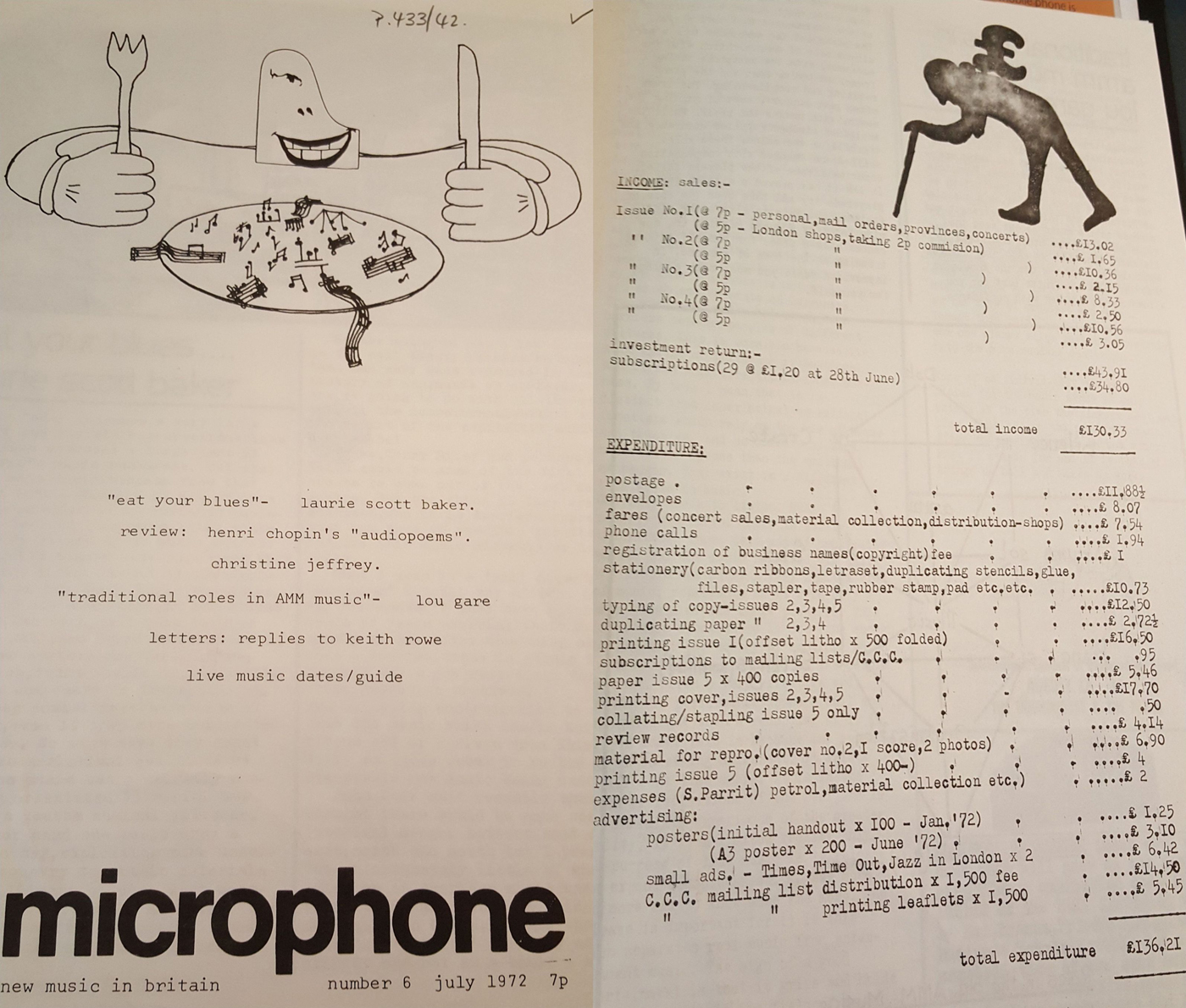
The British publication Microphone, for instance, can be seen as a direct embodiment of what we might call a late 1960s and early 1970s mixed avant-garde (and indeed Piekut quotes from it directly at one point in his article). Set up and run as an independent monthly ‘new music magazine’ by Nigel Rollings in 1972, Microphone lasted for six issues proper, with a dummy seventh sent out to subscribers giving information as to the parlous financial state of the magazine. Microphone featured a low-cost, almost grungy DIY aesthetic, with limited numbers of images and typed-up text presented with minimal fuss (Figure 1 features the cover of issue 6 and the accounting statement from issue 7 by way of illustration of the visual aesthetic and typical financial difficulties of the magazine). Microphone’s loose-leaved and limited number of pages feel as much like a pamphlet as anything else; Seymour Wright in fact refers to it as a ‘pamphlet-magazine’ in his PhD thesis on the band AMM.Footnote 16 Pamphlet or not, Microphone was sold in a number of independent book shops around the UK for a price of 7p, and it had a readership of about 250 people per issue.
Microphone issue 6 cover and excerpt from issue 7.

Microphone managed to generate a significant degree of debate and conversation in its short lifespan, despite its relatively small readership. This was most notable in the case of a controversial Keith Rowe review of a John Cage/David Tudor concert at the Royal Albert Hall. In that piece Rowe critiqued Cage's supposedly bourgeois politics by invoking a remark of the composer's that China then stood as a hopeful country for the future because of the lack of syntax in its language. Rowe suggested in response that, ‘by peddling this nonsense Cage is upholding the line of the “Bourgeois Individualist” that everything is subject to personal opinion’, and that ‘it is fine to leave everything to chance’.Footnote 17 (Rowe would not be the only Microphone scribe to call Cage out for his politics; Laurie Scott Baker went on to criticize what he saw as the ‘inherent social dangers’ of Cage's music.Footnote 18) This diatribe-disguised-as-review generated heated response in the next issue from notable figures on the scene, including then fellow AMM member Eddie Prévost.Footnote 19
Controversy generated by a member of AMM in response to a John Cage concert sums up the Microphone purview quite well. The focus here is ‘new music’ fairly conventionally understood as notes-on-the-page composition, with heavy doses of improvisation of one form or another pushing that focus somewhat into new mixed avant-garde terrain. And yet despite those heavy doses, and even as someone like Howard Riley railed in the second issue against the lack of coverage and support that improvised music entities such as the Musicians’ Co-Op were getting in the mainstream music press and institutions at the time,Footnote 20 the language and culture of composition is invoked again and again as a central frame of reference across each issue of Microphone. The pervasiveness of the term ‘composer’ to describe all sorts of musicians in the magazine is rather telling in this regard. Microphone, then, can be seen as a fairly standard new music publication of the early 1970s, albeit one heavily inflected with the newer improvisational tendencies of the scene at the time. It represents a ‘mixed’ avant-garde but only in a somewhat limited sense.
This was typical of the exploratory music scene at this time both in and outside the UK. Treading on similar musical ground to Microphone, for example, were slightly more formalised and in some cases more established journals such as Musique en jeu and VH 101 in France and Source: Music of the Avant-Garde and Soundings in the United States. These journals either specialized in notated music but made room for Cornelius Cardew and AMM and others alongside figures such as Cage and Stockhausen, as, for example, with Source’s practice-driven coverage of everything from Robert Ashley and Ben Johnston to its Anthony Braxton, Fluxus, Portsmouth Sinfonia, and Scratch Orchestra-featuring tenth issue,Footnote 21 or at least dedicated particular issues to the broad world of experimental practice. The latter can be seen for example with VH IOI’s contemporary music special in its fourth issue, which featured composers such as Morton Feldman, John Cage, and La Monte Young.Footnote 22 Musique en jeu, for its part, included discussions of sociology and politics and examined broader questions of popular music culture alongside its more pervasive coverage of figures such as Pierre Boulez, Henri Pousseur, and Dieter Schnebel.Footnote 23
These French and American journals therefore echo Microphone in their mixed coverage of improvised and experimental currents. In this they reinforce and remind us of the fact that advanced notated competition at this time increasingly shared discursive space with newer forms of experimental music making. This fact is well known. But Piekut and these examples help us see that these sorts of improvised and composed mixtures were a little more widespread and far-reaching than we might have previously suspected.
The specialized press examples looked at so far do not tell the full story of what we might call ‘avant-garde’ musical coverage in the West in the late 1960s and early 1970s, however. At this time various mainstream musical and non-musical publications dedicated at least some space to music that we might retrospectively designate as belonging to the mixed avant-garde. This can be seen, for example, in notable if piecemeal pieces on improvised music or improv-infused composition in places such as The Musical Times (where improv received a plethora of references in listings and elsewhere, and occasionally appeared in more substantial form in reviews and previews),Footnote 24 and the BBC publication The Listener (e.g., Michael Parsons, again, writing about Cardew).Footnote 25 Meanwhile, the so-called counter-cultural ‘underground press’ in Britain often directly addressed avant-garde music, whether post-Cage, post-Coleman or otherwise. This can be seen in the variety of musical coverage found in International Times (IT hereafter), which went across the outré boards. The AMM, Soft Machine, Yoko Ono, and Pink Floyd-featuring line-up of its Roundhouse concert launch on 15 October 1966 illustrates this well. Similarly, issue 2 featured articles on Pink Floyd and the Beatles as well as Anton Webern, Stockholm's experimental studio Fylkingen, and Morton Feldman, whilst issue 4 featured the Mike Butterfield Blues Band alongside Albert Ayler and the Society for the Protection of New Music.Footnote 26 This kind of preference for the interesting and challenging permeated the first few years of IT.
Virginia Anderson underlines this point in ‘1968 and the Experimental Revolution in Britain’, using a specific example to do so: ‘Of four pages in the 1968 IT New Music Supplement, two focused on Cardew, Tilbury and Bedford, and one on Hugh Davies’ electronic studio’, as well as featuring ‘short biographical sections on Stockhausen, Boulez, Messiaen and Berio’.Footnote 27 Anderson paints a picture in this piece of a late 1960s counter-cultural nexus encompassing the more challenging, exploratory ends of both popular and ‘high’ forms of music. In this way, her reading of IT offers further support to Piekut's thesis of a material and discursively ‘tangled’ mixed avant-garde. Similar support can be found in all sorts of other ‘underground’ publications from the time, whether we think of the vibrant, politically driven counter-cultural journalism of Oz, where music featured less frequently than in IT but where ‘mixed’ avant-garde groups such as Soft Machine would regularly be written about (see, e.g., issue 18),Footnote 28 or the more Líberation-like Seven Days, which likewise made room for artists such as Taj Mahal Travellers.Footnote 29 What we get through these publications is an image of a counter-culture in which fairly distinct musical factions, whether we think of those represented by AMM, Stockhausen, Soft Machine, or even Paul McCartney, could be articulated in some meaningful way as co-authors of the same cultural moment. For a certain kind of engaged listener, it was becoming harder and harder to separate different musical forms, which could be listened to and read about in the same kind of mainstream and non-mainstream places. This kind of contextual matrix speaks well to the nature of the musical avant-garde at this time.
And yet, this particular late 1960s and early 1970s ‘mixed’ moment was not to last. For Piekut, the mixed avant-garde seen in these examples evolved into something new with the decline of organizations such as Music Now and the emergence of the mid-1970s so-called ‘second generation’ of free improvisers such as Peter Cusack and Steve Beresford.Footnote 30 For her part, Anderson argues that, eventually, ‘the commercialisation of the counterculture marginalized “high-art” scenes’.Footnote 31 This was such that groups such as the Scratch Orchestra were left to burrow away at the margins, and also such that pop and pot, as it were, assumed a singular counter-cultural driving seat. Alessandro Bratus makes a similar point in more far-reaching ways in his ‘Scene Through the Press’, where rock and avant-garde movements are seen first to coalesce as twin agents of art/life equating critical cultural transformation in the late 1960s, before the institutionalization of rock in the early 1970s as an establishment form with both commercial and modernist dimensions drained it of its revolutionary potential and redoubled the supposed former hardness of high and low boundaries.Footnote 32 This line of thinking, where a hybrid cultural moment shifts or even reverts over the course of the early to mid-1970s into more discrete practices, provides the background for my own historical story, even if I frame boundaries in that later period in a very different way.
Lacking a central organ of record for marginal music, we have to read into the tea leaves of all these various publications a snatched narrative of musicians generating new approaches to music making across different styles and contexts. Even though specialist coverage for those at the centre of the mixed avant-garde (as opposed to comparatively mainstream artists such as the Beatles and Stockhausen at its edges) was restricted to smaller independent publications such as Microphone, adventurous music making of this sort at least had some chance of getting written about in a variety of different settings. But as the scene moved ever further away from established reference points and stylistic clusters over the course of the 1970s – to put more precise musical detail on this, as, say, the Scratch Orchestra, AMM, MEV, Soft Machine, and Group Ongaku gave way to Skeleton Crew, Naked City, Alterations, General Strike, Throbbing Gristle, and Non, or as Derek Bailey and Evan Parker and John Stevens gave way to Zeena Parkins, John Zorn, and Steve Beresford – there was a danger that it would remain underserved by the press. That magazines and journals would remain beholden to musical and critical standards inherited from the previous generation even as the music and musicians advanced beyond them. In a seeming response to just this kind of danger, a handful of new publications were founded from the mid-1970s on that catered much more directly to this expanding music culture whilst also centring marginal music in an unprecedented way.
Transition: Musics and mid-1970s diffusions
Musics was set up by Evan Parker and Madeleine and Martin Davidson in 1975. Its aim, as David Toop told me, was ‘to draw attention to free improvisation’, though as will become clear this musical focus quickly spread into other Western and non-Western, experimental and avant-garde territories (loosely organized under the tagline of ‘impromental and experivisation’).Footnote 33 This was such that, by the twenty-third and final issue of November 1979, articles on everything from music in Greece, to New York sounds, to MEV, and to microphones accompanied the variety of by-then typical coverage of improvised musics.Footnote 34
Before Musics these various specialist musics were simply not getting the coverage that they perhaps deserved. As such, the magazine would in this sense satisfy the need for reviews, interviews, conversation and argument – all the things that go into building music scenes. More prosaically, but in this foundational spirit all the same, Steve Beresford pointed out to me how important the extensive calendar section at the back of each issue of the magazine would be to a community where information was often scarce.
In keeping with the often Marxist (or at least, as Toop describes it, ‘instinctive anarchist’), anti-commercial principles endorsed by many on the free improv scene, Musics would emphasise DIY production values in terms of both presentation and production. To wit: all sorts of typefaces, image styles, and articles featured on the thirty-two A4 pages of each issue, from handwritten annotations to short diary pieces, conventional typed text to long discursive articles or photo pieces. Editorial decisions were likewise made on an ad-hoc collectivist basis. Overlapping directly with the London Musicians Collective (founded in 1976, LMC hereafter) as time wore on, with which it shared office space and personnel, as well as with entities such as Music for Socialism, Musics made an explicit effort in this spirit to keep its organizational structure non-hierarchical. Conflict, variety, and tussle were the order of the day, as Mark Sinker noted in a review of the Musics anthology that came out on Ecstatic Peace in 2016:
The 1960s dream, of politics as the manifestation of the all-embracing bliss-out/love-in, was just what many of improvisation's pioneers intuitively distrusted. Conflict was important, taking place in full view, onstage: and a close reading of the mutations of the listed staff over 54 months throws up all manner of Kreminological guesswork, about whose authority waxed and waned, and when.Footnote 35
Facilitating such public conflict, a broad and evolving group of contributors took editorial board decisions en masse rather than under the guidance of a singular figure. This group included everyone from Max Boucher to Derek Bailey, Lindsay Cooper to John Russell, and Richard Leigh to Annabel Nicolson. Meanwhile, regular open meetings would be held at the LMC offices as to the direction and shape of the magazine. These echoed the LMC open gatherings for musicians that took place around the same time, which were billed as being ‘open to anyone who wants to come along to get involved in helping to produce the magazine, or find out how it's done’.Footnote 36
Extending this collectivist spirit outwards, each issue of Musics featured a kind of ‘parish notices’ section with reports from various musicians’ collectives up and down the country. These described everything from things events that were being put on, to the people involved with the collectives, and to their financial arrangements, as can be seen for instance in the discussions of the Bristol, Leeds, and Manchester collectives in issue 15 or the report on the York Musicians’ Collective by Trevor Wishart in issue 23.Footnote 37 Meanwhile, in this vein of group labour, fractious debates would be had in the magazine's pages about the directions it was taking. A notable example of this can be seen in the letter from guitarist John Russell that was published in issue 22. It is worth quoting at length from this, since it not only reinforces the image given above about the founding impetus of the magazine being directed towards providing vital information about an under-exposed and under-resourced scene but also gives at least one particular view on where that impetus had eventually lead:
When this magazine started it had for me the air of a venture, in that it not only offered a chance of providing information about the music which was not then available in other journals but also it was a way of understanding the mechanics of providing this information. In reading it now I feel that is has succumbed to the problems that we as a group were trying to avoid.
Musics has always had a greater emphasis towards improvised music than any other magazine … this bias has been used to colonise the music … Now the magazine is no longer representative and as such can only function as a voice for a specific group. A magazine has been created that has become an institution … the only difference is that Musics whines incessantly about its open structure.Footnote 38
The efforts at conflictual collectivist transparency embodied in this letter and in the editorial arrangements I have been discussing also extended to money. Financial information relating to the production of the magazine would be discussed openly in its pages, as can be seen for instance in the preview of the Musics Benefit of December 1978 in issue 20.Footnote 39 On this financial note, it will probably come as little surprise at this stage to learn that Musics was run on a fully independent basis, with no funds sought from either state agencies such as the Arts Council or commercial advertisers. Revenue from subscription and sales alone funded the typesetting and paste-up of the next issue, whilst contributors were unpaid. This slightly haphazard arrangement obviously made the magazine vulnerable and would indeed contribute to its eventual demise after twenty-three issues, even as it gave it a financial and political independence that was in keeping with the collectivist principles outlined above.
So, as will be clear, Musics was run with a kind of missionary zeal for improvised music and its attendant values, such that collectivist decision-making shaped both the magazine and the music it concentrated on. And in looking through its archives we can indeed see a clear focus on concerns of particular relevance to improvisers as well as a tendency both to cover improvised music releases and events and to draw on the international improv scene for writers and contributors. For instance, ‘crowd-sourced’ articles on themes such as practising and improvisation, on singing in improvised music, special issues on topics such as the improv-heavy Music/Context festival, and long features on the Feminist Improvising Group and other key improvising avant-garde acts all connect Musics directly to both the people and the principles of the improv scene.Footnote 40
But the magazine was much more than a house publication for the LMC and its core group of improvisers, despite Russell's worries in this regard. Various examples speak to its wider musical interests. First, its willingness in its first few issues to cover questions emerging out of the tension between conventional new music and improvised music. It did this in a variety of ways, as for instance in the first issue with Beresford's humorous ‘Some of my best friends are composers’ quiz as well as Peter Riley's much more polemical ‘Old European Music’ and Evan Parker's similarly biting address on ‘Music in the Future’.Footnote 41 Second, the increasingly diverse set of musical reference points evident in later issues. In those issues, in addition to the variety of topics included in the final issue that I mentioned earlier, we find pieces discussing everything from the Los Angeles Free Music Society and the use of water in music; music ecology and composed music; echoes in music and ‘Piobaireachd’, the ‘classical music of the Highland bagpipes’; and Roland Barthes and soundscapes of Venezuela, Istanbul, and Kyodo.Footnote 42
And in fact the two large contextual swerves I have just identified, towards composed music early on and towards non-improv musics and topics in later issues, sum up quite neatly the magazine's unique position straddling my so-called ‘2 cultures’. As is indicated by its ‘impromental and expirivisation’ tagline, Musics very much had its feet planted in the soil of Piekut's tangled network of post-Cage and post-Coleman tendencies. Musics clearly and self-consciously addressed both composed and improvised musics in this way whilst at the same time creating a dedicated space for the political principles and the practical existence of improv. But what is crucial here is that in both its growing eclecticism and indeed its rootedness from the jump in a very broad musical and cultural context, Musics seems to me at least to communicate something quite different to the new music-led but improv-informed agendas of publications such as Source, Soundings, and Microphone.
Musics therefore plays a key role in my narrative of expanding tastes and practices. Its relative success was a key factor in the further evolution of the mixed avant-garde I have been discussing. But it can also be seen in retrospect as a first nail in the coffin. For even as the magazine emerges from and acts as a stage for the kind of collectivist impulses then driving much experimental music making in places such as the UK, the Netherlands, and Sweden (both of which latter places Musics regularly covered, as for instance with Peter Cusack's piece on the former in issue 15, and the reviews of improvised music from Sweden in issue 11),Footnote 43 it also might be seen to herald a new culture of broader horizons and even muddier waters.
Musics was not alone amongst specialist mid- to late 1970s publications in toeing a catholic and potentially transitional historical line whilst having a firm basis in fairly well-established mixed avant-garde music. Kenneth Ansell's Impetus magazine, for instance, started in the mid-1970s as a wilfully eclectic, personal publication driven by a wide agenda and a keen sense of engagement with musical goings on both in Britain and abroad. Its 1976 first issue covered everyone from Can, Stomu Yamashta, and Manfred Mann to Keith Tippet, Carla Bley, György Ligeti, and Alexander Scriabin.Footnote 44 By issues 4 and 5, which encompass Can, Lol Coxhill, and Mike Westbrook, as well as Steve Reich, the British comedy group Alberto y Lost Trios Paranoias, and the music collector David Lewitson, we start to get a clear sense of both the magazine's willingness to delve deeply into popular, classical, folk, and fringe avant-garde traditions, as well as Ansell's dedication to covering these topics in as much depth as possible.Footnote 45
Later issues of Impetus continue this kind of extensive ethos, with number 6 focusing on Derek Bailey's Company, for instance, and 8 covering Olivier Messiaen, Talking Heads, This Heat, and Annette Peacock.Footnote 46 The juxtaposition in 8 of a piece on Messiaen by Noel White, which was analytical in nature and included everything from a primer on the development of serial, post-tonal, and synthetic modal harmonic languages to in-depth, illustrated discussion of particular pieces by the composer, with a diaristic tour diary and musical map by Ansell of the Talking Heads and their circle, is the eclectic approach of Impetus in microcosm.Footnote 47 Issues 9 and 10, meanwhile, broaden out from these musically driven themes into more explicitly political contexts, with 9 looking broadly at the Rock in Opposition movement and 10 clearing the decks for an extended focus on Ett minne för livet, a Stockholm-based musicians’ collective of four groups founded very much on progressivist political principles.Footnote 48 The ‘Tracking On’ review section in each issue reflected the magazine's eclecticism in further microcosm, featuring as they did an invariably wide range of musical reference points, even if these reviews tended to orbit around improvised or notated music in one form or another – as for instance with issue 10, which has reviews of music by Anthony Braxton, Evan Parker, Archie Shepp, Don Cherry, Stockhausen, and Hans Werner Henze, amongst others.Footnote 49
Impetus was less beholden to hard-line collectivist decision-making and was the product of a smaller team as compared to Musics. As such, it maintained a more relaxed and uniform style and tone. But in other respects the two magazines shared a lot of common ground. This is clear not just in the burgeoning eclecticism or in the attention paid to fringe forms of improvised and notated music in both magazines, but also in their minority reach and the financial constraints they suffered under. For both Impetus and Musics played to small audiences. And, loyal as this audience probably was, it could not practically support the publication of such specialist magazines in perpetuity. As Beresford pointed out to me, running a publication in that kind of pressurized context takes its toll: ‘We all wanted it to stop for us. [Though] we didn't think the magazine was a bad idea.’Footnote 50 Similarly, even though Impetus received a small amount of Arts Council funding to cover its losses, there is constant reflection throughout its various issues on pricing strategies and frequent appeals for funding and support. This can be seen for instance in Ansell's rueful overview of finances on the back page of issue 8, where distribution and printing costs ate up almost all of the cover price. Eclectic, quasi-postmodern coverage, as might be expected, was not any more a quick line to mainstream commercial relevance or impact in this period as it is now.
Culture 2: the late 1970s and 1980s unpop avant-garde
Impetus and Musics can be seen as a transitional point in our story. Piekut's mixed avant-garde evolves in the pages of these magazines, taking on different references and influences and opening out to other forms. Whether we buy into his and others’ fairly strict separation of first- and second-generation improvisers (and therefore into the 1975 and 1976 period as seeming to mark some kind of decisive generational turning point) or not, it is clear just from these magazines that musical agendas were shifting in this mid- to late 1970s period. This played into the eventual collapse of Musics at the end of 1979, although it was certainly not the only or even primary catalyst. By the time the magazine got to issue 20 in December 1978, the financial problems that had inevitably plagued it from the beginning became pressing enough that it had gone into a ‘few hundred pounds worth of debt’.Footnote 51 This led to the launch of a campaign to raise a ‘fighting fund’ to pay off the debt and also to finance future issues. The ‘fighting fund’ would be driven both by donations and by special events held to support the magazine, as with the aforementioned 16 December 1978 Musics Benefit of a concert and an all-day musical jumble sale.
Whilst all this was successful enough that the group behind the magazine managed to produce three more jam-packed (if slightly higher-priced; up from 35p to 45p) issues, other concerns were pressing. As noted, Musics was run on a collective basis, with decision-making theoretically devolved to the group and the means of production made explicit to readers through editorials and open meetings. This unique collectivist character allowed the magazine to evolve and mutate in unusual and often interesting ways. Many of the issues are indeed filled with unexpected flourishes and pungent personal polemic as a result of this productive tension, whether we think of Beresford's injections of levity (e.g., the aforementioned quiz in the first issue, or his diary entry about dragging a sheet behind him ‘like a poodle’ as part of the Camden Canal Project in issue 20), of the protean purview of Toop that is visible throughout many later issues, or of the examples of disapproving invective from the editors (e.g., the note in issue 21 about the sexism of the language used in various articles in the previous issue).Footnote 52 But the magazine's bristling collectivism also led to a degree of in-fighting that proved decisive in the end. As Toop told me, ‘idiotic interventions’, ‘silliness’, and ‘inward-facing aggression’ become pervasive. When I asked Beresford why the magazine ended, he wryly said ‘I think we were just going mad.’Footnote 53
All these various financial and philosophical tensions culminated in the abrupt cessation of Musics in November 1979, when a blunt ‘Final Issue’ printed on the front page of issue 23 was the only obvious fanfare announcing the magazine's end (though with hindsight one could always read ‘Musics: A Valedictory’, printed as ‘a commentary on an unknown Hexagram’ and written by Paul Burwell, as a kind of oblique farewell).Footnote 54 Though plans for an unnamed new editorial group to take the magazine over got to the stage of that group applying to Arts Council for funding, these plans soon foundered. But the tensions had positive as well as negative outcomes, as they led to the decision by four people heavily involved with Musics – David Toop, Peter Cusack, Sue Steward, and Steve Beresford – to launch Collusion about 18 months later (though Cusack left after a disagreement over the first issue).
Collusion grew directly out of a desire by Toop and Beresford to avoid the conflicts, in-fighting, and lack of individualist freedom to broaden focus that bedevilled Musics; which, for all its variety, remained an improv-based publication to the end. They wanted instead to launch a magazine with a much wider musical and cultural remit. Beresford contrasted the catholic mission of the new magazine with the perceived narrowness of the mainstream music press at this time:
The idea with Collusion was that we were seeing all these other types of music. It was always felt at the time that all the ‘inkies’, as they called them, were full of stuff about white boys going ‘uuuhhh’ … They had all these charts and they were always about independent music that Rough Trade liked. And we felt this was, well, racist for a start. Not that I think Geoff [Travis, founder of Rough Trade] was racist, very far from it. But we did feel they created a middle-class ghetto and that there's a lot of stuff outside that, like Sunny [Roberts, of Orbitone Records], who did very well for instance selling Ace Cannon records.Footnote 55
Beresford described this situation as one of ‘frustration’. Speaking in response to a suggestion from Green Gartside of Scritti Pollitti, whom the team met as part of an attempt to get Rough Trade involved in the publication, that they leave articles on Indian music to the ‘ethnomusicological magazines’, Beresford suggested in the same kind of spirit that,
the whole point of the magazine was that we're not doing that. This should be a magazine you can flip through, and has articles on music that no one is writing about in that context … we wanted to run a piece about Grandmaster Flash and then a piece about Evan Parker in the same space. We felt very strongly this music's been devalued. It still is.Footnote 56
Collusion was very much self-consciously designed, then, as a corrective to perceived racial critical hierarchies, in which white-identified forms of music making were given prominence both in the press and by record labels such as Rough Trade. Of course, as we will see, it is still the case that with Collusion that the same voices – usually white and male, though the latter was becomingly increasingly less common, with plenty of women contributing to its pages – were centred in the discourse. Even if black and popular forms of music were being drawn into the conversation as equal partners alongside ‘white’ improv, it was still the proverbial privilege of white observers to lead and control that conversation. And indeed the editorial model of Collusion, where the collectivist impulses of the plural (albeit basically white and British) Musics were abandoned in favour of centralized control, embodies this dynamic even further.
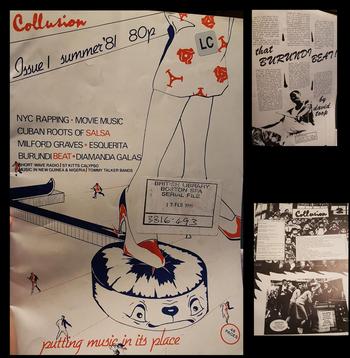
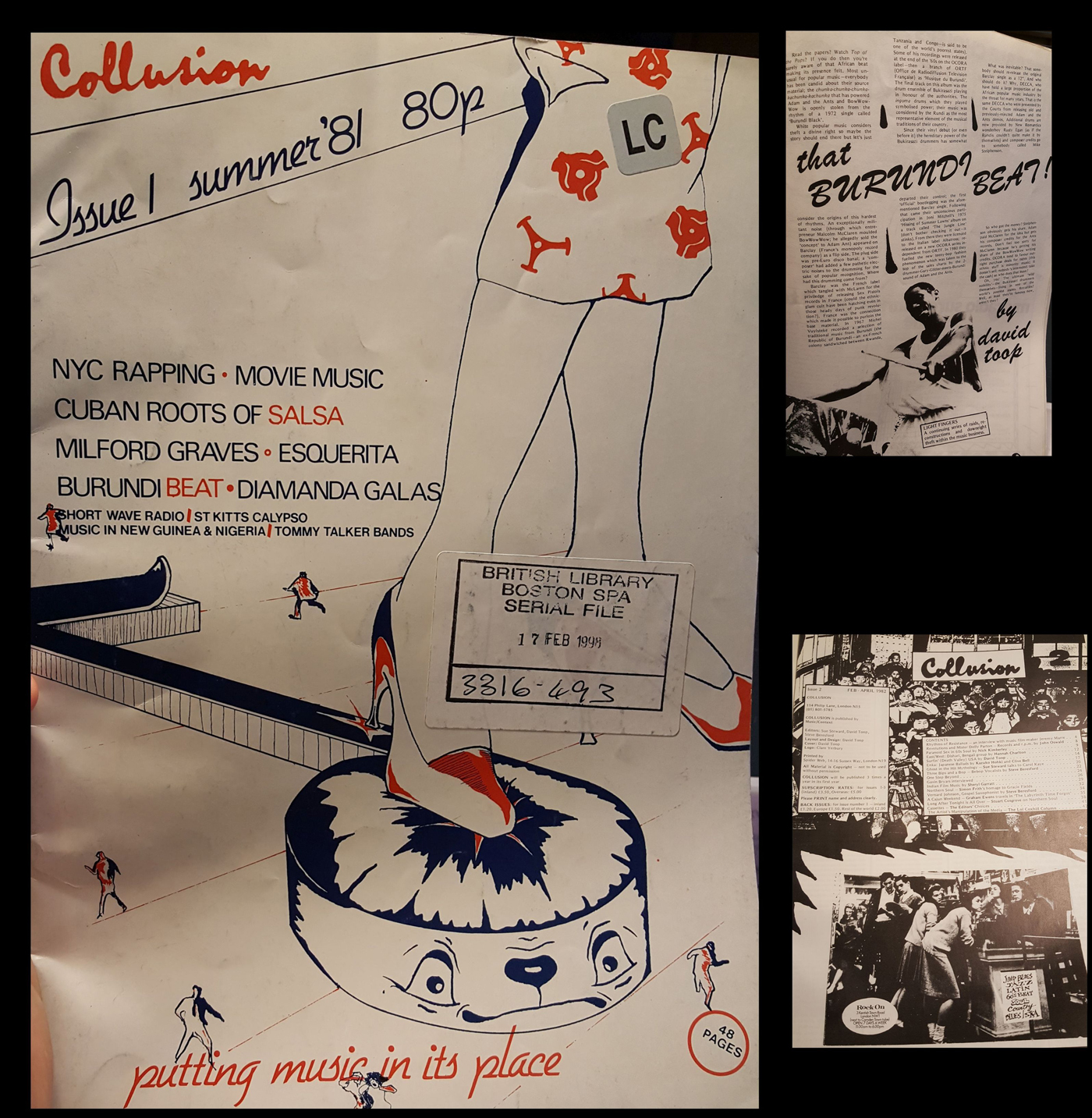
Collusion also pursued a different visual language to Musics, glossier and deliberately made to a higher professional standard and appearance. Musics’ unpredictable layout and typesetting, where handwritten scrawls would bump up against typed text and awkward boxing of articles and where unusual image/text juxtapositions were commonplace, had its own kind of DIY appeal. But the higher quality glossy paper, the more vivid and colourful style and the more deliberately streamlined and professional design of Collusion differentiates it clearly from its predecessor. This visual style can be seen in Figure 2, which places the cover of issue 1 beside an image from an article on Burundi Beat in the same issue (seen here on the top right of Figure 2), and an excerpt from the contents page of issue 2 (bottom right). (The British Library sticker, needless to say, was not part of the original.)
Images from issues 1 and 2 of Collusion.
Financing was likewise now approached in a different way from how it had been in Musics. Collusion readily printed ads from all sorts of commercial entities, notably mainstream popular music magazines and shops, as well as from the smaller scale enterprises such as Bead Records that had been Musics bread and butter in terms of review coverage. Collusion was therefore funded on a sales and advertising basis, in contrast to Musics. But far from guaranteeing the kind of commercial viability that eluded Musics, this financial model in the end proved ruinous; Collusion ran for only two years and six issues after its launch in the summer of 1981. This reminds us that even in fusing experimental and pop idioms and subjects as a matter of course it is difficult to build mainstream audiences: ‘Nobody got payed for Collusion believe me’, Beresford drily noted, ‘or if they did no one ever told me about it!’Footnote 57
And yet, despite this relatively circumscribed lifespan, it is clear that Collusion was founded on a broad and historically unusual musical remit – whether placed against forebears such as Musics or Microphone or more mainstream music publications such as Rolling Stone in the United States or NME in the UK (though the latter went where Collusion did not at this time in fairly regularly publishing writing from black writers such as Linton Kwesi Johnson). In its mix of everything from improv to traditional folk to the poppiest of pop, in its presentation of this mix as if it was the most natural thing in the world, and in its attempt to infuse independent music publishing with both a fizzier visual style and a more balanced range of contributors than had been the norm within these localized circles, Collusion can be seen in this sense as an important and perhaps seminal historical document of cultural change in motion. We can read it in this way as a localized barometer of the exciting expansions, evolutions, and interpenetrations that were then shaping music culture, where ‘world’ music and popular forms such as hip-hop seemed to exert more and more influence over avant-garde musicians, identity politics were coming to the fore, and pop styles such as punk were mutating to incorporate all sorts of challenging avant-garde tropes. Beresford described this notion of Collusion and the early 1980s more broadly as embodying a new admixture of musical and cultural overlays in slightly rose-tinted but nevertheless interesting terms:
I think we again caught an explosion of new music. I mean particularly, obviously hip-hop, but then at that time for instance you could go and see Eddie Palmieri, and Willy Colon, and Hector Labora, without much effort; I saw all those people in London quite often for nothing. Cos it was the GLC [Greater London Council], and they were particularly interested in Latin music. So I think there was possibility, yeah; the whole world music thing was coming out for example. I think there was really a lot of stuff happening at that time, and we were responding to it.Footnote 58
It would of course be as interesting to trace the persistence of tensions and divisions in this historical moment as it is to identify crossovers and confluence, as Beresford is doing here. To point for example to the continued dominance of white musicians in both the pop establishment and the music-institutional mainstreams in spite of notable exceptions such as mixed-heritage bands such as the Specials or unusually wide-ranging specialist music publications such as Collusion. These broader divisions and social problems had not gone away and indeed continue to make their presence felt to this day, both within music and outside it. If anything, the markers of expansion and eclecticism present throughout Collusion are more interesting when read against this complex historical background: they appear in this light both as signals of (well-meaning) privilege and as harbingers of precisely the kind of varied consumption that would become typical of the discerning postmodern consumer at this time and beyond. And yet they also feel hopeful and generous, as steps towards a genuine cross-cultural encounter (albeit one defined by well-trodden paths of exchange).
All this eclecticism was writ large across each of the six issues of Collusion. The visual style was lively and adventurous from the get-go, as we have seen. The eclecticism of content was likewise in place right at the outset. The first issue alone, for instance, covered rap in New York City, film music, Diamanda Galas, salsa, international radio stations, political economy in the record industry, women in music, Milford Graves, philosophies of music education, Calypso, and appropriation of Burundi Beat by Adam Ant and Bow Wow Wow.Footnote 59
Despite the queasiness expressed above around race, representation, and power, this first edition of the magazine featured writers from across the spectrum of popular, experimental, and improvised music, including journalists such as Hannah Charlton and Simon Frith, and practitioners such as Milford Graves. Later issues only repeat this bewildering mix. For example, improvising saxophonist Lol Coxhill wrote a regular diaristic column from issue 2 onwards; each of the three editors did any number of interesting pieces on various pop or traditional or experimental topics; and Charlton, Sheryl Garratt, Clive Bell/Kazuko Hohki, and Steve Harvey published fascinating work, respectively, on AMM, the Bay City Rollers, Enka, and ESG.Footnote 60 Complementing this variety, Collusion, did not shy away from the polemical styles frequently found in Musics. A good example of this would be Hannah Charlton's AMM piece, which led to an angry response from AMM themselves (Rowe, Prevost, and Tilbury at the time), who described it as an example of ‘sensationalism’ and also as ‘offensive’.Footnote 61 And this is merely to scratch the surface of the magazine's broiling pages.
Each of these elements, then – the visual language, the eclecticism, the writing style filled with both unvarnished polemic and diaristic accessibility – remained in place from Musics to Collusion. But the latter can be seen to be infused with new targets and topics at the same time, spreading much more liberally across new subjects beyond the narrower purview of the more improv-anchored Musics. Rather than salting improv parish discussions with music from outside, Collusion leant more directly into musical variety as home-base, whilst also deliberately moving into a more commercial mind-set in which ads and glossier visuals took the place of hard-line collectivist ideology. Collusion was doing something different even whilst picking up the threads of the fugitive eclecticism from earlier and even whilst still largely inhabiting the same cultural hierarchies as before. Key barriers are down by this point and experimental musicians and journalists can be seen in these pages to be as enthused and informed by Western and non-Western pop styles as by any other form. Collusion is in this sense an embodiment and expression of the kind of transversal musical spirit, identity-conscious politics, and free-ranging cultural taste that have since come more and more to the fore.
This spirit of eclectic coverage founded on a kind of pop-infused avant-garde position can be seen further afield than Britain at this time. RE/Search Publications, an independent publisher run by Japanese-American V. Vale from a San Francisco base and active from 1980 right up until the present day, provides a notable point of comparison in this respect – particularly because the very different cultural position it was coming from generated a contrasting but fundamentally related cultural mix to the ones I have been discussing primarily in the context of the UK. Building on Vale's Search and Destroy punk fanzine, which was based from 1977 to 1979 out of City Lights Bookstore in San Francisco, RE/Search consciously framed itself as a ‘counter-culture enterprise against the status quo’, at least as described by Vale looking back from the present day.Footnote 62 In this sense, RE/Search, and in particular the eponymous zine (RE/Search) that was launched in 1980 and on which I will be focusing, stands from today's perspective as a vivid illustration of the kind of unpop avant-garde spirit I have been describing.
RE/Search was published and edited by Vale, in collaboration with Andrea Juno for issues such as 6/7, as well as written to a large extent by him likewise; notable contributors nevertheless included Jon Savage, Violet Ray, and photographer Ruby Ray. It moved from a newspaper-like format in issues 1–3 of 1980 and 1981, in which all sorts of what we might call ‘unpop’ cultural activity was considered, to more substantial magazine-books on specific themes within the same area from issues 4/5 onward in 1982. These included everything from J. G. Ballard in issues 8/9 to ‘Incredibly Strange Films’ in 10 and ‘Pranks’ in 11. In the Industrial Culture Handbook (issues 6/7) from 1983, Vale formulated his central themes. He described an interest in ‘deviant’ artists whose work deals in ‘gross, atrocious, horrific, demented and unjust’ things expressed with ‘black-humour’:
These are not gallery or salon artists struggling to get to where the money is: these are artists in spite of art. There is no standard or value left unchallenged. The values, standards, and content that remain are of a perversely anarchic nature, grounded in a post-holocaust mortality. Swept away are false politeness, etiquette, preoccupation with texture and form – all the niceties associated with several generations of art about other art.Footnote 63
This last detail, about rejecting art for art's sake formalist mentalities in favour of a classically avant-garde concern for institutional rejection and challenging content, echoes Jon Savage's claim in the Introduction to the same volume that pop-anchored industrial culture pivoted centrally on shock tactics, extra-musical elements, and organizational autonomy.Footnote 64 As we will see, this alliance of avant-garde and pop means and ends – an alliance already written into the foundational spirit of both the historical avant-gardes, which were ‘dialectically related’ to the life of the masses, and the postmodernism that Huyssen thinks emerged from their ‘adversarial’ spirit – made for a significant mix.Footnote 65
In its struggle against the status quo RE/Search drew as a generative principle on punk's so-called ‘terminal philosophy’. This zoning in on the nihilistic limits of punk is reflected in the magazine's frequent consideration of political themes of resistance and revolt as well as its taste for transgressive authors such as William Burroughs (to whom a large portion of issues 4/5 was dedicated). But this kind of strategic self-positioning at the terminus of punk is perhaps more significantly reflected in the zine's dedicated and expansive coverage of industrial noise music (these early figures’ music sits close to nascent noise traditions – hence my use of the term ‘industrial noise’). This coverage focused on artists such as Throbbing Gristle, Monte Cazazza, and Boyd Rice, all of whose work drew on avant-garde aesthetics of formal experiment and confrontational content but framed these using pop tools and methods such as short song forms, guitars, and the star-system of mass culture.
So, although industrial noise music was considered in a wider context of pop and jazz styles in RE/Search (more on that next), it undoubtedly took the role of protagonist for Vale. The first issue alone, for instance, covered Factrix, Non, Cabaret Voltaire, and Throbbing Gristle. Vale's writing here embraced unusual, often non-musical topics, from the life-story in the Throbbing Gristle piece of master thief and youth counsellor LELLI, to a discussion of conditioned audiences and news as entertainment with Cabaret Voltaire. Musical practice served here as a typical avant-garde portal into broader social-political themes. Meanwhile, the famous Industrial Culture Handbook from 1983 had a self-evident emphasis. It covered Throbbing Gristle, Mark Pauline, Cabaret Voltaire, Boyd Rice, Monte Cazazza, SPK, Z'ev, and Johanna Went, all industrial musicians or performance artists, and the French industrial record label, Sordide Sentimentale. These pieces again took a noticeably non-‘musical’ slant, choosing to focus on political themes of control, decay, and de-indoctrination, amongst other topics. In this vein, the Cazazza interview surveyed his extensive ‘acts of mayhem’ in his life and career, the Throbbing Gristle one their relationship to decaying industrial Britain around them, and the Non one Rice's desire to expose people's unwitting indoctrination in systems of authoritative control.Footnote 66 Again, all these music-based practices can be seen here to place a typically avant-garde emphasis on social critique and cultural transformation, but spoken here from the heart of the commodity (echoing, perhaps, Huyssen's notion of the commodity and commodity critique being in a necessarily dialectical relation with one another from the start, both within avant-garde derived traditions and in modernism more broadly speaking).Footnote 67
This was not all that was included in RE/Search. Vale's frequent invocations of his punk background as well as the generalist aims that are contained within his ‘counter-cultural enterprise’ agenda suggest catholicity rather than modernist purity. RE/Search indeed dedicates space in its early issues to everything from nuclear disaster and authors J. G. Ballard and Octavio Paz to the Slits and Young Marble Giants, and from West African pop, James Blood Ulmer, and German electronic music to excerpts from an erotic novel and the band DNA's thoughts on Mayan culture.Footnote 68 Even the later ‘book’ form zines on particular topics are more eclectic than they might seem at first glance. The aforementioned Industrial Culture Handbook, for instance, opens out to everyday life; an extensive discussion and analysis of the purpose and experience of popular culture in this kind of spirit can be found across the Jon Savage introduction as well as the Throbbing Gristle interview.
These then are very much broad-based, ecumenically minded publications, even as they focus on ‘deviant’ avant-garde artists in their attempt to chart what Vale has called ‘a global continuum of everyone who has ever produced permanently inspirational thoughts of liberty and revolt’.Footnote 69 The lens is wide here and the targets it picks out, as with Collusion and to a certain degree Musics and Impetus likewise, are spread out across the spectrum of culture, from pop and punk to post-punk industrial and outsider noise. We are no longer in the world of Piekut's mixed avant-garde. Instead these magazines speak of an eclectic spirit of challenging, fringe cultural activity that can be seen in quite novel ways to be engaging with popular and other forms culture as direct conversation partners.
Savage put this well in his Introduction to the Industrial Culture Handbook:
the conditions of dialogue between the ‘avant-garde’ and ‘pop’—into which ‘industrial’ was a brief and vigorous intervention—have changed parameters. Focus has shifted from ‘the underground’ to the ‘mainstream’: our problems are too pressing to permit the ghettoization of possible new solutions … the new styles promoted by the phrase ‘New Musick’ were always intended to be part of a full meeting of pop and what is called, in a phrase usually denoting lack of access and cultural impotence, ‘avant-garde’.Footnote 70
As Savage notes, far from a Balkanized situation of discrete avant-garde and pop blocks (which would serve as an artificial distinction at best in any case, as I have been demonstrating through Huyssen), which a permissive postmodernism would open up access between but preserve, these new figures, from Rice to Cazazza to Throbbing Gristle, could be seen to be making politicized, challenging avant-garde art documenting and critiquing capitalist iniquity, which nevertheless operated from the heart of mass culture. From inside punk, pop and other forms.
This situation did not arise as the result of conscious social engineering but instead out of a fairly organic diversification of popular and art streams, as well as being based in the deep-rooted historical blends discussed at the start of this article. It also emerged from an expansion of technological and cultural means, where for example ‘Mail Art’ ‘linked together outsiders rebelling against “High Art” who later formed “genius cluster” bands such as Throbbing Gristle or Cabaret Voltaire or SPK’. Vale himself echoes this kind of situation in his own life, where as we have seen he was surrounded (perhaps tellingly, in America) by such a range of cultural activity that, as he told me, he ‘actually didn't learn the phrase “high and low culture” until probably the 1980s’.Footnote 71 This is as good an illustration of the so-called ‘unpop’ figure as any other: listeners and artists operating within a cultural mixture where recherché styles blended with both classically avant-garde aims and popular cultural tools and reference points in fairly organic ways.
This new unpop flavour plays out in the case of RE/Search not just on the level of content but also in the different kind of impact it was able to have when compared to something like Musics, whose circulation it outstripped through its Rough Trade-driven distribution in Tower Records and independent book shops around the world (‘100s’ of which, Vale told me, carried the zine). Though obviously a biased observer, Vale even claimed to me that ‘my Industrial Culture Handbook played a big role in encouraging people all over the world to launch “noise music” bands, freeing them from the “slavery” of having to write 3-minute songs with lyrics’.Footnote 72 This claim is of course rather grand. But it is clear from our vantage point nevertheless that RE/Search can be read as a significant example of a non-British source in which the kinds of concrete links to and discussions of an unusually wide range of music and culture that was evident in British publications such as Collusion can be seen to be embodied.
Conclusion: the unpop avant-garde and post-literate music culture
This wide range, reflecting as it does what seems to me to be something of a new musical and cultural mix, represented primarily within the UK radical music scene but explored elsewhere too, forms the last stage of the narrative of expansion and cultural change that I have been laying out. In looking at the scene discourses of various publications across the 1970s and early 1980s, I have tried to show that we can identify a diversifying cultural narrative where expanding activity leads to the fomentation of new mixtures and links. This diversification is identifiable in a shift in the tastes and practices largely of radical musicians in the UK (and Europe and the United States), from a ‘mixed avant-garde’ in the early 1970s, where improvised and composed music intermingled and a literary conception of music held sway, to a post-literate ‘unpop’ avant-garde in the early 1980s in which liminal, fringe practices as well as influences from popular and non-Western musics were all in the emergence.
By the time we get to the early 1980s, and, to keep things focused on scene discourse, to magazines such as Musik Texte in Germany and Resonance and The Wire in the UK, we are therefore in a very different place to that described by Piekut and myself with regards to the early 1970s. The Wire is a particularly useful emblem of the cultural change I have described, not just because of its emergence in my nascent unpop era or its eventual coverage of all sorts of different kinds of musics but also because of its prominence as the organ of record for what we might call the international ‘unpop’ scene. Demonstrating its broad focus even in its first issue in Summer 1982, The Wire billed itself as a magazine of ‘jazz, improvised music and …’.Footnote 73 It would soon branch out from that point to cover exploratory music making from right across the spectrum, from free jazz and improv to electronic dance music, experimental rock, composition, and more. The notated paradigms of the late 1960s and early 1970s give way in this example to a pop-infused sensibility that thinks nothing of putting acts such as Radiohead and Bjork on the cover only two months apart, even as heady coverage of more traditionally understood ‘avant-garde’ musicians and composers continues all the same.
The Wire therefore acts as a useful bookend and supporting text for my historical narration of a shift from the mixed to the unpop. This narrative should of course be seen as partial and provisional. To name one exception by way of acknowledging this: Contact, founded by Keith Potter and Chris Villars in Birmingham in 1971, positioned itself as ‘a journal devoted to the discussion of twentieth century music of all kinds; pop, jazz and folk as well as “serious” music’, and to ‘the widely differing forms that contemporary music takes’.Footnote 74 Subsequent issues do not quite bear out these early catholic ambitions, with notated composition largely taking centre stage. But both the articles in this first issue, which cover everything from Michael Tippett to jazz and, in Richard Middleton's phrase, the ‘musical significance of pop’, speak to the breadth of the journal.Footnote 75 Contact, then, very clearly presents a kink in my smooth historical narrative of a shift from the mixed to the unpop.
And yet, despite exceptions, I argue that the publications I have looked at reveal an interesting historical dynamic where particular members of the UK music scene were expanding their range of interests in notable and perhaps illustrative ways. This neglected part of the documentary record by these means tells a story of localized cultural change wherein the centre of gravity of ‘challenging’ music shifts away from a mixed literate culture to a sprawling, unsettled, post-literate unpop one. This is an expanded field of motion where noisy guitar music, humour- or rock-infused improv, and post-punk experiments with politically and sonically outré material have as much claim to cultural boundary-pushing as more traditional examples do likewise.
This unpop situation, thinking in broader terms for a moment, has if anything taken root in culture in the decades since the early 1980s. Challenging, exploratory music making, though still framed to some extent by traditional institutional boundaries, exists more and more in part-obscure, part-commercial, and part-public spaces than ever before. And this is significant. For as I argued in the Conclusion of Sounds of the Underground, ‘this messy, sprawling … cultural space, outside or on the fringes of “high” and “low” institutions, may point the way to future modes of minority artistic creation, where the kind of dense, intricate expression formerly tied to high culture might, in the context of a shrinking public sector and the seeming collapse or evolution of the older model of subsidized high art, more and more take place’.Footnote 76 The publications I have been looking at fill in some of the backstory to that claim, at least in the context of the UK and its marginal scene discourses, showing us that this expanded field of minority artistic creation has clear historical roots. This is the unpop avant-garde, whose story publications such as Musics, Impetus, Collusion, RE/Search, and, eventually, The Wire, all play their part in telling.