Introduction
The low precipitation in semiarid regions across the globe may be a limiting factor for the possibility of intensifying animal production. On this basis, research is warranted to investigate the water-plant-animal relationships to enable or intensify the productivity of herds in those regions. Wickens (Reference Wickens1998) reported that slightly over one-third of the Earth's surface is arid or semiarid, with 49 million km2 consisting of arid regions and 21 km2 of semiarid regions. Those areas are home to 1.2 billion people, or 0.2 of the world population, whose food base is typically derived from small-ruminant farming.
The semiarid region is characterized by a varied vegetation composed of tree, cactus and grass species and low annual precipitation (Wickens, Reference Wickens1998). Precipitation in the semiarid region ranges between 380 and 760 mm, and the annual potential evapotranspiration is greater than the annual precipitation.
Soil and climatic conditions of semiarid regions limit the efficiency of extensive animal production systems because of the low availability of feed and water that occurs during the dry season.
As a consequence, animals have a deficient feed and water intake, which may affect their growth and body weight (BW) gain (Silva et al., Reference Silva, Araújo, Oliveira, Azevêdo and Furtado2016). In addition, in the absence of water sources, the animal spends more time and energy in search of water (Ben Salem and Smith, Reference Ben Salem and Smith2008). Jacob et al. (Reference Jacob, Pethick, Clark, D'Souza, Hopkins and White2006) found that water deprivation for 48 h in crossbred lambs caused a loss of 0.5 kg (~2.5%) in standard hot carcass weight, 1 mm of fat and 4% of individual muscle mass.
In regions where water resources are scarce, animals may be subject to water restriction. Increasing the amount of concentrate in the diet improves feed efficiency and animal performance. The feedlot system allows animals to obtain the same nutritional level throughout the year as in pasture-based systems (Parente et al., Reference Parente, Parente, Gomes, Sodré, Moreira Filho, Rodrigues and Araújo2016). However, both adequate feeding management and water supply can improve the performance and health of animals (Lima et al., Reference Lima, Vargas Júnior, Martins, Santos Pinto, Nubiato and Fernandes2012).
Depending on the type of feed supplied, dehydration may culminate in reduced feed intake. As the nutritional value of the diets increases, the effect of water restriction is reduced (Chedid et al., Reference Chedid, Jaber, Giger-Reverdin, Duvaux-Ponter and Hamadeh2014). Ahmed Muna and El Shafei Ammar (Reference Ahmed Muna and El Shafei Ammar2001) investigated the performance of water-restricted goats fed diets containing high- and low-quality hay and observed lower BW losses in animals under restricted access to water when fed high-quality hay.
Thus, it is possible that higher dietary proportions of concentrate, which increases the energy levels and provides greater amounts of soluble carbohydrates when oxidized in the rumen, will supply a larger amount of metabolic water to animals, whose performance will be maintained despite water restrictions. Based on these considerations, the current study was conducted to evaluate the carcass characteristics and yields of Santa Inês crossbred lambs provided with different proportions of roughage, concentrate and water.
Materials and methods
Location, animals and treatments
The experiment was conducted in the Caatinga biome, in Petrolina, PE, Brazil (9°23′ S and 40°30′ W; 376 m altitude). The climate in that region is a tropical semiarid type with rainy summers and average annual precipitation of 407.1 mm (APAC, 2017).
Forty uncastrated Santa Inês crossbred lambs with an initial BW of 19 ± 2.8 kg, at an average age of 5 ± 2.0 months, were used. The animals were weighed, dewormed, intramuscularly injected with a vitamin-mineral supplement (Modificador Orgânico Vallée®, Vallée S/A, São Paulo, Brazil) and housed in individual 1 × 2 m stalls inside a covered shed. The average temperature, humidity and wind/air flow recorded in the shed were 27.7 °C, 38.7% and 0.84 m/s, respectively.
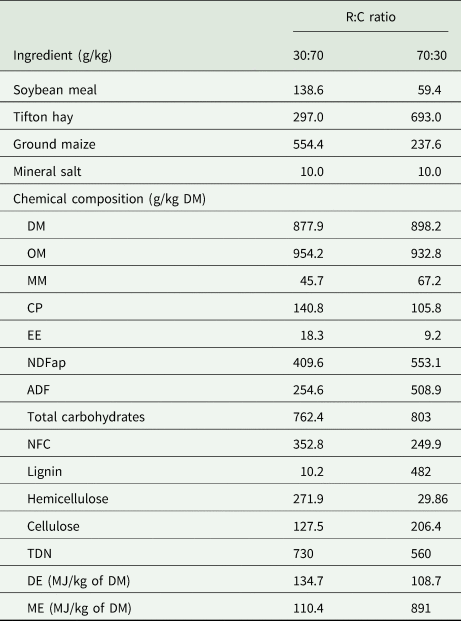
A completely randomized design was adopted with a 2 × 2 factorial arrangement consisting of two roughage:concentrate (R:C) ratios in the diet (30:70 and 70:30) (metabolizable energy (ME): 2.67 and 2.10 Mcal/kg DM, crude protein (CP): 14.08 and 10.58% DM, respectively and 1% mineral salt [Table 1]); and two levels of water supply: ad libitum (1.0) and restricted (0.5). The experiment lasted 73 days, consisting of 13 days of adaptation to the feedlot and diets and 60 days of data collection. Diets were formulated to provide weight gains of 200 and 150 g/day, in accordance with the NRC (2007).
Ingredients and chemical composition of experimental diets, as a % DM

NDFap, neutral detergent fibre corrected for ash and protein; ADF, acid detergent fibre; NFC, non-fibrous carbohydrates; TDN, total digestible nutrients; DE, digestible energy; ME, metabolizable energy.
Soybean meal, ground maize and Tifton hay (Cynodon spp.) were used in the diets. The feed was provided in two daily meals, at 08.00 and 15.30 h, allowing for 5 to 10% orts. Orts were weighed daily to calculate the intakes of dry matter (DM) and other nutrients. The animals were weighed weekly in the morning, after a 16-h feed withdrawal period, to monitor BW gain and feed conversion, using a mobile digital scale for small- and medium-sized animals with a maximum capacity of 300 kg. Feed conversion was calculated as the ratio between DM intake and total BW gain during the experimental period.
The chemical composition of orts, diets and diet ingredients was analysed to determine the DM, organic matter (OM), mineral matter (MM) and ether extract (EE) contents, according to the method described by AOAC (1990); CP, by the Kjeldahl method; and neutral detergent fibre (NDF) corrected for ash and protein (NDFap) and acid detergent fibre (ADF), as proposed by Van Soest et al. (Reference Van Soest, Robertson and Lewis1991). The digestible energy (DE) and ME values were estimated by the following equation: DE = (TDN/100) × 4.409. The total digestible nutrient (TDN) contents of the feeds and orts were estimated by using the following equation, proposed by Weiss (Reference Weiss1999): TDN (%) = (0.98 × %NFC) + (0.93 × %CP) + 2.25 × (%EE − 1) + 0.75 × (%NDFap − %Lig) × [1 − (%Lig/%NDFap)0.667]− 7. And ME = DE × 0.82, according to the NRC, 1989 (Table 1). To be converted to MJ/kg, the obtained results in Mcal/kg were by multiplied by 4.184.
Water supply
The animals in the ad libitum (control) group received 5 l of water daily. On the next day, water was weighed to determine the amount consumed by the control group, by difference. For the group under water restriction, the amount of water to be supplied per animal was determined as the daily water intake of the control group, considering a similar BW and receiving similar diets, multiplied by 0.5.
Slaughter and carcass parameters
Lambs were slaughtered at the end of the 60-day experimental period. Before slaughter, the animals were deprived of feed for 16 h and weighed to determine slaughter weight. Thereafter, the lambs were stunned by brain concussion, hoisted by their hind legs and bled from the jugular vein and carotid artery. Blood was immediately collected and weighed. Next, the animals were skinned, head and hooves were removed and the carcasses were then eviscerated. The gastrointestinal tract (reticulum, rumen, omasum, abomasum, bladder, gallbladder and intestines) was emptied and washed to determine empty body weight (EBW), which was estimated by subtracting the gastrointestinal tract contents from BW.
The carcasses were chilled in a cold room at 4 °C for 24 h, where they were hung by the calcaneal tendon on proper hooks with a distance of 17 cm between articulations. Hot carcass weight and cold carcass weight (HCW and CCW) were recorded for later calculations of hot carcass yield and cold carcass yield (HCY and CCY), dressing percentage and chilling losses. After the chilling period, the carcasses were divided lengthwise into two halves and six prime cuts were obtained from the left half of the carcass, namely, neck, shoulder, rib, hindquarter (pistola cut), loin and leg.
For the analyses of pH, colour, cooking loss and shear force, the loin was dissected to reveal the Longissimus lumborum muscle (LM), which was then divided into two samples: one comprising the anterior (L1–L3) and another the posterior (L3–L6) portion. Two steaks were extracted from the anterior portion of the loin (2.54 cm) in the transverse direction of the LM fibres for analyses of pH, colour, cooking loss and shear force, all in three replicates. The pH was measured before the anterior and posterior portions of the LM muscle were obtained, using a pH meter/thermometer probe (model 205, Testo do Brasil, Campinas, SP, Brazil) calibrated at room temperature (17 °C). One sample was used for analysis of moisture, ash and protein, according to procedures no. 985.41, 920.153 and 928.08, respectively (AOAC 1990); and total lipids, which were extracted according to the method described by Folch et al. (Reference Folch, Lees and Sloane Stanley1957).
The LL surface colour was measured after a 50-min bloom time at room temperature (17 °C) using a hand-held colour measurement device (Chromameter CR-400, Minolta). Colour measurements were taken in the CIE L*, a*, b* colour space [in which L* measures the relative lightness (100 white, 0 black); a*, relative redness (+ red, – green) and b*, relative yellowness (+ yellow, – blue)], with the average of three measurements taken across the same cross-section of muscle. The Chromameter was calibrated on a white calibration plate (Y = 87.1, x = 0.3158, y = 0.3225) before the colour was measured. The measuring head was set to C lighting with 2° standard observer and 8-mm aperture.
Following the colour measurements, the LM samples were grilled in a grill-broiler set in an electric oven (FISCHER, Model Star) at 150 °C, until the internal temperature reached the threshold of 71 °C (monitored by a digital thermometer [TENMARS, Model TM 364] with a type-K thermocouple [IMPAC] introduced in the geometric centre of each sample), and then the steaks were chilled at room temperature until reaching an internal temperature of 24–25 °C.
Cooking loss was analysed by weighing the grill-broiler set with and without samples, before and after cooking them (Wheeler et al., Reference Wheeler, Shackelford and Koohmaraie1995). To determine shear force (Wheeler, Shackelford and Koohmaraie, Reference Wheeler, Shackelford and Koohmaraie1995) in these samples, the LM fibres of at least two 1.27-cm cylinders (specimens) were obtained separately. These cylinders were sheared in a Warner Bratzler shear machine (G-R Manufacturing CO.) with a 25-kgf/cm2 load cell and crosshead speed of 20 cm/min.
Statistical analyses
The experiment was set up as a completely randomized design with a 2 × 2 factorial arrangement consisting of two R:C ratios in the diet (30:70 or 70:30) and two levels of water supply (ad libitum [control] or 0.5 of the amount drunk when it was freely available). Ten replicates were performed for each factor.
Analysis of variance (ANOVA) was applied to analyse data. The analysis was carried out to check whether the assumptions of normal distribution, additivity and homoscedasticity of data were met.
The following statistical model was used in the analysis of data:

in which Y ijk = observed value of the trait; μ = overall mean; E i = effect relative to the proportions of roughage and concentrate (i = 30:70 and 70:30), considering X i = observed value of the co-variable and X = mean of the co-variable; A j = effect relative to water availability (j = restricted, ad libitum), considering X j = observed value of co-variable and X = mean of the co-variable; E Aij = effect of the proportions of roughage and concentrate i and water availability j, considering X ij = observed value of the co-variable and X = mean of the co-variable and ε ijk = random error associated with each observation Y ijk.
The obtained data were subjected to ANOVA using the GLM procedures of SAS (2002) software (SAS Inst. Inc., Cary, NC, USA), adopting 0.05 as the critical level of type-I error probability. The initial BW was adopted as a co-variable for final weight, total weight gain, average daily gain and slaughter weight.
Results
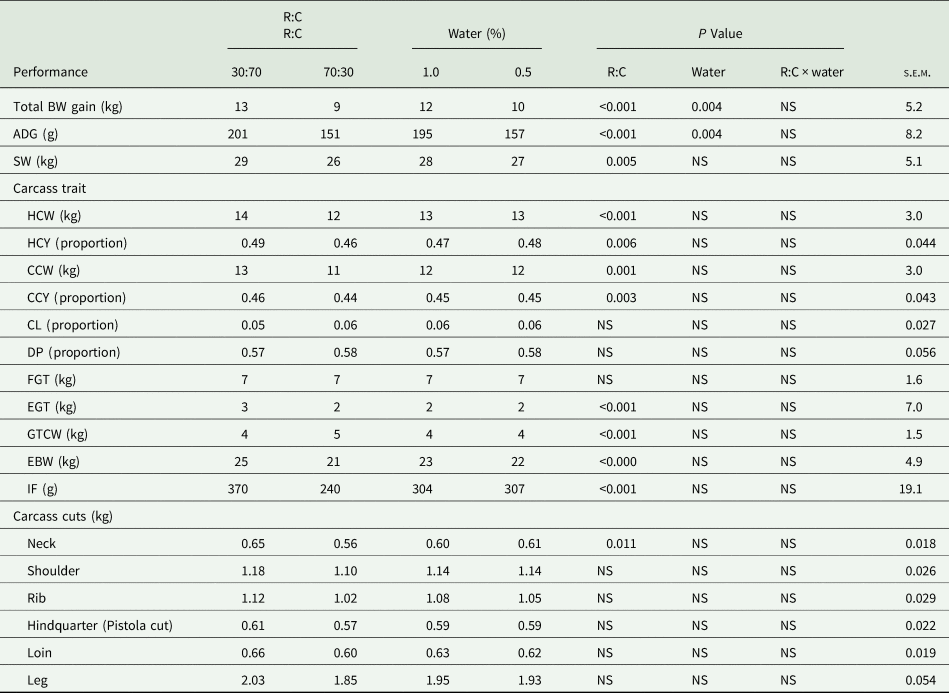
There was no interaction effect (P > 0.05) between the R:C ratio and water supply on the evaluated variables (Table 2); thus, the variables will be presented and discussed separately according to the R:C and levels of water supply. Final weight, total weight gain and average daily gain were affected by water restriction and R:C. Slaughter weight was influenced by R:C, but not by water restriction. The higher proportion of concentrate in the diet resulted in a heavier slaughter weight (28.9 kg), whereas the animals which consumed less concentrate had a slaughter weight of 26.4 kg.
Animal performance, carcass traits and carcass cuts of Santa Inês crossbred lambs provided with two R:C ratios and water supplies
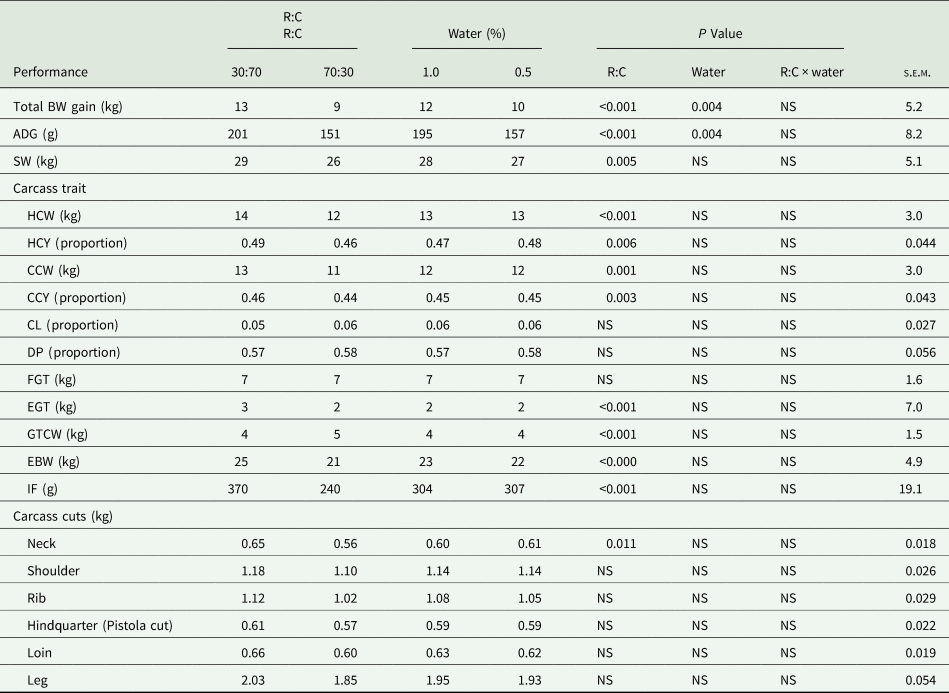
ADG, average daily gain; SW, slaughter weight; HCW, hot carcass weight; HCY, hot carcass yield; CCW, cold carcass weight; CCY, cold carcass yield; CL, chilling loss; DP, dressing percentage; FGT, full gastrointestinal tract; EGT, empty gastrointestinal tract; GTCW, gastrointestinal tract content weight; EBW, empty body weight; IF, internal fat; SEM = standard error of the mean.
Water restriction to 0.5 did not affect (P > 0.05) carcass weight, carcass yield or chilling loss (Table 2). The R:C ratio influenced (P < 0.05) HCW and CCW and HCY and CCY, empty gastrointestinal tract, gastrointestinal tract content weight and EBW (Table 2).
The diet with more concentrate resulted in higher values for HCW and CCW and HCY and CCY, empty gastrointestinal tract weight, EBW and internal fat. The gastrointestinal tract content was heavier in the animals that received the diet with a lower proportion of concentrate.
Carcass dressing percentage was not affected (P > 0.05) by water supply or R:C, although the diet influenced HCY and EBW. EBW differed (P < 0.05) between diets, with the diet containing the smaller amount of concentrate leading to a lower value (21.10 kg) compared to the 24.78 kg obtained with the diet containing a higher proportion of concentrate.
There was no interaction effect (P > 0.05) between R:C and water supply for the weight of the meat cuts (Table 2), except for neck weight, which was influenced by the dietary R:C. These variables were also not affected (P > 0.05) by water restriction.
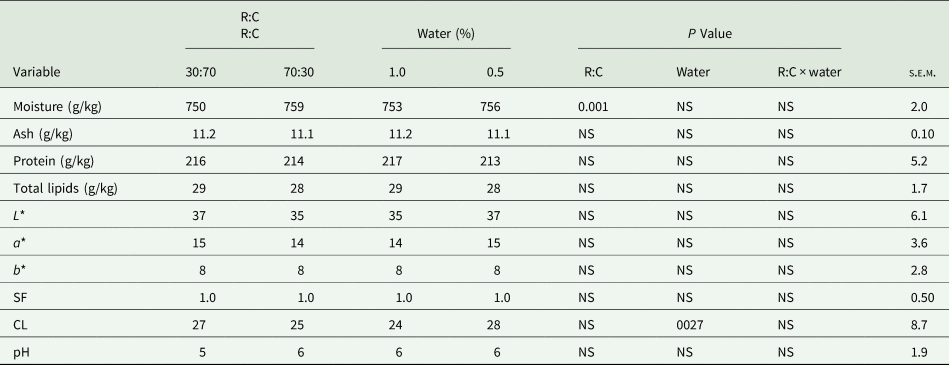
Water supply did not affect (P > 0.05) the percentages of moisture, protein, ash, or total lipids (Table 3). The R:C of the diet only influenced (P < 0.05) the percentage of moisture, which was highest in the meat from the animals fed the diets with less concentrate.
Centesimal composition, colour (L*, a* and b*), shear force, cooking loss and pH of meat from Santa Inês crossbred lambs according to the R:C ratio and water supply
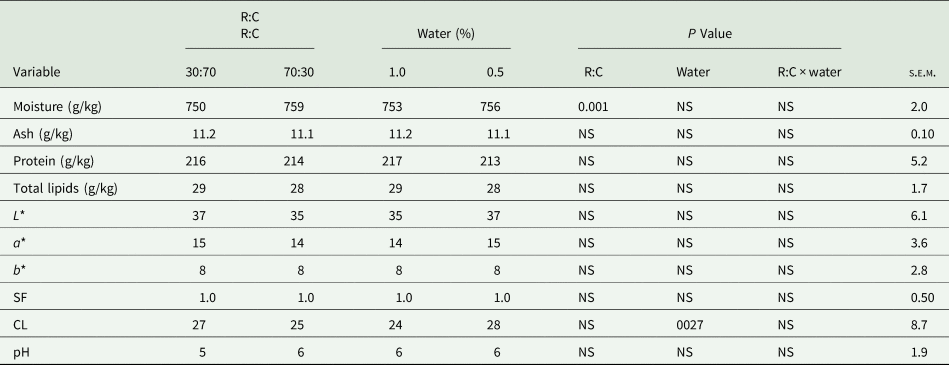
s.e.m., standard error of the mean; L, lightness; a, intensity of red; b, intensity of yellow; SF, shear force; CL, cooking loss.
The colour (L*, a* and b*), shear force and pH measurements of the meat were not affected by the R:C of the diet or by water supply. Water restriction affected (P < 0.05) cooking loss; the highest values for this variable were seen in the lambs subjected to water restriction (Table 3).
Discussion
The current study proposes to evaluate the effects of two R:C ratios and water restriction on the carcass yield and meat quality of feedlot lambs. The supply of higher proportions of concentrate has been proposed as a way to increase digestibility and consequently increase weight gain and carcass yield. Parente et al. (Reference Parente, Parente, Gomes, Sodré, Moreira Filho, Rodrigues and Araújo2016) observed that DM digestibility increased linearly with increasing levels of concentrate in lamb diets.
Total BW gain, average daily gain, final BW and slaughter weight were higher in the group that received the larger proportion of concentrate. Diets with a higher proportion of concentrate lead to increased propionate production in the rumen (Clementino et al., Reference Clementino, Sousa, Medeiros, Cunha, Gonzaga Neto, Carvalho and Cavalcante2007; Agle et al., Reference Agle, Hristov, Zaman, Schneider, Ndegwa and Vaddella2010). Upon being absorbed by the rumen wall, this fatty acid becomes the main substrate for hepatic gluconeogenesis, resulting in increased availability of energy in the form of glucose and, consequently, increased average daily weight gain (Sousa et al., Reference Sousa, Cartaxo, Costa, Cezar, Cunha, Pereira Filho and Santos2012). This response was also due to the higher intakes of CP, EE and ME seen in that group, which led to increased muscle tissue deposition and reduced fibre intake.
The higher CP intake (113.40 g/day higher proportion of concentrate and 85.75 g/day for low, Silva et al., Reference Silva, Araújo, Oliveira, Azevêdo and Furtado2016) resulted in increased weight gain and carcass yield. This increased weight gain is a response to the higher TDN intake (679.91 g/day higher proportion of concentrate and 548.45 g/day for low, Silva et al., Reference Silva, Araújo, Oliveira, Azevêdo and Furtado2016), since, as stated by Pereira et al. (Reference Pereira, Oliveira, Heinzen, Araújo and Pereira2015), higher TDN intakes increase microbial protein production. Microbial protein is considered the main source of metabolizable protein (MP) for ruminants (Santos and Mendonça, Reference Santos, Mendonça, Berchielli, Pires and Oliveira2011). Additionally, MP is mentioned by the NRC (1996) as the total absorbable amino acids in the small intestine resulting from the intestinal digestion of microbial protein and rumen-undegradable protein. Thus, it is suggested that the larger the amount of amino acids absorbed in the small intestine, the higher weight gain can be.
A larger proportion of concentrate in the diet also contributes to a reduction of energy losses as fermentation gases (mainly methane) and to decreased production of dissipated heat originating from the fermentation of fibrous substrates, resulting in a more efficient utilization of ME (Pereira et al., Reference Pereira, Pimentel, Fontenele, Medeiros, Regadas Filho and Villarroel2010).
Water restriction to 0.5 of the daily requirement affected average daily weight gain, total weight gain and final BW (Table 2). The lower daily DM intake in response to water restriction (724.55 g/day for water restriction and 879.55 g/day for water intake free, Silva et al., Reference Silva, Araújo, Oliveira, Azevêdo and Furtado2016) led to a decrease in average daily weight gain, consequently reducing total weight gain and final BW. Jaber et al. (Reference Jaber, Chedid, Hamadeh and Akıncı2013) reported that DM intake by ruminants may be influenced by changes in the osmolarity of body fluids such as hypovolemia and hyperosmolality due to saliva and gastric juice production. These mechanisms may stimulate ruminants to ingest water while eating or not to eat when dehydrated. In the current study, water restriction reduced water intake (2.88 and 1.53 kg/day for water intake free and water restriction, respectively (Silva et al., Reference Silva, Araújo, Oliveira, Azevêdo and Furtado2016)).
Forbes (Reference Forbes2007) stated that water is the most important nutrient and that its intake is usually twice as much as the animal's DM intake. Water is important for the processes of digestion and nutrient metabolism, considering that restricted water supply reduces the secretion of digestive juices. The intake of drinking water by ruminants is affected by the DM content of the feed (Fischer et al., Reference Fischer, Kaiser and Pickert2017).
Water restriction to 0.5 did not affect carcass weights or yields because of the quality of the feed supplied to the animals. This result conflicts with those observed by Tibin et al. (Reference Tibin, Bushara, Elemam, Tibin and Jadalla2011), who reported lower slaughter weight, HCW and EBW in animals with restricted access to water, at 2- to 3-day intervals; however, those animals did not receive concentrate supplementation, and hence their lower weight gain. Moreover, the water restriction period in their study was shorter than that tested in the present study.
Higher HCY and CCY were observed in the animals which received the larger amount of concentrate. These findings are explained by the higher intakes of protein, EE and TDN, which led to higher protein synthesis and muscle development in the animals. Carcass yield depends on the visceral content, which corresponds to the digestive tract, ranging from 8 to 18% of BW (Sainz, Reference Sainz1996), and which varies depending on the nature of the feed, duration of fast and gastrointestinal tract development. This might explain the higher carcass yields found in the group fed the high-concentrate diet.
In the current study, the animals which received the diet with a higher proportion of concentrate exhibited a heavier empty gastrointestinal tract weight (P < 0.05). The higher amount of starch derived from the maize present in the high-concentrate diets can explain this response. Ren et al. (Reference Ren, Zhao, Zhang, Jiang, Wu Q, Liu, Yang, Liu, Zhu, Wang and Y2016) evaluated the gastrointestinal tract development of lambs fed diets with high proportions of amylose and amylopectin and noted that the diet with the maize source improved the weight and volume of the gastrointestinal tract as well as accelerated the physical development of the rumen and intestine compartments. The diet with the higher proportion of concentrate contained 352.8 g NFC v. 249.9 g in the high-roughage diet (Table 1). There was probably a higher starch fermentation rate in the gastrointestinal tract and, consequently, higher development of this tissue.
The animals which received the diet with more roughage presented a heavier gastrointestinal tract weight (P < 0.05), which may be explained by the high NDF content of the high-roughage diet. In the current study, the diet with more roughage contained 26% more NDF than the high-concentrate treatment (Table 1). According to Mertens (Reference Mertens1997), NDF is a slow and incompletely digestible fraction which has a filling effect on the gastrointestinal tract.
A lower EBW is obtained when diets with lower percentages of concentrate and high percentages of NDF are supplied, because the latter are less digestible and remain a longer period in the gastrointestinal tract during the fasting period (Medeiros et al., Reference Medeiros, Carvalho, Batista, Dutra Junior, Santos and Andrade2009). This can be verified by the gastrointestinal tract weight, which was heavier in the animals fed diets with more roughage.
The energy intake level may modify the partitioning of energy utilization for the synthesis of protein and lipids or development of muscle and fat tissues (Oddy, Reference Oddy1993; Hocquette et al., Reference Hocquette, Ortigues-Martya, Pethickb, Herpinc and Fernandezd1998). However, the R:C of the diet had no effect on the weight and yield of cuts, except for neck weight, despite affecting HCW.
The R:C of the diet affected the percentage of moisture in the LM, which was likely because of the differences in slaughter weight obtained with the diets. Bonagurio et al. (Reference Bonagurio, Pérez, Furusho-Garcia, Santos and Lima2004) stated that a heavier slaughter weight resulted in decreased moisture content. More-advanced ages and heavier weights at slaughter usually result in a larger carcass fat content, and hence the reduced meat moisture content.
Average shear force was 1.00 kgf/cm2, which is a very low value, characterizing the meat as tender. According to Cezar and Sousa (Reference Cezar and Sousa2007), lamb meat with shear force values lower than 2.27 kgf/cm2 can be classified as tender. This value is probably because of the young age at which the animals were slaughtered, which was 8 months, on average. Gularte et al. (Reference Gularte, Treptow, Pouey and Osório2000) evaluated the tenderness of meat from lambs slaughtered at different ages and observed that the shear force of the LM of the animals slaughtered at 9 months (3.43 kgf/cm2) was greater than that found in lambs slaughtered at 8 months of age (2.31 kgf/cm2).
Though not significant, the ad libitum water supply led to a higher total lipid content in the meat, which consequently resulted in lower cooking losses. Higher intra- (marbling) and intermuscular fat levels have been reported to provide lower cooking losses and juicier meats, which is explained by the fat present in the meat acting as a barrier against moisture loss (Sañudo et al., Reference Sañudo, Sierra, María, Olleta and Santolaria1997).
In the present study, the meat colour values (L*, a* and b*) were not influenced by water restriction or feed supply. The meat colour is the first characteristic considered by the consumer when deciding about its quality and acceptability, as it reflects the chemical state and myoglobin content of the muscle. According to Fleck et al. (Reference Fleck, Kozačinski, Njari, Marenčić, Mršić, Špiranec, Špoljarić, Čop, Živković and Popović2015), colour represents a very important criterion in the determination of meat quality and is used as a parameter to classify the meat into pale, soft and exudative or dark, firm, dry.
The meat pH was not affected by R:C or water supply. This result contrasts with those published by Asplund and Pfander (Reference Asplund and Pfander1972), who reported lower pH values in the meat from lambs whose water supply was limited, probably as a result of the larger quantities of fatty acids produced. The pH ranged from 5.4 to 5.8, which is within the recommended thresholds of 5.5 to 5.8 for lamb meat (Silva and Sobrinho, Reference Silva Sobrinho2005).
Conclusions
Water restriction reduces ADG, but does not affect slaughter weight or carcass and meat yields. A higher proportion of concentrate in the diet results in heavier HCW and CCW and HCY and CCY and heavier EBW. Restricting the water supply to 0.5 of the amount consumed ad libitum does not affect the centesimal composition, colour, shear force or pH measurements of meat from Santa Inês crossbred lambs.
Implications/recommendations
In extreme drought conditions, it is recommended to provide soluble carbohydrate sources to the animals, as they will supply metabolic water to the organism upon being oxidized. In the present study, water restriction did not alter the meat characteristics or carcass yield. Therefore, to overcome the effects of water scarcity without affecting animal performance, the water supply can be restricted to up to of the animal's daily requirement in situations of low availability. However, further research should be undertaken to reinforce the effect of water restriction on the carcass yield and meat characteristics of lambs and other ruminants.
Financial support
The authors acknowledge the support of CAPES, Embrapa and the Federal University of Paraiba.
Conflict of interest
The authors declare no conflicts of interest.
Ethical standards
The experiment was approved by the Ethics Committee on Animal Science at the Federal University of Campina Grande (approval no. 105-2013 – UFCG) and, in compliance with those norms, the animals did not suffer during the experimental procedures.